Author: Dou Wan Le
July 13, 2026, Seoul.
The Korea Composite Stock Price Index (KOSPI) plummeted 8.95% in a single day, triggering its 7th trading halt of the year. SK Hynix, seen by Koreans as a "national destiny stock," plunged 15.37%, a drop not seen in nearly two decades. Samsung Electronics also fell over 10%.
Over 1.2 million leveraged accounts received margin calls, with broker systems automatically liquidating between 320,000 to 460,000 accounts. Even more heartbreaking, 62% of those wiped out were young people aged 20 to 30. Some lost their down payment for a home, others traded with borrowed money...
A man in his 20s in Busan, after losing money following a stock YouTuber's recommendation, stabbed the influencer with a knife.
In the past, these descriptions would likely have been used for scenes after a crypto market crash. Now, they are being reenacted in the markets of South Korea, the United States, and Japan following the tech stock downturn.
Sharp rises and falls are just the surface. What's truly changing is the pricing method: narrative outweighs valuation, leverage amplifies sentiment, and social media rapidly pushes consensus to extremes.
Global stock markets, especially tech stocks, are becoming more and more like the crypto sphere.
Returning to the Native Home
"Welcome back to the native home."
After the crash, crypto traders who had switched to stocks wrote numerous posts about their losses. Comments like the above were everywhere.

This "native home" refers to cryptocurrency. From the second half of 2025 to early 2026, a grand "departure from the native home" unfolded in the crypto world.
A group of KOLs and veterans who had been in the crypto market for years began losing confidence. Bitcoin was range-bound with low trading volume, meme coins were repeatedly harvested. Many felt "the scene is boring" and started turning their attention to US stocks.
This choice seemed very reasonable.
Stocks have revenue, profits, financial reports, and SEC regulation. Compared to crypto projects lacking cash flow and relying entirely on consensus pricing, US stocks at least seemed like a more mature, safer asset class.
The traders brought not just liquidity, but also their trading methods.
In the crypto market, they were accustomed to chasing new narratives, seeking high-volatility targets, using leverage, and rapidly switching positions based on social media sentiment. Entering the stock market, this method barely changed; only the trading objects switched from tokens to AI, memory chips, and leveraged ETFs, repeatedly achieving significant results.
Memory stocks quickly became the new collective consensus.
The logic wasn't complex: AI servers require more High Bandwidth Memory (HBM), supply can't meet demand, memory prices rise, so Micron, Samsung Electronics, and SK Hynix naturally become the most direct "shovel sellers." The phrase "there's never enough memory" became deeply ingrained.
Many crypto KOLs transformed, starting to talk about US stocks, memory cycles, and AI capital expenditures. Products like 2x leveraged ETFs on SK Hynix were also treated as "more efficient" betting tools than ordinary stocks.
Until the market reversed in July.
Bitcoin Becomes the "Low-Volatility Asset"
How long does it take to fall from peak to half?
Bitcoin took 268 days. Silver took 169 days for a similar magnitude of decline.
In contrast, SanDisk fell about 55% in just 36 days. SK Hynix fell about 53% in just 34 days.
Similarly "halving," Bitcoin took nearly nine months, while memory stocks took just over one month.
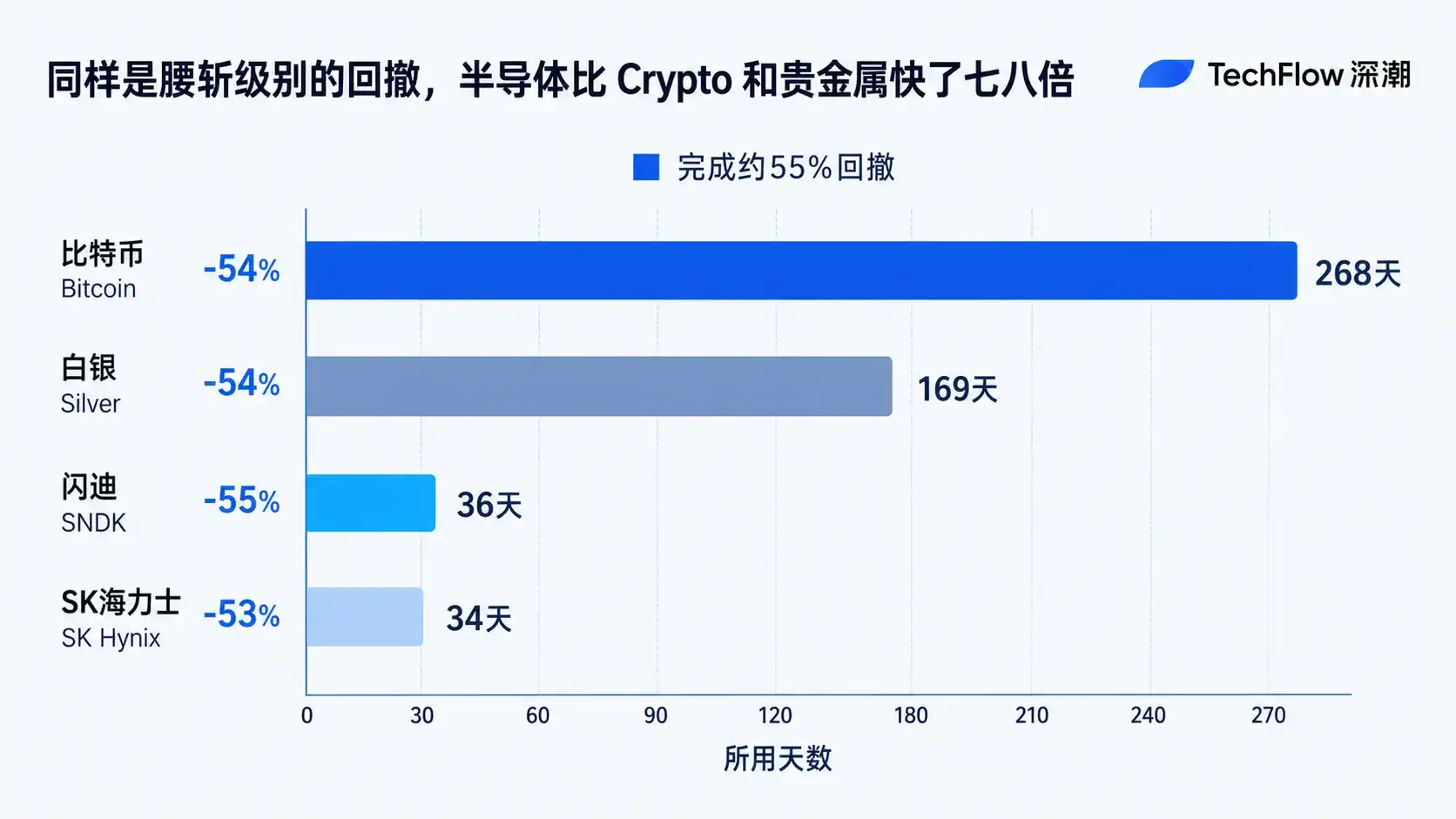
This is the perverse nature of this market cycle: In the past, investors worried Bitcoin would skyrocket or crash in days, while stocks adjusted slowly based on earnings and valuation. Now, some tech stocks are completing a full bubble burst in a shorter time than cryptocurrencies.
It's very counterintuitive. Compared to some tech stocks, Bitcoin is becoming relatively stable.
Charles Schwab statistics show Bitcoin's historical volatility in 2025 was about 42%, with a maximum drawdown of about 32%. Tesla's volatility in the same period was about 63% with a max drawdown of 48%, while Nvidia's volatility was about 50% with a max drawdown of 37%.
Bitcoin remains a high-risk asset, it's just that some large-cap tech stocks are even more volatile.
Bitwise even predicted in its 2026 outlook that Bitcoin's overall volatility might continue to be lower than Nvidia's.
So the current situation is quite absurd: Bitcoin is becoming more like tech stocks, while tech stocks are becoming more like Bitcoin.
When Narrative Becomes the Valuation Anchor
An old saying in crypto: Trading crypto is trading narratives.
In 2026, global tech stocks are turning this into reality.
AI is certainly not hot air. Nvidia, Microsoft, Google, and major cloud companies have real revenue and are investing real money building data centers.
But between "AI will indeed create value" and "any company associated with AI is worth buying at any price," there is a long road.
At the peak of the frenzy, the market simply skipped this road.
AI servers, optical modules, memory chips, data centers, power equipment, even nuclear energy companies—as long as they could be placed in the AI industrial chain, their stock prices could soar rapidly. Businesses were still in planning, orders not yet landed, but the market would price them based on the best-case scenario years in advance.
Korea's story was "AI semiconductors are tied to national destiny." As KOSPI kept hitting new highs, more families started opening stock accounts for their minor children, gifting them popular stocks like Samsung and SK Hynix as long-term presents.
A similar concentration appeared in the A-share market. In the first half of 2026, the TMT sector's market cap reached 41.78 trillion yuan, about 31.45% of the total A-share market cap; on some trading days, tech sector turnover once approached half of the entire market.
The US market long revolved around pricing a few large tech companies. When index gains rely increasingly on a handful of firms, when funds, options, and retail investors flood into the same stocks, seemingly diversified portfolios are actually betting on the same AI story.
This resembles the old crypto scene. Dogecoin's surge in 2021 wasn't due to technical breakthroughs, but because Elon Musk tweeted. The 2026 tech stock surge wasn't because all companies had explosive earnings, but because ChatGPT made everyone believe "AI will rewrite everything."
Narratives can dominate the market so quickly, also thanks to changes in dissemination methods.
In the past, stock information came mainly from financial reports, research reports, and institutional roadshows. Today, more people make investment decisions based on YouTube, X (Twitter), short videos, and paid communities.
Complex company research is compressed into a few phrases: Time will prove computing power and optical modules, AI computing power will never be enough...
Social media algorithms don't reward caution; overnight riches are always the traffic password: someone doubled their money overnight with options, an office worker achieved financial freedom by heavily investing in memory stocks, someone earned years of salary in months with leveraged ETFs.
Charts are the best advertising. Many mothers and aunts started investing their private savings, even selling properties to trade stocks, just like students dropping out to all-in on Web3 years ago...
Leverage Carnival
The most terrifying thing in crypto isn't volatility; it's the deadly combination of leverage plus volatility. In 2026, global stock markets are perfectly replicating it.
On May 27, 2026, the Korea Exchange approved the listing of 16 single-stock 2x leveraged ETFs, tracking Samsung Electronics and SK Hynix.
Retail investors went crazy. From approval to mid-July, Korean retail investors net purchased 14 trillion won (about 64 billion RMB) worth of these single-stock leveraged ETFs, while foreign investors bought only about 2 trillion won.
These ETFs have several fatal designs.
Such products rebalance daily. The more volatile the swings, the more severe the NAV erosion. If a stock first falls 10%, then rises 11.1%, the price returns to its origin. The corresponding 2x leveraged product would first fall 20%, then rise 22.2%, ultimately still losing about 2.2%.
During rapid declines, the problem is worse.
To maintain target leverage, the product must passively reduce risk exposure after a drop. Selling further depresses the underlying price, which triggers more de-leveraging, stop-losses, and margin pressure.
Goldman Sachs later noted that the "rapid de-leveraging" of these products was the main cause of KOSPI's intraday abnormal volatility, with 62% of institutional net selling coming from ETF-related liquidations.
Two months later, Korean regulators urgently halted all new single-stock leveraged ETF listings, significantly raising the minimum margin requirement from 10 million won to 30 million won, and only accepting cash.
But it was too late. 2.3 trillion won in forced liquidation amount, the wealth of hundreds of thousands of families vanished into thin air.
Even the deepest global market, the US stock market, is experiencing the backlash of leverage.
J.P. Morgan analysts recently pointed out that US stocks still have "de-leveraging space," needing three months to return to pre-April levels.
The ratio of memory chip stock leveraged ETF size to underlying market cap is three times the average of all stock ETFs. Even for broad leveraged stock index ETFs, their ratios are at historically high levels.
A Regression
"Stock markets turning crypto-like" doesn't mean stocks have become identical to cryptocurrencies.
Stocks still have companies, assets, revenue, and cash flow behind them, along with financial disclosure, auditing, and regulation. Even when market sentiment fades, a truly profitable company still has calculable value.
What's truly changing is the trading layer.
In the past, people bought a company's future profits. Now, more and more people are trading the hype of a theme.
The crypto-ification of stock markets is essentially a revolution of de-rationalization.
Traditional stock markets look at P/E, cash flow; crypto-ified stock markets look at narrative, imagination. Traditional stock volatility of 20% is considered high; crypto-ified stock markets see individual stock daily swings of 10% to 15% as normal.
Traditional stock leverage via margin financing; crypto-ified stock markets via ETFs, derivatives, quantitative strategies. Traditional stock information from research reports, financial statements; crypto-ified stock markets from Twitter, YouTubers, communities. Traditional markets have institutional rational pricing; crypto-ified markets have institutions acting like retail, quant funds chasing momentum...
What's even more laughable is that now Bitcoin is striving to become more like stocks, through ETFs, institutionalization, declining volatility, gradually gaining mainstream financial acceptance.
It's a surreal intersection.
Those who moved from crypto to stocks eventually found they never left their "native home"—it's the same mechanism repeating: grand stories, crowded trades, easily accessible leverage, and everyone believing they can exit before everyone else.
The sentence written by a Korean retail investor on a trading forum is worth remembering: I want to go back to the days before I traded stocks, give me my money back.
But the market never issues refunds.