The deal, concluded as part of a development agreement with the city of McGregor, provides for the creation of an artificial intelligence and high-performance computing campus on the site of the McGregor industrial park. The land sale brought the city revenue of approximately $7.5 million.
Galaxy is expanding its 1.6-gigawatt Helios campus in Dickens County, West Texas, where the company states it is already the largest employer and taxpayer.
"McGregor is the next step in our strategy of building a disciplined, multi-campus data center business," Galaxy Founder and CEO Mike Novogratz noted on Tuesday. He characterized the demand for computing power as a structural shift, not a temporary cycle.
What Galaxy intends to build
The company has signed a preliminary agreement with the local energy company to begin construction of interconnection facilities. The first phase of development aims to achieve a capacity of 74 megawatts.
Galaxy plans to coordinate with the energy company to push the project over the 75 MW threshold, which ERCOT classifies as a "large load." The company expects the McGregor facility to begin receiving power in 2028, with subsequent expansion of operations. Galaxy believes that by 2030, the complex could become a facility with a capacity of several hundred megawatts, depending on the development of new power transmission infrastructure.
The project will operate on a closed-loop cooling system—the same water-saving design used at the Helios facility, which ensures water is recirculated within the system rather than constantly drawn from the local water supply.
Tax base and jobs
Under the agreement, Galaxy will fund and build its own private electrical substation—a move intended to avoid shifting infrastructure costs onto local taxpayers. The company will also fulfill its full tax obligations from the outset, which is estimated to add at least $130 million to McGregor's tax base, intended to fund schools and emergency services.
The construction is expected to provide several hundred trade and construction jobs, followed by permanent operational jobs with, the company states, competitive wages.
What this means for GLXY investors
Galaxy Digital stock trades on the Nasdaq under the ticker GLXY. As of the close on July 27, the share price was $22.70, up $0.02 (0.09%) from the previous day in pre-market trading.
Short-term stock performance is unfavorable. Over five days, GLXY shares have declined by 7.01%, over the past month by 17.48%, and over six months by 32.23%. Since the beginning of the year, shares are down 0.83%, and over the past year, they are down 27.73%.
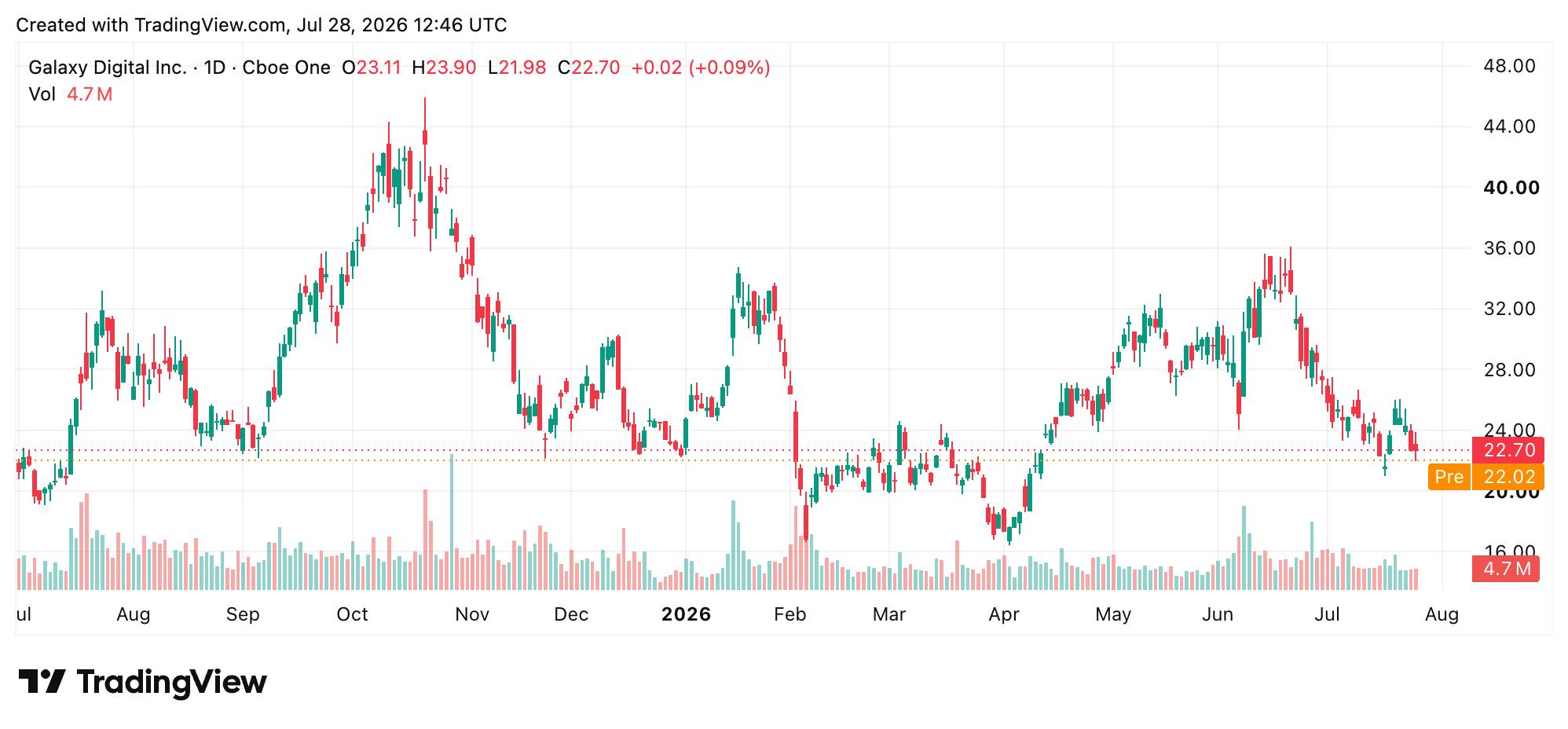
This volatility reflects the stock's high beta relative to the overall sentiment in the cryptocurrency market. Earlier this year, Galaxy placed priority secured bonds worth about $3.5 billion, tied to data center operations, and on August 5, the company will release its earnings report.
The McGregor deal provides Galaxy with a second concrete facility as part of what the company describes as a "multi-campus" strategy, built on long-term demand for AI computing power, regardless of stock price fluctuations.
end-content