Storj Labs Files for Bankruptcy Protection: Can Token Holders Exchange for Company Equity?

Foresight NewsDipublikasikan tanggal 2026-07-27Terakhir diperbarui pada 2026-07-27

Abstrak

Storj Labs, parent company of decentralized cloud storage platform Storj, filed for Chapter 11 bankruptcy protection on July 26 in the U.S. District Court for the Northern District of West Virginia. The company stated its network will operate normally and token functions will be unaffected. Notably, Storj plans to propose a mechanism in its reorganization plan allowing STORJ token holders a path to equity in the restructured company—an unprecedented offer in the crypto industry. However, its feasibility depends on whether any residual value remains after creditor repayments, as token holders are low in the legal priority hierarchy. Founded in 2014, Storj is an early decentralized infrastructure project. It reported a 7x increase in Annual Recurring Revenue (ARR) to approximately $30 million in 2024. In October 2025, it was acquired by Inveniam Capital Partners. Less than a year later, the merged entity entered bankruptcy proceedings. Storj attributed the filing to historical debts from past operations and acquisitions, stating they were too large to be absorbed by business growth. The company also plans to refocus on its core decentralized storage business, likely divesting Valdi, a GPU computing company acquired in 2024. The proposed token-to-equity conversion faces significant legal hurdles. Under U.S. bankruptcy law, creditors are paid before equity holders, and utility token holders are not automatically recognized as equity members. The details—such as eligibility, all...


Written by: ChandlerZ, Foresight News


Storj Labs, the parent company of the decentralized cloud storage platform Storj, filed for Chapter 11 bankruptcy protection in the U.S. Bankruptcy Court for the Northern District of West Virginia on July 26.
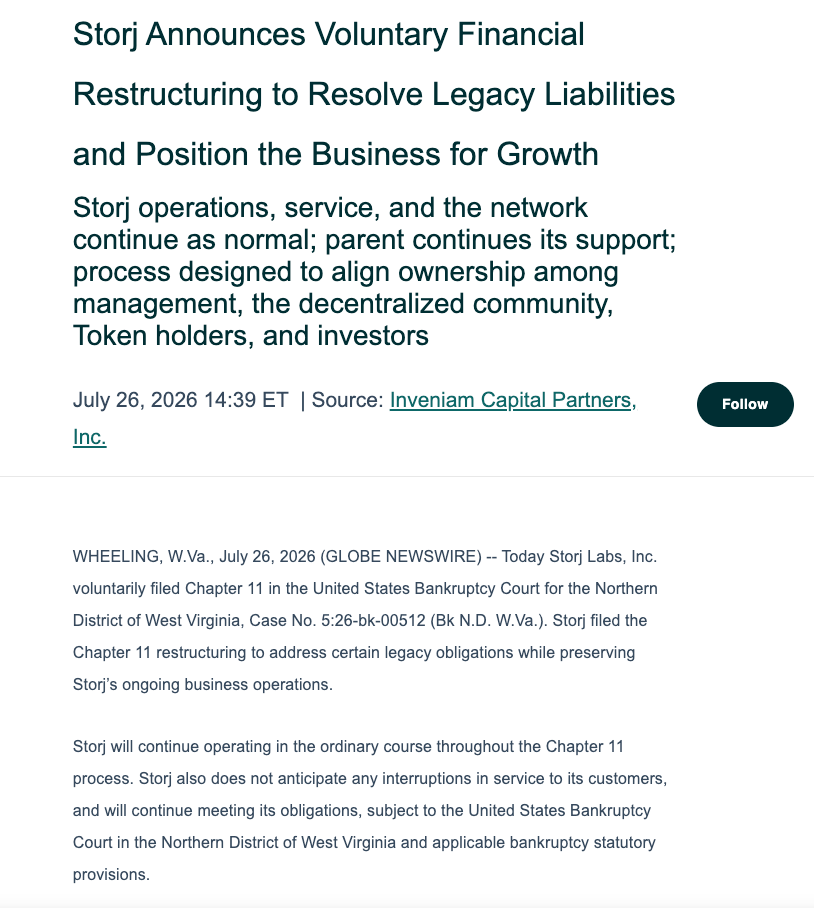


Storj stated that the network will continue to operate normally, token functionality will remain unaffected, and it plans to include in its reorganization plan a path for STORJ token holders to obtain equity in the restructured company. This proposed token-to-equity swap is unprecedented in the crypto industry, and its implementation hinges on whether there is residual value after creditors are repaid.


Bankruptcy Within a Year of Acquisition


Storj was founded in 2014 and is one of the earliest decentralized infrastructure projects in the crypto industry. Its core business is building a distributed cloud storage network via blockchain incentive mechanisms, encouraging global node operators to contribute idle hard drive space as an alternative to centralized storage services like Amazon S3. Users pay for storage and bandwidth with the STORJ token, and node operators are rewarded in STORJ.


In its early stages, the project received seed funding from Google Ventures, Qualcomm Ventures, and Techstars. It raised approximately $30 million through a token sale in 2017. In 2024, Storj achieved a 7x growth in Annual Recurring Revenue (ARR), reaching about $30 million, with a team size of 81 people. That same year, Storj also acquired GPU computing company Valdi, expanding its business from pure storage to compute power leasing.


In October 2025, Inveniam Capital Partners, focused on data assetization, acquired Storj through a reverse triangular merger. CEO Colby Winegar remained in his position, and Executive Chairman Ben Golub joined the Inveniam board. On the day the acquisition was announced, the STORJ token fell by 18%. Less than a year later, the merged entity entered bankruptcy proceedings.


In a public letter, Storj attributed the bankruptcy to historical debts, stating that the liabilities primarily stemmed from previous operations and acquisitions, predating the current business strategy, and were too large to be naturally absorbed through business growth. The company claimed its current operations are streamlined, but the burdens of the past can only be resolved through a court-supervised reorganization. The company also stated it would divest non-core businesses brought in by previous acquisitions during the restructuring to refocus on its core decentralized storage business.


The GPU computing company Valdi, acquired in July 2024, is the most likely asset to be divested. Valdi brought Storj a compute network of over 16,000 GPUs globally, originally the core of Storj's expansion into AI computing. However, from a bankruptcy restructuring perspective, this acquisition itself may be one of the sources of increased debt. Divesting Valdi means Storj will return to the pure storage track, abandoning its previous positioning as a full-stack distributed cloud platform.


Token-to-Equity Swap: Promise or Empty Promise?


The most notable proposal in the official public letter is providing a path for token holders to company equity. Storj management indicated plans to propose a mechanism in the reorganization plan allowing token holders to participate in the equity distribution of the restructured company, realigning company ownership among management, the decentralized community, token holders, and investors.


Kaloyan Raev, Director of Software Engineering at Storj, was quite measured in his wording in the public letter, stating the company would give users a seat and sincere intent, not a guaranteed outcome. The company has not yet disclosed eligibility criteria (whether a token snapshot or lock-up is required), the proportion of equity available for distribution, or the specific participation mechanisms. All terms need to be formulated during the reorganization process and approved by the court.


The core obstacle to this proposal lies in the priority rules of bankruptcy law. In Chapter 11 reorganization, creditor repayment takes precedence over equity holders. Token holders are legally closest to the position of equity holders, at the very end of the repayment sequence. Only after creditors are fully or proportionally repaid can residual value potentially flow to token holders.


There is no bankruptcy precedent in the crypto industry for a token-to-equity swap. In the WTT lawsuit involving crypto miner Giga Watt's bankruptcy after raising about $22 million via an ICO, the court ruled that utility token holders did not qualify as members of the company. This means token holders cannot automatically gain equity status; separate rights must be created through the reorganization plan. The FTX bankruptcy case set precedents in crypto asset valuation but dealt with creditor claims, which is entirely different from the token-to-equity path proposed by Storj.


Another noteworthy variable is the concentration of token holdings. The total STORJ supply is 425 million tokens, with approximately 30% (about 130 million) still held by Storj Labs. If the company's own token holdings also participate in the equity conversion, there is a potential conflict of interest between management and external token holders.


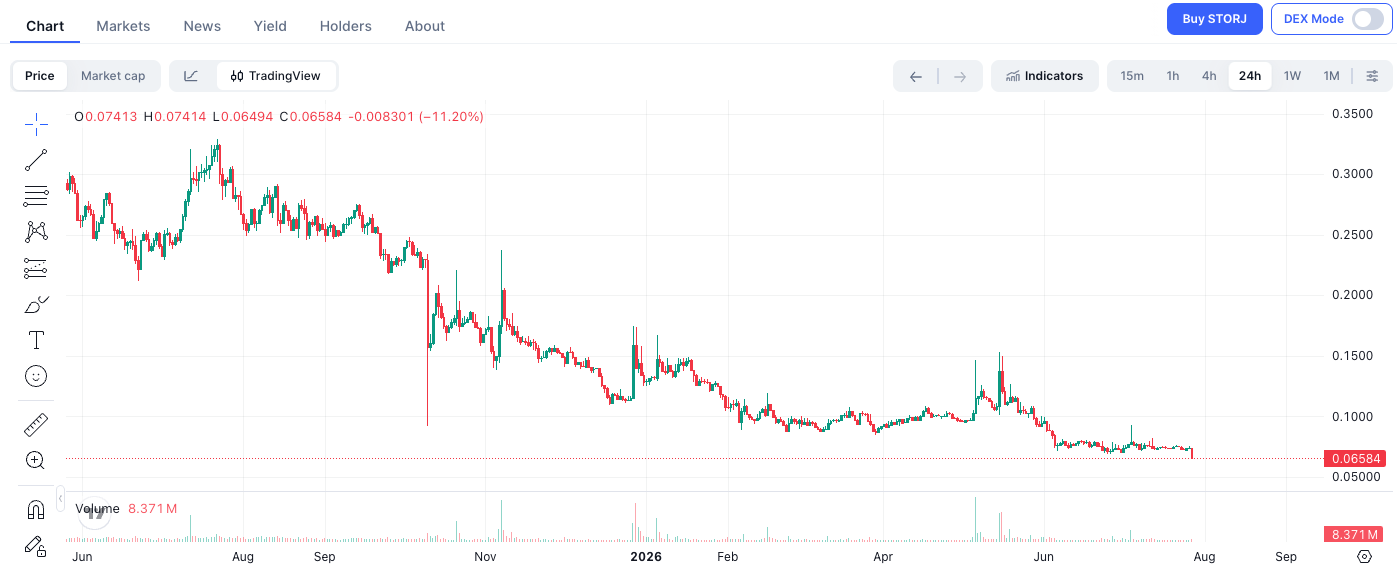
The STORJ token is currently priced around $0.06584, with a total market capitalization of approximately $27.97 million. The price fell 11.2% in the 24 hours following the news announcement.


A Marginal Player in the Decentralized Storage Race


Storj's scale in the decentralized storage sector is far smaller than its top competitors. Filecoin's current market capitalization is approximately $607 million, nearly 20 times that of STORJ, with a network capacity exceeding 1.8 EiB. In early 2026, Filecoin officially launched its Onchain Cloud roadmap, supporting automated data repair, perpetual renewals, and liquid staking of storage power via the Filecoin Virtual Machine (FVM), positioning itself as a decentralized alternative to AWS. Arweave follows another path, capturing the market for NFT metadata and blockchain historical state storage with its one-time payment for permanent storage model.


In comparison, Storj's advantage lies in retrieval speed. Storj uses Erasure Coding to split files into over 80 fragments distributed across global nodes, requiring only 29 fragments to reconstruct a file, achieving millisecond-level retrieval latency, performance close to that of centralized cloud providers. This gives Storj some competitiveness in hot data storage (video streaming, application data), but its market share is far behind Filecoin's.


During bankruptcy restructuring, whether node operators and enterprise clients will migrate to Filecoin or Arweave due to uncertainty is a real risk for the Storj network. For STORJ token holders, the key variables to monitor include: the specific terms of the token-to-equity swap in the reorganization plan and court approval progress, how the company's 30% token holdings will be handled, and whether the post-Valdi-divestiture business can support valuation.

Kripto yang Sedang Tren

Pertanyaan Terkait

QWhat is the main reason Storj Labs cited for filing for Chapter 11 bankruptcy protection?

AStorj Labs cited historical legacy debts from previous operations and acquisitions, which were incurred prior to the current business strategy. The company stated that the scale of this debt was too large to be digested through natural business growth.

QWhat unprecedented proposal has Storj made for its STORJ token holders during the restructuring process?

AStorj has proposed creating a path for STORJ token holders to potentially acquire equity in the restructured company. This is presented as an effort to realign company ownership among management, the decentralized community, token holders, and investors. However, this is an unprecedented proposal in the crypto industry and its implementation is not guaranteed.

QAccording to the article, what is the major legal hurdle for Storj's proposal to convert tokens to equity?

AThe major legal hurdle is the priority rules in bankruptcy law. In Chapter 11 restructuring, creditors are paid before equity holders. Token holders are positioned similarly to equity holders at the end of the payment priority sequence. They would only receive any value after creditors are fully or partially satisfied.

QWhat key non-core asset acquired in 2024 is Storj likely to divest during its restructuring?

AStorj is likely to divest Valdi, a GPU computing company acquired in July 2024. This acquisition was part of Storj's expansion into AI computing, but divesting it means the company will refocus on its core decentralized storage business.

QHow does Storj's market position in decentralized storage compare to its main competitor, Filecoin?

AStorj is a much smaller player compared to Filecoin. Filecoin's market capitalization is approximately $607 million, which is nearly 20 times larger than STORJ's market cap of around $28 million. Filecoin's network capacity exceeds 1.8 EiB, and it is positioning itself as a decentralized alternative to AWS.

Bacaan Terkait

Huang Xiaoming, Li Bin, Lei Jun, Liang Wenfeng... Siapa Pemenang Terbesar dalam Pesta IPO Changxin?

Odaily melaporkan bahwa Changxin Technology, "saham memori domestik pertama", telah melantai di pasar STAR A-shares dengan kapitalisasi pasar mencapai 3,28 triliun RMB, menempati posisi teratas di pasar saham A. IPO ini menciptakan gelombang penciptaan kekayaan yang besar. Pendiri dan CEO Changxin, Zhu Yiming, menjadi penerima manfaat terbesar dengan kekayaan keluarganya melonjak hampir 300% menjadi 139 miliar USD, dimana kepemilikan sahamnya di Changxin saja bernilai sekitar 80 miliar RMB. Lebih dari 237 karyawan menjadi jutawan baru. Beberapa investor dan tokoh terkenal juga mencetak keuntungan besar: Liang Wenfeng dari Deepseek meraih keuntungan belum direalisasi 827 juta RMB dari penawaran umumnya; Kong Jianping dari Nano Labs mendapat pengembalian sekitar 44 kali lipat; mantan eksekutif Midea Huang Xiaoming (bukan aktor) mendapat keuntungan 503 juta RMB; pendiri NIO Li斌 mendapat keuntungan sekitar 740 juta RMB melalui grupnya; dan anak perusahaan Xiaomi yang dikendalikan oleh Lei军 mendapat keuntungan 736 juta RMB (meskipun Xiaomi menekankan bahwa ini adalah investasi perusahaan, bukan kekayaan pribadi). Zhu Yiming juga berencana menyumbangkan 768 juta sahamnya senilai lebih dari 37,6 miliar RMB untuk insentif karyawan masa depan dalam 10 tahun ke depan, berpotensi menciptakan rekor insentif ekuitas individu terbesar di A-share. IPO ini tidak hanya menguntungkan pendiri dan tim eksekutif, tetapi juga menciptakan "gelombang pemerataan kekayaan" bagi ribuan karyawan.

Odaily星球日报10m yang lalu

Huang Xiaoming, Li Bin, Lei Jun, Liang Wenfeng... Siapa Pemenang Terbesar dalam Pesta IPO Changxin?

Odaily星球日报10m yang lalu

Tujuh Perusahaan Fintech Bergabung dengan 'Kotak Pasir' Zimbabwe di Tengah Popularitas Tokenisasi Aset Digital yang Meningkat

Komisi Sekuritas dan Bursa Zimbabwe (SECZ) telah menyetujui tujuh perusahaan fintech untuk bergabung dalam program "regulatory sandbox"-nya. Langkah ini diumumkan oleh penjabat CEO Tichaona Mushambadope sebagai bagian dari upaya mendukung inovasi keuangan digital sambil memastikan pengawasan pasar yang memadai. Sandbox regulatori menyediakan lingkungan pengujian yang dikontrol dengan parameter dan batas waktu tertentu, memungkinkan peserta menguji produk, layanan, dan model bisnis inovatif sebelum diluncurkan ke pasar yang lebih luas. Peserta terbaru mencakup berbagai teknologi pasar modal, termasuk platform berbasis blockchain, perdagangan sintetik, crowdfunding, dan tokenisasi aset. Di antara perusahaan yang terpilih adalah Zimbabwe Entrepreneurship Exchange (platform penggalangan modal berbasis blockchain), Ndarama Standard (platform tokenisasi aset), Questview Brokers (platform perdagangan sintetik), Crowdaxe Capital (platform crowdfunding web), serta Procode Platforms, Financial Securities Exchange, dan Colmin Resources Zimbabwe yang mengkhususkan diri dalam berbagai bentuk tokenisasi aset, infrastruktur, atau sekuritas. Tujuan utama program ini adalah mendorong inovasi yang bertanggung jawab, memperluas akses layanan keuangan, dan merangsang pengembangan pasar modal Zimbabwe yang adil, transparan, dan efisien. SECZ menekankan bahwa peserta tetap tunduk pada regulasi ketat untuk perlindungan investor dan akan terus dipantau serta dievaluasi selama masa pengujian. Regulator juga memperingatkan bahwa klaim di luar parameter yang disetujui akan dianggap menyesatkan.

cryptonews.ru19m yang lalu

Tujuh Perusahaan Fintech Bergabung dengan 'Kotak Pasir' Zimbabwe di Tengah Popularitas Tokenisasi Aset Digital yang Meningkat

cryptonews.ru19m yang lalu

Strategi Membuka Jalan untuk Penjualan Bitcoin — Michael Saylor Jelaskan Mengapa Ini Tepat

Strategi Inc. (Nasdaq: MSTR), yang diketuai oleh Michael Saylor, telah mengumumkan bahwa pembelian kembali saham preferen seri A (STRC) mereka dapat didanai melalui penjualan Bitcoin atau penerbitan saham MSTR, tergantung kondisi pasar. STRC adalah saham preferen dengan nilai nominal $100. Perusahaan bertekad untuk mempertahankan harga STRC mendekati nilai nominal tersebut dengan likuiditas tinggi dan volatilitas rendah. Penjualan Bitcoin dianggap sebagai opsi pembiayaan yang menarik terutama ketika harga STRC diperdagangkan jauh di bawah $100, memungkinkan perusahaan membeli kembali saham dengan diskon. Pada minggu yang berakhir 26 Juli, Strategic membeli 288.930 saham STRC senilai sekitar $25 juta dengan harga rata-rata $86,52 per saham, mencatat diskon $13,48 per saham. Presiden dan CEO Phong Le menekankan bahwa pembelian kembali ini merupakan investasi modal yang menarik karena mengurangi kewajiban dividen di masa depan. Selain itu, Strategic telah meningkatkan cadangan dolar AS-nya menjadi rekor $3,75 miliar melalui penjualan saham MSTR. Cadangan ini, yang ditetapkan khusus untuk pembayaran dividen dan pelunasan utang, tidak akan digunakan untuk program pembelian kembali. Dengan demikian, pendanaan untuk pembelian kembali STRC akan bersumber dari dua saluran utama: penerbitan saham MSTR dan penjualan Bitcoin saat dianggap tepat secara ekonomi, memberikan fleksibilitas bagi perusahaan.

cryptonews.ru21m yang lalu

Strategi Membuka Jalan untuk Penjualan Bitcoin — Michael Saylor Jelaskan Mengapa Ini Tepat

cryptonews.ru21m yang lalu

Trading

Spot

Artikel Populer

Cara Membeli STORJ

Selamat datang di HTX.com! Kami telah membuat pembelian STORJ (STORJ) menjadi mudah dan nyaman. Ikuti panduan langkah demi langkah kami untuk memulai perjalanan kripto Anda.Langkah 1: Buat Akun HTX AndaGunakan alamat email atau nomor ponsel Anda untuk mendaftar akun gratis di HTX. Rasakan perjalanan pendaftaran yang mudah dan buka semua fitur.Dapatkan Akun SayaLangkah 2: Buka Beli Kripto, lalu Pilih Metode Pembayaran AndaKartu Kredit/Debit: Gunakan Visa atau Mastercard Anda untuk membeli STORJ (STORJ) secara instan.Saldo: Gunakan dana dari saldo akun HTX Anda untuk melakukan trading dengan lancar.Pihak Ketiga: Kami telah menambahkan metode pembayaran populer seperti Google Pay dan Apple Pay untuk meningkatkan kenyamanan.P2P: Lakukan trading langsung dengan pengguna lain di HTX.Over-the-Counter (OTC): Kami menawarkan layanan yang dibuat khusus dan kurs yang kompetitif bagi para trader.Langkah 3: Simpan STORJ (STORJ) AndaSetelah melakukan pembelian, simpan STORJ (STORJ) di akun HTX Anda. Selain itu, Anda dapat mengirimkannya ke tempat lain melalui transfer blockchain atau menggunakannya untuk memperdagangkan mata uang kripto lainnya.Langkah 4: Lakukan trading STORJ (STORJ)Lakukan trading STORJ (STORJ) dengan mudah di pasar spot HTX. Cukup akses akun Anda, pilih pasangan perdagangan, jalankan trading, lalu pantau secara real-time. Kami menawarkan pengalaman yang ramah pengguna baik untuk pemula maupun trader berpengalaman.

195 Total TayanganDipublikasikan pada 2024.12.12Diperbarui pada 2026.06.02

Cara Membeli STORJ

Diskusi

Selamat datang di Komunitas HTX. Di sini, Anda bisa terus mendapatkan informasi terbaru tentang perkembangan platform terkini dan mendapatkan akses ke wawasan pasar profesional. Pendapat pengguna mengenai harga STORJ (STORJ) disajikan di bawah ini.

活动图片