Trump Backs Down on Ethics Provision, as 'CLARITY Act' Enters Senate's Critical Window

marsbitDipublikasikan tanggal 2026-07-21Terakhir diperbarui pada 2026-07-21

Abstrak

On July 21st, sources report President Trump has agreed to include ethics provisions in the *CLARITY Act*, a major digital asset market structure bill, clearing a key obstacle after months of negotiation. The bill, which has already passed the House, aims to establish federal regulatory clarity for crypto by defining SEC and CFTC roles. The text is expected imminently, with a narrow window for Senate passage before the August recess. However, passage remains uncertain due to potential Democratic opposition over the ethics rules and the absence of key Republican senators. The ethics clause, a major sticking point, seeks to restrict federal officials, including the president, from profiting from digital assets while in office. This directly addresses controversies around Trump's own crypto holdings. While industry lobbyists urge Congress not to let ethics derail the broader bill, several Democratic senators have demanded stricter provisions covering family members and stronger consumer protections. Amid this legislative push, on-chain data shows significant Bitcoin accumulation by large holders ("whales") in recent weeks. After extended outflows, U.S. Bitcoin and Ethereum spot ETFs have seen two consecutive weeks of net inflows. Major corporate holders like Strategy and Metaplanet continue to accumulate or hold significant Bitcoin reserves. Notably, BitMEX co-founder Arthur Hayes recently made substantial Ethereum purchases, expressing a view that while AI is absorbing market...

July 21, according to reporting by crypto journalist Eleanor Terrett citing sources, U.S. President Donald Trump agreed to include ethics provisions in the 'CLARITY Act' (Digital Asset Market Structure Bill). The White House has reached a consensus on the ethics plan for the 'CLARITY Act', clearing the final major obstacle for this crypto regulatory legislation that has been contested for months. The bill text could be released as early as the same day, but may be slightly delayed; as of the report, the Democratic side had not yet seen the specific text.

Following the news, the probability on Polymarket for "Will the 'CLARITY Act' be signed into law in 2026" rebounded to 43%. Research firm Galaxy Research had previously assessed its probability of passage in 2026 as roughly 50/50.
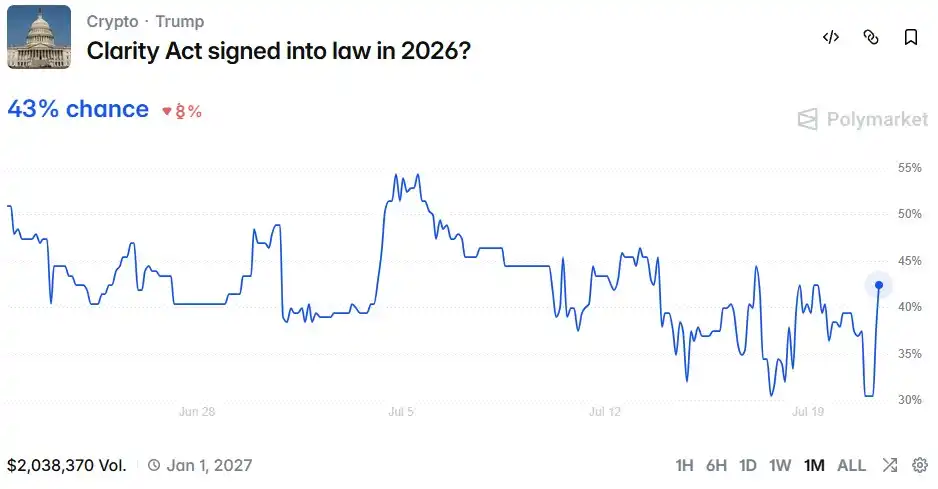
Previously, on July 16, a meeting between Trump, Republican Senators Bernie Moreno and Cynthia Lummis, and White House Crypto Advisor Patrick Witt did not result in an immediate agreement, but a deal was finalized by the President himself on the subsequent Monday evening. The provision aims to restrict the President, Vice President, members of Congress, and other federal officials from profiting from digital assets during their terms. The core controversy has centered around the Trump family's meme tokens and World Liberty Financial. Financial documents disclosed last month showed Trump's crypto income reached approximately $1.4 billion, which had once brought negotiations to a standstill.

The Final Stretch Before the August Recess

If ultimately enacted, the 'CLARITY Act' would, for the first time, provide comprehensive regulation for the digital asset industry at the federal level, clarifying the jurisdictional division between the SEC and the CFTC.

The U.S. House of Representatives previously passed the bill with a bipartisan majority of 294 to 134 votes in 2025. The Senate Banking Committee cleared it on May 14 this year with a 15 to 9 vote. It is currently stalled in final negotiations before a full floor vote.

The bill text is expected to be released in the coming days, then submitted for a full Senate vote; the window lasts only until the recess in the first week of August (the Senate will enter recess on August 7, returning on September 14). If passed, it would still need to go back to the House for reconsideration and text reconciliation, before finally reaching the President's desk for signature.

The vote count in the Senate tightened in mid-July. Following a visit to Ukraine, Republican Senator Lindsey Graham from South Carolina passed away suddenly from an aortic dissection on the night of July 11, at the age of 71, reducing the Republican seats in the Senate from 53 to 52 temporarily.

According to AP, the state's Governor Henry McMaster appointed Graham's sister, Darline Graham Nordone, to the seat two days later. She was sworn in on July 14, immediately restoring the seat.

However, Republican Senator Mitch McConnell has been absent from votes since being hospitalized on June 14. As of July 12, he himself stated he was not yet ready to return to the Senate, and there has been no further news about his potential return since.

Under the cloture procedure of Senate Rule XXII, if Mitch McConnell remains absent, the bill would need to secure at least 8 additional Democratic votes beyond the actual number of Republican votes present to pass.

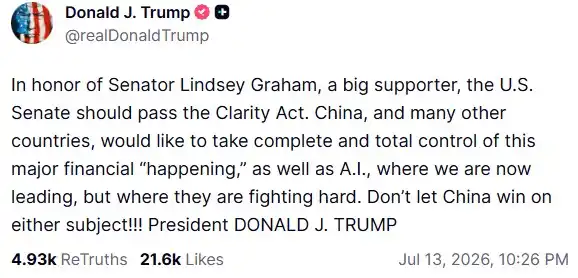
Trump previously posted on Truth Social, urging the Senate to quickly pass the 'CLARITY Act', stating it was in memory of the late Senator Lindsey Graham, and emphasizing it was also about preventing China from gaining dominance in digital finance and artificial intelligence.
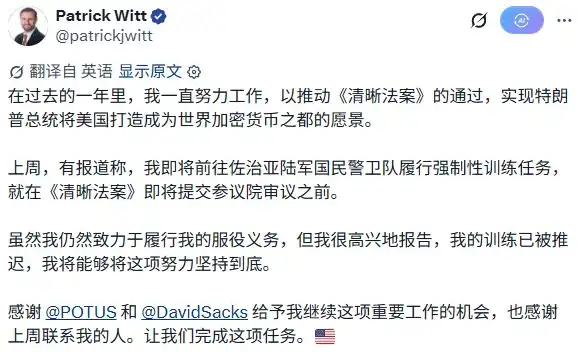
Personnel changes at the White House level also indicate the urgency of the push. Crypto Advisor Patrick Witt was originally scheduled to be away this week due to mandatory training with the Georgia Army National Guard; the training has been postponed, and he will remain in place to advance the legislation. His deputy, Harry Jung, announced he would leave in two weeks.
"One-Yard Line" or "Elephant in the Room"?

The industry lobbying side's stance is direct. Blockchain Association CEO and former CFTC Commissioner Summer Mersinger stated at the Injective Summit in Washington D.C. on July 16 that the core provisions of the bill were "very close to agreement, with only a few details left to iron out," and called the ethics issue the "elephant in the room," the biggest current obstacle.
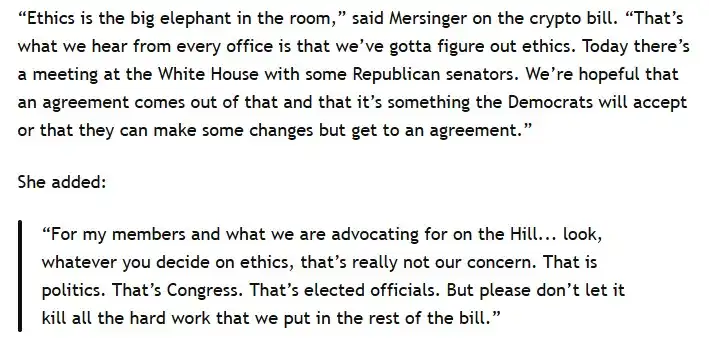
She called out to Congress: "Whatever decision you make on the ethics provision, that's really not what we care about, that's politics, that's Congress, that's elected officials. But please don't let it kill all the work we've done on the rest of the bill."

Coinbase Vice Chairman and former SEC official Ryan VanGrack's statement on CNBC in mid-July was more blunt: "The 'CLARITY Act' is at the one-yard line, the momentum to pass is obvious." Senate Majority Leader John Thune offered a more cautious judgment: "There is a path to a deal, but time is running out."

These statements essentially say the same thing: we don't care how the ethics clause is written, just don't let it derail the rest of the bill.

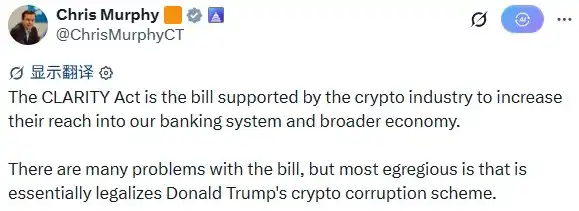
Skepticism comes mainly from the Democratic side, directly targeting the inadequacy of the ethics provision itself. Senator Chris Murphy criticized in a Facebook post on July 14, calling the 'CLARITY Act' "a bill supported by the crypto industry, aiming to expand its influence on the banking system and the broader economy," and explicitly demanded that "the bill must have provisions stating that the President and his family members cannot issue cryptocurrencies during their term, whether meme tokens or stablecoins... The ethics provision must cover the President and his immediate family members."

Senators Warren, Jack Reed, Chris Van Hollen, and others also jointly stated in mid-July that they "cannot support the current version of the 'CLARITY Act'," citing reasons including the need for stronger consumer protection, stricter conflict-of-interest and ethics rules, and more safeguards against crypto fraud and market manipulation. Senator Mark Warner said bluntly: "I am very pessimistic about the progress."
Whales, ETFs & Crypto Treasury Moves

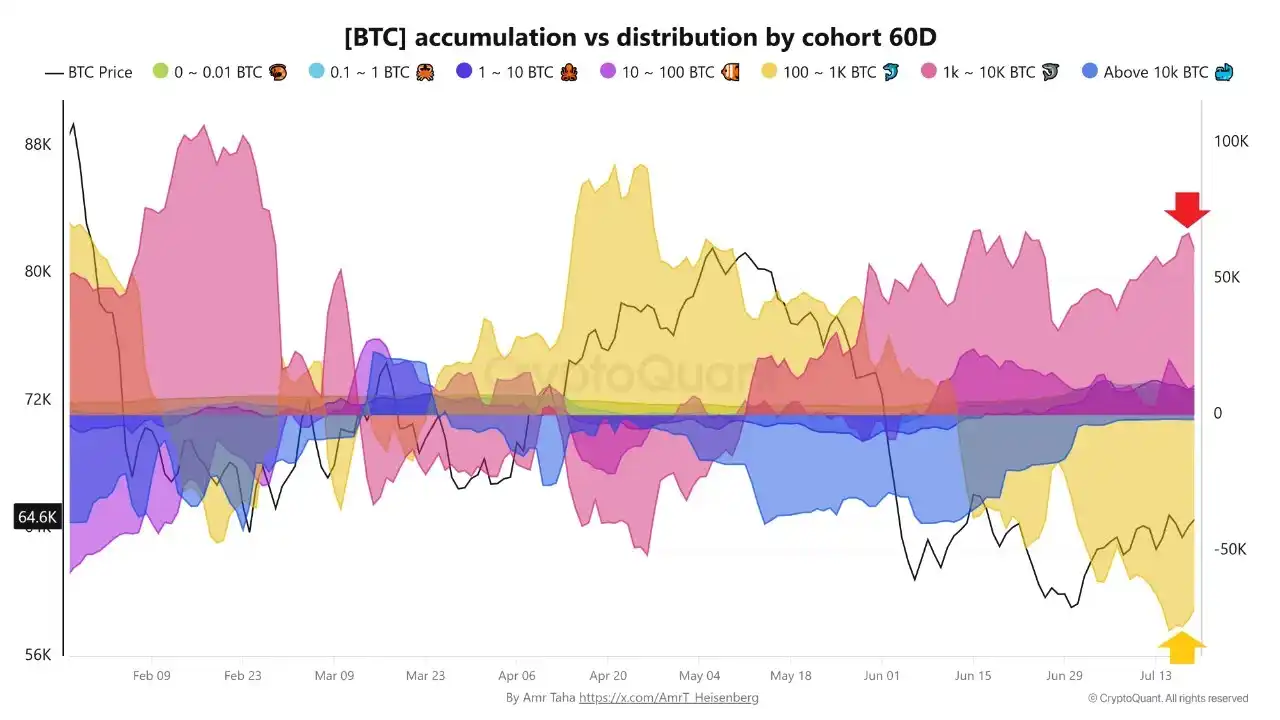
On-Chain Whales: According to CryptoQuant data from July 20, addresses holding 1,000 to 10,000 BTC saw a net increase of approximately 66,700 BTC over 60 days, the strongest wave of buying since mid-February; meanwhile, medium-holding addresses with 100 to 1,000 BTC sold off about 77,800 BTC in the same period. Data provided by Bitfinex analysts to CoinDesk shows that whale addresses collectively added over 270,000 BTC, worth about $16.7 billion, in the first two weeks of July.
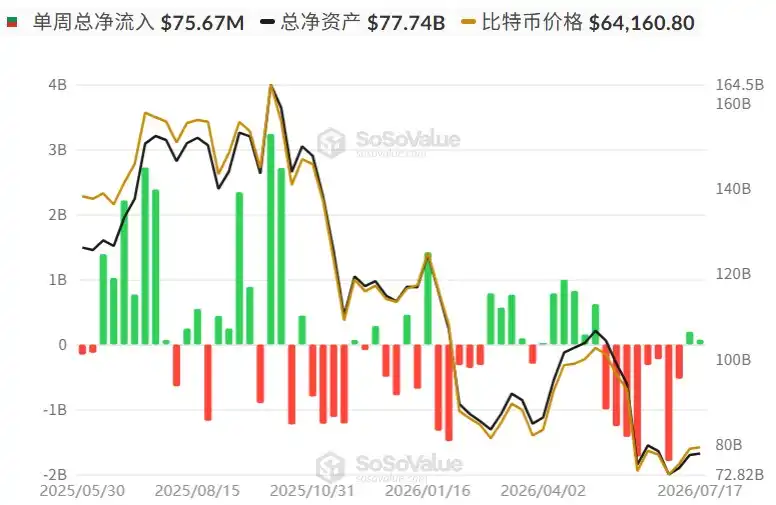
Spot ETFs: According to SoSoValue weekly data, U.S. Bitcoin spot ETFs saw net outflows for 8 consecutive weeks starting the week of May 15, with the week of June 26 experiencing the heaviest outflow at $1.79 billion. It wasn't until the week of July 10 that flows turned positive, with a net inflow of $197 million, followed by another net inflow of $75.67 million the week of July 17.
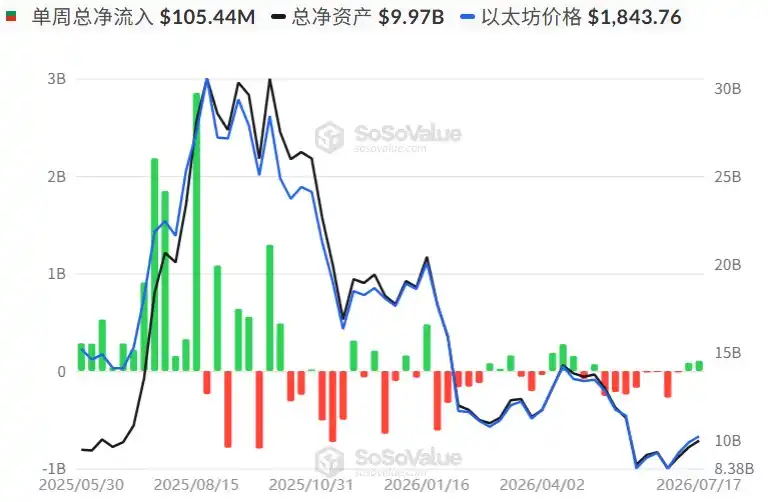
The trend for Ethereum spot ETFs was almost synchronized: also 8 consecutive weeks of net outflows from May 15 to July 2, turning to net inflows for the weeks of July 10 and 17, with $84.42 million and $105 million respectively.
Crypto Treasuries: Strategy holdings remained at approximately 844,000 BTC, having not purchased Bitcoin for two consecutive weeks. In mid-July, it raised $263.5 million in cash through a stock issuance but did not immediately add to its position, instead holding it as a buffer for preferred stock dividends and interest. Japanese-listed company Metaplanet added 2,823 BTC in Q2, bringing its total holdings to 43,000 BTC, ranking third globally among public companies; its subsidiary completed a convertible bond financing of approximately $59.5 million on July 21, planning to continue buying.

BitMine increased its holdings by 7,430 ETH last week, bringing its total to 5,777,468 ETH, accounting for about 4.8% of the total ETH supply. Of this, 85% is staked, generating an estimated annual staking yield of about $247 million. The company concurrently repurchased approximately 5.5 million common shares at an average price of $15.62. Tom Lee stated this slowed the buying pace, but weekly accumulation has never been interrupted since the reserve strategy launch on June 30, 2025.

Arthur Hayes: According to monitoring by Yu Jin, BitMEX co-founder Arthur Hayes spent 2.5 million USDC on July 15 to chase and buy 1,293 ETH at $1,933. On July 20, he bought another 2.5 million USDC worth of ETH via FalconX and Cumberland OTC at $1,876. The two transactions totaled 5 million USDC, purchasing 2,625.7 ETH at an average cost of $1,904. Hayes previously wrote that the AI sector is absorbing market liquidity, putting short-term pressure on BTC, but once liquidity returns, the crypto market still has room for a rebound.


Pertanyaan Terkait

QWhat major obstacle did the inclusion of an ethics clause in the CLARITY Act overcome?

AThe major obstacle overcome was securing agreement from former President Trump, who reportedly has significant digital asset holdings (approximately $14 billion in crypto income), to include restrictions limiting federal officials from profiting from digital assets during their terms.

QWhat is the significance of the August recess deadline mentioned for the CLARITY Act?

AThe August recess (starting August 7th) creates a tight legislative window. The bill must pass a full Senate vote before the recess to avoid significant delays, as Congress will not reconvene until September 14th.

QAccording to industry lobbyists, what was the primary concern regarding the ethics clause negotiations?

AIndustry lobbyists, like the Blockchain Association's CEO, were concerned that the politically contentious ethics clause negotiations could derail the entire bill. Their primary stance was that the clause's specifics were a political matter for Congress, but it should not jeopardize the passage of the broader regulatory framework.

QWhat criticism did some Democratic senators have regarding the CLARITY Act?

ASome Democratic senators criticized the bill for needing stronger consumer protections, stricter conflict-of-interest and ethics rules (specifically covering the President's immediate family), and more safeguards against crypto fraud and market manipulation. They expressed skepticism and pessimism about the current version.

QWhat recent trend was observed regarding Bitcoin holdings by different wallet sizes, according to the article?

AAccording to CryptoQuant data, 'whale' addresses (holding 1,000 to 10,000 BTC) saw their strongest net accumulation since mid-February, adding approximately 66,700 BTC over 60 days. In contrast, mid-sized addresses (holding 100 to 1,000 BTC) were net sellers, offloading approximately 77,800 BTC in the same period.

Bacaan Terkait

Setelah Tiga Kuartal Berturut-Turut Turun, Bisakah Pasar Kripto Menyambut Jendela Stabilitas di Kuartal Ketiga?

Pasar kripto mengalami kuartal terburuk sejak 2022, dengan kapitalisasi pasar turun 12.6% menjadi $2.1 triliun, didorong oleh keluarnya modal dan penurunan volume perdagangan. Bitcoin dan Ethereum masing-masing jatuh 14.2% dan 25.4% di kuartal kedua. Aliran keluar bersih dari ETF Bitcoin AS mencapai $4.67 miliar, menandakan tekanan jual yang berkelanjutan. Faktor utama meliputi terputusnya hubungan dengan saham AS, kebijakan moneter Federal Reserve yang ketat, dan pelepasan aset oleh perusahaan seperti Strategy. Proses legislasi UU CLARITY yang akan memberikan kejelasan regulasi terhambat, meningkatkan premi risiko di sektor ini. Namun, ada tanda-tanda potensi stabilisasi. Aliran keluar ETF yang besar secara historis sering terjadi di akhir fase penurunan, dan para pemegang Bitcoin jangka panjang mulai menambah kepemilikan lagi. Sementara sebagian besar sektor menyusut, pasar prediksi dan aset koleksi yang ditokenisasi mencatat pertumbuhan signifikan. Pandangan untuk kuartal ketiga sangat bergantung pada pertemuan Fed akhir Juli. Sinyal kebijakan yang lunak dapat mendukung pemulihan Bitcoin, sementara sikap yang hawkish dapat memicu konsolidasi lebih lanjut. Meskipun tantangan regulasi tetap ada, indikator teknis seperti harga Bitcoin yang mendekati rata-rata bergerak 200-mingguannya menunjukkan dasar jangka panjang belum rusak. Logika pasar telah bergeser dari mengandalkan narasi ke faktor fundamental seperti kebijakan dan ekspektasi suku bunga.

marsbitKemarin 08:40

Setelah Tiga Kuartal Berturut-Turut Turun, Bisakah Pasar Kripto Menyambut Jendela Stabilitas di Kuartal Ketiga?

marsbitKemarin 08:40

The SpaceX Trade, Terbuka: SPCXON Mulai Diperdagangkan di WEEX

SpaceX meluncurkan IPO terbesar dalam sejarah pada Juni 2026, namun akses bagi banyak pedagang terhambat oleh batasan regional dan prosedur broker. WEEX kini menghadirkan SPCXON/USDT di pasar spotnya, sebuah instrumen tokenisasi yang memungkinkan paparan terhadap pergerakan harga SpaceX melalui akun kripto yang diselesaikan dengan USDT, tanpa memerlukan broker AS atau pembiayaan bank. SPCXON adalah produk tokenisasi yang mencerminkan ekonomi kepemilikan SpaceX bagi pedagang yang memenuhi syarat di luar AS, dengan dividen diinvestasikan kembali. Aset ini diperdagangkan di WEEX sebagai pasangan spot dengan USDT, tersedia selama jam pasar, memberikan akses mudah bagi trader kripto. Kasus investasi untuk SpaceX didasarkan pada pertumbuhan pendapatan Starlink dan pencapaian Starship, meskipun valuasinya yang tinggi (sekitar 90-110 kali pendapatan) telah memperhitungkan eksekusi sempurna selama bertahun-tahun. Faktor seperti jumlah saham publik yang terbatas dan masa buka kunci (unlock) insider pertama menjadi pertimbangan penting. Penting untuk diingat bahwa SPCXON memberikan paparan, bukan kepemilikan langsung atas saham atau hak suara. Harganya dapat diperdagangkan pada premium atau diskon terhadap nilai aset bersih. WEEX menawarkan akses ke berbagai aset TradFi yang ditokenisasi seperti ini dalam satu akun terpadu, bersama dengan pasar futures dan kampanye perdagangan dengan pool hadiah.

TheNewsCryptoKemarin 08:33

The SpaceX Trade, Terbuka: SPCXON Mulai Diperdagangkan di WEEX

TheNewsCryptoKemarin 08:33

Momen Perdagangan BIT: BTC Masih Tertekan oleh EMA 200 Mingguan, Setelah Ditolak Mungkin Kembali Turun, Saham Penyimpanan dan Semikonduktor yang Melonjak Malam Kemudian Mulai Anjlok di Pasar Malam

**PASAR KRIPTO & SAHAM: BTC Hadapi Resistensi, Saham Semikonduktor Turun di Perdagangan Malam** Pasar kripto melanjutkan pemulihan, dengan harga Bitcoin bertahan di sekitar $66,000 setelah rebound lebih dari 15% dari titik terendah Juli. Namun, BTC menghadapi **tembok resistensi kuat di dekat $68,000**, yang bertepatan dengan biaya rata-rata investor selama lima bulan terakhir dan titik gagalnya rebound pertengahan Juni. Secara teknis, perhatian tertuju pada **200 EMA mingguan (~$68,328) sebagai level kunci**. Jika BTC ditolak di level ini, potensi penurunan menuju support $63,000 terbuka. Analis menyoroti volume rendah dan penurunan open interest futures di CME, menandakan rebound ini lebih dipicu likuiditas rendah musim panas daripada awal bull run penuh. Di pasar saham AS, **indeks futures utama turang** setelah sesi kemarin yang kuat. Sektor semikonduktor dan penyimpanan (storage), yang melonjak pada hari Selasa (contoh: Micron +12%), **mengalami koreksi di perdagangan malam (night trading)**. ETF semikonduktor turun 2,22% dan saham Micron turun 2,29%. Meski begitu, ada sorotan positif seperti **Super Micro Computer (SMCI)** yang naik lebih dari 15% setelah melaporkan pandangan pendapatan yang kuat dan pesanan baru yang sangat besar, mengonfirmasi permintaan server AI tetap solid. Kekhawatiran makro muncul dari **kenaikan harga minyak mentah (di atas $91)** akibat ketegangan geopolitik dan **lonjakan imbal hasil (yield) obligasi pemerintah AS**, dengan imbal hasil 10-tahun mencapai sekitar 4,64%. Faktor-faktor ini dapat menambah tekanan inflasi dan membatasi ruang gerak pasar saham. Saham terkait kripto seperti Coinbase dan Robinhood naik kuat didorong oleh perkembangan regulasi yang lebih jelas di AS. Di Asia, **Korea Selatan** dan **Jepang** menunjukkan kinerja beragam. Indeks KOSPI Korea naik didukung pemulihan saham semikonduktor, sementara pasar Jepang melemah dengan **Yen terus melemah ke level terendah sejak 1986**, meningkatkan kekhawatiran akan intervensi bank sentral. **Yang Perlu Diperhatikan Selanjutnya:** * **22 Juli:** Acara AI AMD, rilis laporan keuangan dari Google (Alphabet), Tesla, IBM. * **23 Juli:** Keputusan suku bunga Bank Sentral Eropa (ECB), data klaim pengangguran AS, laporan keuangan Intel. * Perkembangan lebih lanjut dari **harga minyak, imbal hasil obligasi, dan dinamika Yen Jepang** akan menjadi penentu sentimen pasar risiko secara keseluruhan.

marsbitKemarin 08:32

Momen Perdagangan BIT: BTC Masih Tertekan oleh EMA 200 Mingguan, Setelah Ditolak Mungkin Kembali Turun, Saham Penyimpanan dan Semikonduktor yang Melonjak Malam Kemudian Mulai Anjlok di Pasar Malam

marsbitKemarin 08:32

Mantan Ketua CFTC dan Presiden Circle, Tarbert: Satu Pihak Menasihati Anda untuk Berpikir Jangka Panjang, di Sisi Lain Menguangkan $30 Juta Sendiri

Penulis: Zen, PANews Heath Tarbert, mantan Ketua CFTC dan Presiden Circle, baru-baru ini menyerukan kepada investor untuk mengadopsi pandangan jangka panjang terhadap saham Circle, meskipun harganya telah turun 70% dari puncaknya. Namun, ia sendiri secara konsisten menjual saham CRCL sejak perusahaan go public, menguangkan sekitar $30 juta tanpa pernah membeli saham tambahan di pasar terbuka. Tarbert, yang bergabung dengan Circle pada Juli 2023 dan menjadi Presiden pada awal 2025, dikenal sebagai pendukung kuat narasi "jangka panjang" perusahaan. Namun, sehari sebelum IPO Circle, ia menetapkan rencana perdagangan 10b5-1 untuk menjual hingga 353.290 saham dalam setahun. Dalam 13 bulan setelah IPO, ia menjual lebih dari 360.000 saham, termasuk penjualan tunggal senilai $11,5 juta pada Maret 2026. Ia bahkan menetapkan rencana 10b5-1 kedua untuk menjual hingga 160.000 saham lagi pada akhir tahun 2026. Langkah Tarbert ini menuai kecaman karena dianggap tidak konsisten dengan pesan "jangka panjang" yang ia sampaikan kepada publik. Perjalanan kariernya sering dikaitkan dengan "revolving door" antara regulator dan dunia keuangan. Setelah mengundurkan diri sebagai Ketua CFTC pada Maret 2021, ia bergabung dengan Citadel Securities hanya 27 hari kemudian sebagai Kepala Penasihat Hukum, tepat saat perusahaan itu menghadapi pengawasan ketat terkait peristiwa GameStop. Di Citadel, ia juga mendukung undang-undang yang memperluas wewenang CFTC atas pasar crypto, sementara Citadel diketahui berencana berekspansi ke aset kripto. Tarbert kemudian pindah ke Circle pada 2023, membantu perusahaan mengatasi tantangan regulasi dan akhirnya go public melalui IPO langsung. Meskipun sangat berharga bagi perusahaan, tindakannya menjual saham dalam jumlah besar sambil mendorong investor untuk bertahan menimbulkan pertanyaan tentang komitmennya yang sebenarnya terhadap masa depan jangka panjang Circle.

marsbitKemarin 08:09

Mantan Ketua CFTC dan Presiden Circle, Tarbert: Satu Pihak Menasihati Anda untuk Berpikir Jangka Panjang, di Sisi Lain Menguangkan $30 Juta Sendiri

marsbitKemarin 08:09

Gate Research Institute: Produk Keuangan Kripto Menggulirkan Gelombang "Wall Street-ization", Kompetisi atau Integrasi?

**Ringkasan: Gelombang "Wall Street-ization" Produk Keuangan Kripto: Kompetisi atau Integrasi?** Artikel ini membahas fenomena konvergensi antara keuangan tradisional (TradFi) dan keuangan kripto (Crypto). Meskipun Bitcoin awalnya dirancang sebagai sistem peer-to-peer yang terdesentralisasi dan bebas dari perantara seperti bank, pasar kripto kini semakin diintegrasikan ke dalam infrastruktur keuangan tradisional. **Tren "Wall Street-ization":** Dimulai dengan disetujuinya ETF spot Bitcoin pada 2024, aset kripto kini dikemas menjadi produk seperti ETF (oleh BlackRock, Fidelity, dll.), futures, dan sekuritisasi aset riil (RWA) seperti obligasi pemerintah yang ditokenisasi. Ini memberikan akses yang mudah dan teregulasi bagi investor institusional, tetapi juga berarti kekuasaan atas penerbitan, penentuan harga, kustodian, dan distribusi aset kripto semakin bergeser ke lembaga keuangan besar. **Dua Jalur Konvergensi (1+1>2):** Artikel ini menyoroti dua arah integrasi: 1. **Dari CEX ke TradFi:** Dilambangkan oleh **Gate.io**, yang berkembang dari bursa kripto menjadi platform multi-aset. Gate kini menawarkan perdagangan saham nyata (AS, Hong Kong, Korea) menggunakan USDT, menyediakan akses tanpa batas waktu ke pasar tradisional. 2. **Dari TradFi ke Crypto:** Dilambangkan oleh **Robinhood**, platform broker tradisional yang memperluas layanannya ke aset kripto (termasuk melalui akuisisi Bitstamp) dan mengembangkan produk seperti token saham di blockchain. **Tujuan Bersama: Akun Keuangan "Super" Terpadu:** Kedua jalur ini bertujuan menciptakan **akun keuangan generasi berikutnya yang terpadu**. Pengguna di masa depan mungkin dapat memperdagangkan Bitcoin, saham Apple, ETF, emas, dan obligasi pemerintah yang ditokenisasi dalam satu antarmuka yang sama, menggunakan stablecoin sebagai lapisan dana. **RWA dan Obligasi Pemerintah di On-Chain sebagai Lapisan Tengah:** Tokenisasi aset dunia nyata, terutama obligasi pemerintah AS, menyediakan aset berpenghasilan rendah risiko di ekosistem on-chain. Pasar ini tumbuh pesat (naik 40% pada paruh pertama 2026) meskipun pasar kripto turun, menunjukkan permintaan nyata. **Kesimpulan:** "Wall Street-ization" bukanlah pengambilalihan sepihak, melainkan **transformasi timbal balik**. TradFi dan Crypto saling melengkapi: Crypto mendapatkan akses ke likuiditas, kepatuhan, dan jaringan distribusi yang luas, sementara TradFi mengadopsi efisiensi, kecepatan, dan pasar 24/7 dari Crypto. Hasil akhirnya adalah pembentukan **pasar modal terpadu yang lebih efisien dan global**, di mana batas antara aset tradisional dan kripto semakin kabur.

marsbitKemarin 08:07

Gate Research Institute: Produk Keuangan Kripto Menggulirkan Gelombang "Wall Street-ization", Kompetisi atau Integrasi?

marsbitKemarin 08:07

Trading

Spot
活动图片




