HIP-4 Enables Permissionless Deployment, Can Hyperliquid Kill Polymarket?

marsbitDipublikasikan tanggal 2026-07-20Terakhir diperbarui pada 2026-07-20

Abstrak

Hyperliquid announced that its HIP-4 prediction markets will soon support permissionless deployments, similar to its successful HIP-3 model for perpetual contracts. This move aims to ignite growth in its underperforming prediction market segment by allowing third parties to create their own prediction markets upon staking 500,000 HYPE (worth approximately $30 million), with the potential to earn up to 50% fee shares. While this strategy mirrors the approach that propelled HIP-3 and platforms like Trade.xyz to dominance in tokenized trading, the article raises significant challenges for HIP-4. Its current performance is weak, with only $216 million in total volume over three months—pales in comparison to Polymarket's $4.6 billion monthly volume. The high staking barrier may exclude smaller teams, potentially limiting innovation and event diversity. Furthermore, Hyperliquid missed the crucial timing window of the 2026 World Cup, a major catalyst for prediction market activity, which competitors like Polymarket capitalized on heavily. The success of HIP-3 was partly due to perfect timing, such as during the U.S.-Iran conflict when traditional markets were closed. Without a similar catalytic event and facing an established leader like Polymarket, it remains uncertain whether Hyperliquid's "decentralized" strategy can successfully disrupt the prediction market landscape.

Original | Odaily Planet Daily (@OdailyChina)

Author | Golem (@web3_golem)
Just after the World Cup ended, Hyperliquid dropped a "nuclear bomb" into the prediction market sector.

On July 20th, Hyperliquid announced that HIP-4 will support permissionless deployment in the future, just like HIP-3. The staking requirement for HIP-4 deployers is also 500,000 HYPE, which will be locked for 6 months. HIP-4 deployers can set a fee share of up to 50% in the markets they deploy. This feature will first be available on the testnet and then launched on the mainnet.
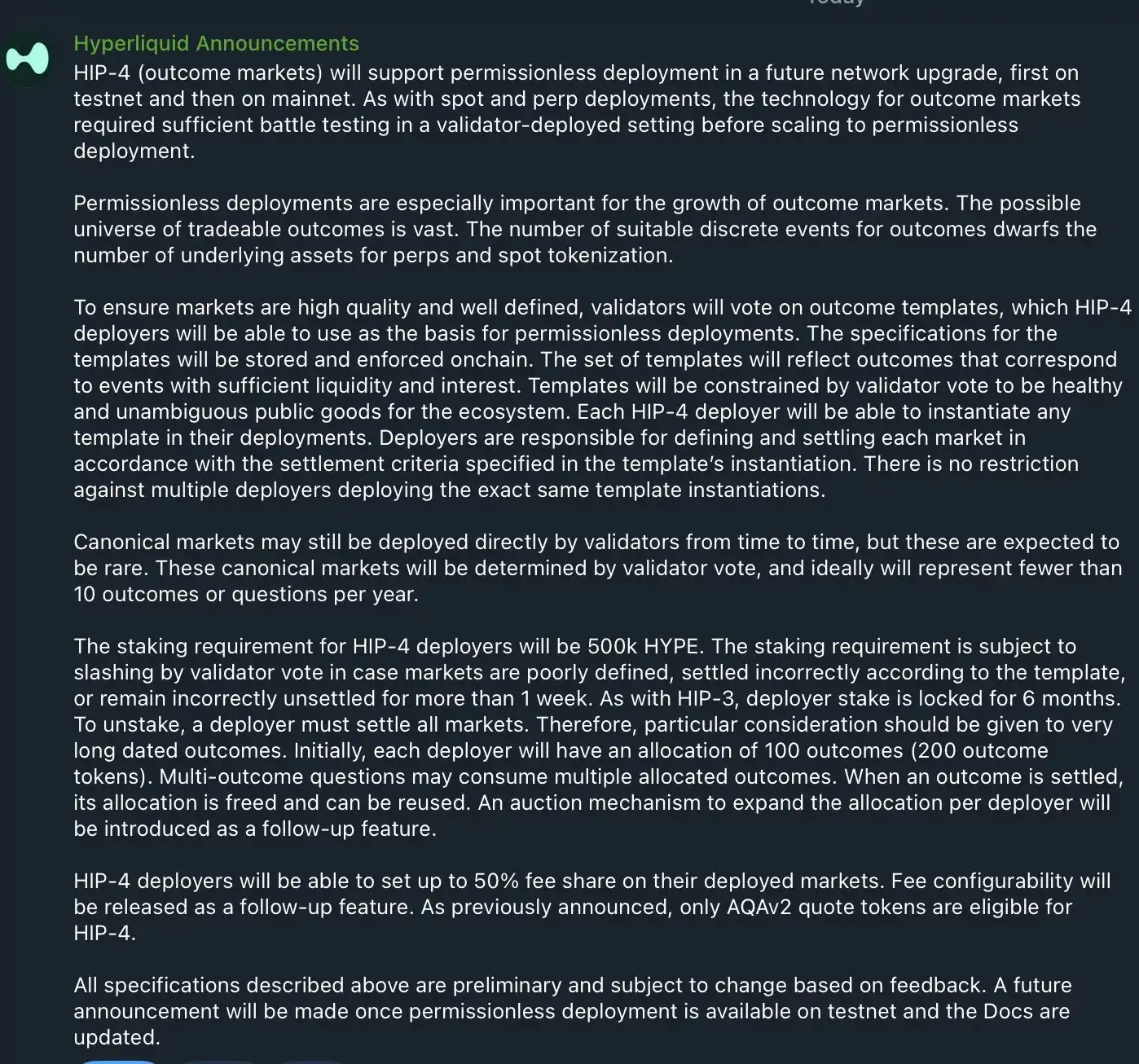
Hyperliquid Announces HIP-4 Open Permissionless Deployment

Although this announcement from Hyperliquid is just a preliminary notice, with the specific opening time for HIP-4 permissionless deployment not yet confirmed, the market has already gotten excited following the news.

Hyperliquid's current status as the world's largest platform for stock tokens and on-chain commodity perpetual contracts, even outpacing traditional financial markets in pricing enterprise IPOs, is largely thanks to its launch of HIP-3 and opening of third-party permissionless creation of perpetual contract markets in October 2025.

Therefore, this time, investors believe Hyperliquid can once again rely on the power of "decentralization" to surpass all the frontrunners in the prediction market sector.

Who Will Be the Next Trade.xyz?

Hyperliquid launched the HIP-4 market on May 2nd, 2026, marking its official entry into the prediction market sector. Before the HIP-4 market went live, the market was generally optimistic that it would become Hyperliquid's next core narrative. However, nearly three months after its launch, its performance can be described as poor.

According to official Hyperliquid data, the cumulative trading volume of the HIP-4 market over the past 3 months is only $216 million, with a daily average trading volume of just $10 million. The peak daily active users reached only 7,000, and the total fee revenue is a mere $442.38. In contrast, DeFiLlama data shows Polymarket's trading volume over the past month reached $4.587 billion, with fees amounting to $50 million.
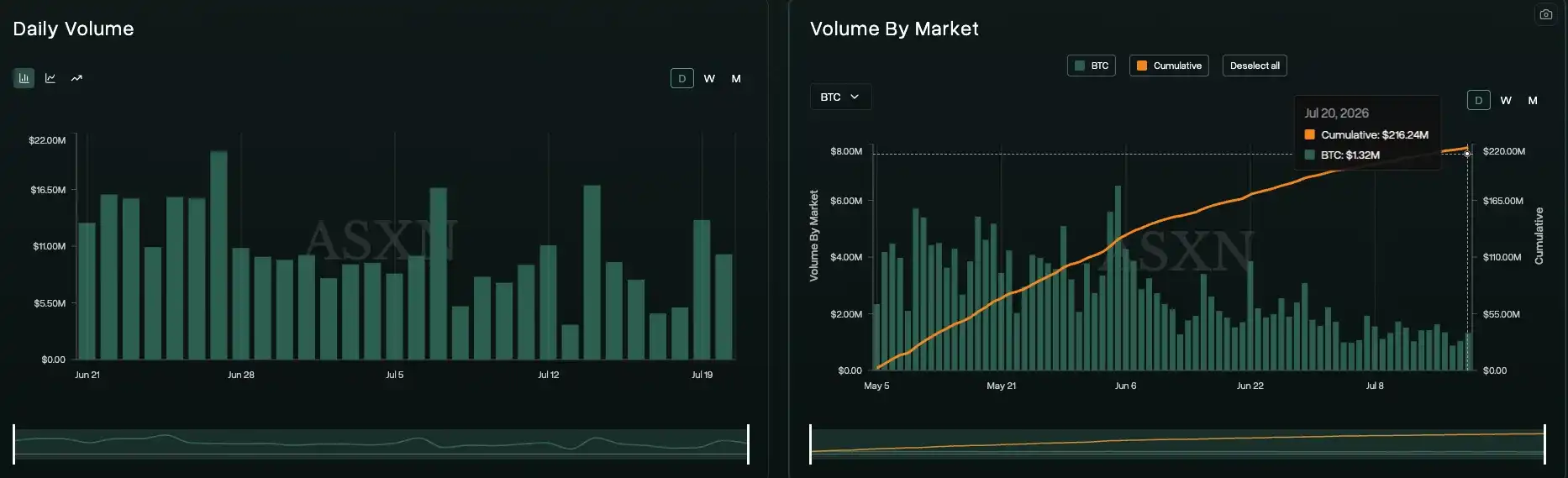
HIP-4 Daily Average Trading Volume and Total Trading Volume

Not only are there few users and low trading volume, but the number of events with resolvable outcomes on HIP-4 is also very limited. Currently, the entire HIP-4 market has only 6 predictive markets, which is a drop in the bucket compared to Polymarket in terms of both quantity and variety.
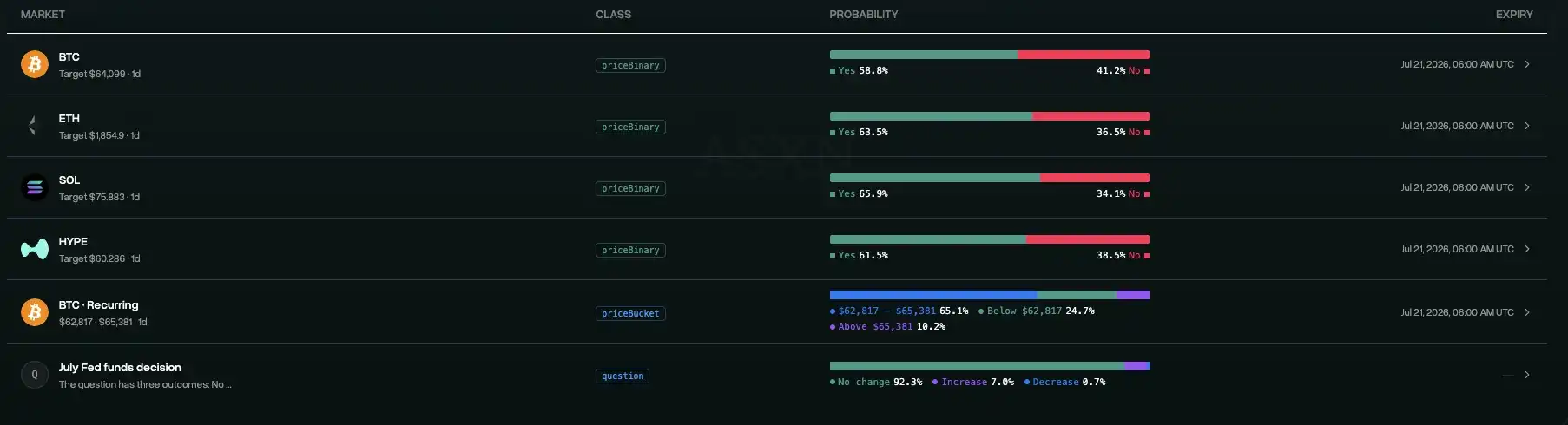
Currently Tradable Events on HIP-4

Given such a vast disparity in scale, Hyperliquid chose to follow the path of dependency, adhering to the successful experience of HIP-3. Since they couldn't build it up themselves, they would give the stage to the community, aiming to create another Trade.xyz within HIP-4.

Hyperliquid opening permissionless deployment for the HIP-4 market is equivalent to Polymarket allowing users to autonomously create predictive market events. Hyperliquid founder Jeff also stated that permissionless deployment is particularly important for the growth of outcome markets (HIP-4) because the scope of outcomes that can be traded is extremely vast. The number of independent events suitable for outcome trading far exceeds the number of underlying assets used for derivatives and real-world asset tokenization.

Moreover, having the community or third parties deploy predictive market events offers greater flexibility. Currently, the creation of predictive market contracts is mainly initiated by the team or reviewed after community proposals. This process is not decentralized enough, and team members cannot possibly pay attention to every niche across all fields. Especially for trending real-world events, this model slows down the time from market reaction to final execution and launch.

On the HIP-4 market, as long as a third party stakes enough HYPE tokens, they can list predictive market events according to their own standards without Hyperliquid team review. Hyperliquid also stipulates that it will not restrict multiple deployers from simultaneously deploying identical events. This will also incentivize healthy competition within the HIP-4 market, as only those who provide users with a wider range of events and deeper liquidity will prevail in the competition.

Hyperliquid's product philosophy has always adhered to a win-win strategy. The HIP-3 market has already nurtured the giant Trade.xyz, which holds over 90% of the HIP-3 market share. The first 10 perpetual contract listings it launched each exceeded $10 billion in trading volume.

Perhaps many teams are already gearing up. On the day Hyperliquid's mainnet opens HIP-4 for permissionless deployment, we will witness a lively "War of the Gods."

Can Hyperliquid Disrupt the Prediction Market Landscape?

But can Hyperliquid really "use one trick to conquer all"?

Firstly, Hyperliquid is no longer what it used to be. The HYPE price remains stable above $60. The requirement for HIP-4 market deployers to stake 500,000 HYPE (approximately $30 million) actually bars small startup teams from entering. Nowadays, a single funding round for a crypto project might not even reach $30 million. And prediction market projects capable of raising $30 million might prefer to develop their own prediction market platforms.

Therefore, the excessively high staking threshold for HIP-4 deployers might drastically reduce the number of third-party competitors. In the end, only "well-funded" prediction market projects would come to attract traffic. The number of tradable independent events would also be limited, severely hampering the innovation momentum of the entire HIP-4 market.

Secondly, Hyperliquid's timing for launching HIP-4 permissionless deployment missed even the last bus. One main reason why 2026 became a year of opportunity for the prediction market sector's development is the recent concentration of major sporting events, especially coinciding with the once-every-four-years World Cup. Various prediction markets were focusing their efforts around World Cup matches. For example, on Polymarket, the total trading volume for the Argentina vs. Spain match event on July 20th alone reached $83.75 million.

But Hyperliquid completely missed this crucial World Cup time window, which is undoubtedly a huge strategic oversight. Even the success of the HIP-3 market was a combination of favorable timing, location, and people. The US-Iran conflict in February this year, which caused fluctuations in international crude oil prices, became a significant catalyst for the HIP-3 market's development. The first day of the war fell on a weekend. With traditional markets closed, traders urgently needing to adjust positions and hedge had to find new tradable markets, and Hyperliquid's HIP-3 market became the first choice.

When Hyperliquid launched HIP-3, it did not emphasize that it was built for stock tokens and commodity tokenization. Yet, it ultimately gave rise to Trade.xyz and Hyperliquid's current leading position in the tokenized trading market. If Hyperliquid had not seized the opportunity presented by the US-Iran conflict, perhaps Hyperliquid would have no place in today's tokenized trading market.

Similarly, having missed the World Cup opportunity, how much confidence can we have that Hyperliquid can now disrupt the prediction market giants?


Kripto yang Sedang Tren

Pertanyaan Terkait

QAccording to the article, what major feature is Hyperliquid planning to implement for HIP-4, and what was the similar feature that contributed to its previous success?

AHyperliquid is planning to implement permissionless deployment for HIP-4, which will allow third parties to create prediction markets. A similar feature, the permissionless creation of perpetual contract markets under HIP-3, was a key factor in Hyperliquid's previous success, particularly leading to the rise of Trade.xyz.

QWhat are the current performance metrics of Hyperliquid's HIP-4 prediction market according to the article, and how do they compare to its main competitor, Polymarket?

AOver the past three months, Hyperliquid's HIP-4 market had a cumulative trading volume of only $216 million, with an average daily volume of around $10 million, a peak daily active user count of 7,000, and total fee revenue of just $442.38. In contrast, in just the past month, Polymarket achieved a trading volume of $45.87 billion and generated $50 million in fees, demonstrating a massive disparity in scale.

QWhat potential issue does the article identify regarding the staking requirement for HIP-4 deployers?

AThe article suggests that the staking requirement for HIP-4 deployers is too high. It requires a stake of 500,000 HYPE (worth approximately $30 million), which could exclude smaller entrepreneurial teams and lead to a significant reduction in potential third-party competitors. This, in turn, might limit the number and variety of tradable independent events and hinder innovation within the HIP-4 ecosystem.

QWhat significant timing opportunities did Hyperliquid miss for the launch of its HIP-4 market, and why were these opportunities important?

AHyperliquid missed the opportunity to launch its HIP-4 market during the recent World Cup, a major event that drove significant activity on competing prediction platforms like Polymarket. The article compares this to the successful timing of HIP-3's launch, which coincided with the US-Iran conflict when traders needed alternative markets. Missing such critical timing windows is seen as a major strategic oversight that could impact HIP-4's ability to compete.

QHow does the article characterize the logic behind Hyperliquid's decision to enable permissionless deployment for HIP-4, and what existing success story is cited as a model?

AThe article characterizes the decision as one of 'path dependence' and a strategic reliance on the successful model of decentralization from HIP-3. Since its own efforts on HIP-4 have performed poorly, Hyperliquid is giving the stage to the community, aiming to replicate the success of Trade.xyz—a major player that emerged from HIP-3's permissionless model—within the prediction market space.

Bacaan Terkait

Kes Perceraian Chey Tae-won Selesai: Mengungkap Garis Suksesi Tersembunyi di Balik Kerajaan Triliunan SK Hynix

Kasus perceraian Ketua SK Group, Choi Tae-won, akhirnya diputuskan, mengungkap garis suksesi tersembunyi di balik kerajaan triliunan won SK Hynix. Artikel ini menjelaskan perjalanan ketiga anaknya sebagai generasi penerus ketiga dalam keluarga Chaebol Korea Selatan yang tidak mengikuti skenario tradisional. Anak tertua, **Choi Yun-jung**, dianggap sebagai kandidat penerus yang paling jelas. Berpendidikan tinggi di bidang biologi dan informatika biomedis, dia memegang posisi eksekutif di SK Inc., mengelola perencanaan jangka panjang dan ekspansi global. Pernikahannya dengan pendiri startup infrastruktur AI mencerminkan pergeseran dari pernikahan dinasti tradisional. Anak kedua, **Choi Min-jung**, memiliki koneksi mendalam dengan SK Hynix, Washington, dan jaringan militer. Sebagai veteran Angkatan Laut Korea yang pernah bertugas di Teluk Aden, dia bekerja di divisi kebijakan internasional SK Hynix sebelum mendirikan startup perawatan kesehatan berbasis AI di AS. Dia menikahi mantan perwira Korps Marinir AS, menguatkan hubungannya dengan lingkungan geopolitik tempat perusahaan semikonduktor beroperasi. Putra satu-satunya, **Choi In-geun**, adalah yang paling sesuai dengan profil penerus tradisional namun justru paling diam. Setelah bekerja di SK E&S, dia kini berkarier di McKinsey Seoul, sebuah langkah yang dianggap sebagai pelatihan eksternal standar, bukan pernyataan suksesi. Kasus perceraian orang tua mereka, dengan tuntutan pembagian aset mencapai triliunan won, juga membawa ketiganya ke dalam narasi publik melalui berkas hukum. Sementara SK Hynix melonjak menjadi aset geopolitik global di era AI, ketiga anak ini tidak mewarisi jawaban sederhana, melainkan serangkaian tantangan kompleks industri AI global. Pewarisan bagi mereka bukan lagi sekadar masalah keluarga, melainkan uji kelayakan publik di panggung dunia baru.

marsbit2 hari yang lalu 09:11

Kes Perceraian Chey Tae-won Selesai: Mengungkap Garis Suksesi Tersembunyi di Balik Kerajaan Triliunan SK Hynix

marsbit2 hari yang lalu 09:11

2 Bulan, Valuasi Melonjak dari 88 Miliar Jadi 680 Miliar! OpenRouter, 'Stasiun Transit' AI Terbesar, Akan Diakuisisi

Stripe, pemroses pembayaran terbesar di dunia, dilaporkan sedang dalam negosiasi untuk mengakuisisi OpenRouter, pasar yang menghubungkan lebih dari 400 model AI besar, dengan harga sekitar 100 miliar USD. Harga ini mencerminkan lonjakan valuasi hampir 7 kali lipat dari 13 miliar USD dua bulan lalu. OpenRouter berfungsi sebagai lapisan perantara atau "mesin perbandingan harga" yang memungkinkan pengembang mengakses berbagai model AI (seperti GPT, Claude, atau model open-source) melalui satu API. Platform ini secara otomatis mencocokkan permintaan pengguna dengan model terbaik berdasarkan kompleksitas tugas, biaya, dan kecepatan, membantu aplikasi AI mengoptimalkan biaya tanpa mengubah pengalaman pengguna. Didirikan pada 2023 oleh Alex Atallah (salah satu pendiri OpenSea) dan Louis Vichy, OpenRouter telah mencatat pertumbuhan pesat dengan pendapatan tahunan mencapai 50 juta USD per April 2025. Akuisisi ini merupakan bagian dari strategi Stripe untuk memperluas infrastruktur ekonomi AI. Pada akhir 2025, mereka mengakuisisi Metronome, platform penagihan berbasis penggunaan. Dengan menggabungkan OpenRouter (pemilihan dan perutean model) dan Metronome (penagihan), Stripe bertujuan menawarkan solusi terpadu—dari pemilihan model, penagihan sesuai pemakaian, hingga pembayaran—bagi bisnis yang menggunakan AI. Langkah ini memperkuat posisi Stripe sebagai "pusat kendali" dalam alur kerja AI. Meski transaksi berpotensi diumumkan dalam sebulan, negosiasi masih bisa gagal.

链捕手2 hari yang lalu 09:03

2 Bulan, Valuasi Melonjak dari 88 Miliar Jadi 680 Miliar! OpenRouter, 'Stasiun Transit' AI Terbesar, Akan Diakuisisi

链捕手2 hari yang lalu 09:03

Trading

Spot

Artikel Populer

Cara Membeli 4

Selamat datang di HTX.com! Kami telah membuat pembelian 4 (4) menjadi mudah dan nyaman. Ikuti panduan langkah demi langkah kami untuk memulai perjalanan kripto Anda.Langkah 1: Buat Akun HTX AndaGunakan alamat email atau nomor ponsel Anda untuk mendaftar akun gratis di HTX. Rasakan perjalanan pendaftaran yang mudah dan buka semua fitur.Dapatkan Akun SayaLangkah 2: Buka Beli Kripto, lalu Pilih Metode Pembayaran AndaKartu Kredit/Debit: Gunakan Visa atau Mastercard Anda untuk membeli 4 (4) secara instan.Saldo: Gunakan dana dari saldo akun HTX Anda untuk melakukan trading dengan lancar.Pihak Ketiga: Kami telah menambahkan metode pembayaran populer seperti Google Pay dan Apple Pay untuk meningkatkan kenyamanan.P2P: Lakukan trading langsung dengan pengguna lain di HTX.Over-the-Counter (OTC): Kami menawarkan layanan yang dibuat khusus dan kurs yang kompetitif bagi para trader.Langkah 3: Simpan 4 (4) AndaSetelah melakukan pembelian, simpan 4 (4) di akun HTX Anda. Selain itu, Anda dapat mengirimkannya ke tempat lain melalui transfer blockchain atau menggunakannya untuk memperdagangkan mata uang kripto lainnya.Langkah 4: Lakukan trading 4 (4)Lakukan trading 4 (4) dengan mudah di pasar spot HTX. Cukup akses akun Anda, pilih pasangan perdagangan, jalankan trading, lalu pantau secara real-time. Kami menawarkan pengalaman yang ramah pengguna baik untuk pemula maupun trader berpengalaman.

799 Total TayanganDipublikasikan pada 2025.10.20Diperbarui pada 2026.06.02

Cara Membeli 4

Diskusi

Selamat datang di Komunitas HTX. Di sini, Anda bisa terus mendapatkan informasi terbaru tentang perkembangan platform terkini dan mendapatkan akses ke wawasan pasar profesional. Pendapat pengguna mengenai harga 4 (4) disajikan di bawah ini.

活动图片