ACL 2026 Dominated by Chinese Scholars, All Best Paper First Authors Are Chinese, Outstanding Papers Nearly Swept

marsbitDipublikasikan tanggal 2026-07-09Terakhir diperbarui pada 2026-07-09

Abstrak

ACL 2026, held in San Diego, saw a record 12,148 submissions, a 45% increase, with LLM-centric topics dominating. Among 4,462 accepted papers, three were awarded Best Paper, all with Chinese first authors. 1. **"The Imperfective Paradox in Large Language Models"** (Bolei Ma et al.) exposed a "teleological bias" in LLMs: they default to assuming goal-oriented actions succeed, even when context suggests otherwise, acting more as "predictive narrative engines" than logical reasoners. 2. **"Memory efficiency and resource-rational encoding in sentence processing"** (Weijie Xu et al.) showed that constraining Transformer memory with noise injection, mimicking human working memory limits, leads to representations and reading patterns more aligned with human language processing. 3. **"Characterizing the Expressivity of Local Attention in Transformers"** (Jiaoda Li et al.) formally proved, using formal language theory, that local attention strictly increases a Transformer's expressive power, explaining why it often outperforms pure global attention. The conference highlighted the field's scale, with 54% of authors from Mainland China and an average of 6.25 authors per paper. Out of 18 Outstanding Papers awarded, a significant portion also featured prominent contributions from researchers of Chinese descent.

【Introduction】Submissions surge 45% to 12,148! ACL 2026 overrun by LLM papers. First authors of all three best papers are Chinese, Chinese scholars nearly sweep outstanding papers.

The best papers of ACL 2026 are out!

As the premier annual conference in computational linguistics, ACL this year selected three Best Paper Awards, with all first authors being Chinese.

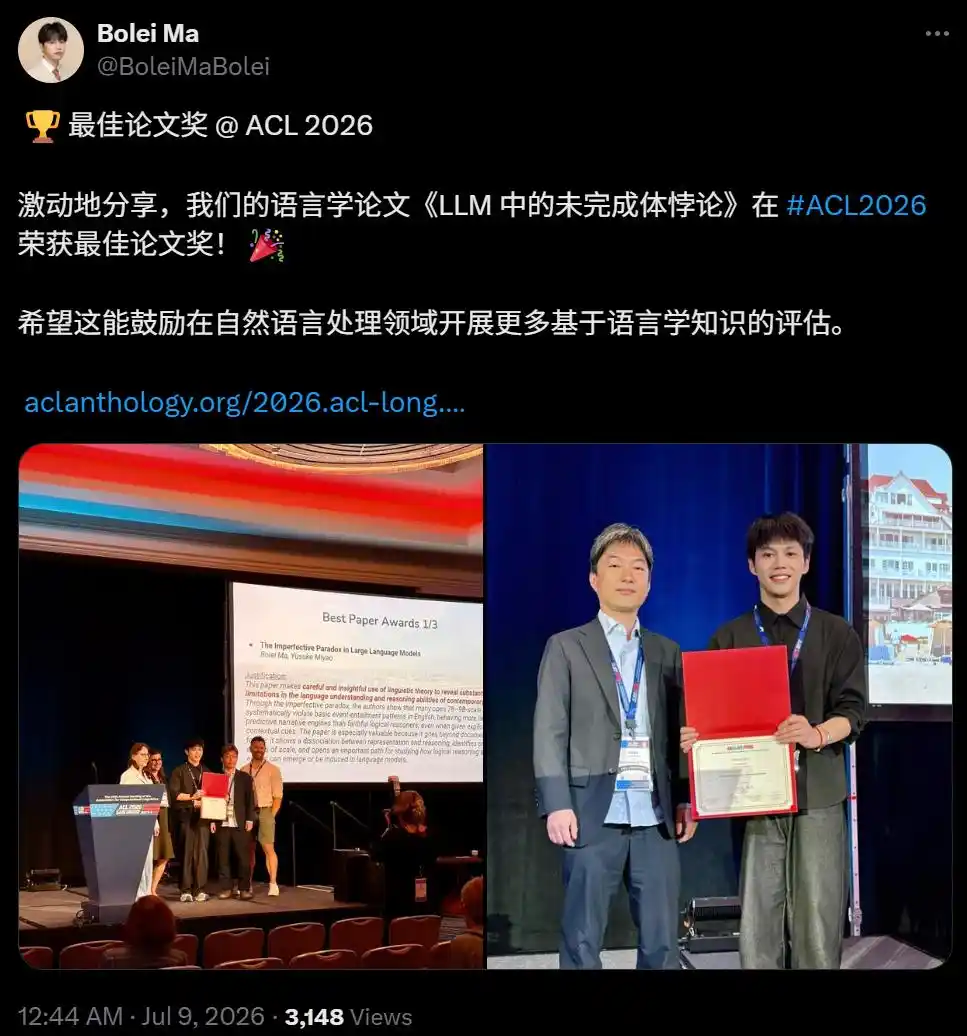
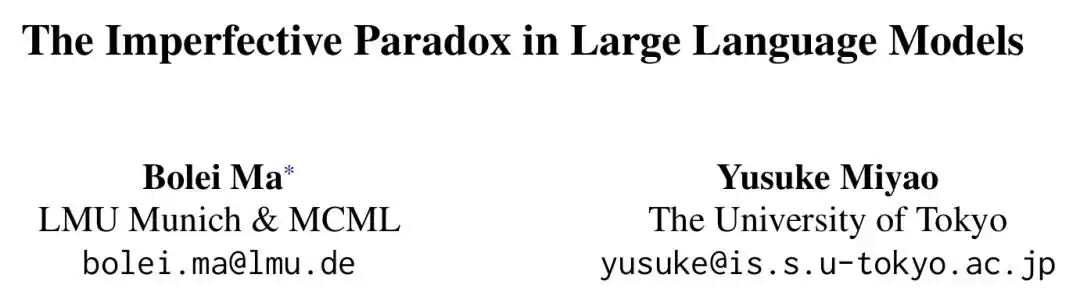
"The Imperfective Paradox in Large Language Models", authors are Bolei Ma from Ludwig Maximilian University of Munich and Yusuke Miyao from the University of Tokyo.

It tests seven open-source large models with a grammar question even elementary school students can answer correctly, revealing their fundamental flaws.
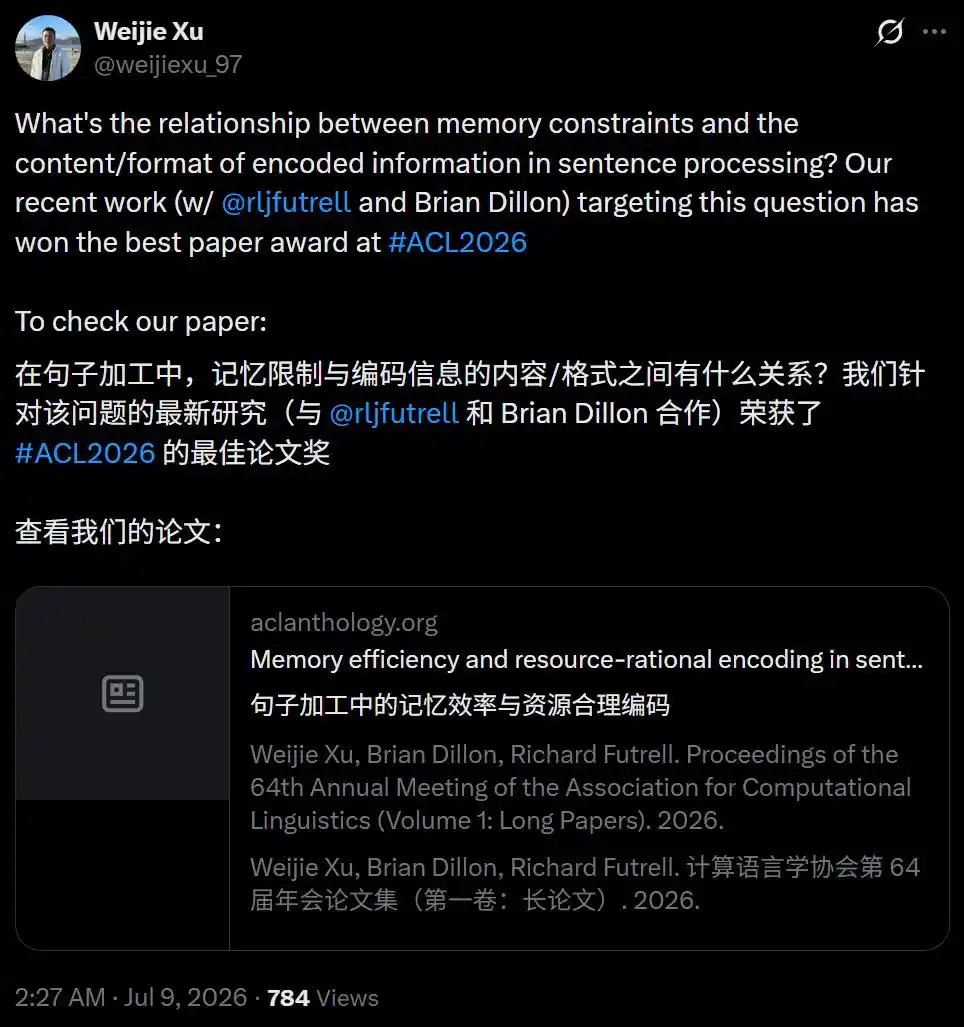
"Memory efficiency and resource-rational encoding in sentence processing", authors are Weijie Xu from University of California, Irvine, Brian Dillon from University of Massachusetts Amherst, and Richard Futrell from University of California, Irvine.

It takes the opposite approach, forcing a "forgetful" human brain onto large models, and finds the models actually become more human-like.
"Characterizing the Expressivity of Local Attention in Transformers", authors are Jiaoda Li and Ryan Cotterell from ETH Zurich.

Using formal language theory, it clearly explains a long-used but poorly understood question: why "local-only" attention is actually more powerful.

The Most Competitive ACL in History

ACL 2026 was held this July in San Diego, USA, setting a new record in scale.

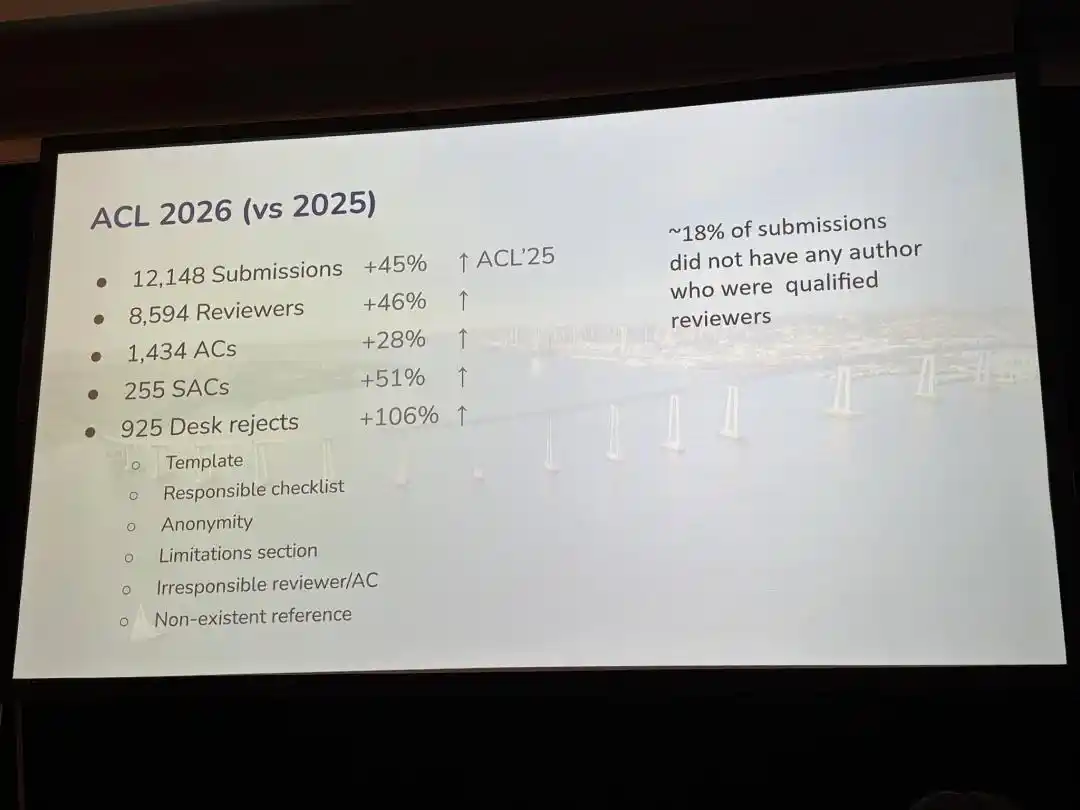
The main conference received 12,148 submissions, a 45% surge compared to 2025.

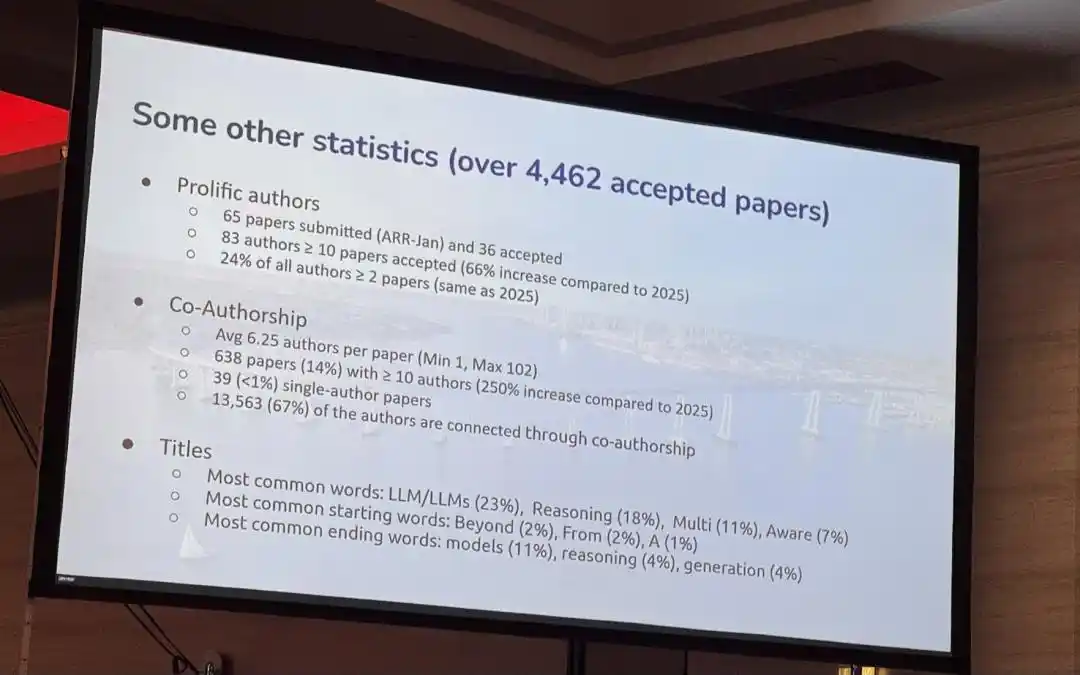
Ultimately, the main conference accepted 2,297 papers (acceptance rate 18.9%), Findings accepted 2,164 papers (17.8%), totaling over 4,462 accepted papers.

On average, each paper has 6.25 authors; one paper had a staggering 102 names. In contrast, only 39 papers were single-authored, accounting for less than 1%.

Among them, 83 authors had more than 10 papers accepted each (66% more than last year); one author even submitted 65 papers in the January batch alone, with 36 accepted.

67% (13,563) of all authors are connected through co-authorship.
Supporting this review process were 8,594 reviewers (+46%), 1,434 area chairs (+28%), and 255 senior area chairs (+51%).

Desk rejections more than doubled to 925 (+106%), for various reasons: non-compliant templates, missing Limitations sections, anonymity violations, even citing non-existent literature.

Approximately 26,000 authors attended, another increase from last year's 20,000.
By country/region, authors from Mainland China accounted for 54.0%, firmly ranking first; the US at 18.4% second; followed by South Korea 3.8%, Singapore 2.3%, UK 2.0%, Germany 1.9%, India 1.7%, Japan 1.5%.

If there's a "sign of the times" for this conference, it's written in the paper titles: "LLM/LLMs" appears in 23% of all titles, "Reasoning" 18%, "Multi" 11%.

This year also introduced new tracks—AI/LLM Agents, LLM Safety & Alignment, Mathematical & Symbolic Reasoning, Code Models, LLM Efficiency, Clinical & Biomedical Applications—almost all revolving around large models.
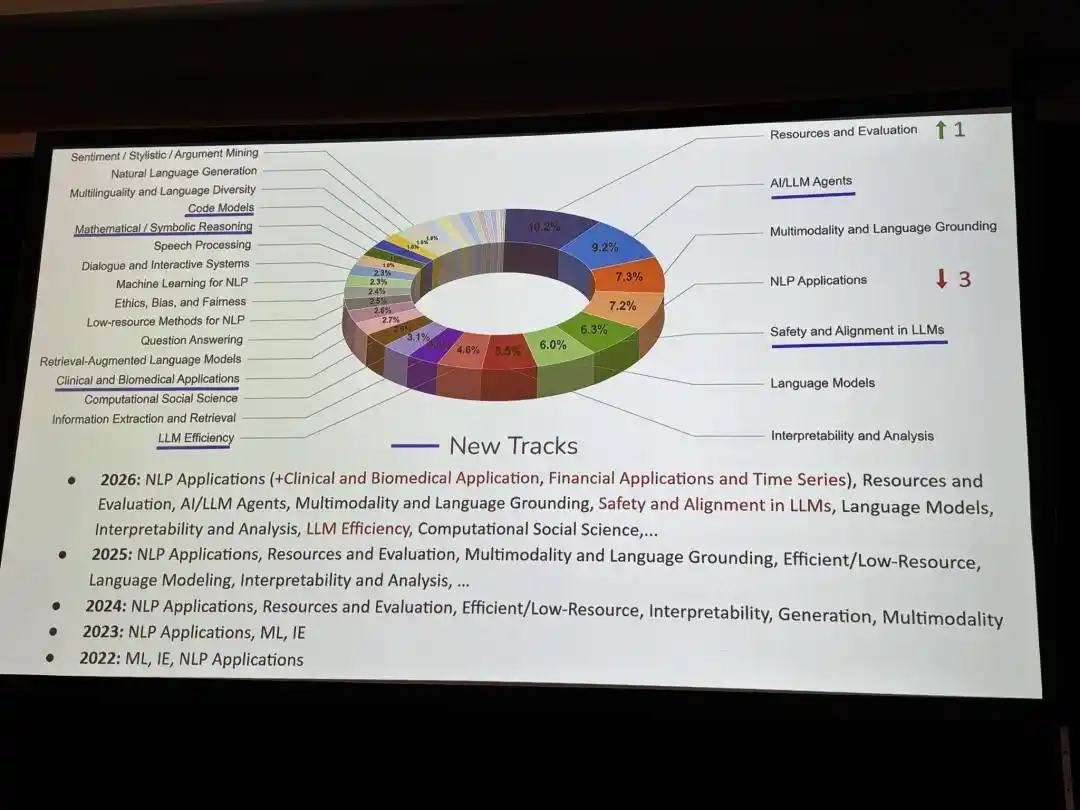
In other words, this was an ACL completely dominated by large language models.

Yet, the highest honors went to two papers that are "not so LLM".

Best Paper I: A Grammar Question Stumps 7 Large Models

Paper: The Imperfective Paradox in Large Language Models

Authors: Bolei Ma, Yusuke Miyao

Institutions: Ludwig Maximilian University of Munich, University of Tokyo
Paper Link:https://aclanthology.org/2026.acl-long.689/

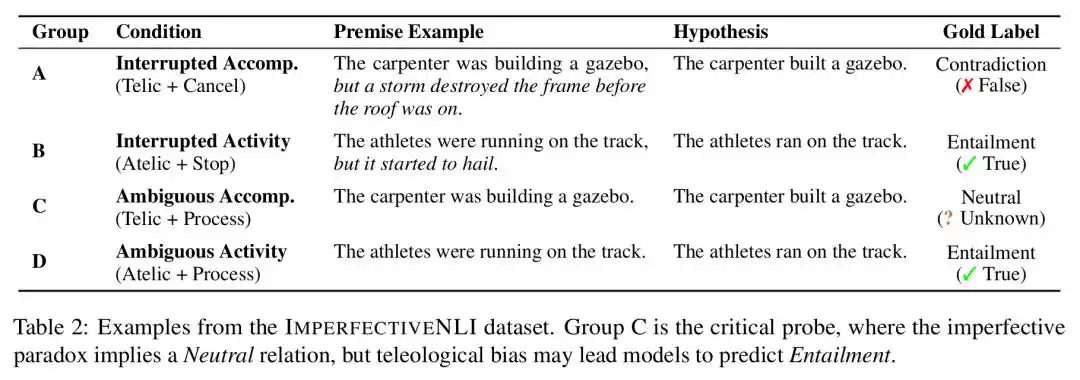
The core of this paper is a classic linguistic phenomenon: the Imperfective Paradox.

In Chinese, "He is running" generally implies "He ran," because "activity" verbs have no inherent endpoint; being halfway counts as having occurred.

But "The carpenter is building a gazebo" does not imply "The gazebo is built," because "accomplishment" verbs have a clear endpoint; construction might be halted halfway by a storm.

The progressive form implies "realized" for the former but not for the latter—this is the Imperfective Paradox, something anyone with basic language training hardly gets wrong.
What about large models?

The authors constructed a diagnostic dataset ImperfectiveNLI with 400 English samples, using 2x2 minimal pairs of accomplishment/activity verbs to isolate semantic reasoning ability, then tested seven open-source models from 7B to 90B parameters. The result was a near "total rout."

Faced with ambiguous sentences like "The carpenter is building a gazebo," models almost uniformly judged it as "built."

The authors named this flaw of "assuming success upon seeing a goal" the "teleological bias."

Under zero-shot conditions, Llama-3.1's bias rate was as high as 0.98, Mistral 0.97, DeepSeek even 1.00: any action with a goal was deemed completed.

More absurdly, even when sentences explicitly stated "a storm destroyed the frame before the roof was installed," many models still insisted it was done. Gemma-2's accuracy on such questions was only 3%; it didn't read the context, just guessed based on the inertia that "construction always succeeds."
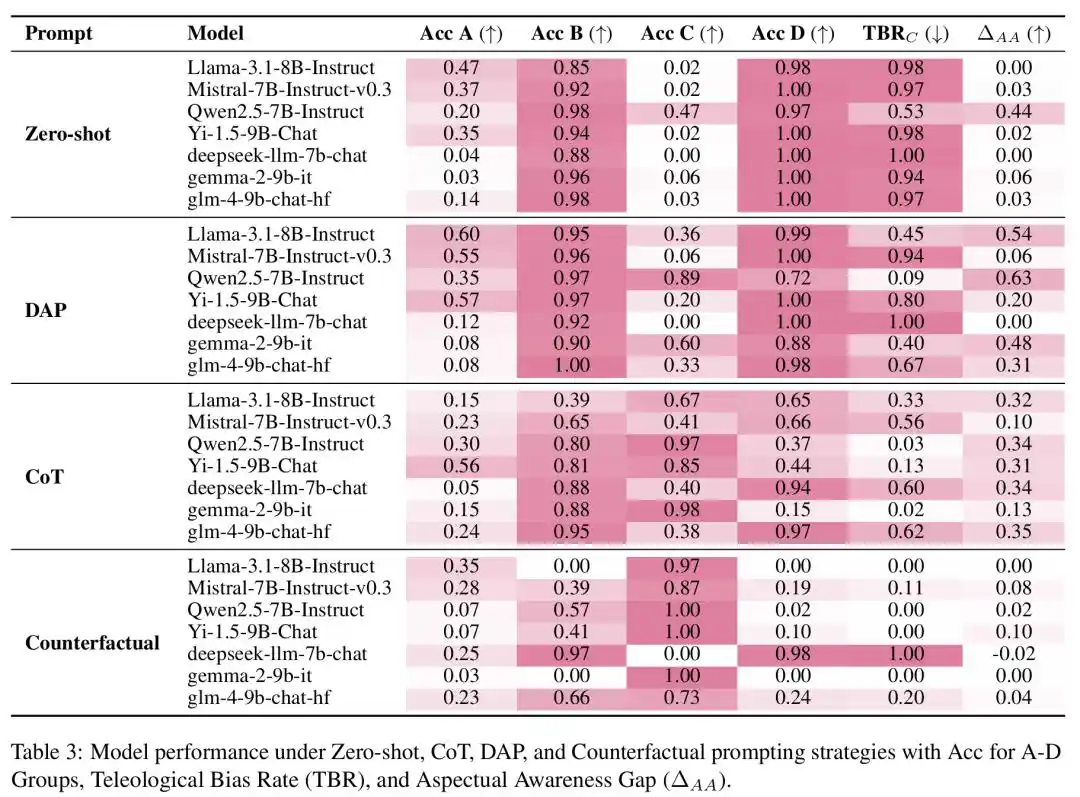
Thus, the authors gave the paper's key conclusion—

These open-source large models "operate more like predictive narrative engines rather than faithful logical reasoners."

In other words, they are not reasoning, just guessing the most likely story ending.

A deeper finding is the separation between representation and reasoning.

From a near-perfect inverse correlation (correlation coefficient -0.97), it's evident the encoding layers actually "know" that was building and built are not the same, but during decoding, they are swayed by world knowledge priors.
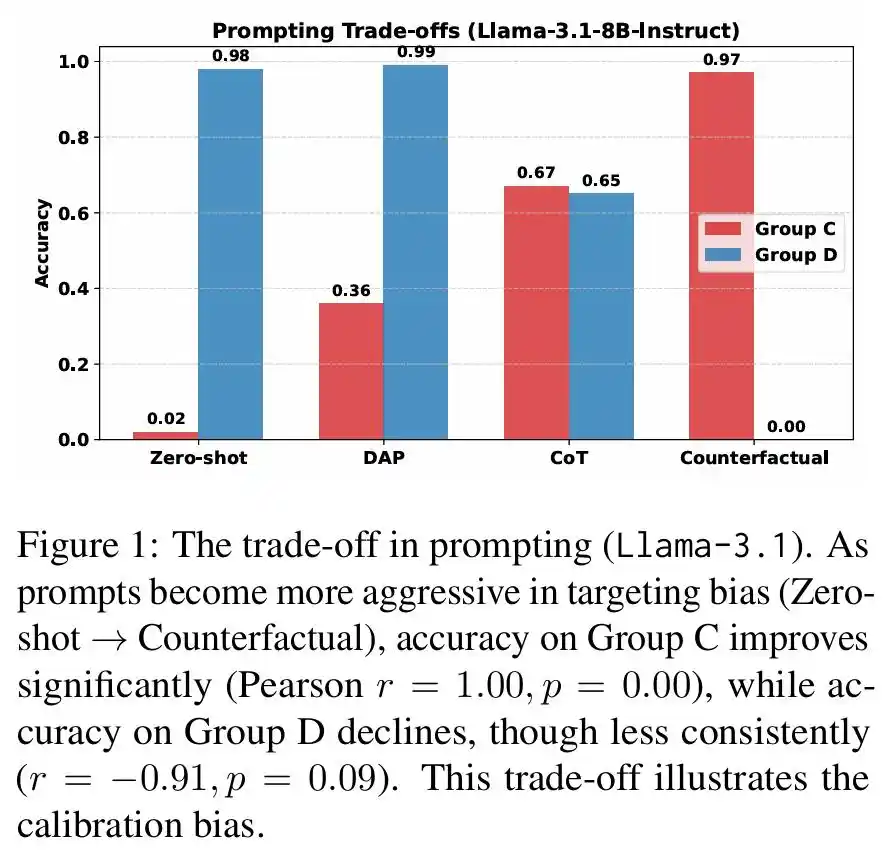
At this point, prompt engineering is just robbing Peter to pay Paul.

Counterfactual prompts can fix the bias but make models overly suspicious of simple activity sentences, denying them all, oscillating between "naive optimism" and "paranoid suspicion."

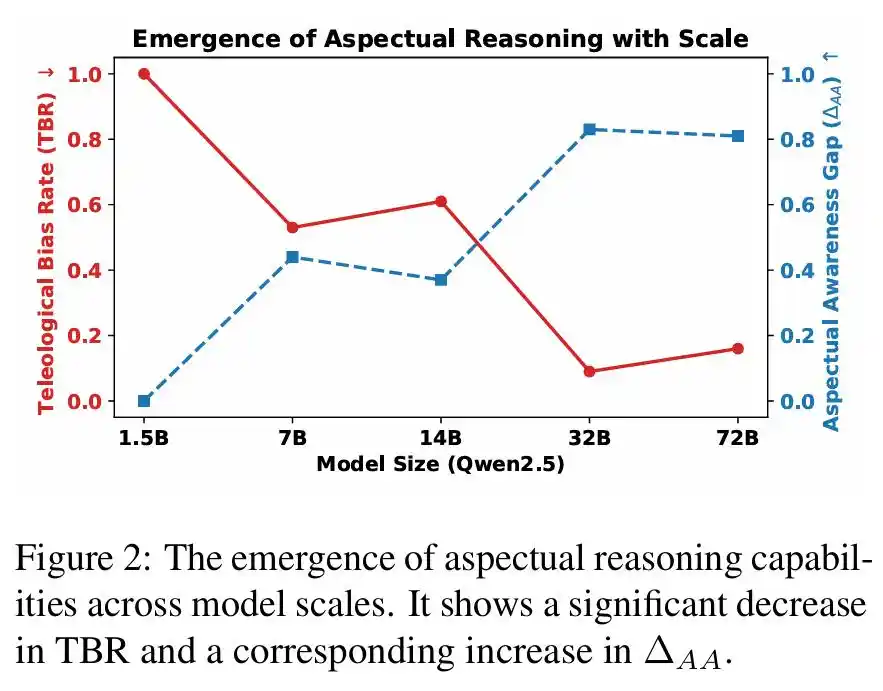
Fortunately, Scaling seems helpful: from 1.5B scaling to 720B parameters, bias rates dropped significantly, with a "phase transition" around 320B where accuracy soared to 0.91.
The Young Scholar "Grilling" Large Models with Linguistics

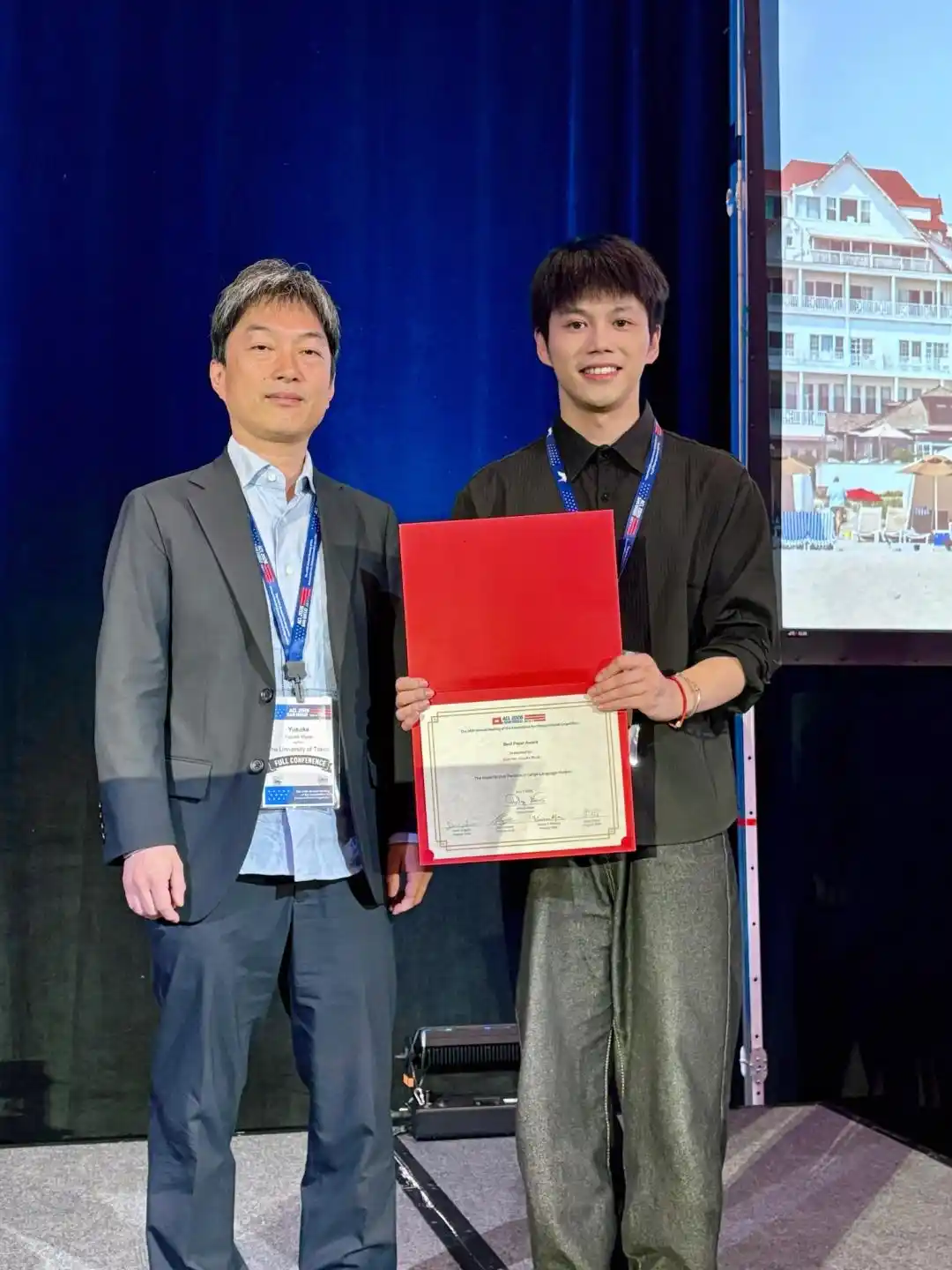
The first author, Bolei Ma, is a PhD candidate at Ludwig Maximilian University of Munich.

He belongs to the Social Data Science and AI Lab (SODA Lab, advisor Frauke Kreuter) in the Department of Statistics, is a junior member of the Munich Center for Machine Learning (MCML), and an external PhD candidate at the MaiNLP Lab (advisor Barbara Plank).

Bolei Ma's research long focuses on "Human-Centered NLP," computational social science, and computational semantics & pragmatics—exactly the foundation of this paper: using solid linguistic theory to examine trendy large models.
Best Paper II: Giving Large Models a Forgetful Human Brain

Paper: Memory efficiency and resource-rational encoding in sentence processing

Authors: Weijie Xu, Brian Dillon, Richard Futrell

Institutions: University of California, Irvine, University of Massachusetts Amherst
Paper Link:

This paper aims to solve: For language models to truly model "human language processing," they must, like humans, carefully manage limited working memory.

The brain's working memory is a scarce resource, yet it's used effortlessly. Humans instinctively allocate limited memory precision to unexpected, high-information content, while glossing over predictable parts.

The authors' approach is clever: inject noise at an adjustable rate into the Transformer's hidden representations, then train the model with a hybrid objective—under the hard constraint of "total encoding precision limited," predict the next word as accurately as possible.

In other words, force the model to be "stingy," spending precious memory on what matters most.
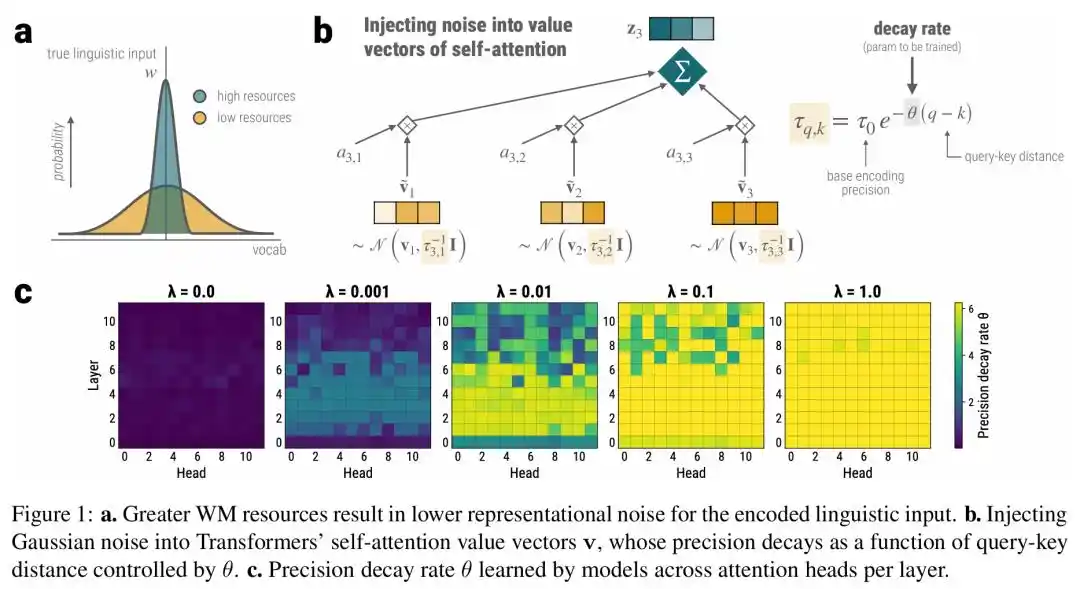
There are two key findings.

First, after adding this working memory constraint, the model's fit to human reading times significantly improved. That is, its "rhythm" of reading sentences became closer to real humans.

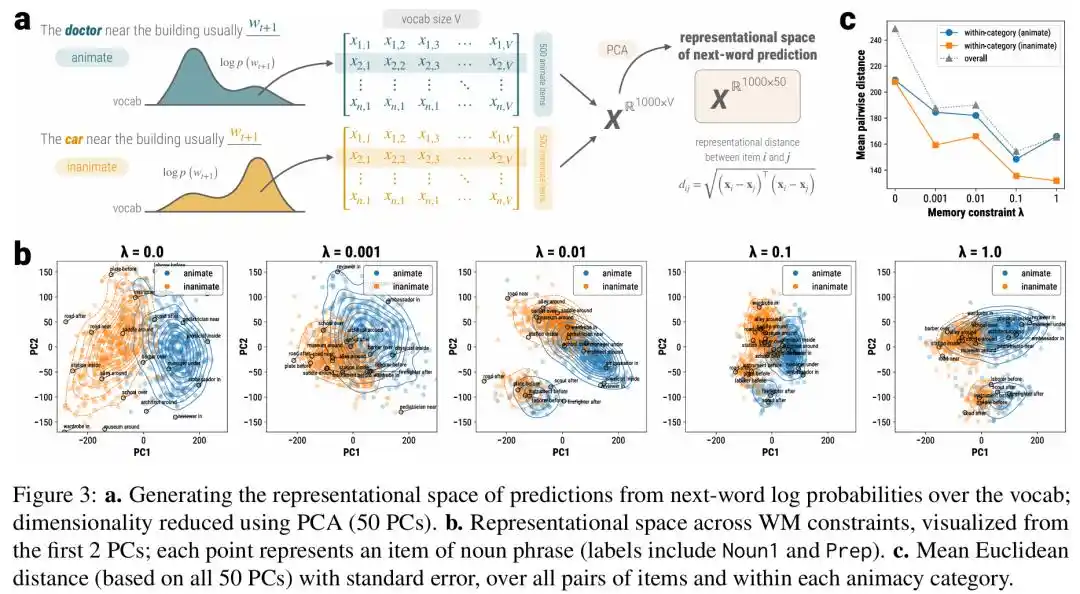
Second, and more importantly—to manage encoding precision, the model's contextual representations were reshaped, becoming more "compressed" and more "categorical."

This points to a thought-provoking conclusion: In models of human sentence processing, the working memory "retrieval mechanism" and the underlying "memory representation" can be dissociated.

In other words, giving a model more memory doesn't make it more human-like; rather, giving it a "must save" constraint causes it to develop representations closer to the human brain.
From Spanish Major to Computational Psycholinguistics

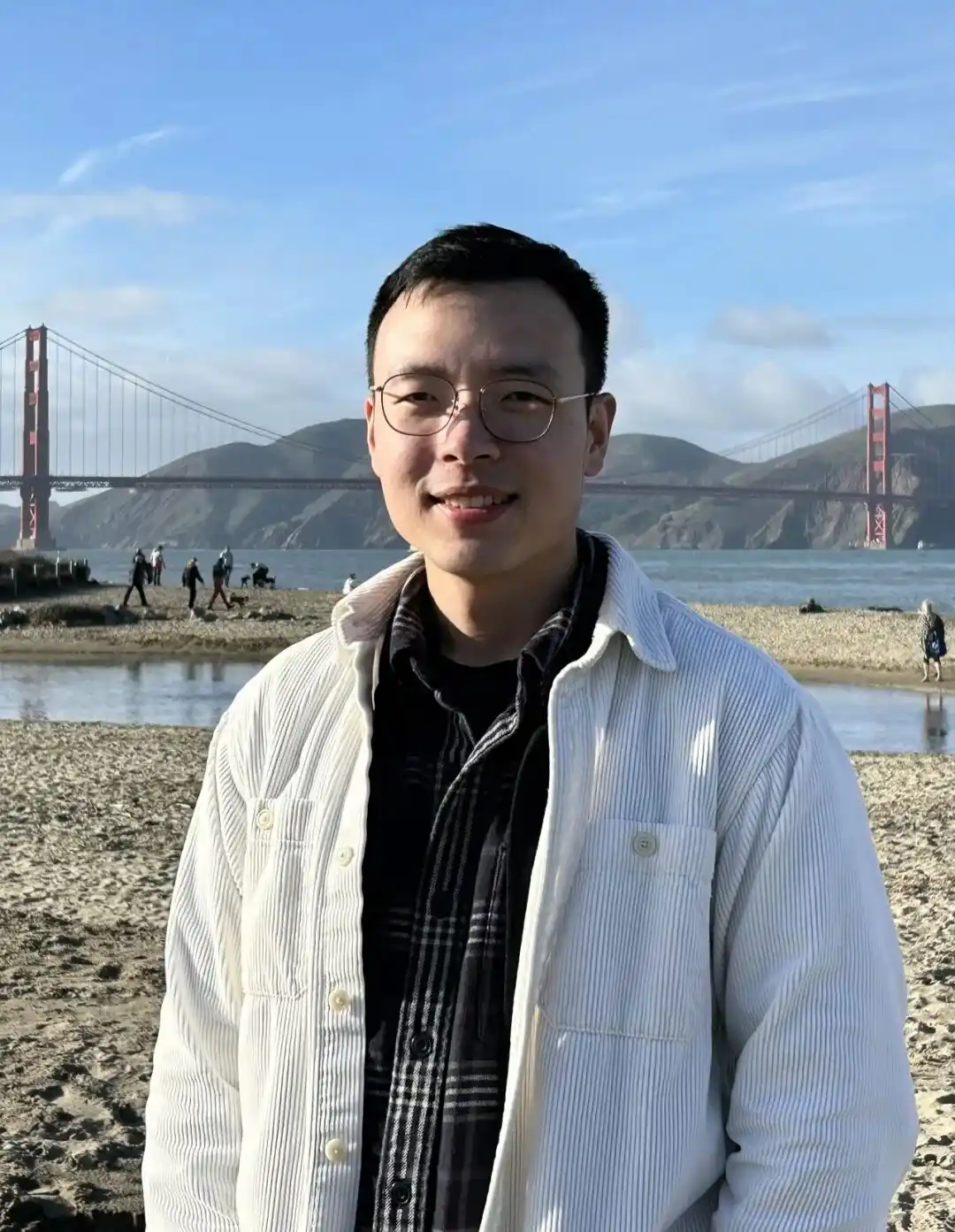
First author Weijie Xu is currently a PhD student in Language Science at UC Irvine, advised by computational psycholinguist Richard Futrell, specializing in computational psycholinguistics.

His undergraduate major was Spanish Language and Literature at Shanghai International Studies University. He then earned a Master's in Computational Social Science from the University of Chicago, advised by Ming Xiang.

In Fall 2026, he will begin postdoctoral research at the University of Massachusetts Amherst.

He writes on his homepage that human cognitive systems are heavily constrained, yet operate almost effortlessly; his research aims to use human language as a window to peer into the "limited" nature of the human mind.
Best Paper III: Why "Local-Only" Attention is Actually Stronger

Paper: Characterizing the Expressivity of Local Attention in Transformers

Authors: Jiaoda Li, Ryan Cotterell

Institutions: ETH Zurich
Paper Link:https://aclanthology.org/2026.acl-long.1739/

Transformer's signature skill is "global attention"—each generated word looks back at all previous words. A common variant, "local attention," only lets each word look back at neighbors within a fixed window, reducing quadratic computational cost to linear.

Local attention was originally for saving compute, but people found it often improves model performance. This phenomenon lacked a proper explanation.

This paper uses formal language theory to provide an answer.
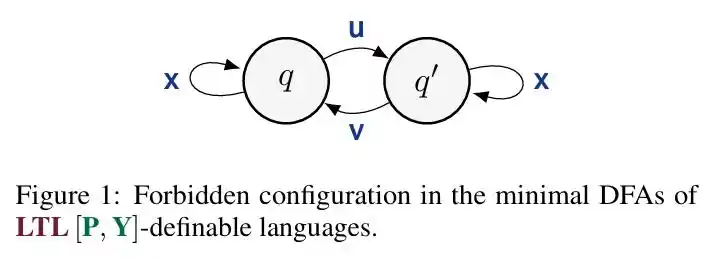
Previous conclusions stated that Transformers with fixed precision and only global attention correspond to the fragment of linear temporal logic containing only one "past operator."

The authors further prove that adding local attention introduces a second temporal operator, strictly expanding the class of regular languages the model can recognize.

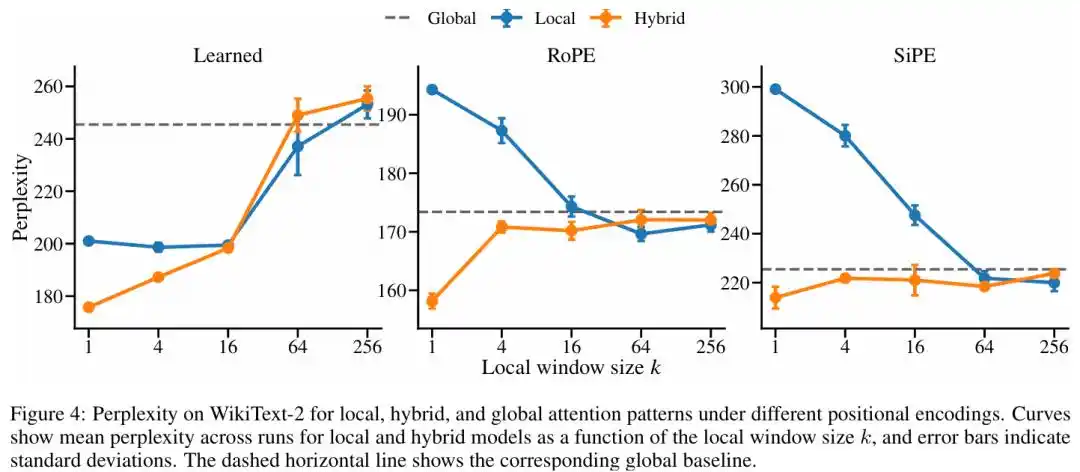
Even better, global and local attention "complement" each other in expressive power; neither can replace the other. Combining both yields the richest class.

Experiments on formal language recognition and natural language modeling confirm this: hybrid Transformers with global+local attention steadily outperform pure global versions.
First author Jiaoda Li is a doctoral researcher at the AI Center of ETH Zurich, advised by computational linguists Ryan Cotterell and Stefan Feuerriegel, focusing on interpretable NLP.

His undergraduate major was Electronic and Communication Engineering at City University of Hong Kong; he then obtained a Master's in Data Science from ETH and continued to his PhD.

Outstanding Papers: Chinese Scholars Nearly Sweep

Besides Best Papers, ACL 2026 also selected 18 Outstanding Papers.

A glance at the list reveals a more direct fact: Chinese scholars occupy nearly half the field, especially in the hottest directions of reinforcement learning and LLM safety, where several papers are entirely by Chinese teams.

Reasoning & Reinforcement Learning

1. Evolutionary Guided Decoding: Iterative Value Refinement for LLMs

Authors: Zhenhua Liu, Lijun Li, Ruizhe Chen, Yuxian Jiang, Tong Zhu, Zhaochen Su, Wenliang Chen, Jing Shao

Institutions: Shanghai AI Laboratory, Soochow University, Zhejiang University, Fudan University

2. Rethinking Entropy Interventions in RLVR: An Entropy Change Perspective

Authors: Zhezheng Hao, Hong Wang, Haoyang Liu, Jian Luo, Jiarui Yu, Hande Dong, Qiang Lin, Can Wang, Jiawei Chen

Institutions: Zhejiang University, Tencent

3. GeoRA: Geometry-Aware Low-Rank Adaptation for RLVR

Authors: Jiaying Zhang, Lei Shi, Jiguo Li, Jun Xu, Jiuchong Gao, Jinghua Hao, Renqing He

Institutions: Meituan, Peking University

4. CURE: Critique-Driven Unified Reinforcement Learning for Test-Time Self-Improvement

Authors: Guirong Chen, Shuqi Ye, Wenkai Yang, Shiqi Shen, Guangyao Shen, Yankai Lin

Agents & Evaluation

5. CAR-bench: Evaluating the Consistency and Limit-Awareness of LLM Agents under Real-World Uncertainty

Authors: Johannes Kirmayr, Lukas Stappen, Elisabeth André

Institutions: BMW Group Research, University of Augsburg

6. MediEval: A Unified Medical Benchmark for Patient-Contextual and Knowledge-Grounded Reasoning in LLMs

Authors: Zhan Qu, Michael Färber

Institutions: Technische Universität Dresden, ScaDS.AI (Germany)

7. Mind the (DH) Gap! A Contrast in Risky Choices Between Reasoning and Conversational LLMs

Authors: Luise Ge, Yongyan Zhang, Yevgeniy Vorobeychik

Institutions: Washington University in St. Louis

8. CIG: Measuring Conversational Information Gain in Deliberative Dialogues with Semantic Memory Dynamics

Authors: Ming-Bin Chen, Jey Han Lau, Lea Frermann

Institutions: University of Melbourne

Safety, Trustworthiness & Detection

9. Lying with Truths: Open-Channel Multi-Agent Collusion for Belief Manipulation via Generative Montage

Authors: Jinwei Hu, Xinmiao Huang, Youcheng Sun, Yi Dong, Xiaowei Huang

Institutions: University of Liverpool, Mohamed bin Zayed University of Artificial Intelligence (MBZUAI)

10. Beyond the Final Actor: Modeling the Dual Roles of Creator and Editor for Fine-Grained LLM-Generated Text Detection

Authors: Yang Li, Qiang Sheng, Zhengjia Wang, Yehan Yang, Danding Wang, Juan Cao

Institutions: Institute of Computing Technology, Chinese Academy of Sciences, University of Chinese Academy of Sciences

11. Maximizing Local Entropy Where It Matters: Prefix-Aware Localized LLM Unlearning

Authors: Naixin Zhai, Pengyang Shao, Binbin Zheng, Yonghui Yang, Fei Shen, Long Bai, Xun Yang

Institutions: University of Science and Technology of China, National University of Singapore

Efficiency

12. From Local to Global: Revisiting Structured Pruning Paradigms for Large Language Models

Authors: Ziyan Wang, Enmao Diao, Qi Le, Pu Wang, Minwoo Lee, Shu-ping Yeh, Evgeny V Stupachenko, Hao Feng, Li Yang

Institutions: University of North Carolina at Charlotte, University of Minnesota, Intel, DreamSoul

Speech & Multimodal

13. MauBERT: Universal Phonetic Inductive Biases for Few-Shot Acoustic Units Discovery

Authors: Angelo Ortiz Tandazo, Manel Khentout, Youssef Benchekroun, Thomas Hueber, Emmanuel Dupoux

Institutions: École Normale Supérieure (ENS/PSL), CNRS, Université Grenoble Alpes (GIPSA-lab), Meta AI (France)

14. Hierarchical Acoustic-Semantic Modeling: Modality Separation and Semantic Coherence for Full-Duplex SLMs

Authors: Zhenyu Liu, Xuanyu Zhang, Yunxin Li, Qixun Teng, Shenyuan Jiang, Haolan Chen, Minjun Zhao, Fanbo Meng, Yu Xu, Yancheng He, Baotian Hu, Haizhou Li, Min Zhang

Institutions: Harbin Institute of Technology (Shenzhen), The Chinese University of Hong Kong (Shenzhen), Shenzhen Loop Area Institute

15. ViLL-E: Video LLM Embeddings for Retrieval

Authors: Rohit Gupta, Jayakrishnan Unnikrishnan, Fan Fei, Sheng Liu, Son Tran, Mubarak Shah

Institutions: Amazon, University of Central Florida

Linguistics & Multilingual

16. Systematicity between Forms and Meanings across Languages Supports Efficient Communication

Authors: Doreen Osmelak, Yang Xu, Michael Hahn, Kate McCurdy

Institutions: Saarland University, University of Toronto

17. Massively Multilingual Joint Segmentation and Glossing

Authors: Michael Ginn, Lindia Tjuatja, Enora Rice, Ali Marashian, Maria Valentini, Jasmine Xu, Graham Neubig, Alexis Palmer

Institutions: University of Colorado Boulder, Carnegie Mellon University

18. CxMP: A Linguistic Minimal-Pair Benchmark for Evaluating Constructional Understanding in Language Models

Authors: Miyu Oba, Saku Sugawara

Institutions: Nara Institute of Science and Technology, National Institute of Informatics, University of Tokyo

References:

https://x.com/BoleiMaBolei/status/2074897470572925124?s=20

https://x.com/weijiexu_97/status/2074923463094218973

https://msukhareva.substack.com/p/outstanding-paper-awards-of-acl-2026

This article is from the WeChat public account "AI Era," author: ASI Revelation; editor: Moses

Kripto yang Sedang Tren

Pertanyaan Terkait

QAccording to the article, what was a major trend in the topics of papers submitted to ACL 2026?

AThe dominant trend was papers focusing on Large Language Models (LLMs). The keywords 'LLM/LLMs' appeared in 23% of all paper titles, followed by 'Reasoning' at 18% and 'Multi' at 11%. Many new tracks were also established around LLMs, such as AI/LLM agents, large model security and alignment, and mathematical/symbolic reasoning.

QWhat is the 'teleological bias' identified in the first Best Paper, and how did the study demonstrate it?

AThe 'teleological bias' is the tendency of large language models to assume that actions with a stated goal have been completed, even when the context suggests otherwise. The study demonstrated this by using a diagnostic dataset called ImperfectiveNLI. It presented models with sentences like 'The carpenter was building a pavilion' and found that models like Llama-3.1, Mistral, and DeepSeek overwhelmingly inferred 'The carpenter built a pavilion,' showing a strong bias towards assuming successful completion. Even when given contradictory context (e.g., a storm destroyed it), many models still insisted the action was completed.

QWhat key insight about human language processing did the second Best Paper achieve by constraining a model's working memory?

AThe key insight was that imposing a 'resource-rational' constraint on a model's working memory—forcing it to allocate limited encoding precision efficiently—made its behavior more human-like. Specifically, the model's predictions of reading times better matched actual human reading times. Furthermore, the constraint caused the model to develop more compressed and categorical internal representations, suggesting that in human sentence processing, the mechanisms for memory retrieval and the underlying memory representations can be dissociated. Efficiency constraints are crucial for modeling human cognition.

QWhat theoretical explanation did the third Best Paper provide for the empirical observation that local attention in Transformers often works better than global attention?

AUsing formal language theory, the paper proved that adding local attention to a Transformer strictly increases the class of regular languages it can recognize compared to a model with only global attention. It introduces an additional temporal operator. Global and local attentions were found to be complementary in expressive power; neither can fully replace the other. Their combination yields the richest expressive class, which explains why hybrid models often outperform pure global-attention models in both formal language recognition and natural language modeling tasks.

QWhat statistical fact from the article highlights the collaborative nature of modern NLP research at ACL 2026?

AA key statistic highlighting collaboration is the average number of authors per paper, which was 6.25. Furthermore, 67% of all authors (13,563 people) were connected through co-authorship networks. In stark contrast, single-author papers were extremely rare, with only 39 such papers (less than 1% of the total). This shows that research in the field is predominantly conducted through large, interconnected teams.

Bacaan Terkait

Setelah Tiga Kuartal Berturut-Turut Turun, Bisakah Pasar Kripto Menyambut Jendela Stabilitas di Kuartal Ketiga?

Pasar kripto mengalami kuartal terburuk sejak 2022, dengan kapitalisasi pasar turun 12.6% menjadi $2.1 triliun, didorong oleh keluarnya modal dan penurunan volume perdagangan. Bitcoin dan Ethereum masing-masing jatuh 14.2% dan 25.4% di kuartal kedua. Aliran keluar bersih dari ETF Bitcoin AS mencapai $4.67 miliar, menandakan tekanan jual yang berkelanjutan. Faktor utama meliputi terputusnya hubungan dengan saham AS, kebijakan moneter Federal Reserve yang ketat, dan pelepasan aset oleh perusahaan seperti Strategy. Proses legislasi UU CLARITY yang akan memberikan kejelasan regulasi terhambat, meningkatkan premi risiko di sektor ini. Namun, ada tanda-tanda potensi stabilisasi. Aliran keluar ETF yang besar secara historis sering terjadi di akhir fase penurunan, dan para pemegang Bitcoin jangka panjang mulai menambah kepemilikan lagi. Sementara sebagian besar sektor menyusut, pasar prediksi dan aset koleksi yang ditokenisasi mencatat pertumbuhan signifikan. Pandangan untuk kuartal ketiga sangat bergantung pada pertemuan Fed akhir Juli. Sinyal kebijakan yang lunak dapat mendukung pemulihan Bitcoin, sementara sikap yang hawkish dapat memicu konsolidasi lebih lanjut. Meskipun tantangan regulasi tetap ada, indikator teknis seperti harga Bitcoin yang mendekati rata-rata bergerak 200-mingguannya menunjukkan dasar jangka panjang belum rusak. Logika pasar telah bergeser dari mengandalkan narasi ke faktor fundamental seperti kebijakan dan ekspektasi suku bunga.

marsbitKemarin 08:40

Setelah Tiga Kuartal Berturut-Turut Turun, Bisakah Pasar Kripto Menyambut Jendela Stabilitas di Kuartal Ketiga?

marsbitKemarin 08:40

The SpaceX Trade, Terbuka: SPCXON Mulai Diperdagangkan di WEEX

SpaceX meluncurkan IPO terbesar dalam sejarah pada Juni 2026, namun akses bagi banyak pedagang terhambat oleh batasan regional dan prosedur broker. WEEX kini menghadirkan SPCXON/USDT di pasar spotnya, sebuah instrumen tokenisasi yang memungkinkan paparan terhadap pergerakan harga SpaceX melalui akun kripto yang diselesaikan dengan USDT, tanpa memerlukan broker AS atau pembiayaan bank. SPCXON adalah produk tokenisasi yang mencerminkan ekonomi kepemilikan SpaceX bagi pedagang yang memenuhi syarat di luar AS, dengan dividen diinvestasikan kembali. Aset ini diperdagangkan di WEEX sebagai pasangan spot dengan USDT, tersedia selama jam pasar, memberikan akses mudah bagi trader kripto. Kasus investasi untuk SpaceX didasarkan pada pertumbuhan pendapatan Starlink dan pencapaian Starship, meskipun valuasinya yang tinggi (sekitar 90-110 kali pendapatan) telah memperhitungkan eksekusi sempurna selama bertahun-tahun. Faktor seperti jumlah saham publik yang terbatas dan masa buka kunci (unlock) insider pertama menjadi pertimbangan penting. Penting untuk diingat bahwa SPCXON memberikan paparan, bukan kepemilikan langsung atas saham atau hak suara. Harganya dapat diperdagangkan pada premium atau diskon terhadap nilai aset bersih. WEEX menawarkan akses ke berbagai aset TradFi yang ditokenisasi seperti ini dalam satu akun terpadu, bersama dengan pasar futures dan kampanye perdagangan dengan pool hadiah.

TheNewsCryptoKemarin 08:33

The SpaceX Trade, Terbuka: SPCXON Mulai Diperdagangkan di WEEX

TheNewsCryptoKemarin 08:33

Momen Perdagangan BIT: BTC Masih Tertekan oleh EMA 200 Mingguan, Setelah Ditolak Mungkin Kembali Turun, Saham Penyimpanan dan Semikonduktor yang Melonjak Malam Kemudian Mulai Anjlok di Pasar Malam

**PASAR KRIPTO & SAHAM: BTC Hadapi Resistensi, Saham Semikonduktor Turun di Perdagangan Malam** Pasar kripto melanjutkan pemulihan, dengan harga Bitcoin bertahan di sekitar $66,000 setelah rebound lebih dari 15% dari titik terendah Juli. Namun, BTC menghadapi **tembok resistensi kuat di dekat $68,000**, yang bertepatan dengan biaya rata-rata investor selama lima bulan terakhir dan titik gagalnya rebound pertengahan Juni. Secara teknis, perhatian tertuju pada **200 EMA mingguan (~$68,328) sebagai level kunci**. Jika BTC ditolak di level ini, potensi penurunan menuju support $63,000 terbuka. Analis menyoroti volume rendah dan penurunan open interest futures di CME, menandakan rebound ini lebih dipicu likuiditas rendah musim panas daripada awal bull run penuh. Di pasar saham AS, **indeks futures utama turang** setelah sesi kemarin yang kuat. Sektor semikonduktor dan penyimpanan (storage), yang melonjak pada hari Selasa (contoh: Micron +12%), **mengalami koreksi di perdagangan malam (night trading)**. ETF semikonduktor turun 2,22% dan saham Micron turun 2,29%. Meski begitu, ada sorotan positif seperti **Super Micro Computer (SMCI)** yang naik lebih dari 15% setelah melaporkan pandangan pendapatan yang kuat dan pesanan baru yang sangat besar, mengonfirmasi permintaan server AI tetap solid. Kekhawatiran makro muncul dari **kenaikan harga minyak mentah (di atas $91)** akibat ketegangan geopolitik dan **lonjakan imbal hasil (yield) obligasi pemerintah AS**, dengan imbal hasil 10-tahun mencapai sekitar 4,64%. Faktor-faktor ini dapat menambah tekanan inflasi dan membatasi ruang gerak pasar saham. Saham terkait kripto seperti Coinbase dan Robinhood naik kuat didorong oleh perkembangan regulasi yang lebih jelas di AS. Di Asia, **Korea Selatan** dan **Jepang** menunjukkan kinerja beragam. Indeks KOSPI Korea naik didukung pemulihan saham semikonduktor, sementara pasar Jepang melemah dengan **Yen terus melemah ke level terendah sejak 1986**, meningkatkan kekhawatiran akan intervensi bank sentral. **Yang Perlu Diperhatikan Selanjutnya:** * **22 Juli:** Acara AI AMD, rilis laporan keuangan dari Google (Alphabet), Tesla, IBM. * **23 Juli:** Keputusan suku bunga Bank Sentral Eropa (ECB), data klaim pengangguran AS, laporan keuangan Intel. * Perkembangan lebih lanjut dari **harga minyak, imbal hasil obligasi, dan dinamika Yen Jepang** akan menjadi penentu sentimen pasar risiko secara keseluruhan.

marsbitKemarin 08:32

Momen Perdagangan BIT: BTC Masih Tertekan oleh EMA 200 Mingguan, Setelah Ditolak Mungkin Kembali Turun, Saham Penyimpanan dan Semikonduktor yang Melonjak Malam Kemudian Mulai Anjlok di Pasar Malam

marsbitKemarin 08:32

Mantan Ketua CFTC dan Presiden Circle, Tarbert: Satu Pihak Menasihati Anda untuk Berpikir Jangka Panjang, di Sisi Lain Menguangkan $30 Juta Sendiri

Penulis: Zen, PANews Heath Tarbert, mantan Ketua CFTC dan Presiden Circle, baru-baru ini menyerukan kepada investor untuk mengadopsi pandangan jangka panjang terhadap saham Circle, meskipun harganya telah turun 70% dari puncaknya. Namun, ia sendiri secara konsisten menjual saham CRCL sejak perusahaan go public, menguangkan sekitar $30 juta tanpa pernah membeli saham tambahan di pasar terbuka. Tarbert, yang bergabung dengan Circle pada Juli 2023 dan menjadi Presiden pada awal 2025, dikenal sebagai pendukung kuat narasi "jangka panjang" perusahaan. Namun, sehari sebelum IPO Circle, ia menetapkan rencana perdagangan 10b5-1 untuk menjual hingga 353.290 saham dalam setahun. Dalam 13 bulan setelah IPO, ia menjual lebih dari 360.000 saham, termasuk penjualan tunggal senilai $11,5 juta pada Maret 2026. Ia bahkan menetapkan rencana 10b5-1 kedua untuk menjual hingga 160.000 saham lagi pada akhir tahun 2026. Langkah Tarbert ini menuai kecaman karena dianggap tidak konsisten dengan pesan "jangka panjang" yang ia sampaikan kepada publik. Perjalanan kariernya sering dikaitkan dengan "revolving door" antara regulator dan dunia keuangan. Setelah mengundurkan diri sebagai Ketua CFTC pada Maret 2021, ia bergabung dengan Citadel Securities hanya 27 hari kemudian sebagai Kepala Penasihat Hukum, tepat saat perusahaan itu menghadapi pengawasan ketat terkait peristiwa GameStop. Di Citadel, ia juga mendukung undang-undang yang memperluas wewenang CFTC atas pasar crypto, sementara Citadel diketahui berencana berekspansi ke aset kripto. Tarbert kemudian pindah ke Circle pada 2023, membantu perusahaan mengatasi tantangan regulasi dan akhirnya go public melalui IPO langsung. Meskipun sangat berharga bagi perusahaan, tindakannya menjual saham dalam jumlah besar sambil mendorong investor untuk bertahan menimbulkan pertanyaan tentang komitmennya yang sebenarnya terhadap masa depan jangka panjang Circle.

marsbitKemarin 08:09

Mantan Ketua CFTC dan Presiden Circle, Tarbert: Satu Pihak Menasihati Anda untuk Berpikir Jangka Panjang, di Sisi Lain Menguangkan $30 Juta Sendiri

marsbitKemarin 08:09

Gate Research Institute: Produk Keuangan Kripto Menggulirkan Gelombang "Wall Street-ization", Kompetisi atau Integrasi?

**Ringkasan: Gelombang "Wall Street-ization" Produk Keuangan Kripto: Kompetisi atau Integrasi?** Artikel ini membahas fenomena konvergensi antara keuangan tradisional (TradFi) dan keuangan kripto (Crypto). Meskipun Bitcoin awalnya dirancang sebagai sistem peer-to-peer yang terdesentralisasi dan bebas dari perantara seperti bank, pasar kripto kini semakin diintegrasikan ke dalam infrastruktur keuangan tradisional. **Tren "Wall Street-ization":** Dimulai dengan disetujuinya ETF spot Bitcoin pada 2024, aset kripto kini dikemas menjadi produk seperti ETF (oleh BlackRock, Fidelity, dll.), futures, dan sekuritisasi aset riil (RWA) seperti obligasi pemerintah yang ditokenisasi. Ini memberikan akses yang mudah dan teregulasi bagi investor institusional, tetapi juga berarti kekuasaan atas penerbitan, penentuan harga, kustodian, dan distribusi aset kripto semakin bergeser ke lembaga keuangan besar. **Dua Jalur Konvergensi (1+1>2):** Artikel ini menyoroti dua arah integrasi: 1. **Dari CEX ke TradFi:** Dilambangkan oleh **Gate.io**, yang berkembang dari bursa kripto menjadi platform multi-aset. Gate kini menawarkan perdagangan saham nyata (AS, Hong Kong, Korea) menggunakan USDT, menyediakan akses tanpa batas waktu ke pasar tradisional. 2. **Dari TradFi ke Crypto:** Dilambangkan oleh **Robinhood**, platform broker tradisional yang memperluas layanannya ke aset kripto (termasuk melalui akuisisi Bitstamp) dan mengembangkan produk seperti token saham di blockchain. **Tujuan Bersama: Akun Keuangan "Super" Terpadu:** Kedua jalur ini bertujuan menciptakan **akun keuangan generasi berikutnya yang terpadu**. Pengguna di masa depan mungkin dapat memperdagangkan Bitcoin, saham Apple, ETF, emas, dan obligasi pemerintah yang ditokenisasi dalam satu antarmuka yang sama, menggunakan stablecoin sebagai lapisan dana. **RWA dan Obligasi Pemerintah di On-Chain sebagai Lapisan Tengah:** Tokenisasi aset dunia nyata, terutama obligasi pemerintah AS, menyediakan aset berpenghasilan rendah risiko di ekosistem on-chain. Pasar ini tumbuh pesat (naik 40% pada paruh pertama 2026) meskipun pasar kripto turun, menunjukkan permintaan nyata. **Kesimpulan:** "Wall Street-ization" bukanlah pengambilalihan sepihak, melainkan **transformasi timbal balik**. TradFi dan Crypto saling melengkapi: Crypto mendapatkan akses ke likuiditas, kepatuhan, dan jaringan distribusi yang luas, sementara TradFi mengadopsi efisiensi, kecepatan, dan pasar 24/7 dari Crypto. Hasil akhirnya adalah pembentukan **pasar modal terpadu yang lebih efisien dan global**, di mana batas antara aset tradisional dan kripto semakin kabur.

marsbitKemarin 08:07

Gate Research Institute: Produk Keuangan Kripto Menggulirkan Gelombang "Wall Street-ization", Kompetisi atau Integrasi?

marsbitKemarin 08:07

Trading

Spot

Artikel Populer

Cara Membeli F

Selamat datang di HTX.com! Kami telah membuat pembelian Synfutures (F) menjadi mudah dan nyaman. Ikuti panduan langkah demi langkah kami untuk memulai perjalanan kripto Anda.Langkah 1: Buat Akun HTX AndaGunakan alamat email atau nomor ponsel Anda untuk mendaftar akun gratis di HTX. Rasakan perjalanan pendaftaran yang mudah dan buka semua fitur.Dapatkan Akun SayaLangkah 2: Buka Beli Kripto, lalu Pilih Metode Pembayaran AndaKartu Kredit/Debit: Gunakan Visa atau Mastercard Anda untuk membeli Synfutures (F) secara instan.Saldo: Gunakan dana dari saldo akun HTX Anda untuk melakukan trading dengan lancar.Pihak Ketiga: Kami telah menambahkan metode pembayaran populer seperti Google Pay dan Apple Pay untuk meningkatkan kenyamanan.P2P: Lakukan trading langsung dengan pengguna lain di HTX.Over-the-Counter (OTC): Kami menawarkan layanan yang dibuat khusus dan kurs yang kompetitif bagi para trader.Langkah 3: Simpan Synfutures (F) AndaSetelah melakukan pembelian, simpan Synfutures (F) di akun HTX Anda. Selain itu, Anda dapat mengirimkannya ke tempat lain melalui transfer blockchain atau menggunakannya untuk memperdagangkan mata uang kripto lainnya.Langkah 4: Lakukan trading Synfutures (F)Lakukan trading Synfutures (F) dengan mudah di pasar spot HTX. Cukup akses akun Anda, pilih pasangan perdagangan, jalankan trading, lalu pantau secara real-time. Kami menawarkan pengalaman yang ramah pengguna baik untuk pemula maupun trader berpengalaman.

419 Total TayanganDipublikasikan pada 2024.12.21Diperbarui pada 2026.06.02

Cara Membeli F

Diskusi

Selamat datang di Komunitas HTX. Di sini, Anda bisa terus mendapatkan informasi terbaru tentang perkembangan platform terkini dan mendapatkan akses ke wawasan pasar profesional. Pendapat pengguna mengenai harga F (F) disajikan di bawah ini.

活动图片