Token FOLD Auction Imminent, What is The Interfold, Supported by Vitalik?

Foresight NewsDipublikasikan tanggal 2026-07-08Terakhir diperbarui pada 2026-07-08

Abstrak

**Title:** FOLD Token Auction Approaches: What is The Interfold, Supported by Vitalik? **Summary:** The Interfold, a "confidential coordination infrastructure" previously known as Enclave, is launching its functional token FOLD via a Uniswap Continuous Clearing Auction (CCA) starting July 8th. Endorsed by Ethereum co-founder Vitalik Buterin in May, the protocol tackles the core problem of governance bribery in decentralized voting (e.g., on platforms like Votium) by enabling multiple parties to compute a verifiable result without exposing their private input data. Its core technology, the Encrypted Execution Environment (E3), uses a distributed network of "Ciphernodes" that perform computations on fully encrypted data using Fully Homomorphic Encryption (FHE), with process integrity verified by Zero-Knowledge (ZK) proofs and decryption keys managed via Decentralized Threshold Cryptography (DTC) to eliminate a single point of trust. The primary application is CRISP (Coercion-Resistant Impartial Selection Protocol) for DAO governance, which ensures encrypted voting, "receipt-free" votes to prevent bribery, and verifiable tallying. The Interfold, developed by the Gnosis Guild team (creators of the Zodiac DAO tooling), positions itself as a focused solution to make on-chain voting truly un-buyable, realizing the vision of Vitalik's earlier MACI (Minimal Anti-Collusion Infrastructure) framework without its reliance on a single trusted coordinator. FOLD tokens will be used for C...


Author:angelilu,Foresight News

Originally Published on June 2nd


Vitalik wrote an article in May this year supporting The Interfold, a confidential coordination infrastructure. Its token FOLD will officially start auctioning today (July 8th) at 22:00 via the Uniswap CCA (Continuous Commitment Auction) mechanism, lasting for 48 hours until July 10th.


FOLD is the functional token of The Interfold: Ciphernodes can use it to stake and join the network and receive rewards, applications can use it to pay for encrypted computation requests, and holders can participate in protocol governance.


This auction adopts a uniform clearing price mechanism, where all successful bidders transact at the same price. Portions of bids exceeding the clearing price can be withdrawn for rebidding. Participation in the auction requires KYC verification via Predicate, and the pre-registration window closed yesterday. After the auction, there is a 40-day cooling period, during which FOLD can only be used for Ciphernode staking and cannot be freely transferred. The official TGE is expected on August 19th.


Below is the original article:


On-chain voting is one of the most attractive aspects of decentralized protocols—transparent, open, and accessible to anyone. But openness does not guarantee it fully represents community consensus. The existence of 'governance bribery markets' like Votium allows anyone with sufficient funds to directly bid to voters before the voting deadline. The result is: the direction of a protocol is often not decided by community consensus, but by the highest bidder.


A protocol called The Interfold has chosen to tackle this problem at its root.


Confidential Coordination Infrastructure


The Interfold (formerly known as Enclave) positions itself as a 'confidential coordination infrastructure,' aiming to allow multiple independent participants to jointly produce a verifiable result without exposing their respective input data.
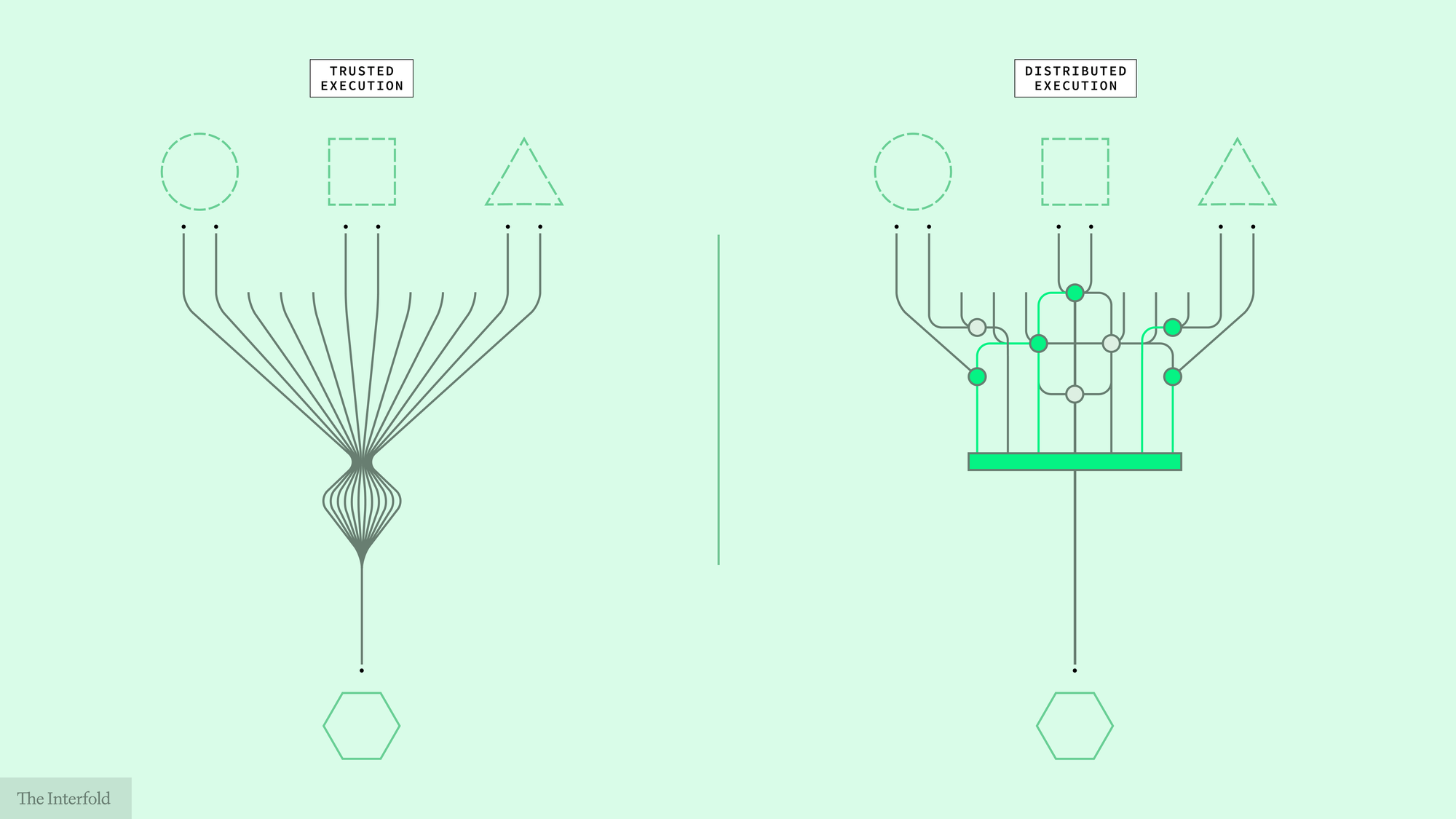


The core concept of The Interfold is E3 (Encrypted Execution Environment). Its principle is: computation tasks are assigned to a distributed network of 'Ciphernodes': user input always remains encrypted, computations are performed directly on ciphertext, and finally, only the aggregated result is decrypted and made public. No party can see anyone else's original data throughout the entire process.
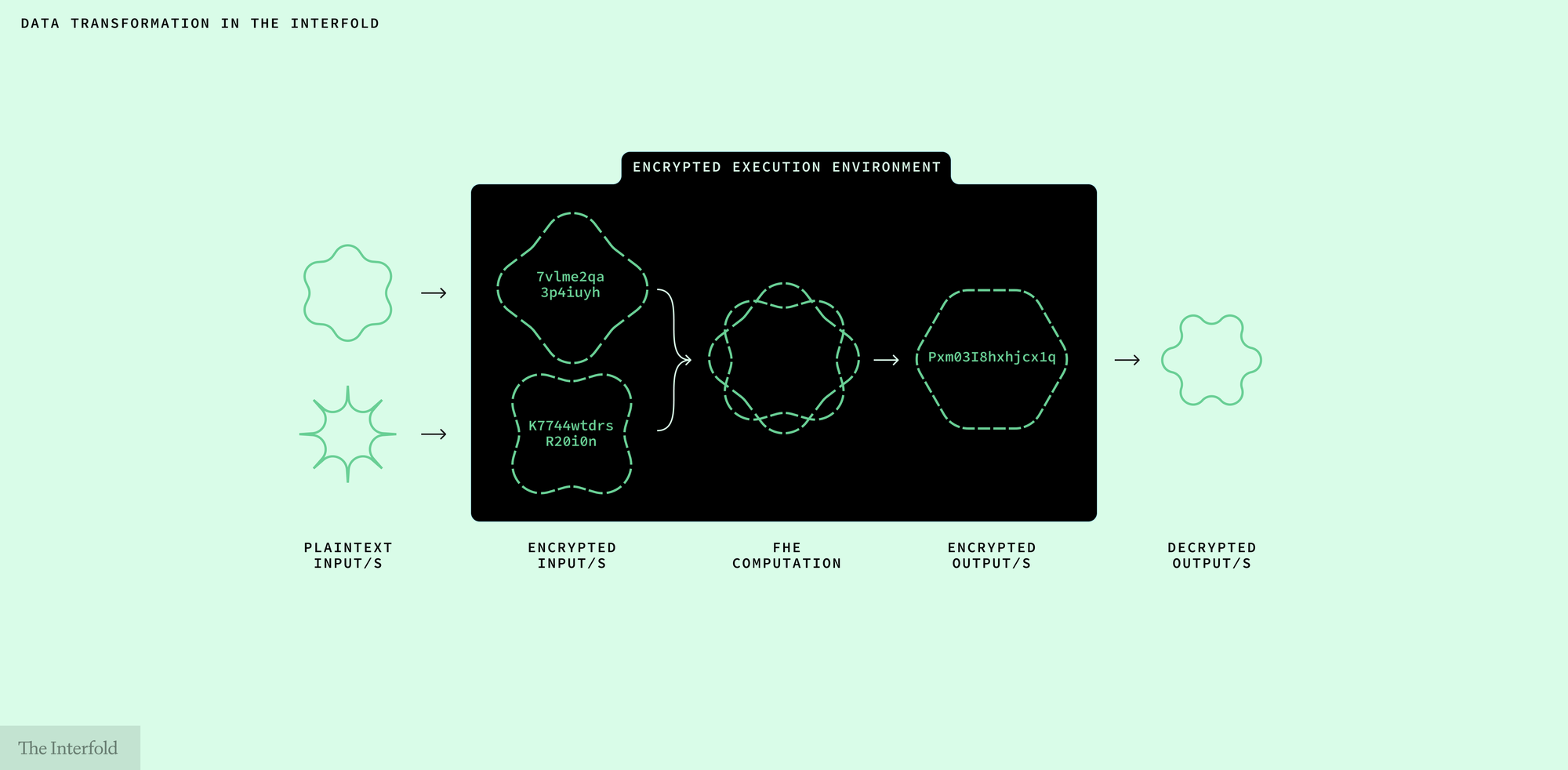


The technology stack supporting this mechanism consists of three layers: FHE (Fully Homomorphic Encryption) allows computations directly on encrypted data; ZK proofs (Zero-Knowledge proofs) verify whether the computation process itself was executed honestly; and DTC (Decentralized Threshold Cryptography) distributes decryption authority across multiple nodes, eliminating single points of trust.


The Interfold's currently promoted application scenario is CRISP (Coercion-Resistant Impartial Selection Protocol), designed for voting scenarios within DAO governance. CRISP achieves three things: the entire voting process is encrypted, and no one can view individual votes before the tally; 'receipt-free voting,' where users cannot prove to a third party how they voted, fundamentally cutting off bribery paths; and ZK proofs ensure the verifiability of tally results.


Two demo versions of CRISP are already live, with the team currently in the system integration and internal testnet validation phase. Confirmed ecosystem partnerships include: Zcash community's private governance tool Zecret Ballots, mobile DAO governance application Goverland, and joint integrations with Aragon and Status App.


Vitalik's Public Endorsement


On-chain governance bribery is not a new problem, but its measurable scale has rapidly expanded since 2024. Within the Curve ecosystem alone, the total value of bribes flowing through platforms like Votium exceeded $120 million in 2024; meanwhile, the median voter participation rate for various DAO proposals remains in the single digits.


The Ethereum community has not been unaware of this issue. In 2019, Vitalik posted a research note on ethresear.ch, proposing the conceptual framework of MACI (Minimal Anti-Collusion Infrastructure), envisioning the use of cryptographic means to eliminate voting bribery. This post has since been frequently cited, but practical implementation progress has been limited—the MACI scheme relies on a trusted 'Coordinator' role, who can see all votes. Once data is leaked, privacy guarantees immediately fail.


On May 28th, 2026, Vitalik publicly endorsed The Interfold on the X platform, stating: 'It basically is the thing I've been yelling for almost a decade for someone to build, and it's now built in a generalized way.'


The Interfold's core bet is: a single trusted coordinator is the fundamental bottleneck of MACI, and distributed threshold decryption is the correct path.


Team Background


The Interfold is developed by Gnosis Guild, a team with long-term expertise in Ethereum DAO infrastructure, previously well-known for its modular DAO toolset Zodiac. Zodiac is one of the most widely used permission and execution frameworks in the Ethereum DAO ecosystem, with partners covering several leading protocols. Specific core member names have not been publicly disclosed through official channels. The project also has no publicly disclosed institutional funding records.


Compared to larger-scale general-purpose privacy protocols like Aztec and Zama, The Interfold is a 'small but beautiful' project. It does not attempt to become a general-purpose privacy infrastructure; instead, it focuses on a specific, long-unresolved problem—making on-chain votes truly un-purchasable. The ambition may not be vast, but the target is precise.


From MACI to The Interfold


The conceptual framework of MACI (Minimal Anti-Collusion Infrastructure), proposed by Vitalik in 2019, has seen deployment in scenarios like Gitcoin but always had a structural flaw: it required a trusted coordinator, and if its private key were leaked, the entire privacy guarantee would fail. The Interfold is a generalized implementation of this framework—replacing a single coordinator with a distributed network of Ciphernodes, turning 'trust in a person' into 'trust in cryptography.'


Kripto yang Sedang Tren

Pertanyaan Terkait

QWhat is the main problem in DAO governance that The Interfold aims to solve?

AThe Interfold aims to solve the problem of governance bribery in DAO voting, where individuals or entities with sufficient funds can directly 'bribe' voters to sway decisions, undermining true community consensus.

QWhat is the core technological concept of The Interfold, and what does it stand for?

AThe core technological concept of The Interfold is the E3, or Encrypted Execution Environment. It enables a distributed network of 'Ciphernodes' to perform computations directly on encrypted user data, with only the final aggregated result being decrypted and revealed.

QAccording to the article, what is the key difference between The Interfold's approach and the earlier MACI framework proposed by Vitalik Buterin?

AThe key difference is that the original MACI framework relied on a single trusted 'coordinator' who could see all votes, creating a privacy vulnerability. The Interfold replaces this single point of trust with a distributed network of nodes using threshold cryptography.

QWhat are the primary uses of the FOLD token within The Interfold ecosystem?

AThe FOLD token has three primary uses: 1) For Ciphernodes to stake and join the network to earn rewards. 2) For applications to pay for encrypted computation requests. 3) For holders to participate in protocol governance.

QWhat major public endorsement did The Interfold receive, and who gave it?

AVitalik Buterin publicly endorsed The Interfold on the X platform on May 28, 2026, stating, 'It's basically the thing I've been shouting for almost a decade that someone should build, and it's now implemented in a general form.'

Bacaan Terkait

human.tech Meluncurkan Clean SDK untuk Aplikasi Web3 yang Mengutamakan Privasi

human.tech meluncurkan Clean SDK, toolkit yang memungkinkan pengembang membuat aplikasi Web3 yang mengutamakan privasi dan akuntabilitas transparan. SDK ini menyediakan komponen untuk verifikasi identitas tanpa pengetahuan (zero-knowledge), pemeriksaan sanksi, dan transaksi privat tanpa harus menangani data pengguna sensitif atau membangun infrastruktur kepatuhan dari nol. Clean SDK mengatasi tantangan klasik Web3: memungkinkan privasi tanpa mengorbankan akuntabilitas. Dengan menggabungkan zero-knowledge proof dan verifikasi terprogram, aplikasi dapat membuktikan legitimasi pengguna dan dana telah lolos pemeriksaan sanksi, sambil menjaga kerahasiaan identitas pribadi. Shield, aplikasi pertama yang dibangun di atas Clean SDK, diluncurkan bersamaan. Aplikasi ini berfungsi sebagai jembatan privat ke Aztec, memungkinkan pengguna mentransfer aset sambil membuktikan bahwa transfer dilakukan oleh manusia unik dan dana telah diperiksa terhadap sumber sanksi, tanpa mengungkap identitas. SDK ini menawarkan tiga teknik verifikasi inti: Proof of Innocence (pemeriksaan sanksi), Proof of Personhood (verifikasi manusia), dan Proof of Clean Hands (verifikasi identitas pemerintah zero-knowledge). Fitur-fitur ini memungkinkan autentikasi pengguna dan transaksi tanpa membocorkan informasi pribadi. Didesain untuk pengembang di Aztec, Clean SDK memungkinkan integrasi privasi terprogram langsung ke dalam aplikasi terdesentralisasi. Peluncurannya mencerminkan permintaan yang tumbuh akan infrastruktur yang menyeimbangkan privasi dan akuntabilitas secara transparan, tanpa bergantung pada basis data identitas konvensional.

TheNewsCrypto44m yang lalu

human.tech Meluncurkan Clean SDK untuk Aplikasi Web3 yang Mengutamakan Privasi

TheNewsCrypto44m yang lalu

Melepaskan Likuiditas $100 Juta? Kebijakan Baru Pump.fun Menguji Teknik '5-Menit Pump'

Pump.fun, platform peluncuran token meme di Solana, resmi memperkenalkan mode BOOST pada 21 Juli sebagai mekanisme standar baru. Inti dari mode ini adalah mengubah 20% likuiditas yang sebelumnya terkunci secara permanen di pool likuiditas (LP) setelah migrasi token, menjadi pembeli aktif. Dana yang sebelumnya "terjebak" sebagai "likuiditas mati" itu sekarang akan digunakan untuk membeli token tersebut selama 5 menit pertama setelah migrasi ke PumpSwap, menggunakan metode TWAP (Time-Weighted Average Price). Semua token yang dibeli kemudian akan langsung dimusnahkan (burn). Mekanisme ini bertujuan menciptakan tekanan beli jangka pendek sekaligus mengurangi pasokan token yang beredar secara permanen. Pump.fun memperkirakan, kebijakan lama yang mengunci likuiditas menyebabkan pemborosan lebih dari $100 juta per tahun. BOOST berupaya memanfaatkan dana tersebut untuk meningkatkan momentum perdagangan sesaat setelah peluncuran, dengan harapan meningkatkan retensi trader dan volume perdagangan berkelanjutan bagi token-token yang diluncurkan. Namun, beberapa kekhawatiran muncul. Beberapa pihak menilai hal ini bisa mempermudah token berkualitas rendah terlihat sukses di menit-menit awal, dan justru mendorong perilaku peluncuran yang lebih spekulatif. Kekhawatiran lain adalah risiko kejatuhan harga yang lebih tajam setelah periode 5 menit berakhir, jika diikuti dengan penjualan besar-besaran.

marsbit52m yang lalu

Melepaskan Likuiditas $100 Juta? Kebijakan Baru Pump.fun Menguji Teknik '5-Menit Pump'

marsbit52m yang lalu

Menjual Ruang Blok Sudah Mati: Blockchain Publik Harus Menemukan Cara Hidup Baru

Penulis Castle Labs, dikompilasi oleh TechFlow, membahas perlunya perubahan model bisnis blockchain publik. Dalam dua tahun terakhir, 14 perusahaan crypto menghasilkan pendapatan lebih dari $200 juta, namun hanya satu yang merupakan blockchain publik: Hyperliquid. Sebagai perbandingan, Arbitrum hanya menghasilkan $430.000 dalam 30 hari terakhir, sementara Hyperliquid menghasilkan sekitar $58 juta. Hal ini menunjukkan bahwa model bisnis tradisional menjual ruang blok tidak lagi cukup. Blockchain publik perlu beralih menjadi studio produk, distributor aplikasi, jalur pembayaran, atau tumpukan SaaS vertikal untuk menghasilkan pendapatan berkelanjutan dan menghindari risiko kehabisan dana. Artikel ini juga membahas serangan terhadap Ostium, di mana lebih dari 40% TVL hilang karena input harga palsu, menekankan pentingnya kontrol keamanan yang ketat untuk protokol yang membawa pasar off-chain ke on-chain. Selain itu, diskusi tentang opsi keuangan menyoroti bahwa untuk adopsi yang lebih luas, manfaat opsi harus disajikan dalam produk yang lebih mudah dipahami seperti vault hasil, opsi biner jangka pendek, produk terstruktur, atau pasar prediksi, bukan sebagai instrumen kompleks dengan istilah teknis. Protokol baru yang menarik perhatian termasuk Flex (pasar uang suku bunga tetap dari Yearn), Base App yang kini dikelola oleh Cobie, Plether (DEX kontrak berkelanjutan untuk indeks dolar AS), dan fokus Starknet pada peningkatan privasi dan ketahanan kuantum untuk pertumbuhan kelembagaan di on-chain.

marsbit1j yang lalu

Menjual Ruang Blok Sudah Mati: Blockchain Publik Harus Menemukan Cara Hidup Baru

marsbit1j yang lalu

Trading

Spot

Artikel Populer

Cara Membeli AUCTION

Selamat datang di HTX.com! Kami telah membuat pembelian Auction (AUCTION) menjadi mudah dan nyaman. Ikuti panduan langkah demi langkah kami untuk memulai perjalanan kripto Anda.Langkah 1: Buat Akun HTX AndaGunakan alamat email atau nomor ponsel Anda untuk mendaftar akun gratis di HTX. Rasakan perjalanan pendaftaran yang mudah dan buka semua fitur.Dapatkan Akun SayaLangkah 2: Buka Beli Kripto, lalu Pilih Metode Pembayaran AndaKartu Kredit/Debit: Gunakan Visa atau Mastercard Anda untuk membeli Auction (AUCTION) secara instan.Saldo: Gunakan dana dari saldo akun HTX Anda untuk melakukan trading dengan lancar.Pihak Ketiga: Kami telah menambahkan metode pembayaran populer seperti Google Pay dan Apple Pay untuk meningkatkan kenyamanan.P2P: Lakukan trading langsung dengan pengguna lain di HTX.Over-the-Counter (OTC): Kami menawarkan layanan yang dibuat khusus dan kurs yang kompetitif bagi para trader.Langkah 3: Simpan Auction (AUCTION) AndaSetelah melakukan pembelian, simpan Auction (AUCTION) di akun HTX Anda. Selain itu, Anda dapat mengirimkannya ke tempat lain melalui transfer blockchain atau menggunakannya untuk memperdagangkan mata uang kripto lainnya.Langkah 4: Lakukan trading Auction (AUCTION)Lakukan trading Auction (AUCTION) dengan mudah di pasar spot HTX. Cukup akses akun Anda, pilih pasangan perdagangan, jalankan trading, lalu pantau secara real-time. Kami menawarkan pengalaman yang ramah pengguna baik untuk pemula maupun trader berpengalaman.

181 Total TayanganDipublikasikan pada 2024.12.12Diperbarui pada 2026.06.02

Cara Membeli AUCTION

Diskusi

Selamat datang di Komunitas HTX. Di sini, Anda bisa terus mendapatkan informasi terbaru tentang perkembangan platform terkini dan mendapatkan akses ke wawasan pasar profesional. Pendapat pengguna mengenai harga AUCTION (AUCTION) disajikan di bawah ini.

活动图片












