Securitize Drops 40% in First Week of Trading as Tokenization Industry Enters Patent Wars

Foresight NewsDipublikasikan tanggal 2026-07-08Terakhir diperbarui pada 2026-07-08

Abstrak

The article discusses the recent stock performance of Securitize (NYSE: SECZ) and a looming patent war in the tokenization industry. Securitize, a leading tokenization platform and transfer agent for BlackRock's BUIDL fund, debuted on the NYSE via a SPAC merger on July 2. After an initial rise, its stock plummeted nearly 40% within a week, closing at $8.06 on July 7. Analysts attribute the sharp decline largely to typical post-SPAC investor turnover and broader pressure on crypto-related stocks, rather than fundamental business deterioration. Concurrently, Securitize faces significant legal challenges. On June 15, infrastructure rival tZERO accused Securitize of patent infringement concerning its core DS Protocol and Vault Registrar products. Securitize preemptively filed a lawsuit on June 22 seeking a declaratory judgment of non-infringement. tZERO, holding 105 patents, has indicated it has identified at least six other market participants for potential infringement actions, signaling a broader industry-wide patent conflict. A separate lawsuit was also filed by Liquid Rarity Exchange. The article concludes that while Securitize's stock drop may be a temporary SPAC-related correction, the patent disputes initiated by tZERO represent a more profound, long-term risk for the entire tokenization sector, potentially shifting competitive dynamics from business execution to intellectual property litigation.


Written by: Sanqing, Foresight News


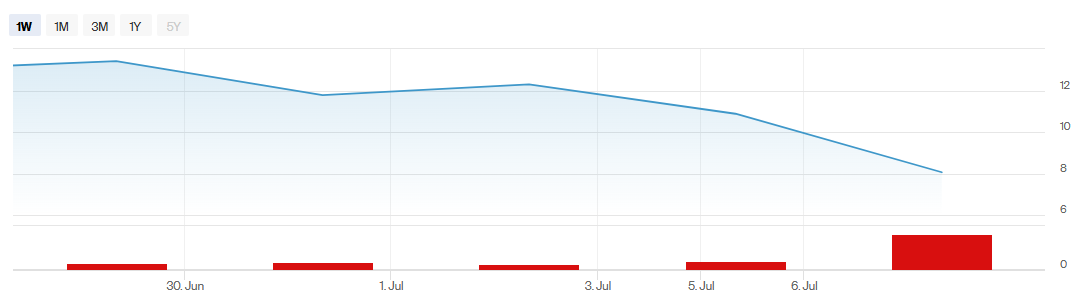
On July 2nd, Securitize (NYSE:SECZ) officially listed on the New York Stock Exchange via a SPAC merger completed with Cantor Equity Partners II. The stock rose on its first trading day, an event initially seen by the market as a landmark signaling the acceptance of the tokenization industry by traditional capital markets. However, the script took a sharp turn just a few trading days later. By the close on July 7th, SECZ was trading at $8.06, plummeting 25.92% for the day, having touched an intraday low of $8.00. This represented a pullback of approximately 40% from its peak during the first week of trading.

Source: NYSE


This is a company selected by BlackRock's tokenized money market fund BUIDL as its transfer agent, widely recognized by the capital markets as a leading platform in the tokenization space, with a pre-merger valuation of $1.25 billion. The stark contrast of its post-listing decline has led many investors to scrutinize the gap between the "tokenization narrative" and the "secondary market reality."


SPAC Mechanism Exposes Issues Before Fundamentals


In recent years, crypto-related companies that have gone public via SPAC have almost universally undergone similar valuation re-pricing during the handover period.


Twenty One Capital (XXI), also orchestrated by an entity affiliated with Cantor Fitzgerald, fell about 25% on its first day of trading on the NYSE via a SPAC merger on December 9th, 2025, closing at $11.42. It continued to decline thereafter, with its share price once falling below $6, a drop of over 80% from its peak of $49. ProCap Financial (BRR), a Bitcoin treasury company that completed its merger around the same time, debuted at $10 and is now trading around $2.4, a decline of roughly 76%.


Several market participants attribute the recent sharp decline to the SPAC structure itself rather than a deterioration in company fundamentals.


According to a CoinDesk report, Jeff Dorman of Arca stated publicly that this volatility is more a result of the SPAC mechanism than a worsening of fundamentals. Post-SPAC listing, the investor base undergoes a complete shift—from the original SPAC subscribers who prefer fixed income to long-term equity holders focused on fundamentals. This handover process inherently creates significant volatility.


Market confidence in the "tokenization" story itself has not collapsed; what has collapsed is confidence in the SPAC pricing mechanism. Despite the falling stock price, Securitize tokenized $295 million worth of its own stock on its first trading day and deployed it on Solana and Avalanche.


Securitize's decline also coincided with broader pressure on U.S.-listed crypto-related stocks. By early July, shares of Coinbase and Circle had fallen approximately 63% and 74%, respectively, from their respective all-time highs set in July 2025. Over the same period, the S&P 500 index retreated only about 2% from its June peak. When the entire sector's stocks are more volatile than their underlying assets, a newly listed tokenization platform can hardly remain unscathed.


Patent Lawsuit Reveals Industry Fissures


On June 15th, tokenization infrastructure company tZERO sent a "cease and desist and reservation of rights" letter to Securitize, alleging that its two core products, DS Protocol and Vault Registrar, infringe patents held by tZERO. The allegations specifically involve U.S. Patents No. 11,216,802 ("Smart Contract Rules for Self-Executing Security Tokens") and No. 11,394,560 ("Cryptographic Integration Platform").


tZERO demanded that Securitize cease commercialization of the relevant products by June 18th or face injunctive relief and claims for monetary damages.


Securitize took the offensive, filing a declaratory judgment action for non-infringement on June 22nd in the U.S. District Court for the District of Delaware (Case No. 1:26-cv-00722, Securitize, Inc. v. tZERO Group, Inc. et al.). It seeks a court declaration that its products do not infringe tZERO's patents, characterizing the allegations as "baseless," "lacking in substance," and "contrary to the spirit of fair competition in the industry."


The case is currently in its early stages, assigned to Judge Gregory B. Williams. There have been no substantive pleadings, counterclaims, motions to dismiss, or settlement announcements. This means the case could still take various paths, including an out-of-court settlement, partial dismissal, or even a withdrawal of the allegations by tZERO.


The weight of this lawsuit far exceeds that of an ordinary commercial dispute.


tZERO's patent assertions were not made on a whim. Founded in 2014 and stemming from the vision of a security token trading platform by Overstock.com (a longstanding U.S. online retailer whose founder, Patrick Byrne, was an early blockchain evangelist), the company initiated a strategic review of its intellectual property portfolio following a management reshuffle at the end of 2025.


According to tZERO's announcement on June 15th regarding the progress of its IP portfolio enforcement, it holds 105 patents across 23 patent families. Its business scope spans core aspects of tokenization infrastructure, including compliant security token systems, crypto asset integration, and KYC verification processes.


More critically, tZERO has explicitly stated that its patent review has identified "at least six" other market participants with potential infringements, covering areas such as compliant RWA platforms, institutional infrastructure, prime brokers, and decentralized exchanges. It plans to issue infringement warning letters to more companies after completing its analysis.


As of July 8th, the case remains in its early stages, with neither party having submitted substantive pleadings, counterclaims, or settlement documents.


However, the patent pressure facing Securitize is not limited to tZERO. Concurrently, Liquid Rarity Exchange has also filed a separate lawsuit against Securitize over two other patents, seeking damages and injunctive relief.


In other words, Securitize might be the first, but not the only one. According to data from rwa.xyz, the RWA market has accelerated its expansion from approximately $22 billion at the beginning of the year to over $33 billion, moving from the "proof-of-concept" stage to "actual deployment."


This is the backdrop against which tZERO has chosen to turn its long-dormant patent portfolio into a commercial bargaining chip. When the patent barriers within the tokenization industry begin to be actively asserted, nearly every platform claiming to "master core technologies" risks being drawn into similar disputes. This warrants more long-term attention than a single stock price pullback.


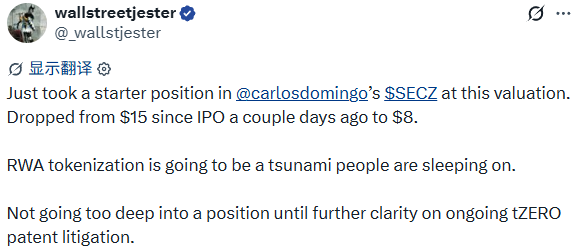
As X user wallstreetjester noted, he "just opened a position" in SECZ but clearly stated he "will not add significantly until the lawsuit has clearer progress." This represents the genuine sentiment of a segment of potential buyers.


Primary Market Believes in Institutions, Secondary Market Believes in Liquidity


Securitize's shareholder roster is impressively distinguished. It was chosen by BlackRock's BUIDL fund as its transfer agent, and during its PIPE financing round, it attracted institutional investors like Borderless Capital and Hanwha Investment. The SPAC transaction itself was initiated by an affiliate of Cantor Fitzgerald.


This narrative of "joint endorsement by traditional financial institutions" is highly persuasive during primary market fundraising and was a key support for Securitize's $1.25 billion pre-merger valuation.


However, the secondary market doesn't care about endorsements; it only cares about liquidity. The market still buys into the "tokenization" story; what has cooled off is merely the short-term pricing of Securitize's specific stock.


BlackRock's name might make primary market investors willing to pay for the valuation story, but it cannot convince the secondary market to continue holding shares when patent disputes are unresolved and SPAC handover pressure persists. Trust is a static brand asset; liquidity is the dynamic outcome of market博弈. This sharp decline precisely proves there is no necessary conversion rate between the two.


Securitize's share price will eventually stabilize or rebound as the investor base transition completes, a near-inevitable phase of growing pains for SPAC-listed companies. However, the patent war ignited by tZERO warrants vigilance from all participants in the tokenization industry.


With tZERO holding 105 patents and targeting at least six potential infringers, the next round of competition in the tokenization industry may no longer be just about compliance licenses, institutional relationships, or trading volume.


For platforms still relying on the valuation story of "we were the first to implement a certain technical solution," a cease-and-desist letter could bring that story to an abrupt halt at any moment.


Securitize's fall has wiped out short-term valuation; but tZERO's lawsuit may have unveiled a patent war that the entire tokenization industry is not yet prepared to face.


Pertanyaan Terkait

QWhat are the main reasons for Securitize's (SECZ) sharp stock price decline shortly after its NYSE listing?

AThe primary reasons for SECZ's decline are attributed to the inherent volatility of the SPAC listing mechanism and sector-wide pressure on crypto-related stocks. The SPAC structure triggered a shift in investor base from SPAC investors to long-term equity holders, causing significant price volatility during the handover. Simultaneously, the entire crypto-stock sector, including companies like Coinbase and Circle, has been underperforming the broader market, creating a negative backdrop for SECZ.

QWhat is the core nature of the legal dispute between tZERO and Securitize mentioned in the article?

AtZERO has accused Securitize of patent infringement, specifically alleging that Securitize's DS Protocol and Vault Registrar products violate two of its U.S. patents related to self-executing smart contract rules for security tokens and crypto integration platforms. Securitize responded by filing a declaratory judgment lawsuit, asking the court to confirm that its products do not infringe and characterizing tZERO's claims as baseless.

QHow does the article contrast the forces driving primary market valuation versus secondary market performance for companies like Securitize?

AThe article contrasts that in the primary market, valuation is driven by institutional trust and prestigious backers (like BlackRock, Cantor Fitzgerald), which supported Securitize's $1.25 billion pre-merger valuation. However, the secondary market prioritizes liquidity and immediate risk factors over brand endorsements. It reacts to concrete issues like pending patent lawsuits and SPAC-related selling pressure, leading to a disconnect between the initial valuation narrative and the stock's trading reality.

QWhat broader implication does the tZERO vs. Securitize patent lawsuit hold for the tokenization industry according to the article?

AThe lawsuit signals the potential start of a widespread patent war within the tokenization industry. tZERO's announcement that it has identified at least six other market participants as potential infringers suggests that patent enforcement could become a new, critical competitive dimension. This shift moves the industry beyond competition based solely on compliance, institutional relationships, and trading volume, introducing legal and intellectual property risks that could disrupt many platforms' business narratives.

QAccording to the article, what is the current status of the patent lawsuits against Securitize as of July 8th?

AAs of July 8th, the legal cases are in their early stages. The primary lawsuit filed by Securitize against tZERO (case 1:26-cv-00722) is before Judge Gregory B. Williams, with no substantive pleadings, counterclaims, motions to dismiss, or settlement news filed yet. Additionally, Securitize faces a separate, independent patent infringement lawsuit from Liquid Rarity Exchange. The outcomes remain uncertain, with possibilities ranging from out-of-court settlement to case dismissal.

Bacaan Terkait

Setelah Tiga Kuartal Berturut-Turut Turun, Bisakah Pasar Kripto Menyambut Jendela Stabilitas di Kuartal Ketiga?

Pasar kripto mengalami kuartal terburuk sejak 2022, dengan kapitalisasi pasar turun 12.6% menjadi $2.1 triliun, didorong oleh keluarnya modal dan penurunan volume perdagangan. Bitcoin dan Ethereum masing-masing jatuh 14.2% dan 25.4% di kuartal kedua. Aliran keluar bersih dari ETF Bitcoin AS mencapai $4.67 miliar, menandakan tekanan jual yang berkelanjutan. Faktor utama meliputi terputusnya hubungan dengan saham AS, kebijakan moneter Federal Reserve yang ketat, dan pelepasan aset oleh perusahaan seperti Strategy. Proses legislasi UU CLARITY yang akan memberikan kejelasan regulasi terhambat, meningkatkan premi risiko di sektor ini. Namun, ada tanda-tanda potensi stabilisasi. Aliran keluar ETF yang besar secara historis sering terjadi di akhir fase penurunan, dan para pemegang Bitcoin jangka panjang mulai menambah kepemilikan lagi. Sementara sebagian besar sektor menyusut, pasar prediksi dan aset koleksi yang ditokenisasi mencatat pertumbuhan signifikan. Pandangan untuk kuartal ketiga sangat bergantung pada pertemuan Fed akhir Juli. Sinyal kebijakan yang lunak dapat mendukung pemulihan Bitcoin, sementara sikap yang hawkish dapat memicu konsolidasi lebih lanjut. Meskipun tantangan regulasi tetap ada, indikator teknis seperti harga Bitcoin yang mendekati rata-rata bergerak 200-mingguannya menunjukkan dasar jangka panjang belum rusak. Logika pasar telah bergeser dari mengandalkan narasi ke faktor fundamental seperti kebijakan dan ekspektasi suku bunga.

marsbitKemarin 08:40

Setelah Tiga Kuartal Berturut-Turut Turun, Bisakah Pasar Kripto Menyambut Jendela Stabilitas di Kuartal Ketiga?

marsbitKemarin 08:40

The SpaceX Trade, Terbuka: SPCXON Mulai Diperdagangkan di WEEX

SpaceX meluncurkan IPO terbesar dalam sejarah pada Juni 2026, namun akses bagi banyak pedagang terhambat oleh batasan regional dan prosedur broker. WEEX kini menghadirkan SPCXON/USDT di pasar spotnya, sebuah instrumen tokenisasi yang memungkinkan paparan terhadap pergerakan harga SpaceX melalui akun kripto yang diselesaikan dengan USDT, tanpa memerlukan broker AS atau pembiayaan bank. SPCXON adalah produk tokenisasi yang mencerminkan ekonomi kepemilikan SpaceX bagi pedagang yang memenuhi syarat di luar AS, dengan dividen diinvestasikan kembali. Aset ini diperdagangkan di WEEX sebagai pasangan spot dengan USDT, tersedia selama jam pasar, memberikan akses mudah bagi trader kripto. Kasus investasi untuk SpaceX didasarkan pada pertumbuhan pendapatan Starlink dan pencapaian Starship, meskipun valuasinya yang tinggi (sekitar 90-110 kali pendapatan) telah memperhitungkan eksekusi sempurna selama bertahun-tahun. Faktor seperti jumlah saham publik yang terbatas dan masa buka kunci (unlock) insider pertama menjadi pertimbangan penting. Penting untuk diingat bahwa SPCXON memberikan paparan, bukan kepemilikan langsung atas saham atau hak suara. Harganya dapat diperdagangkan pada premium atau diskon terhadap nilai aset bersih. WEEX menawarkan akses ke berbagai aset TradFi yang ditokenisasi seperti ini dalam satu akun terpadu, bersama dengan pasar futures dan kampanye perdagangan dengan pool hadiah.

TheNewsCryptoKemarin 08:33

The SpaceX Trade, Terbuka: SPCXON Mulai Diperdagangkan di WEEX

TheNewsCryptoKemarin 08:33

Momen Perdagangan BIT: BTC Masih Tertekan oleh EMA 200 Mingguan, Setelah Ditolak Mungkin Kembali Turun, Saham Penyimpanan dan Semikonduktor yang Melonjak Malam Kemudian Mulai Anjlok di Pasar Malam

**PASAR KRIPTO & SAHAM: BTC Hadapi Resistensi, Saham Semikonduktor Turun di Perdagangan Malam** Pasar kripto melanjutkan pemulihan, dengan harga Bitcoin bertahan di sekitar $66,000 setelah rebound lebih dari 15% dari titik terendah Juli. Namun, BTC menghadapi **tembok resistensi kuat di dekat $68,000**, yang bertepatan dengan biaya rata-rata investor selama lima bulan terakhir dan titik gagalnya rebound pertengahan Juni. Secara teknis, perhatian tertuju pada **200 EMA mingguan (~$68,328) sebagai level kunci**. Jika BTC ditolak di level ini, potensi penurunan menuju support $63,000 terbuka. Analis menyoroti volume rendah dan penurunan open interest futures di CME, menandakan rebound ini lebih dipicu likuiditas rendah musim panas daripada awal bull run penuh. Di pasar saham AS, **indeks futures utama turang** setelah sesi kemarin yang kuat. Sektor semikonduktor dan penyimpanan (storage), yang melonjak pada hari Selasa (contoh: Micron +12%), **mengalami koreksi di perdagangan malam (night trading)**. ETF semikonduktor turun 2,22% dan saham Micron turun 2,29%. Meski begitu, ada sorotan positif seperti **Super Micro Computer (SMCI)** yang naik lebih dari 15% setelah melaporkan pandangan pendapatan yang kuat dan pesanan baru yang sangat besar, mengonfirmasi permintaan server AI tetap solid. Kekhawatiran makro muncul dari **kenaikan harga minyak mentah (di atas $91)** akibat ketegangan geopolitik dan **lonjakan imbal hasil (yield) obligasi pemerintah AS**, dengan imbal hasil 10-tahun mencapai sekitar 4,64%. Faktor-faktor ini dapat menambah tekanan inflasi dan membatasi ruang gerak pasar saham. Saham terkait kripto seperti Coinbase dan Robinhood naik kuat didorong oleh perkembangan regulasi yang lebih jelas di AS. Di Asia, **Korea Selatan** dan **Jepang** menunjukkan kinerja beragam. Indeks KOSPI Korea naik didukung pemulihan saham semikonduktor, sementara pasar Jepang melemah dengan **Yen terus melemah ke level terendah sejak 1986**, meningkatkan kekhawatiran akan intervensi bank sentral. **Yang Perlu Diperhatikan Selanjutnya:** * **22 Juli:** Acara AI AMD, rilis laporan keuangan dari Google (Alphabet), Tesla, IBM. * **23 Juli:** Keputusan suku bunga Bank Sentral Eropa (ECB), data klaim pengangguran AS, laporan keuangan Intel. * Perkembangan lebih lanjut dari **harga minyak, imbal hasil obligasi, dan dinamika Yen Jepang** akan menjadi penentu sentimen pasar risiko secara keseluruhan.

marsbitKemarin 08:32

Momen Perdagangan BIT: BTC Masih Tertekan oleh EMA 200 Mingguan, Setelah Ditolak Mungkin Kembali Turun, Saham Penyimpanan dan Semikonduktor yang Melonjak Malam Kemudian Mulai Anjlok di Pasar Malam

marsbitKemarin 08:32

Mantan Ketua CFTC dan Presiden Circle, Tarbert: Satu Pihak Menasihati Anda untuk Berpikir Jangka Panjang, di Sisi Lain Menguangkan $30 Juta Sendiri

Penulis: Zen, PANews Heath Tarbert, mantan Ketua CFTC dan Presiden Circle, baru-baru ini menyerukan kepada investor untuk mengadopsi pandangan jangka panjang terhadap saham Circle, meskipun harganya telah turun 70% dari puncaknya. Namun, ia sendiri secara konsisten menjual saham CRCL sejak perusahaan go public, menguangkan sekitar $30 juta tanpa pernah membeli saham tambahan di pasar terbuka. Tarbert, yang bergabung dengan Circle pada Juli 2023 dan menjadi Presiden pada awal 2025, dikenal sebagai pendukung kuat narasi "jangka panjang" perusahaan. Namun, sehari sebelum IPO Circle, ia menetapkan rencana perdagangan 10b5-1 untuk menjual hingga 353.290 saham dalam setahun. Dalam 13 bulan setelah IPO, ia menjual lebih dari 360.000 saham, termasuk penjualan tunggal senilai $11,5 juta pada Maret 2026. Ia bahkan menetapkan rencana 10b5-1 kedua untuk menjual hingga 160.000 saham lagi pada akhir tahun 2026. Langkah Tarbert ini menuai kecaman karena dianggap tidak konsisten dengan pesan "jangka panjang" yang ia sampaikan kepada publik. Perjalanan kariernya sering dikaitkan dengan "revolving door" antara regulator dan dunia keuangan. Setelah mengundurkan diri sebagai Ketua CFTC pada Maret 2021, ia bergabung dengan Citadel Securities hanya 27 hari kemudian sebagai Kepala Penasihat Hukum, tepat saat perusahaan itu menghadapi pengawasan ketat terkait peristiwa GameStop. Di Citadel, ia juga mendukung undang-undang yang memperluas wewenang CFTC atas pasar crypto, sementara Citadel diketahui berencana berekspansi ke aset kripto. Tarbert kemudian pindah ke Circle pada 2023, membantu perusahaan mengatasi tantangan regulasi dan akhirnya go public melalui IPO langsung. Meskipun sangat berharga bagi perusahaan, tindakannya menjual saham dalam jumlah besar sambil mendorong investor untuk bertahan menimbulkan pertanyaan tentang komitmennya yang sebenarnya terhadap masa depan jangka panjang Circle.

marsbitKemarin 08:09

Mantan Ketua CFTC dan Presiden Circle, Tarbert: Satu Pihak Menasihati Anda untuk Berpikir Jangka Panjang, di Sisi Lain Menguangkan $30 Juta Sendiri

marsbitKemarin 08:09

Gate Research Institute: Produk Keuangan Kripto Menggulirkan Gelombang "Wall Street-ization", Kompetisi atau Integrasi?

**Ringkasan: Gelombang "Wall Street-ization" Produk Keuangan Kripto: Kompetisi atau Integrasi?** Artikel ini membahas fenomena konvergensi antara keuangan tradisional (TradFi) dan keuangan kripto (Crypto). Meskipun Bitcoin awalnya dirancang sebagai sistem peer-to-peer yang terdesentralisasi dan bebas dari perantara seperti bank, pasar kripto kini semakin diintegrasikan ke dalam infrastruktur keuangan tradisional. **Tren "Wall Street-ization":** Dimulai dengan disetujuinya ETF spot Bitcoin pada 2024, aset kripto kini dikemas menjadi produk seperti ETF (oleh BlackRock, Fidelity, dll.), futures, dan sekuritisasi aset riil (RWA) seperti obligasi pemerintah yang ditokenisasi. Ini memberikan akses yang mudah dan teregulasi bagi investor institusional, tetapi juga berarti kekuasaan atas penerbitan, penentuan harga, kustodian, dan distribusi aset kripto semakin bergeser ke lembaga keuangan besar. **Dua Jalur Konvergensi (1+1>2):** Artikel ini menyoroti dua arah integrasi: 1. **Dari CEX ke TradFi:** Dilambangkan oleh **Gate.io**, yang berkembang dari bursa kripto menjadi platform multi-aset. Gate kini menawarkan perdagangan saham nyata (AS, Hong Kong, Korea) menggunakan USDT, menyediakan akses tanpa batas waktu ke pasar tradisional. 2. **Dari TradFi ke Crypto:** Dilambangkan oleh **Robinhood**, platform broker tradisional yang memperluas layanannya ke aset kripto (termasuk melalui akuisisi Bitstamp) dan mengembangkan produk seperti token saham di blockchain. **Tujuan Bersama: Akun Keuangan "Super" Terpadu:** Kedua jalur ini bertujuan menciptakan **akun keuangan generasi berikutnya yang terpadu**. Pengguna di masa depan mungkin dapat memperdagangkan Bitcoin, saham Apple, ETF, emas, dan obligasi pemerintah yang ditokenisasi dalam satu antarmuka yang sama, menggunakan stablecoin sebagai lapisan dana. **RWA dan Obligasi Pemerintah di On-Chain sebagai Lapisan Tengah:** Tokenisasi aset dunia nyata, terutama obligasi pemerintah AS, menyediakan aset berpenghasilan rendah risiko di ekosistem on-chain. Pasar ini tumbuh pesat (naik 40% pada paruh pertama 2026) meskipun pasar kripto turun, menunjukkan permintaan nyata. **Kesimpulan:** "Wall Street-ization" bukanlah pengambilalihan sepihak, melainkan **transformasi timbal balik**. TradFi dan Crypto saling melengkapi: Crypto mendapatkan akses ke likuiditas, kepatuhan, dan jaringan distribusi yang luas, sementara TradFi mengadopsi efisiensi, kecepatan, dan pasar 24/7 dari Crypto. Hasil akhirnya adalah pembentukan **pasar modal terpadu yang lebih efisien dan global**, di mana batas antara aset tradisional dan kripto semakin kabur.

marsbitKemarin 08:07

Gate Research Institute: Produk Keuangan Kripto Menggulirkan Gelombang "Wall Street-ization", Kompetisi atau Integrasi?

marsbitKemarin 08:07

Trading

Spot
活动图片




