Solana Ecosystem Shows Signs of Recovery: On-Chain Governance Upgrade, Tokenized Stocks and Meme Coins Heat Up

marsbitDipublikasikan tanggal 2026-07-03Terakhir diperbarui pada 2026-07-03

Abstrak

Solana Ecosystem Shows Signs of Revival: Governance Upgrades, Tokenized Stocks, and Memecoins Heat Up While the broader crypto market faces a downturn, Solana has shown relative strength with its price rising nearly 15% recently. This resilience is attributed to warming ecosystem activity, particularly in tokenized stocks and memecoins, coupled with a major upgrade to its on-chain governance. In the Real World Assets (RWA) sector, Solana now leads all public chains in both the number of unique holder wallets and the quantity of RWA assets. Its tokenized stock weekly trading volume has surged to a record $1.42 billion, capturing about 96% of the market share, largely driven by the Backpack exchange. Simultaneously, the Solana memecoin sector has reignited, fueled by the rapid ascent of the ANSEM token following endorsements from a prominent crypto influencer. This has boosted activity across platforms like Pump.fun and increased fee revenue for several Solana-based exchanges. A key development is the launch of Solana Governance Proposals (SGP), a new on-chain mechanism. It allows validators with at least 100,000 SOL delegated to submit proposals for community vote, enhancing decentralized decision-making. SGP will operate alongside the existing technical proposal process (SIMD), focusing on broader ecosystem governance. Despite these positive signals in specific areas, overall on-chain activity and transaction volumes still lag behind previous bull market peaks, indicatin...

Author: Nancy, PANews

Recently, the crypto market has been shrouded in a chill once again, with Bitcoin once falling below the $60,000 mark, and mainstream crypto assets generally weakening.

In contrast, Solana has shown a relatively independent trend, rising about 14.9% in the past week. Behind the price increase lies the driving force of local ecosystem recovery and on-chain governance upgrades.

Ecosystem Shows Recovery Signals, RWA and Meme Coins Both Heating Up

Recently, the Solana ecosystem has released signals of recovery, especially in the two major sectors of tokenized stocks and meme coins.

In the RWA field, RWA.xyz data shows that as of July 3, based on the number of holding wallets, the number of RWA holding wallets on the Solana chain has exceeded 293,000, accounting for about 31.1% of the entire network, ranking first among all public chains. The second and third places, Plume and Ethereum, have approximately 248,000 and 205,000 respectively. Meanwhile, the number of RWA assets on the Solana chain has reached 2,119, also ranking first, surpassing mainstream public chains such as Arbitrum, Ethereum, and BNB Chain.
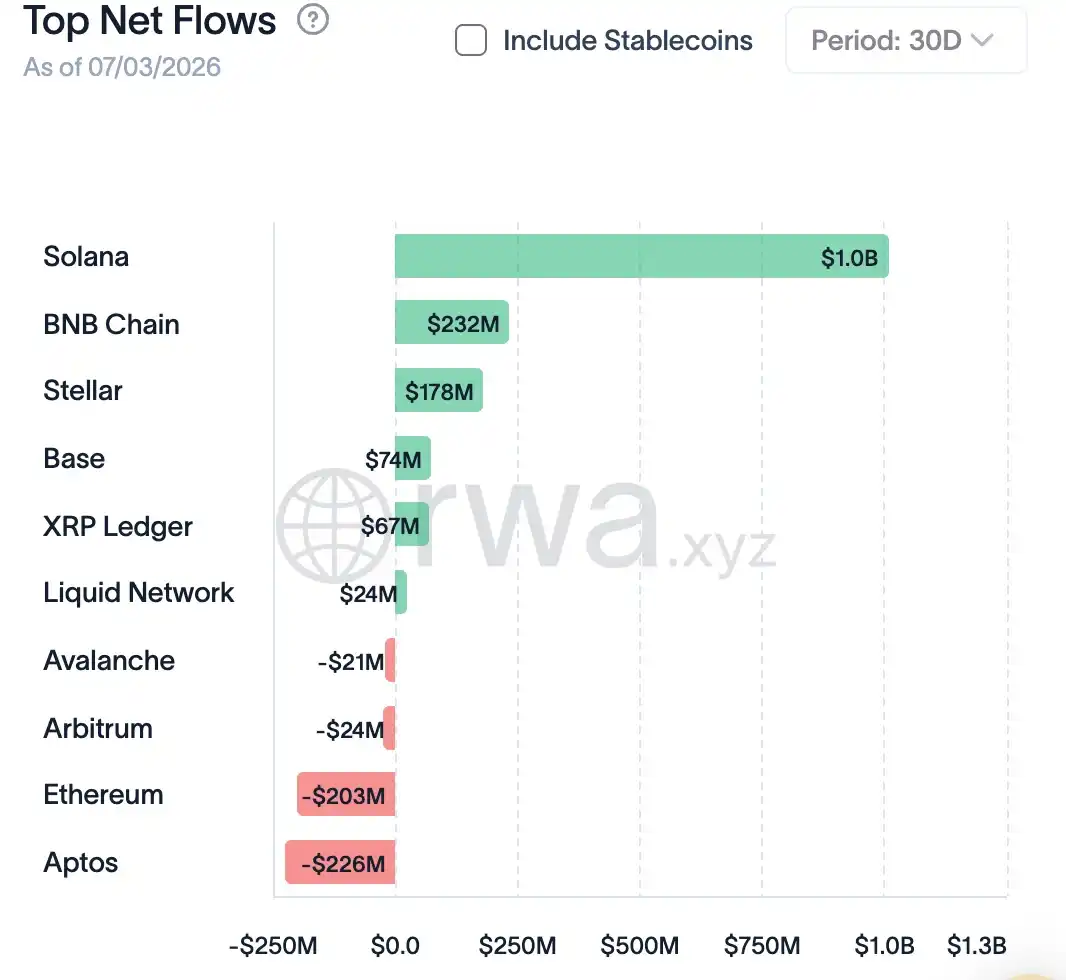
However, from the perspective of asset scale, Solana still has significant room for catch-up. Currently, the total value of RWAs on its chain is about $3.55 billion, still showing a considerable gap compared to Ethereum. But observing from capital flow, the net inflow of RWAs on the Solana chain over the past 30 days has exceeded $1 billion, significantly leading public chains such as Ethereum, BNB Chain, Arbitrum, Base, XRP Ledger, and Aptos, which confirms that funds have recently been flowing into the Solana ecosystem.

Behind this round of growth in the RWA market on Solana is the rapid expansion of the tokenized stock market.
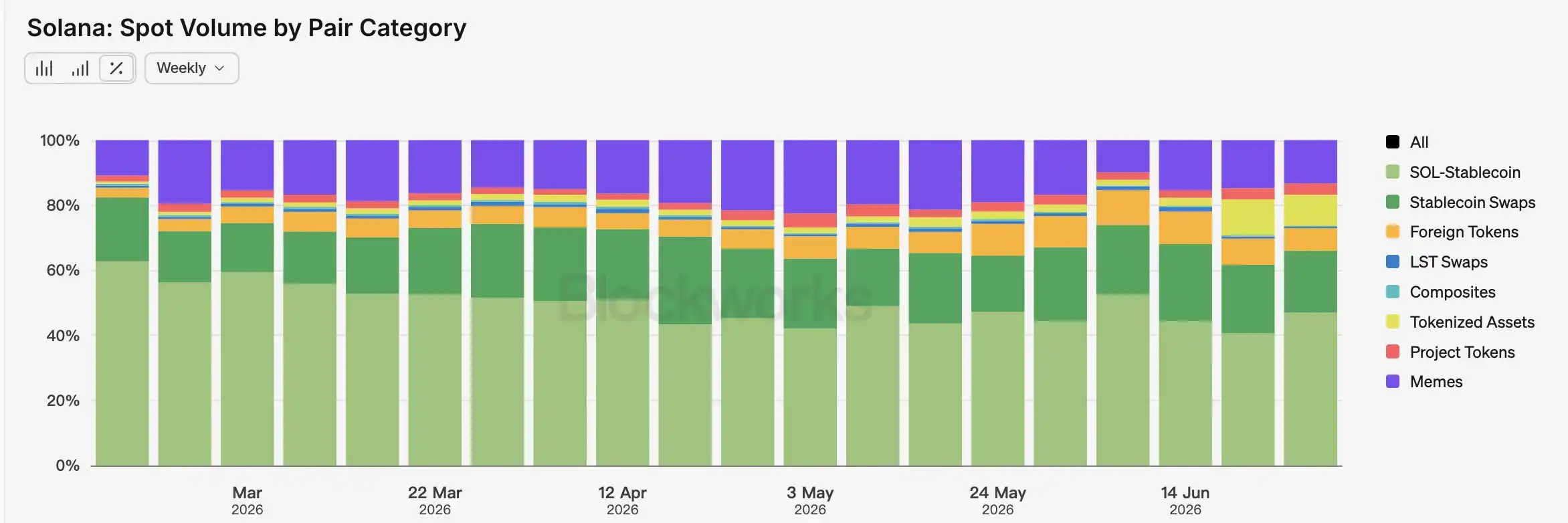
According to the latest data from Blockworks, tokenized assets now account for about 10% of Solana's weekly spot trading volume, a significant increase from just 1% at the beginning of the year. They have now become the second-largest trading category after meme coins.
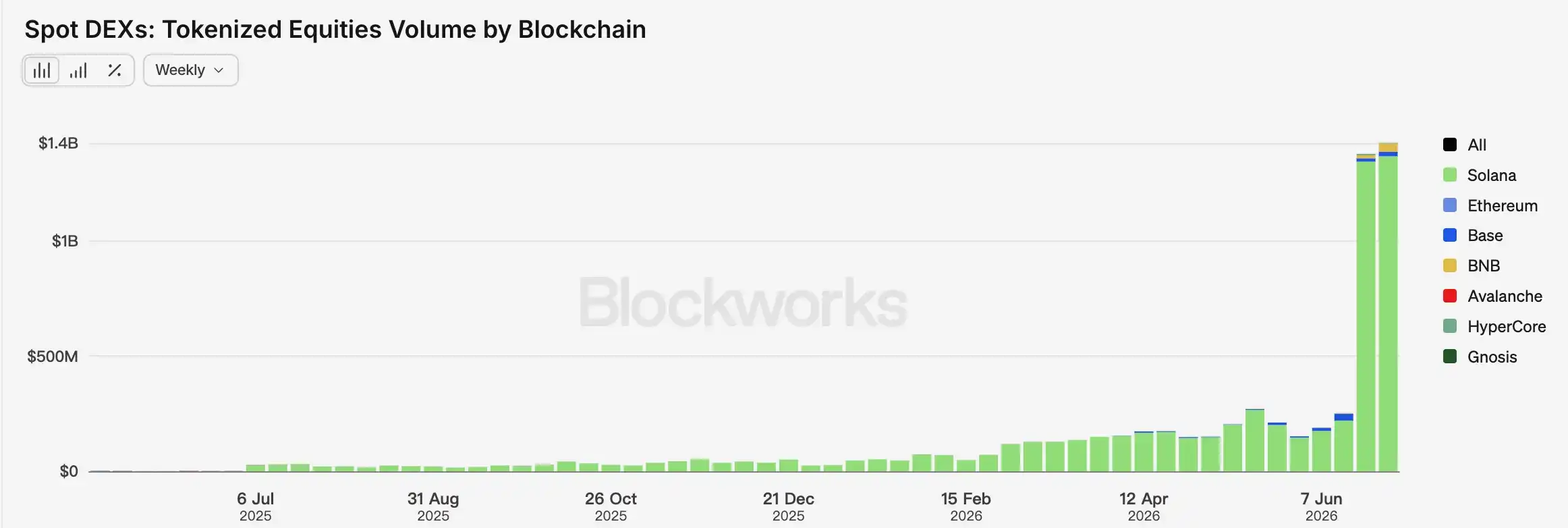
At the same time, the weekly trading volume of tokenized stocks on Solana has also reached a historical high, breaking $1.42 billion, a 30.9-fold increase compared to the beginning of the year, accounting for about 96% of the entire tokenized stock market's trading share. This growth mainly benefits from the tokenized stock business launched by Backpack last month. Currently, Backpack has become Solana's largest tokenized stock issuance platform. The tokenized stocks SPCX and MU it launched contribute about 95% and 99% of Solana's chain trading volume, respectively.

On the other hand, the meme coin market, which had been quiet for a long time, has also started to warm up.

Recently, crypto KOL Ansem publicly supported the eponymous meme coin ANSEM, quickly igniting "trench" trading enthusiasm on the Solana chain. Driven by factors such as celebrity endorsement, high concentration (Ansem holds 65% of the total token supply), and airdrop expectations, the market cap of ANSEM once surged to over $180 million within just a few days.

Dune data shows that as of July 3, Ansem has airdropped ANSEM tokens worth over $12.57 million to 979 addresses. Meanwhile, currently about 94.75% of ANSEM traders are in profit, further stimulating market sentiment.
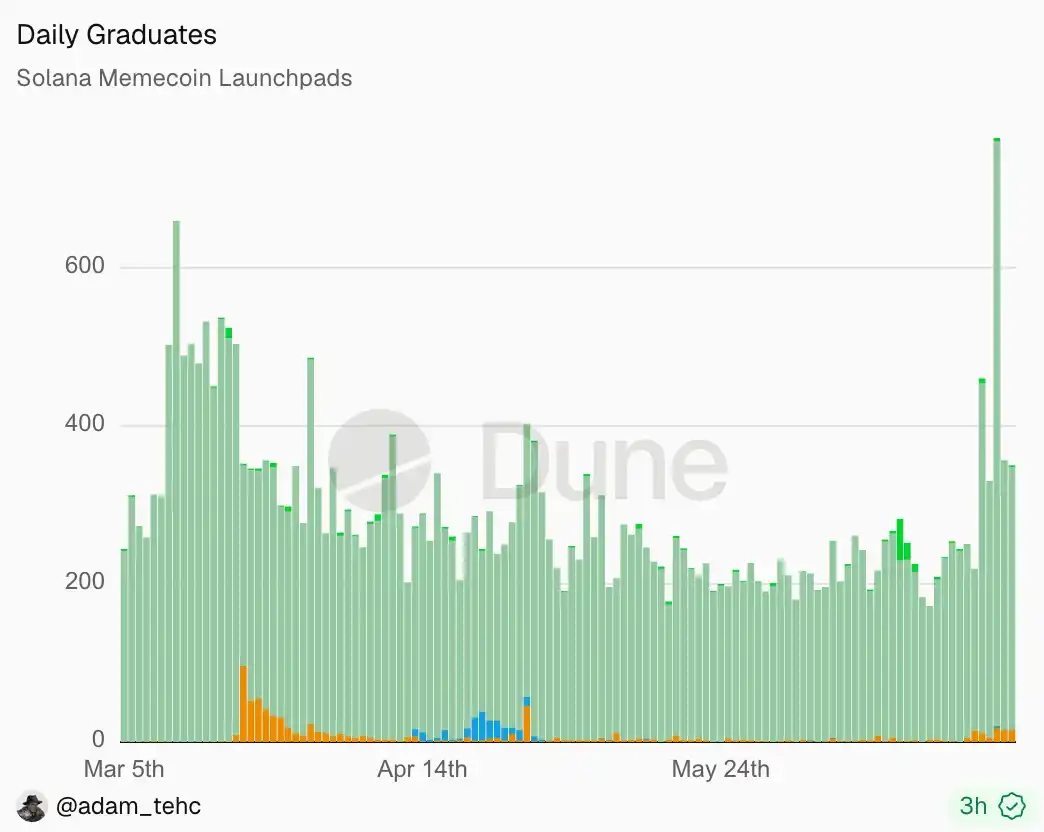
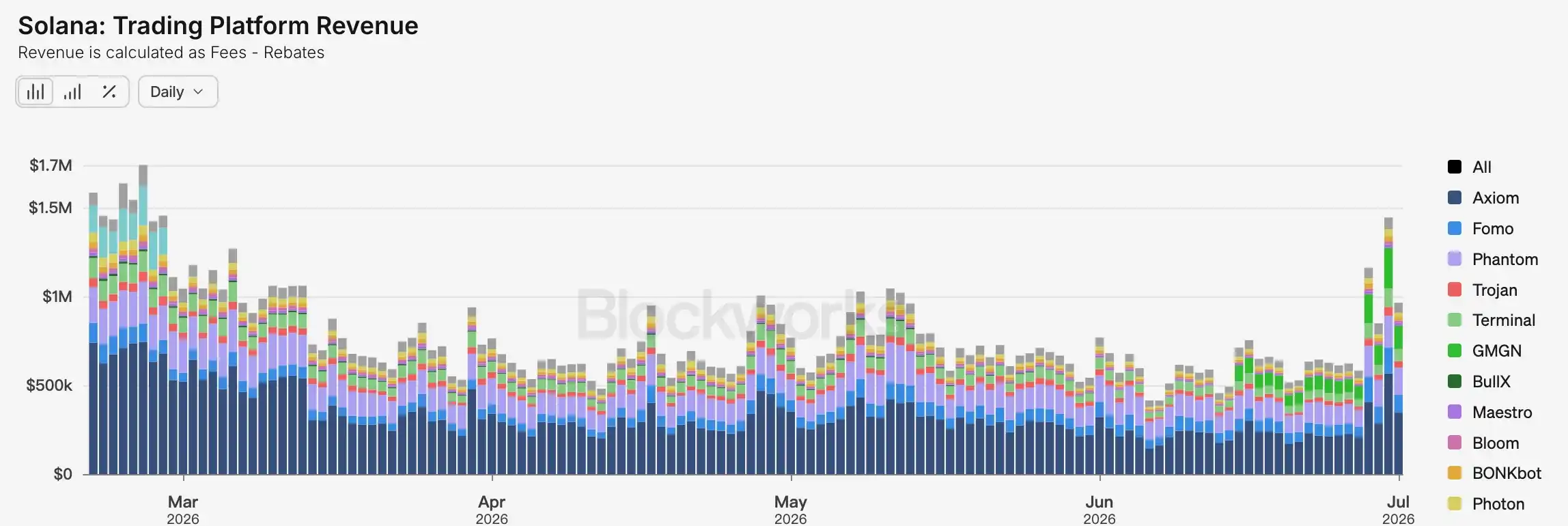
Driven by the ANSEM trend, the activity of the Solana meme ecosystem has also rebounded. Taking Pump.fun as an example, Dune data shows that the number of tokens successfully graduating from the platform daily has reached a new high since April, with daily trading volume more than doubling compared to a month ago. At the same time, Blockworks data shows that the daily revenue of Solana ecosystem trading platforms such as Axiom, Phantom, GMGN, and Fomo recently once again hit new highs since February of this year.
Solana On-Chain Governance Welcomes Key Upgrade: 100,000 SOL Required to Propose

Recently, Solana's on-chain governance mechanism has undergone an upgrade, further enhancing the decentralization of protocol decision-making, which is expected to promote the further healthy development of the ecosystem.

On July 2, the Solana Foundation announced the official launch of the on-chain governance mechanism Solana Governance Proposals (SGP). Validators can submit, support, and vote on core protocol decisions through SGP. The entire governance process is completed on-chain, employing a stake-weighted voting mechanism and verified through Merkle proofs.

According to the rules, any validator who has received at least 100,000 SOL delegated (approximately $8 million at the current price) can initiate a governance proposal. Previously, stakers mainly participated indirectly by delegating to validators. Voting weight will be calculated based on the amount staked. Additionally, delegates can override the voting choices of the validators they delegate to, which to some extent enhances community participation and further lowers the governance threshold.

Before the launch of SGP, Solana's protocol governance primarily relied on the SIMD (Solana Improvement Documents) process.

Developers typically submit technical proposals on GitHub. After open community discussion and review by core developers, the core team is responsible for completing the development and releasing a new client version. Subsequently, validators independently decide whether to upgrade their node software. When the active stake proportion running the new version reaches a sufficient threshold and the network is stable, the corresponding features are officially activated at a designated Slot or Epoch through Feature Gates.

This governance model is essentially off-chain consensus combined with practical client adoption, effectively avoiding network splits caused by hard forks while maintaining high iteration efficiency. However, direct community participation in major governance matters was relatively limited.

It is worth noting that SGP will not replace SIMD; the two will coexist in a division of labor. SIMD will continue to focus on protocol upgrades and technical improvements, while SGP will focus on important ecological governance issues, providing a unified, transparent, on-chain decision-making channel for the community and validators, also further lowering the governance threshold. This clear division of governance responsibilities both increases community engagement and helps maintain the independence and efficiency of core protocol development.

To prevent governance resources from being consumed by low-quality proposals, Solana has also set thresholds. Governance proposals must first be initiated through the SGP process and receive support from no less than 15% of the active stake before they can formally enter the on-chain voting stage. This ensures that proposals entering the voting stage have a certain foundation of community consensus. Currently, Solana's total staked amount is approximately 42.8 million SOL (about 68% of the total supply), meaning a proposal needs support from about 6.42 million SOL staked to enter the voting stage.

In addition to the governance mechanism upgrade, Solana is simultaneously advancing tokenomics optimization, with proposals SIMD-550 and SIMD-553 expected to be implemented in 2026. These two proposals aim to increase SOL's annual inflation reduction rate from 15% to 30% and are estimated to reduce the issuance of approximately 18.9 million new SOL over the next 6 years.

Looking at the entire ecosystem, the current recovery is still mainly concentrated in hot sectors. Whether it's the number of active on-chain addresses or the overall transaction scale, there is still a significant gap compared to the peak of the last bull market. This indicates that the Solana ecosystem is still in a stage of local recovery, with some distance to go before a full-scale recovery.

Kripto yang Sedang Tren

Pertanyaan Terkait

QAccording to the article, what are the two key areas showing signs of recovery within the Solana ecosystem?

AAccording to the article, the two key areas showing signs of recovery within the Solana ecosystem are tokenized stocks (a subcategory of RWA) and the Meme coin market.

QWhat is the name of the new on-chain governance mechanism launched by the Solana Foundation, and what is the minimum delegation requirement for a validator to submit a proposal?

AThe new on-chain governance mechanism is called Solana Governance Proposals (SGP). A validator needs at least 100,000 SOL delegated to them (approximately $8 million at the time of the article) to submit a governance proposal.

QWhich platform is identified as the largest tokenized stock issuance platform on Solana, and which two stocks contributed the most to its trading volume?

ABackpack is identified as the largest tokenized stock issuance platform on Solana. The tokenized stocks SPCX and MU contributed approximately 95% and 99% of Solana's tokenized stock trading volume, respectively.

QWhat role did the meme coin ANSEM play in the recent activity on Solana, and what was a key factor in its rapid growth?

AThe meme coin ANSEM ignited trading enthusiasm on Solana, leading to a surge in its market cap to over $180 million in a few days. A key factor in its rapid growth was the public endorsement and high token holdings (65% of total supply) by the crypto influencer Ansem, along with airdrop expectations.

QHow do the new Solana Governance Proposals (SGP) and the existing SIMD process differ in their focus, according to the article?

AAccording to the article, the Solana Governance Proposals (SGP) focus on important ecological governance issues, providing a unified and transparent on-chain decision-making channel for the community and validators. The existing SIMD (Solana Improvement Documents) process continues to focus on protocol upgrades and technical improvements. They are designed to coexist and serve different purposes.

Bacaan Terkait

Perubahan Sepuluh Tahun: Jalan Menuju Kepunahan Startup Kripto

**Perjalanan Satu Dekade: Transformasi Ekosistem Startup Kripto dari Masa Inovasi Bebas Menuju Era Kendala Regulasi dan Konsolidasi** Era awal industri kripto (sekitar 2017-2018) ditandai dengan kemudahan memulai bisnis: modal rendah, regulasi minimal, dan kemunculan ICO yang memungkinkan tim kecil dengan ide bagus mengumpulkan dana dari publik secara langsung. Inovasi tumbuh subur, meski banyak proyek akhirnya gagal atau curang. Kini, pada tahun 2026, realitanya berubah total. Startup yang ingin beroperasi secara legal di pasar seperti AS, UE, atau Asia harus menghadapi biaya kepatuhan yang sangat tinggi (hingga jutaan dolar), persyaratan modal minimum, dan proses perizinan yang rumit dan panjang seperti BitLicense atau MiCA. Perubahan ini didorong oleh peristiwa seperti runtuhnya Terra dan FTX, yang mengubah pola pikir regulator dan investor ventura. Aliran modal ventura kini lebih terkonsentrasi pada perusahaan matang (putaran lanjutan/C+) dan infrastruktur inti seperti bursa dan layanan kelembagaan, sementara pendanaan untuk startup tahap awal (seed) menyusut drastis. Akibatnya, inovasi teknologi saja tidak lagi cukup. Kunci sukses kini terletak pada akses ke saluran distribusi, lisensi, kemitraan perbankan, dan kepercayaan institusional—aset yang lebih mudah diperoleh melalui akuisisi ("akuisisi jembatan") daripada dibangun dari nol. Contohnya adalah akuisisi Deribit oleh Coinbase untuk mendapatkan lisensi dan basis klien institusionalnya. Industri menjadi lebih stabil dan menarik bagi investor institusi, tetapi mengorbankan kemampuan pendatang baru tanpa sumber daya besar untuk berinovasi secara bebas. Industri kripto, yang lahir untuk mendemokratisasi keuangan, kini mengikuti kurva kematangan industri tradisional: konsolidasi, hambatan masuk tinggi, dan dominasi oleh pemain mapan yang memiliki sumber daya untuk memenuhi tuntutan regulasi yang ketat. Pertanyaan besarnya adalah apakah masih ada ruang bagi inovator tanpa dukungan besar untuk menciptakan sesuatu yang benar-benar baru.

Foresight News16m yang lalu

Perubahan Sepuluh Tahun: Jalan Menuju Kepunahan Startup Kripto

Foresight News16m yang lalu

Robot Belajar Operasi dari Video, UC Berkeley Pertama Kali Menghubungkan Video Internet dengan Penerapan pada Robot Tangan Lincah di Dunia Nyata

**Ringkasan: Robot Belajar dari Video untuk Operasi Manual, Peneliti UC Berkeley Pertama Kali Menerapkan Jaringan dari Video Internet ke Penerapan Aktual pada Tangan Robot Lincah** Peneliti UC Berkeley memperkenalkan metode "Do as I Do," sebuah alur kerja yang pertama kali berhasil mengubah video RGB monokular sehari-hari manusia menjadi lintasan gerak yang dapat dieksekusi oleh tangan robot lincah Sharpa Wave. Penelitian ini mengatasi tantangan utama: mengubah data video yang berisik menjadi instruksi yang dapat dijalankan robot. Prosesnya terdiri dari dua tahap: 1. **Pelacakan 4D Tangan-Benda yang Stabil:** Menggunakan model difusi terpandu untuk merekonstruksi interaksi tangan-benda dari video, mempertahankan kontinuitas dan mengurangi kesalahan. 2. **Pengalihan Aksi yang Tangguh:** Memodifikasi metode pengalihan aksi (seperti SPIDER) dengan penyesuaian agar dapat memproses lintasan referensi yang berisik dari video, meningkatkan tingkat keberhasilan dari 25% menjadi 71%. Sistem ini telah menghasilkan 500 lintasan gerak yang divalidasi untuk 20 jenis operasi seperti menulis, menuang, mengaduk, dan memalu. Lintasan ini telah berhasil dijalankan pada platform robot nyata dengan lengan UR3e ganda dan sepasang tangan Sharpa Wave (22 derajat kebebasan). Penelitian ini juga menyoroti bahwa tidak semua video internet dapat langsung digunakan. Analisis menunjukkan bahwa hanya sekitar 5% dari klip video yang disaring untuk interaksi tangan-benda yang benar-benar dapat diproses menjadi data robot yang andal, menekankan pentingnya penyaringan data yang cermat. Pada intinya, "Do as I Do" mengubah video manusia menjadi kumpulan data operasi berskala besar untuk robot, membuka jalur baru bagi robot untuk belajar dari banyaknya video yang ada di internet.

marsbit1j yang lalu

Robot Belajar Operasi dari Video, UC Berkeley Pertama Kali Menghubungkan Video Internet dengan Penerapan pada Robot Tangan Lincah di Dunia Nyata

marsbit1j yang lalu

Trading

Spot

Artikel Populer

Apa Itu MEME 2.0

Memecoin 2.0: Kebangkitan $MEME 2.0 di Dunia Cryptocurrency Pendahuluan Dalam lanskap cryptocurrency yang terus berkembang, sebuah pesaing baru telah muncul. Memecoin 2.0, yang disimbolkan sebagai $MEME 2.0, membawa konsep koin meme ke tingkat yang menarik. Sebagai produk sampingan dari Memecoin yang asli, proyek ini telah menarik perhatian komunitas kripto dengan mengalihkan fokus dari insentif finansial yang biasa ke pengalaman yang menarik dan menghibur. Beroperasi di blockchain Ethereum, Memecoin 2.0 dengan berani mendefinisikan kembali keterlibatan komunitas di ranah kripto. Apa itu Memecoin 2.0, $MEME 2.0? Pada intinya, Memecoin 2.0 adalah proyek cryptocurrency yang memprioritaskan semangat komunitas dan kesenangan yang terkait dengan budaya meme. Berbeda dengan cryptocurrency konvensional, yang berkonsentrasi pada kasus penggunaan praktis dan manfaat yang nyata, Memecoin 2.0 membedakan dirinya dengan menerima sisi yang lebih ringan dari mata uang digital. Proyek ini ada tanpa janji utilitas, peta jalan yang terstruktur, atau pengembalian finansial, tetapi lebih fokus pada pengembangan komunitas yang dinamis yang berpusat pada meme dan kesenangan yang dibagikan. Dengan melakukan hal ini, proyek ini memanfaatkan tren budaya meme yang berkembang di ruang online, menjadikannya pemain yang unik di dunia aset digital. Pencipta Memecoin 2.0, $MEME 2.0 Meskipun telah dilakukan penelitian mendalam tentang asal-usul Memecoin 2.0, identitas eksplisit penciptanya tetap tidak diketahui. Anonimitas ini tidak jarang terjadi di komunitas kripto, di mana banyak proyek dipimpin oleh individu atau kelompok yang lebih memilih untuk tetap berada di belakang layar. Kurangnya informasi yang tersedia untuk umum mengenai pencipta proyek ini dapat dipandang sebagai langkah strategis, menyoroti keterlibatan komunitas daripada ketenaran individu dalam ruang ini. Investor Memecoin 2.0, $MEME 2.0 Informasi mengenai para investor atau dukungan finansial untuk Memecoin 2.0 jarang ditemui. Ketidakadaan detail ini mungkin menunjukkan bahwa proyek ini didanai sendiri atau bahwa fokusnya pada komunitas daripada struktur investasi tradisional telah menarik jenis pendukung yang berbeda. Karena dunia koin meme biasanya melibatkan lebih banyak keterlibatan akar rumput daripada investasi institusional, pendekatan ini sejalan dengan etos proyek yang digerakkan oleh komunitas. Bagaimana Memecoin 2.0, $MEME 2.0 Bekerja? Memecoin 2.0 beroperasi sepenuhnya di blockchain Ethereum, memanfaatkan fitur keamanan dan skalabilitas yang kuat. Dengan memanfaatkan kekuatan Ethereum, Memecoin 2.0 dapat menawarkan lingkungan yang aman untuk interaksi pengguna sambil memastikan bahwa transaksi efisien dan hemat biaya. Salah satu atribut unik dari Memecoin 2.0 terletak pada strukturnya yang digerakkan oleh komunitas. Nilai dan popularitas token $MEME 2.0 berasal dari partisipasi aktif penggunanya, bukan dari utilitas yang melekat. Desain ini memperkuat fokus proyek pada aspek hiburan dari cryptocurrency, menunjukkan bahwa tawa dan keterlibatan komunitas adalah mata uang sejati yang mendorong kesuksesannya. Selain itu, proyek ini cocok dalam ekosistem yang lebih luas dari koin meme, di mana nilai setiap koin meme berfluktuasi berdasarkan budaya, tren, dan keterlibatan komunitas daripada prinsip ekonomi tradisional. Garis Waktu Memecoin 2.0, $MEME 2.0 Untuk lebih memahami evolusi dan tonggak sejarah Memecoin 2.0, berikut adalah garis waktu yang menyoroti peristiwa signifikan dalam sejarahnya: 2024: Proses penciptaan Memecoin 2.0 diakui sebagai cabang dari Memecoin yang asli, menetapkan dirinya di dalam konteks koin meme yang berkembang pesat sambil beroperasi di blockchain Ethereum. 13 Juli 2024: Memecoin 2.0 secara resmi memposisikan dirinya sebagai koin meme yang berfokus pada komunitas di jaringan Ethereum, menekankan pendekatan yang berfokus pada hiburan yang mengundang pengguna untuk terlibat dan berpartisipasi dalam pertumbuhannya. Poin Kunci Tentang Memecoin 2.0, $MEME 2.0 Beberapa karakteristik penting yang mendefinisikan Memecoin 2.0: Pendekatan Berfokus pada Komunitas: Misi utama Memecoin 2.0 adalah menciptakan pengalaman komunitas yang menyenangkan dan menarik, memanfaatkan kesenangan kolektif yang bersumber dari budaya memetik. Dibangun di atas Ethereum: Beroperasi di blockchain Ethereum memberikan proyek ini infrastruktur penting yang memastikan keamanan dan skalabilitas. Kurangnya Utilitas atau Peta Jalan: Dalam suatu perubahan yang mencolok dari cryptocurrency tradisional, Memecoin 2.0 tidak menjanjikan fitur utilitarian atau pengembalian finansial, menegaskan kembali komitmennya terhadap keterlibatan komunitas dan interaksi sosial. Fokus pada Budaya Memetik: Dengan menerima aspek humor dan budaya dari fenomena meme, Memecoin 2.0 menyediakan platform bagi pengguna untuk terlibat dengan kripto secara offline dan online. Konteks Tambahan: Signifikansi Koin Meme Koin meme telah muncul sebagai kelas cryptocurrency yang berbeda, sering kali didorong oleh humor dan pendekatan ringan terhadap perdagangan. Koin-koin ini umumnya tidak memiliki utilitas signifikan atau peta jalan pengembangan, menarik pengguna dengan janji kesenangan, interaksi komunitas, dan relevansi budaya. Dalam lanskap ekosistem kripto yang lebih luas, koin meme menghidupkan kembali pentingnya keterlibatan komunitas, menolak pendekatan yang hanya berorientasi keuntungan. Proyek-proyek seperti Memecoin 2.0 membuka era di mana hiburan dapat harmonis dengan aspirasi finansial, menjadikan blockchain sebagai taman bermain untuk kreativitas dan interaksi sosial. Kesimpulan Memecoin 2.0, atau $MEME 2.0, mewujudkan gelombang baru cryptocurrency yang memprioritaskan keterlibatan komunitas di atas struktur finansial yang kaku. Dengan fokus pada humor dan interaksi sosial, proyek ini memanfaatkan daya tarik yang mengelilingi budaya meme. Dengan beroperasi di blockchain Ethereum, Memecoin 2.0 memanfaatkan kemampuan teknologi sambil tetap teguh dalam komitmennya terhadap nilai hiburan dari mata uang digital. Seiring ruang seputar cryptocurrency terus berkembang, Memecoin 2.0 menjadi sebuah bukti bahwa masa depan aset digital mungkin sangat bergantung pada pengalaman bersama, tawa, dan hubungan komunitas yang kuat. Di dunia kripto yang tidak dapat diprediksi, mungkin kebahagiaan dapat sama berharganya dengan keuntungan finansial tradisional.

156 Total TayanganDipublikasikan pada 2024.04.04Diperbarui pada 2024.12.03

Apa Itu MEME 2.0

Cara Membeli MEME

Selamat datang di HTX.com! Kami telah membuat pembelian Memeland (MEME) menjadi mudah dan nyaman. Ikuti panduan langkah demi langkah kami untuk memulai perjalanan kripto Anda.Langkah 1: Buat Akun HTX AndaGunakan alamat email atau nomor ponsel Anda untuk mendaftar akun gratis di HTX. Rasakan perjalanan pendaftaran yang mudah dan buka semua fitur.Dapatkan Akun SayaLangkah 2: Buka Beli Kripto, lalu Pilih Metode Pembayaran AndaKartu Kredit/Debit: Gunakan Visa atau Mastercard Anda untuk membeli Memeland (MEME) secara instan.Saldo: Gunakan dana dari saldo akun HTX Anda untuk melakukan trading dengan lancar.Pihak Ketiga: Kami telah menambahkan metode pembayaran populer seperti Google Pay dan Apple Pay untuk meningkatkan kenyamanan.P2P: Lakukan trading langsung dengan pengguna lain di HTX.Over-the-Counter (OTC): Kami menawarkan layanan yang dibuat khusus dan kurs yang kompetitif bagi para trader.Langkah 3: Simpan Memeland (MEME) AndaSetelah melakukan pembelian, simpan Memeland (MEME) di akun HTX Anda. Selain itu, Anda dapat mengirimkannya ke tempat lain melalui transfer blockchain atau menggunakannya untuk memperdagangkan mata uang kripto lainnya.Langkah 4: Lakukan trading Memeland (MEME)Lakukan trading Memeland (MEME) dengan mudah di pasar spot HTX. Cukup akses akun Anda, pilih pasangan perdagangan, jalankan trading, lalu pantau secara real-time. Kami menawarkan pengalaman yang ramah pengguna baik untuk pemula maupun trader berpengalaman.

526 Total TayanganDipublikasikan pada 2024.12.12Diperbarui pada 2026.06.02

Cara Membeli MEME

Diskusi

Selamat datang di Komunitas HTX. Di sini, Anda bisa terus mendapatkan informasi terbaru tentang perkembangan platform terkini dan mendapatkan akses ke wawasan pasar profesional. Pendapat pengguna mengenai harga MEME (MEME) disajikan di bawah ini.

活动图片