Aave V4 to Move Wall Street Securities Financing On-Chain: Composability Layer Transforms from Risk Point to Backbone

marsbitDipublikasikan tanggal 2026-07-03Terakhir diperbarui pada 2026-07-03

Abstrak

Aave V4 aims to bring Wall Street securities financing on-chain, targeting the massive traditional markets for repo, securities lending, and margin financing. It proposes three core products: securities-backed loans, atomic repo settlements, and securities lending. This shifts the narrative from "RWA as collateral" to building foundational "on-chain securities finance infrastructure." The key innovation lies in its third-layer approach: composability. V4 doesn't alter underlying asset credit but systematically connects all on-chain assets to leverage and liquidation mechanisms, making composability the system's backbone instead of just a risk point. Aave's dominant market share and its relatively prudent engineering for its Horizon institutional RWA lending market support this ambition. However, a critical design choice introduces a new risk dimension. The "centralized liquidity Hub + multiple Spoke" architecture and Horizon's shared liquidity pools prioritize capital efficiency by allowing new assets instant access to deep liquidity. The trade-off is the loss of risk isolation: a problem with one collateral type in a stress period can draw from the same stablecoin pool backing all others, spreading risk across the entire market. This risk is not theoretical, as demonstrated by a 2026 incident where compromised collateral from a bridge attack created bad debt on Aave. As the system scales—with Horizon targeting over $1B—it remains untested in a genuine credit or liquidity ...

On June 19th, Aave founder Kulechov positioned the upcoming Aave V4 as an on-chain alternative to Wall Street securities financing, targeting the U.S. daily markets of approximately $12.6 trillion in repo, $4.6 trillion in securities available for lending, and margin financing. He proposed three product types: securities-backed loans, repo (atomic settlement), and securities lending. Its institutional-grade RWA lending market, Horizon, has accumulated about $440 to $550 million in deposits since its launch in August 2025, with a target of exceeding $1 billion by 2026. This upgrades the narrative from "RWA as collateral" as a single product to "on-chain securities financing infrastructure."

Using the three-layer framework, the essence of this lies in the third layer—composability. V4 does not change the credit of any underlying assets, nor does it directly create liquidity mismatches; what it does is uniformly connect any issues from the first two layers to on-chain leverage and liquidation. In other words, it transforms the composability layer we have consistently highlighted, from a risk point, into the backbone of the system.

Aave is qualified to do this. By the end of 2025, it commanded about 61.5% of the active lending market share and held over half of the total TVL in the entire lending sector. Its engineering is also more prudent than typical DeFi—Horizon uses Chainlink's NAV oracle for net asset value pricing, employs LlamaRisk and Chaos Labs for risk parameters, makes aTokens non-transferable, and maintains non-custodial contracts. These aspects should be acknowledged, not dismissed outright.

However, one design choice warrants closer examination. V4's "centralized liquidity Hub + multiple Spokes" architecture, along with Horizon's shared liquidity pool, reflects the same orientation—prioritizing capital efficiency. The shared pool allows new assets to immediately access deep liquidity upon listing, resulting in more stable interest rates, which is an advantage; the trade-off is the loss of risk isolation: if collateral of a certain type encounters problems during stress periods, it draws from the same stablecoin pool shared by all other collateral types. While enhancing efficiency, the shared pool expands the risk exposure of the composability layer from a single asset to the entire market. This is the other side of the trillion-dollar TAM narrative that is often overlooked.

This risk is not hypothetical. In April 2026, an attack on a third-party cross-chain bridge resulted in approximately 116,500 unbacked rsETH being deposited as collateral into Aave, creating bad debt—this is precisely the template for "collateral integrity issues → bad debt," unrelated to whether the underlying asset defaults.

In terms of scale, Horizon's current ~$500 million and target of $1 billion is just a starting point relative to the $12.6 trillion repo market it aims for (see chart below); precisely because of this, this mechanism for uniformly levering various RWAs has not yet been tested in any genuine credit or liquidity stress scenario. Combined with our previous estimate of 5%–10% NAV drift for CLO-like tokens during stress periods, leveraged positions might be wiped out before the NAV is rebalanced. We tend to believe that the first scaled bad debt or forced liquidation for RWA collateral will be triggered by a dislocation between the price/NAV of the collateral token during stress, rather than by underlying asset default—manifesting as a liquidation or loss distribution in an institutional-grade RWA lending market, while the underlying credit does not default.

The implications differ for various parties: Institutions supplying collateral to such markets should set discounts based on the "NAV vs. on-chain price" gap during stress, not just credit. Lenders supplying stablecoins to these markets must understand they are exposed to a shared pool and to every type of collateral within it, not just the specific type they favor. For risk service providers and protocols, the choice between isolated pools and shared pools is a trade-off between risk isolation and capital efficiency. Within our three-layer framework, this article, along with the concurrent stablecoin discussion (the assets being borrowed) and the previous CLO discussion (the assets being collateralized), point to the same main theme—the market still primarily focuses on the credit layer, while tokenization repeatedly creates new risks in the latter two layers. Independently pricing the liquidity and composability risks of collateral tokens is precisely Coinfound's position.
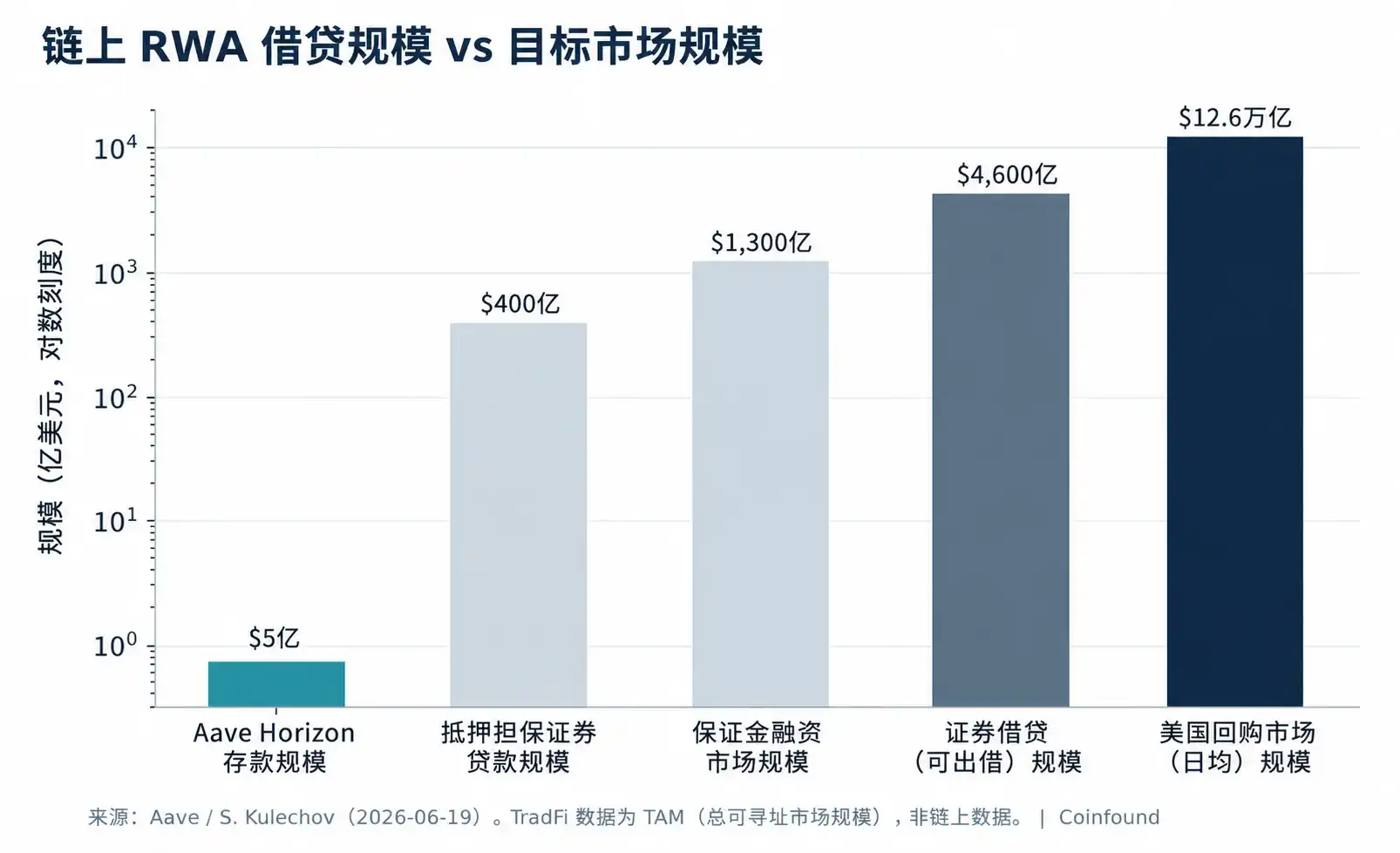
Chart: On-chain RWA lending remains minuscule relative to the traditional securities financing market it targets (Source: Aave / Kulechov, 2026-06)

Disclaimer: This article is for informational purposes only and does not constitute any investment advice; data may be delayed or contain errors, please refer to official disclosures.

Kripto yang Sedang Tren

Pertanyaan Terkait

QAccording to the article, what is the core innovation of Aave V4 and how does it change the role of the 'composability layer'?

AThe core innovation of Aave V4 is positioning itself as an on-chain alternative to Wall Street securities financing, targeting markets like repo and securities lending. It changes the role of the 'composability layer' from being a point of risk to becoming the main backbone of the system by connecting all underlying asset issues to on-chain leverage and liquidation mechanisms.

QWhat specific risk does the 'centralized liquidity Hub + multi-Spoke' architecture and shared liquidity pool design in Aave V4 introduce?

AThe 'centralized liquidity Hub + multi-Spoke' architecture and shared liquidity pool design prioritize capital efficiency but introduce a key risk: the loss of risk isolation. If one type of collateral experiences problems during a stress period, it can drain liquidity from the shared stablecoin pool that supports all other collateral types, potentially amplifying risks across the entire market.

QWhat real-world incident does the article cite as a template for the risk where 'collateral integrity failure leads to bad debt'?

AThe article cites an incident in April 2026 where a third-party cross-chain bridge was attacked, resulting in approximately 116,500 unbacked rsETH being deposited as collateral into Aave, creating bad debt. This serves as a template for the risk of collateral integrity failure leading to bad debt, independent of the underlying asset's default.

QWhat is the article's prediction for the likely first trigger of a large-scale bad debt or forced liquidation in RWA collateral markets?

AThe article predicts that the first trigger for large-scale bad debt or forced liquidation in RWA collateral markets will likely be a dislocation between the price/net asset value (NAV) of the tokenized collateral during stress periods, rather than an actual default of the underlying credit asset.

QFor providers of stablecoin liquidity to markets like Aave V4, what key understanding about their risk exposure does the article emphasize?

AThe article emphasizes that providers of stablecoin liquidity must understand they are exposed to every type of collateral asset within a shared liquidity pool, not just the specific collateral types they might individually favor or analyze. Their risk is pooled across the entire market supported by that shared capital.

Bacaan Terkait

Ingin Manfaatkan Robinhood Chain? Proyek-Proyek Ekosistem Mana yang Layak Diperhatikan?

**Ingin Manfaat dari Airdrop Robinhood Chain? Proyek-Proyek Ekosistem Ini Perlu Diperhatikan** Robinhood Chain, Layer 2 inti Robinhood, dengan cepat membangun ekosistem lengkap yang mencakup token saham, RWA, perdagangan perpetual, dan spot. Pada 2 Juli 2026, jaringan ini meluncurkan mainnet sekaligus kampanye pembebasan biaya Gas selama 90 hari. Dalam 4 hari, TVL ekosistemnya mencapai sekitar $76,73 juta. Artikel ini menyoroti beberapa proyek utama di ekosistem Robinhood Chain yang menawarkan peluang potensial: 1. **Arcus**: DEX untuk token saham dan crypto yang dibangun bersama oleh dYdX Labs dan Robinhood Crypto, berfokus pada spot dan perpetual. Token Arcus rencananya akan didistribusikan kepada komunitas dYdX. 2. **Lighter**: DEX terdesentralisasi berbasis ZK untuk perdagangan perpetual dan spot. Platform ini menawarkan program rewards senilai $11 juta dalam token LIT untuk pengguna yang bertransaksi. 3. **Morpho**: Digunakan dalam produk Robinhood Earn, yang memungkinkan pengguna AS meminjamkan stablecoin USDG untuk mendapatkan imbal hasil. USDG ini dialokasikan di pasar Morpho. 4. **Rialto**: Platform perdagangan spot on-chain yang mendukung crypto, saham, ETF, dan komoditas, termasuk lebih dari 90 token saham Robinhood. 5. **Arrakis**: Protokol market maker on-chain non-kustodial untuk penerbit token, membantu mengelola likuiditas di DEX. 6. **Meridian**: Platform pasar prediksi dan kontrak perpetual yang berfokus pada RWA, menggunakan USDe sebagai aset penyelesaian. 7. **Native**: Sistem penemuan harga dan eksekusi on-chain yang baru saja diterapkan di Robinhood Chain. Catatan penting: Artikel ini bukan saran investasi. Selalu lakukan penelitian sendiri (DYOR) dan evaluasi toleransi risiko sebelum berinteraksi dengan proyek-proyek ini.

Foresight News26m yang lalu

Ingin Manfaatkan Robinhood Chain? Proyek-Proyek Ekosistem Mana yang Layak Diperhatikan?

Foresight News26m yang lalu

Akhir Koreksi atau Lanjutan Tren: Tinjauan Struktur Teknis BTC & HYPE | Analisis Tamu

Analisis Teknikal BTC dan HYPE: Ulasan Struktur dan Proyeksi Minggu Ini Laporan mingguan ini berfokus pada analisis struktur teknikal multi-timeframe untuk BTC dan HYPE. Untuk BTC, analisis dilakukan pada timeframe harian dan 4 jam, menelusuri struktur koreksi sejak puncak 6 Mei. Model kuantitatif eksklusif digunakan untuk memproyeksikan level kunci resistance, support, serta jalur operasional jangka pendek dan menengah minggu ini. Bagian HYPE berfokus pada pergerakan rebound di timeframe 4 jam, menganalisis evolusi strukturnya, dan memberikan saran manajemen risiko untuk operasi jangka pendek. **BTC:** * **Analisis Struktur:** Koreksi sejak awal Mei menunjukkan pola empat segmen di chart harian. Pergerakan saat ini berada di segmen rebound (3-4). Hasil akhir "Titik 4" akan menentukan arah jangka pendek: tembus di atas $65.700 mengarah pada konsolidasi rentang (skenario lebih mungkin), sementara kegagalan di bawah $64.500 meningkatkan kemungkinan penurunan lanjutan. * **Level Penting:** Resistance kunci di $64.500-$65.700, $67.300, dan $69.500-$71.000. Support kunci di $60.950-$62.300, $57.820, dan sekitar $55.000. * **Strategi:** Posisi short menengah dipertahankan sekitar 20%, dengan kemungkinan penambahan jika ada penolakan di zona $65.700-$67.300. Operasi jangka pendek (30% modal) dapat mencari peluang 'spread' di sekitar level support/resistance dengan manajemen risiko ketat. **HYPE:** * **Analisis Struktur:** Rebound dari low akhir Juni membentuk struktur tujuh segmen naik di chart 4 jam. Pergerakan saat ini (segmen 60-61) mendekati zona resistance tinggi historis ($76.94). Model sinyal telah memicu peringatan top di area ini, mengindikasikan risiko koreksi jangka pendek. * **Level Penting:** Resistance di $75-$76.94 dan $80. Support di $68, $65.5, dan $60.5-$61.5. * **Strategi:** Fokus pada penguncian profit dan manajemen risiko. Untuk posisi long yang ada, disarankan menggeser stop loss ke atas (misalnya, dekat $68). Amati hasil perebutan di zona resistance $75-$76.94. Laporan juga menyertakan rekapitulasi perdagangan short HYPE pekan sebelumnya yang menghasilkan profit ~10.23%, berdasarkan sinyal dari model "Spread Trading" dan "Dynamic Momentum". Pesan penting: Selalu terapkan stop loss segera, dan geser stop loss untuk mengamankan modal serta mengunci profit secara dinamis.

marsbit30m yang lalu

Akhir Koreksi atau Lanjutan Tren: Tinjauan Struktur Teknis BTC & HYPE | Analisis Tamu

marsbit30m yang lalu

Penyesuaian Akhir atau Kelanjutan Tren: Tinjauan Struktur Teknis BTC dan HYPE | Analisis Tamu

**Analisis Struktur Teknis BTC dan HYPE: Akhir Penyesuaian atau Kelanjutan Tren?** (06-12 Juli 2024) Laporan mingguan ini menganalisis struktur teknis Bitcoin (BTC) dan HYPE. **Bitcoin (BTC):** * **Analisis:** Penyesuaian BTC sejak puncak 6 Mei menunjukkan struktur 4 tahap. Kunci saat ini adalah melihat apakah rebound dari level terendah 57.820 USD dapat menembus resistance 65.700 USD. * **Skenario:** 1. Jika tembus 65.700 USD: Kemungkinan besar pasar akan bergerak dalam kisaran konsolidasi, mengurangi momentum turun dan mempersiapkan rebound berikutnya. 2. Jika gagal tembus (bahkan di bawah 64.500 USD): Risiko tinggi untuk melanjutkan tren turun dan menembus support 57.820 USD. * Model kuantitatif penulis lebih mendukung **Skenario 1** (konsolidasi). * **Level Penting:** * **Resistance:** 64.500-65.700 USD; 67.300 USD; 69.500-71.000 USD. * **Support:** 60.950-62.300 USD; 57.820 USD; 55.000 USD. * **Strategi:** * **Menengah:** Pertahankan posisi short 20%. Tambah hingga 50% jika harga rally ke 65.700-67.300 USD dan menunjukkan sinyal jenuh jual. * **Pendek (30% modal):** Cari peluang "price gap" di sekitar level support/resistance. * **Rencana A:** Short 30% di area 65.700-67.300 USD jika ada sinyal resistance. * **Rencana B:** Long 15% di dekat support kuat 57.820 USD jika ada sinyal rebound. **HYPE:** * **Analisis:** Rebound HYPE dari low 58.5 USD menunjukkan struktur naik 7 segmen di chart 4-jam. Harga sedang mendekati area resistance tinggi historis (76.94 USD). * **Peringatan:** Model "price gap" telah memicu sinyal peringatan puncak di dua titik terakhir. **Hindari beli saat harga tinggi**, waspadai risiko koreksi jangka pendek. * **Level Penting:** * **Resistance:** 75-76.94 USD; 80 USD. * **Support:** 68 USD; 65.5 USD; 60.5-61.5 USD. * **Strategi Minggu Ini:** Fokus pada penguncian profit dan manajemen risiko. Amati perebutan di area 75-76.94 USD. Jika sudah memegang long, naikkan stop loss ke 68 USD untuk lindungi profit. Lakukan profit taking jika pasar terkoreksi. **Catatan Khusus:** Selalu terapkan manajemen risiko ketat: pasang stop loss awal, geser ke titik impas saat profit 1%, dan geser lebih lanjut untuk mengunci keuntungan. *Disclaimer: Analisis ini adalah catatan trading pribadi dan bukan saran investasi. Pasar keuangan sangat dinamis dan berisiko. Lakukan penelitian sendiri dan investasi dengan hati-hati.*

Odaily星球日报33m yang lalu

Penyesuaian Akhir atau Kelanjutan Tren: Tinjauan Struktur Teknis BTC dan HYPE | Analisis Tamu

Odaily星球日报33m yang lalu

Trading

Spot

Artikel Populer

Cara Membeli LAYER

Selamat datang di HTX.com! Kami telah membuat pembelian Solayer (LAYER) menjadi mudah dan nyaman. Ikuti panduan langkah demi langkah kami untuk memulai perjalanan kripto Anda.Langkah 1: Buat Akun HTX AndaGunakan alamat email atau nomor ponsel Anda untuk mendaftar akun gratis di HTX. Rasakan perjalanan pendaftaran yang mudah dan buka semua fitur.Dapatkan Akun SayaLangkah 2: Buka Beli Kripto, lalu Pilih Metode Pembayaran AndaKartu Kredit/Debit: Gunakan Visa atau Mastercard Anda untuk membeli Solayer (LAYER) secara instan.Saldo: Gunakan dana dari saldo akun HTX Anda untuk melakukan trading dengan lancar.Pihak Ketiga: Kami telah menambahkan metode pembayaran populer seperti Google Pay dan Apple Pay untuk meningkatkan kenyamanan.P2P: Lakukan trading langsung dengan pengguna lain di HTX.Over-the-Counter (OTC): Kami menawarkan layanan yang dibuat khusus dan kurs yang kompetitif bagi para trader.Langkah 3: Simpan Solayer (LAYER) AndaSetelah melakukan pembelian, simpan Solayer (LAYER) di akun HTX Anda. Selain itu, Anda dapat mengirimkannya ke tempat lain melalui transfer blockchain atau menggunakannya untuk memperdagangkan mata uang kripto lainnya.Langkah 4: Lakukan trading Solayer (LAYER)Lakukan trading Solayer (LAYER) dengan mudah di pasar spot HTX. Cukup akses akun Anda, pilih pasangan perdagangan, jalankan trading, lalu pantau secara real-time. Kami menawarkan pengalaman yang ramah pengguna baik untuk pemula maupun trader berpengalaman.

867 Total TayanganDipublikasikan pada 2025.02.11Diperbarui pada 2026.06.02

Cara Membeli LAYER

Diskusi

Selamat datang di Komunitas HTX. Di sini, Anda bisa terus mendapatkan informasi terbaru tentang perkembangan platform terkini dan mendapatkan akses ke wawasan pasar profesional. Pendapat pengguna mengenai harga LAYER (LAYER) disajikan di bawah ini.

活动图片