US CFTC Launches Broad Investigation into Polymarket, Is the Prediction Market Party Coming to an End?

marsbitDipublikasikan tanggal 2026-06-30Terakhir diperbarui pada 2026-06-30

Abstrak

The U.S. Commodity Futures Trading Commission (CFTC) is conducting a broad investigation into the prediction market platform Polymarket, focusing on its business practices including social media promotions. This follows a bipartisan letter from U.S. senators urging the CFTC to probe alleged fraudulent marketing tactics used to promote gambling-like products. The action coincides with a period of explosive growth for the prediction market sector, driven by events like the World Cup, with platforms like Kalshi and Robinhood reporting record trading volumes and revenue. The investigation signals a potential end to the sector's unregulated expansion and may lead to clearer federal oversight, particularly regarding investor protection and distinguishing prediction markets from traditional sports betting. The CFTC's move has also intensified a jurisdictional conflict with multiple U.S. states (including Kentucky and New York), which have sued platforms like Polymarket and Kalshi, accusing them of operating illegal sports betting and threatening state gambling tax revenues. Furthermore, the CME Group has sued the CFTC, challenging its approval of certain prediction market products. The report also highlights the political and capital interests intertwined with the industry. Donald Trump Jr. holds advisory and investment roles in both Kalshi and Polymarket, and the Trump administration has previously emphasized federal regulatory authority over these markets. The CFTC's investigati...

Original | Odaily Planet Daily (@OdailyChina)

Author | Wenser(@wenser2010 )
Polymarket's deceptive marketing has finally caught the attention of regulatory authorities.

Recently, the U.S. Commodity Futures Trading Commission (CFTC) has initiated a broad investigation into the prediction market platform Polymarket, covering its business activities including social media campaigns. Previously, U.S. Republican Senator John Curtis and Democratic Senator Adam Schiff co-signed a letter to CFTC Chairman Mike Selig, urging an investigation into Polymarket's practices of paying KOLs for deceptive marketing and using fraudulent marketing tactics to promote gambling-like products to American audiences.

At a time when the World Cup is driving a surge in prediction market trading volumes, this move may pour cold water on the development of this sector. More importantly, the CFTC's investigation into Polymarket has brought to light conflicts of interest between U.S. federal and state authorities, as well as between officials and capital. (Recommended reading: "WSJ: Fake Websites, Fake Trades, Real Promotion, Polymarket's Traffic Scam").

End of the Wild West Era for Prediction Market Marketing, Regulatory Policies May Enter Deep Waters

If the earlier incidents involving Polymarket—such as university students posting fake profit videos and paid KOLs exaggerating prediction profits—were seen as the wild attempts of the early expansion phase of prediction markets, then the formal CFTC investigation is clear proof that this wild growth period is over.

Prediction Market Platform Data Sees Explosive Growth, Attracting Strong Attention from Traditional Internet Giants

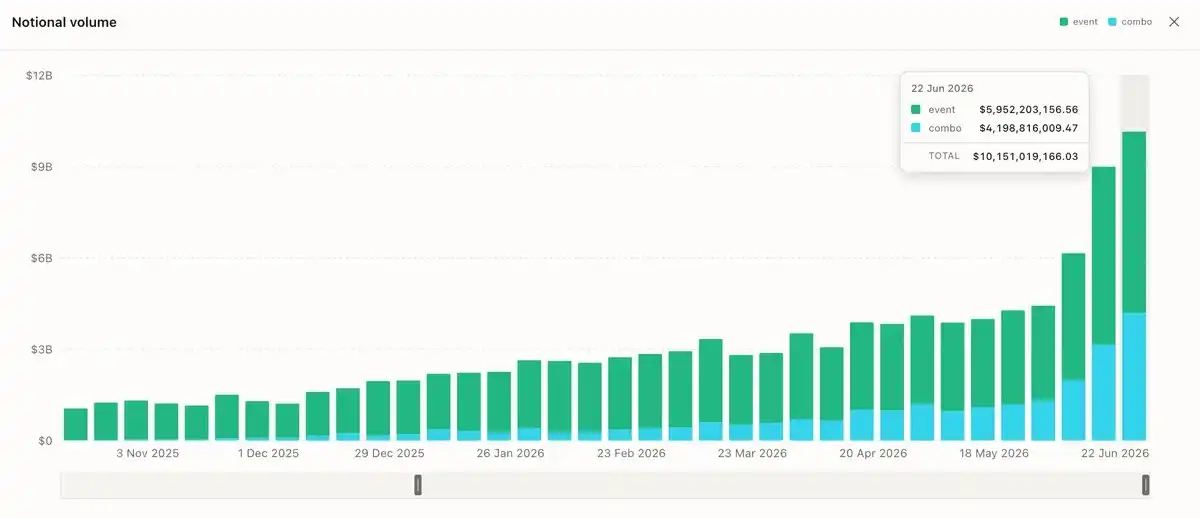
As we entered June 2026, with the official start of the World Cup, prediction markets have received unprecedented attention, leading to a continuous rise in trading volumes.

Data from a16z crypto shows that prediction market trading volume has hit record highs for three consecutive weeks. The total market trading volume reached a historic first of $144 billion last week, a significant increase from approximately $50–60 billion at the beginning of the year. The previous record high of around $100 billion was set just the week before. From the platform side, the data has also seen substantial growth:

  • Latest data shows Kalshi's weekly notional trading volume surpassed $100 billion for the first time.
  • Polymarket officially stated that its annualized revenue has significantly exceeded $1 billion, a development occurring just six weeks after the removal of the waitlist for its U.S. trading platform; data shows that the U.S. platform's daily trading volume grew from about $50 million in mid-May to over $200 million on June 20 (based on Dune Analytics data).
  • Robinhood's prediction market platform business is growing rapidly, with annualized revenue reaching $500 million. In Q2 as of June 25, Robinhood's active contract trading volume was approximately 12.3 billion contracts. Based on a standard rate of 1 cent per contract, the prediction market revenue for this quarter is estimated to be at least $123 million. Its recently launched Rothera prediction market platform achieved over 900 million contract trades in its first week, contributing nearly 60% growth in active contract trading volume for Robinhood.
Such impressive data has also attracted the attention of stock market giant Meta. According to media reports, Meta CEO Mark Zuckerberg has urged the company to explore partnerships with prediction markets Polymarket and Kalshi. Meanwhile, Meta is developing a similar prediction market application called Arena.

All signs indicate that prediction markets have leapt from a niche sector a few years ago to a hot industry experiencing exponential expansion. In the face of this trend, regulatory authorities are unlikely to stand idly by. The recent deceptive marketing incidents at Polymarket serve as a timely and fitting 'soft knife,' providing an opportunity for regulatory intervention. The author believes that subsequent regulations may gradually clarify the boundaries for prediction market platforms regarding marketing, event contract content, and trading fees, aiming to strengthen investor protection and clearly distinguish them from traditional gambling businesses.

Simultaneously, as the investigation deepens, the power struggle between federal regulatory agencies represented by the U.S. CFTC and state-level regulators is also coming to light.

When U.S. CFTC and Nine U.S. States Lock Horns: The Battle for Prediction Market Regulatory Power

Last Tuesday, the U.S. CFTC formally filed a lawsuit against Kentucky, attempting to reaffirm the agency's jurisdiction over prediction market platforms.

In the complaint filed with the U.S. District Court for the Eastern District of Kentucky, the CFTC stated that Kentucky's attempt to shut down federally regulated designated contract markets interferes with the federal regulatory system Congress established for the national swaps market. It claims "exclusive jurisdiction" over related event contracts and prediction market products.

Previously, Kentucky sued platforms like Kalshi and Polymarket, accusing them of operating unlicensed illegal sports betting and gambling businesses within the state. As of June, over 12 U.S. states, including Kentucky and New York, have taken legal action against Polymarket and Kalshi, alleging they operate illegal sports betting. Kentucky has become the ninth state sued by the CFTC in the prediction market regulatory dispute.

This action highlights the escalating conflict between federal derivatives regulation and state-level gambling regulation.

There are two main reasons behind this dispute:

  • First, the practical interests of state and local gambling industries, such as tax revenue. Traditional sports betting previously brought significant tax revenue to various states (e.g., high-tax-rate online gambling). If prediction markets completely replace the gambling industry, potential tax losses for states could amount to hundreds of millions of dollars annually (one estimate is around $600 million).
  • Second, the definition of the regulatory boundary between the gambling industry and prediction markets as an emerging industry. The CFTC seeks to maintain the classification of "event contracts" as commodity derivatives, futures, or swaps, enforcing a policy of federal law preemption.

The final outcome and specific definitions may depend on the interpretation and rulings by state courts, and potentially the U.S. Supreme Court, regarding the Commodity Exchange Act (CEA).

Furthermore, the battle between exchanges and the U.S. CFTC has also ignited. The CFTC's previous approval of Kalshi's application for perpetual futures trading triggered CME's lawsuit—

Reportedly, CME has sued the U.S. Commodity Futures Trading Commission and its Chairman Michael Selig in the U.S. District Court for the District of Columbia. Regarding the CFTC's May 29th approval for prediction market platform Kalshi to launch perpetual futures contracts linked to the Bitcoin spot price, among other actions, the CFTC's treatment of "futures" with expiration dates as "swaps" violates U.S. Congressional directives and the Commodity Exchange Act. CME requests the court to overturn the related perpetual futures actions. CME also claimed that Selig acted unilaterally without the presence of the full five-member panel of commissioners.

A CFTC spokesperson responded that CME is waging a "legal war" against the agency and the government's crypto policy, stating that "the act of filing the lawsuit is extremely imprudent." (Essentially saying "your lawsuit is filed too hastily" right on its forehead.)

Of course, it's no wonder CME is so agitated. The CFTC's move to allow Kalshi to trade crypto perpetual futures contracts essentially lets prediction market platforms like Kalshi, along with crypto exchanges like Coinbase and Kraken, encroach upon CME's "trading territory." As for the driving force behind this, it might have some connection to the Trump family.

The Trump Family's Prediction Market 'Double-Down Strategy': Don Jr. Bets on Kalshi and Polymarket

Recently, it was revealed that Kalshi is negotiating a new round of funding at a valuation of approximately $40 billion, with the deal potentially closing as early as Q3. Following a $10 billion financing round in May (investors included Sequoia Capital, Andreessen Horowitz, Coatue, and Morgan Stanley), Kalshi's valuation rose from its previous $12 billion to $22 billion. Now, that number is about to double.

Kalshi CEO Tarek Mansour stated that the company is considering an IPO no earlier than late 2027 or 2028. Kalshi officially stated that as of April 2026, its annualized trading volume reached $178 billion, a 32-fold increase year-over-year.

Such remarkable market data and the high enthusiasm from capital markets are hard to separate from one of the Trump family's prominent figures, Donald Trump Jr.

It is understood that Don Jr. is essentially "hedging his bets" in the prediction market sector:

On one hand, he served as a paid strategic advisor for Kalshi in early 2025, receiving approximately $300,000 worth of company equity at a time when Kalshi's valuation was less than $2 billion. That investment alone has yielded over a 10x return;

On the other hand, he also serves as an advisor to Polymarket and has made a strategic investment in the latter through his venture capital firm, 1789 Capital, where he is a partner.

Coupled with Trump's previous emphasis on federal government regulatory authority over prediction markets, and his mention that "Kalshi and Polymarket will thrive under his leadership,"

To some extent, the conflict of interest between capital and official regulatory agencies has been eased; and the Trump family serves as the "best lubricant" in this contradictory situation.

Thus, a network of interests connecting the U.S. CFTC and other federal regulatory agencies, U.S. state governments, and Trump family investment entities gradually takes shape.

As for the U.S. CFTC's investigation into Polymarket, it may just be an inevitable step in regulating the prediction market industry.

The era of wild growth, the 'Spring of Prediction Markets,' is coming to an end, while the 'Prosperous Summer' for the prediction market industry is slowly approaching.


Kripto yang Sedang Tren

Pertanyaan Terkait

QWhat is the US CFTC investigating regarding Polymarket?

AThe US Commodity Futures Trading Commission (CFTC) is conducting a broad investigation into the prediction market platform Polymarket, covering aspects of its business including social media activities. The investigation is prompted by concerns over paid KOLs engaging in deceptive marketing, using fraudulent methods to promote gambling-like products to a US audience.

QWhat is the core conflict highlighted between the US CFTC and certain US states in the article?

AThe core conflict is a jurisdictional battle between federal regulatory authority (the CFTC) and state-level power. The CFTC asserts exclusive federal jurisdiction over event contracts and prediction market products under the Commodity Exchange Act. However, states like Kentucky and New York are suing platforms like Polymarket and Kalshi, accusing them of operating illegal sports betting and gambling businesses within their borders, which are traditionally regulated by the states. This conflict involves both regulatory boundaries and potential state tax revenue losses from the traditional gambling industry.

QWhat role does Donald Trump Jr. play in the prediction market sector according to the article?

AAccording to the article, Donald Trump Jr. is involved with both major prediction market platforms. He serves as a paid strategic advisor for Kalshi, receiving company equity, and also acts as an advisor for Polymarket through his venture capital firm, 1789 Capital, which made a strategic investment in the platform. His involvement is presented as part of a network connecting capital, political influence, and regulatory bodies.

QWhat significant legal action did the CME Group take against the CFTC, and why?

AThe CME Group filed a lawsuit against the US CFTC and its Chairman, Michael Selig, in the US District Court for the District of Columbia. The lawsuit challenges the CFTC's approval for Kalshi to launch perpetual futures contracts tied to Bitcoin's spot price. CME argues the CFTC violated the Commodity Exchange Act by treating futures with expiration dates as 'swaps' and that Chairman Selig acted unilaterally without a full commission. The move is seen as CME protecting its trading turf from encroachment by prediction market and crypto exchanges.

QHow does the article characterize the current stage and future of the prediction market industry?

AThe article characterizes the current massive growth, driven by events like the World Cup, as the end of a 'wild spring' or野蛮生长期 (barbaric growth period) for prediction markets, marked by early expansion tactics like deceptive marketing. The CFTC's investigation is seen as the start of increased regulatory scrutiny. However, the conclusion suggests this is a necessary step, and a 'prosperous summer' for a more regulated and mature prediction market industry is slowly approaching.

Bacaan Terkait

Terbukti: Claude Code Mengintip Pengguna, Zona Waktu dan Lab AI China Jadi Kata Kunci

Hari ini, Anthropic mengalami dua perkembangan. Di satu sisi, mereka merilis model Claude Sonnet 5 yang disebut sebagai model "paling mirip agen" hingga saat ini. Di sisi lain, Departemen Perdagangan AS mencabut pembatasan ekspor untuk model Claude Fable 5 dan Mythos 5. Namun, di komunitas pengembang, sebuah laporan mengungkapkan kontroversi mengenai Claude Code, asisten coding dari Anthropic. Laporan tersebut menyatakan bahwa Claude Code diduga menyisipkan kode tersembunyi yang dapat mendeteksi informasi pengguna, seperti zona waktu (terutama Asia/Shanghai atau Asia/Urumqi) dan penggunaan proxy (dengan memeriksa variabel lingkungan ANTHROPIC_BASE_URL). Informasi ini kemudian dikirim secara diam-diam ke server dengan menyembunyikannya di dalam prompt sistem, tepatnya pada bagian "Today's date is...", melalui variasi karakter Unicode yang sulit dibedakan mata telanjang (seperti ' , ʼ, atau ʹ). Mekanisme ini juga membandingkan domain proxy dengan daftar berisi 147 entri yang mencakup domain perusahaan teknologi dan lab AI China (seperti Baidu, Alibaba, ByteDance) serta layanan penjualan ulang atau mirror API Claude. Tujuannya diduga untuk mengidentifikasi dan membatasi akses tidak resmi di wilayah tertentu. Isu utamanya adalah transparansi. Meskipun pengumpulan data telemetri umum dilakukan, metode penyembunyian informasi dalam prompt ini dilakukan tanpa sepengetahuan pengguna, sehingga merusak kepercayaan, terutama untuk alat yang memiliki akses ke kode sumber dan eksekusi perintah. Anthropic telah menanggapi bahwa kode tersebut akan dihapus dalam pembaruan berikutnya. Sumber laporan berasal dari diskusi di Hacker News, blog The Real LO, dan International Cyber Digest.

marsbit38m yang lalu

Terbukti: Claude Code Mengintip Pengguna, Zona Waktu dan Lab AI China Jadi Kata Kunci

marsbit38m yang lalu

Grayscale: Setelah Anjlok 50%, BTC Mendekati Titik Terendah Siklus Ini

Harga Bitcoin (BTC) telah mengalami penurunan signifikan, turun lebih dari 50% dari puncak Oktober 2025 sebesar $125.000, dan mencapai level terendah baru siklus ini di bawah $60.000. Menurut analis Grayscale, Zach Pandl, ini adalah koreksi siklus biasa dalam tren naik jangka panjang Bitcoin, bukan pembalikan tren. Tekanan harga baru-baru ini terutama berasal dari perubahan ekspektasi kebijakan Federal Reserve AS di bawah ketua baru yang lebih hawkish, yang memperlemah narasi perdagangan "penurunan nilai mata uang". Faktor lainnya termasuk ketidakpastian seputar adopsi RUU CLARITY di Senat AS, tekanan neraca leverage di sektor aset digital, serta kekhawatiran tentang risiko keamanan komputasi kuantum. Namun, tren positif struktural seperti adopsi teknologi blockchain oleh institusi tetap berlanjut. Dua skenario utama diidentifikasi untuk keluar dari pasar bearish ini: 1. **Skenario Dasar/Optimis:** RUU CLARITY disetujui, tekanan leverage teratasi, dan Fed tidak menaikkan suku bunga. Dalam kasus ini, Bitcoin mungkin sudah mendekati titik terendahnya. 2. **Skenario Pesimis:** RUU CLARITY gagal, terjadi deleveraging lebih lanjut, dan Fed terpaksa menaikkan suku bunga karena inflasi. Ini dapat menyebabkan penurunan harga lebih lanjut, meskipun kemungkinan tidak sedalam siklus sebelumnya karena kenaikan bullish yang lebih moderat dan permintaan institusional yang lebih kuat. Kesimpulannya, apakah harga Bitcoin telah mencapai titik terendah siklus ini bergantung pada katalis seperti keputusan suku bunga Fed dan perkembangan RUU CLARITY. Meski demikian, dengan prospek pertumbuhan struktural jangka panjang untuk teknologi blockchain dan aset digital, valuasi saat ini dianggap sebagai titik masuk yang menarik bagi investor dengan horizon panjang.

marsbit1j yang lalu

Grayscale: Setelah Anjlok 50%, BTC Mendekati Titik Terendah Siklus Ini

marsbit1j yang lalu

Panduan Bertahan di Musim Dingin Web3: 10 Buku yang Membantu Anda Melintasi Siklus

**Panduan Bertahan di Musim Bear Web3: 10 Buku untuk Menavigasi Siklus** Dalam sejarah 17 tahun Crypto yang telah mengalami 4 siklus bull dan bear, musim bear adalah masa pembentukan ulang industri. Bagi yang ingin bertahan, ini adalah waktu untuk memperdalam pemahaman dan membangun kemampuan. Berikut 10 rekomendasi buku untuk membingkai ulang pemikiran: 1. **"2049: The Next 10000 Days" (Kevin Kelly):** Memberikan "teleskop jangka panjang" untuk melampaui kebingungan jangka pendek dan membayangkan masa depan teknologi, termasuk posisi crypto sebagai mata uang global kedua. 2. **"Human Action" (Ludwig von Mises):** Membangun kerangka filosofis tentang tindakan manusia, spekulasi, dan peran uang sebagai alat kalkulasi, memberikan ketangguhan untuk bertindak di tengah ketidakpastian. 3. **"The Nature of Technology" (W. Brian Arthur):** Menjelaskan evolusi teknologi melalui "kombinasi" modul yang ada, membantu memahami perkembangan blockchain dan crypto sebagai hasil dari penyatuan disiplin ilmu. 4. **"The Distant Savior" (Dou Tian):** Menganalisis "atribut budaya" (kuat vs. lemah) yang menentukan nasib, mengajarkan untuk tidak bergantung pada "juru selamat" tetapi pada diri sendiri dan hukum objektif. 5. **"The Sovereign Individual" (James Dale Davidson & William Rees-Mogg):** Meramalkan pergeseran kekuasaan dari negara-bangsa ke individu berdaulat yang didukung oleh teknologi seperti mata uang digital, sebuah buku "manual untuk masa depan". 6. **"Melihat ke Jepang: Panduan Bertahan di Era Resesi":** Belajar dari pengalaman Jepang tentang peluang struktural (seperti ekspansi global) yang tetap ada bahkan dalam ekonomi stagnan, relevan untuk mencari segmen yang tumbuh di bear market crypto. 7. **"The Denationalization of Money" (Friedrich Hayek):** Landasan intelektual untuk Bitcoin, menganjurkan kompetisi mata uang swasta untuk mengakhiri monopoli negara dan inflasi, memperkuat keyakinan pada eksperimen moneter crypto. 8. **"Catatan Tanya Jawab Investasi Duan Yongping":** Menekankan prinsip sederhana "lakukan hal yang benar" dan "buat daftar 'tidak dilakukan'", fokus pada aset fundamental dan membangun sistem investasi yang kokoh selama bear market. 9. **"The Balaji Prediction: Technology, Truth, and Building the Future" (Balaji Srinivasan):** Visi dari pendiri Coinbase CTO tentang crypto sebagai "transplantasi sumsum tulang" bagi industri tech, dengan prediksi berani seperti pasar prediksi sebagai media masa depan. 10. **"Selected Works of Mao Zedong":** Kumpulan metodologi tentang bagaimana kekuatan yang lebih lemah dapat bertahan dan menang melawan sistem lama, menawarkan kerangka analisis strategis untuk menghadapi tantangan dan oposisi dalam revolusi teknologi Web3. Buku-buku ini tidak membahas trading, tetapi membangun ketangguhan kognitif dan keyakinan untuk bertahan dan berkembang melintasi siklus crypto.

Foresight News1j yang lalu

Panduan Bertahan di Musim Dingin Web3: 10 Buku yang Membantu Anda Melintasi Siklus

Foresight News1j yang lalu

Siapa Pria Paling Jago Cari Uang di Dunia Crypto? Trump Raup Lebih dari 14 Miliar Dolar AS pada 2025

Menurut laporan pengungkapan keuangan tahunan 2025 Presiden AS Donald Trump yang dirilis oleh Kantor Etika Pemerintah (OGE), total pendapatan yang dapat dihitung dari aset kripto terkait Trump mencapai sekitar $14,27 miliar. Kekayaan ini terutama berasal dari posisi penerbit, bukan investasi pasif. Entitas CIC Digital LLC miliknya, yang mengoperasikan bisnis meme coin, menerima royalti sekitar $635 juta pada 2025 dari perjanjian lisensi token "Celebration Coins". Entitas lain, DT Marks Defi LLC, memperoleh pendapatan sekitar $594 juta dari penjualan token dan bagi hasil. Istri Trump, Melania, juga mendapat pendapatan $6 juta dari penjualan NFT. Laporan ini dirilis saat pasar kripto sedang bearish, menciptakan kontras mencolok. Sementara token Trump yang bernama sama turun drastis dari puncaknya, menyebabkan kerugian bagi banyak pemegang, Trump sendiri mendapat miliaran dari royalti. Hal ini memicu kritik tentang konflik kepentingan, terutama karena terjadi bersamaan dengan pembahasan undang-undang kripto AS (CLARITY Act) yang memperdebatkan larangan pejabat memegang aset kripto. Wakil Presiden JD Vance hanya mengungkapkan kepemilikan Bitcoin senilai $250.000-$500.000, yang dianggap lebih seperti investasi biasa. Inti masalahnya bukan pejabat yang memegang aset kripto, tetapi presiden yang secara langsung menjadi penerbit dan mengambil keuntungan dari industri yang dia awasi.

Foresight News1j yang lalu

Siapa Pria Paling Jago Cari Uang di Dunia Crypto? Trump Raup Lebih dari 14 Miliar Dolar AS pada 2025

Foresight News1j yang lalu

Laporan Keuangan 25 Tahun Trump: Keluarga Raup Lebih dari $10 Miliar dari Crypto, Sementara Retail Masih Rugi di $TRUMP

Laporan keuangan tahunan Donald Trump untuk 2025, yang dirilis oleh Kantor Etika Pemerintah AS, mengungkapkan bahwa bisnis cryptocurrency keluarganya menghasilkan pendapatan sekitar $12 miliar. Jumlah ini bahkan melampaui sebagian besar portofolio properti yang dibangunnya selama beberapa dekade. Pendapatan tersebut berasal dari dua sumber utama. Pertama, World Liberty Financial, sebuah proyek DeFi yang dipegang bersama dengan pengembang properti Steve Witkoff, menghasilkan lebih dari $5 miliar dari penjualan produk crypto baru seperti "token tata kelola". Kedua, CIC Digital LLC memperoleh sekitar $635 juta dalam bentuk royalti dari meme coin $TRUMP yang menampilkan wajah Trump dan diluncurkan di Solana. Sementara Trump mengunci pendapatan besar, banyak investor ritel yang membeli token-token tersebut mengalami kerugian. Harga $TRUMP anjlok dari puncaknya sekitar $74 menjadi $1,68, dan token World Liberty Financial turun 80% sejak perdagangan dimulai. Sekitar 80% pasokan $TRUMP masih dipegang oleh entitas yang terkait dengan Trump. Kesuksesan crypto ini terjadi di tengah ekspansi besar-bisnis properti Trump di dalam dan luar negeri, serta pergeseran kebijakannya yang ramah terhadap industri cryptocurrency setelah menjabat, yang membalikkan pendekatan ketat era Biden. Meski ada kekhawatiran mengenai konflik kepentingan—terutama terkait proyek properti di negara-negara seperti Vietnam, UEA, dan Arab Saudi—Gedung Putih menegaskan bahwa Trump bertindak hanya untuk kepentingan publik dan bisnisnya dikelola dalam trust oleh putra-putranya.

marsbit1j yang lalu

Laporan Keuangan 25 Tahun Trump: Keluarga Raup Lebih dari $10 Miliar dari Crypto, Sementara Retail Masih Rugi di $TRUMP

marsbit1j yang lalu

Trading

Spot

Artikel Populer

Cara Membeli POL

Selamat datang di HTX.com! Kami telah membuat pembelian Polygon Ecosystem Token (POL) menjadi mudah dan nyaman. Ikuti panduan langkah demi langkah kami untuk memulai perjalanan kripto Anda.Langkah 1: Buat Akun HTX AndaGunakan alamat email atau nomor ponsel Anda untuk mendaftar akun gratis di HTX. Rasakan perjalanan pendaftaran yang mudah dan buka semua fitur.Dapatkan Akun SayaLangkah 2: Buka Beli Kripto, lalu Pilih Metode Pembayaran AndaKartu Kredit/Debit: Gunakan Visa atau Mastercard Anda untuk membeli Polygon Ecosystem Token (POL) secara instan.Saldo: Gunakan dana dari saldo akun HTX Anda untuk melakukan trading dengan lancar.Pihak Ketiga: Kami telah menambahkan metode pembayaran populer seperti Google Pay dan Apple Pay untuk meningkatkan kenyamanan.P2P: Lakukan trading langsung dengan pengguna lain di HTX.Over-the-Counter (OTC): Kami menawarkan layanan yang dibuat khusus dan kurs yang kompetitif bagi para trader.Langkah 3: Simpan Polygon Ecosystem Token (POL) AndaSetelah melakukan pembelian, simpan Polygon Ecosystem Token (POL) di akun HTX Anda. Selain itu, Anda dapat mengirimkannya ke tempat lain melalui transfer blockchain atau menggunakannya untuk memperdagangkan mata uang kripto lainnya.Langkah 4: Lakukan trading Polygon Ecosystem Token (POL)Lakukan trading Polygon Ecosystem Token (POL) dengan mudah di pasar spot HTX. Cukup akses akun Anda, pilih pasangan perdagangan, jalankan trading, lalu pantau secara real-time. Kami menawarkan pengalaman yang ramah pengguna baik untuk pemula maupun trader berpengalaman.

335 Total TayanganDipublikasikan pada 2024.12.11Diperbarui pada 2026.06.02

Cara Membeli POL

Diskusi

Selamat datang di Komunitas HTX. Di sini, Anda bisa terus mendapatkan informasi terbaru tentang perkembangan platform terkini dan mendapatkan akses ke wawasan pasar profesional. Pendapat pengguna mengenai harga POL (POL) disajikan di bawah ini.

活动图片