When Transfers Become Truly Frictionless: How Sui Uses 'Zero Gas' to Become the Underlying Infrastructure for Stablecoin Payments

marsbitDipublikasikan tanggal 2026-06-22Terakhir diperbarui pada 2026-06-22

Abstrak

Title: Sui Launches Zero-Gas Stablecoin Transfers to Become the Foundation for Stablecoin Payments Sui has introduced a zero-gas fee feature for peer-to-peer stablecoin transfers, eliminating the need for users or businesses to hold separate SUI tokens to pay transaction costs. This innovation, built on a new underlying account architecture called Address Balances, significantly reduces validator processing costs for eligible transactions. Currently, the feature applies to a whitelist of stablecoins for transfers meeting a minimum amount, effectively preventing spam. This development aims to unlock mainstream payment use cases for stablecoins—such as everyday purchases, remittances, and subscriptions—by removing cost and complexity barriers. It is also positioned to benefit high-frequency micro-payments for AI agents and institutional B2B payments, reducing operational friction. Major custody provider Fireblocks has already announced support. The move follows Sui processing over $1 trillion in stablecoin transfer volume since August 2025. Looking ahead, Sui plans to enhance this infrastructure with protocol-level confidential transactions later in 2026, aiming to provide scalable, free, and privacy-preserving payments. Together, these advancements strengthen Sui's goal of becoming the default settlement layer for stablecoin payments.

Author: Deep Tide TechFlow

If you go to an ATM to transfer money, and the ATM tells you that you must first buy "ATM usage coupons," you would probably think the ATM has gone crazy.

But this has been the operating rule for blockchain for over a decade: to make a transfer, first prepare the Gas.

As stablecoins play an increasingly critical role in the payment field, the cost of this threshold becomes clearer: new users are blocked outside, and payment scenarios are difficult to implement.

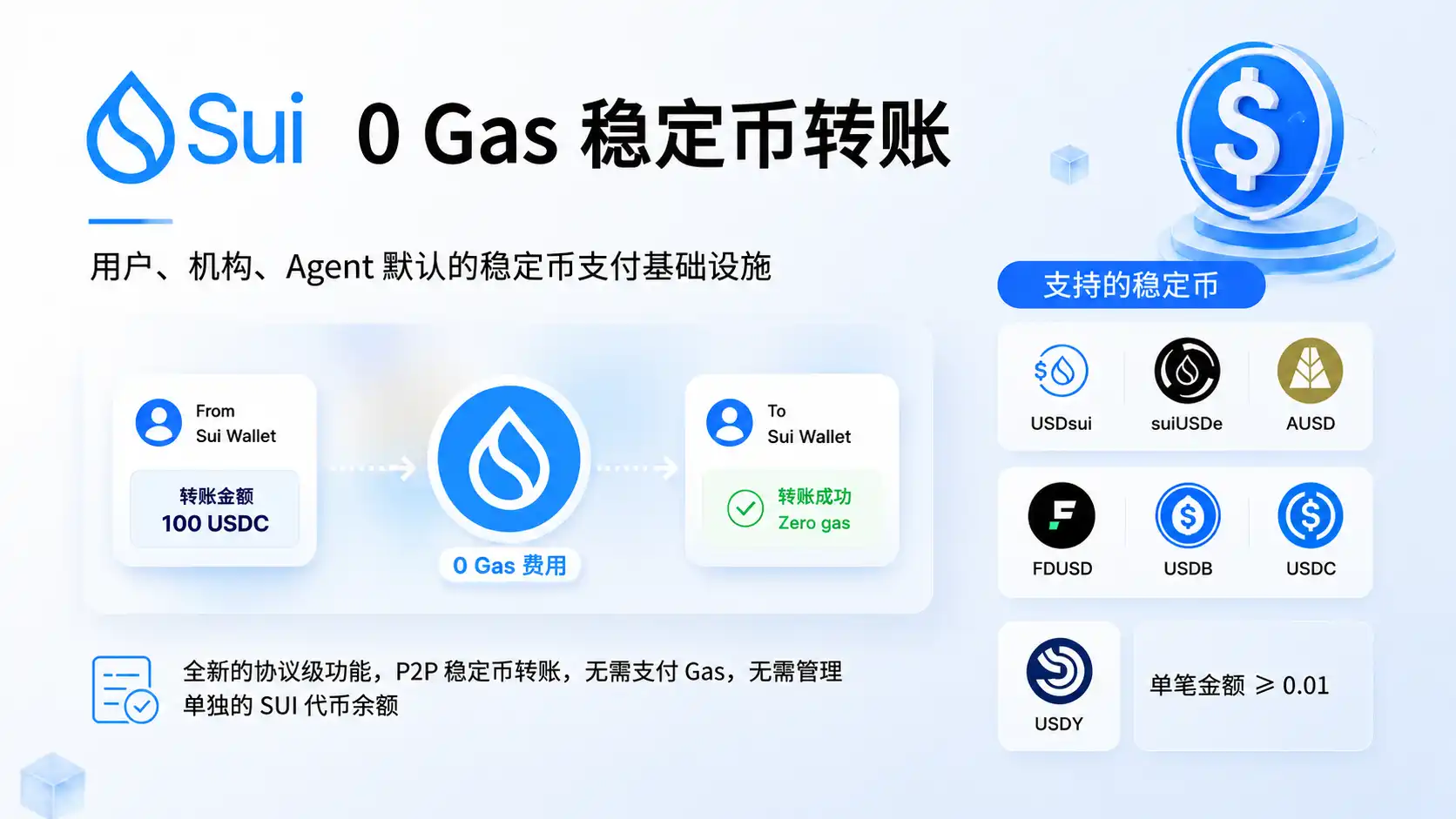
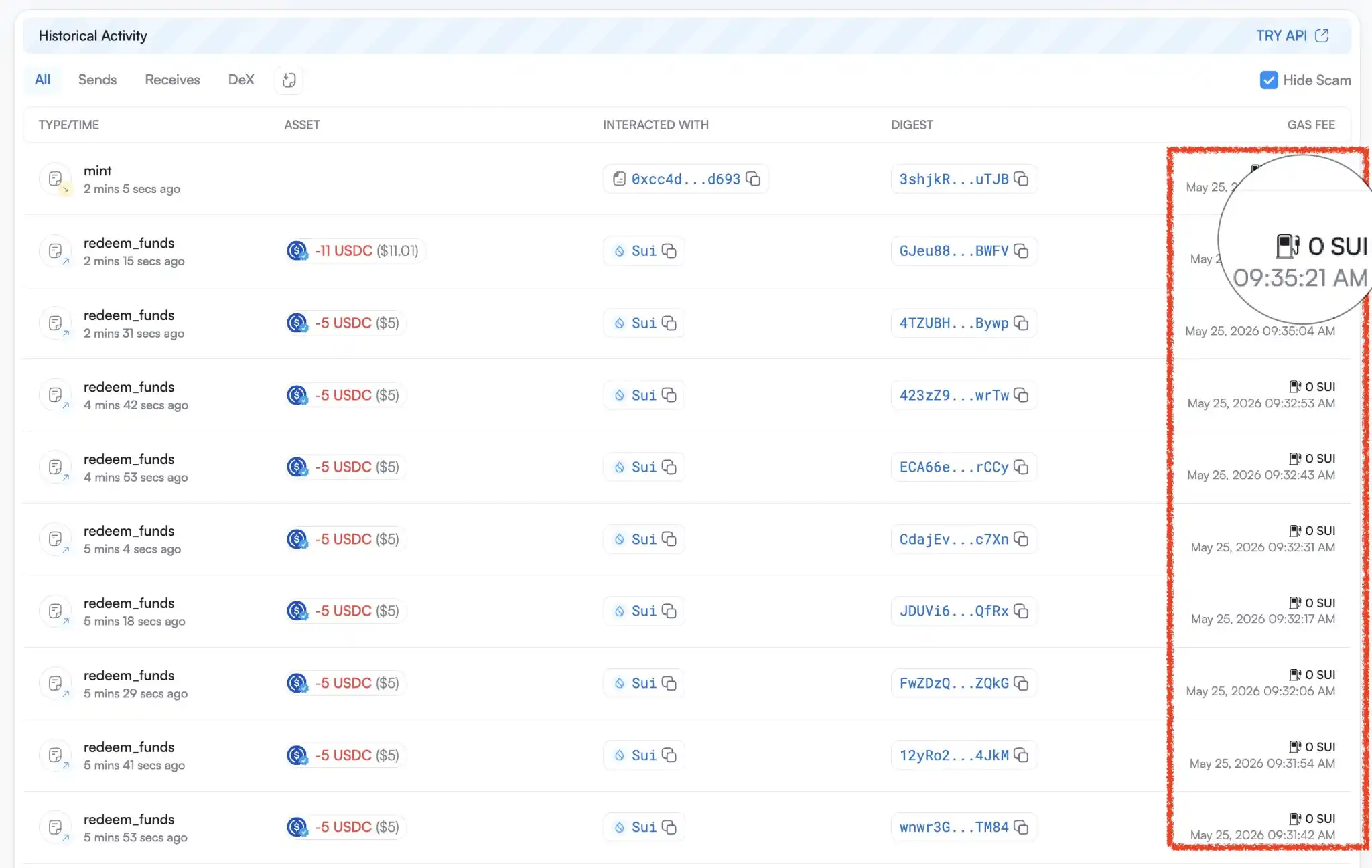
As a key initiative in building the "underlying infrastructure for stablecoin payments," on May 20, 2026, Sui announced the launch of a zero Gas stablecoin transfer feature, allowing users and enterprises to send stablecoins peer-to-peer without paying Gas fees, and without needing to manage a separate SUI token balance.

Although currently, this feature only supports P2P transfers of whitelisted stablecoins, stablecoins now have a real chance to transform from "crypto assets" into "payment infrastructure." The entity achieving this also further strengthens its position as a strong contender for the role of the "default foundation for stablecoin payments."
A New Kind of "Zero Gas": No One Is Paying for You in the Background

When mentioning zero Gas, most users' first reaction might be: Who paid the Gas for me?

This habitual thinking stems from past incomplete attempts at "zero Gas": either through subsidies or relays. The Gas never disappeared; someone was just quietly settling the bill in the background, a superficial solution that doesn't address the root cause.

Sui's "Zero Gas Stablecoin Transfer" targets the fundamental root.

It is built upon a new underlying account architecture called Address Balances. When tokens are sent using specific Move functions, they are automatically consolidated into the single balance of the recipient's address, eliminating the need to create or manage Coin objects. This saves the overhead of object creation, splitting, merging, and version tracking. The processing cost for validators is extremely low, low enough that they can refrain from charging users fees.

Costs are reduced, and boundaries must also be clearly defined: Under the highly restricted PTB mechanism, only P2P transfers of whitelisted stablecoins, with amounts no less than 0.01, are judged as zero Gas. This supports payment scenarios while isolating malicious transactions.
What Can This Infrastructure Run?

Firstly, it opens the door to daily payments. When the experience is frictionless and the cost is zero, those payment scenarios we once pinned high hopes on for stablecoins—including consumption, tipping, subscriptions, cross-border remittances, etc.—gain the potential for rapid penetration. Stablecoin payments, for the first time, possess the basic conditions to compete head-on with traditional payment tools, potentially even faster and better.

Of course, for high-frequency micro-payment scenarios, many will think of the Agent economy. In the past, actions like AI autonomous transactions and arbitrage required additional Gas management. The zero Gas stablecoin transfer will become the lowest-cost, least-resistance choice for Agents. Combined with Sui's high-performance advantages, it will further support the large-scale deployment of autonomous payment flows.

Another keyword is: Institutions. This is a group Sui officials specifically emphasize. Whether it's cross-border B2B payments, supplier settlements, or platform profit sharing, institutions often face higher payment friction. The protocol-level zero Gas mechanism transforms stablecoins into a payment tool that institutions can directly utilize.

Worth mentioning is that when the zero Gas feature was launched, Fireblocks had already announced support for address balances, and soon after, it supported Gas-free stablecoin transfers, further enhancing the accessibility of Sui's payment infrastructure for institutions. At the same time, several institutional-grade custody platforms and wallets have announced they will support zero Gas transactions.

Zero Gas: The First Half; Privacy: The Second Half

Since August 2025, stablecoin transfer volume on the Sui network has exceeded $1 trillion. This figure is sufficient to show that the underlying logic for stablecoin payments in the Sui ecosystem is already working. The launch of zero Gas stablecoin transfers will undoubtedly accelerate the construction of Sui's role as the "default foundation for stablecoin payments."

But this is only the first half of Sui's 2026 payment narrative.

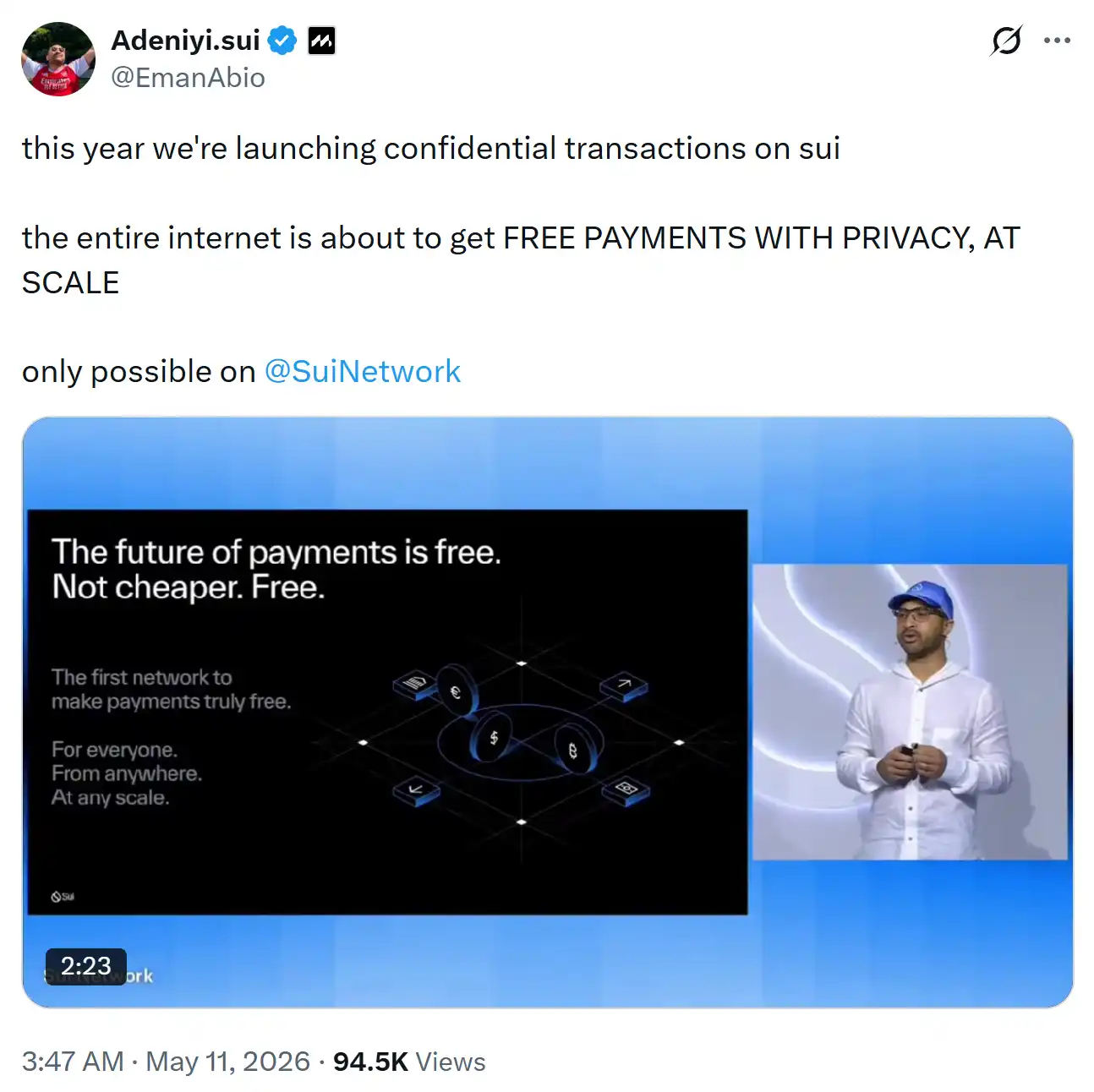
Regarding the second half, the Mysten Labs product team has hinted multiple times: Protocol-level confidential transaction functionality will be launched within 2026, aiming to achieve large-scale, free payments with privacy protection.

Transfers will not only be cost-free but will also be able to hide transaction amounts and certain details, while retaining necessary audit and compliance capabilities.

This combination is crucial for adoption, especially for institutions. The higher the compliance requirements, the greater the value of confidential transactions.
Let Money Flow Like Information.

This can be considered a phrase that runs through all of Sui's technological and ecosystem initiatives.

And now, from payments to Agents to institutions, the fuse that will decide large-scale adoption might just be lit by zero Gas stablecoin transfers.

Kripto yang Sedang Tren

Pertanyaan Terkait

QWhat is the main announcement made by Sui regarding stablecoin transfers, and when was it announced?

ASui announced a zero Gas stablecoin transfer function on May 20, 2026. This feature allows users and businesses to send stablecoins peer-to-peer without paying Gas fees and without needing to manage a separate SUI token balance.

QHow does Sui's 'zero Gas' mechanism for stablecoin transfers fundamentally differ from previous attempts at eliminating Gas fees?

AUnlike previous methods that relied on subsidies or relayers where someone else ultimately pays the Gas, Sui's approach targets the underlying architecture. It is built on the new Address Balances system, where tokens are sent using specific Move functions and automatically merged into the recipient's single balance. This eliminates the overhead of creating, splitting, merging, and tracking Coin objects, reducing validator processing costs so low that fees can be waived for the user.

QAccording to the article, what are some of the key use cases or scenarios enabled by zero Gas stablecoin transfers on Sui?

AThe key use cases include: 1) Everyday payments like consumption, tipping, subscriptions, and cross-border remittances. 2) High-frequency micropayments for the Agent/AI economy, enabling autonomous transactions with minimal cost. 3) Institutional payments such as cross-border B2B payments, supplier settlements, and platform revenue sharing, where reducing friction is crucial.

QWhat is the 'second half' or next major development in Sui's 2026 payment narrative mentioned in the article?

AThe 'second half' of Sui's 2026 payment narrative is the planned launch of a protocol-level confidential transaction feature within the year. The goal is to enable large-scale, free (zero Gas), and privacy-preserving payments that can hide transaction amounts and certain details while retaining necessary audit and compliance capabilities.

QWhat underlying technical principle allows Sui to offer zero Gas fees for eligible stablecoin transfers?

AIt is enabled by the new Address Balances account architecture. When tokens are sent using specific Move functions, they are automatically merged into the recipient's address balance without creating individual Coin objects. This drastically reduces the computational overhead (like object creation, splitting, merging, and version tracking) for validators, making the cost so low that fees are not charged to users for qualifying transactions.

Bacaan Terkait

Bitcoin Mungkin Belum Selesai Mengalami Kapitulasi - Mengapa Dasar Harga $50.000 Masih Berpeluang

Bitcoin (BTC) saat ini menghadapi ujian teknis dan makroekonomi yang signifikan. Aset kripto ini telah mencatatkan tiga kuartal kerugian berturut-turut, sebuah tren yang terakhir terlihat pada pasar bearish 2022. Lebih dari 50% pasokan Bitcoin yang beredar saat ini berada dalam posisi rugi (underwater). Yang menarik, pemegang jangka panjang (long-term holders/LTHs), yang menguasai 78% pasokan beredar, justru menunjukkan ketahanan dengan terus mengakumulasi aset dan tidak menjual selama pelemahan ini. Pasokan LTH bahkan mencapai rekor tertinggi pada Juni, menunjukkan pola yang berbeda dari siklus sebelumnya di mana penyerahan (capitulation) LTH biasanya menandai titik terendah pasar. Namun, tekanan dari lingkungan makroekonomi bisa menjadi ujian terberat. Ekspektasi pasar terhadap kebijakan Federal Reserve telah bergeser, dengan probabilitas kenaikan suku bunga pada bulan September meningkat. Hal ini mengindikasikan kondisi keuangan yang lebih ketat di masa mendatang. Secara historis, pasar bearish Bitcoin pada 2018 dan 2022 tidak mencapai dasar hingga mencatatkan sembilan bulan penurunan berturut-turut. Siklus saat ini baru mencapai tujuh bulan. Jika pola ini berlanjut, fase capitulation mungkin belum selesai. Titik terendah yang berkelanjutan baru akan terbentuk setelah LTH mulai menyerah, dan potensi pergerakan menuju level $50.000 pada akhir kuartal ketiga masih mungkin terjadi sebelum pembentukan dasar pasar yang sebenarnya.

ambcrypto1j yang lalu

Bitcoin Mungkin Belum Selesai Mengalami Kapitulasi - Mengapa Dasar Harga $50.000 Masih Berpeluang

ambcrypto1j yang lalu

Menghitung Mundur Q-Day: Akankah Komputasi Kuantum Mengakhiri Mata Uang Kripto?

**Ringkasan: Ancaman Komputasi Kuantum terhadap Dunia Kripto dan Upaya Menghadapinya** Komputasi kuantum, yang diwakili oleh algoritme seperti Shor, berpotensi meruntuhkan fondasi kriptografi kunci publik (seperti ECC dan RSA) yang menjadi tulang punggung blockchain dan cryptocurrency. Momen ketika hal ini menjadi kenyataan dikenal sebagai "Q-Day", diprediksi terjadi sekitar tahun 2035–2045. Menggunakan ketidaksetaraan Mosca (X + Y > Z), terlihat bahwa proses migrasi ke sistem tahan-kuantum harus dimulai sekarang, mengingat data sensitif hari ini dapat dikumpukan dan dipecahkan di masa depan. Solusi praktis yang sedang dikembangkan adalah **Kriptografi Pasca-Kuantum (PQC)**, yaitu algoritme yang berjalan di komputer klasik namun tahan terhadap serangan kuantum. NIST telah menstandarisasi algoritme inti seperti ML-KEM, ML-DSA, dan SLH-DSA. Strategi migrasi melibatkan **penerapan hybrid** (menggabungkan algoritme lama dan baru) dan meningkatkan **kelincahan kriptografi** sistem. **Dampak pada Blockchain** bersifat sistemik. Bitcoin menghadapi risiko tinggi pada aset di alamat lama yang kunci publiknya sudah terpapar di chain, serta tantangan teknis (seperti pembengkakan ukuran tanda tangan) dan **tantangan politik** yang kompleks terkait bagaimana menangani aset warisan (legacy) yang tidak bermigrasi. Ethereum, dengan strategi "Lean", berencana melakukan migrasi bertahap di seluruh lapisan (eksekusi, konsensus, data) dengan memanfaatkan **abstraksi akun** dan **lapisan-2** sebagai tempat uji coba. Kesimpulannya, komputasi kuantum bukanlah "hari kiamat" bagi cryptocurrency, melainkan **ujian tekanan ekstrem** yang memaksa seluruh ekosistem untuk bermigrasi. Bitcoin diuji pada konsensus sosial dan tata kelola propertinya, sementara Ethereum diuji pada kompleksitas rekayasa seluruh tumpukan teknologinya. Jendela waktu untuk melakukan transisi yang terkoordinasi dengan baik diperkirakan hanya tersisa **5-8 tahun**, sehingga persiapan dan aksi kolaboratif dari seluruh pemangku kepentingan (pengembang, bursa, dompet, dan pengguna) sangat mendesak.

marsbit7j yang lalu

Menghitung Mundur Q-Day: Akankah Komputasi Kuantum Mengakhiri Mata Uang Kripto?

marsbit7j yang lalu

Trading

Spot

Artikel Populer

Cara Membeli GAS

Selamat datang di HTX.com! Kami telah membuat pembelian GAS (GAS) menjadi mudah dan nyaman. Ikuti panduan langkah demi langkah kami untuk memulai perjalanan kripto Anda.Langkah 1: Buat Akun HTX AndaGunakan alamat email atau nomor ponsel Anda untuk mendaftar akun gratis di HTX. Rasakan perjalanan pendaftaran yang mudah dan buka semua fitur.Dapatkan Akun SayaLangkah 2: Buka Beli Kripto, lalu Pilih Metode Pembayaran AndaKartu Kredit/Debit: Gunakan Visa atau Mastercard Anda untuk membeli GAS (GAS) secara instan.Saldo: Gunakan dana dari saldo akun HTX Anda untuk melakukan trading dengan lancar.Pihak Ketiga: Kami telah menambahkan metode pembayaran populer seperti Google Pay dan Apple Pay untuk meningkatkan kenyamanan.P2P: Lakukan trading langsung dengan pengguna lain di HTX.Over-the-Counter (OTC): Kami menawarkan layanan yang dibuat khusus dan kurs yang kompetitif bagi para trader.Langkah 3: Simpan GAS (GAS) AndaSetelah melakukan pembelian, simpan GAS (GAS) di akun HTX Anda. Selain itu, Anda dapat mengirimkannya ke tempat lain melalui transfer blockchain atau menggunakannya untuk memperdagangkan mata uang kripto lainnya.Langkah 4: Lakukan trading GAS (GAS)Lakukan trading GAS (GAS) dengan mudah di pasar spot HTX. Cukup akses akun Anda, pilih pasangan perdagangan, jalankan trading, lalu pantau secara real-time. Kami menawarkan pengalaman yang ramah pengguna baik untuk pemula maupun trader berpengalaman.

273 Total TayanganDipublikasikan pada 2024.12.12Diperbarui pada 2026.06.02

Cara Membeli GAS

Diskusi

Selamat datang di Komunitas HTX. Di sini, Anda bisa terus mendapatkan informasi terbaru tentang perkembangan platform terkini dan mendapatkan akses ke wawasan pasar profesional. Pendapat pengguna mengenai harga GAS (GAS) disajikan di bawah ini.

活动图片