WeChat AI Card Hands-On Guide: Has the AI Shopping Era Arrived?

marsbitDipublikasikan tanggal 2026-06-18Terakhir diperbarui pada 2026-06-18

Abstrak

**"WeChat AI Card" Practical Test Guide: Has the Era of AI Shopping Arrived?** WeChat has officially launched the "AI Exclusive Card," a feature integrated into its Workbuddy AI assistant. This card is designed to handle payments for AI-initiated purchases. Our hands-on test reveals it's not yet a tool for fully autonomous AI shopping, but rather a controlled payment layer for AI agents. The AI Card functions as an isolated sub-wallet within WeChat Pay. Users must bind the card and transfer funds into it from their main wallet. Crucially, every transaction requires explicit user confirmation via smartphone scan; AI cannot spend autonomously. Currently accessible through the Workbuddy agent, the card targets specific digital consumption scenarios: purchasing paid content (reports, data), calling paid APIs/tools, and subscribing to services. Its design prioritizes security and control by separating funds and mandating approval for each payment. We tested a real-world scenario: ordering bubble tea via Workbuddy using a "Meituan Life Assistant" skill. The process encountered multiple hurdles: high "skill" usage costs (exceeding daily free credits), and most importantly, while a payment was successfully initiated, the AI purchased an incorrect product (a mismatched group-buy coupon instead of the desired drink). This highlights the current limitation: the **AI Card only solves the payment step**. The broader challenge lies in the **AI agent's execution chain**—accurately unde...

Author: Alan | Biteye Content Team

On June 17th, WeChat's official account "微信派" announced that WeChat Pay has officially launched the AI-exclusive card. According to the official description, users can propose consumption needs in conversations with Workbuddy and complete related payments through the AI-exclusive card.

This sounds quite interesting: in the future, to order a milk tea, purchase a service, or subscribe to a tool, you could just let the AI handle the entire process seamlessly.

However, after practical testing, we found that the WeChat AI-exclusive card currently does not support "fully automated AI consumption." A more accurate understanding is: it is a layer of payment capability opened by WeChat Pay for AI Agents, but each transaction still requires user confirmation. Moreover, whether a purchase can actually be completed depends on the Agent, Skills, third-party platform authorization, and product fulfillment processes.

This article will explore two questions and one hands-on test:

  1. What exactly is the WeChat AI-exclusive card?

  2. What can it do now, and what can't it do?

  3. A practical test: using it to order a cup of milk tea to see how many pitfalls we can encounter.

1. Conclusion First: The WeChat AI-exclusive Card is Not a Card for "AI to Spend Freely"

From a product mechanism perspective, the WeChat AI-exclusive card is more like a "small wallet" isolated from the main WeChat wallet.

Users first need to bind the AI-exclusive card and then transfer funds from their WeChat wallet to this card. Subsequently, relevant consumption by AI Agents will be deducted from this independent balance first, rather than directly from the user's daily WeChat wallet funds.
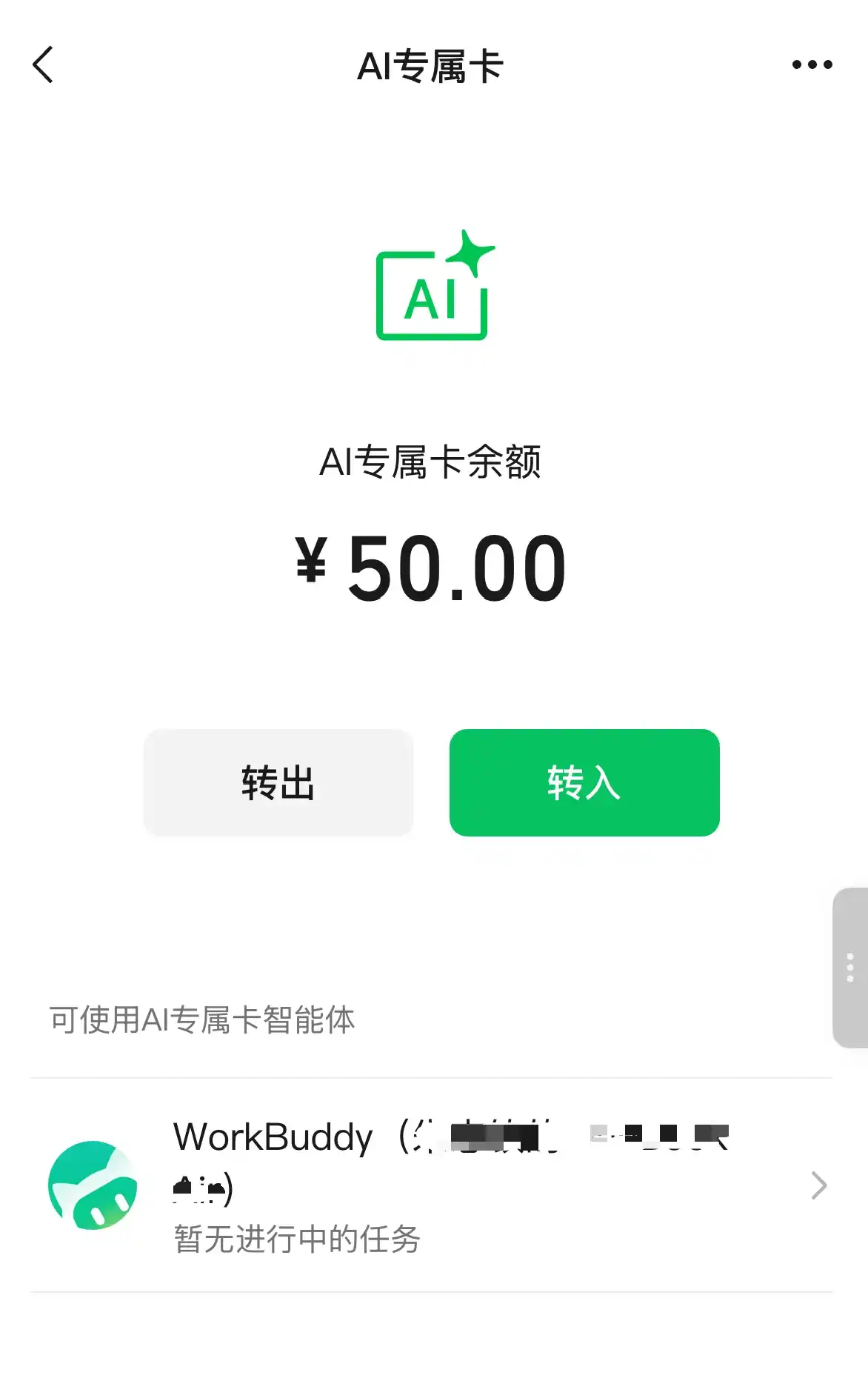
Simply put, it primarily addresses three questions:

First, where does the money for AI consumption come from.

The AI-exclusive card has an independent balance, making financial boundaries clearer.

Second, whether AI consumption can be controlled.

Each payment still essentially requires user confirmation on the mobile device after scanning a QR code; it's not automatic deduction by the AI.

Third, how AI consumption records are managed.

AI-related expenses are separated from ordinary WeChat Pay transactions, making them easier to view and manage.

2. How to Activate: Entry Point is in the Workbuddy Conversation

WorkBuddy is a desktop office efficiency agent launched by Tencent, closer to an Agent workbench, with an interface similar to CodeX. It can understand user goals in conversation and then use different "expert" Agents or Skills to call external capabilities to complete tasks, such as office processing, information queries, and local life services.
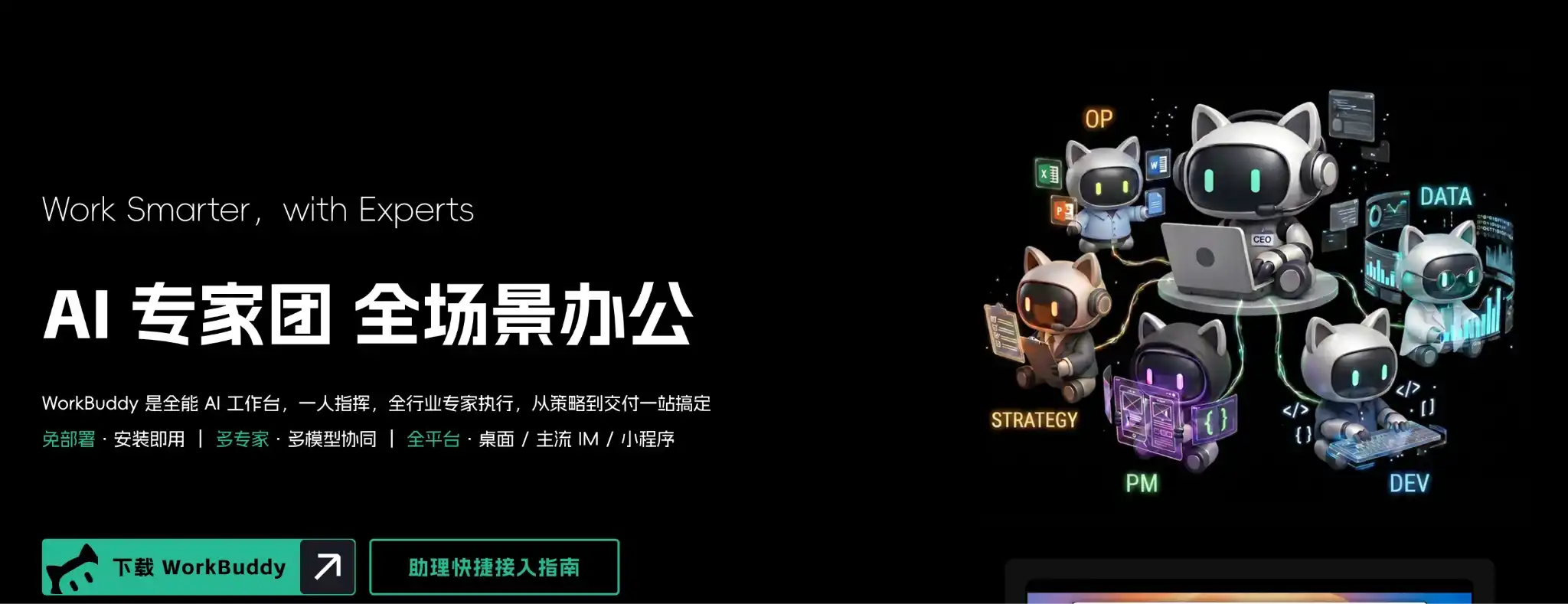
This time, WeChat Pay's AI-exclusive card was first integrated into WorkBuddy, which also implies that WeChat Pay is not directly opening up to all AI applications. Instead, it is first testing the complete process of "AI initiating payment, user confirming deduction" within a relatively controlled Agent scenario.

The actual activation process is not complicated:

Step One, ask in the Workbuddy dialog:

"How do I use the WeChat AI-exclusive payment card?"

The Agent will return a jump link ⬇️
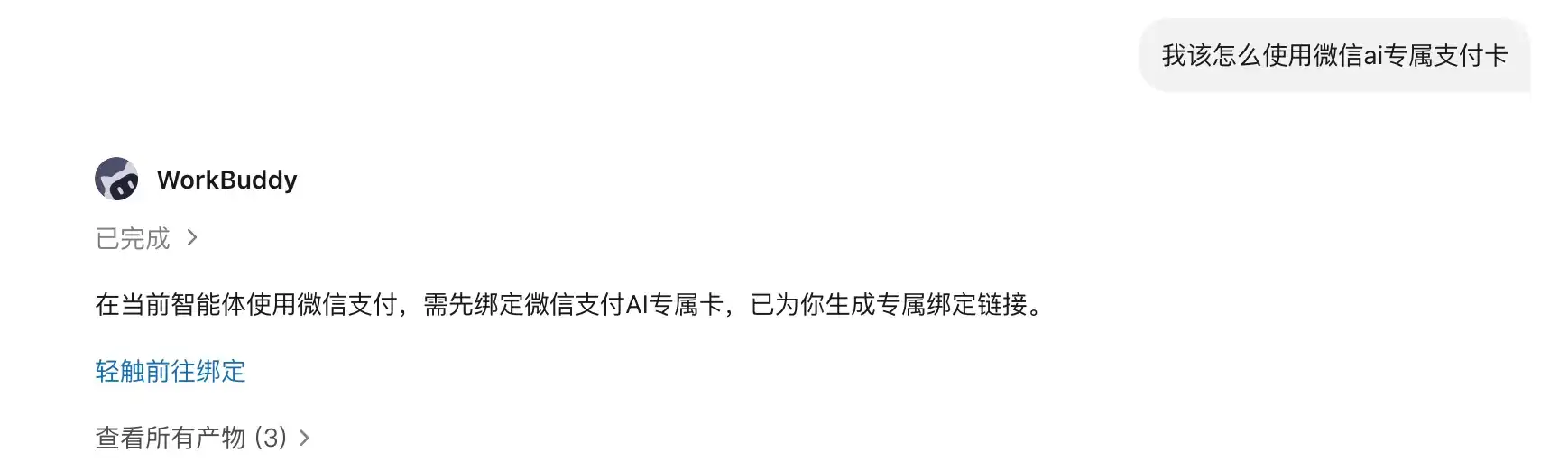
Step Two, after clicking the link, you need to scan a QR code with WeChat to complete the binding.
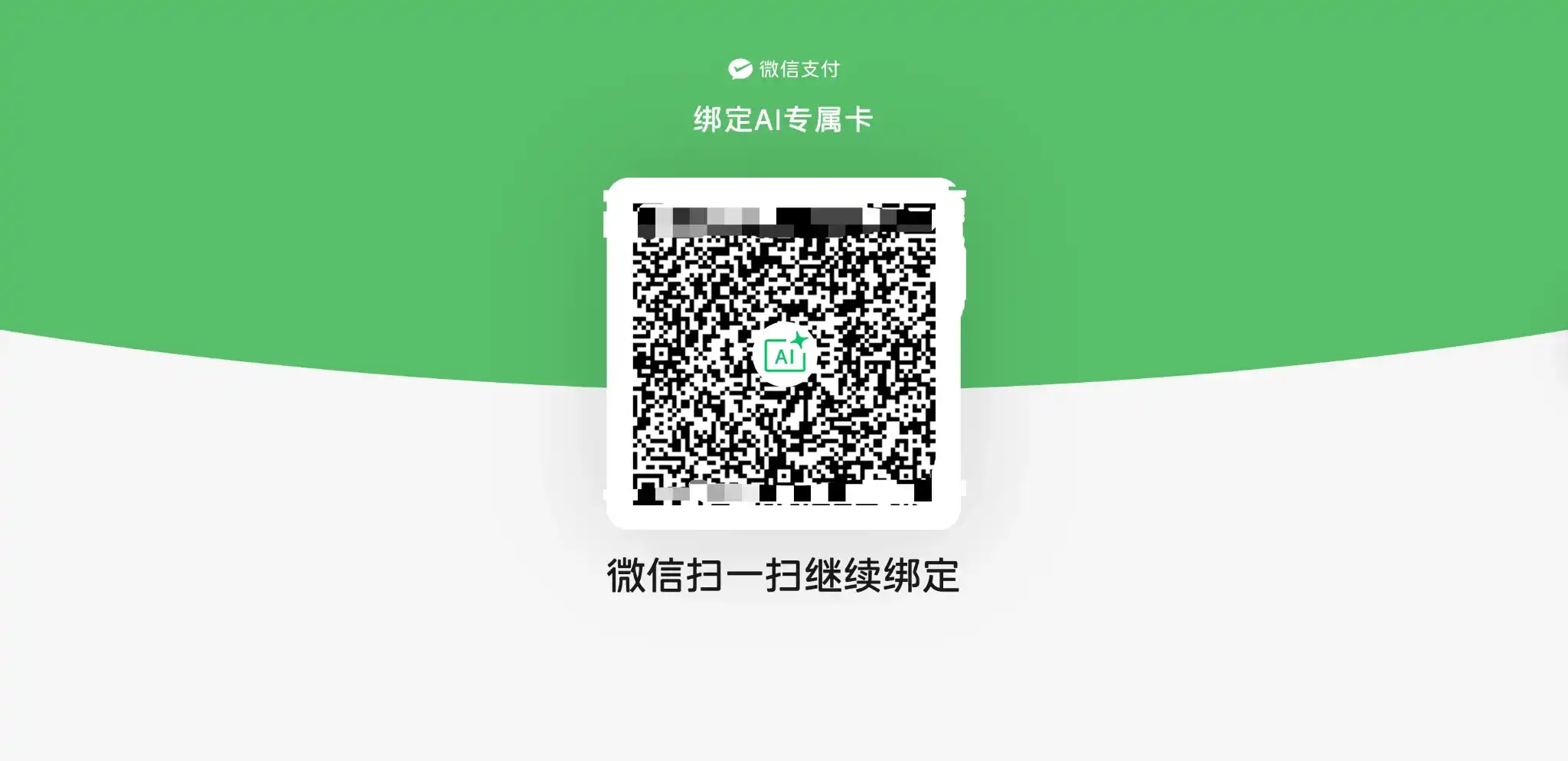
A small detail here: the binding link is only valid for 5 minutes after generation, so you need to scan the code promptly.

Step Three, read and agree to the relevant agreements, and after entering your payment password, you can complete the binding.

Step Four, after binding is complete, users can transfer funds from their original WeChat wallet to the AI-exclusive card.
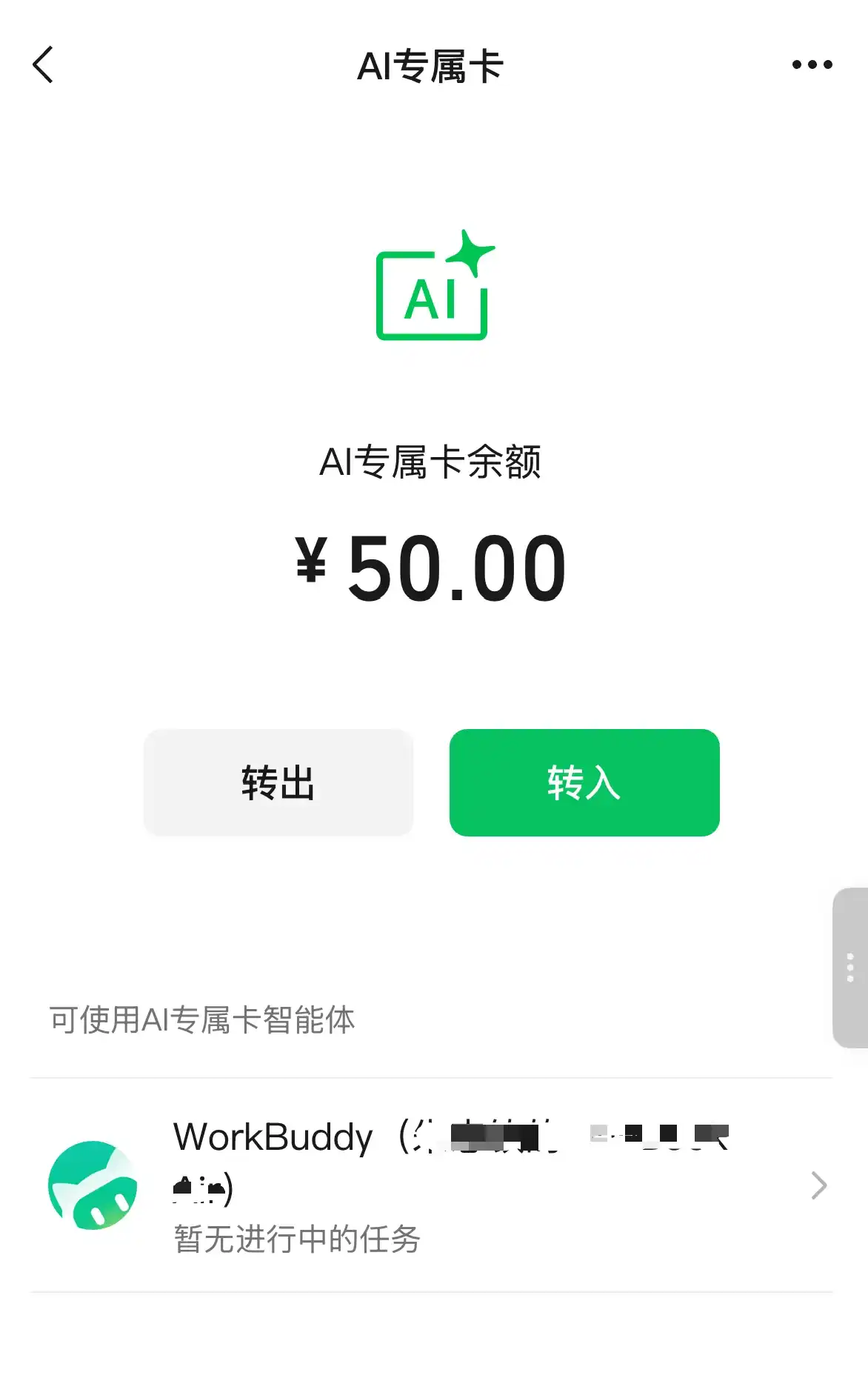
The activation and top-up experience is quite smooth. However, the real challenge with AI payment doesn't lie in "how to get the card," but in what happens after you get it—can the AI actually help users complete purchases smoothly?

3. What Scenarios Is It Currently Suitable For?

According to Workbuddy's explanation, the AI-exclusive card is mainly intended for several types of AI consumption scenarios:

1️⃣ Purchasing Paid Content

Such as reports, data, professional analysis services, etc.

2️⃣ Calling Paid APIs or Tools

Such as certain online plugins, professional database queries, tool capabilities charged per use.

3️⃣ Subscribing to or Renewing Services

Such as in-platform value-added features, membership services, etc.

These scenarios share a common point: the payment objects are relatively standardized, the consumption chain is short, and the fulfillment method is quite clear.

However, unfortunately, so far, our tests have not identified any of these three types of applications within Workbuddy that can directly trigger payment using the AI-exclusive card. According to Workbuddy, it needs to trigger certain specific built-in paid features ⬇️
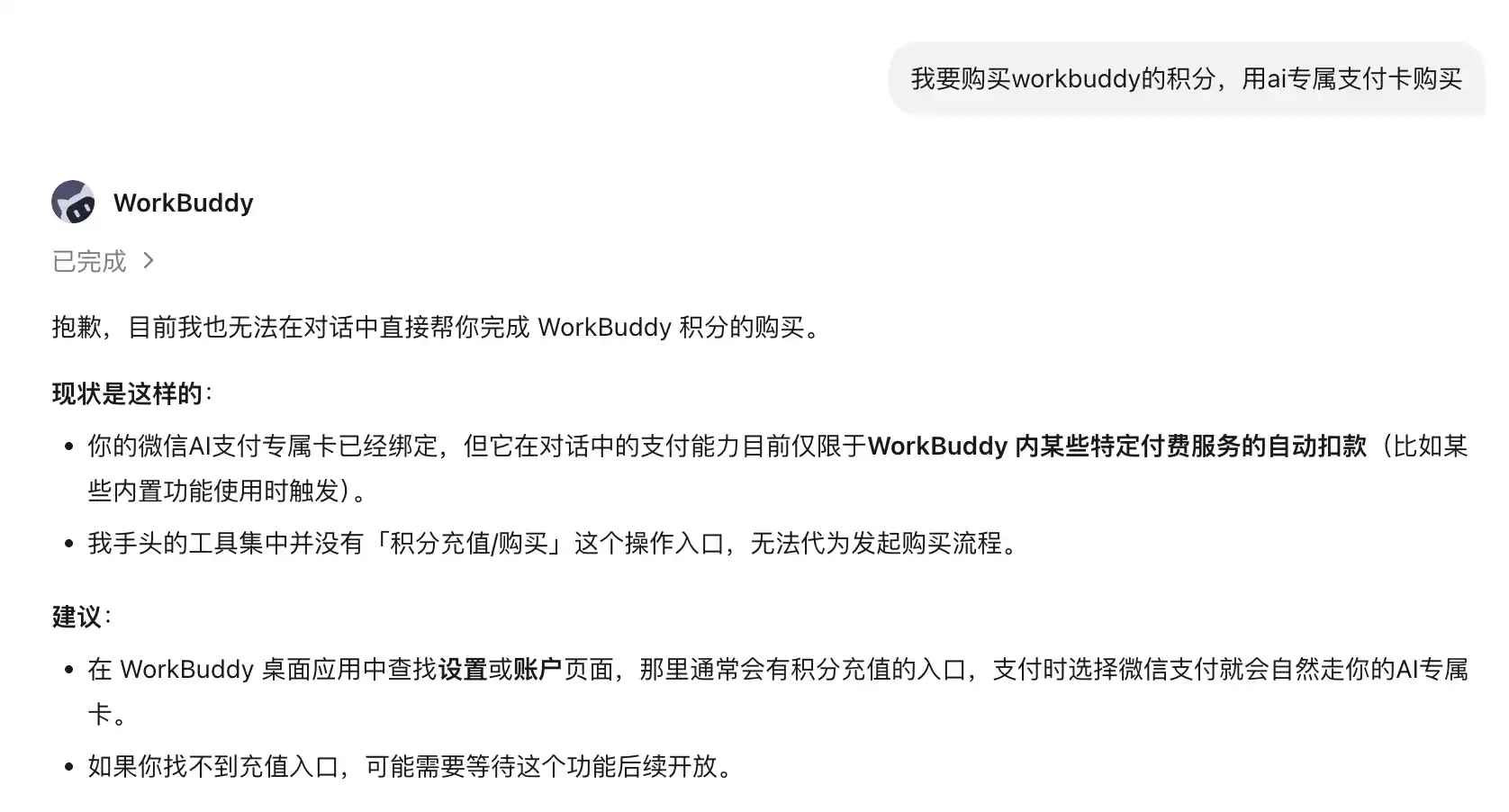
4. Hands-on Test: Asking Workbuddy to Order a Heytea for Me—Failed

🥤 We tried one of the most intuitive life scenarios: asking Workbuddy to order a cup of Heytea for me.

The first step encountered a limitation. Workbuddy itself cannot directly fulfill such takeout or beverage ordering needs; it requires calling the corresponding life service Skill.
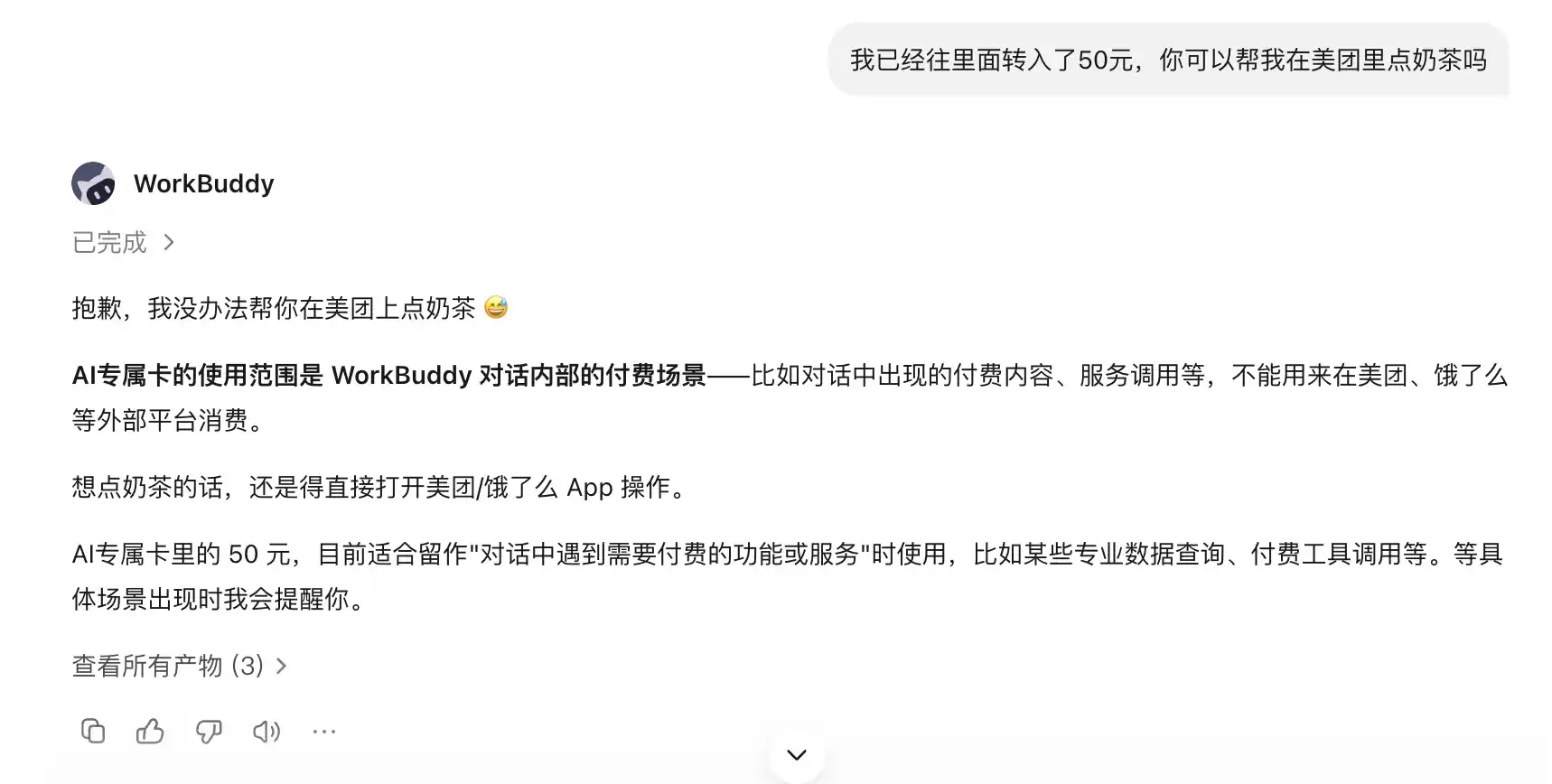
Therefore, following WeChat's official demonstration, we selected the "Meituan Life Assistant" Skill.

This step introduced a new cost issue: just generating the QR code to log into the Meituan account consumed 185.37 points. In comparison, Workbuddy awards 150 points daily upon login.

This means that before even starting the actual order, the step of just authorizing the login had already exceeded the daily free point allowance.

After completing the account login authorization, we continued to ask it to order milk tea. When the AI-exclusive card payment link popped up, the experience did indeed feel close to "AI buying something for me."
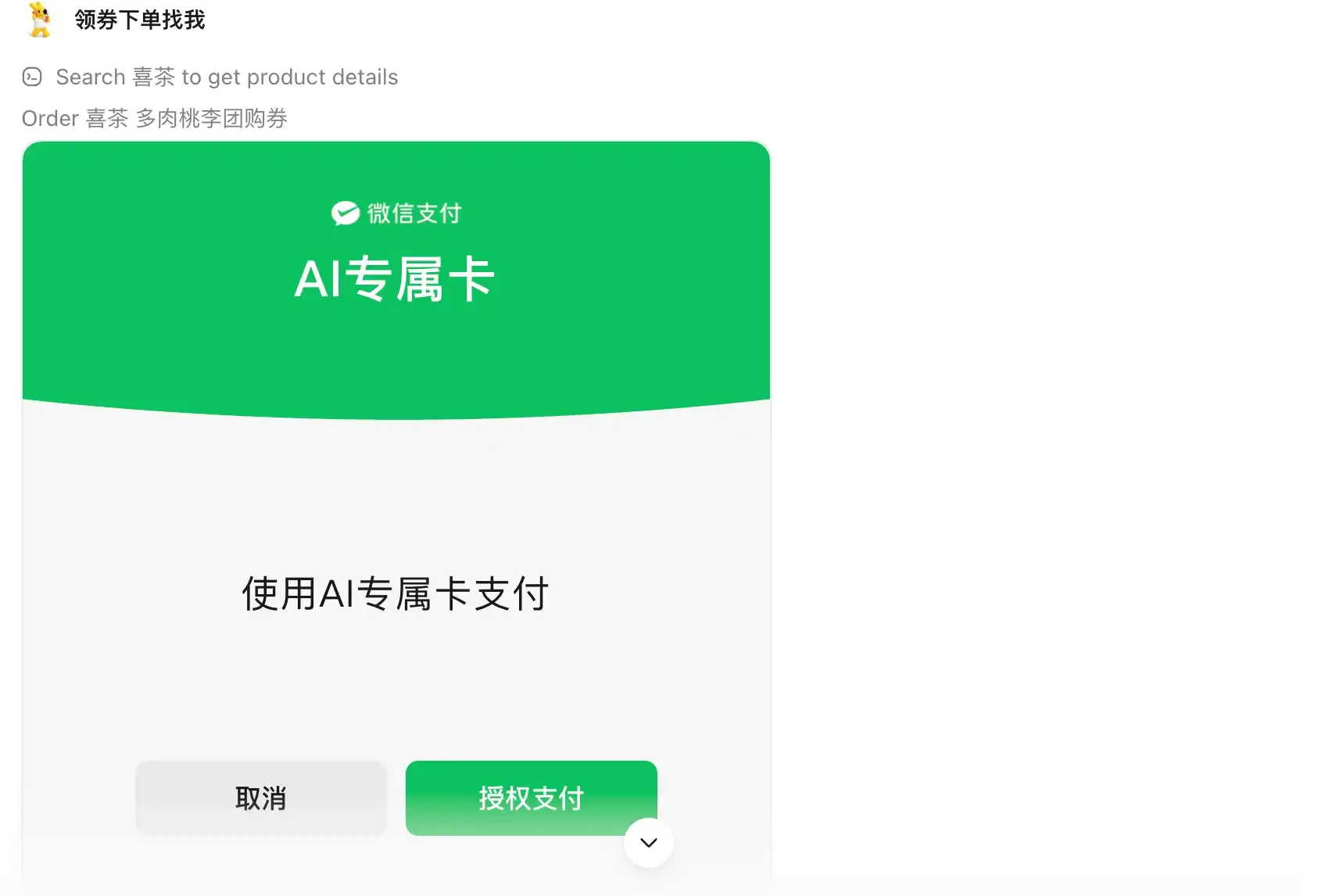
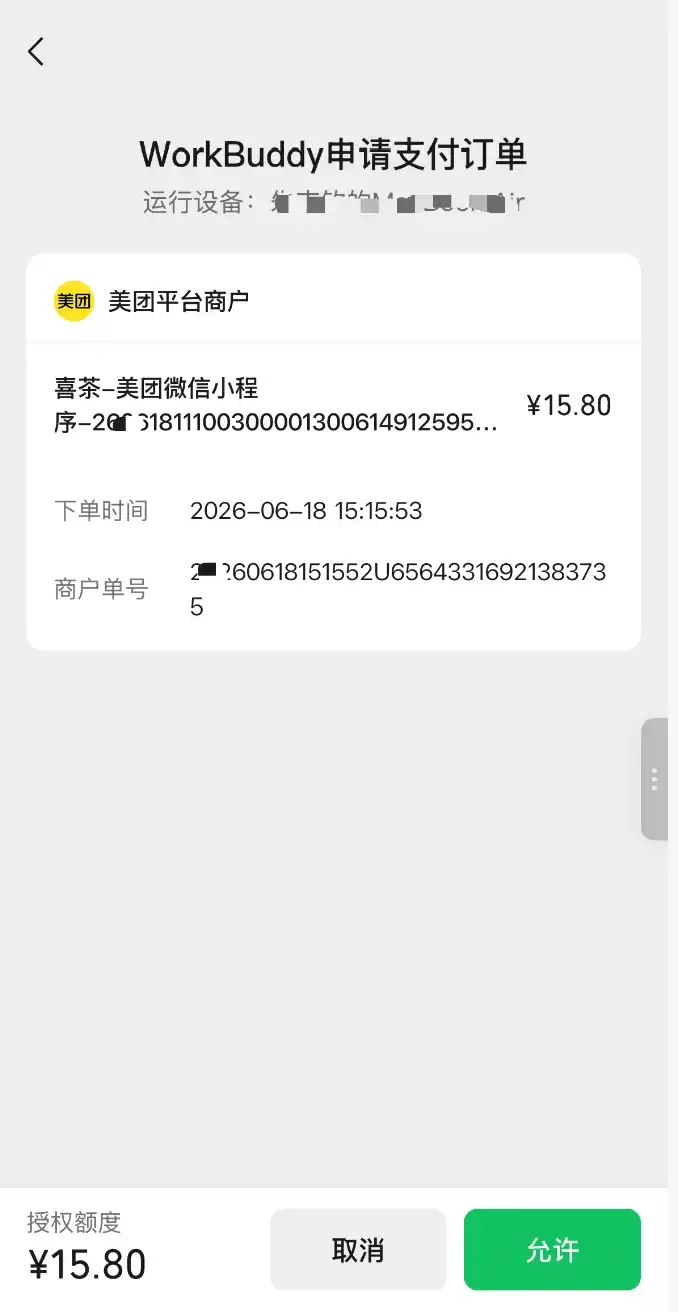
However, after payment, we discovered that what Workbuddy actually purchased was not the specific cup of milk tea we wanted, but a Meituan group-buying coupon that didn't match our needs.

The payment action was completed, but the purchase result did not align with the user's needs.

5. Reasons for Failure: The Problem Isn't with Payment, but with the Agent Execution Chain

In fact, this failure cannot be simply attributed to the AI-exclusive card being "not useful." More accurately, the AI-exclusive card is responsible for the payment capability, not the complete purchasing capability.

What really got stuck was the Agent execution chain.

A task like "help me order a cup of milk tea" involves at least the following steps:

Identifying user needs, calling a third-party platform, completing account authorization, selecting the correct product, confirming the fulfillment method, initiating payment, user confirming payment, completing subsequent fulfillment...

The AI-exclusive card only covers the "payment" part. As for the preceding steps like product identification, platform redirection, account authorization, product matching, and the subsequent delivery or verification, they all deeply rely on the capabilities of the Agent and third-party Skills.

Therefore, in this test, the AI did trigger the payment, but it did not complete the "correct purchase."

This is a common issue many AI Agents currently face: they can call tools, but they are not yet guaranteed to reliably complete complex real-world tasks.

6. Current Mechanism: Users Still Hold Final Payment Confirmation Authority

From a security perspective, the AI-exclusive card does not allow the AI to bypass the user and make payments directly.

The current mechanism can be roughly summarized as:

Aspect

Current Mechanism

Source of Funds

Only uses the independent balance in the AI-exclusive card

Payment Confirmation

Every payment requires user confirmation on the mobile device

Main Account

Does not directly deduct funds from the main WeChat account

In-Store Goods

After payment is completed, the user still needs to go to the store for verification/redemption

This design is relatively restrained and aligns with the current realistic state of AI consumption scenarios.

If the AI could directly and autonomously make payments, the risks would actually be very high: buying the wrong product, duplicate orders, accidental subscriptions, or induced consumption could all become real problems.

Therefore, the WeChat AI-exclusive card currently functions more like a small WeChat wallet with controllable limits, confirmation for each transaction, and isolation from the main account.

Final Thoughts

If you just want to experience the WeChat AI-exclusive payment card, you can try activating it. However, it is recommended to start with low-amount, low-risk, digital service scenarios first. But please keep the following three points in mind:

1️⃣ Top up with a small amount first; don't deposit too much at once.

2️⃣ Carefully check the product name, amount, and fulfillment method before paying.

3️⃣ Do not assume that the AI Agent has understood your real needs, especially when it involves specific stores, delivery, group-buying coupons, or packages.


Kripto yang Sedang Tren

Pertanyaan Terkait

QWhat is the core function of WeChat's AI-specific card according to the article?

AAccording to the article, the core function of WeChat's AI-specific card is to act as an isolated 'small wallet' or a payment capability layer for AI Agents. It provides a separate balance for AI-related transactions, requiring user confirmation for each payment. It is designed to clarify the source of funds, give users control over payments, and manage AI spending records separately from regular WeChat Pay transactions.

QHow does a user bind the WeChat AI-specific card, and where is the binding entry?

AThe user binds the WeChat AI-specific card through the WorkBuddy desktop office efficiency Agent. The process involves: 1. Asking 'How do I use the WeChat AI-specific payment card?' in the WorkBuddy dialogue. 2. Clicking the returned jump link, which is only valid for 5 minutes. 3. Scanning the QR code with WeChat to bind. 4. Reading and agreeing to the relevant agreements and entering the payment password to complete the binding.

QWhat are the main payment scenarios that the AI-specific card currently supports?

AThe main payment scenarios supported by the AI-specific card include: 1. Purchasing paid content like reports, data, and professional analysis services. 2. Calling paid APIs or tools, such as online plugins or professional database queries. 3. Subscribing to or renewing services, such as platform add-on features or memberships. These scenarios are characterized by relatively standardized payment objects and shorter consumption chains.

QWhy did the article's test of using WorkBuddy to order bubble tea fail? What was the underlying issue?

AThe test to order bubble tea through WorkBuddy failed because the AI-specific card only handles the payment part of the transaction. The failure occurred earlier in the Agent's execution chain. While the AI successfully triggered a payment, it purchased an incorrect product—a Meituan group purchase coupon instead of the specific tea. The underlying issue is the Agent's inability to correctly handle the complex real-world task chain: identifying user needs, calling third-party platforms (Meituan), completing account authorization, selecting the correct product, and confirming fulfillment methods.

QWhat safety mechanisms are in place for the AI-specific card to prevent uncontrolled AI spending?

AThe safety mechanisms for the AI-specific card include: 1. Using only the independent balance pre-loaded into the AI-specific card, isolating it from the user's main WeChat wallet funds. 2. Requiring explicit user confirmation on their mobile device for every single payment. 3. After payment for physical goods or services, the user is still responsible for on-site verification or fulfillment. This design ensures the user retains ultimate control and prevents risks like buying wrong items, duplicate orders, or unauthorized subscriptions.

Bacaan Terkait

TechFlow Intel: Peluang IPO Anthropic Lebih dari 80%, Iran Tutup Lagi Selat Hormuz Picu Gejolak Harga Minyak

Market memperkirakan Anthropic akan mengumumkan IPO sebelum November 2026, dengan valuasi yang ditargetkan mencapai triliunan dolar. Namun, pertanyaannya adalah apakah valuasi sebesar itu dapat selaras dengan janji keamanan AI inti mereka. Sementara itu, militer Iran kembali mengumumkan penutupan Selat Hormuz, menyebabkan gejolak harga minyak, meskipun data pelacakan kapal menunjukkan beberapa kapal masih melintas. Di sisi lain, Iran melanjutkan pemuatan minyak di Pulau Kharg, dengan hingga 20 juta barel minyak akan memasuki pasar. Di sektor teknologi, merek-merek mulai menggunakan influencer virtual AI untuk pemasaran produk. Elon Musk berbicara tentang menghabiskan "septillion dolar" untuk penelitian antimateri untuk perjalanan antariksa. Goldman Sachs memperingatkan bahwa belanja modal AI senilai $5,3 triliun mendekati titik jenuh kredit. Cloudflare meluncurkan fitur akun sementara untuk agen AI. Google melaporkan lalu lintas IPv6-nya melebihi 50% untuk pertama kalinya. Hyundai Motor Group berencana mengakuisisi 9,65% saham Boston Dynamics. Di pasar saham, investor ritel membeli saham SpaceX senilai $370 juta dalam tiga hari. Di Eropa, terjadi default ekuitas CLO pasca-krisis pertama, menyalakan alarm di pasar kredit. Garis bawah hari ini: Tiga berita tentang Iran, default CLO Eropa, dan peringatan Goldman Sachs semuanya menunjukkan logika dasar yang sama: likuiditas global sedang menyempit dan biaya marginal meningkat di berbagai sektor. Namun, pada saat yang sama, modal masih mencari narasi baru, seperti yang terlihat pada rencana IPO Anthropic, antusiasme ritel terhadap SpaceX, dan visi antimateri Musk.

marsbit4j yang lalu

TechFlow Intel: Peluang IPO Anthropic Lebih dari 80%, Iran Tutup Lagi Selat Hormuz Picu Gejolak Harga Minyak

marsbit4j yang lalu

Pemburu Jadi Mangsa, MEV Bot yang Paling Cuan Diretas

Penyerang MEV Bot yang Terkenal, Jaredfromsubway.eth, Kehilangan Lebih dari $7,5 Juta dalam Serangan 'Perangkap Madu'. Alamat MEV Bot Ethereum yang terkenal dan sangat aktif, Jaredfromsubway.eth, mengalami serangan rantai yang sangat bertarget pada hari Sabtu, yang mengakibatkan kerugian lebih dari $7,5 juta. Menurut investigasi Blockaid, serangan ini bukanlah serangan phishing tradisional atau eksploitasi kerentanan kontrak pintar, melainkan serangan 'perangkap madu MEV balik' (counter-MEV honeypot attack) yang dirancang khusus untuk mengeksploitasi logika perilaku MEV Bot. Penyerang telah menyebarkan 66 kontrak token palsu dan kumpulan likuiditas palsu selama beberapa minggu sebelumnya. Aset-aset ini disamarkan sebagai aset stabil utama seperti WETH, USDC, dan USDT, dan membangun jalur perdagangan arbitrase yang tampak nyata. Rantai serangan berkembang: kumpulan likuiditas palsu menciptakan sinyal 'kesenjangan harga yang dapat diarbitrase'; bot MEV secara otomatis mengidentifikasi peluang dan mengeksekusi perdagangan; bot memberikan otorisasi ke kontrak bantu yang dikendalikan penyerang selama proses perdagangan; otorisasi ini tidak dicabut tepat waktu, menciptakan paparan izin yang terus-menerus; akhirnya, penyerang memanggil logika 'pintu belakang' yang telah dipasang sebelumnya dalam satu transaksi, secara langsung mentransfer aset ETH, USDC, dan USDT yang dipegang oleh alamat MEV bot tersebut. Jaredfromsubway.eth adalah salah satu bot MEV paling aktif dan menguntungkan di jaringan Ethereum, yang terkenal karena menjalankan serangan 'sandwich' secara sistematis untuk menangkap keuntungan dari pergerakan harga. Cointelegraph Research menunjukkan bahwa sekitar 70% dari sekitar 60.000 hingga 90.000 serangan sandwich bulanan di Ethereum antara November 2024 dan Oktober 2025 terkait dengan strateginya. Diperkirakan bot ini telah menghasilkan puluhan juta dolar AS. Peristiwa ini menjadi peringatan keras tentang meningkatnya ancaman keamanan di ekosistem crypto. Bahkan pemain tingkat atas seperti Jaredfromsubway.eth, yang biasanya berada di sisi 'predator', kini menjadi target dari serangan canggih yang mengeksploitasi logika operasional otomatis mereka sendiri. Selain itu, setelah peretasan, sebuah akun X tidak dikenal dengan 94.000 pengikut mengubah namanya menjadi Jaredfromsubway.eth dan secara palsu mengklaim akan menawarkan hadiah $1 juta untuk pengembalian dana, memicu peringatan dari pengembang agar pengguna tetap waspada terhadap kemungkinan penipuan.

marsbit5j yang lalu

Pemburu Jadi Mangsa, MEV Bot yang Paling Cuan Diretas

marsbit5j yang lalu

Trading

Spot
Futures

Artikel Populer

Cara Membeli ERA

Selamat datang di HTX.com! Kami telah membuat pembelian Caldera (ERA) menjadi mudah dan nyaman. Ikuti panduan langkah demi langkah kami untuk memulai perjalanan kripto Anda.Langkah 1: Buat Akun HTX AndaGunakan alamat email atau nomor ponsel Anda untuk mendaftar akun gratis di HTX. Rasakan perjalanan pendaftaran yang mudah dan buka semua fitur.Dapatkan Akun SayaLangkah 2: Buka Beli Kripto, lalu Pilih Metode Pembayaran AndaKartu Kredit/Debit: Gunakan Visa atau Mastercard Anda untuk membeli Caldera (ERA) secara instan.Saldo: Gunakan dana dari saldo akun HTX Anda untuk melakukan trading dengan lancar.Pihak Ketiga: Kami telah menambahkan metode pembayaran populer seperti Google Pay dan Apple Pay untuk meningkatkan kenyamanan.P2P: Lakukan trading langsung dengan pengguna lain di HTX.Over-the-Counter (OTC): Kami menawarkan layanan yang dibuat khusus dan kurs yang kompetitif bagi para trader.Langkah 3: Simpan Caldera (ERA) AndaSetelah melakukan pembelian, simpan Caldera (ERA) di akun HTX Anda. Selain itu, Anda dapat mengirimkannya ke tempat lain melalui transfer blockchain atau menggunakannya untuk memperdagangkan mata uang kripto lainnya.Langkah 4: Lakukan trading Caldera (ERA)Lakukan trading Caldera (ERA) dengan mudah di pasar spot HTX. Cukup akses akun Anda, pilih pasangan perdagangan, jalankan trading, lalu pantau secara real-time. Kami menawarkan pengalaman yang ramah pengguna baik untuk pemula maupun trader berpengalaman.

800 Total TayanganDipublikasikan pada 2025.07.17Diperbarui pada 2026.06.02

Cara Membeli ERA

Diskusi

Selamat datang di Komunitas HTX. Di sini, Anda bisa terus mendapatkan informasi terbaru tentang perkembangan platform terkini dan mendapatkan akses ke wawasan pasar profesional. Pendapat pengguna mengenai harga ERA (ERA) disajikan di bawah ini.

活动图片