Japan's Central Bank on the Verge of Raising Rates, Can the AI Bull Market Still Hold?

marsbitDipublikasikan tanggal 2026-06-15Terakhir diperbarui pada 2026-06-15

Abstrak

TL;DR: The impending Bank of Japan (BOJ) interest rate hike is shifting global market focus this week, raising questions about its potential impact on the AI-driven bull market and cryptocurrencies like Bitcoin. For years, the yen has served as a cheap global "funding currency," enabling carry trades where investors borrowed yen at low rates to buy higher-yielding assets. This dynamic amplified liquidity and risk appetite in global markets, benefiting high-beta assets like AI tech stocks and crypto. The BOJ's expected move to raise rates from 0.75% to 1.0% signals a shift away from this era of ultra-low-cost funding. The core concern isn't the 1% rate itself, but the direction of change and its potential to reduce global leverage and risk tolerance. An unwinding of yen carry trades could force investors to sell global assets to buy back yen for repayment, potentially triggering synchronized volatility in overvalued sectors. While AI fundamentals and crypto-specific drivers remain intact, the market impact will depend on whether the BOJ signals a faster-than-expected pace of normalization. Post-decision, watch for correlations between a strengthening yen, rising Japanese bond yields, and simultaneous pressure on tech stocks and cryptocurrencies to gauge if the market is pricing in a broader tightening of cheap global liquidity.

TL;DR

If you regularly follow the price fluctuations of NVIDIA, Microsoft, Bitcoin, or Ethereum, you typically focus on tracking core variables such as U.S. inflation data, the Federal Reserve's interest rate policy path, AI-related revenue realization, and on-chain capital flows. But this week, the market's attention has been captured by what seems like a more distant variable: the direction of the Bank of Japan's interest rates.

The reason is not complicated. For many years, the yen has been one of the cheapest funding currencies in the world. Investors could borrow low-interest yen, convert it into dollars or other currencies, and then buy higher-yielding, faster-appreciating assets. This is the yen carry trade, simply put, borrowing low-interest yen to buy high-yield assets.

It may not directly appear on a particular AI stock or a specific Bitcoin address, but it can affect global risk appetite and leverage costs. Now, the Bank of Japan is exiting its long-term ultra-low interest rate environment, and the market is beginning to recalculate how much longer this 'low-interest credit card' can be swiped.

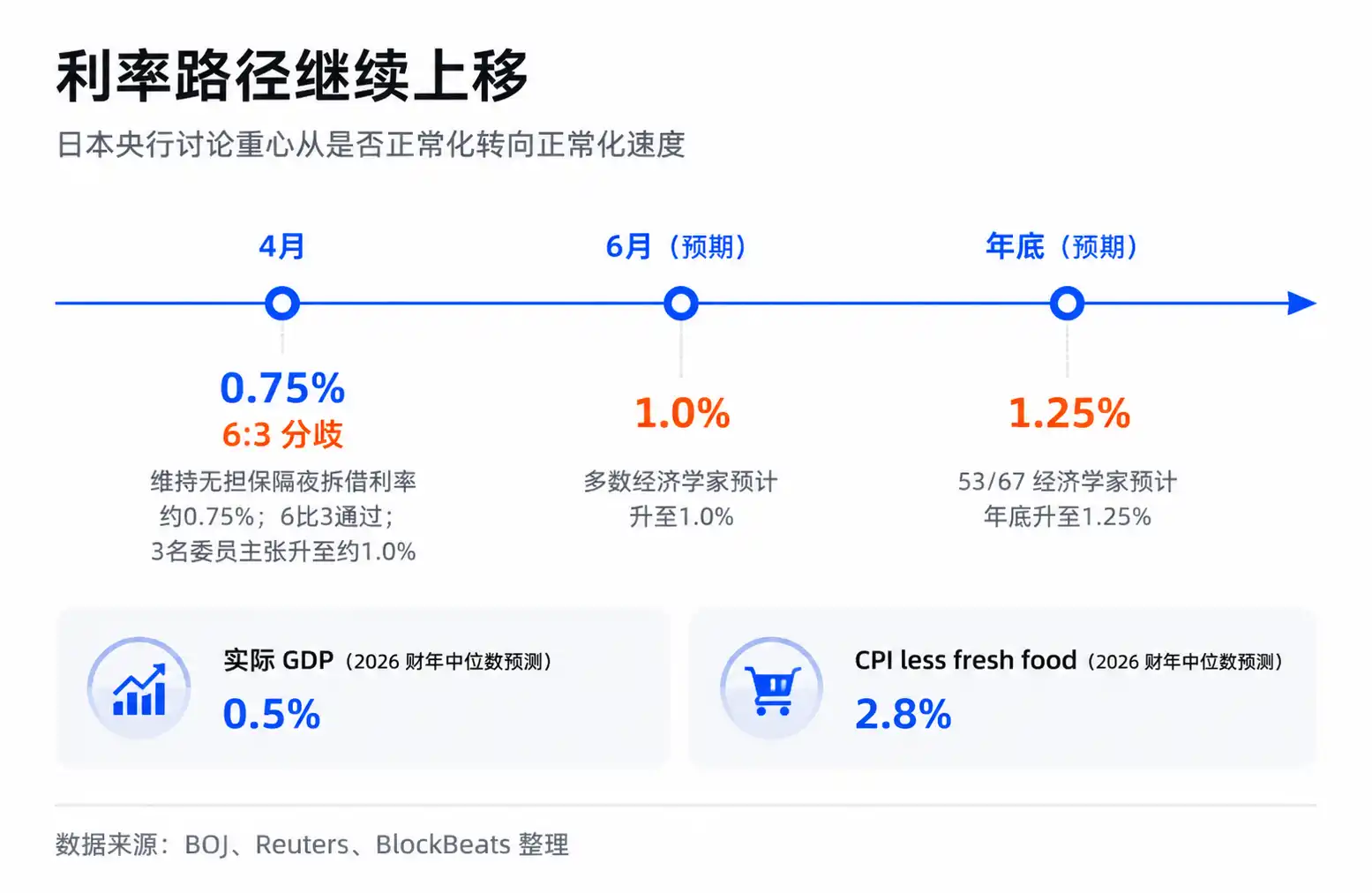
According to a Reuters report on June 10, 66 out of 70 economists expect the Bank of Japan to raise its policy rate from 0.75% to 1.0% at its June meeting. In another survey, 53 out of 67 economists expect the rate to rise to 1.25% by year-end. This meeting will conclude on June 16th. As of June 15th, 1.0% remains the economists' survey expectation, not an already announced result.
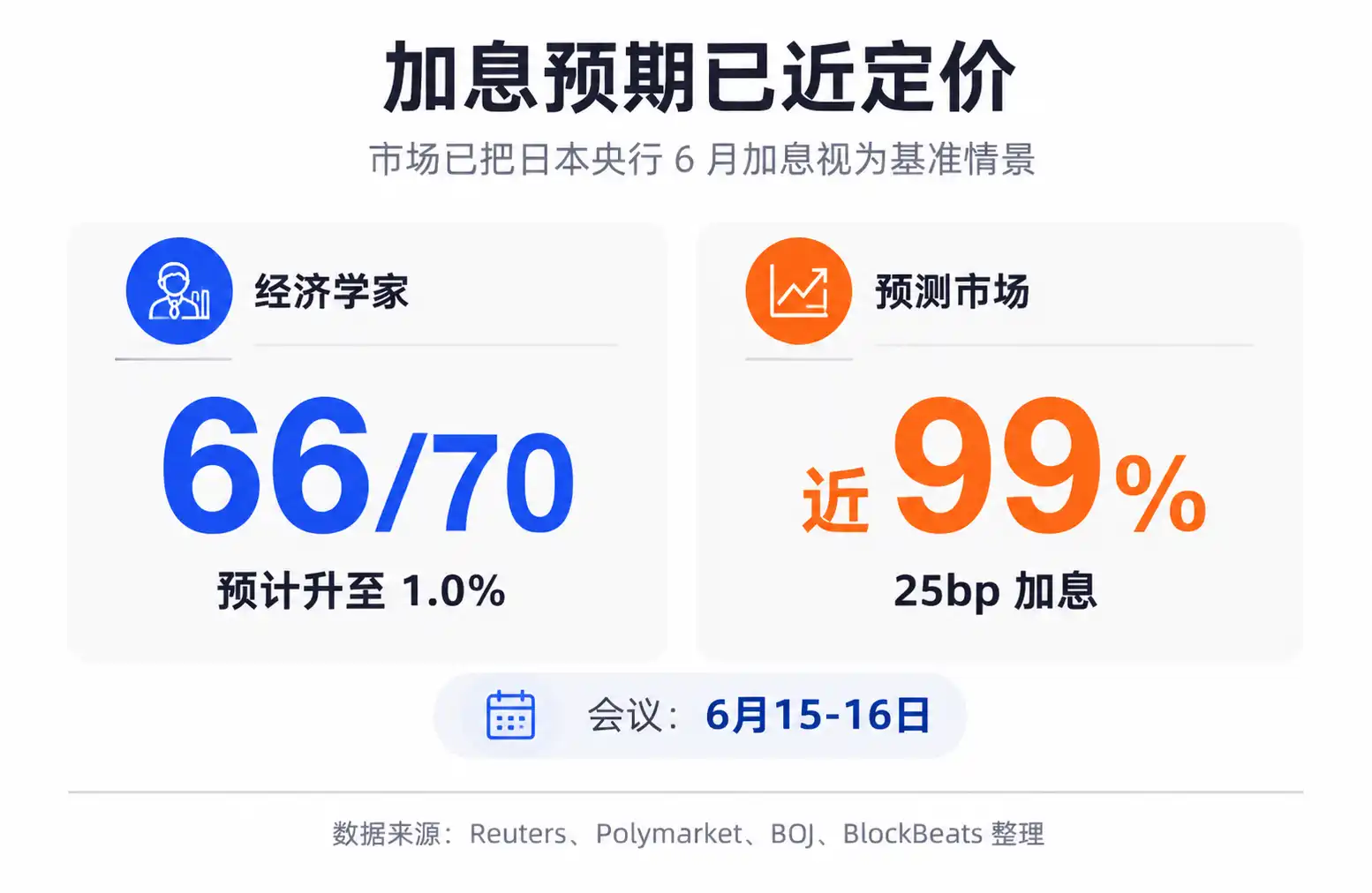
25 basis points may seem small. What the market fears is not the number 'Japanese interest rates reaching 1%', but whether assets that have relied on cheap funding, crowded positions, and high-risk appetites will be repriced after long-term cheap money starts to become more expensive. AI mega-tech and crypto are precisely the most sensitive terminals on this chain.

The Bank of Japan Affects the Global Funding Foundation

Think of the yen carry trade as a low-interest credit card. As long as the borrowing cost is low enough, the exchange rate stable enough, and the target assets rise fast enough, investors are willing to swipe this card to add leverage. The yen has long played the role of this global credit card.

This card is important because it doesn't just serve the Japanese market. Low-interest yen can be converted into dollars, flowing into U.S. stocks, bonds, emerging markets, commodities, and also indirectly affecting the risk appetite in crypto markets. When global asset prices rise, carry trades amplify liquidity. When the yen appreciates or Japanese interest rates rise, this chain works in reverse, forcing some funds to reduce positions, repay loans, and cut leverage.

Therefore, investors cannot judge its market impact solely based on 'the size of the Japanese economy.' The Bank of Japan is changing not the profit outlook of one local industry, but a long-term, low-cost foundation within the global funding map.

The April meeting already signaled this. At that time, the BOJ maintained the uncollateralized overnight call rate at around 0.75%, but the vote was 6 to 3, with 3 members already advocating an immediate hike to around 1.0%. In its Outlook Report that same month, the BOJ lowered its real GDP forecast for fiscal 2026 to 0.5% and raised its core CPI forecast to 2.8%. The policy discussion has shifted from whether to normalize to how fast normalization should be.
The market consensus remains relatively mild: the BOJ will raise rates gradually, with ample policy communication, and part of the yen carry trade has already been unwound during past bouts of volatility. But the risk framework looks at something else. As long as residual leverage remains, what triggers volatility is often not the absolute level of interest rates, but the speed of change in interest rate differentials and exchange rate expectations.

For AI stocks and crypto, this speed matters. They are both high-beta assets, meaning assets with greater price elasticity. They rise more sharply when liquidity is loose and fall faster when risk appetite declines. AI leaders have real revenue and industry trend support, and Bitcoin also has ETFs, the halving cycle, and on-chain structures, but their marginal pricing still highly depends on global risk appetite.

When cheap money diminishes, the market may not immediately reject the AI or crypto narratives, but it may lower the valuation multiples it is willing to pay for future growth.

25bp Amplified by Leverage and Exchange Rates

Looking solely at 25 basis points, a Japanese rate hike shouldn't seem likely to shock global assets. The problem is that carry trades are not simple comparisons of deposits and loans; they are a system layered with leverage, exchange rates, and crowded positions.

A typical yen carry trade has three sources of return: low borrowing cost in yen, high returns on purchased assets, and a stable or depreciating yen. As long as these three hold, the trade is comfortable. Once Japanese rates rise, the first source of return is compressed. If the market begins to expect yen appreciation, the third source becomes a risk. Investors not only earn less but may also lose money on the exchange rate.

That's why 1% itself isn't necessarily scary, but moving from 0.75% towards 1.0%, with the market expecting 1.25% by year-end, changes the calculus for capital. What carry trades fear most is not a slow rise in cost, but everyone simultaneously realizing the same trade is no longer profitable and then rushing to unwind.

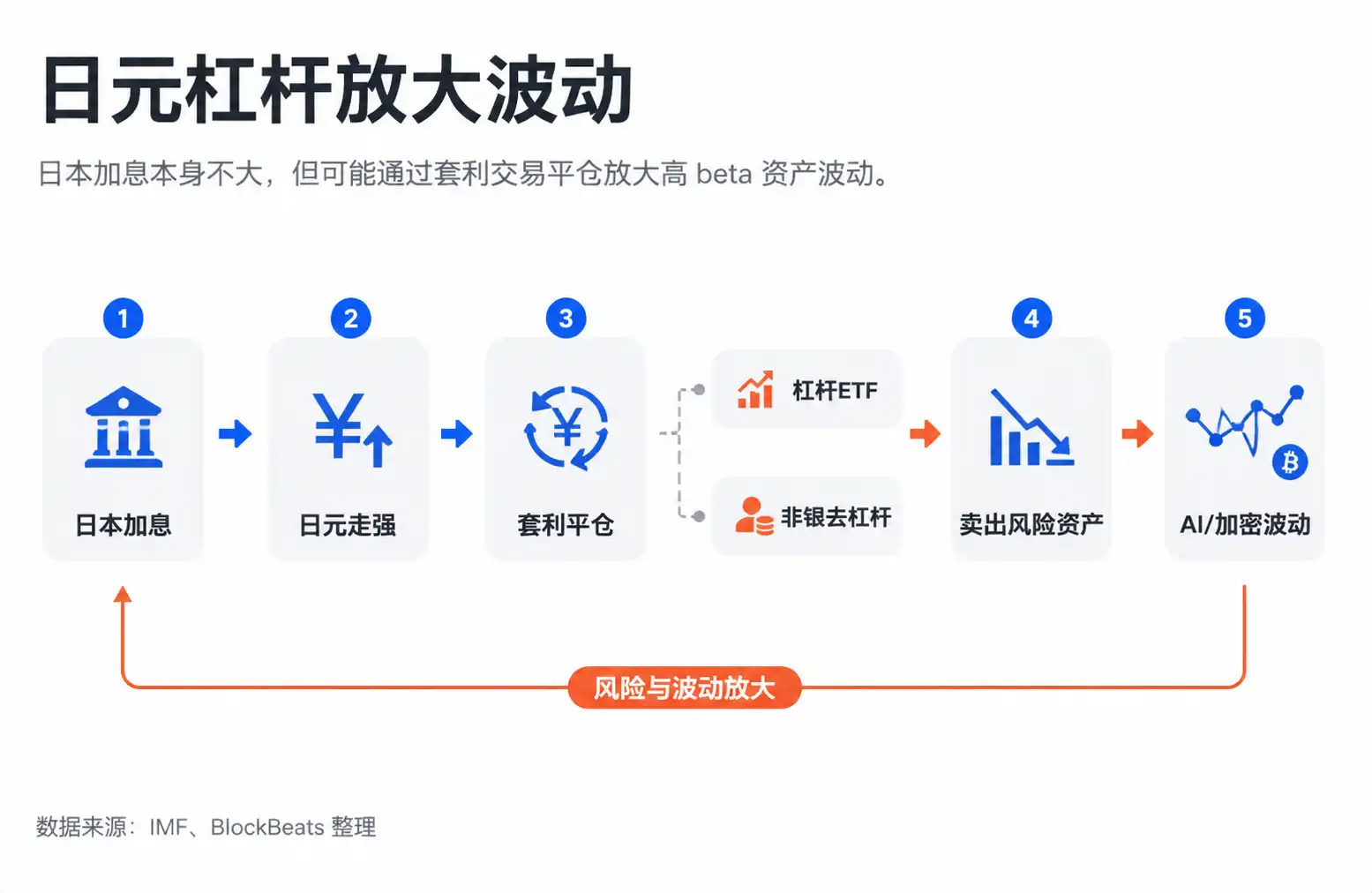
Unwinding transmits local Japanese policy to global risk assets. Investors need to buy back yen to repay debt, potentially selling dollar-denominated assets, tech stocks, crypto, commodities, or emerging market positions. If many funds act similarly at the same time, price declines can trigger more risk controls, margin calls, and volatility model adjustments, creating secondary amplification.

The IMF noted in its April 2026 Global Financial Stability Report that carry trade unwinding could amplify market volatility through channels like capital flows, bond yield volatility, leveraged ETFs, and non-bank financial institution deleveraging. The key point here is not that a particular downturn is solely caused by the BOJ, but that this mechanism exists and can exacerbate shocks when liquidity is tight.
Over the past two years, the market has repeatedly seen similar phenomena: momentum stocks, AI tech stocks, and Bitcoin experiencing synchronized volatility without clear new Fed signals or a sudden deterioration in single-company fundamentals. Institutional analysis often cites yen carry trade unwinding as one explanation. Strictly speaking, this can only prove a high temporal coincidence and a plausible mechanism, not sole causation. But for trading, correlation and transmission mechanisms are sufficient to constitute a risk variable.

The Market Is Trading on Higher Funding Hurdles

More precisely, the market is not trading on 'Japan's rate hike destroying AI,' but on 'higher funding hurdles for global risk assets.' These are two different things.

The AI rally still has its own main drivers. Cloud provider capital expenditures, GPU demand, model application deployment, enterprise software revenue—these are the long-term fundamentals for companies like NVIDIA and Microsoft. Bitcoin also has its own main drivers, including ETF inflows, regulatory frameworks, macro hedging narratives, and on-chain supply structure. The BOJ will not replace these variables.

But at high valuation stages, fundamentals answer whether there is long-term value, while liquidity answers what multiple the market is willing to pay for that future. When global low-cost funding is more abundant, investors are more willing to pay a high price for future growth. When funding costs rise and risk appetite falls, the same growth story may be discounted more heavily.

This is the meaning of implicit funding cost. It may not manifest as a rise in a specific company's loan rate, nor does it necessarily mean a specific fund directly borrowed yen. It's more like the overall leverage temperature of the market: when money is cheap, investors chase high-volatility assets. When money becomes expensive, the market's tolerance for losses, distant profits, and valuation bubbles declines.

Therefore, the market significance of this BOJ meeting does not lie in whether 1% is a high interest rate. In the U.S. or many emerging markets, 1% is certainly not high. But in the history of the yen as a global funding currency, it represents a change in direction. A pipeline of capital that has long provided cheap leverage is moving from extremely low cost towards normal cost.

'Most carry trades have already been unwound' also does not mean the risk disappears. Some trades have indeed been reduced in past volatility, and the market has also digested the June hike expectation in advance. But as long as residual exposure remains within the banking system, offshore yen lending, and non-bank leverage, prices will remain sensitive to the speed of normalization.

More importantly, the yen is just one visible anchor point. Global risk assets in recent years have not relied solely on the Fed but also on various low-cost funding currencies, offshore liquidity, and cross-market leverage. When these funding sources simultaneously become less cheap, a dovish Fed pivot may not fully offset the marginal tightening from other currency systems.

Post-Decision, Watch Linkage Between Yen, JGBs, and High-Beta Assets

The verification point for this narrative is clear: after the Bank of Japan's decision on June 16th, does the market just 'buy the rumor, sell the fact,' or does it begin repricing a faster normalization path?

If the BOJ raises to 1.0% as per the economists' survey expectation, but its tone is dovish, USD/JPY reacts calmly, and U.S. tech stocks and crypto do not come under synchronized pressure, then this looks more like a digested policy event. The market will continue to refocus on AI revenue, the Fed's path, and the U.S. earnings cycle, with Japan being a short-term disturbance.

If the decision or subsequent remarks lead the market to price in a year-end 1.25% or even higher path earlier, with the yen appreciating rapidly and Japanese bond yields rising, while NVIDIA, other momentum tech stocks, BTC, and ETH experience synchronized volatility, it would indicate investors are starting to trade not the 25 basis points, but a renewed contraction in the yen leverage chain.

Next, watch the linkage between prices: does yen strength accompany weakness in high-beta assets, does volatility rise without new U.S. negatives, do leveraged ETFs and crowded momentum stocks bear the brunt first. As long as these signals appear together, the Bank of Japan is no longer just the Bank of Japan—it is reminding the market that the map of global cheap money is becoming more expensive.


Pertanyaan Terkait

QWhat is the core market concern behind the Bank of Japan's potential rate hike, beyond the immediate interest rate change?

AThe market is not primarily concerned about Japan's interest rate reaching 1% itself. Instead, the worry is that as a long-term source of cheap money (the 'global credit card') begins to get more expensive, assets that have relied on low-cost financing, crowded positions, and high risk appetite may face repricing. The article highlights that AI stocks and cryptocurrencies are particularly sensitive 'terminal points' on this chain.

QAccording to the article, why is the potential impact of the Bank of Japan's policy greater than Japan's economic size might suggest?

AThe Bank of Japan's policy change is significant because it alters a key piece of low-cost 'foundation' in the global financing map. The Japanese yen has long served as a cheap funding currency for global carry trades. Investors borrow low-interest yen, convert it to dollars, and invest in higher-yielding assets worldwide. A policy shift in Japan thus does not just change a local industry's profit outlook but impacts the global cost of leverage and risk appetite.

QWhat are the three layers of profit in a typical yen carry trade, and how does a Bank of Japan rate hike threaten them?

AA typical yen carry trade has three profit layers: 1) The low cost of borrowing yen. 2) The higher return from the purchased asset. 3) The yen not appreciating (or even depreciating). A Bank of Japan rate hike directly compresses the first layer (higher borrowing cost). Furthermore, if the rate hike leads to market expectations of yen appreciation, the third layer turns into a risk, as investors could lose money on the currency exchange when repaying the loan.

QThe article distinguishes between 'fundamentals' and 'liquidity' for high-beta assets like AI stocks. What is the key difference in their roles?

AFor high-beta assets like AI stocks and Bitcoin, fundamentals answer the question of long-term value (e.g., cloud capital expenditure, GPU demand, ETF inflows, supply structure). Liquidity, on the other hand, answers the question of the valuation multiple the market is willing to pay for that future growth. When global low-cost financing is abundant, investors pay higher prices for future growth stories. When financing costs rise and risk appetite falls, the same growth story may be discounted at a lower multiple.

QWhat key market signals should investors watch after the Bank of Japan's June meeting to assess the impact on global risk assets?

AInvestors should watch for specific inter-market linkages: whether a stronger yen is accompanied by weakness in high-beta assets (like momentum tech stocks, BTC, ETH), whether market volatility rises without new U.S. catalysts, and whether leveraged ETFs and crowded momentum stocks lead the decline. The simultaneous appearance of these signals would indicate the market is trading on the theme of a broader contraction in global cheap funding, beyond just the immediate rate decision.

Bacaan Terkait

Debut Wash: Ketua FED yang Paling Paham Crypto Sepanjang Sejarah Akan Datangkan Kejutan atau Teror Bagi Pasar?

**Penampilan Perdana Kevin Warsh: Ketua Fed Paling Paham Crypto, Akan Bawa Kejutan atau Kekhawatiran?** Ketua Federal Reserve yang baru, Kevin Warsh, bersiap untuk konferensi pers kebijakan moneter pertamanya di tengah situasi sulit: inflasi yang bangkit kembali, tekanan pasar untuk menaikkan suku bunga, dan desakan Presiden Trump untuk menurunkan suku bunga. Yang unik, Warsh adalah ketua Fed pertama yang secara terbuka memiliki portofolio investasi tidak langsung yang signifikan di aset kripto dan perusahaan Web3, mencakup berbagai sektor seperti blockchain, DeFi, dan infrastruktur pembayaran. Pemahaman pribadinya tentang teknologi ini berbeda dengan pendahulunya. Analisis kebijakannya berfokus pada dua hal: **sikap hawkish melawan inflasi** yang mungkin berarti lingkungan suku bunga ketat, dan **sikap ramah terhadap aset digital** yang bisa membawa perubahan regulasi dari "pencegahan" menjadi "integrasi dan inovasi". Dampak pada pasar kripto dapat dilihat dari: **pergeseran ekspektasi regulasi** yang lebih mendukung, **penetapan ulang premi risiko** bergantung pada komunikasi kebijakan yang jelas dari Warsh, serta **aliran modal global** yang mungkin mengalir lebih deras ke aset kripto karena legitimasi yang meningkat. Dua skenario utama untuk penampilan perdananya: 1. **Kejutan:** Gabungan sikap kebijakan moneter yang relatif lunak (dovish) dan sinyal ramah kripto dapat memulihkan sentimen pasar. 2. **Kekhawatiran:** Sinyal hawkish yang lebih keras dari perkiraan, seperti isyarat kenaikan suku bunga, dapat memicu tekanan jual di aset berisiko, termasuk kripto. Meski secara etika Warsh telah menjual semua kepemilikannya terkait kripto, pemahaman mendalamnya tentang blockchain diharapkan dapat membentuk kerangka regulasi yang lebih koheren dan mendukung, menjadi infrastruktur penting bagi arus utama aset kripto dalam jangka panjang.

marsbit5j yang lalu

Debut Wash: Ketua FED yang Paling Paham Crypto Sepanjang Sejarah Akan Datangkan Kejutan atau Teror Bagi Pasar?

marsbit5j yang lalu

AGI Bukan Akhir, Makalah Baru DeepMind: Menuju ASI, Kemajuan AI yang Sesungguhnya Baru Dimulai

Jika Kecerdasan Buatan Umum (AGI) tercapai, apakah itu titik akhir? Tim Google DeepMind dalam laporan terbarunya berpendapat bahwa AGI **bukanlah akhir perjalanan**. AI diprediksi akan terus berkembang melampaui kemampuan tim ahli manusia terbaik, menuju Superintelligence (ASI). Laporan ini membedakan tiga konsep: AGI (kecerdasan setara manusia rata-rata), ASI (melampaui manusia di hampir semua bidang), dan UAI (batas teoretis maksimal). Transisi dari AGI ke ASI dapat melalui empat jalur potensial: 1. **Ekspansi Lanjutan**: Meningkatkan skala komputasi, model, dan data. 2. **Inovasi Algoritma**: Penyempurnaan paradigma yang ada atau pergeseran paradigma baru. 3. **Peningkatan Diri Secara Rekursif**: AI yang lebih kuat membantu mengembangkan generasi AI berikutnya yang lebih kuat. 4. **Koordinasi Multi-Agen**: Kecerdasan kolektif dari banyak sistem AGI yang berkolaborasi. Namun, terdapat enam kemacetan potensial: dinding data, tekanan sumber daya ekonomi & alam, batasan paradigma jaringan saraf saat ini, meningkatnya kesulitan penelitian, hambatan abstraksi, serta tantangan regulasi dan penerimaan sosial. Laporan ini juga menyoroti bahwa jika AI melampaui manusia, sistem evaluasi (benchmark) yang ada menjadi tidak relevan. Diperlukan kerangka pengukuran baru, seperti tugas kolaborasi/kompetisi multi-agen, pengujian yang dihasilkan otomatis, atau indikator tidak langsung seperti produktivitas ekonomi. ASI bukanlah sistem ajaib yang mahatahu; perkembangannya tetap dibatasi oleh hukum fisika, kompleksitas komputasi, data, sumber daya, dan umpan balik dunia nyata. Arah dan kecepatan kemajuan AI masih penuh ketidakpastian, sehingga memerlukan penelitian, prediksi, dan mekanisme evaluasi yang terus diperbarui.

marsbit6j yang lalu

AGI Bukan Akhir, Makalah Baru DeepMind: Menuju ASI, Kemajuan AI yang Sesungguhnya Baru Dimulai

marsbit6j yang lalu

Trading

Spot
Futures

Artikel Populer

Apa Itu $BANK

Bank AI: Langkah Revolusioner di Masa Depan Perbankan Pendahuluan Dalam era yang ditandai dengan kemajuan teknologi yang pesat, Bank AI berada di persimpangan kecerdasan buatan (AI) dan layanan perbankan. Proyek inovatif ini bertujuan untuk mendefinisikan ulang lanskap keuangan, meningkatkan efisiensi operasional, langkah-langkah keamanan, dan pengalaman pelanggan melalui kekuatan AI. Saat kita memulai eksplorasi terhadap Bank AI, kita akan menyelami apa yang dimaksud dengan proyek ini, dinamika operasionalnya, konteks historisnya, dan tonggak pentingnya. Apa itu Bank AI? Pada intinya, Bank AI mewakili inisiatif transformasional yang bertujuan untuk mengintegrasikan kecerdasan buatan ke dalam berbagai operasi perbankan. Proyek ini memanfaatkan kemampuan AI untuk mengotomatiskan proses, meningkatkan protokol manajemen risiko, dan meningkatkan interaksi dengan pelanggan melalui layanan yang dipersonalisasi. Tujuan utama dari Bank AI meliputi: Automatisasi Fungsi Perbankan: Dengan memanfaatkan teknologi AI, Bank AI bertujuan untuk mengotomatiskan tugas rutin, mengurangi beban pada sumber daya manusia dan meningkatkan efisiensi. Peningkatan Manajemen Risiko: Proyek ini menggunakan algoritma AI untuk memprediksi dan mengidentifikasi risiko, sehingga memperkuat langkah-langkah keamanan terhadap penipuan dan ancaman lainnya. Personalisasi Layanan Perbankan: Bank AI fokus pada menawarkan produk dan layanan keuangan yang disesuaikan dengan menganalisis data dan perilaku pelanggan. Meningkatkan Pengalaman Pelanggan: Implementasi solusi yang didorong oleh AI, seperti chatbot dan asisten virtual, bertujuan untuk memberikan interaksi yang lebih manusiawi bagi pengguna, merevolusi cara pelanggan berinteraksi dengan bank. Dengan tujuan-tujuan ini, Bank AI memposisikan dirinya sebagai pemain kunci dalam menjadikan perbankan lebih efisien, aman, dan berfokus pada pengguna. Siapa Pencipta Bank AI? Detail mengenai pencipta Bank AI masih belum diketahui. Dengan demikian, tidak ada individu atau organisasi spesifik yang telah diidentifikasi dalam informasi yang tersedia. Anonimitas seputar penciptaan proyek ini menimbulkan pertanyaan tetapi tidak mengurangi visi dan tujuan ambisiusnya. Siapa Investor Bank AI? Mirip dengan penciptanya, informasi spesifik mengenai investor atau organisasi pendukung Bank AI belum diungkapkan. Tanpa informasi ini, sulit untuk menguraikan dukungan finansial dan institusi yang mungkin mendorong proyek ini ke depan. Namun, pentingnya memiliki dasar investasi yang kuat adalah kunci untuk mempertahankan pengembangan di bidang inovatif seperti ini. Bagaimana Cara Kerja Bank AI? Bank AI beroperasi di beberapa front inovatif, dengan fokus pada faktor unik yang membedakannya dari kerangka perbankan tradisional. Berikut adalah fitur utama operasionalnya: Automatisasi: Dengan menerapkan algoritma pembelajaran mesin, Bank AI mengotomatiskan berbagai proses manual di dalam bank. Ini menghasilkan pengurangan biaya operasional dan memungkinkan pekerja manusia untuk mengalihkan upaya mereka ke aktivitas yang lebih strategis. Manajemen Risiko yang Canggih: Integrasi AI ke dalam praktik manajemen risiko memberikan bank alat untuk secara akurat memprediksi potensi ancaman seperti penipuan, memastikan bahwa informasi dan aset pelanggan tetap aman. Rekomendasi Keuangan yang Disesuaikan: Melalui pembelajaran terus-menerus dari interaksi pelanggan, sistem AI mengembangkan pemahaman yang mendalam tentang kebutuhan pengguna, memungkinkan mereka untuk memberikan saran yang disesuaikan tentang keputusan keuangan. Interaksi Pelanggan yang Ditingkatkan: Dengan memanfaatkan chatbot dan asisten virtual yang didukung oleh AI, Bank AI memungkinkan pengalaman pelanggan yang lebih menarik, memungkinkan pengguna untuk mendapatkan jawaban untuk pertanyaan mereka dengan cepat, sehingga mengurangi waktu tunggu dan meningkatkan tingkat kepuasan. Bersama-sama, fitur-fitur operasional ini memposisikan Bank AI sebagai pelopor di sektor perbankan, menetapkan tolok ukur baru untuk penyampaian layanan dan keunggulan operasional. Garis Waktu Bank AI Memahami jalur perkembangan Bank AI memerlukan melihat konteks historisnya. Berikut adalah garis waktu yang menyoroti tonggak penting dan perkembangan: Awal 2010-an: Konseptualisasi integrasi AI ke dalam layanan perbankan mulai mendapatkan perhatian saat institusi perbankan mengenali manfaat potensialnya. 2018: Terjadi peningkatan signifikan dalam implementasi teknologi AI ketika bank mulai menggunakan alat AI seperti chatbot untuk layanan pelanggan dasar dan sistem manajemen risiko untuk penanganan keamanan yang lebih baik. 2023: Kecanggihan AI terus maju, dengan AI generatif diperkenalkan untuk tugas yang lebih kompleks seperti pemrosesan dokumen dan analisis investasi waktu nyata. Tahun ini menandai lompatan signifikan dalam kemampuan yang diberikan kepada bank oleh teknologi AI. 2024-Status Saat Ini: Hingga tahun ini, Bank AI berada pada jalur yang meningkat, dengan penelitian dan pengembangan yang sedang berlangsung berpotensi meningkatkan kemampuan dalam operasi perbankan. Eksplorasi berkelanjutan terhadap aplikasi AI menunjukkan perkembangan menarik yang akan datang. Poin Kunci tentang Bank AI Integrasi AI dalam Perbankan: Bank AI fokus pada mengadopsi kecerdasan buatan untuk memperlancar proses perbankan dan meningkatkan pengalaman pengguna. Fokus pada Automatisasi dan Manajemen Risiko: Proyek ini sangat menekankan bidang ini, bertujuan untuk mengalihkan beban tugas rutin sambil meningkatkan kerangka keamanan melalui analitik prediktif. Solusi Perbankan yang Dipersonalisasi: Dengan memanfaatkan data pelanggan, Bank AI memungkinkan layanan perbankan yang disesuaikan dengan kebutuhan pengguna individu. Komitmen terhadap Pengembangan: Bank AI tetap berkomitmen pada upaya penelitian dan pengembangan yang berkelanjutan, memastikan adaptabilitas dan relevansi yang terus berlanjut seiring teknologi terus berkembang. Kesimpulan Secara ringkas, Bank AI merupakan langkah penting ke depan di industri perbankan, memanfaatkan kecerdasan buatan untuk membentuk kembali paradigma operasional, meningkatkan keamanan, dan mempromosikan kepuasan pelanggan. Meskipun ada kekurangan informasi mengenai pencipta dan investor, tujuan yang jelas dan mekanisme fungsional dari Bank AI memberikan dasar yang kuat untuk evolusi berkelanjutan. Seiring teknologi AI terus berkembang dan bergabung dengan sektor perbankan, Bank AI berada pada posisi yang baik untuk memberikan dampak signifikan terhadap masa depan layanan keuangan, meningkatkan cara kita memahami dan berinteraksi dengan perbankan.

157 Total TayanganDipublikasikan pada 2024.04.06Diperbarui pada 2024.12.03

Apa Itu $BANK

Cara Membeli BANK

Selamat datang di HTX.com! Kami telah membuat pembelian Lorenzo Protocol (BANK) menjadi mudah dan nyaman. Ikuti panduan langkah demi langkah kami untuk memulai perjalanan kripto Anda.Langkah 1: Buat Akun HTX AndaGunakan alamat email atau nomor ponsel Anda untuk mendaftar akun gratis di HTX. Rasakan perjalanan pendaftaran yang mudah dan buka semua fitur.Dapatkan Akun SayaLangkah 2: Buka Beli Kripto, lalu Pilih Metode Pembayaran AndaKartu Kredit/Debit: Gunakan Visa atau Mastercard Anda untuk membeli Lorenzo Protocol (BANK) secara instan.Saldo: Gunakan dana dari saldo akun HTX Anda untuk melakukan trading dengan lancar.Pihak Ketiga: Kami telah menambahkan metode pembayaran populer seperti Google Pay dan Apple Pay untuk meningkatkan kenyamanan.P2P: Lakukan trading langsung dengan pengguna lain di HTX.Over-the-Counter (OTC): Kami menawarkan layanan yang dibuat khusus dan kurs yang kompetitif bagi para trader.Langkah 3: Simpan Lorenzo Protocol (BANK) AndaSetelah melakukan pembelian, simpan Lorenzo Protocol (BANK) di akun HTX Anda. Selain itu, Anda dapat mengirimkannya ke tempat lain melalui transfer blockchain atau menggunakannya untuk memperdagangkan mata uang kripto lainnya.Langkah 4: Lakukan trading Lorenzo Protocol (BANK)Lakukan trading Lorenzo Protocol (BANK) dengan mudah di pasar spot HTX. Cukup akses akun Anda, pilih pasangan perdagangan, jalankan trading, lalu pantau secara real-time. Kami menawarkan pengalaman yang ramah pengguna baik untuk pemula maupun trader berpengalaman.

695 Total TayanganDipublikasikan pada 2025.05.09Diperbarui pada 2026.06.02

Cara Membeli BANK

Diskusi

Selamat datang di Komunitas HTX. Di sini, Anda bisa terus mendapatkan informasi terbaru tentang perkembangan platform terkini dan mendapatkan akses ke wawasan pasar profesional. Pendapat pengguna mengenai harga BANK (BANK) disajikan di bawah ini.

活动图片