Retail Ecology Dwindles, ZKsync Bets on Bank Pilots for a Breakthrough

Foresight NewsDipublikasikan tanggal 2026-06-12Terakhir diperbarui pada 2026-06-12

Abstrak

Amidst declining retail activity, ZKsync is pivoting to target institutional banking as its primary growth strategy. The article explores this shift, contrasting it with the competitive "survival of the fittest" narrative by highlighting a cooperative model inspired by naturalist Peter Kropotkin. ZKsync is developing infrastructure like its private, permissioned Prividium suite for banks (e.g., Deutsche Bank's use case via Memento), enabling private transactions with public verifiability via zero-knowledge proofs. This appeals to institutions needing privacy, compliance, and Ethereum-based settlement security, unlike fully private chains (e.g., JPMorgan's Kinaxis) or consortium models (e.g., R3 Corda). However, this strategic focus has coincided with a steep decline in its public DeFi ecosystem, evidenced by plunging TVL and the departure of major protocols like Aave due to low fees. The network's future now hinges on banking adoption, with upcoming pilots like the Cari Network involving regional banks holding over $600 billion in deposits. A significant challenge is balancing this institutional focus with ZKsync's decentralized governance. Banks must operate on a network where rules and fees (denominated in the volatile ZK token) can be changed via community vote, and where a Security Council holds emergency control—a stark contrast to the predictable, contract-bound environments of traditional finance. The coming 18 months will test whether ZKsync can successfully onboar...


Written by: Thejaswini M A

Compiled by: Saoirse, Foresight News


When we think of competition, the phrase 'survival of the fittest' often comes to mind. Hearing it, I picture a brutal scene of everyone fighting each other: the strongest predator wins by eliminating all rivals.


But I've started to doubt that sustainable ecosystems are built this way. In the early 20th century, naturalist and philosopher Peter Kropotkin challenged this notion in his evolutionary essays on mutual aid. Kropotkin observed that species surviving extreme climate changes relied on sophisticated systems of collective cooperation. From a long-term evolutionary perspective, the power of mutual support far outweighs individual struggle. The true 'fittest' are those who know how to cooperate and build stable, shared frameworks to navigate unpredictable environments.


This principle applies across industries.


Right now, all crypto projects are finding their niche; protocols that weathered the bear market have made crucial choices for their future.


Some development teams are returning to their original core tenets, pursuing absolute censorship resistance and pure decentralization; others are adding centralized controls to maintain basic solvency; a few are building walled-garden ecosystems, funneling internal liquidity into isolated scaling chains.


ZKsync has taken a distinctly different path, centered on mutual aid: it is building infrastructure for banks.


The Boston Consulting Group (BCG) predicts the tokenized asset market will fully migrate to blockchain systems, reaching $10-16 trillion by 2030. Major mainstream banks are already running pilots, with some moving from trials to full-scale operations. The infrastructure solutions being chosen now will determine the flow of trillions in capital and who controls the underlying rails.


ZKsync is now a highly competitive Layer 2 solution for these financial rails. Even if you haven't looked at Layer 2 since the last bull run, its trajectory is worth noting.


Why are banks moving into blockchain? And why specifically ZKsync?


The ZKsync environment used by Deutsche Bank is completely segregated from regular crypto users. The bank relies on ZKsync's Prividium suite, with Memento building a private, permissioned Layer 2 network—Memento ZK Chain.


Prividium is ZKsync's commercial product for institutions, supporting private transactions, tiered access controls, built-in compliance tools, with all transactions ultimately settling on Ethereum. Memento compared and tested five blockchain ecosystems before choosing ZKsync. This solution shortened capital deployment timelines from two-to-three months down to two-to-three weeks.


The core reason banks favor zero-knowledge technology: it can prove a statement is true without revealing the underlying private information. Banks can verify transactions without disclosing sensitive details like counterparty names, amounts, or specific assets to the public. This privacy architecture gives banks full control over data visibility, protecting corporate secrets while providing clear evidence to regulators, perfectly fitting Wall Street's existing operational models.


The Tradable platform already hosts $1.7 billion in private credit products on ZKsync, listing nearly 30 institutional-grade investment vehicles with 8% to 15.5% annual yields. In October 2024, Buenos Aires, the capital of Argentina, quietly migrated its entire city-wide digital identity system to ZKsync Era, giving 3.6 million citizens officially recognized, crypto-protected identity credentials overnight, with local governments unable to trace the data—making it the first city globally to deploy such an application.


By the end of 2025, the global private credit market reached $3.5 trillion, while Tradable's volume represents less than 0.05% of that total. The tokenized credit sector will either capture significant market share or remain niche, but current data shows it's on a growth trajectory. Regardless, a vast gap remains between current on-chain capital and the overall market size.


Consider the decision from a corporate risk team's perspective: they have three options—a completely self-controlled, isolated private network; a contractual enterprise consortium; or a public network governed by an online community.


JPMorgan's Kinexys is an example of a fully internal, private network. Since 2019, this operation has independently built a blockchain system, handling repo trades, cross-border payments, and asset settlement with partners like BlackRock and Siemens. JPMorgan runs its own servers, manages the ledger, and has no interaction with the public crypto community. Fees don't change arbitrarily based on token holder votes, system upgrades follow internal planning, and governance is entirely in JPMorgan's hands.


But the bank's own data reveals this model's weakness: Kinexys processes about $5 billion in daily transaction volume, while JPMorgan's payment division handles $10 trillion daily. Five years after launch, its own blockchain business carries only 0.05% of the bank's payment traffic. The bank with the highest level of infrastructure control has the lowest adoption rate. Full self-control hasn't solved the core problem of scaling.


Another competitor, R3 Corda, has cleared $10 billion in tokenized real-world assets and processes one million transactions daily. It's a consortium of over 200 financial institutions, with all rules agreed upon via contracts before launch; to update features, all members must sign off. Every bank gets a seat at the rule-making table before the first transaction settles.


These platforms are ZKsync's competitors, but ZKsync has unique advantages that dedicated consortium or private chains cannot replicate: publicly verifiable transaction validity without leaking private data, coupled with a settlement layer independent of any single corporate entity's survival. If a firm shuts down its internal blockchain tomorrow, on-chain assets are immediately at operational risk; assets anchored on ZKsync ultimately settle on the Ethereum mainnet, with no corporate executive who can order the network shut down. This underlying isolation is its core differentiating advantage, but balancing this with the risks of open governance remains an ongoing industry debate.


Before pivoting fully to institutional business, ZKsync launched an incentive program called Ignite, subsidizing DeFi protocols to maintain on-chain activity. After the strategic shift, the project terminated Ignite, clearly refocusing on enterprise clients, and on-chain activity declined along with the incentives.


Around the same time, the original network ZKsync Lite, launched in 2020, was permanently shut down. Matter Labs signaled this as early as December 2025 and announced the exact shutdown date in late February the following year. User assets remain withdrawable permanently, and no institutional deployments were built on ZKsync Lite, so they were unaffected.


The leading lending DeFi protocol, Aave, proposed shutting down its lending market on ZKsync Era, citing dismal revenue data: over 30 consecutive days, ZKsync generated only $714 in fee revenue for Aave. In contrast, Base chain brought in $300,000, and Ethereum mainnet a staggering $7.7 million during the same period. The governance forum concluded this Layer 2 chain didn't truly meet retail DeFi market demand and proposed a new rule: Aave would only consider deploying a market on any public chain generating at least $2 million in annual fee revenue.


At the peak of the retail Layer 2 scaling frenzy, ZKsync Era's Total Value Locked (TVL) consistently held at several hundred million dollars; now, its public DeFi ecosystem TVL is only about $15 million. In comparison, top retail-focused Layer 2 networks typically have TVLs in the tens of billions.
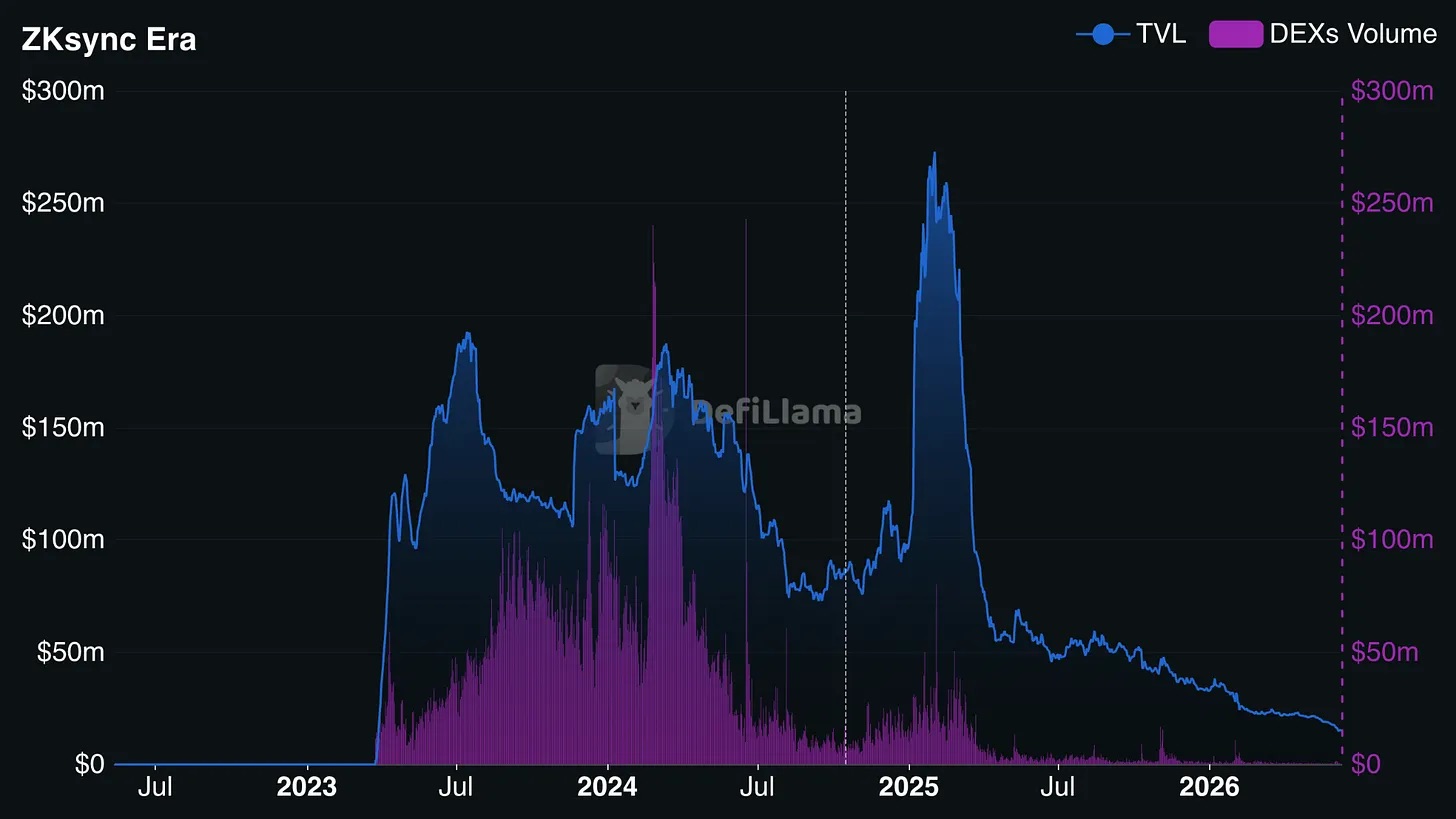

After launching in 2023, ZKsync Era's on-chain TVL (blue line) and DEX volume (purple bars) peaked in early 2025 before sharply and continuously declining, with retail DeFi activity becoming extremely low by 2026. Source: @defillama.com


If the retail ecosystem continues to wither, the chain's entire development will bet solely on the institutional business line. Is a Layer 2 network a retail crypto playground gradually infiltrated by banks, or merely an enterprise financial rail settled on Ethereum? The answer will determine ZKsync's ultimate fate.


Earlier this year, Matter Labs CEO Alex Gluchowski publicly revealed a roadmap clearly refocusing the project on building heavy-duty financial infrastructure for traditional markets.


Product evolution confirms this: the team first launched Prividium, creating segregated environments for banks with non-leaking transaction data; then launched the Bank Stack suite, partnering with institutions like Cari Network to onboard regional banks managing hundreds of billions in traditional deposits. So Aave's departure wasn't a surprise to the development team.


As for Cari Network's rollout plan: led by former US Office of the Comptroller of the Currency officials, it plans to pilot with five regional banks next quarter, which collectively hold over $600 billion in deposits.


If this pilot succeeds, the transaction volume gap left by departing retail DeFi apps will be completely filled by banks' massive flows; but if it fails, ZKsync will become an technologically advanced yet experimental tool with no real mainstream users, hosting only a handful of corporate pilot projects.


The v31 protocol upgrade, passed via ZKsync governance forum vote, officially went live in early May.


ZKsync's official X account posted a reminder: this protocol upgrade was submitted to the governance forum for review. The v31 upgrade includes several core updates, using the ZK token as a universal pricing unit to enable native interoperability across all ZK-based scaling chains.


Key announcement points: This ZKsync Improvement Proposal (ZIP-16) was submitted for forum vote:


  • ZKsync Interoperability Protocol: Enables native cross-chain interaction for all ZK-based scaling chains;
  • Phase 1 supports scaling chains that can settle on Ethereum Layer 1;
  • Expands ZKsync OS compatibility.


Under v31 rules, each cross-chain call between different ZK chains costs a flat fee of 10 ZK tokens, a rate set by DAO vote. Banks already constantly deal with variable costs—like blockchain gas fees, cloud computing costs, foreign exchange spreads—so such fluctuating costs are a normal part of business.


Not just the fee rate, but the entire fee mechanism can be rewritten via the same governance forum, with no obligation for the project to pre-notify institutional partners on the chain.


The ZK Nation governance forum is already discussing next-stage adjustments, currently debating node operator transaction fees, staking rules, and customized pricing for zero-knowledge proof verification. Any topic could trigger a community vote, altering the cost model for all cross-chain operations of institutions like Deutsche Bank and Tradable. All discussions are publicly viewable at forum.zknation.io.


In contrast: JPMorgan's Kinexys system permissions are entirely in its own hands; R3 Corda's rule changes also have formal contracts specifying amendment conditions and processes.


So why would banks choose ZKsync over JPMorgan's private chain? Because ZKsync can provide publicly verifiable proof of transaction validity without leaking private data.


If JPMorgan shuts down its blockchain business tomorrow, all on-chain assets would be frozen; even if Matter Labs, the development company behind ZKsync, goes bankrupt, the network can still run because all assets are ultimately anchored to Ethereum for settlement. But the price for this underlying security is accepting the network belongs to no single entity. An ownerless network's governance belongs to all participating token holders who vote.


The ZK token currently trades around $0.01, having hit an all-time high of $0.3285 in June 2024, a 96% drop from its peak. At a 10 ZK token cross-chain fee, a transaction cost about $3.28 at the bull market peak, now just $0.10. Token price volatility can be managed through hedging, but a community-voted mechanism that can change rules at any time makes long-term, stable budgeting difficult for corporate financial planning.


Layer 2 rating agency L2Beat classifies ZKsync Era as a Stage 0 network: an independent security council can bypass the full DAO voting process to directly pause or modify smart contracts. Mature Stage 1 Layer 2 networks like Arbitrum lack such centralized intervention powers. Enterprise risk managers often favor emergency kill switches to mitigate losses from smart contract bugs; but this control resides with a Web3 security council, completely outside traditional corporate management structures.


Sygnum tokenized $50 million of Matter Labs' corporate treasury assets on ZKsync, connecting to a Fidelity liquidity fund; subsequently, Fidelity also launched an institutional money market fund on the network. The development team injected initial transaction volume by deploying its own capital, creating core enterprise use cases. This asset flow operates smoothly, but the entire business setup directly serves the project's founding team.


The core infrastructure remains subject to an independent security council holding the highest system permissions. In emergencies, the council can bypass normal delay processes entirely, modifying smart contract parameters or freezing functions without prior notice. Actual network control is split between the security council and the active token governance community, meaning partnering banks must operate within a continuously dynamic governance system, not a fixed corporate cooperation agreement.


ZKsync is betting its entire existence on a group that has never led crypto project development—licensed traditional financial institutions. Banks don't care about token prices, nor will they participate in governance forum votes.


But once a bank chooses a core infrastructure to build its business on, it often becomes deeply embedded and difficult to migrate. This adoption path has higher initial barriers, but once established, it's hard to replace.


ZKsync will either become the first crypto project to achieve this, or serve as an expensive case study proving banks ultimately choose to build their own blockchains, then abandon external public chain solutions. The market will deliver its verdict within the next 18 months.


In crypto, many projects boast strong technology but falter on governance mechanisms and long-term sustainability, eventually fading away. ZKsync's grand experiment in governance models is still ongoing.


Pertanyaan Terkait

QWhat major strategic shift has ZKsync made to address the decline in its retail user and DeFi ecosystem?

AZKsync has pivoted its strategic focus towards building heavyweight financial infrastructure for traditional institutions, particularly banks, moving away from competing directly in the retail-focused DeFi arena.

QWhat are the key features and advantages of ZKsync's 'Prividium' suite that appeal to banks like Deutsche Bank?

APrividium offers features like private, permissioned Layer 2 networks, confidential transactions, tiered access control, built-in compliance tools, and settlement on Ethereum. Its key advantage is enabling zero-knowledge proofs that allow transaction verification without exposing sensitive data, fitting perfectly with banking confidentiality and regulatory requirements.

QAccording to the article, what is the core dilemma or challenge ZKsync faces in its new institutional-focused strategy?

AZKsync faces a core governance dilemma: its network is governed by a decentralized community of token holders (ZK Nation) and a Security Council, which can dynamically change rules and fees via voting. This introduces significant uncertainty for institutional clients like banks, who are used to stable, contractually-bound agreements and have no control over or interest in participating in crypto governance processes.

QHow does the article contrast ZKsync's approach with that of its competitors like J.P. Morgan's Kinexys and the R3 Corda consortium?

AJ.P. Morgan's Kinexys is a fully private, internally controlled network offering maximum control but suffering from low internal adoption. R3 Corda is a consortium where rules are set by contract among members before launch. ZKsync differs by offering public verifiability via Ethereum settlement without data exposure, providing independence from any single entity, but at the cost of being subject to unpredictable decentralized governance.

QWhat is the significance of the upcoming pilot with Cari Network and regional banks for ZKsync's future, as described in the article?

AThe pilot with Cari Network, involving five regional banks managing over $600 billion in deposits, is a critical test. Its success could flood ZKsync with massive institutional transaction volume, filling the gap left by departed retail DeFi. Its failure, however, could relegate ZKsync to a niche experimental tool with only minor corporate pilots, jeopardizing its entire institutional-focused strategy.

Bacaan Terkait

Debut Wash: Ketua FED yang Paling Paham Crypto Sepanjang Sejarah Akan Datangkan Kejutan atau Teror Bagi Pasar?

**Penampilan Perdana Kevin Warsh: Ketua Fed Paling Paham Crypto, Akan Bawa Kejutan atau Kekhawatiran?** Ketua Federal Reserve yang baru, Kevin Warsh, bersiap untuk konferensi pers kebijakan moneter pertamanya di tengah situasi sulit: inflasi yang bangkit kembali, tekanan pasar untuk menaikkan suku bunga, dan desakan Presiden Trump untuk menurunkan suku bunga. Yang unik, Warsh adalah ketua Fed pertama yang secara terbuka memiliki portofolio investasi tidak langsung yang signifikan di aset kripto dan perusahaan Web3, mencakup berbagai sektor seperti blockchain, DeFi, dan infrastruktur pembayaran. Pemahaman pribadinya tentang teknologi ini berbeda dengan pendahulunya. Analisis kebijakannya berfokus pada dua hal: **sikap hawkish melawan inflasi** yang mungkin berarti lingkungan suku bunga ketat, dan **sikap ramah terhadap aset digital** yang bisa membawa perubahan regulasi dari "pencegahan" menjadi "integrasi dan inovasi". Dampak pada pasar kripto dapat dilihat dari: **pergeseran ekspektasi regulasi** yang lebih mendukung, **penetapan ulang premi risiko** bergantung pada komunikasi kebijakan yang jelas dari Warsh, serta **aliran modal global** yang mungkin mengalir lebih deras ke aset kripto karena legitimasi yang meningkat. Dua skenario utama untuk penampilan perdananya: 1. **Kejutan:** Gabungan sikap kebijakan moneter yang relatif lunak (dovish) dan sinyal ramah kripto dapat memulihkan sentimen pasar. 2. **Kekhawatiran:** Sinyal hawkish yang lebih keras dari perkiraan, seperti isyarat kenaikan suku bunga, dapat memicu tekanan jual di aset berisiko, termasuk kripto. Meski secara etika Warsh telah menjual semua kepemilikannya terkait kripto, pemahaman mendalamnya tentang blockchain diharapkan dapat membentuk kerangka regulasi yang lebih koheren dan mendukung, menjadi infrastruktur penting bagi arus utama aset kripto dalam jangka panjang.

marsbit8j yang lalu

Debut Wash: Ketua FED yang Paling Paham Crypto Sepanjang Sejarah Akan Datangkan Kejutan atau Teror Bagi Pasar?

marsbit8j yang lalu

AGI Bukan Akhir, Makalah Baru DeepMind: Menuju ASI, Kemajuan AI yang Sesungguhnya Baru Dimulai

Jika Kecerdasan Buatan Umum (AGI) tercapai, apakah itu titik akhir? Tim Google DeepMind dalam laporan terbarunya berpendapat bahwa AGI **bukanlah akhir perjalanan**. AI diprediksi akan terus berkembang melampaui kemampuan tim ahli manusia terbaik, menuju Superintelligence (ASI). Laporan ini membedakan tiga konsep: AGI (kecerdasan setara manusia rata-rata), ASI (melampaui manusia di hampir semua bidang), dan UAI (batas teoretis maksimal). Transisi dari AGI ke ASI dapat melalui empat jalur potensial: 1. **Ekspansi Lanjutan**: Meningkatkan skala komputasi, model, dan data. 2. **Inovasi Algoritma**: Penyempurnaan paradigma yang ada atau pergeseran paradigma baru. 3. **Peningkatan Diri Secara Rekursif**: AI yang lebih kuat membantu mengembangkan generasi AI berikutnya yang lebih kuat. 4. **Koordinasi Multi-Agen**: Kecerdasan kolektif dari banyak sistem AGI yang berkolaborasi. Namun, terdapat enam kemacetan potensial: dinding data, tekanan sumber daya ekonomi & alam, batasan paradigma jaringan saraf saat ini, meningkatnya kesulitan penelitian, hambatan abstraksi, serta tantangan regulasi dan penerimaan sosial. Laporan ini juga menyoroti bahwa jika AI melampaui manusia, sistem evaluasi (benchmark) yang ada menjadi tidak relevan. Diperlukan kerangka pengukuran baru, seperti tugas kolaborasi/kompetisi multi-agen, pengujian yang dihasilkan otomatis, atau indikator tidak langsung seperti produktivitas ekonomi. ASI bukanlah sistem ajaib yang mahatahu; perkembangannya tetap dibatasi oleh hukum fisika, kompleksitas komputasi, data, sumber daya, dan umpan balik dunia nyata. Arah dan kecepatan kemajuan AI masih penuh ketidakpastian, sehingga memerlukan penelitian, prediksi, dan mekanisme evaluasi yang terus diperbarui.

marsbit9j yang lalu

AGI Bukan Akhir, Makalah Baru DeepMind: Menuju ASI, Kemajuan AI yang Sesungguhnya Baru Dimulai

marsbit9j yang lalu

Trading

Spot
Futures

Artikel Populer

Apa Itu $BANK

Bank AI: Langkah Revolusioner di Masa Depan Perbankan Pendahuluan Dalam era yang ditandai dengan kemajuan teknologi yang pesat, Bank AI berada di persimpangan kecerdasan buatan (AI) dan layanan perbankan. Proyek inovatif ini bertujuan untuk mendefinisikan ulang lanskap keuangan, meningkatkan efisiensi operasional, langkah-langkah keamanan, dan pengalaman pelanggan melalui kekuatan AI. Saat kita memulai eksplorasi terhadap Bank AI, kita akan menyelami apa yang dimaksud dengan proyek ini, dinamika operasionalnya, konteks historisnya, dan tonggak pentingnya. Apa itu Bank AI? Pada intinya, Bank AI mewakili inisiatif transformasional yang bertujuan untuk mengintegrasikan kecerdasan buatan ke dalam berbagai operasi perbankan. Proyek ini memanfaatkan kemampuan AI untuk mengotomatiskan proses, meningkatkan protokol manajemen risiko, dan meningkatkan interaksi dengan pelanggan melalui layanan yang dipersonalisasi. Tujuan utama dari Bank AI meliputi: Automatisasi Fungsi Perbankan: Dengan memanfaatkan teknologi AI, Bank AI bertujuan untuk mengotomatiskan tugas rutin, mengurangi beban pada sumber daya manusia dan meningkatkan efisiensi. Peningkatan Manajemen Risiko: Proyek ini menggunakan algoritma AI untuk memprediksi dan mengidentifikasi risiko, sehingga memperkuat langkah-langkah keamanan terhadap penipuan dan ancaman lainnya. Personalisasi Layanan Perbankan: Bank AI fokus pada menawarkan produk dan layanan keuangan yang disesuaikan dengan menganalisis data dan perilaku pelanggan. Meningkatkan Pengalaman Pelanggan: Implementasi solusi yang didorong oleh AI, seperti chatbot dan asisten virtual, bertujuan untuk memberikan interaksi yang lebih manusiawi bagi pengguna, merevolusi cara pelanggan berinteraksi dengan bank. Dengan tujuan-tujuan ini, Bank AI memposisikan dirinya sebagai pemain kunci dalam menjadikan perbankan lebih efisien, aman, dan berfokus pada pengguna. Siapa Pencipta Bank AI? Detail mengenai pencipta Bank AI masih belum diketahui. Dengan demikian, tidak ada individu atau organisasi spesifik yang telah diidentifikasi dalam informasi yang tersedia. Anonimitas seputar penciptaan proyek ini menimbulkan pertanyaan tetapi tidak mengurangi visi dan tujuan ambisiusnya. Siapa Investor Bank AI? Mirip dengan penciptanya, informasi spesifik mengenai investor atau organisasi pendukung Bank AI belum diungkapkan. Tanpa informasi ini, sulit untuk menguraikan dukungan finansial dan institusi yang mungkin mendorong proyek ini ke depan. Namun, pentingnya memiliki dasar investasi yang kuat adalah kunci untuk mempertahankan pengembangan di bidang inovatif seperti ini. Bagaimana Cara Kerja Bank AI? Bank AI beroperasi di beberapa front inovatif, dengan fokus pada faktor unik yang membedakannya dari kerangka perbankan tradisional. Berikut adalah fitur utama operasionalnya: Automatisasi: Dengan menerapkan algoritma pembelajaran mesin, Bank AI mengotomatiskan berbagai proses manual di dalam bank. Ini menghasilkan pengurangan biaya operasional dan memungkinkan pekerja manusia untuk mengalihkan upaya mereka ke aktivitas yang lebih strategis. Manajemen Risiko yang Canggih: Integrasi AI ke dalam praktik manajemen risiko memberikan bank alat untuk secara akurat memprediksi potensi ancaman seperti penipuan, memastikan bahwa informasi dan aset pelanggan tetap aman. Rekomendasi Keuangan yang Disesuaikan: Melalui pembelajaran terus-menerus dari interaksi pelanggan, sistem AI mengembangkan pemahaman yang mendalam tentang kebutuhan pengguna, memungkinkan mereka untuk memberikan saran yang disesuaikan tentang keputusan keuangan. Interaksi Pelanggan yang Ditingkatkan: Dengan memanfaatkan chatbot dan asisten virtual yang didukung oleh AI, Bank AI memungkinkan pengalaman pelanggan yang lebih menarik, memungkinkan pengguna untuk mendapatkan jawaban untuk pertanyaan mereka dengan cepat, sehingga mengurangi waktu tunggu dan meningkatkan tingkat kepuasan. Bersama-sama, fitur-fitur operasional ini memposisikan Bank AI sebagai pelopor di sektor perbankan, menetapkan tolok ukur baru untuk penyampaian layanan dan keunggulan operasional. Garis Waktu Bank AI Memahami jalur perkembangan Bank AI memerlukan melihat konteks historisnya. Berikut adalah garis waktu yang menyoroti tonggak penting dan perkembangan: Awal 2010-an: Konseptualisasi integrasi AI ke dalam layanan perbankan mulai mendapatkan perhatian saat institusi perbankan mengenali manfaat potensialnya. 2018: Terjadi peningkatan signifikan dalam implementasi teknologi AI ketika bank mulai menggunakan alat AI seperti chatbot untuk layanan pelanggan dasar dan sistem manajemen risiko untuk penanganan keamanan yang lebih baik. 2023: Kecanggihan AI terus maju, dengan AI generatif diperkenalkan untuk tugas yang lebih kompleks seperti pemrosesan dokumen dan analisis investasi waktu nyata. Tahun ini menandai lompatan signifikan dalam kemampuan yang diberikan kepada bank oleh teknologi AI. 2024-Status Saat Ini: Hingga tahun ini, Bank AI berada pada jalur yang meningkat, dengan penelitian dan pengembangan yang sedang berlangsung berpotensi meningkatkan kemampuan dalam operasi perbankan. Eksplorasi berkelanjutan terhadap aplikasi AI menunjukkan perkembangan menarik yang akan datang. Poin Kunci tentang Bank AI Integrasi AI dalam Perbankan: Bank AI fokus pada mengadopsi kecerdasan buatan untuk memperlancar proses perbankan dan meningkatkan pengalaman pengguna. Fokus pada Automatisasi dan Manajemen Risiko: Proyek ini sangat menekankan bidang ini, bertujuan untuk mengalihkan beban tugas rutin sambil meningkatkan kerangka keamanan melalui analitik prediktif. Solusi Perbankan yang Dipersonalisasi: Dengan memanfaatkan data pelanggan, Bank AI memungkinkan layanan perbankan yang disesuaikan dengan kebutuhan pengguna individu. Komitmen terhadap Pengembangan: Bank AI tetap berkomitmen pada upaya penelitian dan pengembangan yang berkelanjutan, memastikan adaptabilitas dan relevansi yang terus berlanjut seiring teknologi terus berkembang. Kesimpulan Secara ringkas, Bank AI merupakan langkah penting ke depan di industri perbankan, memanfaatkan kecerdasan buatan untuk membentuk kembali paradigma operasional, meningkatkan keamanan, dan mempromosikan kepuasan pelanggan. Meskipun ada kekurangan informasi mengenai pencipta dan investor, tujuan yang jelas dan mekanisme fungsional dari Bank AI memberikan dasar yang kuat untuk evolusi berkelanjutan. Seiring teknologi AI terus berkembang dan bergabung dengan sektor perbankan, Bank AI berada pada posisi yang baik untuk memberikan dampak signifikan terhadap masa depan layanan keuangan, meningkatkan cara kita memahami dan berinteraksi dengan perbankan.

157 Total TayanganDipublikasikan pada 2024.04.06Diperbarui pada 2024.12.03

Apa Itu $BANK

Cara Membeli BANK

Selamat datang di HTX.com! Kami telah membuat pembelian Lorenzo Protocol (BANK) menjadi mudah dan nyaman. Ikuti panduan langkah demi langkah kami untuk memulai perjalanan kripto Anda.Langkah 1: Buat Akun HTX AndaGunakan alamat email atau nomor ponsel Anda untuk mendaftar akun gratis di HTX. Rasakan perjalanan pendaftaran yang mudah dan buka semua fitur.Dapatkan Akun SayaLangkah 2: Buka Beli Kripto, lalu Pilih Metode Pembayaran AndaKartu Kredit/Debit: Gunakan Visa atau Mastercard Anda untuk membeli Lorenzo Protocol (BANK) secara instan.Saldo: Gunakan dana dari saldo akun HTX Anda untuk melakukan trading dengan lancar.Pihak Ketiga: Kami telah menambahkan metode pembayaran populer seperti Google Pay dan Apple Pay untuk meningkatkan kenyamanan.P2P: Lakukan trading langsung dengan pengguna lain di HTX.Over-the-Counter (OTC): Kami menawarkan layanan yang dibuat khusus dan kurs yang kompetitif bagi para trader.Langkah 3: Simpan Lorenzo Protocol (BANK) AndaSetelah melakukan pembelian, simpan Lorenzo Protocol (BANK) di akun HTX Anda. Selain itu, Anda dapat mengirimkannya ke tempat lain melalui transfer blockchain atau menggunakannya untuk memperdagangkan mata uang kripto lainnya.Langkah 4: Lakukan trading Lorenzo Protocol (BANK)Lakukan trading Lorenzo Protocol (BANK) dengan mudah di pasar spot HTX. Cukup akses akun Anda, pilih pasangan perdagangan, jalankan trading, lalu pantau secara real-time. Kami menawarkan pengalaman yang ramah pengguna baik untuk pemula maupun trader berpengalaman.

695 Total TayanganDipublikasikan pada 2025.05.09Diperbarui pada 2026.06.02

Cara Membeli BANK

Diskusi

Selamat datang di Komunitas HTX. Di sini, Anda bisa terus mendapatkan informasi terbaru tentang perkembangan platform terkini dan mendapatkan akses ke wawasan pasar profesional. Pendapat pengguna mengenai harga BANK (BANK) disajikan di bawah ini.

活动图片