Capturing 15 Top-Tier Zero-Day Vulnerabilities: A Consensus Protocol Debug Agent Framework Built by 0G Lab in Collaboration with Teams from NUS, PKU, and BUPT

marsbitDipublikasikan tanggal 2026-06-11Terakhir diperbarui pada 2026-06-11

Abstrak

"Agents Capture 15 Critical Zero-Day Bugs: 0G Lab's Multi-Agent Framework Automates Debugging in Consensus Protocols" Distributed consensus protocols are notoriously difficult to debug due to complex, intertwined states. A novel framework, Agora, developed by 0G Labs with researchers from NUS, Peking University, and Beijing University of Posts and Telecommunications, tackles this by fusing deep domain expertise with a collaborative multi-agent LLM architecture. Agora moves beyond the limitations of single LLMs and traditional testing like fuzzing. It employs three specialized agents: an Orchestrator for global state, a Strategy agent for generating attack scenarios using distributed systems knowledge, and a TestGen agent that creates executable tests. A core innovation is its efficient "Succinct Memory & Communication" mechanism and a dynamic test harness. This allows the system to translate abstract hypotheses into concrete tests across languages like Go and Rust, run them, capture failures, and refine the approach in a closed loop—all with minimal token overhead. In rigorous evaluations on production-level protocols including Raft, EPaxos, and components from etcd and Sui, Agora discovered 15 previously unknown deep logic bugs (e.g., execution divergence, liveness violations). In stark contrast, powerful standalone LLMs like GPT-5.2 and Claude 4.5 found zero such bugs. Agora achieved this with a high precision of 73.9% and at an average cost of only about $40 per bug fou...

The "Holy Grail" of distributed systems—consensus protocols—has long been a "Bug Hell" for top-tier infrastructure engineers. Due to their extremely complex states and intertwined multi-node interactions, traditional testing and monolithic LLMs are almost powerless against hardcore Deep Bugs (deep logical vulnerabilities).

Recently, in a paper accepted at the upcoming ICML 2026, researchers from 0G Labs and top academic-industry teams including the National University of Singapore, Peking University, and Beijing University of Posts and Telecommunications proposed Agora—the first automated testing framework that deeply integrates domain knowledge with large language model multi-agent collaboration.

Through an innovative architecture that directly tackles the pain points of protocols, this framework has successfully captured 15 previously unknown protocol-level Deep Bugs in industrial and academic core protocols such as Raft, EPaxos, HotStuff, and BullShark! In stark contrast, top native large models like GPT-5.2 and Claude 4.5 all failed, scoring zero. As multi-agent systems and "Agentic Quality Control" become the hottest tracks in 2026, Agora delivers not just a paper, but a practical, industrial-grade solution.

Paper: "Agora: Toward Autonomous Bug Detection in Production-Level Consensus Protocols with LLM Agents"

1. Background: A Powerful Alliance between 0G and NUS, Merging Long-Term System Knowledge with the Cross-Generational Multi-Agent Paradigm

The evolution of distributed consensus protocols is both a history of genius innovation and a bloody chronicle of pitfalls encountered by countless top engineers. As Turing Award winner Lamport stated, ensuring the correctness of distributed protocol implementations is as challenging as navigating a constantly shaking maze blindfolded. On this "hellish" track, the market is quietly shifting: According to Gartner observations, enterprise consulting demand for multi-agent systems has surged over tenfold in just over a year, and the multi-agent platform market is entering a period of rapid expansion, nearly doubling annually—using "multi-agent collaboration" for the most hardcore low-level system verification is transforming from a frontier concept to an industry necessity.

Facing this hellish challenge, tech giants with halos were the first to embark on heavy-asset exploration. For example, industry leader Anthropic's recent internal Glasswing project within Claude Code attempted to use agents for low-level infrastructure testing, but its architecture still heavily relies on top-tier commercial large models, with vague project details and closed-door collaborations limited to a handful of large institutions and multinational corporations. More critically, such giant-led solutions may exhibit terrifying token consumption during operation. This high computational barrier and heavy-asset approach directly shut out startups and SMEs with limited budgets.

Are smaller companies and open-source communities doomed to be unable to afford top-tier automated vulnerability auditing tools?

Engineers from 0G Labs, collaborating with Xiang Liu from the National University of Singapore, Sa Song and Yong Sun from Beijing University of Posts and Telecommunications, and Ph.D. student Zhao-wei Zhang and researcher Ce-yao Zhang from Peking University's School of Intelligence, leveraged their profound knowledge in the agent domain to empower systems, launching a disruptive "David vs. Goliath" innovation. Their work has been accepted at the 2026 AI top conference ICML.

The academic world's "long-term accumulation of system knowledge" meets the industry's "pain points and keen insight." How can this ignite the next revolution in system security?

The 0G team has accumulated extremely rich production-level attack and defense experience in implementing blockchain consensus protocols; while the academic team has profound expertise in high-performance distributed systems, low-level concurrency control, and formal verification. They are keenly aware that traditional methods (like fuzzing) often struggle with state-space explosion when facing industrial-scale codebases. The researchers decided to infuse the "soul"—their long-accumulated knowledge of global invariant logical deduction in distributed systems—into the cutting-edge multi-agent collaboration paradigm and automated harness architecture, launching the open-source and accessible Agora framework.

Simultaneously, as a leader in modular AI infrastructure and high-performance decentralized data availability networks, the 0G team has accumulated extremely rich production-level attack/defense experience and real-world protocol defect samples in the industrial implementation of blockchain consensus protocols and high-concurrency BFT (Byzantine Fault Tolerance) architectures.

This cross-domain fusion fundamentally changes the game: it is neither blind brute-force testing nor large models "fumbling in the dark" without domain knowledge. Instead, through specialized agent roles, it transforms the decades of logical deduction intuition from seasoned system experts into strategic interaction and collaboration among agents, thereby acquiring the hardcore capability to outperform traditional testing tools.

Unlike Glasswing's heavy-asset approach, which voraciously consumes expensive top-tier tokens, Agora presents a highly accessible alternative for SMEs—it proves that even with a "slightly inferior" base model and higher cost-effectiveness, a cleverly designed domain-aware multi-agent collaborative architecture can still unearth hardcore Deep Bugs!

2. Pain Point: Monolithic LLMs Struggle to Break Through, Distributed Systems Hang Under the "Damocles' Sword" of Deep Logic

In today's world dominated by big data, blockchain, and distributed databases, consensus protocols (like Paxos, Raft, PBFT, etc.) form the foundational bedrock of the entire digital world. However, implementing consensus protocols is notoriously "hellishly difficult." Even industrial-grade benchmark projects like etcd, honed by countless top engineers worldwide over years of operation, still harbor Deep Bugs (deep logical vulnerabilities) that send chills down one's spine.

These vulnerabilities differ from ordinary low-level implementation bugs like memory leaks or integer overflows. They span multiple execution phases and depend on complex concurrent states. If maliciously triggered, they can not only cause core data corruption but also lead to catastrophic financial-level losses.

While Large Language Models (LLMs), hugely popular in recent years, have shown promise in general code analysis, they appear "intellectually challenged" when facing distributed consensus. They can at best find shallow defects in local code. When confronted with protocol-level logical vulnerabilities dependent on global state, monolithic LLMs often get stuck in the mud of local code, completely unable to perform global temporal reasoning.

3. The Breakthrough: Agora's Three-Agent Paradigm and Core Harness Architecture

To break this deadlock, Agora is the first to introduce the classic academic paradigm of Hypothesis-Driven Testing (HDT) into large model agent systems. To achieve efficient global reasoning, Agora completely abandons the traditional "lone wolf" mode, elegantly decoupling the workflow into three highly specialized agents with distinct roles:

Orchestrator Agent: Responsible for maintaining global state and performing "vulnerability exploitation" by extrapolating from known bugs.

Strategy Agent: Responsible for injecting distributed domain knowledge and generating highly aggressive anomalous scenarios tailored for CFT and BFT protocols.

TestGen Agent: The practical executor. The key that truly enables Agora to be operational and generate effective tests in a closed loop lies in its core automated testing architecture.

The architecture is illustrated in the following diagram:
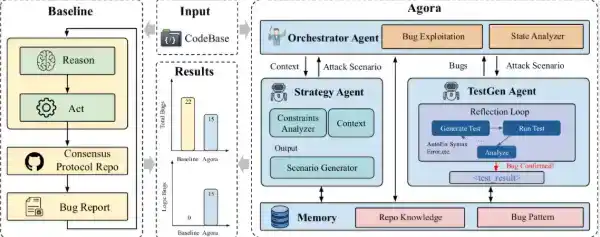
In Agora's overall design, this "David vs. Goliath" accessible magic does not come out of thin air; it stems from the deep integration of its ingenious agent interaction mechanisms and the testing harness architecture.

The research team specially designed an extremely succinct and efficient communication and memory mechanism (Succinct Memory & Communication) within the system framework. While ensuring each agent focuses on its core tasks, it minimizes redundant context transmission overhead to the lowest level. Under this extreme communication constraint, the Orchestrator Agent (responsible for global coordination and state control), the Strategy Agent (responsible for generating distributed anomalous environments and scenarios), and the TestGen Agent (responsible for code testing and dynamic evaluation) are perfectly interwoven, collectively driving and fulfilling the Harness architecture:

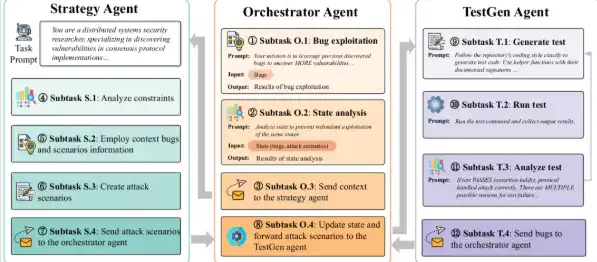
Automated Closed-Loop Synergy: When the Strategy Agent deduces an abstract distributed attack scenario, relying on the highly decoupled interaction framework, the TestGen Agent can immediately launch the underlying test harness. This architecture not only possesses strong environmental adaptability, capable of spanning different programming language environments like Go and Rust to translate attack hypotheses into real, runnable unit tests, but also incorporates efficient reflection-loop technology.

Once a test throws an error during execution in the environment, the system precisely and real-time captures the call stack and execution logs, concisely feeding them back to the agents for targeted self-correction. This organic combination of "multi-agent minimal interaction + dynamic harness closed-loop" not only allows Agora to capture the most elusive deep logical bugs with extremely low token costs but also produces detailed analysis reports with very low false-positive rates.

The final operational overview is illustrated in the following diagram:
4. Results: Capturing 15 Top-Tier Zero-Day Deep Bugs, Baseline Large Models Score Zero

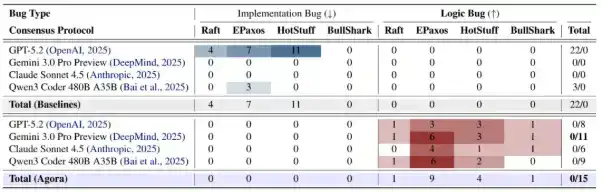
The evaluation results are astounding. The research team conducted a comprehensive assessment on four well-known consensus protocol libraries (including production-grade etcd and the underlying components of the emerging public chain core, Sui), comparing against top-tier models like GPT-5.2, Gemini 3.0 Pro Preview, Claude Sonnet 4.5, and Qwen3 Coder.

The outcome not only made 0G's own operational consensus systems more secure but also demonstrated overwhelming superiority:

15 New Logic Deep Bugs Uncovered: Agora successfully discovered 15 previously unknown protocol-level deep logical vulnerabilities. These span high-risk areas such as execution divergence, monotonicity violations, topology flaws, and signature vulnerabilities.

Native Large Models All Score Zero: In contrast, baseline models (even equipped with advanced ReAct dynamic toolchains) completely failed (0/15) against these deep logical vulnerabilities. They consumed massive amounts of tokens but could only find low-level code implementation bugs.

Extremely Low False-Positive Rate and High Cost-Effectiveness: Among all bug reports generated by Agora, genuine logical vulnerabilities accounted for a high 73.9% (false-positive rate only 26.1%). Even more impressive, it costs only about 5.32M tokens (approximately $40) on average to unearth one top-tier logical bug that would make seasoned architects lose their hair, demonstrating extremely high cost-effectiveness.

Results across multiple LLMs are shown below:
5. The Future: High Generalizability, Advancing into More Hardcore "Uncharted Territories"

Agora's success not only injects confidence into the security of distributed systems but also points the way for large model applications in vertical, industrial-grade scenarios.

Critically, Agora's architectural design demonstrates high generalizability and universality. The research team emphasizes that Agora can also be quickly reproduced and used by a broad user base in the form of plugins or skills. Our code (github.com/0gfoundation/agora) provides corresponding skills to aid reproduction. Furthermore, Agora's "Large Model + Multi-Agent Collaboration + Hypothesis-Driven" paradigm is not limited to consensus protocols. Due to the deep decoupling between its underlying workflow control and the upper-layer domain knowledge base and testing harness, the architecture means it can not only help numerous users quickly debug consensus protocols but can also be rapidly extended to other hardcore fields similarly plagued by "deep logical vulnerability hell" in a "plug-and-play" manner:

Database Concurrency Control: For testing complex transaction conflict defects in distributed databases under extreme isolation levels (like Serializable).

Operating System Kernels / Concurrent Systems: For deeply discovering hidden deadlocks and race conditions in multi-threaded infrastructure.

Web3 Smart Contract Auditing: For in-depth security boundary exploration of cross-chain protocols and DeFi logic involving complex economic models. The blockchain security market is projected to reach about $8.5 billion by 2026, and commercial products using "multi-agent security systems" for smart contract auditing, compressing audit cycles from weeks to hours, are already emerging. Market demand is exploding.

The era of AI-automated security for industrial-grade low-level infrastructure may have been officially inaugurated by Agora and its harness architecture.

We have reason to believe that Agora can help better test the capabilities of coding LLMs by discovering more deep bugs across various domains, and the deep bug use cases it finds can also help enhance coding LLMs' code comprehension abilities.

Agora can significantly improve the security of code repositories that form the foundation for financial secure transactions, such as consensus protocols, concurrency control, and smart contracts. Moreover, Agora can help more tech companies discover deeper logic bugs while consuming fewer tokens, saving funds and being more efficient!

More importantly, this precisely aligns with the two hottest current trends: First, multi-agent systems are transitioning from experimentation to production—Gartner predicts that by 2028, over 30% of enterprise software will have agentic AI built-in, and the multi-agent platform market size is expected to surge from the tens of billions to hundreds of billions of dollars within a few years. Second, "using agents to audit agents"—Agentic Quality Control—is becoming the industry standard for 2026.

Against the backdrop where the Veracode 2025 report indicates approximately 45% of AI-generated code contains security vulnerabilities and the agentic AI security market is growing at a ~42% CAGR, Agora enables tech companies to unearth deeper Logic Bugs with lower token costs, upgrading security auditing from a "human-powered task billed by the week" to an "automated capability delivered by the hour."

And as the landscape of this track becomes clearer, those who truly seize the early advantage are often not the loudest giants, but the team that first operationalizes the methodology and can consistently replicate it.

Kripto yang Sedang Tren

Pertanyaan Terkait

QWhat is the core innovation of the Agora framework presented in the article?

AThe core innovation of the Agora framework is the first integration of deep domain knowledge with a large language model (LLM) multi-agent collaboration paradigm for autonomous bug detection in consensus protocols. It specifically uses a hypothesis-driven testing (HDT) approach with three specialized agents (Orchestrator, Strategy, and TestGen) coordinated within an automated test harness architecture to find deep logic bugs.

QHow does Agora's approach differ from traditional methods or using a single large language model (LLM) for bug detection in consensus protocols?

ATraditional methods like fuzzing struggle with state space explosion in industrial codebases. Single LLMs are limited to finding shallow, local implementation bugs and fail at global state and temporal reasoning required for protocol-level deep logic bugs. Agora overcomes this by decomposing the task into specialized agents that collaboratively perform global reasoning, hypothesis generation, and automated test execution with a reflection loop, enabling it to find complex, cross-stage vulnerabilities.

QWhat were the key experimental results of the Agora framework's evaluation on real consensus protocol codebases?

AIn evaluations on four major consensus protocol libraries (including etcd and Sui's components), Agora discovered 15 previously unknown protocol-level deep logic bugs across categories like execution divergence and monotonicity violations. In stark contrast, state-of-the-art single LLM baselines (GPT-5.2, Claude 4.5, etc.) equipped with advanced toolchains found zero such bugs (0/15). Agora achieved this with a high true positive rate (73.9%) and high cost-efficiency, averaging about 5.32M tokens (~$40) per deep bug found.

QWhat is the significance of Agora's design in terms of cost and accessibility compared to other industry approaches mentioned, like Anthropic's Glasswing project?

AAgora's design provides a cost-effective and accessible alternative to heavyweight, proprietary industry approaches. Unlike projects like Glasswing which rely on top-tier commercial models and incur high computational/token costs, Agora uses a streamlined multi-agent architecture with succinct communication. This allows it to achieve state-of-the-art bug detection using more cost-efficient base models, making advanced automated security auditing feasible for startups, SMEs, and open-source communities.

QBeyond consensus protocols, what other hardcore system domains does the article suggest the Agora framework's methodology could be applied to?

AThe article suggests that Agora's plug-and-play architecture, which decouples the core workflow from domain knowledge, can be generalized to other domains plagued by deep logic bugs. These include database concurrency control (e.g., testing transaction conflicts), operating system kernels/concurrent systems (e.g., for deadlocks and race conditions), and Web3 smart contract auditing (e.g., for complex cross-chain or DeFi protocol logic).

Bacaan Terkait

Harga AI Mengalami Koreksi Keras, Momen Deepseek-nya GLM?

Pada hari Selasa, pasar perdagangan kecerdasan buatan (AI) menghadapi tekanan penjualan paling tajam tahun ini. KOREAN KOSPI sempat anjlok hampir 10%, memicu penghentian perdagangan (circuit breaker). Saham inti rantai pasokan AI global seperti Samsung Electronics dan SK Hynix terpukul berat, dan tekanan menjalar ke sesi AS dengan saham memori, penyimpanan, dan semikonduktor menjadi wilayah yang paling menderita. Beberapa analis menyebut penurunan ini sebagai "momen DeepSeek-nya Zhipu AI", mereplikasi dampak pasar dari rilis model DeepSeek awal 2025. Model open-source GLM-5.2 dari Zhipu dinilai telah masuk peringkat tiga besar model bahasa global, memicu keraguan pasar tentang dominasi AI AS dan menimbulkan pertanyaan apakah pengeluaran modal besar-besaran perusahaan teknologi AS untuk pusat data masih dapat mendukung valuasi saat ini jika model open-source yang lebih murah sudah cukup baik. Tekanan lain berasal dari meningkatnya ketidakpastian atas imbal hasil investasi AI dan ekspektasi suku bunga yang lebih tinggi. Penurunan terfokus pada perusahaan yang paling diuntungkan dari narasi infrastruktur AI, seperti hyperscaler (Alphabet, Amazon, Meta) yang masih berencana mengeluarkan ratusan miliar dolar. Kekhawatiran juga muncul seiring meningkatnya ketergantungan pendanaan infrastruktur AI pada utang, seperti yang diilustrasikan oleh rencana penerbitan obligasi SpaceX. Meski demikian, banyak analis melihat ini sebagai koreksi yang diperlukan setelah kenaikan berlebihan dan "pemeriksaan realitas" dalam perdagangan teknologi, bukan akhir dari cerita AI. Pertanyaan inti beralih dari "apakah AI akan tumbuh" menjadi "apakah harga yang dibayar untuk pertumbuhan itu terlalu tinggi", menekankan pada kemampuan perusahaan mengubah pengeluaran modal menjadi arus kas dan keberlanjutan valuasi. Laporan keuangan Micron yang akan datang dipandang sebagai tolok ukur kunci untuk kesehatan rantai pasokan perangkat keras.

marsbit6m yang lalu

Harga AI Mengalami Koreksi Keras, Momen Deepseek-nya GLM?

marsbit6m yang lalu

8.5 Juta USDT Mengalir Keluar dalam Semalam, Bisakah Vault Stablecoin Berpenghasilan Tinggi Masih Dipercaya untuk Menyimpan Dana?

Altura mengalami penarikan dana besar-besaran senilai lebih dari 8,5 juta USDT dalam 24 jam, yang mendorong platform untuk memulai penutupan vault secara teratur. Insiden ini dipicu oleh hilangnya penjaminan audit pihak ketiga dari proyek stablecoin yield lain, MainStreet, yang mengikis kepercayaan pasar secara luas terhadap seluruh produk serupa. Meskipun Altura menegaskan tidak memiliki eksposur langsung ke MainStreet dan portofolionya tidak menunjukkan kerugian, pengguna mulai mempertanyakan likuiditasnya. Krisis ini menyoroti kerentanan produk stablecoin berimbal hasil: strategi investasi yang mendasarinya—seperti pinjaman kredit pribadi atau aset dunia nyata (RWA)—memiliki siklus penyelesaian yang tidak dapat mencocokkan permintaan penarikan instan pengguna DeFi. Periode pembayaran yang tidak sinkron antara aset yang berbeda berarti bahwa bahkan tanpa kerugian aktual, hilangnya kepercayaan dapat memicu gelombang penarikan dana. Penarikan besar-besaran memaksa Altura untuk mengalihkan fokus dari peningkatan hasil menjadi prioritas likuiditas. Tantangan ke depan adalah apakah platform dapat menyelesaikan proses penutupan secara tertib, mengembalikan dana pengguna tepat waktu, dan menghindari penjualan aset jangka panjang dengan harga rendah. Peristiwa ini menjadi pelajaran penting bagi industri tentang bagaimana kepercayaan pasar dan transparansi likuiditas sama pentingnya dengan audit itu sendiri.

marsbit19m yang lalu

8.5 Juta USDT Mengalir Keluar dalam Semalam, Bisakah Vault Stablecoin Berpenghasilan Tinggi Masih Dipercaya untuk Menyimpan Dana?

marsbit19m yang lalu

Dialog dengan Jason Huang, Pendiri NDV: Menusuk Gelembung AI dan Mitos MicroStrategy, Mencari Kartu As Terakhir di Pasar Kripto

Dalam wawancara dengan Jason Huang, pendiri NDV, dibahas penurunan harga Bitcoin baru-baru ini dan faktor-faktor penyebabnya. Jason menyebutkan bahwa penurunan awal disebabkan oleh tekanan jual siklus empat tahunan Bitcoin, sementara penurunan terkini dipicu oleh koreksi pasar saham AS, kontraksi likuiditas, serta tekanan utang MicroStrategy (MSTR). Ia menilai pasar belum mencapai titik terendah sebenarnya, karena dasar pasar bearish biasanya memerlukan peristiwa besar seperti runtuhnya FTX untuk memicu keputusasaan menyeluruh. Mengenai strategi investasi, dana tahap kedua Jason menghasilkan sekitar 20% tahun ini, dengan diversifikasi ke komoditas seperti minyak, emas, dan perak. Ia menghindari saham AI karena kurangnya keunggulan perdagangan, dan mengkhawatirkan gelembung dalam perdagangan semikonduktor serta IPO SpaceX. Meski pesimis jangka pendek, Jason optimis dengan stablecoin sebagai inovasi paling jelas dan berguna dalam industri crypto, dengan ruang pertumbuhan yang masih besar. Jason juga membahas mekanisme MicroStrategy, yang menggunakan utang dan penerbitan saham untuk membeli Bitcoin. Namun, penurunan harga Bitcoin mengubah siklus positif menjadi negatif, memaksa perusahaan menjual aset kriptonya. Pasar merespons dengan "lari lebih dulu" karena kekhawatiran atas potensi penjualan lebih besar. Untuk pasar crypto, Jason percaya titik terendah belum tercapai dan memprediksi Bitcoin mungkin turun di bawah $48.000. Ia sangat tidak optimis dengan Ethereum, sementara tetap melihat peluang jangka panjang dalam Bitcoin dan aset seperti kartu olahraga, yang memiliki basis penggemar dan pasokan terbatas. Secara keseluruhan, Jason menekankan pentingnya menunggu kepanikan pasar sepenuhnya terlepaskan sebelum mempertimbangkan membeli aset kripto, serta menjaga jarak dari kebisingan pasar untuk keputusan investasi jangka panjang.

marsbit41m yang lalu

Dialog dengan Jason Huang, Pendiri NDV: Menusuk Gelembung AI dan Mitos MicroStrategy, Mencari Kartu As Terakhir di Pasar Kripto

marsbit41m yang lalu

Dialog dengan Pendiri NDV Jason Huang: Menusuk Gelembung AI dan Mitos Strategi Mikro, Mencari Kartu As Terakhir di Pasar Kripto

Pada episode podcast WuShuo, pendiri NDV Jason Huang membahas penurunan harga Bitcoin baru-baru ini, peristiwa penjualan MicroStrategy, risiko pasar makro, serta peluang di industri crypto. Menurutnya, setengah awal penurunan crypto didorong oleh tekanan jual siklus empat tahunan Bitcoin, sedangkan bagian baru-baru ini diperparah oleh koreksi saham AS, kontraksi likuiditas, dan tekanan utang MicroStrategy. Ia menilai pasar belum benar-benar mencapai titik terendah; titik balik bearish biasanya memerlukan peristiwa besar seperti runtuhnya FTX yang memicu keputusasaan luas dan kondisi di mana tidak ada lagi yang membahas pasar. Dalam strategi investasi, dana tahap kedua Jason menghasilkan sekitar 20% tahun ini, dengan diversifikasi ke komoditas seperti minyak, emas, dan perak. Ia menghindari saham AI karena merasa tidak memiliki keunggulan trading meski merupakan pengguna berat AI, serta mengkhawatirkan risiko gelembung dalam perdagangan padat terkait saham AS, semikonduktor, dan rencana IPO SpaceX. Meski pesimis untuk jangka pendek, ia tetap optimis tentang nilai jangka panjang stablecoin di industri crypto, menilai stablecoin sebagai inovasi paling jelas dan berguna dengan ruang penetrasi yang masih besar. Jason menganalisis masalah model bisnis MicroStrategy, di mana penurunan harga Bitcoin mengubah siklus positif menjadi negatif, memicu aksi jual antisipatif pasar. Untuk Bitcoin, ia memperkirakan pergerakan selanjutnya mungkin turun lebih dalam, dengan level $48.000 belum tentu menjadi support kuat. Ia sangat tidak optimis dengan Ethereum, sementara untuk Bitcoin ia melihat kemungkinan penurunan besar diikuti pemulihan signifikan dalam satu tahun ke depan, dengan titik terendah sejati sering muncul setelah kepanikan total dan ketidakpedulian pasar. Ia menekankan bahwa investor sebaiknya menjauhi kebisingan pasar saat kondisi paling suram, menetapkan harga beli target, dan fokus pada potensi jangka panjang berdasarkan difusi konsensus dan tingkat penetrasi.

链捕手46m yang lalu

Dialog dengan Pendiri NDV Jason Huang: Menusuk Gelembung AI dan Mitos Strategi Mikro, Mencari Kartu As Terakhir di Pasar Kripto

链捕手46m yang lalu

Arah Pasar Saham AS (24 Juni): Penurunan Tajam Saham Korea Selatan Mengguncang Chip Global, Micron Turun Lebih dari 10%, Kepastian Pasokan Jangka Panjang Menghadapi 'Ujian Keras'

**Pasar Saham AS (24 Juni): Saham Korea Anjlok, Guncang Chip Global, Micron Jatuh Lebih dari 10%, Kepastian Pasokan Jangka Panjang Diuji** Indeks KOSPI Korea anjlok 10% pada Senin, didorong oleh rumor bahwa SK Hynix mungkin memperlambat ekspansi produksi HBM4. Guncangan ini dengan cepat menyebar ke rantai pasok chip di AS. Saham Micron Technology anjlok 13,18%, Sandisk turun 13,64%, dan Marvell turun 8%. Indeks Philadelphia Semiconductor menutup turun 7,87%, sementara Nasdaq turun 2,21%. Saham chip, terutama memori, menjadi penyebab utama penurunan. Selain Micron dan Sandisk, Western Digital turun 8,5%. Raksasa chip seperti Nvidia, AMD, dan Intel juga terkoreksi. Sektor defensif seperti IBM, Accenture, Walmart, dan Johnson & Johnson relatif tahan banting. Tekanan jual ini tidak mengarah pada permintaan AI itu sendiri, tetapi pada penilaian ulang terhadap optimisme berlebihan terkait kapasitas chip memori. Rumor tentang SK Hynix memicu kekhawatiran bahwa sinyal lemah dari sisi pasokan HBM dapat mengurangi kepastian siklus infrastruktur AI. Perhatian beralih ke data inflasi PCE AS pada Kamis, yang akan mempengaruhi ekspektasi suku bunga. Laporan keuangan Micron pada hari yang sama juga menjadi sorotan, dengan fokus pada margin HBM dan panduan kapasitas untuk 2027. Komentar konservatif dapat memicu penjualan lebih lanjut. Dari perspektif *Chao Xiang*, penurunan ini menandai pergeseran siklus arbitrase AI dari fase euforia ke fase penentuan harga yang lebih rasional. Saham seperti Micron, yang sebelumnya dihargai sebagai penjamin infrastruktur AI, kini dilihat lebih seperti komoditas siklis. Kepastian pasokan jangka panjang, yang sebelumnya dianggap kuat, kini dipertanyakan.

marsbit59m yang lalu

Arah Pasar Saham AS (24 Juni): Penurunan Tajam Saham Korea Selatan Mengguncang Chip Global, Micron Turun Lebih dari 10%, Kepastian Pasokan Jangka Panjang Menghadapi 'Ujian Keras'

marsbit59m yang lalu

Trading

Spot
Futures

Artikel Populer

Cara Membeli 0G

Selamat datang di HTX.com! Kami telah membuat pembelian 0G (0G) menjadi mudah dan nyaman. Ikuti panduan langkah demi langkah kami untuk memulai perjalanan kripto Anda.Langkah 1: Buat Akun HTX AndaGunakan alamat email atau nomor ponsel Anda untuk mendaftar akun gratis di HTX. Rasakan perjalanan pendaftaran yang mudah dan buka semua fitur.Dapatkan Akun SayaLangkah 2: Buka Beli Kripto, lalu Pilih Metode Pembayaran AndaKartu Kredit/Debit: Gunakan Visa atau Mastercard Anda untuk membeli 0G (0G) secara instan.Saldo: Gunakan dana dari saldo akun HTX Anda untuk melakukan trading dengan lancar.Pihak Ketiga: Kami telah menambahkan metode pembayaran populer seperti Google Pay dan Apple Pay untuk meningkatkan kenyamanan.P2P: Lakukan trading langsung dengan pengguna lain di HTX.Over-the-Counter (OTC): Kami menawarkan layanan yang dibuat khusus dan kurs yang kompetitif bagi para trader.Langkah 3: Simpan 0G (0G) AndaSetelah melakukan pembelian, simpan 0G (0G) di akun HTX Anda. Selain itu, Anda dapat mengirimkannya ke tempat lain melalui transfer blockchain atau menggunakannya untuk memperdagangkan mata uang kripto lainnya.Langkah 4: Lakukan trading 0G (0G)Lakukan trading 0G (0G) dengan mudah di pasar spot HTX. Cukup akses akun Anda, pilih pasangan perdagangan, jalankan trading, lalu pantau secara real-time. Kami menawarkan pengalaman yang ramah pengguna baik untuk pemula maupun trader berpengalaman.

460 Total TayanganDipublikasikan pada 2025.09.22Diperbarui pada 2026.06.02

Cara Membeli 0G

Diskusi

Selamat datang di Komunitas HTX. Di sini, Anda bisa terus mendapatkan informasi terbaru tentang perkembangan platform terkini dan mendapatkan akses ke wawasan pasar profesional. Pendapat pengguna mengenai harga 0G (0G) disajikan di bawah ini.

活动图片