Sui Reveals What Caused Three Mainnet Halts After Major Network Upgrade

bitcoinistDipublikasikan tanggal 2026-06-02Terakhir diperbarui pada 2026-06-02

Abstrak

The Sui mainnet experienced three outages on May 28 and 29 following its 1.72 network upgrade. The first two halts, on Thursday and Friday morning, were caused by a bug in the new hybrid gas charging logic for address balances. A transaction cancellation due to insufficient funds could later trigger an underflow during the gas settlement process. A temporary patch was applied, but a masked error caused a repeat halt Friday morning. The third outage Friday afternoon was a separate issue triggered by a scheduled epoch change. A bug prevented validators from properly persisting the failed status of a randomness generation protocol, stalling the transition. All issues have been resolved with no risk to user funds, and network activity has resumed. The Sui Foundation cited lessons around improving epoch resilience and the critical nature of gas charging logic.

Sui’s mainnet suffered three separate outages across May 28 and May 29 after the network’s 1.72 release exposed edge cases in gas charging and validator restart logic, according to a postmortem from the Sui Foundation. The foundation said the issues have since been resolved, network activity has resumed, and “no user funds were at risk.”

The incidents began on Thursday, May 28, when Sui’s mainnet halted at around 7 a.m. PT and remained down until roughly 1:30 p.m. PT. A second outage followed on Friday morning, starting at about 5 a.m. PT and ending around 8:30 a.m. PT. The third halt began Friday afternoon at approximately 1:30 p.m. PT and was resolved around 7:20 p.m. PT.

According to the foundation, the first two outages stemmed from crash bugs involving the interaction between gas charging logic and Sui’s 1.72 upgrade, which introduced address balances. The third outage was separate, triggered during a scheduled epoch change after validator restarts exposed a latent bug in how randomness state was preserved.

“During the outages, no user funds were at risk, and the network did not revert any committed transactions when it resumed,” the Sui Foundation said. “As of now, validators have fully addressed the known issues caused by both the original gas-charging bug and the randomness-state bug, and network activity has resumed.”

Sui Gas Charging Bug Triggered Initial Halts

The first problem centered on Sui’s new address balance feature, which allows users to store funds and pay for gas without relying solely on coin objects. Transactions on Sui can pay gas through address balances, coin objects, or a hybrid structure combining both.

The edge case emerged in that hybrid gas path. When a transaction attempted to spend from an address balance that could not cover competing transactions, the scheduler correctly cancelled it with an InsufficientFundsForWithdraw error. But later, during gas smashing — the process of combining input coins into a single gas-paying coin — the same reservation could still attempt to debit funds again.

In the foundation’s explanation, the crash did not occur directly during gas smashing but during settlement, when balance deltas were reconciled by a system transaction. A negative delta applied to a zero balance caused an underflow.

The immediate fix was conceptually straightforward: avoid gas smashing when a transaction is cancelled with InsufficientFundsForWithdraw. Validators adopted that fix on Thursday, bringing the network back online. But the foundation acknowledged that the patch was an interim measure, chosen to restore the network while engineers developed a more complete solution.

“Changing gas logic is a delicate operation,” the foundation wrote. “As explained above, there are complicated interactions between address balances and coins. Other than fixing bugs, gas logic changes must preserve all previous behavior or use appropriate version gating.”

That interim patch contained a known weakness. If a transaction had multiple cancellation reasons, another error could mask the InsufficientFundsForWithdraw condition. When that happened Friday morning, the original underflow path could still be reached, causing a second halt.

Epoch Change Exposed Randomness-State Bug

The third outage came after the network had resumed normal operation Friday morning. At the next scheduled epoch change, validators failed to complete the transition because of a bug tied to Sui’s distributed key generation protocol, or DKG, which bootstraps randomness for transactions that depend on on-chain randomness.

During the earlier restart cycle, participation was not high enough for the next epoch’s DKG process, so randomness was disabled as designed. The problem was that the failure verdict was not written to disk. As validators restarted again, they came back up without remembering that DKG had failed.

“With validators no longer remembering DKG had failed, neither could happen, the paused queue grew, and end-of-epoch logic — which must drain that queue before closing — was left waiting on DKG that would never come,” the foundation said.

The fix had two parts: persisting DKG status across restarts and adding a mechanism that allowed validators to close the stuck epoch at a coordinated point. That mechanism was used once to close the affected epoch, after which the network moved into the next epoch and randomness was restored.

The postmortem framed the outages as a broader engineering lesson for Sui. The foundation said end-of-epoch resilience needs further investment, particularly around graceful degradation and operational force-close mechanisms. It also said gas charging deserves the same level of rigor as the Move VM or Mysticeti consensus, given its interaction with settlement, conservation checks, and scheduling.

At press time, SUI traded at $0.8798.
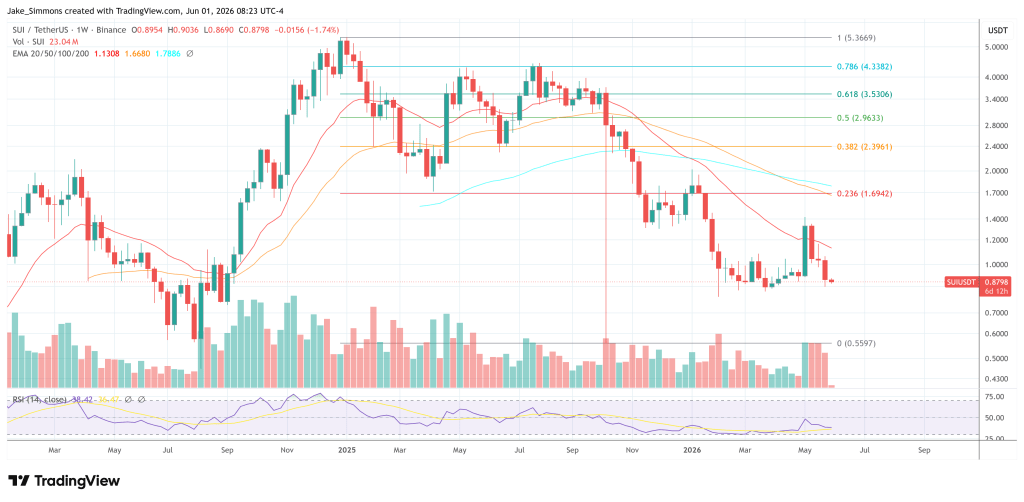
Sui remains below the 20-week EMA, 1-week chart | Source: SUIUSDT on TradingView.com

Pertanyaan Terkait

QWhat were the root causes of the three mainnet halts experienced by Sui?

AThe first two outages were caused by crash bugs involving the interaction between the new address balance feature in the 1.72 upgrade and gas charging logic. The third outage was caused by a latent bug related to how randomness state was preserved during validator restarts, which was exposed during a scheduled epoch change.

QAccording to the postmortem, were any user funds at risk during the network outages?

ANo. The Sui Foundation stated that during the outages, no user funds were at risk, and the network did not revert any committed transactions when it resumed.

QWhat specific condition triggered the gas-charging bug that led to the first two halts?

AThe bug was triggered in a hybrid gas payment scenario. When a transaction attempted to spend from an address balance that could not cover competing transactions, it was cancelled. Later, during the 'gas smashing' process, the system incorrectly tried to debit funds from the same cancelled reservation again, leading to an underflow error during settlement.

QWhat was the key issue with the Distributed Key Generation (DKG) protocol that caused the third outage?

ADuring validator restarts, the failure verdict of a DKG process (which was disabled due to low participation) was not written to disk. When validators restarted again, they had no memory of the DKG failure. This caused the end-of-epoch logic to wait indefinitely for a DKG process that would never complete, stalling the epoch transition.

QWhat broader engineering lessons did the Sui Foundation highlight from these incidents?

AThe foundation highlighted two main areas for improvement: 1) Enhancing end-of-epoch resilience with better graceful degradation and operational force-close mechanisms. 2) Applying the same level of engineering rigor to gas charging logic as is applied to the Move VM or consensus, due to its complex interactions with settlement, conservation checks, and scheduling.

Bacaan Terkait

Debut Wash: Ketua FED yang Paling Paham Crypto Sepanjang Sejarah Akan Datangkan Kejutan atau Teror Bagi Pasar?

**Penampilan Perdana Kevin Warsh: Ketua Fed Paling Paham Crypto, Akan Bawa Kejutan atau Kekhawatiran?** Ketua Federal Reserve yang baru, Kevin Warsh, bersiap untuk konferensi pers kebijakan moneter pertamanya di tengah situasi sulit: inflasi yang bangkit kembali, tekanan pasar untuk menaikkan suku bunga, dan desakan Presiden Trump untuk menurunkan suku bunga. Yang unik, Warsh adalah ketua Fed pertama yang secara terbuka memiliki portofolio investasi tidak langsung yang signifikan di aset kripto dan perusahaan Web3, mencakup berbagai sektor seperti blockchain, DeFi, dan infrastruktur pembayaran. Pemahaman pribadinya tentang teknologi ini berbeda dengan pendahulunya. Analisis kebijakannya berfokus pada dua hal: **sikap hawkish melawan inflasi** yang mungkin berarti lingkungan suku bunga ketat, dan **sikap ramah terhadap aset digital** yang bisa membawa perubahan regulasi dari "pencegahan" menjadi "integrasi dan inovasi". Dampak pada pasar kripto dapat dilihat dari: **pergeseran ekspektasi regulasi** yang lebih mendukung, **penetapan ulang premi risiko** bergantung pada komunikasi kebijakan yang jelas dari Warsh, serta **aliran modal global** yang mungkin mengalir lebih deras ke aset kripto karena legitimasi yang meningkat. Dua skenario utama untuk penampilan perdananya: 1. **Kejutan:** Gabungan sikap kebijakan moneter yang relatif lunak (dovish) dan sinyal ramah kripto dapat memulihkan sentimen pasar. 2. **Kekhawatiran:** Sinyal hawkish yang lebih keras dari perkiraan, seperti isyarat kenaikan suku bunga, dapat memicu tekanan jual di aset berisiko, termasuk kripto. Meski secara etika Warsh telah menjual semua kepemilikannya terkait kripto, pemahaman mendalamnya tentang blockchain diharapkan dapat membentuk kerangka regulasi yang lebih koheren dan mendukung, menjadi infrastruktur penting bagi arus utama aset kripto dalam jangka panjang.

marsbit5j yang lalu

Debut Wash: Ketua FED yang Paling Paham Crypto Sepanjang Sejarah Akan Datangkan Kejutan atau Teror Bagi Pasar?

marsbit5j yang lalu

AGI Bukan Akhir, Makalah Baru DeepMind: Menuju ASI, Kemajuan AI yang Sesungguhnya Baru Dimulai

Jika Kecerdasan Buatan Umum (AGI) tercapai, apakah itu titik akhir? Tim Google DeepMind dalam laporan terbarunya berpendapat bahwa AGI **bukanlah akhir perjalanan**. AI diprediksi akan terus berkembang melampaui kemampuan tim ahli manusia terbaik, menuju Superintelligence (ASI). Laporan ini membedakan tiga konsep: AGI (kecerdasan setara manusia rata-rata), ASI (melampaui manusia di hampir semua bidang), dan UAI (batas teoretis maksimal). Transisi dari AGI ke ASI dapat melalui empat jalur potensial: 1. **Ekspansi Lanjutan**: Meningkatkan skala komputasi, model, dan data. 2. **Inovasi Algoritma**: Penyempurnaan paradigma yang ada atau pergeseran paradigma baru. 3. **Peningkatan Diri Secara Rekursif**: AI yang lebih kuat membantu mengembangkan generasi AI berikutnya yang lebih kuat. 4. **Koordinasi Multi-Agen**: Kecerdasan kolektif dari banyak sistem AGI yang berkolaborasi. Namun, terdapat enam kemacetan potensial: dinding data, tekanan sumber daya ekonomi & alam, batasan paradigma jaringan saraf saat ini, meningkatnya kesulitan penelitian, hambatan abstraksi, serta tantangan regulasi dan penerimaan sosial. Laporan ini juga menyoroti bahwa jika AI melampaui manusia, sistem evaluasi (benchmark) yang ada menjadi tidak relevan. Diperlukan kerangka pengukuran baru, seperti tugas kolaborasi/kompetisi multi-agen, pengujian yang dihasilkan otomatis, atau indikator tidak langsung seperti produktivitas ekonomi. ASI bukanlah sistem ajaib yang mahatahu; perkembangannya tetap dibatasi oleh hukum fisika, kompleksitas komputasi, data, sumber daya, dan umpan balik dunia nyata. Arah dan kecepatan kemajuan AI masih penuh ketidakpastian, sehingga memerlukan penelitian, prediksi, dan mekanisme evaluasi yang terus diperbarui.

marsbit7j yang lalu

AGI Bukan Akhir, Makalah Baru DeepMind: Menuju ASI, Kemajuan AI yang Sesungguhnya Baru Dimulai

marsbit7j yang lalu

Trading

Spot
Futures

Artikel Populer

Cara Membeli SUI

Selamat datang di HTX.com! Kami telah membuat pembelian SUI Network (SUI) menjadi mudah dan nyaman. Ikuti panduan langkah demi langkah kami untuk memulai perjalanan kripto Anda.Langkah 1: Buat Akun HTX AndaGunakan alamat email atau nomor ponsel Anda untuk mendaftar akun gratis di HTX. Rasakan perjalanan pendaftaran yang mudah dan buka semua fitur.Dapatkan Akun SayaLangkah 2: Buka Beli Kripto, lalu Pilih Metode Pembayaran AndaKartu Kredit/Debit: Gunakan Visa atau Mastercard Anda untuk membeli SUI Network (SUI) secara instan.Saldo: Gunakan dana dari saldo akun HTX Anda untuk melakukan trading dengan lancar.Pihak Ketiga: Kami telah menambahkan metode pembayaran populer seperti Google Pay dan Apple Pay untuk meningkatkan kenyamanan.P2P: Lakukan trading langsung dengan pengguna lain di HTX.Over-the-Counter (OTC): Kami menawarkan layanan yang dibuat khusus dan kurs yang kompetitif bagi para trader.Langkah 3: Simpan SUI Network (SUI) AndaSetelah melakukan pembelian, simpan SUI Network (SUI) di akun HTX Anda. Selain itu, Anda dapat mengirimkannya ke tempat lain melalui transfer blockchain atau menggunakannya untuk memperdagangkan mata uang kripto lainnya.Langkah 4: Lakukan trading SUI Network (SUI)Lakukan trading SUI Network (SUI) dengan mudah di pasar spot HTX. Cukup akses akun Anda, pilih pasangan perdagangan, jalankan trading, lalu pantau secara real-time. Kami menawarkan pengalaman yang ramah pengguna baik untuk pemula maupun trader berpengalaman.

678 Total TayanganDipublikasikan pada 2024.12.12Diperbarui pada 2026.06.02

Cara Membeli SUI

Diskusi

Selamat datang di Komunitas HTX. Di sini, Anda bisa terus mendapatkan informasi terbaru tentang perkembangan platform terkini dan mendapatkan akses ke wawasan pasar profesional. Pendapat pengguna mengenai harga SUI (SUI) disajikan di bawah ini.

活动图片