The Midlife Crisis of Crypto GPs: No PMF, No Next Check from LPs

marsbitDipublikasikan tanggal 2026-06-01Terakhir diperbarui pada 2026-06-01

Abstrak

The article "The Midlife Crisis of Crypto GPs: No PMF, No Next LP Check" analyzes the shifting crypto fundraising landscape. It argues the era of selling grand visions to LPs is over; GPs must now offer products with clear Product-Market Fit (PMF). The author categorizes crypto fundraising products into three types: Primary (VC funds), Liquid (trading strategies), and CeFi/DeFi Native Yield. This summary focuses on the Primary market. Key points include: * **Market Shift:** LPs are impatient, demand immediate returns, and are skeptical of future promises. The "easy money" narrative has faded. * **GP Value Erosion:** LP learning curves have shortened (aided by AI), reducing the value of a GP's basic "crypto knowledge." Superior judgment is now rare. * **Weakened LP Motivations:** Traditional reasons for LPs to invest in crypto VC funds (capturing industry beta, gaining access, leveraging GP judgment) have weakened due to new products like ETFs and increased LP sophistication. * **Surviving in Primary:** The primary market will likely persist for: 1) large funds in endowment mandates treating it as a lottery ticket, 2) family offices/HNWIs using proprietary capital, 3) a few funds with proven recent outperformance, and 4) funds with strong ecosystem "deal-making" capabilities. * **Conclusion:** For most GPs, rebuilding trust requires starting over in a niche, demonstrating alpha-generating ability, or providing concrete value/services to LPs.

Author: Yi.Pineapple

LPs are no longer buying dreams; GPs must sell products. This article will attempt to categorize current crypto fundraising products into three types: Primary, Liquid, and CeFi / DeFi Native Yield. The first part focuses on Primary: after VC blind pools have lost their appeal, who remains at this table, and who must prove themselves anew? The answer is at the end; you can scroll directly to the bottom.

Note: This article aims to provide a landscape overview of the entire crypto fundraising market. The first part mainly categorizes and explains the current market situation from a product perspective, while the second part will analyze more from the perspective of LPs. As the author is primarily based in the Asian market, this article may have a regional bias.

Market Status

Having lost the grand vision, most Crypto GPs who failed to earn excess returns this cycle must get down to earth and launch a product with PMF. They must either prove they still have the ability to generate excess returns for LPs through some niche market or help LPs/partners solve specific problems in order to survive.

  • For most GPs, this market has long moved from the stage of "buying a future vision" to the stage of "buying a specific product."
  • LPs have lost patience and no longer want to gaze at the stars and the sea; they want to see something that can make money immediately, right away, and with relative certainty.
  • Crypto LPs have lost trust in the market and are no longer willing to easily believe the "next cycle" narrative (this has been discussed too much and will not be elaborated here). Moreover, many did not make easy money this cycle. Once the way to make money becomes difficult, investment actions tend to become more cautious and conservative.
  • Most traditional LPs have also completed a round of learning and moved past the story-listening stage. The 2020/2021 bull market was the time of peak FOMO. Dollar funds were cheap (Treasury yield close to 0), LPs were still making money relatively easily (on the eve of the economic downturn), and Crypto was in an explosive period (there were many wealth creation myths, and there was still a dream to sell). Back then, many people, even with only a vague understanding of crypto, were willing to make impulsive purchases for the dream; or, for strategic reasons, paid to enter and learn.
  • AI and falling labor costs have also changed the positioning of GPs. The costs for LPs to learn, hire, analyze data, trade, and make small direct investments are all declining. The trend of LPs transforming into GPs is significant. If GPs only offer the vague capability of "I understand crypto," their value will become increasingly precarious.
  • As for the storytelling track, unless they are U.S.-based funds with strong brand power, who, based on their past track records, can still tell stories and visions in specific niches (e.g., a16z leveraging its advantage in the AI sector to talk about crypto * AI, Dragonfly leveraging its investments in Ethena/Polymarket to talk about internet capital markets), there is still an opportunity. In Asia, this positioning is already difficult. After all, to some extent, in both crypto projects and funds, the opportunity to tell stories often goes to those with a "white paper" (a play on words implying Western or native English speakers have an advantage).

Product Overview

This article categorizes crypto fundraising products into three major types for discussion: Primary, Liquid, and CeFi / DeFi Native Yield (Note: This categorization is not entirely precise; there are some blurred lines between the three). (*This time, only Primary is covered)

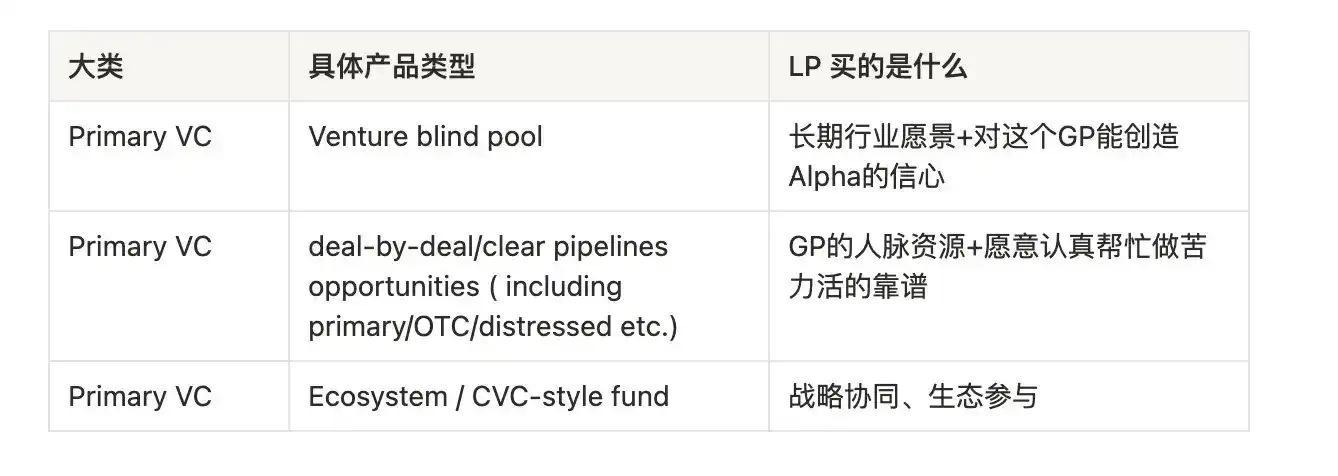
Primary VC:

In terms of transparency, they can be roughly divided into blind pools and those with clear pipelines.

In terms of liquidity, they can be roughly divided into primary and primary-secondary.
Liquid:

In terms of source of returns, roughly divided into alpha-focused (buying GP's personal ability) and beta-focused (buying industry trends).

In terms of directionality, roughly divided into directional (buying cycle judgments) and market neutral (buying market inefficiencies in immature markets).
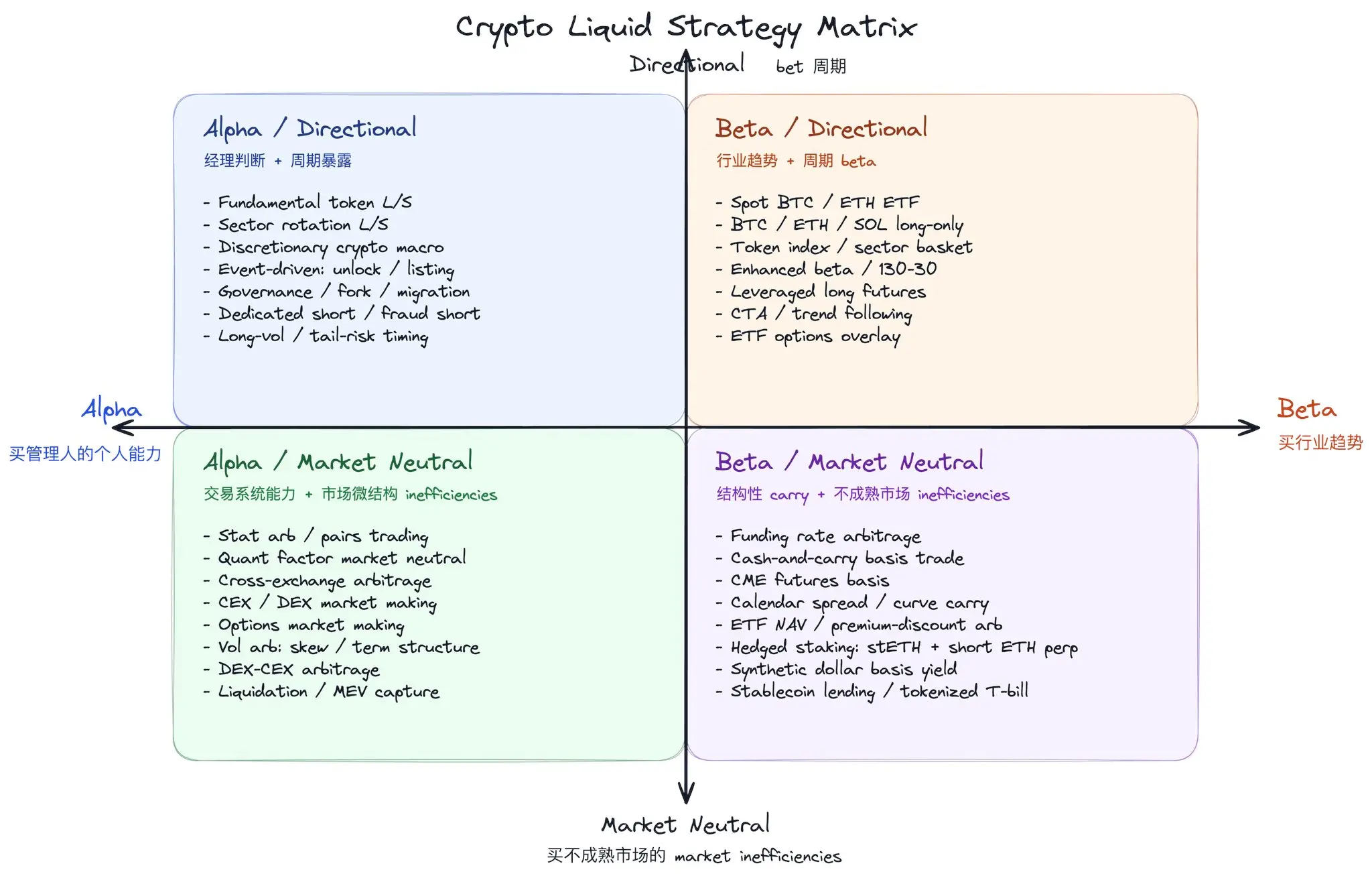
There are many ways to categorize; this is just to provide an idea

CeFi/DeFi Native Yield:

In theory, CeFi/DeFi Native Yield can be viewed as a type of return source within or spanning the crypto primary market and liquid market. The reason for listing it separately is mainly because, from the perspective of TradFi investors, they usually use the framework of traditional financial markets to understand crypto: for example, crypto VC can be understood as a sub-sector under the VC category, and staking/lending yield can be analogized to fixed income or cash management products.

However, crypto indeed contains some玩法 (play/mechanisms) and return mechanisms not entirely corresponding to traditional financial markets, such as mine-trade-sell, points/airdrop farming, protocol incentives, on-chain liquidity mining, etc. These are more like crypto-native issuance, user acquisition, and incentive mechanisms, warranting separate discussion.

Secondly, for many Crypto Native Investors, their earliest entry point and understanding of financial markets were not the traditional equity/bond market, but rather crypto-native scenarios like exchange wealth management products, staking, DeFi lending, LP, points/airdrop farming, basis trade, etc. Therefore, when they look at this part of the yield, they may not necessarily translate it into TradFi's fixed income, cash management, or alternative yield first. Instead, they more naturally understand it from the perspectives of protocol incentives, liquidity provision, token emission, on-chain risk, counterparty risk, and capital efficiency.

For Crypto Native LPs, accessing this part of the yield does not require a GP; at most, they might need a reliable key account manager.

For TradFi LPs, there are now some institutions packaging this part of the yield into fund forms to sell to TradFi LPs.

Primary Market

From the perspective of the entire primary market, crypto VC is just a sub-sector under the VC category. 2021 was a crazy year; whether crypto or non-crypto, the real returns of that vintage are not good. As a cruel fact, LPs have learnt their lessons, tired of any products with ultra-long lock-up periods (traditional VC typically 10 years, crypto VC also often 5-10 years). Because without a hard lock-up, they at least have the chance to withdraw part of their money if circumstances change.

In a sense, crypto is even worse off than traditional VC because the entire vision has collapsed. It is not a new industrial revolution; at most, it's a revolution in financial infrastructure. This judgment is not to disparage crypto—a revolution in financial infrastructure is still very important—but it's not as grand as many imagined in the last bull market. Worse, the market was too immature back then, and many projects were invested in without sufficient due diligence and legal protection. Many failed projects are a combination of investment failure and founders running away. There are already too many articles in the industry discussing the current dire situation; it will not be elaborated here.

Investing in VC is like VC investing in projects—a power-law business, a lottery-like business. As long as there are people willing to buy lottery tickets, this table will not disappear.

Why LPs invested in crypto VC back then, and why these reasons have weakened now

1. Invest to capture the beta of the industry

This reason was especially valid for tradfi LPs. It was true in the early days because market choices were few. For outsiders, on-ramping, buying tokens, going on-chain, using CEXs, and managing wallets were all difficult. They worried about losing private keys and CEXs running away. Investing in VC seemed like a more reliable access point then.

But today, when a traditional LP enters crypto, they have a whole set of choices before them: BTC ETF, ETH ETF, crypto ETP, DAT, custody accounts, SMAs, structured products. More importantly, these products do not require them to learn on-chain operations; they can trade just like they used to buy stocks.

According to CoinShares, the AUM of global digital asset investment products it covered reached about $156.9B in mid-May 2026. This number is not the total industry AUM, only the ETF/ETP/trust/closed-end funds and other listed or quotable products. But it's enough to show that gaining crypto exposure no longer requires investing in VC blind pools.

However, for long-term capital with clear mandates (e.g., endowment, etc.), this reason still applies. For them, to position in an industry often requires allocating to a basket of assets, so there is still likely a 1~2% allocation to Crypto VC.

2. Invest for accessibility

This usually happened to crypto LPs and some tradfi LPs with strategic positioning visions. At that time, many such LPs did not have the energy/time/ability to build their own investment teams, so they gave money to GPs, hoping to get good deal access.

But they later found this reason unstable too. When the market is good, GPs themselves don't have enough allocation, and it's hard for LPs to get truly good access. When the market is bad, competition is not fierce, and if you are willing to engage, getting allocation is not that difficult.

For traditional LPs, access had another meaning: they knew nothing at the time but hoped to enter the ecosystem and gain insider information by investing in crypto-native GPs. This was a strategic investment when there was no clear strategic target. Now the situation has changed. Many traditional LPs have either left for hotter industries like AI or have developed their own internal teams. AI and cheap researchers have narrowed the knowledge gap. New learners still exist, but their learning speed is accelerating, and their paths are multiplying; investing in the primary market with ultra-long lock-ups may not be the optimal choice for them.

3. Invest for judgment

This is the trickiest part. In a market developing extremely fast, unless GPs can continuously self-iterate, the judgment premium will disappear quickly. The rules of the game change every cycle, but it's not easy for people to change themselves (is this another version of "old habits die hard"?).

We must face a cruel reality: most GPs did not prove to LPs in the last cycle that they had superior judgment.

For traditional LPs, part of the purpose of investing in crypto-native GPs back then was to educate themselves and learn the industry through the GP's judgment. This typically happened to two types: one was companies hoping to strategically enter web3, such as large internet companies; the other was sophisticated tradfi investors, such as traditional GPs or family offices, who wanted to do their own web3 direct investment in the future. The learning period is now over, and only a small number of GPs who have truly proven they have superior judgment can remain on their investment lists.
For crypto LPs, they found that rather than betting on a GP's judgment, it's better to lose money themselves. Losing money themselves at least has emotional value, and they don't have to pay management fees.

4. Invest for deal-making ability

From an investment return perspective, deal-making ability mainly manifests as whether it can achieve a good exit for the project ultimately. Ideally, it would be best to help the project achieve healthy growth and ultimately obtain good returns in the secondary market. Otherwise, having the ability to organize the next round of financing is also important (essentially the difference between relying on retail investors or large investors to take over).

However, as a form of financial innovation, Crypto sometimes resembles a large-scale capital game. Sometimes, investment is just a way of exchanging interests, ensuring everyone has aligned interests and can make money together relatively assuredly.

5. Invest for reputation

For some large LPs, the money invested in a single VC is only about 1% of their overall portfolio, negligible. Sometimes they invest in a GP just to be cool (like investing in A16Z). However, most GPs are not in this category.

Who can still stay at the primary table

From a pure capital source perspective, the players most likely to continue staying at the primary table are:

Funds large enough to enter the mandates of endowments/other similar long-term patient capital. These institutions buy crypto VC as lottery tickets, without short-term funding pressure.

FOs, companies, HNW proprietary primary crypto investments using their own money. FOs/HNWs are more likely to do accelerator-like, very early funds; companies are more likely to do direct strategic investments/acquisitions.

The few funds that really made bets/accumulated BTC this cycle and actually generated excess returns for LPs. LPs believe they can win next time.

Funds with clear deal-making ability, possessing ecosystem resources that can be exchanged for interests with LPs.

For other players, if trust has been lost, it might be better to mentally start over and rebuild trust. Prove the ability to generate excess returns for investors again in a niche sector, or provide some specific service/value, and then scale up based on that.


Pertanyaan Terkait

QAccording to the article, what is the main reason why most crypto GPs are now forced to develop a product with Product-Market Fit (PMF)?

AThe main reason is that LPs have lost patience and are no longer willing to invest based on future visions or 'the next cycle' narrative. They now demand immediate, relatively certain profit opportunities or specific problem-solving capabilities. The market has shifted from 'buying a future vision' to 'buying a specific product.'

QInto which three broad categories does the article classify crypto fundraising products?

AThe article classifies crypto fundraising products into three categories: 1. Primary (like VC funds), 2. Liquid (trading-focused products), and 3. CeFi / DeFi Native Yield (products based on staking, lending, airdrop farming, etc.).

QWhat was a key reason for traditional LPs to invest in crypto native GPs in the past that has now significantly weakened?

AA key past reason was 'Invest for accessibility'—LPs lacked the knowledge, team, or operational ability to enter crypto directly and used GPs to access deals and insider information. This has weakened as learning resources improved, internal teams were built, and easier access products (like ETFs) emerged, reducing the necessity of a VC blind pool for exposure.

QWhat does the article identify as 'the most tricky part' regarding the 'Invest for judgement' reason for backing a GP?

AThe most tricky part is that the 'judgement premium' of a GP can disappear quickly in the fast-evolving crypto market unless the GP can continuously self-iterate. The article states the harsh reality that most GPs failed to prove they had superior judgement in the last cycle, eroding LP trust.

QBased on the article, which types of players are most likely to remain at the 'primary' investment table?

A1. Large funds that fit into the mandate of long-term, patient capital like endowments. 2. Family Offices, companies, and High-Net-Worth individuals investing their own money. 3. A few funds that delivered outsized returns in this cycle. 4. Funds with clear ecosystem resources and deal-making ('攒局') capabilities for利益置换 (interest exchange).

Bacaan Terkait

Volume Pengiriman TPU Google Dinaikkan 50%

Kebutuhan AI akan daya komputasi terus meningkat, dan pasar sedang mengalami koreksi ekspektasi penting. Beberapa lembaga luar negeri secara diam-diam telah merevisi perkiraan pengiriman Google TPU ke atas. Dari perkiraan awal 10 juta unit untuk tahun 2027, penelitian industri terbaru menunjukkan angka ini dapat dinaikkan menjadi 15 juta unit, peningkatan 50%. Peningkatan signifikan dalam volume TPU ini akan langsung mengalir ke seluruh rantai pasokan. Skema interkoneksi optik penuh yang standar pada kluster TPU Google berarti kebutuhan perangkat keras pendukungnya kaku dan hampir tetap, termasuk NPO Optical Engine (yang dipasangkan 1:1 dengan TPU), modul optik 1.6T, OCS Optical Switch, catu daya server, serta kabel serat optik dan konektor MPO. Setiap kenaikan ekspektasi pengiriman TPU akan mendorong ekspektasi kinerja seluruh rantai ini. Di antara segmen-segmen ini, pendinginan cair (*liquid cooling*) muncul sebagai arah inti dengan perubahan terbesar. Dengan peningkatan daya chip TPU generasi baru, solusi pendingin tradisional sudah tidak memadai. Tahun 2026 diprediksi menjadi tahun peluncuran besar-besaran pendinginan cair untuk Google. Selain akselerasi kinerja, pola persaingan global sedang berubah. Produsen luar negeri menghadapi kendala kapasitas dan teknologi, membuka peluang bagi produsen domestik China untuk masuk ke rantai pasokan inti Google dengan keunggulan iterasi cepat dan kapasitas memadai. Pasar pendinginan cair khusus Google diproyeksikan melonjak dari level ratusan miliar menjadi 300 miliar dalam dua tahun, didorong oleh peningkatan volume dan nilai per unit. Logika di pasar serat optik juga diperbarui. Kebutuhan akan interkoneksi padat di pusat data AI telah mengubahnya dari komoditas siklus menjadi sumber daya strategis. Siklus ekspansi yang panjang untuk preform serat optik (18-24 bulan) menciptakan ketidakseimbangan pasokan dan permintaan global. Vendor cloud besar seperti Google mengamankan pasokan jangka panjang. Produsen serat optik China, dengan keunggulan kapasitas dan biaya, diperkirakan akan mendominasi hampir setengah dari permintaan global untuk serat AIDC pada 2026. Selain itu, peningkatan pasokan TPU juga mendorong pemulihan di segmen pendukung lain seperti modul optik 1.6T dan catu daya server bertegangan tinggi, di mana produsen China juga mendapat peluang substitusi. Intinya, fokus investasi beralih dari spekulasi chip ke pertumbuhan pasti infrastruktur pendukung komputasi. Revisi besar pasokan TPU Google ini mengunci visibilitas kinerja untuk dua tahun ke depan di seluruh rantai industri.

marsbit30m yang lalu

Volume Pengiriman TPU Google Dinaikkan 50%

marsbit30m yang lalu

Setelah Cerita Dunia Kripto Meredup, Apa yang Sebenarnya Diinginkan Wall Street?

Penulis: Blockchain in Plain Language Pada musim gugur 2008, saat Lehman Brothers runtuh, Satoshi Nakamoto meluncurkan Bitcoin dengan pesan sindiran terhadap sistem keuangan tradisional. Setelah 17 tahun, situasinya berbalik. Alih-alih mengadopsi narasi spekulatif "decentralized", Wall Street kini membangun infrastruktur keuangan tradisional yang dikendalikan dan sesuai regulasi di atas teknologi blockchain. Inti transformasi ini adalah tokenisasi aset dunia nyata. Dana BUIDL milik BlackRock, yang di-backing oleh surat utang pemerintah AS jangka pendek, telah menjadi aset dasar yang stabil di blockchain. Securitize, mitra BlackRock, akan melantai di bursa dengan valuasi $1,25 miliar dan bekerja sama dengan NYSE untuk membangun sistem penyelesaian perdagangan saham 24/7 berbasis blockchain. Wall Street juga mengemas volatilitas Bitcoin menjadi produk berpenghasilan tetap. ETF Bitcoin Premium Income (BITA) milik BlackRock akan menghasilkan pendapatan dengan menjual opsi call, mengubah Bitcoin menjadi aset yang membayar dividen bulanan. Dalam pembayaran, stablecoin kini difokuskan sebagai alat transaksi yang efisien. Stripe dan Mastercard mengintegrasikan stablecoin untuk penyelesaian pembayaran lintas batas yang instan, sementara regulasi GENIUS Act 2025 memastikan stablecoin tetap sebagai alat bayar yang tidak membayar bunga dan diawasi ketat. Kesimpulannya, Wall Street tidak lagi mengejar cerita spekulatif cryptocurrency. Mereka membangun pipa keuangan baru di blockchain yang menghasilkan pendapatan, terkendali, dan compliant—mengadopsi teknologi untuk memperkuat, bukan mengganti, sistem keuangan tradisional.

marsbit47m yang lalu

Setelah Cerita Dunia Kripto Meredup, Apa yang Sebenarnya Diinginkan Wall Street?

marsbit47m yang lalu

Terikat pada SpaceX, Jalan Cursor Menuju Kebangkitan dengan Nilai US$600 Miliar

**Ringkasan Bahasa Indonesia: Kisah Cursor, Startup AI Pemrograman yang Meroket dan Masa Depannya di Bawah Elon Musk** Pada 2019, Michael Truell, mahasiswa MIT berusia 18 tahun, menunjukkan bakat pemrograman luar biasa. Beberapa tahun kemudian, ia dan beberapa temannya mendirikan Anysphere dan meluncurkan Cursor, sebuah editor kode berbasis AI. Pada akhir 2025, Cursor digunakan jutaan pengembang dengan pendapatan melampaui $10 miliar, tumbuh 10 kali lipat dalam kurang dari setahun. Pertumbuhan pesat Cursor diiringi kontroversi, seperti proses rekrutmen yang ketat dengan "percobaan kerja" tidak berbayar selama berhari-hari hingga berminggu-minggu. Tantangan struktural utama adalah ketergantungannya pada model AI dari Anthropic (Claude). Ketika Anthropic meluncurkan alat pemrograman saingannya, Claude Code, Cursor merasa terancam dan memulai proyek darurat untuk mengembangkan model AI sendiri bernama Composer. Untuk mengatasi kebutuhan komputasi mahal dalam pengembangan model, Cursor menjalin kerja sama strategis dengan SpaceX milik Elon Musk. Cursor mendapatkan akses ke sumber daya komputasi masif SpaceX, sementara Grok (AI milik Musk/xAI) mendapatkan data pelatihan dari Cursor untuk meningkatkan kemampuan pemrogramannya. Kerja sama ini juga mencakup perjanjian akuisisi potensial senilai $600 miliar oleh SpaceX di kemudian hari. Inti cerita ini adalah pertanyaan tentang masa depan Cursor: akankah menjadi perusahaan perangkat lunak generasi berikutnya yang mandiri, atau hanya menjadi bagian dalam persaingan raksasa AI? Saat ini, dengan 700 karyawan dan melayani 60% perusahaan Fortune 500, Cursor terus tumbuh sambil menavigasi hubungan kompleks dengan mitra model AI dan komitmen besar dengan Elon Musk.

marsbit49m yang lalu

Terikat pada SpaceX, Jalan Cursor Menuju Kebangkitan dengan Nilai US$600 Miliar

marsbit49m yang lalu

Debut Wash: Ketua FED yang Paling Paham Crypto Sepanjang Sejarah Akan Datangkan Kejutan atau Teror Bagi Pasar?

**Penampilan Perdana Kevin Warsh: Ketua Fed Paling Paham Crypto, Akan Bawa Kejutan atau Kekhawatiran?** Ketua Federal Reserve yang baru, Kevin Warsh, bersiap untuk konferensi pers kebijakan moneter pertamanya di tengah situasi sulit: inflasi yang bangkit kembali, tekanan pasar untuk menaikkan suku bunga, dan desakan Presiden Trump untuk menurunkan suku bunga. Yang unik, Warsh adalah ketua Fed pertama yang secara terbuka memiliki portofolio investasi tidak langsung yang signifikan di aset kripto dan perusahaan Web3, mencakup berbagai sektor seperti blockchain, DeFi, dan infrastruktur pembayaran. Pemahaman pribadinya tentang teknologi ini berbeda dengan pendahulunya. Analisis kebijakannya berfokus pada dua hal: **sikap hawkish melawan inflasi** yang mungkin berarti lingkungan suku bunga ketat, dan **sikap ramah terhadap aset digital** yang bisa membawa perubahan regulasi dari "pencegahan" menjadi "integrasi dan inovasi". Dampak pada pasar kripto dapat dilihat dari: **pergeseran ekspektasi regulasi** yang lebih mendukung, **penetapan ulang premi risiko** bergantung pada komunikasi kebijakan yang jelas dari Warsh, serta **aliran modal global** yang mungkin mengalir lebih deras ke aset kripto karena legitimasi yang meningkat. Dua skenario utama untuk penampilan perdananya: 1. **Kejutan:** Gabungan sikap kebijakan moneter yang relatif lunak (dovish) dan sinyal ramah kripto dapat memulihkan sentimen pasar. 2. **Kekhawatiran:** Sinyal hawkish yang lebih keras dari perkiraan, seperti isyarat kenaikan suku bunga, dapat memicu tekanan jual di aset berisiko, termasuk kripto. Meski secara etika Warsh telah menjual semua kepemilikannya terkait kripto, pemahaman mendalamnya tentang blockchain diharapkan dapat membentuk kerangka regulasi yang lebih koheren dan mendukung, menjadi infrastruktur penting bagi arus utama aset kripto dalam jangka panjang.

marsbit11j yang lalu

Debut Wash: Ketua FED yang Paling Paham Crypto Sepanjang Sejarah Akan Datangkan Kejutan atau Teror Bagi Pasar?

marsbit11j yang lalu

Trading

Spot
Futures

Artikel Populer

Cara Membeli CHECK

Selamat datang di HTX.com! Kami telah membuat pembelian Checkmate (CHECK) menjadi mudah dan nyaman. Ikuti panduan langkah demi langkah kami untuk memulai perjalanan kripto Anda.Langkah 1: Buat Akun HTX AndaGunakan alamat email atau nomor ponsel Anda untuk mendaftar akun gratis di HTX. Rasakan perjalanan pendaftaran yang mudah dan buka semua fitur.Dapatkan Akun SayaLangkah 2: Buka Beli Kripto, lalu Pilih Metode Pembayaran AndaKartu Kredit/Debit: Gunakan Visa atau Mastercard Anda untuk membeli Checkmate (CHECK) secara instan.Saldo: Gunakan dana dari saldo akun HTX Anda untuk melakukan trading dengan lancar.Pihak Ketiga: Kami telah menambahkan metode pembayaran populer seperti Google Pay dan Apple Pay untuk meningkatkan kenyamanan.P2P: Lakukan trading langsung dengan pengguna lain di HTX.Over-the-Counter (OTC): Kami menawarkan layanan yang dibuat khusus dan kurs yang kompetitif bagi para trader.Langkah 3: Simpan Checkmate (CHECK) AndaSetelah melakukan pembelian, simpan Checkmate (CHECK) di akun HTX Anda. Selain itu, Anda dapat mengirimkannya ke tempat lain melalui transfer blockchain atau menggunakannya untuk memperdagangkan mata uang kripto lainnya.Langkah 4: Lakukan trading Checkmate (CHECK)Lakukan trading Checkmate (CHECK) dengan mudah di pasar spot HTX. Cukup akses akun Anda, pilih pasangan perdagangan, jalankan trading, lalu pantau secara real-time. Kami menawarkan pengalaman yang ramah pengguna baik untuk pemula maupun trader berpengalaman.

624 Total TayanganDipublikasikan pada 2026.01.19Diperbarui pada 2026.06.02

Cara Membeli CHECK

Diskusi

Selamat datang di Komunitas HTX. Di sini, Anda bisa terus mendapatkan informasi terbaru tentang perkembangan platform terkini dan mendapatkan akses ke wawasan pasar profesional. Pendapat pengguna mengenai harga CHECK (CHECK) disajikan di bawah ini.

活动图片