When Hyperliquid Steals Solana's 'Internet Capital Markets' Playbook

链捕手Dipublikasikan tanggal 2026-05-19Terakhir diperbarui pada 2026-05-19

Abstrak

The article discusses how Solana's grand vision of becoming an "Internet Capital Markets" platform is facing significant challenges in 2026, primarily from the unexpected rise of Hyperliquid. Solana's performance has weakened, with its token SOL experiencing the largest price decline among major cryptocurrencies. Its core narrative of building a global, chain-based marketplace for all assets is under pressure both internally and externally. Hyperliquid, originally a perpetual futures exchange, has evolved into a dedicated Layer 1 financial infrastructure network. Its focused, trading-centric approach is attracting capital and challenging the assumption that a "general-purpose" ecosystem like Solana is necessary for a capital market. Hyperliquid's success suggests that for high-frequency trading, superior performance, liquidity, and user experience may be more critical than a broad application ecosystem. Internally, Solana's strategy suffered a blow from a major hack on the Drift Protocol in April, resulting in over $200 million in losses. In response, Solana founder Anatoly Yakovenko has heavily promoted Phoenix as a new decentralized perpetual futures platform on Solana. While this boosted Phoenix's visibility, its trading volume remains far behind leading platforms. Solana's community has launched a rhetorical attack against Hyperliquid, questioning its decentralization due to its limited validator set and closed-source code. Critics, however, point out Solana's own dec...

Author: Hu Tao

In the cyclical waves of the cryptocurrency market, Solana once returned to its peak with the "Ethereum killer" narrative and extreme performance. However, as we enter 2026, this once high-performance machine is facing unprecedented deceleration pressure, first evident in its price.

In the past year, SOL's price has fallen by up to 73.5% from its high, the largest decline among all mainstream cryptocurrencies. In the recent month's market pullback, SOL's gains have also been very weak, significantly lagging behind other major cryptocurrencies like BTC and ETH.

Furthermore, Solana's core vision of "Internet Capital Markets" has suffered a major blow amidst internal and external challenges, forcing the Solana Foundation's senior team to speak out frequently recently, promoting their ecosystem on the public opinion front.

Solana's Core Narrative Hits a Wall

Over the past few years, Solana has been trying to tell a story far grander than just a "high-performance public chain."

In the definition of the Solana Foundation, Solana's endgame has transformed into "Internet Capital Markets"—a global trading network that brings stocks, commodities, futures, perpetual contracts, and all real-world assets on-chain.

Now, upon opening the official Solana website homepage, the most prominent slogan immediately greeting you is still: "Capital markets for every asset on Earth."
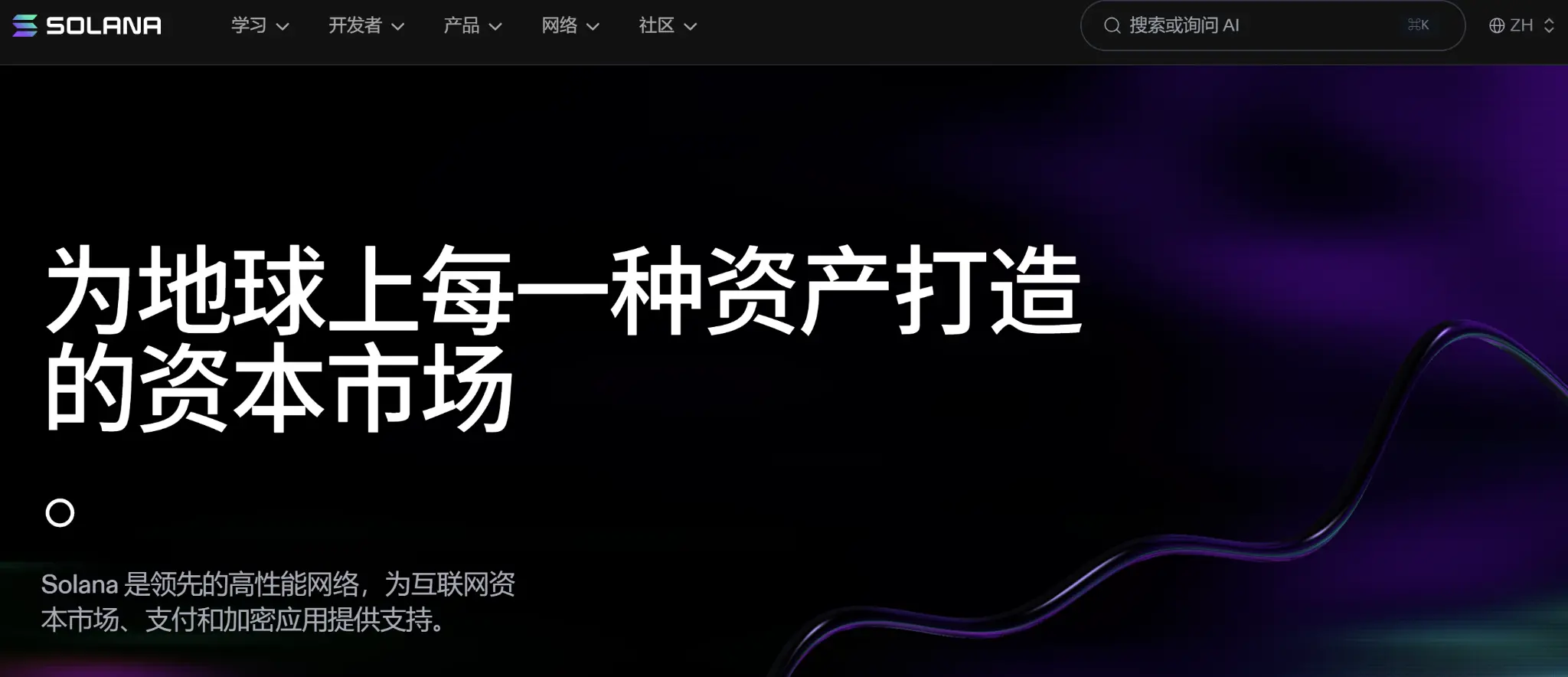
This means Solana aims not only to challenge Ethereum but also to replace traditional exchanges, brokers, and clearing systems, becoming the on-chain version of Nasdaq. High speed, low fees, high throughput, relatively mature user experience, and the strong backing of Wall Street capital once positioned Solana as the public chain closest to achieving this goal.

However, the problem is that as the "Internet Capital Markets" truly begin to take shape, the market is finding that Solana may not necessarily be at its core.

The Unexpected Impact of Hyperliquid

One of the biggest structural changes in the crypto industry over the past year has been the migration of the perpetual futures market away from traditional CEXs to on-chain platforms.

The biggest beneficiary of this trend is not Solana, nor Ethereum, Sui, or other networks, but Hyperliquid.

Initially, Hyperliquid was just an on-chain perpetual futures trading platform, but with the advancement of its Layer1 strategy, it has gradually evolved into a complete financial infrastructure network. Compared to Solana's broad and abstract "capital markets" vision, Hyperliquid has chosen a more focused, transaction-driven path.

For a long time, although the Solana ecosystem has hosted numerous DeFi projects, its core liquidity has always leaned more towards spot trading, Meme Coins, and on-chain speculation. The infrastructure truly capable of supporting institutional-grade trading depth, risk management, and high-frequency trading needs has never matured.

More critically, Hyperliquid has gradually proven something many previously overlooked: an "Internet Capital Markets" may not necessarily require a general-purpose ecosystem.

For high-frequency financial transactions, performance, matching, liquidity, and trading experience are far more important than "richness of on-chain applications." This means a vertical Layer1 specifically designed for financial transactions might be more suitable as the core of on-chain capital markets than a general-purpose public chain like Solana.

This is also why an increasing amount of capital, traders, and attention is converging on Hyperliquid.

After the Drift Incident, Solana Forced to Adjust Perpetual Futures Market Strategy

If Hyperliquid's rise externally squeezes the strategic space for Solana's "capital markets," then the Drift Protocol exploit incident tore open a massive gap from within.

In early April of this year, the Solana DeFi protocol Drift suffered a governance and oracle attack, resulting in over $200 million in losses.

As one of the most important perpetual futures protocols on Solana, Drift had been playing a central liquidity role in Solana DeFi. After the hack, the protocol's functions were directly paralyzed, a large number of assets, vaults, and associated protocols within the Solana ecosystem were affected, and market confidence rapidly deteriorated.

Perpetual futures are a fiercely contested territory in the DeFi space. Faced with the market vacuum left by Drift and the strategic gap in Solana's on-chain derivatives field, the Solana official team must vigorously promote a new alternative product to capture users and market share in this frontline battle for the "Internet Capital Markets" strategy.

At this point, the choices before Solana officials included a series of products like Pacifica, Phoenix, Jupiter, GMTrade, Bullet, and Blink. However, Solana founder Anatoly Yakovenko firmly chose Phoenix.

Over the past five days, Toly has posted at least twenty tweets or retweets related to Phoenix, either forwarding other industry figures' test experiences with Phoenix, directly recommending its use, or discussing his views on Phoenix.

Regarding such "favoritism," Toly has also explained multiple times that Pacifica does not execute trades on the Solana chain; its compatibility with Solana is as good as Hyperliquid's, while Jup is already mature, and he is more focused on early-stage teams building from 0 to 1. Meanwhile, Phoenix is decentralized and can be atomically composable with all other applications on Solana.

Driven by Toly's promotion, Phoenix's popularity has ranked among the top three on RootData's trending projects list for consecutive days, reaching its historical peak in the heat index.

However, in terms of trading volume, Phoenix still lags far behind other established perpetual futures platforms. According to DeFillama data, Phoenix's daily trading volume had long been less than $4 million, and recently, riding the market hype, it surpassed $80 million for the first time. Yet, it still ranks outside the top 20 among all perpetual platforms, with at least a 20-fold gap from the top 5 platforms (minimum $1.6 billion).

Solana's Public Relations Offensive and Internal Rifts

Faced with Hyperliquid's strong rise and the wounds within its own ecosystem, Solana supporters have chosen a seemingly "using the opponent's own spear as a shield" path—wielding decentralization as a weapon to launch a public opinion attack against Hyperliquid.

Solana Foundation member @harkl_ tweeted that Hyperliquid markets itself as a decentralized exchange, but the reality is 24 validator nodes, closed-source node code, a single bridge handling tens of billions of dollars, and a record of forced settlements during market volatility.

"Can you participate in any part of the protocol stack with your own resources without approval from a trusted third party? If not, then it's not permissionless. No matter what you do, you cannot run a Hyperliquid sequencer," Toly further stated.

This argument sparked heated debate in the crypto community. Supporters believe Toly hit Hyperliquid's core weakness—if there are fewer than 30 validator nodes, node code is not open-source, and the bridge is highly centralized, what is the fundamental difference between this so-called "on-chain capital market" and the custodial model of CEXs?

Opponents point out that Solana's own validator count has sharply dropped from 2560 to about 756, its Nakamoto Coefficient has fallen from 31 to 20, and the top twenty validators control over one-third of the staked share—in this context, discussing "decentralization" seems somewhat like "the pot calling the kettle black."

An even thornier issue comes from within the Solana ecosystem. The consistent "favoritism" shown by many Solana Foundation executives has caused discontent among developers of other protocols.

"They will promote what they think is best for themselves. Pushing others away just because a team meets a certain criterion is turning friends into enemies," said kdotcrypto, co-founder of Bulk.

The comment from Pacifica founder Constance was more restrained yet equally damaging: "We chose Solana in 2025, didn't take any funding from the Foundation, didn't raise from investors, just wanted to build the product first and let the market decide." This phrase "let the market decide" carries a veiled protest against the Solana Foundation's role as both "referee and player."

The most brutal truth of the crypto market is this: users don't care about grand narratives; they only care about depth, liquidity, and safety. Hyperliquid's rise is not just a technical victory but a dimensional strike against the "general-purpose public chain" narrative—it proves that the core of building capital markets may not be a sprawling ecosystem, but an ultimate matching engine.

Now, Solana is mired in a quagmire of competing with rivals over "decentralization metrics," and its championed Phoenix still faces a 20-fold trading volume chasm compared to mainstream derivatives platforms.

In this battle for the endgame of "Internet Capital Markets," if Solana cannot regain its dominance in the derivatives field in the second half of 2026, it may remain an excellent Meme playground, but its dream of "hosting global assets" will only drift further away.


Pertanyaan Terkait

QWhat is the core narrative that Solana has been trying to build, and how is it currently being challenged according to the article?

ASolana's core narrative has evolved from being a 'high-performance blockchain' to becoming an 'Internet Capital Markets'—a global trading network for all assets. However, this vision is being challenged externally by Hyperliquid's rise as a vertical Layer1 for financial trading, and internally by the fallout from the Drift Protocol hack and strategic friction within its ecosystem.

QHow does Hyperliquid's approach to becoming a 'capital market' differ from Solana's, and why is it considered a threat?

AHyperliquid takes a more focused, transaction-driven path as a vertical Layer1 specifically designed for high-frequency financial trading, prioritizing performance, matching, liquidity, and trading experience. It is considered a threat because it proves that a specialized financial infrastructure may be more suitable for a capital market core than a general-purpose ecosystem like Solana, drawing away funds, traders, and attention.

QWhat internal event significantly damaged Solana's position in the perpetual futures market, and what was Solana's strategic response?

AThe significant internal event was the governance and oracle attack on the Drift Protocol in April, causing over $200 million in losses and paralyzing a core Solana DeFi protocol. In response, Solana founder Anatoly Yakovenko strongly endorsed and promoted Phoenix as a new decentralized perpetual futures platform to fill the strategic gap and regain market share.

QWhat criticism did Solana's leadership level against Hyperliquid, and what was the counter-argument from critics?

ASolana's leadership criticized Hyperliquid's decentralization, pointing to its limited number of validators (24), closed-source node code, and a single centralized bridge. Critics countered that Solana itself has seen a sharp decline in validators and an increase in stake concentration among top validators, making its focus on Hyperliquid's decentralization seem hypocritical, like 'the pot calling the kettle black.'

QWhat key challenge does the article suggest Solana must overcome to achieve its 'Internet Capital Markets' vision?

AThe article suggests that to achieve its 'Internet Capital Markets' vision, Solana must overcome its significant gap in the derivatives market. It needs to regain dominance in perpetual futures, as its promoted platform, Phoenix, still lags far behind leading platforms in trading volume. Without this, Solana risks remaining just a 'Meme paradise' rather than the global asset network it aims to be.

Bacaan Terkait

Kalshi, MTS, dan Ambisi A16Z

**Ringkasan Artikel: Kalshi, MTS, dan Ambisi a16z** Pasar prediksi (prediction market) menjadi bidang yang menarik perhatian investor, komunitas kripto, dan media pada 2025. Meski memiliki daya tarik bisnis seperti arbitrase regulasi dan potensi fee transaksi tinggi, nilai mendasarnya terletak pada kemampuannya memberikan **"rasa keberadaan" (sense of presence)**. Artikel ini menelusuri evolusi ide pasar prediksi, dari konsep Friedrich Hayek tentang pasar sebagai pengumpul pengetahuan tersebar, hingga mekanisme insentif Robin Hanson (LMSR). Namun, diskusi filosofis ini menemukan relevansi baru ketika a16z (Andreessen Horowitz) berinvestasi pada **Kalshi**, sebuah platform pasar prediksi yang kini bernilai $220 miliar. Bagi a16z, Kalshi bukan sekadar platform taruhan. Ia adalah **media baru** yang memungkinkan orang terlibat secara aktif dalam peristiwa dunia. Dengan menggunakan uang sungguhan untuk "memprediksi" hasil suatu peristiwa (politik, cuaca, berita), pengguna merasa menjadi **pengamat super** yang berpartisipasi, bukan sekadar penonton pasif. Hal ini mengatasi rasa ketidakberdayaan di era modern. Kalshi, dengan volume dan data transaksi nyata, berpotensi memberikan otoritas final atas **kebenaran** dan **pentingnya** suatu peristiwa. Ini selaras dengan ambisi a16z membangun kekaisaran media baru, seperti yang terlihat pada **MTS (Monitoring The Situation)**, media yang melakukan siaran langsung 24/7 untuk "menguasai linimasa". Kombinasi antara narasi media yang intens (seperti MTS) dan legitimasi data nyata dari pasar prediksi (Kalshi) menciptakan **medan distorsi realitas** yang kuat. Kalshi bernilai tinggi karena kemampuannya mempengaruhi persepsi publik secara halus, misalnya melalui probabilitas hasil pemilu yang diperdagangkan, sesuatu yang jarang dimiliki perusahaan swasta. Inilah inti dari ambisi media baru a16z.

marsbit48m yang lalu

Kalshi, MTS, dan Ambisi A16Z

marsbit48m yang lalu

Terbaru: Veteran Chip OpenAI Bergabung dengan Anthropic

Pelaku industri OpenAI, Clive Chan, yang dikenal sebagai karyawan nomor dua di tim perangkat keras dan terlibat dalam proyek chip buatan OpenAI, mengumumkan telah bergabung dengan Anthropic. Ia menyebut tim chip OpenAI memiliki kepadatan bakat yang luar biasa, namun dorongan untuk "mendaki gunung baru dari dasar" membawanya ke Anthropic. Chan terkesan dengan bakat, nilai, dan ambisi tim Anthropic, serta merasakan intensitas kerja yang tinggi sejak hari pertama. Ketika ditanya tentang kemajuan chip buatan OpenAI, Chan merujuk pada blog kolaborasi antara OpenAI dan Broadcom yang dirilis Oktober 2025. Menurut blog tersebut, sistem akselerator AI buatan OpenAI dengan total skala 10GW ini menargetkan penyebaran dimulai pada paruh kedua 2026, dengan pengiriman rak pertama direncanakan pada waktu tersebut. Proyek diperkirakan berlanjut hingga akhir 2029. Chan, lulusan Universitas Waterloo tahun 2021, memiliki pengalaman kerja di Google, SpaceX, Tesla (tim infrastruktur Autopilot), dan QuEra sebelum bergabung dengan OpenAI pada Januari 2024. Kepindahannya ke Anthropic disambut oleh karyawan Anthropic lainnya dan menjadi bahan komentar netizen yang menyoroti tren perpindahan bakat antara kedua perusahaan AI terkemuka ini. Sebelumnya, pada Mei, salah satu pendiri OpenAI, Andrej Karpathy, juga bergabung dengan Anthropic. Anthropic baru-baru ini mengumumkan pendanaan H senilai $650 miliar, dengan valuasi pasca-pendanaan mencapai $9,65 triliun, mendekati klub bernilai triliunan dolar. Arus bakat antara OpenAI dan Anthropic terus berlanjut, menegaskan pentingnya talenta sebagai aset inti dalam persaingan AI mutakhir.

marsbit51m yang lalu

Terbaru: Veteran Chip OpenAI Bergabung dengan Anthropic

marsbit51m yang lalu

Ambisi Kalshi, MTS, dan a16z

Pasar prediksi menjadi bidang yang menarik pada tahun 2025, menghubungkan investor dolar, komunitas kripto, dan media. Artikel ini mengeksplorasi esensi pasar prediksi dan keselarasannya dengan visi "Media Baru" a16z. Pemikiran pasar prediksi berakar dari konsep Hayek tentang penggunaan pengetahuan tersebar dalam masyarakat, yang kemudian dikembangkan oleh Robin Hanson dengan mekanisme insentif LMSR-nya. Namun, diskusi filosofis ini menemukan relevansi barunya ketika a16z berinvestasi di Kalshi, sebuah platform pasar prediksi yang valuasinya melonjak. a16z melihat nilai inti Kalshi dan pasar prediksi terletak pada penyediaan "rasa kehadiran" atau keterlibatan. Dalam dunia di mana individu sering merasa terasing dari peristiwa, pasar prediksi menawarkan cara untuk terlibat secara aktif dengan "mempertaruhkan" pandangan seseorang tentang masa depan. Keterlibatan finansial ini mengubah peserta dari pengamat pasif menjadi "pengamat super" yang merasa terhubung dan memiliki agensi. Konsep "Media Baru" a16z adalah sistem komunikasi berkecepatan tinggi yang bertujuan mendominasi narasi secara instan. Contohnya adalah MTS, media yang menyiarkan berita penting secara real-time. Namun, kekuatan sebenarnya terletak pada otoritas yang dihasilkan pasar prediksi seperti Kalshi. Harga yang dibentuk oleh uang sungguhan memberikan klaim kebenaran dan kepentingan yang sulit disangkal, menciptakan semacam "medan distorsi realitas". Inilah yang menjelaskan valuasi tinggi Kalshi: kemampuannya yang langka untuk memengaruhi persepsi realitas sebagai sebuah perusahaan swasta, menjadikannya batu penjuru penting dalam ambisi kekaisaran media baru a16z.

链捕手1j yang lalu

Ambisi Kalshi, MTS, dan a16z

链捕手1j yang lalu

Mengungkap Kebenaran tentang Bisnis, Pembayaran, dan Infrastruktur Agent

Setahun terakhir, penulis fokus membangun infrastruktur untuk ekonomi Agen, berbicara dengan banyak perusahaan besar dan startup. Kesimpulannya, permintaan riil untuk perdagangan berbasis Agen saat ini masih sangat terbatas, dengan banyak kendala struktural. Di sisi **Agen ke Merchant**, pengalaman belanja via chatbot masih kalah dari e-commerce tradisional untuk kebanyakan produk, kecuali untuk pembelian rutin seperti pesan makanan. Minat merchant saat ini lebih bersifat defensif (optimasi untuk Agen) daripada kebutuhan mendesak. Di sisi **Agen ke API**, kebutuhan pembayaran mikro untuk panggilan API sudah bisa ditangani dengan metode prabayar. Peluang baru ada di pasar ekor panjang di luar penyedia layanan developer utama, namun skalanya terbatas. **Agen ke Agen** masih merupakan visi jangka panjang tanpa volume transaksi nyata, meskipun berpotensi besar di masa depan dengan karakteristik transaksi yang unik. **Agen ke Finansial** adalah satu-satunya kategori dengan permintaan jelas dan pelanggan yang sudah ada, seperti di manajemen investasi dan DeFi, meskipun persaingannya ketat. Intinya, perusahaan besar membangun infrastruktur sebagai investasi jangka panjang. Namun untuk startup, tantangan sebenarnya bukan sekadar membangun lapisan pembayaran, tetapi menyelesaikan masalah koordinasi yang lebih besar antara Agen dan manusia. Solusi koordinasi inilah yang nantinya akan mendorong kebutuhan penyelesaian dan pembayaran.

marsbit1j yang lalu

Mengungkap Kebenaran tentang Bisnis, Pembayaran, dan Infrastruktur Agent

marsbit1j yang lalu

Trading

Spot
Futures

Artikel Populer

Cara Membeli WAVES

Selamat datang di HTX.com! Kami telah membuat pembelian Waves (WAVES) menjadi mudah dan nyaman. Ikuti panduan langkah demi langkah kami untuk memulai perjalanan kripto Anda.Langkah 1: Buat Akun HTX AndaGunakan alamat email atau nomor ponsel Anda untuk mendaftar akun gratis di HTX. Rasakan perjalanan pendaftaran yang mudah dan buka semua fitur.Dapatkan Akun SayaLangkah 2: Buka Beli Kripto, lalu Pilih Metode Pembayaran AndaKartu Kredit/Debit: Gunakan Visa atau Mastercard Anda untuk membeli Waves (WAVES) secara instan.Saldo: Gunakan dana dari saldo akun HTX Anda untuk melakukan trading dengan lancar.Pihak Ketiga: Kami telah menambahkan metode pembayaran populer seperti Google Pay dan Apple Pay untuk meningkatkan kenyamanan.P2P: Lakukan trading langsung dengan pengguna lain di HTX.Over-the-Counter (OTC): Kami menawarkan layanan yang dibuat khusus dan kurs yang kompetitif bagi para trader.Langkah 3: Simpan Waves (WAVES) AndaSetelah melakukan pembelian, simpan Waves (WAVES) di akun HTX Anda. Selain itu, Anda dapat mengirimkannya ke tempat lain melalui transfer blockchain atau menggunakannya untuk memperdagangkan mata uang kripto lainnya.Langkah 4: Lakukan trading Waves (WAVES)Lakukan trading Waves (WAVES) dengan mudah di pasar spot HTX. Cukup akses akun Anda, pilih pasangan perdagangan, jalankan trading, lalu pantau secara real-time. Kami menawarkan pengalaman yang ramah pengguna baik untuk pemula maupun trader berpengalaman.

345 Total TayanganDipublikasikan pada 2024.12.11Diperbarui pada 2026.06.02

Cara Membeli WAVES

Diskusi

Selamat datang di Komunitas HTX. Di sini, Anda bisa terus mendapatkan informasi terbaru tentang perkembangan platform terkini dan mendapatkan akses ke wawasan pasar profesional. Pendapat pengguna mengenai harga WAVES (WAVES) disajikan di bawah ini.

活动图片












