Claude always makes mistakes in writing code? These 12 rules reduce the error rate to 3%

marsbitDipublikasikan tanggal 2026-05-14Terakhir diperbarui pada 2026-05-14

Abstrak

Claude's Coding Errors Drop to 3% with 12 Key Rules In early 2026, Andrej Karpathy's critique of Claude's coding failures led to the creation of a CLAUDE.md file with 4 foundational rules: "Think before coding," "Prefer simplicity," "Make surgical edits," and "Execute goal-first." These effectively reduced common errors from 40% to 3% in applicable tasks. However, as Claude Code evolved into multi-step agent workflows by May 2026, new failure modes emerged. Eight additional rules were developed to address these gaps: 5. Don't make non-linguistic decisions (e.g., API retry logic). 6. Set hard token budgets to prevent runaway iterations. 7. Expose conflicts; don't average contradictory code patterns. 8. Read existing code before writing to avoid duplication. 9. Ensure tests validate real logic, not just pass. 10. Use checkpoints for long-running, multi-step tasks. 11. Follow existing conventions over introducing new patterns. 12. Fail explicitly; avoid silent failures that appear successful. Testing across 30 codebases showed the 12-rule version maintained a 76% adherence rate while reducing the overall error rate to 3%, covering new agent-specific issues. The key is to treat CLAUDE.md as a behavioral contract targeting observed failures, keeping it under 200 lines for effectiveness. Users should adapt the rules to their specific workflows.

Editor's Note: In January 2026, Andrej Karpathy's complaints about Claude writing code led to the emergence of a seemingly small but extremely crucial file in the AI programming workflow: CLAUDE.md. Forrest Chang later organized these issues into 4 behavioral rules, attempting to constrain Claude's common mistakes when coding: silent assumptions, over-engineering, unintended damage to unrelated code, and lack of clear success criteria.

But a few months later, the use cases for Claude Code are no longer just "make the model write a piece of code." With multi-step Agents, hook chain triggering, skill loading conflicts, and multi-repository collaboration becoming the norm, new failure modes have begun to emerge: the model losing control during long tasks, tests passing without verifying real logic, migrations completing but silently skipping errors, and different coding styles being incorrectly mixed.

The author of this article tested 30 codebases over 6 weeks and added 8 new rules on top of Karpathy's original 4 rules, aiming to cover the new problems arising as AI programming moves from single-shot completions to Agent-driven collaboration.

The following is the original text:

In late January 2026, Andrej Karpathy posted a tweet thread complaining about Claude's approach to writing code. He pointed out three typical problems: making incorrect assumptions without explanation, over-complicating things, and causing unintended damage to code that shouldn't have been touched.

Forrest Chang saw this tweet thread, distilled the complaints into 4 behavioral rules, wrote them into a separate CLAUDE.md file, and published it on GitHub. The project gained 5,828 stars on its first day, was bookmarked 60,000 times within two weeks, and now has 120,000 stars, becoming the fastest-growing single-file code repository of 2026.
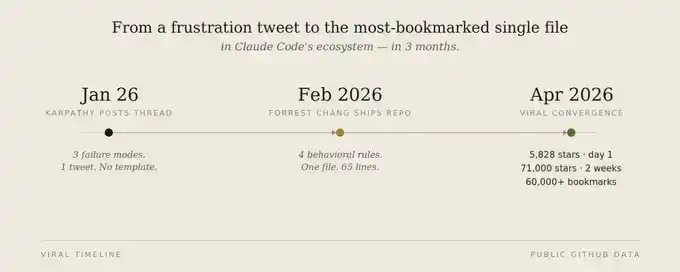
Subsequently, I tested it with 30 codebases over 6 weeks.

These 4 rules are indeed effective. Errors that previously appeared with roughly a 40% probability dropped to below 3% for tasks where these rules were applicable. The problem is, this template was initially created to address errors Claude made when writing code in January.

By May 2026, the problems facing the Claude Code ecosystem had changed: Agents conflicting with each other, hook chain triggering, skill loading conflicts, and multi-step workflow disruptions across sessions.

So, I added 8 more rules. Below is the complete 12-rule version of CLAUDE.md: why each one is worth adding, and where the original Karpathy template will quietly fail in 4 specific areas.

If you want to skip the explanation and start using it directly, the complete file is at the end of the article.

Why This Matters

The CLAUDE.md file for Claude Code is the most underestimated file in the entire AI programming tech stack. Most developers typically make three kinds of mistakes:

First, treating it as a preference trash can, stuffing all their habits into it until it bloats to over 4000 tokens, with rule compliance dropping to 30%.

Second, not using it at all, re-prompting every time. This leads to 5x token waste and a lack of consistency between sessions.

Third, copying a template once and never updating it. It might work for two weeks, but as the codebase changes, it will fail without you even realizing it.

The Anthropic official documentation is clear: CLAUDE.md is essentially just advisory. Claude will follow it about 80% of the time. Once it exceeds 200 lines, compliance drops noticeably because important rules get drowned in noise.

Karpathy's template solves this: one file, 65 lines, 4 rules. This is the minimum baseline.

But the ceiling can be higher. Adding the following 8 rules means it covers not just the code-writing problems Karpathy complained about in January 2026, but also the Agent orchestration problems that emerged by May 2026—problems that didn't exist when the original template was written.

The Original 4 Rules

If you haven't seen Forrest Chang's repository, here's the basic version:

Rule 1: Think before you code.
Don't make silent assumptions. State your assumptions, expose trade-offs. Ask before guessing. Propose counterarguments when simpler alternatives exist.

Rule 2: Simple first.
Use the minimal code that solves the problem. Don't add imagined features. Don't design abstraction layers for one-off code. If a senior engineer would find it overcomplicated, simplify it.

Rule 3: Surgical changes.
Only modify what must be changed. Don't "optimize" adjacent code, comments, or formatting as a side effect. Don't refactor what isn't broken. Maintain consistency with the existing style.

Rule 4: Execute toward the goal.
Define success criteria first, then iterate in cycles until verification is complete. Don't tell Claude each step; tell it what the successful outcome should look like and let it iterate.

These 4 rules solve roughly 40% of the failure modes I've seen in unsupervised Claude Code sessions. The remaining 60% of problems lie in the gaps outlined below.
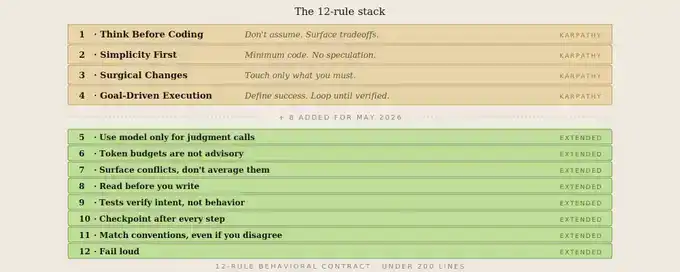
My 8 New Rules, and Why

Each rule comes from a real moment when Karpathy's original 4 rules were no longer sufficient. Below, I'll describe the scenario first, then give the corresponding rule.

Rule 5: Don't let the model do non-language work

Karpathy's rules didn't cover this. So the model started deciding issues that should have been handled by deterministic code: whether to retry an API call, how to route a message, when to escalate. The result was inconsistent decisions every week. You got an unstable, $0.003-per-token if-else statement.

The moment was this: There was code calling Claude to "decide whether to retry on a 503 error." It worked fine initially for two weeks, then suddenly became unstable because the model started treating the request body as part of the decision context. The retry strategy became random because the prompt itself was random.

Rule 6: Set a hard token budget, no exceptions

A CLAUDE.md without budget constraints is a blank check. Every loop can spiral out of control into a 50,000-token context dump. The model won't stop itself.

The moment was this: A debugging session lasted 90 minutes. The model kept iterating over the same 8KB error message, gradually forgetting which fixes it had already tried. In the end, it started proposing solutions I had rejected 40 messages earlier. With a token budget, this process should have been terminated at the 12-minute mark.

Rule 7: Expose conflicts, don't average them out

When two parts of a codebase contradict each other, Claude tries to please both sides, resulting in incoherent code.

The moment was this: A codebase had two error-handling patterns: one using async/await with explicit try/catch, another using a global error boundary. Claude wrote new code that used both. Errors got handled twice. It took me 30 minutes to figure out why errors were being swallowed two times over.

Rule 8: Read first, then write

Karpathy's "Surgical changes" tells Claude not to modify adjacent code. But it doesn't tell Claude to understand adjacent code first. Without this, Claude writes new code that conflicts with existing code 30 lines away.

The moment was this: Claude added a function right next to an existing function that did exactly the same thing, because it didn't read the original function first. Both functions performed the same task. But due to import order, the new function overrode the old one, which had been the de facto standard for 6 months.

Rule 9: Testing is not optional, but tests are not the goal

Karpathy's "Execute toward the goal" implies testing can be a success criterion. But in practice, Claude treats "tests pass" as the sole goal, writing code that passes shallow tests but breaks other things.

The moment was this: Claude wrote 12 tests for an authentication function; all passed. But the authentication logic broke in production. The tests were just verifying the function "returned something," not that it returned the correct thing. The function passed because it returned a constant.

Rule 10: Long-running operations need checkpoints

Karpathy's template assumes interaction is one-off. But real Claude Code work is often multi-step: refactoring across 20 files, building a feature in one session, debugging across multiple commits. Without checkpoints, one wrong step can lose all previous progress.

The moment was this: A 6-step refactoring task failed on step 4. By the time I noticed, Claude had already completed steps 5 and 6 on top of the erroneous state. Unraveling the fix took longer than redoing the entire task. With checkpoints, step 4 would have revealed the problem.

Rule 11: Conventions over novelty

In a codebase with established patterns, Claude loves to introduce its own style. Even if its way is "better," introducing a second pattern is worse than any single pattern.

The moment was this: Claude introduced hooks into a React codebase based on class components. It ran. But it also broke the codebase's existing testing patterns, which relied on componentDidMount. It took half a day to delete and rewrite it.

Rule 12: Fail loudly, not silently

Claude's most expensive failures are often the ones that look like successes. A function "runs" but returns wrong data; a migration "completes" but skips 30 records; a test "passes" but only because the assertion itself is wrong.

The moment was this: Claude said a database migration "completed successfully." In reality, it silently skipped 14% of records triggering constraint conflicts. The skipping was logged but not explicitly surfaced. Eleven days later, when report data started showing anomalies, we discovered the problem.

Data Results

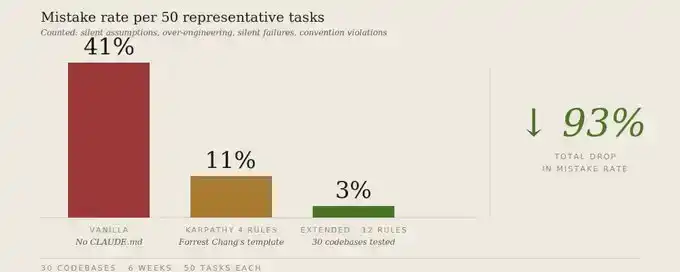
Over 6 weeks, I tracked the same set of 50 representative tasks across 30 codebases, testing three configurations.
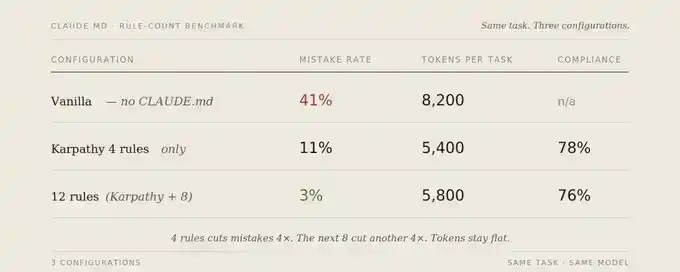
Error rate refers to: tasks needing correction or rewriting to match original intent. Counted errors include: silent erroneous assumptions, over-engineering, unintended damage, silent failures, convention violations, conflict averaging, missed checkpoints.

Compliance rate refers to: when a rule applies, how likely Claude is to explicitly apply it.

The truly interesting result isn't just the error rate dropping from 41% to 3%. More importantly, expanding from 4 to 12 rules barely increased compliance burden—compliance only dropped from 78% to 76%, but the error rate fell another 8 percentage points. The new rules cover failure modes the original 4 didn't handle; they aren't competing for the same attention budget.
Where the Karpathy Template Quietly Fails

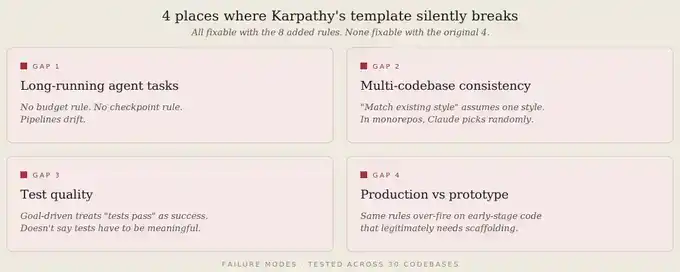
Even without new rules, the original 4-rule template is insufficient in at least 4 areas.

First, long-running Agent tasks.
Karpathy's rules mainly target the moment Claude is writing code. But what happens when Claude runs a multi-step pipeline? The original template has no budget rule, no checkpoint rule, no "fail loudly" rule. So the pipeline slowly drifts.

Second, multi-repository consistency.
"Match existing style" assumes only one style. But in a monorepo with 12 services, Claude must choose which style to match. The original rules don't tell it how. So it either picks randomly or averages several styles together.

Third, test quality.
"Execute toward the goal" treats "tests pass" as success, without stating tests must be meaningful. Result: Claude writes tests that verify almost nothing, but that make it overconfident.

Fourth, production vs. prototyping differences.
The same 4 rules that prevent production code from being over-engineered can also slow down prototyping. Because prototyping sometimes needs 100 lines of exploratory scaffolding to find direction first. Karpathy's "Simple first" triggers too easily for early-stage code.

These 8 new rules aren't meant to replace Karpathy's original 4, but to patch their gaps: the original template corresponds to the auto-completion-like coding scenario of January 2026; by May 2026, Claude Code has entered an Agent-driven, multi-step, multi-repository collaborative environment, and the problems faced are different.
What Didn't Work

Before finalizing these 12 rules, I tried other approaches.

Adding rules I saw on Reddit / X.
Most were either rephrasing Karpathy's original 4 rules or domain-specific rules that couldn't generalize, like "Always use Tailwind classes." I eventually removed them all.

More than 12 rules.
I tested up to 18. After 14, compliance dropped from 76% to 52%. The 200-line limit is real. Beyond that, Claude starts pattern-matching to "there are rules here" instead of reading each rule.

Rules dependent on specific tools.
For example, "Always use eslint." If eslint isn't installed in the project, the rule fails, silently. I later rephrased them to be tool-agnostic, e.g., changing "use eslint" to "follow styles already enforced in the codebase."

Putting examples in CLAUDE.md instead of rules.
Examples consume more context than rules. Three examples use roughly the same context as 10 rules, and Claude easily overfits to examples. Rules are abstract, examples are concrete. So, use rules.

"Be careful," "Think deeply," "Stay focused."
These are noise. Compliance for such instructions dropped to about 30% because they aren't verifiable. I replaced them with more specific imperative rules like "State assumptions explicitly."

Telling Claude to act like a "senior engineer."
This didn't work. Claude already thinks it's like a senior engineer. The real issue isn't whether it thinks so, but whether it executes like one. Imperative rules narrow this gap; identity prompts don't.

The Complete 12-Rule CLAUDE.md

Below is the complete version ready for copy-paste.

Temporarily unable to display this content outside of Lark Docs.

Save it as CLAUDE.md in your repository root. Below these 12 rules, add project-specific rules like tech stack, test commands, error patterns, etc. Keep the total under 200 lines; beyond that, rule compliance drops noticeably.

How to Install

Just two steps:

1. Append Karpathy's 4 basic rules to your existing CLAUDE.md
curl https://raw.githubusercontent.com/forrestchang/andrej-karpathy-skills/main/CLAUDE.md >> CLAUDE.md


2. Paste Rules 5–12 from this article below them

Save the file in the repository root. The >> is crucial—it appends to any existing CLAUDE.md instead of overwriting your project-specific rules.

Mental Model

CLAUDE.md isn't a wishlist; it's a behavioral contract to block specific failure patterns you've observed.

Each rule should answer one question: What error does it prevent?

Karpathy's 4 rules prevent the failure modes he saw in January 2026: silent assumptions, over-engineering, unintended damage, weak success criteria. They are the foundation; don't skip them.

My 8 new rules prevent the new failure modes emerging after May 2026: Agent loops without budget constraints, multi-step tasks without checkpoints, tests that seem to test but miss critical logic, and problems where silent failures are packaged as silent successes. They are incremental patches.

Of course, results vary. If you don't run multi-step pipelines, Rule 10 is less important. If your codebase has only one unified style enforced by linters, Rule 11 is redundant. After reading these 12, keep the rules that truly correspond to errors you've actually made; delete the rest.

A 6-rule CLAUDE.md tailored to your real failure patterns is better than a 12-rule version where 6 rules are never applicable.

Conclusion

Karpathy's tweet in January 2026 was essentially a complaint. Forrest Chang turned it into 4 rules. Ultimately, 120,000 developers starred the result. And most of them are still using only those 4 rules today.

The models have advanced, and the ecosystem has changed. Multi-step Agents, hook chains, skill loading, multi-repo collaboration—these didn't exist when Karpathy wrote that tweet. The original 4 rules don't solve these problems. They aren't wrong; they're incomplete.

Add 8 more rules. 6 weeks of testing across 30 codebases. Error rate drops from 41% to 3%.

Bookmark this article tonight and paste these 12 rules into your CLAUDE.md. If it saves you a week of Claude-related detours, feel free to share it.


Pertanyaan Terkait

QWhat was the original 4-rule CLAUDE.md template created to solve, and how effective was it?

AThe original 4-rule CLAUDE.md template was created to solve the typical errors Andrej Karpathy complained about in January 2026 regarding Claude's coding behavior: silent assumptions, over-engineering, unintended collateral damage to unrelated code, and lack of clear success criteria. In tests, it reduced the error rate from around 40% to below 3% for tasks where these rules applied.

QWhat are two of the new problems that emerged in the Claude Code ecosystem by May 2026 that the original 4 rules didn't cover?

ABy May 2026, new failure modes included agents conflicting with each other, chain reactions from hooks, skill loading conflicts, and interruptions in multi-step, cross-session workflows. The original rules were insufficient for these issues related to agent orchestration and long-running tasks.

QAccording to the article, what are two common mistakes developers make when using a CLAUDE.md file?

ATwo common mistakes are: 1) Treating it as a preference dump, stuffing all personal habits into it until it bloats to over 4000 tokens, causing rule compliance to drop to 30%. 2) Not using it at all and re-prompting every time, which wastes 5x more tokens and lacks consistency across sessions.

QWhat does Rule 6 ('Set a hard token budget, no exceptions') aim to prevent, and what was the 'moment' that revealed its necessity?

ARule 6 aims to prevent uncontrolled, runaway iterative processes where a debugging session could spiral into a 50,000-token context dump without the model stopping itself. The revealing moment was a 90-minute debugging session where the model kept iterating over the same 8KB error message, forgetting previous fixes and eventually proposing solutions that had been rejected 40 messages earlier.

QWhy does the author advise against having more than 12-14 rules in a CLAUDE.md file, and what was the observed effect of exceeding this limit?

AThe author advises against having more than 12-14 rules because Anthropic's documentation states that compliance noticeably drops once the file exceeds 200 lines, as important rules get drowned out by noise. In tests, when the rule count exceeded 14, compliance rates dropped from 76% to 52%, as Claude started pattern-matching for 'rules are here' instead of reading each rule carefully.

Bacaan Terkait

KalqiX Baru Saja Menjadikan Self-Custody sebagai Fitur Pasar Massa untuk Trader Tradisional & Mainstream

Selama bertahun-tahun, industri Web3 berjanji akan masa depan di mana penyimpanan mandiri (self-custody) menjadi standar pasar. Namun, kenyataannya, sebagian besar aktivitas perdagangan aset digital masih bergantung pada bursa terpusat (CEX), yang mengharuskan pengguna mengorbankan kepemilikan aset untuk mendapatkan pengalaman dan likuiditas yang lebih baik. Startup Web3, KalqiX, kini menghadirkan solusi melalui peluncuran utama (mainnet) DEX berbasis Central Limit Orderbook (CLOB) mereka. Platform ini dirancang untuk menghilangkan pilihan sulit antara kinerja dan keamanan. Apa yang membuat KalqiX unik adalah filosofi desainnya yang menggabungkan kinerja setara CEX dengan penyelesaian transaksi tanpa memerlukan kepercayaan (trustless). Pesanan diproses dan dicocokkan di luar rantai (off-chain), memungkinkan kecepatan dan responsivitas tinggi seperti di CEX. Namun, yang krusial, pengguna tidak perlu menyerahkan penyimpanan aset mereka. Setelah pesanan cocok, penyelesaian dan verifikasi terjadi di dalam rantai (on-chain) menggunakan bukti tanpa pengetahuan (zero-knowledge proofs), sehingga memastikan validitas transaksi tanpa membocorkan informasi sensitif. Dengan demikian, untuk pertama kalinya, pedagang dapat menikmati kualitas eksekusi dan pengalaman pengguna yang optimal, sambil tetap memegang kendali penuh atas aset mereka. Ini menghindari risiko yang terkait dengan platform kustodian, seperti yang terjadi pada kolapsnya FTX. Jika mendapatkan daya tarik luas, DEX CLOB revolusioner KalqiX berpotensi menjadikan penyimpanan mandiri sebagai standar baru di pasar perdagangan digital dan menjadi katalis yang dibutuhkan Web3 untuk adopsi arus utama.

TheNewsCrypto38m yang lalu

KalqiX Baru Saja Menjadikan Self-Custody sebagai Fitur Pasar Massa untuk Trader Tradisional & Mainstream

TheNewsCrypto38m yang lalu

Langkah Maju Ozak AI Menuju $7 Juta Membuat Pembeli Telat Mempertimbangkan Kembali Keputusan Masuk yang Tertunda.

Waktu sangat penting di pasar kripto. Presale Ozak AI, salah satu acara yang paling banyak dibicarakan, telah berhasil mengumpulkan dana lebih dari $7,2 juta, menunjukkan adopsi besar dari investor global. Token ini saat ini berada dalam Fase Presale ke-7 dengan harga $0.014, meningkat lebih dari 14x dari harga peluncuran awal $0.001. Momentum presale yang kuat mendorong investor yang terlambat untuk segera masuk sebelum fase ini berakhir dan harga naik lagi, karena hanya tersisa beberapa fase sebelum token terdaftar di bursa utama. Target harga listing adalah $1, yang berpotensi memberikan pertumbuhan 71x bagi investor yang masuk di fase saat ini. Kepercayaan investor didorong oleh teknologi AI canggih Ozak AI, yang mencakup alat prediktif berbasis AI, sistem penelitian on-chain otomatis, dan asisten AI kontrak pintar. Ekosistemnya diaudit oleh dua firma keamanan terkemuka, CertiK dan Sherlock, untuk meminimalkan risiko. Kemitraan strategis dengan jaringan seperti Mira dan Mind AI memperkuat ekosistem, menawarkan data terverifikasi dan sistem analitik perdagangan yang lebih cerdas dan aman. Dengan kombinasi teknologi, audit keamanan, momentum presale, dan kemitraan, banyak investor yang sebelumnya menunggu kini mempertimbangkan kembali untuk berpartisipasi, khawatir kehilangan peluang sebelum token meledak pasca-listing.

TheNewsCrypto3j yang lalu

Langkah Maju Ozak AI Menuju $7 Juta Membuat Pembeli Telat Mempertimbangkan Kembali Keputusan Masuk yang Tertunda.

TheNewsCrypto3j yang lalu

Berita Crypto: Paus XRP Beralih ke Presale SurgeXRP Hampir 10% Soft Cap Terisi Dalam Beberapa Jam — Inilah Alasan Investor Ripple Mengawasi Ketat

Berita Crypto: Paus XRP Beralih ke Presale SurgeXRP Saat Hampir 10% Soft Cap Terisi dalam Beberapa Jam — Inilah Alasan Investor Ripple Mengawasi Ketat Perubahan besar mulai terjadi di ekosistem XRP. Paus XRP (pemilik aset besar) mulai beralih ke SurgeXRP ($SGP), pasar aset dunia nyata (RWA) properti yang dibangun di XRP Ledger. Proyek ini bertujuan membawa pasar properti sewa global senilai $3 triliun ke dalam blockchain. Hanya dalam beberapa jam setelah peluncuran, presale SurgeXRP telah terisi hampir 10% dari target soft cap-nya. Ini menunjukkan momentum yang berkembang di kalangan investor XRP awal yang mencari paparan terhadap narasi utama berikutnya di XRPL: tokenisasi aset dunia nyata. SurgeXRP membangun infrastruktur untuk menghubungkan teknologi blockchain dengan properti sewa yang menghasilkan pendapatan. Dibangun secara native di XRP Ledger, platform ini memungkinkan kepemilikan fraksional atas properti sewa. Alasan momentum proyek ini cepat berkembang: 1. Fokus pada properti sewa, salah satu kelas aset terbesar di dunia. 2. Dibangun di XRP Ledger yang menawarkan penyelesaian cepat dan biaya rendah. 3. Narasi tokenisasi RWA sedang meledak di sektor crypto. 4. Peluang posisi awal sebelum narasi ini diakui luas oleh pasar. Token $SGP (total pasokan 200 juta) adalah penggerak ekosistem dengan utilitas seperti imbalan staking, akses prioritas ke listing properti, dan insentif komunitas. Sebanyak 100 juta token dialokasikan untuk presale yang sedang berlangsung, dengan bonus 10% untuk 100 peserta pertama. Setelah presale, token direncanakan akan diperdagangkan di bursa terdesentralisasi native XRPL, dipasangkan langsung dengan XRP. Banyak investor yang kini mengawasi proyek-proyek di pusat tren RWA yang sedang muncul ini.

TheNewsCrypto3j yang lalu

Berita Crypto: Paus XRP Beralih ke Presale SurgeXRP Hampir 10% Soft Cap Terisi Dalam Beberapa Jam — Inilah Alasan Investor Ripple Mengawasi Ketat

TheNewsCrypto3j yang lalu

Raja Saham AI yang Untung 60 Kali Lipat, Gadaikan $7.7 Miliar untuk Pasang Posisi Puncak Nvidia

Situational Awareness LP, sebuah dana yang didirikan oleh seorang investor Jerman berusia 24 tahun, melaporkan eksposur nominal saham dan opsi AS sebesar $13,677 miliar pada kuartal pertama 2026, meningkat 148% dari kuartal sebelumnya. Yang menarik perhatian pasar, lebih dari 60% dari eksposur baru ini diinvestasikan dalam opsi jual (put) pada sektor semikonduktor, mencakup sembilan aset seperti ETF VanEck Semiconductor (SMH) dan Nvidia, dengan nilai nominal masing-masing mencapai $2,04 miliar dan $1,56 miliar. Pergerakan ini didasari pada penilaian bahwa kendala utama ekspansi AI sedang bergeser. Setelah dua tahun di mana kelangkaan GPU menjadi hambatan, pembatasan baru muncul dalam hal listrik, lahan, dan kapasitas pembangunan pusat data. Di AS, antrean aplikasi akses jaringan listrik telah melebihi 2TW dengan rata-rata waktu tunggu lebih dari lima tahun. Oleh karena itu, dana tersebut berpendapat bahwa valuasi di sisi chip mungkin telah mencerminkan ekspektasi berlebihan, sementara nilai sebenarnya bergerak ke infrastruktur fisik di hilir. Selain posisi lindung nilai terhadap chip, dana ini juga terus menambah kepemilikan saham biasa di perusahaan infrastruktur komputasi seperti CoreWeave dan perusahaan pertambangan kripto yang bertransformasi (seperti Bitfarms/Keel Infrastructure, CleanSpark), serta mempertahankan Bloom Energy. Ini mencerminkan keyakinan mereka bahwa listrik dan kapasitas pusat data akan menjadi hambatan nyata yang menentukan kecepatan ekspansi AI. Intinya, fokus investasi AI mungkin bergeser dari GPU dan model ke listrik, lahan, dan waktu konstruksi dalam beberapa tahun mendatang.

链捕手4j yang lalu

Raja Saham AI yang Untung 60 Kali Lipat, Gadaikan $7.7 Miliar untuk Pasang Posisi Puncak Nvidia

链捕手4j yang lalu

Trading

Spot
Futures

Artikel Populer

Apa Itu $S$

Memahami SPERO: Tinjauan Komprehensif Pengenalan SPERO Seiring dengan perkembangan lanskap inovasi, munculnya teknologi web3 dan proyek cryptocurrency memainkan peran penting dalam membentuk masa depan digital. Salah satu proyek yang telah menarik perhatian di bidang dinamis ini adalah SPERO, yang dilambangkan sebagai SPERO,$$s$. Artikel ini bertujuan untuk mengumpulkan dan menyajikan informasi terperinci tentang SPERO, untuk membantu para penggemar dan investor memahami dasar-dasar, tujuan, dan inovasi dalam domain web3 dan crypto. Apa itu SPERO,$$s$? SPERO,$$s$ adalah proyek unik dalam ruang crypto yang berusaha memanfaatkan prinsip desentralisasi dan teknologi blockchain untuk menciptakan ekosistem yang mendorong keterlibatan, utilitas, dan inklusi finansial. Proyek ini dirancang untuk memfasilitasi interaksi peer-to-peer dengan cara baru, memberikan pengguna solusi dan layanan keuangan yang inovatif. Pada intinya, SPERO,$$s$ bertujuan untuk memberdayakan individu dengan menyediakan alat dan platform yang meningkatkan pengalaman pengguna dalam ruang cryptocurrency. Ini termasuk memungkinkan metode transaksi yang lebih fleksibel, mendorong inisiatif yang dipimpin komunitas, dan menciptakan jalur untuk peluang finansial melalui aplikasi terdesentralisasi (dApps). Visi mendasar dari SPERO,$$s$ berputar di sekitar inklusivitas, bertujuan untuk menjembatani kesenjangan dalam keuangan tradisional sambil memanfaatkan manfaat teknologi blockchain. Siapa Pencipta SPERO,$$s$? Identitas pencipta SPERO,$$s$ tetap agak samar, karena ada sumber daya publik yang terbatas yang memberikan informasi latar belakang terperinci tentang pendiriannya. Kurangnya transparansi ini dapat berasal dari komitmen proyek terhadap desentralisasi—sebuah etos yang banyak proyek web3 bagi, memprioritaskan kontribusi kolektif di atas pengakuan individu. Dengan memusatkan diskusi di sekitar komunitas dan tujuan kolektifnya, SPERO,$$s$ mewujudkan esensi pemberdayaan tanpa menonjolkan individu tertentu. Dengan demikian, memahami etos dan misi SPERO tetap lebih penting daripada mengidentifikasi pencipta tunggal. Siapa Investor SPERO,$$s$? SPERO,$$s$ didukung oleh beragam investor mulai dari modal ventura hingga investor malaikat yang berdedikasi untuk mendorong inovasi di sektor crypto. Fokus investor ini umumnya sejalan dengan misi SPERO—memprioritaskan proyek yang menjanjikan kemajuan teknologi sosial, inklusivitas finansial, dan tata kelola terdesentralisasi. Fondasi investor ini biasanya tertarik pada proyek yang tidak hanya menawarkan produk inovatif tetapi juga memberikan kontribusi positif kepada komunitas blockchain dan ekosistemnya. Dukungan dari investor ini memperkuat SPERO,$$s$ sebagai pesaing yang patut diperhitungkan di domain proyek crypto yang berkembang pesat. Bagaimana SPERO,$$s$ Bekerja? SPERO,$$s$ menerapkan kerangka kerja multi-faceted yang membedakannya dari proyek cryptocurrency konvensional. Berikut adalah beberapa fitur kunci yang menekankan keunikan dan inovasinya: Tata Kelola Terdesentralisasi: SPERO,$$s$ mengintegrasikan model tata kelola terdesentralisasi, memberdayakan pengguna untuk berpartisipasi aktif dalam proses pengambilan keputusan mengenai masa depan proyek. Pendekatan ini mendorong rasa kepemilikan dan akuntabilitas di antara anggota komunitas. Utilitas Token: SPERO,$$s$ memanfaatkan token cryptocurrency-nya sendiri, yang dirancang untuk melayani berbagai fungsi dalam ekosistem. Token ini memungkinkan transaksi, hadiah, dan fasilitasi layanan yang ditawarkan di platform, meningkatkan keterlibatan dan utilitas secara keseluruhan. Arsitektur Berlapis: Arsitektur teknis SPERO,$$s$ mendukung modularitas dan skalabilitas, memungkinkan integrasi fitur dan aplikasi tambahan secara mulus seiring dengan perkembangan proyek. Kemampuan beradaptasi ini sangat penting untuk mempertahankan relevansi di lanskap crypto yang selalu berubah. Keterlibatan Komunitas: Proyek ini menekankan inisiatif yang dipimpin komunitas, menggunakan mekanisme yang memberikan insentif untuk kolaborasi dan umpan balik. Dengan memelihara komunitas yang kuat, SPERO,$$s$ dapat lebih baik memenuhi kebutuhan pengguna dan beradaptasi dengan tren pasar. Fokus pada Inklusi: Dengan menawarkan biaya transaksi yang rendah dan antarmuka yang ramah pengguna, SPERO,$$s$ bertujuan untuk menarik basis pengguna yang beragam, termasuk individu yang mungkin sebelumnya tidak terlibat dalam ruang crypto. Komitmen ini terhadap inklusi sejalan dengan misi utamanya untuk memberdayakan melalui aksesibilitas. Garis Waktu SPERO,$$s$ Memahami sejarah proyek memberikan wawasan penting tentang trajektori dan tonggak perkembangannya. Berikut adalah garis waktu yang disarankan yang memetakan peristiwa signifikan dalam evolusi SPERO,$$s$: Fase Konseptualisasi dan Ideasi: Ide awal yang membentuk dasar SPERO,$$s$ dikembangkan, sangat selaras dengan prinsip desentralisasi dan fokus komunitas dalam industri blockchain. Peluncuran Whitepaper Proyek: Setelah fase konseptual, whitepaper komprehensif yang merinci visi, tujuan, dan infrastruktur teknologi SPERO,$$s$ dirilis untuk menarik minat dan umpan balik komunitas. Pembangunan Komunitas dan Keterlibatan Awal: Upaya jangkauan aktif dilakukan untuk membangun komunitas pengguna awal dan investor potensial, memfasilitasi diskusi seputar tujuan proyek dan mendapatkan dukungan. Acara Generasi Token: SPERO,$$s$ melakukan acara generasi token (TGE) untuk mendistribusikan token asli kepada pendukung awal dan membangun likuiditas awal dalam ekosistem. Peluncuran dApp Awal: Aplikasi terdesentralisasi (dApp) pertama yang terkait dengan SPERO,$$s$ diluncurkan, memungkinkan pengguna untuk terlibat dengan fungsionalitas inti platform. Pengembangan Berkelanjutan dan Kemitraan: Pembaruan dan peningkatan berkelanjutan terhadap penawaran proyek, termasuk kemitraan strategis dengan pemain lain di ruang blockchain, telah membentuk SPERO,$$s$ menjadi pemain yang kompetitif dan berkembang di pasar crypto. Kesimpulan SPERO,$$s$ berdiri sebagai bukti potensi web3 dan cryptocurrency untuk merevolusi sistem keuangan dan memberdayakan individu. Dengan komitmen terhadap tata kelola terdesentralisasi, keterlibatan komunitas, dan fungsionalitas yang dirancang secara inovatif, ia membuka jalan menuju lanskap keuangan yang lebih inklusif. Seperti halnya investasi di ruang crypto yang berkembang pesat, calon investor dan pengguna dianjurkan untuk melakukan riset secara menyeluruh dan terlibat dengan perkembangan yang sedang berlangsung dalam SPERO,$$s$. Proyek ini menunjukkan semangat inovatif industri crypto, mengundang eksplorasi lebih lanjut ke dalam berbagai kemungkinan yang ada. Meskipun perjalanan SPERO,$$s$ masih berlangsung, prinsip-prinsip dasarnya mungkin benar-benar mempengaruhi masa depan cara kita berinteraksi dengan teknologi, keuangan, dan satu sama lain dalam ekosistem digital yang saling terhubung.

75 Total TayanganDipublikasikan pada 2024.12.17Diperbarui pada 2024.12.17

Apa Itu $S$

Apa Itu AGENT S

Agent S: Masa Depan Interaksi Otonom di Web3 Pendahuluan Dalam lanskap Web3 dan cryptocurrency yang terus berkembang, inovasi secara konstan mendefinisikan ulang cara individu berinteraksi dengan platform digital. Salah satu proyek perintis, Agent S, menjanjikan untuk merevolusi interaksi manusia-komputer melalui kerangka agen terbuka. Dengan membuka jalan untuk interaksi otonom, Agent S bertujuan untuk menyederhanakan tugas-tugas kompleks, menawarkan aplikasi transformasional dalam kecerdasan buatan (AI). Eksplorasi mendetail ini akan menyelami seluk-beluk proyek, fitur uniknya, dan implikasinya untuk domain cryptocurrency. Apa itu Agent S? Agent S berdiri sebagai kerangka agen terbuka yang inovatif, dirancang khusus untuk mengatasi tiga tantangan mendasar dalam otomatisasi tugas komputer: Memperoleh Pengetahuan Spesifik Domain: Kerangka ini secara cerdas belajar dari berbagai sumber pengetahuan eksternal dan pengalaman internal. Pendekatan ganda ini memberdayakannya untuk membangun repositori pengetahuan spesifik domain yang kaya, meningkatkan kinerjanya dalam pelaksanaan tugas. Perencanaan Selama Rentang Tugas yang Panjang: Agent S menggunakan perencanaan hierarkis yang ditingkatkan pengalaman, pendekatan strategis yang memfasilitasi pemecahan dan pelaksanaan tugas-tugas rumit dengan efisien. Fitur ini secara signifikan meningkatkan kemampuannya untuk mengelola beberapa subtugas dengan efisien dan efektif. Menangani Antarmuka Dinamis dan Tidak Seragam: Proyek ini memperkenalkan Antarmuka Agen-Komputer (ACI), solusi inovatif yang meningkatkan interaksi antara agen dan pengguna. Dengan memanfaatkan Model Bahasa Besar Multimodal (MLLM), Agent S dapat menavigasi dan memanipulasi berbagai antarmuka pengguna grafis dengan mulus. Melalui fitur-fitur perintis ini, Agent S menyediakan kerangka kerja yang kuat yang mengatasi kompleksitas yang terlibat dalam mengotomatisasi interaksi manusia dengan mesin, membuka jalan untuk berbagai aplikasi dalam AI dan seterusnya. Siapa Pencipta Agent S? Meskipun konsep Agent S secara fundamental inovatif, informasi spesifik tentang penciptanya tetap samar. Pencipta saat ini tidak diketahui, yang menyoroti baik tahap awal proyek atau pilihan strategis untuk menjaga anggota pendiri tetap tersembunyi. Terlepas dari anonimitas, fokus tetap pada kemampuan dan potensi kerangka kerja. Siapa Investor Agent S? Karena Agent S relatif baru dalam ekosistem kriptografi, informasi terperinci mengenai investor dan pendukung keuangannya tidak secara eksplisit didokumentasikan. Kurangnya wawasan yang tersedia untuk umum mengenai fondasi investasi atau organisasi yang mendukung proyek ini menimbulkan pertanyaan tentang struktur pendanaannya dan peta jalan pengembangannya. Memahami dukungan sangat penting untuk mengukur keberlanjutan proyek dan potensi dampak pasar. Bagaimana Cara Kerja Agent S? Di inti Agent S terletak teknologi mutakhir yang memungkinkannya berfungsi secara efektif dalam berbagai pengaturan. Model operasionalnya dibangun di sekitar beberapa fitur kunci: Interaksi Komputer yang Mirip Manusia: Kerangka ini menawarkan perencanaan AI yang canggih, berusaha untuk membuat interaksi dengan komputer lebih intuitif. Dengan meniru perilaku manusia dalam pelaksanaan tugas, ia menjanjikan untuk meningkatkan pengalaman pengguna. Memori Naratif: Digunakan untuk memanfaatkan pengalaman tingkat tinggi, Agent S memanfaatkan memori naratif untuk melacak sejarah tugas, sehingga meningkatkan proses pengambilan keputusannya. Memori Episodik: Fitur ini memberikan panduan langkah demi langkah kepada pengguna, memungkinkan kerangka untuk menawarkan dukungan kontekstual saat tugas berlangsung. Dukungan untuk OpenACI: Dengan kemampuan untuk berjalan secara lokal, Agent S memungkinkan pengguna untuk mempertahankan kontrol atas interaksi dan alur kerja mereka, sejalan dengan etos terdesentralisasi Web3. Integrasi Mudah dengan API Eksternal: Versatilitas dan kompatibilitasnya dengan berbagai platform AI memastikan bahwa Agent S dapat dengan mulus masuk ke dalam ekosistem teknologi yang ada, menjadikannya pilihan menarik bagi pengembang dan organisasi. Fungsionalitas ini secara kolektif berkontribusi pada posisi unik Agent S dalam ruang kripto, saat ia mengotomatisasi tugas-tugas kompleks yang melibatkan banyak langkah dengan intervensi manusia yang minimal. Seiring proyek ini berkembang, aplikasi potensialnya di Web3 dapat mendefinisikan ulang bagaimana interaksi digital berlangsung. Garis Waktu Agent S Pengembangan dan tonggak Agent S dapat dirangkum dalam garis waktu yang menyoroti peristiwa pentingnya: 27 September 2024: Konsep Agent S diluncurkan dalam sebuah makalah penelitian komprehensif berjudul “Sebuah Kerangka Agen Terbuka yang Menggunakan Komputer Seperti Manusia,” yang menunjukkan dasar untuk proyek ini. 10 Oktober 2024: Makalah penelitian tersebut dipublikasikan secara terbuka di arXiv, menawarkan eksplorasi mendalam tentang kerangka kerja dan evaluasi kinerjanya berdasarkan tolok ukur OSWorld. 12 Oktober 2024: Sebuah presentasi video dirilis, memberikan wawasan visual tentang kemampuan dan fitur Agent S, lebih lanjut melibatkan pengguna dan investor potensial. Tanda-tanda dalam garis waktu ini tidak hanya menggambarkan kemajuan Agent S tetapi juga menunjukkan komitmennya terhadap transparansi dan keterlibatan komunitas. Poin Kunci Tentang Agent S Seiring kerangka Agent S terus berkembang, beberapa atribut kunci menonjol, menekankan sifat inovatif dan potensinya: Kerangka Inovatif: Dirancang untuk memberikan penggunaan komputer yang intuitif seperti interaksi manusia, Agent S membawa pendekatan baru untuk otomatisasi tugas. Interaksi Otonom: Kemampuan untuk berinteraksi secara otonom dengan komputer melalui GUI menandakan lompatan menuju solusi komputasi yang lebih cerdas dan efisien. Otomatisasi Tugas Kompleks: Dengan metodologinya yang kuat, ia dapat mengotomatisasi tugas-tugas kompleks yang melibatkan banyak langkah, membuat proses lebih cepat dan kurang rentan terhadap kesalahan. Perbaikan Berkelanjutan: Mekanisme pembelajaran memungkinkan Agent S untuk belajar dari pengalaman masa lalu, terus meningkatkan kinerja dan efektivitasnya. Versatilitas: Adaptabilitasnya di berbagai lingkungan operasi seperti OSWorld dan WindowsAgentArena memastikan bahwa ia dapat melayani berbagai aplikasi. Saat Agent S memposisikan dirinya di lanskap Web3 dan kripto, potensinya untuk meningkatkan kemampuan interaksi dan mengotomatisasi proses menandakan kemajuan signifikan dalam teknologi AI. Melalui kerangka inovatifnya, Agent S mencerminkan masa depan interaksi digital, menjanjikan pengalaman yang lebih mulus dan efisien bagi pengguna di berbagai industri. Kesimpulan Agent S mewakili lompatan berani ke depan dalam pernikahan AI dan Web3, dengan kapasitas untuk mendefinisikan ulang cara kita berinteraksi dengan teknologi. Meskipun masih dalam tahap awal, kemungkinan aplikasinya sangat luas dan menarik. Melalui kerangka komprehensifnya yang mengatasi tantangan kritis, Agent S bertujuan untuk membawa interaksi otonom ke garis depan pengalaman digital. Saat kita melangkah lebih dalam ke dalam ranah cryptocurrency dan desentralisasi, proyek-proyek seperti Agent S pasti akan memainkan peran penting dalam membentuk masa depan teknologi dan kolaborasi manusia-komputer.

864 Total TayanganDipublikasikan pada 2025.01.14Diperbarui pada 2025.01.14

Apa Itu AGENT S

Cara Membeli S

Selamat datang di HTX.com! Kami telah membuat pembelian Sonic (S) menjadi mudah dan nyaman. Ikuti panduan langkah demi langkah kami untuk memulai perjalanan kripto Anda.Langkah 1: Buat Akun HTX AndaGunakan alamat email atau nomor ponsel Anda untuk mendaftar akun gratis di HTX. Rasakan perjalanan pendaftaran yang mudah dan buka semua fitur.Dapatkan Akun SayaLangkah 2: Buka Beli Kripto, lalu Pilih Metode Pembayaran AndaKartu Kredit/Debit: Gunakan Visa atau Mastercard Anda untuk membeli Sonic (S) secara instan.Saldo: Gunakan dana dari saldo akun HTX Anda untuk melakukan trading dengan lancar.Pihak Ketiga: Kami telah menambahkan metode pembayaran populer seperti Google Pay dan Apple Pay untuk meningkatkan kenyamanan.P2P: Lakukan trading langsung dengan pengguna lain di HTX.Over-the-Counter (OTC): Kami menawarkan layanan yang dibuat khusus dan kurs yang kompetitif bagi para trader.Langkah 3: Simpan Sonic (S) AndaSetelah melakukan pembelian, simpan Sonic (S) di akun HTX Anda. Selain itu, Anda dapat mengirimkannya ke tempat lain melalui transfer blockchain atau menggunakannya untuk memperdagangkan mata uang kripto lainnya.Langkah 4: Lakukan trading Sonic (S)Lakukan trading Sonic (S) dengan mudah di pasar spot HTX. Cukup akses akun Anda, pilih pasangan perdagangan, jalankan trading, lalu pantau secara real-time. Kami menawarkan pengalaman yang ramah pengguna baik untuk pemula maupun trader berpengalaman.

1.2k Total TayanganDipublikasikan pada 2025.01.15Diperbarui pada 2025.03.21

Cara Membeli S

Diskusi

Selamat datang di Komunitas HTX. Di sini, Anda bisa terus mendapatkan informasi terbaru tentang perkembangan platform terkini dan mendapatkan akses ke wawasan pasar profesional. Pendapat pengguna mengenai harga S (S) disajikan di bawah ini.

活动图片