Bitcoin traders anticipate new yearly lows after BTC’s $25K rejection — Data disagrees

CointelegraphDipublikasikan tanggal 2022-08-17Terakhir diperbarui pada 2022-08-17

Abstrak

Should traders expect further downside after BTC failed to hold above $25,000?

Bitcoin (BTC) showed weakness on Aug. 15, posting a 5% loss after testing the $25,000 resistance. The move liquidated over $150 million worth of leverage long positions and has led some traders to predict a move back toward the yearly low in the $18,000 range.

The price action coincided with worsening conditions for tech stocks, including Chinese giant Tencent, which is expected to post its first-ever quarterly revenue decline. According to analysts, the Chinese gaming and social media conglomerate is expected to post quarterly earnings around $19.5 billion, which is 4% lower than the previous year.

Moreover, on Aug. 16, Citi investment bank slashed Zoom Video Communications (ZM) recommendation to sell, adding that the stock is "high risk." Analysts explained that a challenging post-COVID dynamic, plus additional competition from Microsoft Teams, potentially caused a 20% drop in ZM shares.

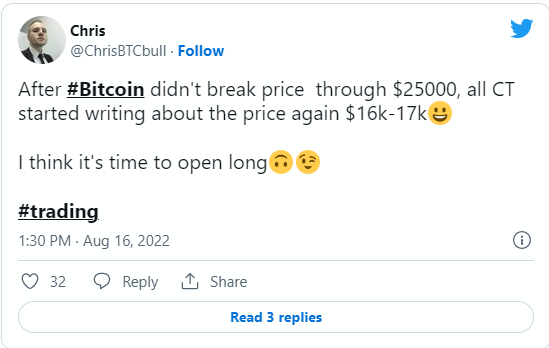
The overall bearish sentiment continues to plague crypto investors, a movement described by influencer and trader @ChrisBTCbull, who mentioned that a simple rejection at $25,000 caused traders to post sub-$17,000 targets.

Margin traders remain bullish despite the $25,000 rejection

Monitoring margin and options markets provides excellent insights into understanding how professional traders are positioned. For instance, a negative read would happen if whales and market makers reduced their exposure as BTC approached the $25,000 resistance.

Margin trading allows investors to borrow cryptocurrency to leverage their trading position, increasing returns. For example, one can increase exposure by borrowing stablecoins to buy an additional Bitcoin position.

On the other hand, Bitcoin borrowers can only short the cryptocurrency as they bet on its price declining. Unlike futures contracts, the balance between margin longs and shorts isn't always matched.

The above chart shows that traders' margin lending ratio has remained relatively stable near 14 while Bitcoin price jumped 6.3% in two days only to be rejected after hitting the $25,200 resistance.

Furthermore, the metric remains bullish by favoring stablecoin borrowing by a wide margin. As a result, pro traders have been holding their bullish positions, and no additional bearish margin trades emerged as Bitcoin retraced 5.5% on Aug. 16.

Option markets hold a neutral stance

There’s uncertainty on whether Bitcoin will make another run towards the $25,000 resistance but the 25% delta skew is a telling sign whenever arbitrage desks and market makers overcharge for upside or downside protection.

The indicator compares similar call (buy) and put (sell) options and will turn positive when fear is prevalent because the protective put options premium is higher than risk call options.

The skew indicator will move above 10% if traders fear a Bitcoin price crash. On the other hand, generalized excitement reflects a negative 10% skew.

Bitcoin 30-day options show 25% delta skew: Source: Laevitas.ch

As displayed above, the 25% delta skew has barely moved since Aug. 11, oscillating between 5% and 7% most of the time. This range is considered neutral because options traders are pricing a similar risk of unexpected pumps or dumps.

If pro traders entered a "fear" sentiment, this metric would have moved above 10%, reflecting a lack of interest in offering downside protection.

Despite the neutral Bitcoin options indicator, whales and market makers maintaining their bullish bets after a 5.5% BTC price decline on Aug. 16. For this reason, investors should expect another retest of the $25,000 resistance as soon as the global macroeconomic conditions improve.


Bacaan Terkait

「Saham Konsep Nvidia」Wawancara dengan Co-Founder CoreWeave: Permintaan AI Terus Meningkat Setiap Hari

Wawancara dengan para eksekutif CoreWeave, penyedia cloud khusus AI, menggarisbawahi bahwa permintaan akan komputasi AI terus meningkat dan berkembang setiap hari, mendorong perubahan besar dalam infrastruktur. Fokus tidak lagi hanya pada ketersediaan GPU, tetapi meluas ke tantangan kompleks seperti daya untuk pusat data, CPU, penyimpanan, dan pasokan komponen. CoreWeave, yang melayani klien utama seperti OpenAI dan Microsoft, melihat pergeseran struktural dalam beban kerja AI. Dengan munculnya AI agen dan model penalaran, pentingnya CPU dan penyimpanan semakin meningkat. Perusahaan merancang ulang pusat datanya untuk mengakomodasi lebih banyak CPU (seperti Vera CPU dari Nvidia) dan penyimpanan di samping server GPU generasi mendatang (seperti Vera Rubin). Para eksekutif menekankan bahwa model bisnis mereka sepenuhnya didorong oleh kontrak dan permintaan pelanggan. Mereka bersaing berdasarkan rekam jejak eksekusi yang terbukti, kemampuan teknikal, dan kemampuan menyediakan kinerja serta efisiensi biaya per token terbaik. Saat ini, hambatan utama bukanlah GPU, melainkan ketersediaan "powered shells" (bangunan pusat data yang siap daya) dan komponen di dalamnya. Mereka juga menjelaskan bahwa biaya komponen seperti HBM (memori bandwidth tinggi) diteruskan kepada pelanggan melalui kontrak yang sudah ditetapkan sebelumnya, sehingga melindungi margin CoreWeave. Untuk generasi hardware baru seperti server Vera Rubin, pola deployment diperkirakan akan meningkat signifikan sekitar tahun 2027, mengikuti pola pendahulunya, platform Blackwell.

marsbit1j yang lalu

「Saham Konsep Nvidia」Wawancara dengan Co-Founder CoreWeave: Permintaan AI Terus Meningkat Setiap Hari

marsbit1j yang lalu

STRC Lepas Anker 11%, Mesin Uang Abadi Strategy Masih Berputar?

Prioritas saham STRC Strategy, yang dirancang untuk diperdagangkan di sekitar nilai nominal $100, terus mengalami disosiasi ("de-pegging"). Harga sempat turun hingga $83.26, jauh di bawah nilai target. STRC adalah mesin utama dalam "roda modal" Strategy, memungkinkan perusahaan mengumpulkan uang tanpa mengencerkan ekuitas pemegang saham biasa (MSTR). Model ini bergantung pada harga STRC yang stabil di $100 agar mekanisme penerbitan saham terus berjalan. Meskipun Strategy telah meningkatkan dividen menjadi 11.5% dan mempercepat pembayarannya untuk menarik investor, harga tetap turun. Penyebabnya diduga karena tekanan jual dari dana arbitrase yang menggunakan leverage dan, yang lebih penting, kekhawatiran pasar terhadap likuiditas Strategy. Laporan Morgan Stanley menyoroti cadangan kas Strategy yang terbatas untuk membayar dividen, sementara Strategy berargumen bahwa cadangan Bitcoin-nya cukup untuk jangka panjang. Namun, keputusan Strategy baru-baru ini untuk menjual sejumlah kecil Bitcoin (meski disebut sebagai "uji coba") telah mengguncang kepercayaan pasar pada narasi "HODL" mereka yang lama. Jika STRC tetap diskon dan kemampuan pendanaan Strategy melemah, kekhawatiran bahwa perusahaan mungkin perlu menjual lebih banyak Bitcoin untuk memenuhi kewajibannya bisa meningkat. Ini berpotensi mengubah Strategy dari pembeli besar Bitcoin menjadi penjual, memberikan tekanan signifikan pada harga pasar.

链捕手1j yang lalu

STRC Lepas Anker 11%, Mesin Uang Abadi Strategy Masih Berputar?

链捕手1j yang lalu

Trading

Spot
Futures
活动图片