2 Days, 20x: A Quick Look at the Automated Market Making Mechanism of the New Gem Snowball

marsbitDipublikasikan tanggal 2025-12-22Terakhir diperbarui pada 2025-12-22

Abstrak

The meme token Snowball" launched on pump.fun on December 18 and gained significant traction in the English-speaking crypto community, reaching a $10 million market cap within four days while largely flying under the radar in Chinese crypto circles. Its core innovation is an automated market-making mechanism: instead of the typical "creator fee" (usually 0.5%–1% per transaction) going to the developer’s wallet—a common setup that often leads to rug pulls—Snowball directs 100% of this fee to an on-chain bot. This bot periodically: 1. Buys back tokens to create buy pressure, 2. Adds the purchased tokens and corresponding SOL to the liquidity pool to improve depth, 3. Burns 0.1% of tokens to induce deflation. The fee rate also adjusts dynamically based on market cap (0.05%–0.95%) to balance accumulation and transaction friction. The idea is a "snowball effect": trading generates fees → fees fuel buybacks → buybacks may push price up → higher prices attract more trading. On-chain data shows 7,270 holders, with the top 10 holding ~20% of supply. Trading volume has been relatively balanced between buys and sells. However, the token remains highly speculative. While the structure reduces dev exit risk, it doesn’t eliminate other meme coin risks like low liquidity, narrative fatigue, or large holder dumps. Similar projects like FIREBALL are emerging, suggesting a trend toward "mechanism-driven memes." But as past examples like OlympusDAO and Safemoon show, complex t...

The crypto market in December is as cold as the weather.

On-chain transactions have been dormant for a long time, and new narratives are hard to come by. Just look at the drama and gossip circulating in the Chinese CT (Crypto Twitter) these past few days, and you'll know hardly anyone is playing in this market anymore.

But the English-speaking community has been discussing something new.

A meme coin called Snowball launched on pump.fun on December 18th. In four days, its market cap surged to $10 million and is still hitting new highs; yet it's barely mentioned in Chinese circles.
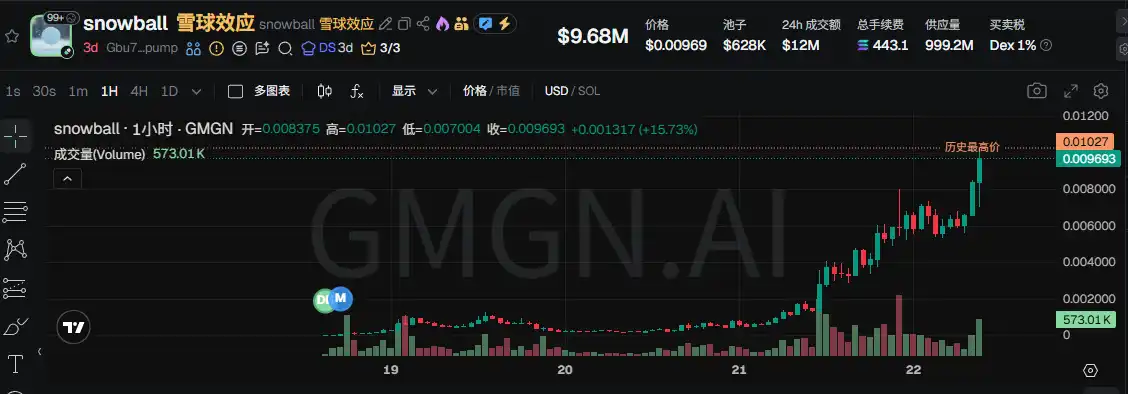
In the current environment, lacking new narratives and where even memes are considered unplayable, this is one of the few things that catches the eye and shows some localized wealth effect.

And the name Snowball itself tells the story it wants to convey:

A mechanism that allows the token to "roll and grow bigger by itself."

Turning Transaction Fees into Buying Pressure, Rolling the Snowball for Market Making

To understand what Snowball is doing, you first need to know how pump.fun tokens typically make money.

On pump.fun, anyone can create a token in minutes. The token creator can set a "creator fee," essentially taking a cut of every transaction into their own wallet, usually between 0.5% and 1%.

This money could theoretically be used for community building and marketing, but in practice, most Devs choose to: accumulate enough and then rug.

This is part of the typical life cycle of a shitcoin. Launch, pump, harvest fees, rug. Investors aren't betting on the token itself, but on the developer's conscience.

Snowball's approach is to not take this creator fee money.

To be precise, 100% of the creator fees do not go to anyone's wallet but are automatically transferred to an on-chain market-making bot.

This bot performs three actions at regular intervals:

First, it uses the accumulated funds to buy tokens on the market, creating buying support;

Second, it adds the bought tokens and the corresponding SOL to the liquidity pool, improving trading depth;

Third, it burns 0.1% of the tokens with each operation, creating deflation.
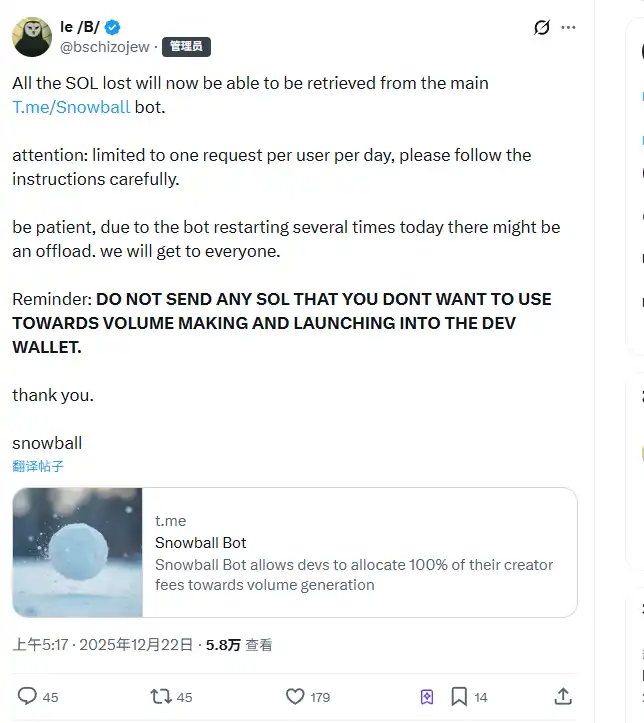
Additionally, the percentage of creator fees this coin charges is not fixed; it fluctuates between 0.05% and 0.95% based on market cap.

It takes a higher percentage when the market cap is low, allowing the bot to accumulate ammunition faster; it reduces the fee when the market cap is high, decreasing transaction friction.

In one sentence, the logic of this mechanism is: every time you trade, a portion of the money automatically becomes buying pressure and liquidity, instead of going into the developer's pocket.

Therefore, you can easily understand this snowball effect:

Transactions generate fees → Fees become buying pressure → Buying pressure pushes up the price → Higher price attracts more transactions → More fees... theoretically, it can roll on by itself.

On-Chain Data Situation

Now that we've covered the mechanism, let's look at the on-chain data.

Snowball launched on December 18th, four days ago. Its market cap grew from zero to $10 million, with a 24-hour trading volume exceeding $11 million.

For a shitcoin on pump.fun, this performance is considered relatively long-lasting in the current environment.

In terms of token distribution, there are currently 7,270 holder addresses. The top ten holders combined account for about 20% of the total supply, with the single largest holder holding 4.65%.
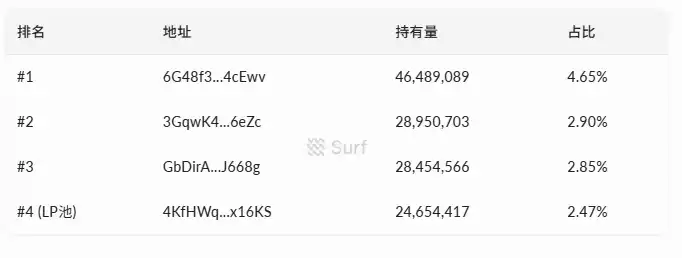
(Data source: surf.ai)

There's no address holding 20-30% of the supply; the distribution is relatively decentralized.

Regarding transaction data, there have been over 58,000 transactions since launch, with 33,000 buys and 24,000 sells. The total buy volume is $4.4 million, and the sell volume is $4.3 million, resulting in a net inflow of about $100,000. Buying and selling are basically balanced, with no one-sided selling pressure.

The liquidity pool holds about $380,000, half in tokens and half in SOL. For a market cap of this size, the depth isn't very thick, and large orders would still experience significant slippage.

Another noteworthy point is that Bybit Alpha announced listing the token less than 96 hours after launch, which to some extent confirms the short-term hype.

Perpetual Motion Meets a Cold Market

After looking around, you can see that the English community's discussion about Snowball mainly focuses on the mechanism itself. Supporters' logic is straightforward:

This is the first meme coin that locks 100% of the creator fees into the protocol, preventing developers from rugging, making it structurally safer than other shitcoins, at least.

The Dev is also playing into this narrative. The developer wallet, market-making bot wallet, and transaction logs are all public, emphasizing "verifiable on-chain."

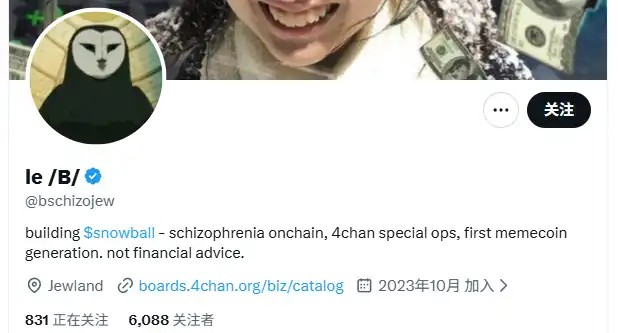
@bschizojew labels himself as "on-chain schizophrenic, 4chan special forces, first-generation meme coin veteran," radiating a self-deprecating degen vibe that strongly appeals to the crypto-native community.
But a safe mechanism and making money are two different things.

The snowball effect relies on the premise that there is sufficient trading volume to continuously generate fees to feed the bot for buybacks. More trades mean more ammunition for the bot, stronger buying pressure, higher prices, attracting more people to trade...

This is the ideal state where any meme coin's so-called buyback flywheel spins up in a bull market.

The problem is, the flywheel needs external force to start.

What is the current crypto market environment? On-chain activity is sluggish, overall meme coin hype is down, and there's already little capital willing to chase shitcoins. In this context, if new buying pressure doesn't keep up and trading volume shrinks, the fees the bot receives will become less and fewer, buybacks will weaken, price support will diminish, and trading willingness will decline further.

The flywheel can spin forward, but it can also spin in reverse.

A more realistic problem is that the mechanism solves only one risk point—"developers taking the money and running"—but meme coins face far more risks than that.

Whales dumping, insufficient liquidity, narratives going out of style—any one of these happening would render the 100% fee buyback largely ineffective.

Everyone is tired of being rugged. A Chinese crypto brother summarized it quite well:

Play if you want, but don't get in over your head.

More Than One Snowball is Rolling

Snowball isn't the only project telling this automated market-making story.

Within the pump.fun ecosystem, a token called FIREBALL is doing something similar: automatic buybacks and burns, packaged as a protocol other tokens can plug into. But its market cap is much smaller than Snowball's.
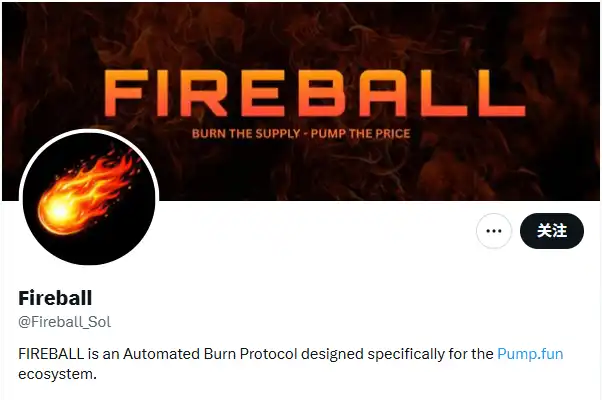
This indicates the market is currently responsive to the direction of "mechanism-based meme coins."

The traditional玩法 of shilling, pumping, and community hype is finding it harder to attract capital. Using mechanism design to tell a "structurally safe" story might be one of the recent trends for meme coins.

That said, artificially creating a specific mechanism isn't a new玩法.

The most typical case in 2021 was OlympusDAO's (3,3), which used game theory to package a staking mechanism, telling the story "if everyone holds, everyone profits," reaching a peak market cap of billions of dollars. The ending, as everyone knows, was a death spiral, dropping over 90%.

Even earlier, there was Safemoon's玩法 of "taxing every transaction and distributing it to holders," also a narrative of mechanism innovation, which ended with the SEC suing and charging the founders with fraud.

Mechanisms can be great narrative hooks, capable of gathering capital and attention in the short term, but the mechanism itself does not create value.

When external capital stops flowing in, even the most精巧designed flywheel will stop turning.

Finally, let's recap what this little gem is actually doing:

Turning the meme coin's creator fees into an "automated market-making bot." The mechanism itself isn't complicated, and the problem it solves is very clear: preventing developers from directly taking the money and running.

The developer not being able to rug doesn't mean you will make money.

If after reading this you find the mechanism interesting and want to participate, remember one thing: it is first and foremost a meme coin, and only secondly an experiment with a new mechanism.


Kripto yang Sedang Tren

Pertanyaan Terkait

QWhat is the core mechanism that Snowball uses to create a 'self-rolling' effect?

ASnowball uses a mechanism where 100% of the creator fees from each transaction are automatically sent to an on-chain market-making bot. This bot periodically uses the accumulated funds to buy tokens (creating buy pressure), adds the purchased tokens and corresponding SOL to the liquidity pool, and burns 0.1% of the tokens to create deflation.

QHow does the creator fee in Snowball differ from a typical pump.fun token?

AIn a typical pump.fun token, the creator fee (usually 0.5% to 1%) goes directly into the developer's wallet, which they can withdraw and potentially abandon the project with. In Snowball, 100% of this fee is automatically sent to an on-chain market-making bot instead of going to any individual, making it structurally harder for the developer to 'rug pull'.

QWhat are the potential risks of investing in a meme coin like Snowball, according to the article?

AThe risks include a general decline in market activity and meme coin hype, which could lead to reduced trading volume. If new buying pressure doesn't materialize, the bot's funding from fees decreases, weakening buy support and price stability. Other risks not solved by the mechanism include large holders (whales) dumping, insufficient liquidity, and the narrative simply falling out of fashion.

QWhat precedent does the article mention for meme coins with innovative mechanisms, and what was their outcome?

AThe article mentions OlympusDAO's (3,3) staking mechanism, which promised mutual gains if holders sold, but its市值 eventually fell over 90%. It also references Safemoon, which used a transaction tax redistribution mechanism and whose founders were later charged with fraud by the SEC. These examples show that mechanisms can be a good narrative but don't inherently create value if external capital stops flowing in.

QWhat key piece of advice does the article give to potential participants interested in Snowball's mechanism?

AThe key advice is to remember that Snowball is first and foremost a meme coin, and only secondly an experiment with a new mechanism. While the mechanism addresses developer rug pulls, it does not guarantee profits. Participants are advised to 'play but don't get too carried away' or 'don't go overboard'.

Bacaan Terkait

Seluruh Dunia Mengagumi Kedatangan Noam, Namun Utang OpenAI Semakin Menebal

OpenAI mengumumkan perekrutan Noam Shazeer, salah satu penulis kunci makalah "Attention Is All You Need", sebagai pemimpin penelitian arsitektur, yang disambut antusias. Namun, di saat yang sama, laporan keuangan teraudit perusahaan mengungkapkan kerugian operasional besar: $20,92 miliar pada 2025 dan pembakaran tunai $3,7 miliar pada kuartal pertama 2026. Artikel ini mempertanyakan logika di balik perekrutan bintang mahal ini dengan latar belakang tekanan keuangan yang parah. Inti masalah OpenAI bukanlah kekurangan bakat teknis, tetapi model bisnisnya: biaya komputasi yang sangat tinggi (termasuk $10,59 miliar untuk sewa daya komputasi dari Microsoft), sambil mengandalkan basis pengguna gratis yang luas dengan hanya 50 juta pengguna berbayar. Sementara itu, OpenAI telah kehilangan banyak pendiri dan peneliti inti seperti Ilya Sutskever dan Jan Leike, menunjukkan pergeseran fokus dari penelitian eksplorasi ke iterasi produk. Perekrutan Noam dilihat sebagai "pembelian cemas" yang lebih bertujuan untuk menciptakan narasi yang kuat guna mendukung valuasi IPO yang sangat tinggi (hingga $1 triliun), daripada menyelesaikan masalah profitabilitas mendasar. Sebagai perbandingan, Anthropic dilaporkan mendekati profitabilitas dengan fokus pada klien korporat yang memberikan aliran pendapatan yang lebih stabil dan dapat diprediksi. Artikel menyimpulkan bahwa tanah subur untuk inovasi berkelanjutan datang dari budaya internal yang mempertahankan talenta, bukan dari menyewa bintang mahal, dan bahwa lembar neraca tidak peduli dengan kejeniusan individu, melainkan dengan jalur yang jelas menuju keberlanjutan keuangan.

marsbit15m yang lalu

Seluruh Dunia Mengagumi Kedatangan Noam, Namun Utang OpenAI Semakin Menebal

marsbit15m yang lalu

「Memiliki」atau「Menyewa」Kecerdasan? Pertanyaan Baru dalam Memulai Bisnis AI

Mythos ditutup minggu ini, menyoroti dilema mendasar bagi startup AI: "menyewa" atau "memiliki" kecerdasan yang menjadi inti produk mereka. Selama ini, diskusi tentang model open source seringkali hanya fokus pada biaya sebagai alternatif yang lebih murah dari model mutakhir (seperti API OpenAI). Namun, insiden Mythos mengingatkan bahwa **kendali** adalah masalah yang lebih kritis. Bergantung sepenuhnya pada model eksternal berarti bisnis Anda rentan terhadap perubahan aturan, harga, atau bahkan keputusan penutupan dari penyedia model. Artikel ini berpendapat bahwa "memiliki kecerdasan" tidak berarti meninggalkan model mutakhir. Sebaliknya, perusahaan harus membangun aset kecerdasan mereka sendiri dengan cara: * Memulai dari model open source yang kuat. * Melatih ulang (fine-tune) model tersebut dengan **data, alur kerja, pengetahuan domain, dan kasus tepi (edge cases)** unik perusahaan. * Mendefinisikan standar evaluasi dan kualitas mereka sendiri. Dengan demikian, nilai perusahaan tertanam dalam model yang semakin terspesialisasi dan mencerminkan operasi bisnisnya yang sebenarnya. Masa depan AI tidak akan didominasi oleh satu model "terdepan" tunggal. Akan ada banyak "batas terdepan": 1. Model mutakhir umum (seperti GPT, Claude). 2. Model yang dilatih ulang dengan pengetahuan khusus perusahaan. 3. Model khusus untuk tugas vertikal yang sempit. 4. Sistem perutean yang menyelaraskan beberapa model untuk kinerja terbaik. Intinya, parit pertahanan sejati di era AI bukanlah sekadar kemampuan memanggil model terkuat, tetapi kemampuan untuk **mengubah kecerdasan menjadi aset perusahaan yang unik dan dikendalikan sendiri**.

marsbit35m yang lalu

「Memiliki」atau「Menyewa」Kecerdasan? Pertanyaan Baru dalam Memulai Bisnis AI

marsbit35m yang lalu

Gelombang Pasar Saham AS (19 Juni): Premi Mereda Usai Kesepakatan AS-Iran, Chip Moncer Cetak Rekor Baru, Energi Terpuruk

Arah Pasar Saham AS (19 Juni): Kesepakatan AS-Iran Tercapai, Premium Geopolitik Menghilang, Chip Unggul dan Mencapai Rekor Tertinggi, Sektor Energi Anjlok Pada Kamis, indeks saam AS naik setelah kesepakatan sementara AS-Iran ditandatangani di Jenewa, meredakan ketegangan geopolitik di Selat Hormuz. S&P 500 naik 1,08%, Nasdaq melonjak 1,91%, dan Dow Jones sedikit menguat. Indeks Philadelphia Semiconductor meroket lebih dari 6% ke rekor tertinggi baru, didorong oleh berita kerja sama Apple dengan Intel untuk fabrikasi chip serta optimisme belanja modal AI. Saham memori seperti Micron dan SanDisk juga melonjak. Di sisi lain, sektor energi menjadi satu-satunya yang merosot karena harga minyak (WTI) jatuh sekitar 2% menyusul hilangnya premium risiko geopolitik. Saham seperti Exxon dan Chevron turun. Volatilitas (VIX) turun tajam, menunjukkan sentimen membaik. Imbal hasil obligasi pemerintah AS sedikit menurun. Emas dan perak melemah. Pasar kripto relatif datar. Analisis "Tren Arus" menyoroti bahwa reli hari ini didukung dua pilar: resolusi geopolitik sekali waktu dan kekuatan fundamental berkelanjutan dari sektor chip/AI. Namun, kenaikan sektor energi mungkin telah berakhir. Tekanan pada SpaceX terkait rencana penerbitan obligasi juga diperhatikan. Prospek pasar ke depan akan sangat bergantung pada data PCE minggu depan dan apakah ekspektasi suku bunga tinggi Federal Reserve akan bertahan atau tidak.

marsbit38m yang lalu

Gelombang Pasar Saham AS (19 Juni): Premi Mereda Usai Kesepakatan AS-Iran, Chip Moncer Cetak Rekor Baru, Energi Terpuruk

marsbit38m yang lalu

Akankah MicroStrategy Masuk ke Dalam Spiral Kematian? Bagaimana Tren Makro di Paruh Kedua?

Pembahasan inti dari podcast ini berfokus pada dua topik besar: tekanan finansial MicroStrategy terhadap harga Bitcoin dan pergeseran tren makro ke arah AI serta aset riil. Analis Didier berpendapat bahwa penurunan Bitcoin baru-baru ini terutama disebabkan oleh ekspektasi pasar bahwa MicroStrategy mungkin akan terus menjual Bitcoin dalam jumlah kecil untuk menutupi arus kas dan dividen saham preferen, demi mempertahankan prinsip "netralitas Bitcoin per saham". Tekanan ini bersifat struktural. Namun, skenario "spiral kematian" bersama Bitcoin dianggap tidak mungkin terjadi kecuali ada guncangan makro baru. Pasar saat ini sedang menunggu level harga dukungan yang tepat. Di sisi lain, Didier melihat AI sebagai pendorong fundamental jangka panjang pasar saham AS. Token dipandang sebagai "tenaga kerja baru" yang menggantikan peran manusia dalam banyak pekerjaan eksekusi, meningkatkan otomatisasi dan profitabilitas perusahaan. Rantai pasokan AI seperti semikonduktor akan terus diuntungkan. Untuk industri crypto, likuiditas telah terkikis parah pasca peristiwa 1011, membuat tren altcoin sulit pulih. Bursa crypto yang beralih menawarkan saham AS merupakan langkah alami menuju aset bernilai riil. Jangka panjang, blockchain berpotensi menjadi infrastruktur untuk "ekonomi mesin" di mana agen AI berinteraksi dan bertransaksi. Secara makro, Didier lebih hati-hati memasuki paruh kedua tahun ini karena ketidakpastian pemilu AS dan IPO raksasa seperti SpaceX yang dapat memberi tekanan likuiditas. Namun, dorongan fundamental AI terhadap produktivitas tetap kuat. Masa depan mungkin melihat kombinasi AI dan blockchain yang lebih matang, mengarah ke fase industri yang lebih institusional dibandingkan spekulasi liar masa lalu.

marsbit40m yang lalu

Akankah MicroStrategy Masuk ke Dalam Spiral Kematian? Bagaimana Tren Makro di Paruh Kedua?

marsbit40m yang lalu

Trading

Spot
Futures

Artikel Populer

Cara Membeli QUICK

Selamat datang di HTX.com! Kami telah membuat pembelian Quickswap (QUICK) menjadi mudah dan nyaman. Ikuti panduan langkah demi langkah kami untuk memulai perjalanan kripto Anda.Langkah 1: Buat Akun HTX AndaGunakan alamat email atau nomor ponsel Anda untuk mendaftar akun gratis di HTX. Rasakan perjalanan pendaftaran yang mudah dan buka semua fitur.Dapatkan Akun SayaLangkah 2: Buka Beli Kripto, lalu Pilih Metode Pembayaran AndaKartu Kredit/Debit: Gunakan Visa atau Mastercard Anda untuk membeli Quickswap (QUICK) secara instan.Saldo: Gunakan dana dari saldo akun HTX Anda untuk melakukan trading dengan lancar.Pihak Ketiga: Kami telah menambahkan metode pembayaran populer seperti Google Pay dan Apple Pay untuk meningkatkan kenyamanan.P2P: Lakukan trading langsung dengan pengguna lain di HTX.Over-the-Counter (OTC): Kami menawarkan layanan yang dibuat khusus dan kurs yang kompetitif bagi para trader.Langkah 3: Simpan Quickswap (QUICK) AndaSetelah melakukan pembelian, simpan Quickswap (QUICK) di akun HTX Anda. Selain itu, Anda dapat mengirimkannya ke tempat lain melalui transfer blockchain atau menggunakannya untuk memperdagangkan mata uang kripto lainnya.Langkah 4: Lakukan trading Quickswap (QUICK)Lakukan trading Quickswap (QUICK) dengan mudah di pasar spot HTX. Cukup akses akun Anda, pilih pasangan perdagangan, jalankan trading, lalu pantau secara real-time. Kami menawarkan pengalaman yang ramah pengguna baik untuk pemula maupun trader berpengalaman.

219 Total TayanganDipublikasikan pada 2024.12.11Diperbarui pada 2026.06.02

Cara Membeli QUICK

Diskusi

Selamat datang di Komunitas HTX. Di sini, Anda bisa terus mendapatkan informasi terbaru tentang perkembangan platform terkini dan mendapatkan akses ke wawasan pasar profesional. Pendapat pengguna mengenai harga QUICK (QUICK) disajikan di bawah ini.

活动图片











