When Curators Become a Risk Variable in DeFi Lending, How Can Algorithms Reshape the Market?

比推Dipublikasikan tanggal 2025-12-10Terakhir diperbarui pada 2025-12-10

Abstrak

The article argues that the current "Curator" model in DeFi lending, as seen in protocols like Morpho and Euler, reintroduces human moral risk and inefficiency. It traces the evolution of lending markets, highlighting that early pooled models (e.g., Compound, Aave) sacrificed lender risk control for borrower convenience, while isolated markets (e.g., Morpho Blue) fragmented liquidity. Curator vaults attempted to bridge this gap but reintroduced trust assumptions and discretionary decision-making. The author proposes a new paradigm inspired by traditional order books: a two-tier architecture separating risk definition from order matching. In this model (exemplified by Avon), lenders deposit into isolated, parameter-defined "strategies" (retaining full risk control), while a shared order book algorithmically aggregates and routes borrower requests across compatible strategies atomically. This eliminates the need for human curators, enhances transparency, and improves liquidity utilization. The approach also benefits RWA by allowing compliance at the strategy level while pooling global liquidity. Built on high-performance chains like MegaETH, this CLOB-based system aims to automate lending coordination without sacrificing lender autonomy or borrower experience.

Original Author: @0xJaehaerys, Gelora Research

Original Compilation: EeeVee, SpecialistXBT, BlockBeats

Original Title: Lending Markets Do Not Need the Curator Model


Editor's Note: After the successive blowups of Stream Finance and USDX, the DeFi community is undergoing a painful disenchantment. The "Curator" model introduced by protocols like Morpho and Euler was originally intended to solve liquidity fragmentation but inadvertently reintroduced the moral hazard of "human" factors on-chain. The author of this article points out that current lending protocols mistakenly bundle "risk definition" with "order matching." By drawing on the order book model from traditional finance, this article constructs a new paradigm that eliminates the need for curators and relies on algorithmic automatic routing.

The Evolutionary Logic of Lending Markets

Reviewing the evolution of on-chain trading provides a reference for understanding lending market.

AMMs based on constant functions (like Uniswap) solved a fundamental problem: how to create a market without active market makers? The answer was to use an invariant function to preset the "shape" of liquidity. Liquidity providers pre-agree to a set of strategies, and the protocol handles execution automatically.

This works well in trading because trading is relatively simple: buyers and sellers meet at a price. But lending is much more complex. A loan involves multiple dimensions:

Interest rate

Collateral type

Loan-to-Value ratio (LTV)

Term (fixed vs. demand)

Liquidation mechanism

Matching a loan requires satisfying constraints across all these dimensions simultaneously.

Early DeFi lending directly adopted solutions similar to AMMs. Protocols like Compound and Aave preset interest rate curves, with lenders joining a shared pool. This allowed lending markets to function without active lenders.

But this analogy has a fatal flaw. In DEX trading, the shape of the constant function curve affects execution quality (slippage, depth); in lending, the shape of the interest rate curve directly determines risk. When all lenders share a single pool, they also share the risk of all collateral accepted by the pool. Lenders cannot express their desire to bear only specific types of risk.

In the trading space, order books solved this problem: they allow market makers to define their own "curve shape." Each market maker quotes at their preferred price, the order book aggregates these quotes into a unified market, but each market maker still controls their own risk exposure.

Can lending adopt the same approach? A project named Avon attempts to answer this question.

The Liquidity Fragmentation Problem

To give lenders control, DeFi's first attempt was market isolation.

Protocols like Morpho Blue and Euler allow anyone to create lending markets with specific parameters: designated collateral, borrowed asset, fixed liquidation LTV, and interest rate curve. Lenders deposit into markets that match their risk preferences. Bad debt in one market never spills over to another.
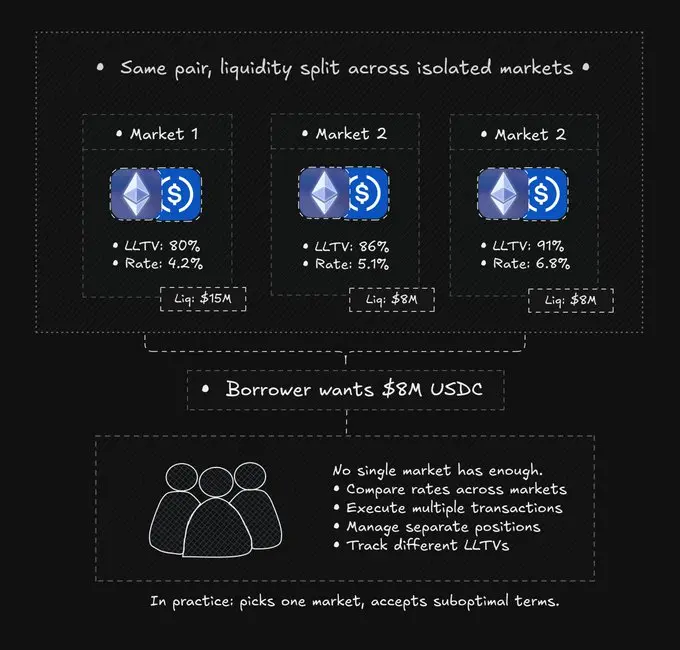
This is perfect for lenders; they get the risk isolation they want.

But for borrowers, this creates fragmentation.

Take ETH-USDC lending as an example. There might be a dozen different markets:

Market B: $3M liquidity, 86% LTV, 5.1% interest rate

Market C: $2M liquidity, 91% LTV, 6.8% interest rate

... and 9 other markets with lower liquidity

A user wanting to borrow $8 million cannot be satisfied from a single market. They must manually compare prices, execute multiple transactions, manage分散的头寸, and track different liquidation thresholds. The theoretical optimal solution requires splitting the loan across four or more markets.

In practice, no one does this. Borrowers typically just pick one market. Capital utilization is low in fragmented pools.

Market risk isolation solved the lender's problem but created a borrower's problem.

The Limitations of Curator Vaults

The curator vault model attempts to bridge this gap.
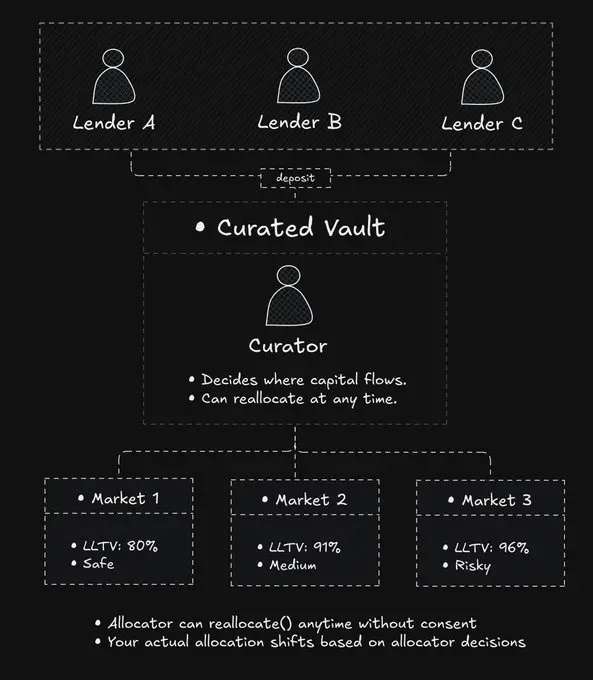
The idea is: professional curators manage capital allocation. Lenders deposit into vaults, and curators allocate funds to underlying markets, optimizing yield and managing risk. Borrowers still face fragmented markets, but at least lenders don't have to manually rebalance.

This helps lenders who want to "set and forget," but it introduces something DeFi aimed to eliminate: discretionary power.
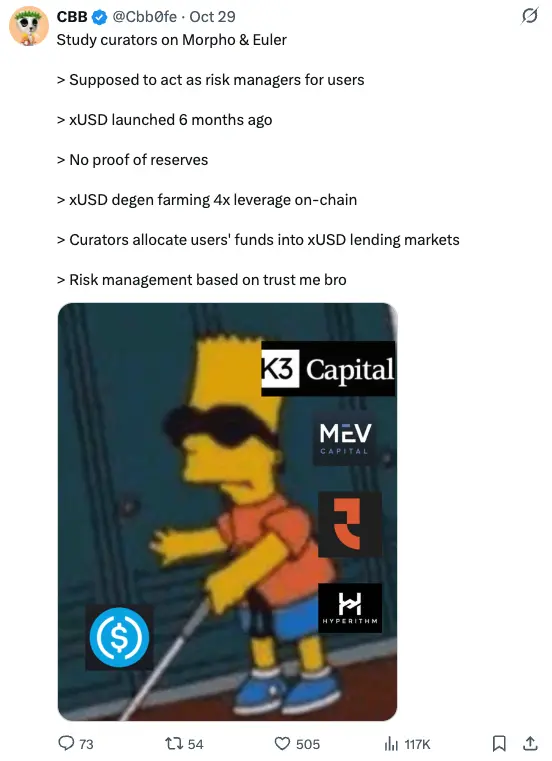
Curators decide which markets get capital and can reallocate at any time. The lender's risk exposure changes with the curator's decisions, unpredictably and uncontrollably. As one Twitter user put it: "The curator is PvPing the borrower, but the borrower doesn't even know they are being farmed."

This asymmetry is not only in strategy but also in the accuracy of the basic interface. Morpho's UI sometimes shows "$3 million available liquidity," but in practice, funds at low interest rates are scarce, with most capital located in higher rate tiers.

When liquidity coordination relies on human decisions, transparency suffers.

Capital allocators adjust market liquidity on their schedule, not based on the market's immediate needs. Vaults try to solve borrower fragmentation through "rebalancing," but rebalancing requires gas fees, depends on the curator's willingness, and often lags. Borrowers still face suboptimal rates.

Separating Risk from Matching

Lending protocols conflate two distinct modules.

User definition of risk: Different lenders have different views on collateral quality, leverage ratios.

The protocol's method of matching loans: This is mechanical. It doesn't require user subjectivity, just efficient routing.

The pooled model bundles these two, lenders lose control.

The isolated pool model separates risk definition but abandons matching, forcing borrowers to manually find the optimal path.

The curator vault model adds matching back through the curator role but introduces a trust assumption in the curator.

Can matching be automated without introducing discretion (human intervention)?

Order books in trading did this. Market makers define quotes, the order book aggregates depth, matching is deterministic (best price first). No one decides where orders go, the mechanism decides everything.

CLOB lending applies the same principle to credit markets:

Lenders define risk through isolated strategies.

Strategies post quotes to a shared order book.

Borrowers interact with unified liquidity.

Matching happens automatically, without curator intervention.

Risk stays with the lender, coordination becomes mechanical. No trust in a third party is needed at any point.

Two-Tier Architecture

Avon implements order book lending through two unique tiers.
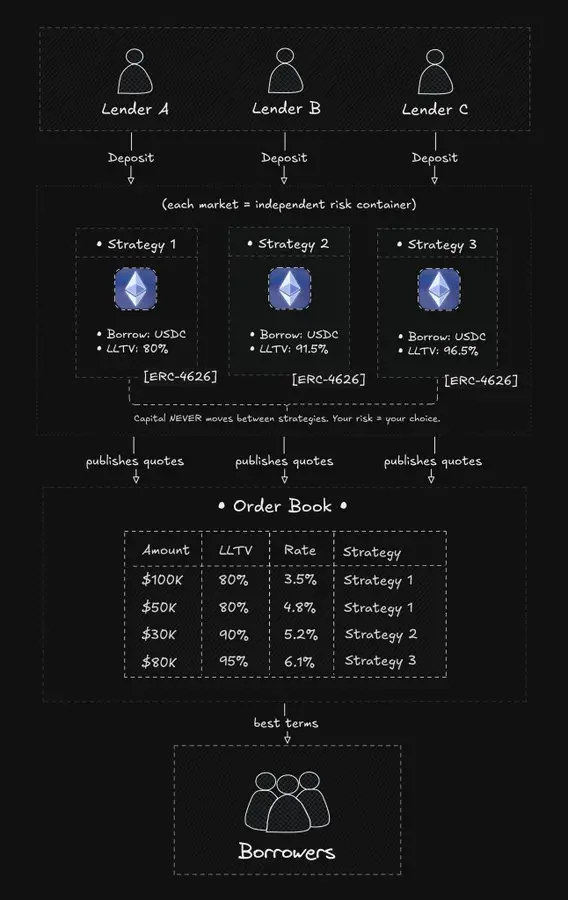
Strategy Layer

A "Strategy" is an isolated lending market with fixed parameters.

The strategy creator defines the following parameters: Collateral/Borrowed Asset, Liquidation LTV, Interest Rate Curve, Oracle, Liquidation Mechanism.

Once deployed, the shape of the interest rate curve cannot be changed. Lenders know the rules exactly before depositing.

Funds never move between strategies.

If you deposit into Strategy A, your money stays in Strategy A until you withdraw. No curators, no rebalancing, no sudden changes in risk exposure.

Although someone (the strategy manager) sets the parameters, they are fundamentally different from a curator: Curators are capital allocators (deciding where money goes), strategy managers are true risk managers (defining rules but not moving money), analogous to Aave DAO. The decision-making power for capital allocation always remains with the lender.

How does the system adapt to market changes? Through competition, not parameter modification. If the risk-free rate soars, this forces old strategies to become obsolete (funds flow out), and new strategies are created (funds flow in). "Discretion" shifts from "where should capital go?" (curator's decision) to "which strategy should I choose?" (lender's decision).

Matching Layer

Strategies do not serve borrowers directly; instead, they post quotes to a shared order book.

The order book aggregates quotes from all strategies into a unified view. Borrowers see the combined depth of all strategies that accept their collateral.

When a borrower places an order, the matching engine:

Filters quotes by compatibility (collateral type, LTV requirements).

Sorts by interest rate.

Executes starting from the cheapest.

Settles within an atomic transaction.

If one strategy can fulfill the entire order, it takes it all; if not, the order is automatically split across multiple strategies. The borrower only perceives one transaction.

Important note: The order book only reads strategy states; it cannot modify them. It is only responsible for coordinating access, not allocating capital.

A Boon for RWA

DeFi has always faced a structural contradiction in institutional adoption: compliance requires isolation, but isolation kills liquidity.
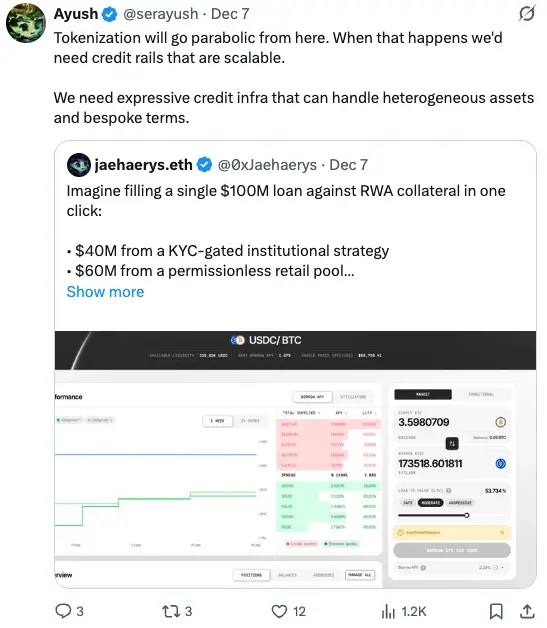
Aave Arc tried the "walled garden" model, where compliant participants have their own pool. The result was shallow liquidity and poor rates. Aave Horizon tried a "semi-open" model (RWA issuers require KYC, but lending is permissionless). This is progress, but institutional borrowers still cannot access the $32 billion liquidity in Aave's main pool. Some projects explored permissioned rollups. The KYC process is completed at the infrastructure level. This approach works for some use cases but fragments liquidity at the network layer. Compliant users on Chain A cannot access liquidity on Chain B.

The order book model offers a third way.

The strategy layer can enforce any access control (KYC, geographic restrictions, accredited investor checks). The matching engine is only responsible for matching.

If a compliant strategy and a permissionless strategy both offer compatible terms, they can simultaneously fill the same loan.

Imagine a corporate treasury抵押代币化国债 borrowing $100 million:

$30 million from a strategy requiring institutional KYC (pension fund LPs)

$20 million from a strategy requiring accredited investor certification (family office LPs)

$50 million from a completely permissionless strategy (retail LPs)

Funds are never mixed at the source, institutions remain compliant, but liquidity is unified globally. This breaks the deadlock of "compliance equals isolation."

Mechanisms for Multi-Dimensional Matching

Order books match on only one dimension: price. The highest bid and lowest ask match.
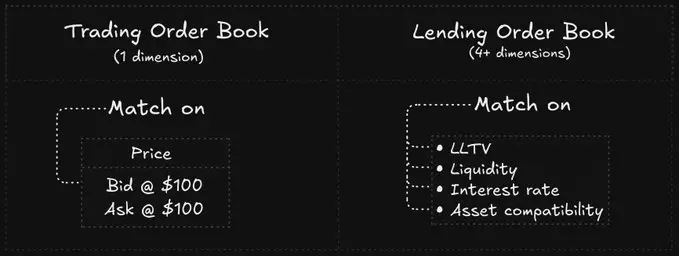
Lending order books must match across multiple dimensions simultaneously:

Interest Rate: Must be below the borrower's acceptable上限.

LTV: The borrower's collateral ratio must meet the strategy's requirements.

Asset Compatibility: Currency match.

Liquidity: Sufficient market liquidity.

Borrowers who provide more collateral (lower LTV) or accept higher interest rates can match with more strategies. The engine finds the cheapest path within this constraint space.

A note for large borrowers. In Aave, $10 billion in liquidity is a monolithic pool. In order book lending, $10 billion might be分散在数百种策略中. A $100 million loan would quickly consume the entire order book, filling from the cheapest strategies first, progressively moving to the most expensive ones. Slippage is visible.

Pool-based systems also have slippage, just manifested differently: a surge in utilization pushes up interest rates. The difference is transparency. In the order book, slippage is visible upfront. In the pool, slippage only becomes apparent after the trade executes.

Floating Rates and Re-quoting

DeFi lending uses floating rates. As utilization changes, so does the interest rate.

This creates a synchronization challenge: if the strategy utilization changes but the quote on the order book isn't updated, the borrower executes at the wrong price.

Solution: Continuous re-quoting.

As soon as the strategy state changes, immediately post a new quote to the order book. This requires extremely high infrastructure performance:

Very fast block times.

Extremely cheap transaction costs.

Atomic state reads.

This is why Avon chose to build on MegaETH. On Ethereum Mainnet, this architecture is prohibitively expensive due to gas fees.

Existing friction:

If market rates move but the strategy's fixed curve doesn't adapt, a "Dead Zone" appears – borrowers find it too expensive to borrow, and lenders earn no yield. In Aave, the curve adjusts automatically, whereas in CLOB mode, this requires lenders to manually withdraw and migrate to new strategies. This is the price paid for control.

Multi-Strategy Position Management

When a loan is filled by multiple strategies, the borrower effectively holds a multi-strategy position.

Although it looks like one loan on the interface, the underlying components are independent:

Independent Interest Rates: Component A's rate might rise due to increased utilization in Strategy A, while Component B remains unchanged.

Independent Health Ratios: When the token price drops, components with stricter LTV limits are liquidated first locally. You don't get liquidated all at once but experience a series of partial liquidations, like being "nibbled away."

To simplify the experience, Avon provides unified position management (one-click add collateral, automatically distributed by weight) and one-click refinancing功能 (automatically borrow new to repay old via flash loans, always locking in the market's best rate).

Conclusion

DeFi lending has gone through several stages:

Pooled Protocols: Gave borrowers depth but剥夺了放贷人的控制权.

Isolated Markets: Gave lenders control but fragmented the borrower experience.

Curator Vaults: Attempted to bridge the two but introduced human decision-making risk.

Order Book Lending (CLOB): Decouples the above models. Risk definition rights return to lenders; matching is achieved through an order book engine.

The design principle is clear: when matching can be achieved through code, human intervention is no longer needed. Markets can self-regulate.


Twitter:https://twitter.com/BitpushNewsCN

Bitpush TG Discussion Group:https://t.me/BitPushCommunity

Bitpush TG Subscription: https://t.me/bitpush

Original Link:https://www.bitpush.news/articles/7594633

Pertanyaan Terkait

QWhat is the core problem with the 'Curator' model in DeFi lending protocols like Morpho and Euler?

AThe Curator model reintroduces human discretion and moral risk into the system. Curators decide where capital is allocated, which can change lenders' risk exposure unpredictably and create information asymmetry, undermining the trustless and transparent ideals of DeFi.

QHow does the proposed CLOB (Central Limit Order Book) model for lending separate risk from matching?

AThe CLOB model separates risk definition and order matching into two distinct layers. The Strategy Layer allows lenders to define risk in isolated, fixed-parameter markets. The Matching Layer is a shared order book that automatically and deterministically routes borrower orders to the best available strategies without any human intervention.

QWhat advantage does the order book model offer for Real-World Assets (RWA) in DeFi?

AIt allows for compliance at the strategy level (e.g., KYC, accreditation checks) while aggregating liquidity at the matching layer. This enables compliant and permissionless strategies to simultaneously serve the same borrower, unifying global capital without mixing it at the source and breaking the 'compliance equals isolation' dilemma.

QWhat is a key infrastructural requirement for a CLOB lending system to function effectively?

AIt requires extremely high-performance infrastructure with fast block times, very low transaction costs, and atomic state reads. This is necessary for strategies to continuously re-quote their rates on the order book in response to market changes, ensuring borrowers get accurate, up-to-date pricing.

QHow does the CLOB model change the experience for a large borrower compared to a pooled model like Aave?

AIn a pooled model, a large borrower interacts with a single pool, and slippage manifests as a sharp increase in the interest rate due to higher utilization. In a CLOB model, liquidity is fragmented across many pools (strategies). Slippage for a large loan is visible upfront as the order is filled progressively from the cheapest to the most expensive strategies, offering more predictable execution.

Bacaan Terkait

"Tutup Polis, Beli Saham", Lansia Korea Berusia di Atas 60 Tahun Sedang Meminjam Uang untuk Bertaruh pada Samsung

Pasar saham Korea Selatan sedang mengalami kenaikan liar, dengan indeks KOSPI naik hampir dua kali lipat dalam setengah tahun. Demam ini mendorong banyak investor, terutama lansia di atas 60 tahun, untuk mengambil langkah berisiko tinggi. Mereka meminjam uang dari perusahaan sekuritas dan bahkan menyerahkan polis asuransi jiwa mereka—meski rugi—untuk membeli saham, terutama raksasa semikonduktor seperti Samsung Electronics dan SK Hynix. Data menunjukkan, utang margin dari kelompok usia 60+ melonjak dua kali lipat dalam setahun, menjadi lebih dari 8 triliun won. Padahal, grup ini paling menderita saat pasar anjlok Maret lalu, dengan kerugian rata-rata hampir 20% untuk akun yang menggunakan pinjaman. Fenomena ini didorong oleh FOMO (fear of missing out) dan kondisi pensiun yang sulit. Tingkat kemiskinan relatif lansia Korea adalah yang tertinggi di OECD, dengan pensiun yang rendah, sehingga banyak yang melihat pasar saham sebagai 'kesempatan terakhir'. Tren ini bahkan terlihat di tempat-tempat seperti Taman Tapgol, tempat lansia berkumpul, di mana obrolan kini beralih ke portofolio saham. Meski pemerintah mendorong partisipasi pasar, para ahli mengingatkan risiko besar yang dihadapi lansia. Kehilangan modal bisa berarti kehilangan tabungan pensiun tanpa kesempatan untuk pulih secara finansial, berbeda dengan investor muda yang masih memiliki waktu bekerja panjang.

marsbit3m yang lalu

"Tutup Polis, Beli Saham", Lansia Korea Berusia di Atas 60 Tahun Sedang Meminjam Uang untuk Bertaruh pada Samsung

marsbit3m yang lalu

Membongkar Anthropic: Perusahaan AI Terbaik, Mungkin Juga Merupakan "Penemuan Organisasi"

Anthropic telah menjadi perusahaan AI yang paling layak dipelajari dalam setahun terakhir, menunjukkan pertumbuhan eksplosif tercepat dalam sejarah bisnis. Kunci kesuksesannya terletak pada dua aspek utama: keputusan strategis dan budaya organisasi. Dari sisi strategi, Anthropic secara konsisten berfokus pada pengembangan kemampuan coding pada model bahasanya, berbeda dengan OpenAI yang mengejar banyak arah sekaligus. Fokus ini didorong oleh visi jangka panjang bahwa coding adalah jalan menuju AGI dan memiliki nilai komersial serta riset yang besar. Pendirinya, Dario Amodei, yang memiliki latar belakang teknis yang kuat, tidak mudah terpengaruh oleh konsensus pasar dan yakin pada skalabilitas hukum peningkatan model (*scaling laws*). Budaya organisasi Anthropic adalah *secret sauce* utama mereka. Perusahaan ini sangat misi-driven, berkomitmen pada keselamatan AI, dan memiliki tingkat kepercayaan tinggi dengan ego yang rendah. Budaya ini dipertahankan melalui proses rekrutmen yang ketat dengan wawancara budaya, transparansi informasi internal yang tinggi melalui sharing konteks oleh pimpinan, struktur pendirian dengan 7 *co-founder* yang setara, serta penekanan pada "satu tim" tanpa sekat kaku antar divisi. Budaya ini terbentuk sebagai respons terhadap pengalaman buruk Dario di perusahaan sebelumnya (seperti persaingan internal di Baidu dan OpenAI), dan sangat cocok untuk pekerjaan engineering intensif seperti pengumpulan dan pembersihan data dalam pengembangan AI. Hal ini menghasilkan tingkat retensi talenta yang tinggi dan tim yang sangat kohesif. Kesimpulannya, Anthropic menunjukkan bahwa dalam perlombaan AI, kemenangan tidak selalu berasal dari ambisi terbesar atau eksplorasi terbanyak. Terkadang, fokus strategis yang tajam, budaya organisasi yang kuat dengan misi yang jelas, dan kerendahan hati justru menjadi keunggulan kompetitif yang signifikan.

marsbit9m yang lalu

Membongkar Anthropic: Perusahaan AI Terbaik, Mungkin Juga Merupakan "Penemuan Organisasi"

marsbit9m yang lalu

Momen Moutai: Saat Likuiditas Mengering, Semua Orang Berkerumun di HYPE dan ZEC

"Waktu Moutai": Saat Likuiditas Mengering, Semua Berkerumun di HYPE dan ZEC Iklim pasar kripto berubah drastis pada Mei 2026. David Hoffman, penginjil Ethereum, mengumumkan telah menjual seluruh ETH-nya. Sementara ETH dan SOL terperosok, dua aset lain melonjak: HYPE (Hyperliquid) dan ZEC (Zcash). Fenomena ini mirip dengan "Moutai moment" di pasar saham China 2020, di mana likuiditas menyusut mendorong modal berkerumun ke sedikit aset inti. Di kripto, aliran dana ETF Bitcoin melambat dan narasi utama runtuh, memicu pencarian tempat berlindung yang baru. HYPE menarik dana karena cerita arus kasnya yang nyata. Sebagai exchange derivatif terdesentralisasi terbesar, ia menghasilkan pendapatan protokol miliaran dolar dan memiliki program buyback agresif. Bitwise bahkan menambahkannya ke neraca dan meluncurkan ETF berbasis HYPE. ZEC, di sisi lain, diuntungkan dari narasi "ketakutan" akan privasi. Ancaman deanonymisasi oleh AI dan komputasi kuantum mendorong permintaan akan aset privasi sejati seperti ZEC. Dukungan dari Arthur Hayes dan Multicoin Capital semakin mendorong sentimen. Kerumunan ini bisa bertahan sampai likuiditas baru mengalir (misalnya dari pivot Fed), atau runtuh karena kepadatan yang berlebihan sendiri – seperti yang ditunjukkan oleh OI dan funding rate yang melonjak. Pertanyaan kritis bagi investor: apakah Anda memegang aset karena keyakinan atau hanya inert? Menemukan aset ketiga yang akan dijadikan sasaran kerumunan berikutnya adalah kunci.

marsbit48m yang lalu

Momen Moutai: Saat Likuiditas Mengering, Semua Orang Berkerumun di HYPE dan ZEC

marsbit48m yang lalu

Trading

Spot
Futures

Artikel Populer

Cara Membeli HPP

Selamat datang di HTX.com! Kami telah membuat pembelian House Party Protocol (HPP) menjadi mudah dan nyaman. Ikuti panduan langkah demi langkah kami untuk memulai perjalanan kripto Anda.Langkah 1: Buat Akun HTX AndaGunakan alamat email atau nomor ponsel Anda untuk mendaftar akun gratis di HTX. Rasakan perjalanan pendaftaran yang mudah dan buka semua fitur.Dapatkan Akun SayaLangkah 2: Buka Beli Kripto, lalu Pilih Metode Pembayaran AndaKartu Kredit/Debit: Gunakan Visa atau Mastercard Anda untuk membeli House Party Protocol (HPP) secara instan.Saldo: Gunakan dana dari saldo akun HTX Anda untuk melakukan trading dengan lancar.Pihak Ketiga: Kami telah menambahkan metode pembayaran populer seperti Google Pay dan Apple Pay untuk meningkatkan kenyamanan.P2P: Lakukan trading langsung dengan pengguna lain di HTX.Over-the-Counter (OTC): Kami menawarkan layanan yang dibuat khusus dan kurs yang kompetitif bagi para trader.Langkah 3: Simpan House Party Protocol (HPP) AndaSetelah melakukan pembelian, simpan House Party Protocol (HPP) di akun HTX Anda. Selain itu, Anda dapat mengirimkannya ke tempat lain melalui transfer blockchain atau menggunakannya untuk memperdagangkan mata uang kripto lainnya.Langkah 4: Lakukan trading House Party Protocol (HPP)Lakukan trading House Party Protocol (HPP) dengan mudah di pasar spot HTX. Cukup akses akun Anda, pilih pasangan perdagangan, jalankan trading, lalu pantau secara real-time. Kami menawarkan pengalaman yang ramah pengguna baik untuk pemula maupun trader berpengalaman.

125 Total TayanganDipublikasikan pada 2026.04.29Diperbarui pada 2026.04.29

Cara Membeli HPP

Apa Itu GENIUS

I. Pengenalan Proyek1. Apa itu Genius?Genius (GENIUS) diposisikan sebagai “terminal on-chain terbaik,” sebuah platform perdagangan terdesentralisasi yang fokus pada privasi dan kecepatan. Dengan mengintegrasikan teknologi privasi kelas atas, platform ini bertujuan untuk membangun infrastruktur perdagangan privasi generasi berikutnya di seluruh jaringan seperti BNB Chain, memungkinkan pengguna untuk berinteraksi on-chain dengan pengalaman yang mulus yang sebanding dengan bursa terpusat.2. Bagaimana Cara Kerja Genius?Arsitektur teknis inti Genius disusun sebagai berikut:(1) Tidak terlihat di rantai: Pengguna tidak perlu menangani persetujuan multi-langkah secara manual untuk operasi lintas rantai, pembungkusan aset, atau manajemen gas yang kompleks.(2) Perdagangan Tanpa Tanda Tangan: Melalui integrasi seperti Turnkey, Genius memungkinkan perdagangan instan tanpa konfirmasi pop-up atau otorisasi per transaksi.(3) Agregator Agregator: Genius didukung oleh tumpukan agregasi terbaik di kelasnya yang terintegrasi dengan lebih dari 150 DEX, mengklaim efisiensi kutipan yang lebih baik dibandingkan produk pesaing.(4) Manajemen Akun: Platform ini mengadopsi arsitektur non-kustodian dan memanfaatkan Turnkey dan Lit Protocol untuk manajemen kunci, memungkinkan pengguna untuk mengakses akun mereka dengan aman melalui passkeys.3. Siapa yang Menciptakan Genius?Menurut Ketentuan Layanan resminya, Genius dikembangkan oleh Shuttle Labs, Inc. Berdasarkan akun X resmi proyek, Ryan Myher adalah salah satu kontributor kunci yang mendorong iterasi produk, termasuk pengembangan seperti peluncuran protokol Ghost, serta keterlibatan komunitas yang lebih luas.Pendiri Binance CZ secara resmi telah bergabung dengan proyek ini sebagai penasihat, dengan tujuan membantu tim membangun pengalaman perdagangan on-chain yang lebih cepat dan lebih menjaga privasi.Selain itu, proyek ini telah menerima dukungan kuat dari YZi Labs, yang telah berinvestasi di Genius dan bekerja sama dengan Genius Foundation, yang bertanggung jawab untuk memelihara Protokol Jembatan Genius (GBP) inti.4. Tokenomik GeniusGENIUS adalah token asli dari ekosistem Genius. Hingga saat ini, proyek ini belum merilis dokumen tokenomik lengkap.Berdasarkan pengungkapan resmi terbaru, Genius menggabungkan mekanisme deflasi, dan 4,6% dari total pasokan token telah dibakar selama fase peluncuran awal.Sistem Genius Points (GP):(1) Perdagangan untuk Mendapatkan: Platform ini telah menetapkan kumpulan hadiah sebesar 200 juta Genius Points, dan pengguna mendapatkan GP untuk setiap perdagangan yang dilakukan melalui terminal.(2) Tingkatan dan Lencana: Genius memiliki sistem lencana berbasis progresi yang berkisar dari Smart hingga God, dengan level yang lebih tinggi membuka keuntungan dan manfaat tambahan.(3) Hasil Asli: Pengguna yang memegang aset tertentu seperti usdGG di dasbor dapat memperoleh hasil asli secara langsung tanpa melalui staking yang kompleks.(4) Insentif Rujukan: Pemberi rujukan dapat memperoleh pengembalian biaya lebih dari 45% yang dibayarkan dalam USDC, bersama dengan GP tambahan.5. Garis Waktu & Tonggak UtamaMaret 2020: Akun X resmi proyek dibuat, menandai awal fase persiapan awalnya.13 Januari 2026: Genius mengumumkan investasi multi-juta dolar dari YZi Labs dan secara bersamaan mengonfirmasi CZ sebagai penasihat untuk mempercepat pembangunan infrastruktur perdagangan privasinya.18 April 2026: Proyek ini mengumumkan bahwa protokol privasi Ghost akan segera diluncurkan.29 April 2026: Protokol Ghost secara resmi dibuka untuk 50 penguji pertamanya, menandai awal era baru untuk perdagangan privasi di BNB Chain. Pada saat yang sama, tim mengonfirmasi bahwa 4,6% token telah dibakar.​II. Informasi Token1) Informasi DasarNama token: GENIUS (Genius)III. Tautan TerkaitSitus web:https://www.tradegenius.com/homePenjelajah:https://bscscan.com/address/0x1f12b85aac097e43aa1555b2881e98a51090e9a6Sosial:https://x.com/GeniusTerminalCatatan: Pengenalan proyek berasal dari materi yang diterbitkan atau disediakan oleh tim proyek resmi, yang hanya untuk referensi dan tidak merupakan nasihat investasi. HTX tidak bertanggung jawab atas kerugian langsung atau tidak langsung yang dihasilkan.

231 Total TayanganDipublikasikan pada 2026.04.29Diperbarui pada 2026.05.12

Apa Itu GENIUS

Cara Membeli GENIUS

Selamat datang di HTX.com! Kami telah membuat pembelian Genius (GENIUS) menjadi mudah dan nyaman. Ikuti panduan langkah demi langkah kami untuk memulai perjalanan kripto Anda.Langkah 1: Buat Akun HTX AndaGunakan alamat email atau nomor ponsel Anda untuk mendaftar akun gratis di HTX. Rasakan perjalanan pendaftaran yang mudah dan buka semua fitur.Dapatkan Akun SayaLangkah 2: Buka Beli Kripto, lalu Pilih Metode Pembayaran AndaKartu Kredit/Debit: Gunakan Visa atau Mastercard Anda untuk membeli Genius (GENIUS) secara instan.Saldo: Gunakan dana dari saldo akun HTX Anda untuk melakukan trading dengan lancar.Pihak Ketiga: Kami telah menambahkan metode pembayaran populer seperti Google Pay dan Apple Pay untuk meningkatkan kenyamanan.P2P: Lakukan trading langsung dengan pengguna lain di HTX.Over-the-Counter (OTC): Kami menawarkan layanan yang dibuat khusus dan kurs yang kompetitif bagi para trader.Langkah 3: Simpan Genius (GENIUS) AndaSetelah melakukan pembelian, simpan Genius (GENIUS) di akun HTX Anda. Selain itu, Anda dapat mengirimkannya ke tempat lain melalui transfer blockchain atau menggunakannya untuk memperdagangkan mata uang kripto lainnya.Langkah 4: Lakukan trading Genius (GENIUS)Lakukan trading Genius (GENIUS) dengan mudah di pasar spot HTX. Cukup akses akun Anda, pilih pasangan perdagangan, jalankan trading, lalu pantau secara real-time. Kami menawarkan pengalaman yang ramah pengguna baik untuk pemula maupun trader berpengalaman.

165 Total TayanganDipublikasikan pada 2026.04.29Diperbarui pada 2026.05.12

Cara Membeli GENIUS

Diskusi

Selamat datang di Komunitas HTX. Di sini, Anda bisa terus mendapatkan informasi terbaru tentang perkembangan platform terkini dan mendapatkan akses ke wawasan pasar profesional. Pendapat pengguna mengenai harga A (A) disajikan di bawah ini.

活动图片