$11 Million Crypto Vanishes In San Francisco Fake-Delivery Heist

bitcoinistDipublikasikan tanggal 2025-11-25Terakhir diperbarui pada 2025-11-25

Abstrak

A staged fake-delivery encounter in San Francisco’s Mission Dolores district escalated into one of the city’s largest known individual crypto...

Trusted Editorial content, reviewed by leading industry experts and seasoned editors. Ad Disclosure

A staged fake-delivery encounter in San Francisco’s Mission Dolores district escalated into one of the city’s largest known individual crypto thefts, after a disguised assailant subdued a resident and escaped with assets worth $11 million, alongside the victim’s phone and laptop.

Mission Dolores Hit By $11M Crypto Robbery

According to a police report obtained by the San Francisco Chronicle, the Saturday evening robbery unfolded in broad daylight on the unit block of Dorland Street, only steps from Mission Dolores Park—a neighborhood where tech proximity and high-value assets have increasingly intersected with targeted crime.

Home-security footage posted by Y Combinator CEO Garry Tan captured the moments leading up to the heist. In the video, the suspect approaches the residence wearing dark clothing, a hooded sweatshirt, gloves and sunglasses, and holding a white package while deliberately turning his head away from the camera.

He rings the doorbell and asks for “Joshua,” claiming the box is addressed to him. The ruse continues when the resident opens the door and confirms his name. The man posing as a courier asks whether the victim can “sign for this,” pats his own pocket as though searching for a pen, and then asks the resident if he has one.

The moment the victim steps inside to retrieve a pen, the intruder follows him into the home and moves out of frame. A loud noise is heard. Police later confirmed that the suspect brandished a firearm and bound the victim with duct tape before fleeing with his belongings. Officers arrived at approximately 6:45 p.m. and found the victim with non-life-threatening injuries. No arrests had been made as of Monday morning, and authorities have not disclosed details about how the $11 million in cryptocurrency was accessed or transferred.

Tan publicly acknowledged the incident on X, describing the victim as a friend and community member. He urged anyone in the neighborhood with security footage from 4:30 to 6 p.m. to contact the San Francisco Police Department. “We have to find the perpetrator,” Tan wrote. “Time is of the essence.”

The Big Risk Of Self-Custody

In a follow-up post referencing the crypto theft, Tan added a pointed observation about crypto asset security: “Self custody of crypto seems like a good idea until it isn’t. Vault storage (at Coinbase or elsewhere) for long term holding is safest.” His comments drew immediate attention from both the tech and crypto communities, highlighting the tension between self-custody principles and the physical-security risks of storing large private-key access at home.

Thus, the incident has reignites a longstanding debate about personal-security practices among high-net-worth crypto holders in urban settings. While hacks, phishing attacks, SIM swaps and insider compromise have dominated crypto asset crime over the past decade, physical-world robberies—once rare—have become increasingly sophisticated.

The San Francisco case stands out due to the scale of assets stolen, the execution of the ruse and the direct commentary from one of Silicon Valley’s most visible figures.

At press time, the total crypto market cap stood at $2.98 trillion.
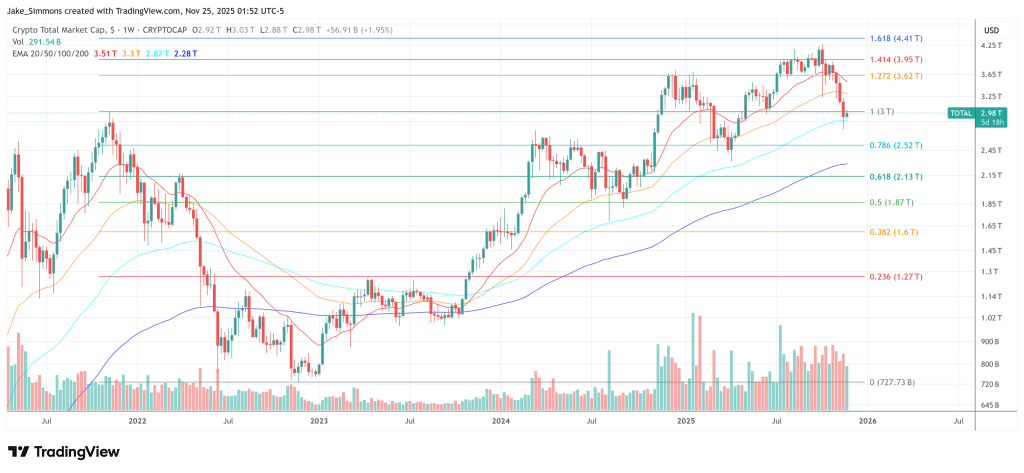
Total crypto market cap
Total crypto market holds above the 100-week EMA, 1-week chart | Source: TOTAL on TradingView.com
Featured image created with DALL.E, chart from TradingView.com
Editorial Process for bitcoinist is centered on delivering thoroughly researched, accurate, and unbiased content. We uphold strict sourcing standards, and each page undergoes diligent review by our team of top technology experts and seasoned editors. This process ensures the integrity, relevance, and value of our content for our readers.

Jake Simmons has been a Bitcoin enthusiast since 2016. Ever since he heard about Bitcoin, he has been studying the topic every day and trying to share his knowledge with others. His goal is to contribute to Bitcoin's financial revolution, which will replace the fiat money system. Besides BTC and crypto, Jake studied Business Informatics at a university. After graduation in 2017, he has been working in the blockchain and crypto sector. You can follow Jake on Twitter at @realJakeSimmons.

Bacaan Terkait

Lima Tahun Investasi Terhenti, Mengapa Ethereum Tiba-tiba Meninggalkan Poseidon?

Pada 13 Agustus, peneliti Ethereum Justin Drake mengumumkan keputusan Ethereum Foundation untuk meninggalkan algoritma hash ramah-SNARK, Poseidon, di lapisan L1 dan beralih ke fungsi hash tradisional seperti SHA2 atau BLAKE2. Keputusan ini menandai perubahan signifikan dalam peta jalan kriptografi pasca-kuantum setelah delapan tahun penelitian dan investasi puluhan juta dolar. Poseidon, yang diluncurkan pada 2019, sebelumnya dianggap ideal untuk aplikasi seperti zkRollup dan zkVM karena efisiensinya dalam sirkuit SNARK. Namun, ketika keamanan pasca-kuantum menjadi persyaratan mutlak, keterbatasan Poseidon mulai terlihat. Perkembangan terbaru dalam desain SNARK, khususnya penggunaan bidang biner (binary field), kini memungkinkan fungsi hash tradisional bekerja seefisien Poseidon dalam sistem bukti nol-pengetahuan, dengan verifikasi mencapai sekitar 1 juta panggilan hash per detik di laptop. Alasan utama pergantian ini adalah percepatan ancaman kuantum. Laporan "The Quantum Threat to Blockchains - 2026" memperingatkan bahwa komputer kuantum dapat membahayakan aset blockchain triliunan dolar pada awal 2030-an. Selain itu, kemajuan AI dalam analisis kriptografi telah melemahkan beberapa skema pasca-kuantum berbasis kisi (lattice) dan isogeni, mendorong Ethereum bertaruh pada skema berbasis hash yang dianggap lebih tahan. Ethereum merencanakan peluncuran leanVM produksi pada 2027, diikuti penyebaran di lapisan konsensus, data, dan eksekusi pada 2028. LeanVM adalah mesin virtual bukti nol-pengetahuan minimalis inti untuk agregasi tanda tangan pasca-kuantum. Sementara itu, blockchain lain seperti Solana telah memilih skema tanda tangan pasca-kuantum Falcon yang distandardisasi NIST, sedangkan Starknet berencana mengadopsi BLAKE2. Dengan beralih ke SHA2/BLAKE2, Ethereum memilih primitif kriptografi yang lebih matang dan teruji secara luas untuk era pasca-kuantum, mengutamakan keamanan jangka panjang daripada efisiensi khusus SNARK.

marsbit1j yang lalu

Lima Tahun Investasi Terhenti, Mengapa Ethereum Tiba-tiba Meninggalkan Poseidon?

marsbit1j yang lalu

Programmer di Seluruh Dunia Memberikan Uang Gratis ke Anthropic! Akhirnya Resmi Turun Tangan

Anthropic merilis blog resmi berisi enam tips untuk menghemat biaya token saat menggunakan Claude Code. Intinya, mereka menyarankan: 1) Bersihkan percakapan (/clear) setelah satu tugas selesai; 2) Tentukan model dan tingkat usaha (/effort) di awal, karena mengubahnya akan menghapus cache dan membuat sejarah percakapan dihitung ulang dengan harga penuh; 3) Gunakan @ untuk menyertakan file langsung, ketimbang mengetikkan path; 4) Tambahkan parameter "quiet" pada perintah yang output-nya panjang agar tidak memenuhi konteks; 5) Lakukan kompresi (/compact) saat cache masih hangat (sebelum istirahat) agar biayanya hanya 10%; 6) Gunakan subagent untuk tugas dengan output besar agar prosesnya terisolasi. Biaya token dipengaruhi oleh model (Opus, Sonnet, Haiku) dan jumlah token. Output token 5x lebih mahal daripada input token karena proses dekodenya yang serial. Kunci penghematan terbesar adalah **prompt caching**: jika prefix permintaan sama dengan sebelumnya, biaya baca cache hanya 0.1x harga normal. Namun, cache bisa gagal jika ada perubahan model, tingkat usaha, mode cepat, kompresi, waktu kedaluwarsa, atau membuka sesi lama. Sejarah percakapan juga bisa membengkak (O(n²)) karena file dan output perintah yang dibaca/dijalankan Claude terus menumpuk. Tips lain: gunakan /rewind untuk membatalkan percakapan yang melenceng tanpa menghapus cache sebelumnya. Mengelola token dengan cerdas kini menjadi keterampilan penting bagi developer di era AI untuk bekerja lebih efisien dengan anggaran yang sama.

marsbit3j yang lalu

Programmer di Seluruh Dunia Memberikan Uang Gratis ke Anthropic! Akhirnya Resmi Turun Tangan

marsbit3j yang lalu

Robert Kiyosaki Menceritakan Ramalan Mentornya tentang Kemunculan Bitcoin dan AI

Pengusaha dan penulis "Rich Dad Poor Dad" Robert Kiyosaki membagikan pengaruh mentor Richard Buckminster Fuller terhadap pandangan dunianya. Kiyosaki menghubungkan prediksi teknologi Fuller puluhan tahun lalu dengan kemunculan Bitcoin dan perkembangan kecerdasan buatan (AI). Ia mengutip Fuller yang disebutnya meramalkan perubahan besar seperti Bitcoin dan bangkitnya AI. Dalam tulisannya, Kiyosaki lebih menekankan ajaran Fuller tentang tujuan hidup. Ia mengutip perkataan Fuller bahwa manusia "milik alam semesta" dan menemukan tujuan sejati dengan "mendedikasikan hidup untuk memberi manfaat sebesar-besarnya bagi orang lain." Kiyosaki mengaku butuh waktu untuk memahami pesan ini, yang akhirnya mendorongnya beralih dari karier di bisnis musik (bekerja untuk band seperti The Police dan Iron Maiden) menciptakan permainan finansial Cashflow dan menulis buku larisnya. Kiyosaki juga mengulangi keyakinannya pada aset kripto. Ia dikenal sebagai pendukung Bitcoin dan Ethereum, yang dilihatnya sebagai pelindung kekayaan dari masalah sistem keuangan tradisional. Dia mengaku membeli Bitcoin saat investor lain panik. Prediksinya termasuk potensi keruntuhan pasar besar pada 2026, yang bisa menjadi peluang bagi investor yang siap dengan aset seperti Bitcoin, Ethereum, emas, dan perak. Dia pernah memprediksi Bitcoin bisa mencapai $750.000 dan Ethereum $95.000 di masa depan.

cryptonews.ru7j yang lalu

Robert Kiyosaki Menceritakan Ramalan Mentornya tentang Kemunculan Bitcoin dan AI

cryptonews.ru7j yang lalu

Trading

Spot
活动图片