MemeCore Explodes 244% In Weekly Gains, Sparks Hunt for Next 1000x Altcoins

bitcoinistDipublikasikan tanggal 2025-09-04Terakhir diperbarui pada 2025-09-04

Abstrak

The altcoin market is back on the rise. Just look at MemeCore ($M), for instance. Since last week, it has...

Trusted Editorial content, reviewed by leading industry experts and seasoned editors. Ad Disclosure

The altcoin market is back on the rise. Just look at MemeCore ($M), for instance. Since last week, it has spiked by an eye-boggling 244%+.

Today marks the first time $M has reached the $1 mark. It’s now valued at a commendable $1.44 and, at least for the time being, shows no signs of slowing down.

And it’s not the only big mover in the altcoin arena. Pump.fun has jumped by over 10% in the past 24 hours, propelled by a hefty $359.2M in trading volume during the same time period.

With more capital flowing into the top altcoins, now might be the perfect time to explore the next crypto to explode to position yourself for potential gains.

Altcoin Market Exceeds 1.6T, Traders Rotate Away From $BTC

MemeCore and Pump.fun’s rallies align with broader market trends.

With the altcoin market cap above $1.6T, it shows that traders are shifting preference from $BTC – despite it being the world’s largest crypto, currently donning a $110K price tag.
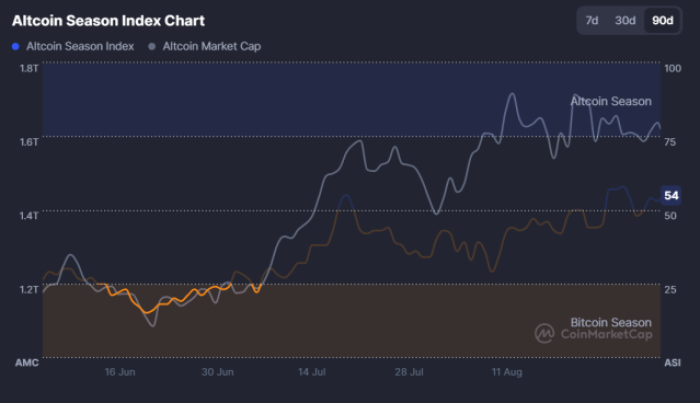
Altcoin Season Index Chart.
Source: CoinMarketCap

Also confirming the altcoin market’s current strength, the Altcoin Season Index (ACI) now sits at 55, up from 43 compared to last month.

In fact, crypto analyst ‘Crypto GEMs’ suggests that the altcoin market is on the verge of its biggest breakout to date.

On a recent X post, they posted a chart that highlights that altcoins surged 34x in 2017 and 68x in 2021–2022 following long accumulation phases.

Now, in 2025, they believe the altcoin sector is about to hit another exciting accumulation period. Their prediction points to a potential 136x rally that could propel the market cap beyond $2.1T.
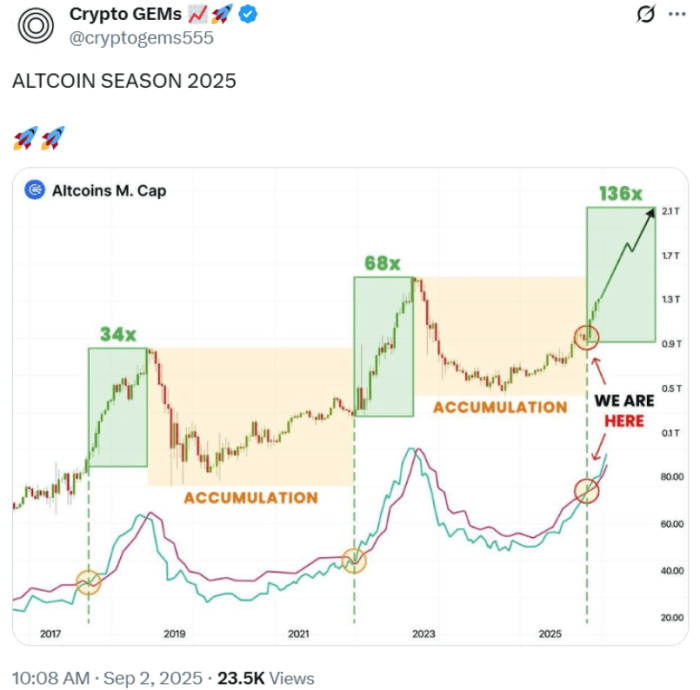
Crypto Gems tweet about alt season

With altcoins poised for even more mighty growth, there may not be a better time to check out top coins with optimal potential.

We have high hopes for Snorter Token ($SNORT), PinLink ($PIN), and Maxi Doge ($MAXI) – and for superb reasons.

1. Snorter Token ($SNORT) – Presale Tops $3.7M as Telegram Bot Launch Nears

Snorter Token ($SNORT) has quickly scooped up $3.7M+ on presale, thanks to its role as the backbone of a novel Telegram trading bot.

Once launched this quarter, Snorter Bot aims to give you a potent edge in the market by allowing you to execute trades instantly, set strategies, and tap into top market opportunitie

All can be achieved through its cutting-edge features, spanning ultra-fast swaps, automated sniping, and copy trading.
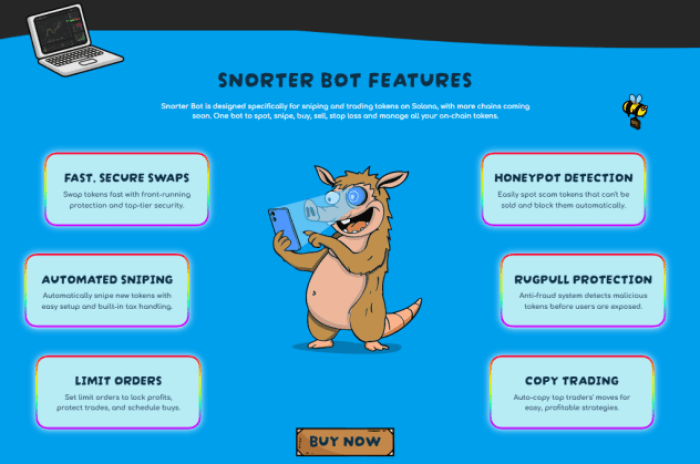
Snorter Bot features.
Source: Snorter Token

First, you can anticipate the bot launching on the Solana network as part of its plan to deliver fast execution with super low fees at just 0.85%. Owing to this, it claims that it’ll override rival bots like Maestro and Trojan.

Then, it’ll expand to Ethereum, BNB Chain, and other EVM networks. This way, you’ll be able to capture the hottest crypto opportunities across networks without having to turn to different platforms and tools.

Best of all, it promises to achieve all this without compromising security. With built-in MEV protection, plus honeypot and rugpull alerts, you can rest assured that the bot will shield you from malicious activity.

To also access premium features, governance rights, and staking rewards (currently at a 125% APY), you can purchase $SNORT on presale for just $0.1033.

But don’t wait around. Once the bot officially goes live and expands multi-chain, it’s anticipated to reach a high of $1.92 in 2026. This means that buying in now could potentially deliver an ROI exceeding 1,759% – and that’s not even counting the passive income from staking rewards.

2. PinLink ($PIN) – RWA-Tokenized Protocol Surges 10% Following Hashrate Initiative Teaser

$PIN is the foundation of PinLink, a cutting-edge RWA-tokenized protocol that connects AI developers with cost-friendly compute power. Why? To unlock new revenue streams for asset owners.

Through ERC-1155 fractionalization, DePin operators can tokenize their assets to raise capital for reinvesting in new infrastructure: expanding compute power, scaling storage, or energy networks.

In return, those who invest in these fractions gain access to steady passive income, even if they don’t own DePin hardware.

If you’re an AI developer, you’ll likely be interested in PinLink’s marketplace that delivers enterprise-grade compute and storage solutions at discounted rates.

$PIN powers the marketplace, enabling transactions, staking, and governance. Additionally, it unlocks dual revenue streams for asset owners.

And it doesn’t end there. PinLink is expanding beyond AI compute with HashLink, its new Bitcoin primitive. It’ll enable future hashrate speculation and direct $BTC payouts via Ethereum – another avenue to give you exposure to mining economics without owning traditionally pricey DePin hardware.
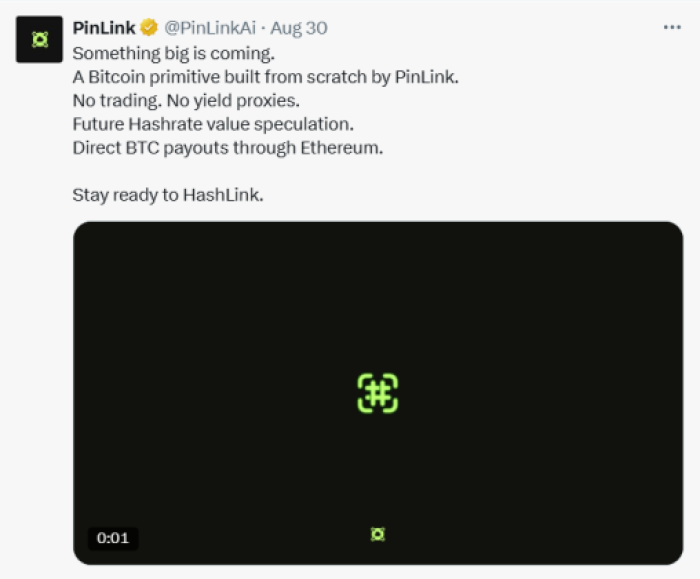
PinLink announced its new hashrate initiative on X.
Source: PinLink

Following this news breaking out, $PIN rose by over 10%. Now signals an opportune time to purchase the token, available for roughly $0.61 on some of the best crypto exchanges.

3. Maxi Doge ($MAXI) – Offers 172% Staking Rewards, Eyes Degen Trading Tournaments

Maxi Doge ($MAXI) is a meme coin on a mission to dominate the $45.1B dog-themed token niche.

As yet another Shiba Inu-inspired coin, it builds on the legacy of the top dogs on the market, $DOGE and $SHIB. But it visually sets itself apart from them, with muscles and a bold heavyweight persona that symbolizes its push toward extreme trading and market strength.
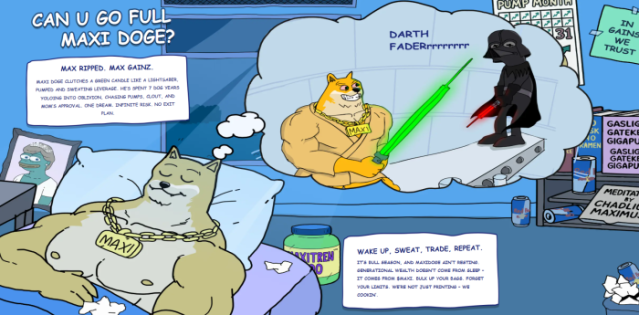
Maxi Doge presale.
Source: Maxi Doge

Despite its meme coin facade and origins, $MAXI wants to bring more to the arena than just speculation, a bit like $SHIB. But instead of launching a DEX or card game like its predecessor, it’s barking up its own path.

Despite only being live on presale thus far, it’s already engaging its community through staking. You can lock up $MAXI to earn daily rewards through smart contract distribution. Right now, its staking APY stands at an eye-catching 172% APY.

To top it off, Maxi Doge plans to host contests and reward top ‘ROI hunters’ with prizes. For the time being, the key details remain under wraps.

The project also aims to integrate futures platform integrations and host gamified tournaments in the future. Then, it’ll offer you a distinct way to partake in degen-style trading. For more information, check out our review.

Considering all the above, it’s no surprise that $MAXI has already raised over $1.8M in presales since launching on July 29, 2025.

You can join the action by acquiring $MAXI on presale for just $0.0002555. And there’s no better time to do precisely that; its price will go up tomorrow and is anticipated to break $0.0024 before 2026 gets going.

Verdict – MemeCore & Pump.fun’s Rally Sparks Growth for Top Altcoins

Hype surrounding altcoins is real, as evidenced by MemeCore and Pump.fun’s surge, plus a rising ASI.

If you’re seeking the next 1000x crypto, it might be wise to consider projects with strong utility and community hype, just like $SNORT, $PIN, and $MAXI.

Whichever one floats your boat, they each have significant growth potential.

Still, only time will truly tell their success. So, as always, DYOR and never invest more than you’d be sad to lose.

Editorial Process for bitcoinist is centered on delivering thoroughly researched, accurate, and unbiased content. We uphold strict sourcing standards, and each page undergoes diligent review by our team of top technology experts and seasoned editors. This process ensures the integrity, relevance, and value of our content for our readers.

Leah is a British journalist with a BA in Journalism, Media, and Communications and nearly a decade of content writing experience. Over the last four years, her focus has primarily been on Web3 technologies, driven by her genuine enthusiasm for decentralization and the latest technological advancements. She has contributed to leading crypto and NFT publications – Cointelegraph, Coinbound, Crypto News, NFT Plazas, Bitcolumnist, Techreport, and NFT Lately – which has elevated her to a senior role in crypto journalism. Whether crafting breaking news or in-depth reviews, she strives to engage her readers with the latest insights and information. Her articles often span the hottest cryptos, exchanges, and evolving regulations. As part of her ploy to attract crypto newbies into Web3, she explains even the most complex topics in an easily understandable and engaging way. Further underscoring her dynamic journalism background, she has written for various sectors, including software testing (TEST Magazine), travel (Travel Off Path), and music (Mixmag). When she's not deep into a crypto rabbit hole, she's probably island-hopping (with the Galapagos and Hainan being her go-to's). Or perhaps sketching chalk pencil drawings while listening to the Pixies, her all-time favorite band.

Bacaan Terkait

Keseimbangan Kekuatan Kembali Apple dan "Micron cs": Membongkar Struktur Profit di Balik iPhone

Pernahkah Anda mempertanyakan bagaimana keuntungan dari penjualan iPhone didistribusikan di antara berbagai pemasok komponen? Sebuah analisis menunjukkan pergeseran kekuatan dalam rantai pasokan Apple. Dulu, pemasok memori seperti Micron (MU) hanya menerima bagian kecil, sekitar 1.6%-2.3% dari harga iPhone X. Laporan dari akun media sosial @BluthCapital menyoroti ketidakseimbangan ini, dengan menyebut Apple membeli chip seharga $5 dan menjualnya kembali seharga $99 kepada konsumen. Data terbaru menunjukkan, dari total keuntungan satu unit iPhone, Apple mengambil porsi terbesar sekitar 25%, sedangkan raksasa memori seperti Micon hanya memperoleh kurang dari 3%. Laporan keuangan Apple Q2 2026 mengungkapkan, laba bersih per unit iPhone sekitar $320-340, dengan margin bersih mencapai 33%-36%. Sementara itu, biaya memori telah meningkat secara signifikan. Pada era iPhone X (2017), biaya memori hanya sekitar 2% dari Biaya Material (BOM). Namun, pada iPhone 17 (2026), proporsi ini melonjak menjadi 12%-15% dari BOM, sekitar $60-80, didorong oleh kenaikan harga memori secara global. Peningkatan tajam harga memori ini, yang disebut CEO Apple Tim Cook sebagai fenomena "sekali dalam 40 tahun", utamanya dipicu oleh permintaan yang sangat besar dari industri AI. Server AI membutuhkan DRAM 8-10 kali lebih banyak dibandingkan server tradisional, menyebabkan pemasok seperti Samsung, SK Hynix, dan Micon mengalihkan produksi ke produk berpenghasilan tinggi seperti HBM (High Bandwidth Memory), yang mengurangi pasokan untuk elektronik konsumen seperti iPhone. Ketimpangan pasokan ini mengubah dinamika kekuatan, memberikan leverage negosiasi yang lebih besar kepada produsen memori. Bahkan, dikabarkan Apple sedang mencoba mendiversifikasi pasokannya dengan mengajukan izin untuk membeli chip memori dari perusahaan China, CXMT. Singkatnya, era di mana Apple mendominasi dengan menekan harga pemasok komponen seperti memori sedang mengalami perubahan. Kekuatan kini bergeser seiring dengan melonjaknya permintaan memori dari sektor AI, memaksa perusahaan seperti Apple untuk menyesuaikan strategi dan menghadapi kenaikan biaya yang signifikan.

Odaily星球日报4m yang lalu

Keseimbangan Kekuatan Kembali Apple dan "Micron cs": Membongkar Struktur Profit di Balik iPhone

Odaily星球日报4m yang lalu

Jawaban Lokal untuk Komputasi Luar Angkasa: Lebih Efisien dengan Foton, Jalur Musk dan Huang Terlalu Berbelit

Perlombaan komputasi luar angkasa telah menjadi perlombaan senjata nyata, dengan Musk dan Jensen Huang (CEO Nvidia) menekankan pentingnya kecerdasan di tempat data dihasilkan dan potensi satelit AI bertenaga surya sebagai solusi komputasi paling hemat biaya pada 2032. Namun, komputasi di luar angkasa menghadapi tantangan teknis yang jauh lebih keras daripada di darat: radiasi partikel energi tinggi yang menyebabkan kesalahan chip, kesulitan dissipasi panas di lingkungan vakum, dan pasokan daya yang sangat terbatas. Di sinilah **komputasi fotonik** muncul sebagai jawaban potensial. Chip komputasi fotonik menggunakan foton (cahaya) sebagai pembawa informasi, yang memiliki keunggulan alami untuk lingkungan luar angkasa: 1. **Tahan Radiasi**: Foton tidak bermuatan listrik, sehingga tidak rentan terhadap gangguan langsung dari partikel energi tinggi. 2. **Rendah Panas**: Proses komputasi dengan cahaya dalam waveguide hampir tidak menghasilkan panas, mengatasi masalah dissipasi panas yang kritis. 3. **Rendah Daya**: Konsumsi daya statis mendekati nol, cocok dengan sumber energi terbatas satelit. Keunggulan ini memungkinkan komputasi fotonik mencapai kepadatan komputasi yang lebih tinggi dengan berat dan volume muatan yang sama dibandingkan chip elektronik tradisional, karena membutuhkan sistem pendukung (pendingin, pelindung radiasi) yang lebih sederhana dan ringan. Sementara chip elektronik mendekati batas fisik penyusutan transistor (quantum tunneling), komputasi fotonik meningkatkan kinerja dengan memperluas skala dan memanfaatkan multidimensi cahaya (panjang gelombang, polarisasi), menawarkan jalur pengembangan yang berbeda. Meski menjanjikan, komputasi fotonik masih perlu mengatasi tantangan seperti integrasi skala besar, memisahkan memori dan komputasi, serta validasi rekayasa untuk kondisi peluncuran (getaran tinggi) dan lingkungan orbit. Jalur menuju komputasi berbasis luar angkasa yang komersial dan terukur masih panjang, tetapi komputasi fotonik dan interkoneksi fotonik ("komputasi & koneksi cahaya") muncul sebagai kartu truf potensial untuk mendorong batas kemampuan konstelasi komputasi di masa depan.

marsbit1j yang lalu

Jawaban Lokal untuk Komputasi Luar Angkasa: Lebih Efisien dengan Foton, Jalur Musk dan Huang Terlalu Berbelit

marsbit1j yang lalu

Trading

Spot
活动图片