[Featured Research]Why I Think Selling My #BLUR Airdrop Was a Mistake

MirrorDipublikasikan tanggal 2023-02-21Terakhir diperbarui pada 2023-02-21

Abstrak

The key is product experience. Majority of their portcos prioritise this, Blur is no exception.

Over the weekend, I've been renewing my personal thesis for $BLUR, why I think selling my airdrop was a mistake, and why Blur Bidding is a game-changer for the NFT space.
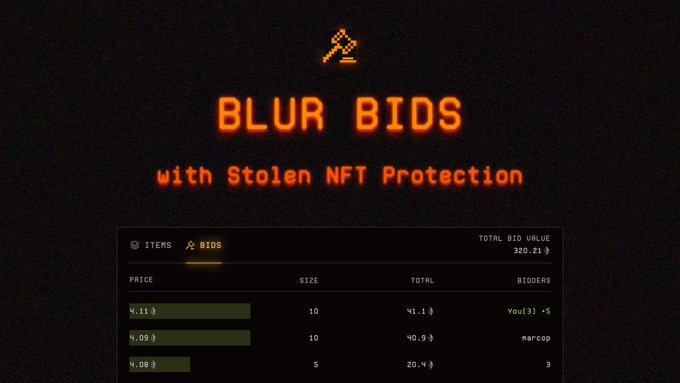
What is the most important aspect wrt product experience on NFT marketplaces? Ease of buying/selling NFTs.

ADVANTAGE OF BLUR

The majority of trading volume in the current state of the NFT market is from whales, and they want one thing: To be able to buy cheaper and sell quickly in SIZE

Compared to the DeFi space, the trading experience for NFTs is subpar. Before blur_io came along, the user experience was terrible and was not optimized for the professional, mass trading market.

NFT trading needs to (at least) attain the usability of fungible tokens in DeFi

Here comes the second (and likely the hardest) pain point: Liquidity.

While attempts have been made to solve this, including (but not limited to) NFT fragmentation, asset tokenization, and incentivization (via trading volume/listing rewards), liquidity is still extremely thin.

If I was looking to sell off 20 Doodles NFT today, it would've been impossible, likely taking days to weeks to unload fully, not to mention a downward spiraling floor price + me needing to actively re-adjust the floor price.

So what did @blur_io do? Introducing the Bid Points system.

Blur's bid mining model is essentially a liquidity pool transaction where users provide ETH (not WETH!) liquidity to a liquidity pool, a parallel comparison would be Uniswap's AMM innovation for the DeFi space.

On the other hand, opensea, LooksRare , and the_x2y2 models are pending order transactions, which makes them illiquid/inaccurate.

Blur's bidding system then incentivizes users who want the airdrop to provide liquidity and bear the risk of NFT prices once the bid is accepted.

In essence, what blur_io did right was find the right PMF (Pro NFT traders) and design a platform that focuses on the best-in-class product experience.

Users get deeper liquidity on Blur than OpenSea, allowing whales to buy/sell large amounts of NFTs frictionlessly.

GREAT AIRDROP

With $BLUR's release, the project imo is one of the most successful projects in transferring the power of protocol value distribution to the community.

The initial circulating supply of 360M tokens (12%) of supply) were distributed to the community, but what about the rest?
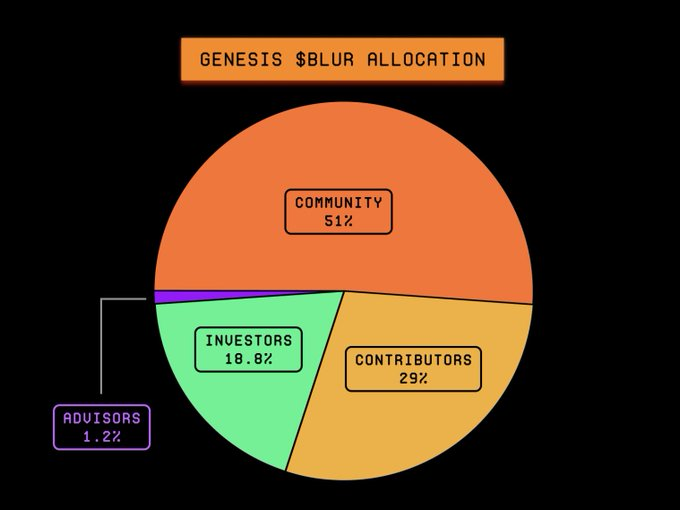
Majority of the airdrop in the first round has already been claimed, and over billions in $BLUR trading volume. Users who wanted to sell the airdrop would have already sold by now and the tokens are transferred to stronger hands.

The first year selling pressure is likely to be high, as circulating supply will increase by nearly 3x to 1 billion by the end of this year. Even so, the majority of the tokens are owned by the community. Investor/Team allocations are also subjected to a 4+ year vesting period

In my view, $BLUR is a proxy of the NFT market and a pure-play bet on the space since Blur benefits when NFT collections rise as a whole.

Assuming Blur becomes the market leader in the future, the current implied FDV of $2-3B is likely justified, given OS valuation of $13B

GREAT NEWS AHEAD

The largest exchange binance has yet to even list $BLUR, and once Blur's clear volume dominance is sustained and gains further traction, it will be inevitable.

Further, if that traction continues to gain steam, additional funding will come pouring in too.

ADVANTAGE COMPARE TO OTHER PLAYERS

Even if OS wanted to compete, they would have to reduce costs to traders and royalties (and they already did), but to really compete with Blur on liquidity, they likely have to switch to a similar model to Blur. (although that offers zero differentiation from Blur lol)

Further, building out a new product might potentially introduce bugs, which could completely destroy OS.

Wen $OS? Imo, highly unlikely, given the regulatory landscape and their desire to IPO. It also doesn't make sense from the business/investor POV; why would they give away their profits?

Also, PacmanBlur and the Blur team understand the NFT market deeply, perhaps better than OpenSea themselves. LooksRare and X2Y2 were focused on incentivizing trading volume instead of the most important thing: Liquidity.

The models used by Looksrare and X2Y2 incentivize wash trading, essentially fake volume that does nothing to improve the product experience. In other words, ponzinomics designed to attract retail who wants a dividend payout. Nothing wrong with that, btw. To each his own.

When the airdrop/token incentives end, how does Blur plan to sustain its liquidity depth? Good question, but this has been reiterated many times in multiple podcasts with @PacmanBlur, and the team is well aware of this and will be optimizing for growth long term.

Being a 2-sided marketplace, as long as user experience is top-notch and prioritized by the team, users will remain sticky to the platform. So product experience = #1

A case in point is OpenSea. Even without a token, users kept using it, of course, until Blur came along.

The Blur team is currently not making $$ themselves since marketplace fees are currently still 0%. And as everyone knows, they are @paradigm backed, but what does that even imply?

The key is product experience. Majority of their portcos prioritise this, Blur is no exception.

Bacaan Terkait

Menginterpretasi Arsitektur Baru Ethereum Foundation: Menegaskan Kembali Kedaulatan Diri dalam Tren Institusionalisasi

Ethereum Foundation (EF) melakukan restrukturisasi besar dengan merilis arsitektur lima lapis kerja baru setelah mengurangi 20% karyawan. Tujuannya adalah memperjelas peran EF sambil menegaskan kembali nilai inti kedaulatan diri (self-sovereignty) di tengah tren institusionalisasi crypto. Lima lapis kerja tersebut adalah: 1. **Lapisan Protokol:** Fokus pada pemeliharaan atribut inti Ethereum (CROPS: Censorship-resistant, Robust, Open, Private, Secure) seperti keamanan, anti-kuantum, dan anti-MEV beracun. 2. **Lapisan Akses:** Memastikan pengguna dapat benar-benar menggunakan kemampuan kedaulatan diri, dengan prinsip *zero option* (selalu ada jalur tanpa perantara). 3. **Lapisan Pengguna:** Menjembatani pengembang dengan kebutuhan nyata pengguna/organisasi untuk menghindari pengambilan keputusan yang terisolasi. 4. **Lapisan Komunitas:** Membangun dan menyebarkan konsensus nilai Ethereum (tidak tunduk pada kepentingan terpusat, netral, pertahankan CROPS) baik di dalam maupun luar ekosistem. 5. **Lapisan Institusional:** Berinteraksi dengan lembaga tradisional, namun dengan prinsip kedaulatan diri sebagai landasan, bukan memudahkan kontrol institusi atas pengguna. Artikel menyoroti bahwa meski adopsi institusi (seperti ETF, stablecoin) membawa kesuksesan, hal itu juga mengikis narasi desentralisasi dan "dolarisasi" ekosistem. EF menekankan bahwa Ethereum harus tetap menjadi "laut bebas" yang netral dan tahan sensor. Restrukturisasi ini adalah upaya untuk menyeimbangkan kebutuhan pertumbuhan dengan komitmen pada nilai-nilai dasar yang membuat Ethereum unik, memastikannya tetap menjadi platform tepercaya bagi layanan global yang benar-benar tanpa izin.

链捕手2m yang lalu

Menginterpretasi Arsitektur Baru Ethereum Foundation: Menegaskan Kembali Kedaulatan Diri dalam Tren Institusionalisasi

链捕手2m yang lalu

Bitcoin Kembali Tembus di Bawah $60.000; Setelah 20 Bulan, yang Kita Tunggu Adalah Level Terendah Baru

Bitcoin kembali turun di bawah level psikologis kunci $60,000, menyentuh terendah $59,023 yang merupakan level terendah dalam hampir 20 bulan sejak Oktober 2024. Artikel ini mengidentifikasi dua penyebab utama penurunan ini. Pertama, ETF spot Bitcoin AS mengalami arus keluar bersih institusional terpanjang sejak diluncurkan, dengan penarikan sekitar $5,94 miliar dalam 30 hari, menciptakan tekanan jual berkelanjutan. Kedua, ekspektasi kebijakan moneter The Fed berubah drastis. Data ketenagakerjaan AS yang kuat dan komentar pejabat Fed yang hawkish meningkatkan probabilitas kenaikan suku bunga, mengurangi daya tarik aset berisiko tinggi seperti Bitcoin. Para analis memiliki pandangan berbeda tentang prospek pasar. 21Shares mempertahankan prediksi harga $100,000 di akhir tahun, dengan keyakinan bahwa arus masuk ETF sebelumnya akan menjadi penyangga. Di sisi lain, Arthur Hayes memperkirakan potensi penyentuhan dasar di sekitar $40,000 dalam enam bulan ke depan karena tekanan likuiditas. Sementara CryptoQuant menunjukkan bahwa harga rata-rata biaya investor saat ini sekitar $53,000, dan sinyal pemuluhan permintaan yang berkelanjutan belum terlihat jelas. Pasar kini memusatkan perhatian pada data inflasi AS yang akan datang dan sinyal kebijakan Fed selanjutnya. Kemampuan Bitcoin untuk bertahan di atas $60,000 akan menjadi ujian kritis untuk menentukan arah tren jangka pendek.

Odaily星球日报1j yang lalu

Bitcoin Kembali Tembus di Bawah $60.000; Setelah 20 Bulan, yang Kita Tunggu Adalah Level Terendah Baru

Odaily星球日报1j yang lalu

Bitcoin Kembali Jatuh di Bawah $60.000; Sudah 20 Bulan, yang Kita Tunggu Adalah Titik Terendah Baru

Bitcoin hari ini kembali menembus level psikologis kunci 60.000 dolar AS, bahkan sempat menyentuh 59.023 dolar AS—titik terendah dalam hampir 20 bulan sejak Oktober 2024. Penurunan kali ini, yang ketiga kalinya pada tahun 2024, terjadi di tengah arus keluar institusional yang berkepanjangan dan pergeseran ekspektasi kebijakan moneter AS. Pendorong utama adalah **ETF spot Bitcoin AS**, yang mengalami periode arus keluar bersih terpanjang sejak peluncurannya, dengan total sekitar 59,4 miliar dolar AS ditarik dalam 30 hari terakhir. **Tekanan makro** juga meningkat setelah data ketenagakerjaan AS yang kuat memicu spekulasi bahwa The Fed mungkin kembali menaikkan suku bunga, mengurangi daya tarik aset berisiko tinggi seperti Bitcoin. Analis memiliki pandangan berbeda: **21Shares** tetap optimis dengan target 100.000 dolar AS di akhir tahun, sementara **Arthur Hayes** memperkirakan kemungkinan penurunan lebih dalam ke 40.000 dolar AS. **CryptoQuant** menunjukkan harga rata-rata kepemilikan investor sekitar 53.000 dolar AS dan menyatakan tanda-tanda pemuluhan permintaan belum terlihat jelas. Pergerakan harga selanjutnya akan sangat bergantung pada data inflasi AS dan sinyal kebijakan The Fed. Tanpa perubahan dalam arus keluar ETF dan sentimen pasar, kemampuan Bitcoin untuk mempertahankan level 60.000 dolar AS akan menjadi kunci bagi tren pasar selanjutnya.

marsbit1j yang lalu

Bitcoin Kembali Jatuh di Bawah $60.000; Sudah 20 Bulan, yang Kita Tunggu Adalah Titik Terendah Baru

marsbit1j yang lalu

Trading

Spot
Futures
活动图片