BITCOIN PRICE CYCLES ANALYSIS
Blockchain will change the world. Unfortunately, that massive promise causes market participants to go wild – both too bullish at times and too bearish at times. We’ve invested through four “crypto winters” already.
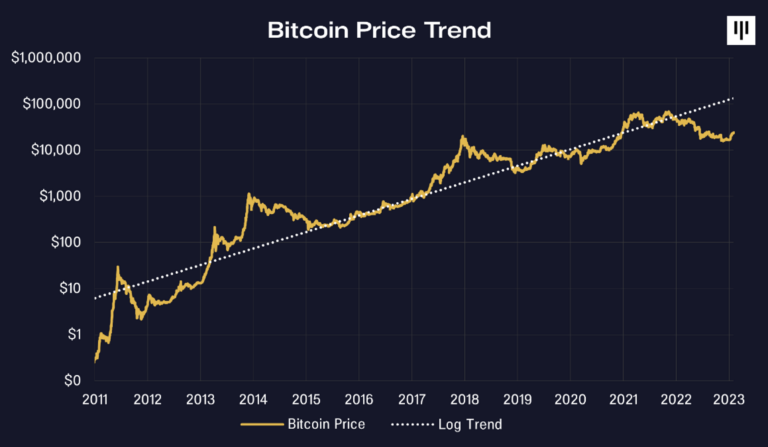
Over the long-term, Bitcoin price has been in a secular uptrend of 2.3x annually over the past twelve years, on average.
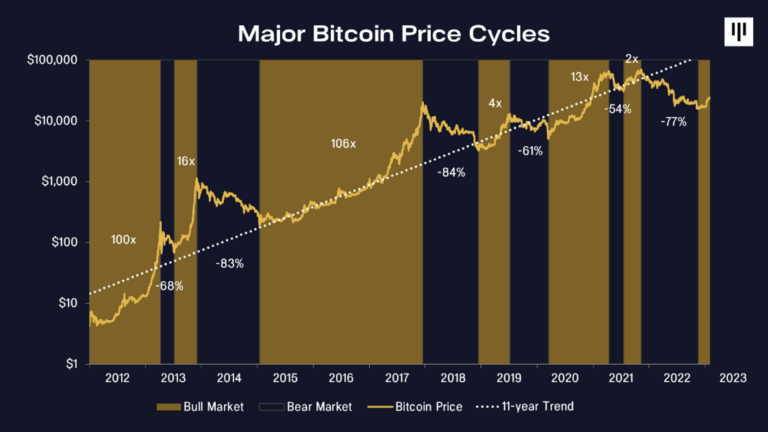
Major Bitcoin Price Cycles
Pantera has been through ten years of bitcoin cycles and I’ve traded through 35 years of similar cycles. I believe that blockchain assets have seen the lows and that we’re in the next bull market cycle – regardless of what happens in the interest-rate-sensitive asset classes.
The decline from November 2021 to November 2022 was the median of the typical cycle. This is the only bear market to more than completely wipe out the previous bull market. In this case giving back 136% of the previous rally.
The median downdraft has been 307 days and the previous bear market was 376. The median drawdown has been a -73% downdraft and the latest bear market ended at -77%.
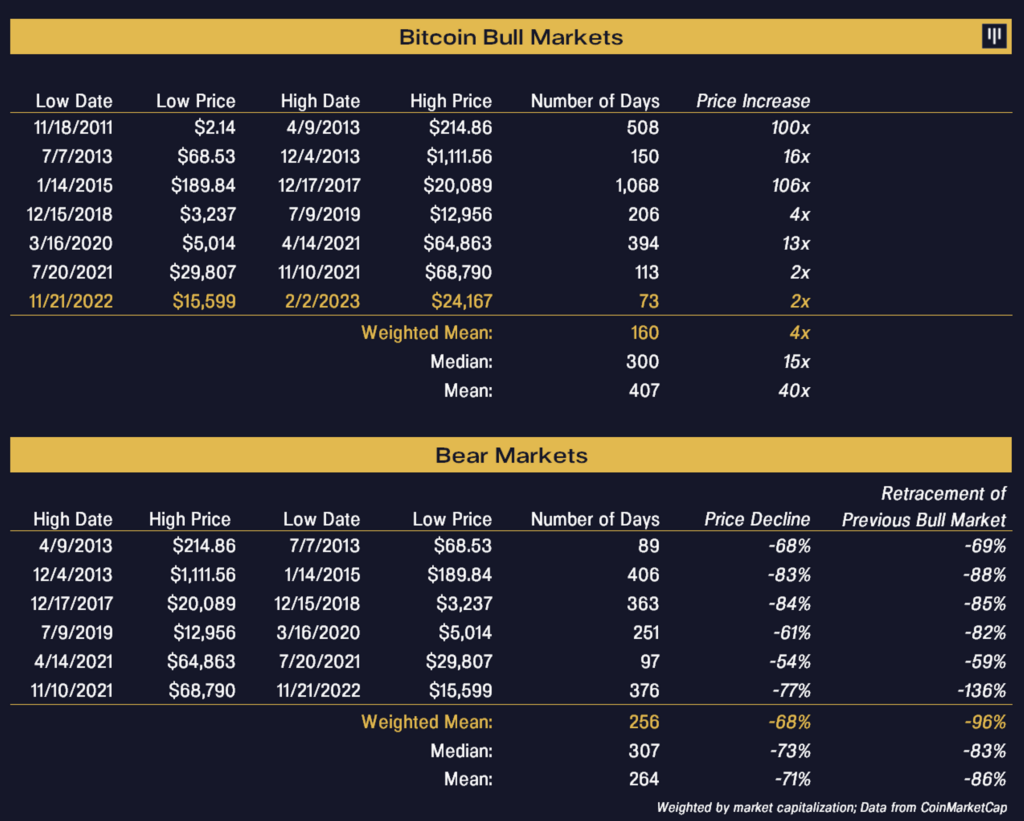
I think we’re done with that and beginning to grind higher. I believe that blockchain assets have seen the lows and that we’re in the next bull market cycle – regardless of what happens in the interest-rate-sensitive asset classes.
That would be the seventh bull cycle, after six bear cycles. (Pantera’s been investing through twelve of the thirteen moves!)
REFLECTIONS ON CENTRALIZED FINANCE AND SOFTWARE
By Ryan Barney, Senior Investment Associate
2023 Will Be The Year For Rebuilding Trust In Centralized Finance (CeFi)
2022 was a year of booms and major busts, especially as it pertains to CeFi. In the span of a few months, the world saw Three Arrows Capital collapse, Do Kwon’s LUNA disintegrate, Voyager Digital go bankrupt, and Sam Bankman-Fried’s (SBF) FTX empire shatter.
What did all these events have in common? The headlines like to suggest that it was crypto or Web3 that failed. But, in fact, it was a combination of bad actors skirting lines in jurisdictions without clear regulations. If 2022 was the year of breaking rules and failing, I believe 2023 is the year that entities instead follow the rules and enjoy the rewards of doing so.
The original promise of crypto included complete decentralization, to fully disable the potential for bad actors to be involved in the financial system. Although this may be true on the longest of horizons (decades not years), for crypto to become widely adopted and used by individuals, institutions, and governments, centralized entities still have a role to play. For this to happen, centralized institutions must first focus on rebuilding the trust that was lost to the tumult of the past year.
This has already begun. Pantera portfolio company Coinbase was first to remind customers that it “carries crime insurance that protects a portion of digital assets held across [its] storage systems against losses from theft, including cybersecurity breaches”, in the wake of FTX. Leading exchange by volume Binance has implemented a proof-of-reserve mechanism for proving customer deposits. After a major entity like FTX falling, these two companies and other CeFi exchanges are proving to be clear short-term winners. They will continue to win and take market share as they prove trust with their customers, and work with regulators to develop clear frameworks that make sense in the crypto context, as well as the broader exchange/banking context in which these companies too reside.
The next set of winners will likely consist of those companies that design innovative ways to attract customers in specific jurisdictions. This is akin to building vertical SaaS (software-as-a-service) vs. horizontal SaaS in the Web2 world. Essentially, places where massive companies were allowed to be created because either regulation was more lenient than in the U.S. or because regulation prohibited out-of-country exchanges. Look to Pantera portfolio companies CoinDCX in India, Valr in South Africa, and Pintu in Indonesia to blaze the trail in creating massive opportunities by working with regulators and establishing greater customer confidence as a result.
DeFi (decentralized finance) should not be overlooked in this year of building trust in CeFi. In fact, I think DeFi will be a powerful tool for CeFi companies to differentiate themselves and attract customers. I think that CeFi companies will act as the front-end for users’ utilization of DeFi. A great example is the Liquid Collective. This company is a DAO (decentralized autonomous organization) that allows liquid staking but doing so through CeFi front-ends. A user could log-on to their Coinbase account and access the protocol. This is a win-win. Regulator KYC/AML requirements are satisfied by the Coinbase front-end. Customers are able to use a trusted entity with a simplified user experience to interact with the DeFi world comprising the back-end.
Let’s begin putting the failures of people and equally fallible third-parties behind us as we look towards the rest of 2023 — but let’s not forget them completely. The best entrepreneurs will learn from the mistakes and centralization failures of those before them, while regulators should accelerate the creation of a clear framework and rules. This combination will allow blockchain-based CeFi to resurge on a jurisdiction-by-jurisdiction level.
Software Is *Still Eating* The World
The crypto bull market run of 2021/2022 was felt in many seams of the world. Headlines were all about the promise of crypto, bitcoin price increasing, NFTs generating record sales, Web3 gaming exploding, and Facebook rebranding to Meta. Family and friend gatherings were saturated with whispers of Apes, Punks, and Chainrunners.
What did this mean for Web3 companies? Application companies were the most obvious winners in this market environment. With the entire world focused on the crypto asset class, user acquisition was never easier or as inexpensive for software providers (except for those pesky Super Bowl ads and stadium naming deals…). Per the explosion of Web3 users, companies needed to quickly develop more robust backends, security, HR, etc. The solution to most of these gaps in company robustness has been and will continue to be: software.
Behind every great application company is an even better software stack. Many of these applications consist of vendor products rather than stack elements built in-house. The dirty little secret of these software companies is that they are incredibly resilient to market swings — even in crypto. They typically charge on a recurring basis and sometimes mix in a usage component. This means that, regardless if a bull or bear market, software providers are still generating revenue — still winning regardless of market conditions.
Software companies took the opportunity of the bull market to sell into all the booming application companies. They will still be capitalizing on those sales as the bear market blossoms. These are companies like Pantera portfolio company Alchemy (developer tooling), Pinata (storage), and Definitive (analytics). They help companies accelerate growth regardless of market conditions.
We are looking forward to finding and helping support the next generation of Web3 software companies developing infrastructure that will power the crypto-asset ecosystem regardless of market sentiment, the price of bitcoin, or… SBF’s legal status.
REFLECTIONS ON CONSUMER APPLICATIONS :: GAMING, METAVERSE, AND BRANDS
By Sehaj Singh, Investment Associate
Games and “Metaverse” experiences enabled by Web3 continue to remain a topic of great excitement and debate. As we look back upon 2022, the following stands out:
Despite Flawed Implementations, Blockchain’s Core Value Proposition For Games Remains Unchanged
By empowering gamers to truly own their in-game assets, blockchains turn the value-extractive framework of the traditional gaming industry on its head. This thesis was validated by Axie Infinity — one of the first blockchain games developed by Sky Mavis — which went viral in 2021 with its “Play-to-Earn” mechanics (i.e., generating inflationary tokens as new players enter the game). At its peak, Axie was generating north of $10M in daily marketplace fees, but as of January 2023, that figure is down to less than $5K.
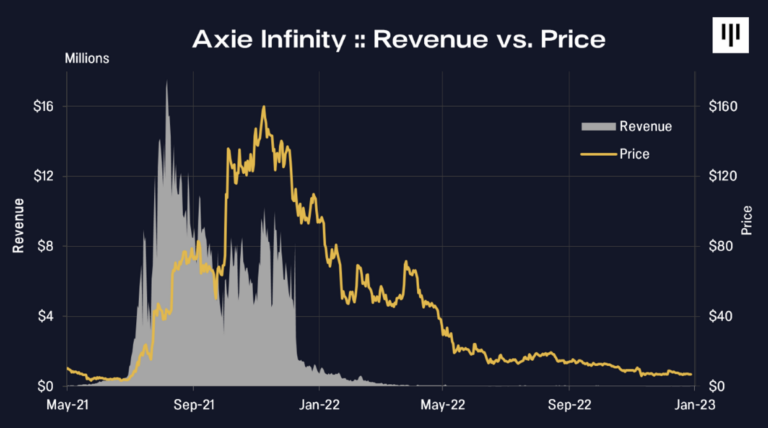
While Axie showed how implementing NFTs and creating secondary markets via true ownership adds a crucial economic layer to games, it also proved that there is no free lunch, and if Web3 games are to succeed, they need to work on making economies more sustainable. 2021 was the year of “Gamified DeFi” — applications that take simple DeFi concepts like liquidity provision and farming, gamifying those concepts by creating an immersive wrapper around them. These “games” were far from being fun or engaging and 2022 has (thankfully) seen their inevitable demise.
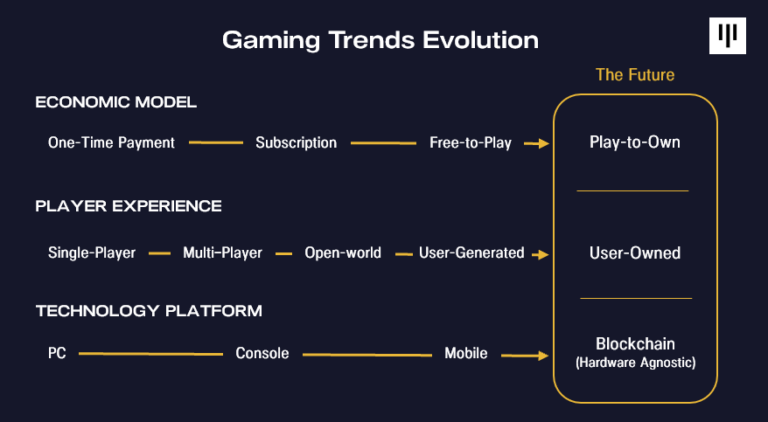
Today, there are several hundred well-funded indie studios (often founded by veterans of the free-to-play gaming industry) experimenting with blockchain gaming models and combining the best of what works in traditional gaming with the ownership and monetization layers of Web3. A recent trend pioneered by Limit Break (a Web3 gaming firm) is the concept of “Free-to-Own”, which involves gaming studios giving away NFTs for free to their most engaged users, who then help evangelize the game and drive more value to the NFTs they hold. This is a tectonic shift from how marketing/distribution occurs in traditional studios and a trend we expect to see more of in 2023. Gaming is a dynamic industry that continues to evolve to suit players’ needs and we think the blockchain-enabled future is already here to stay.
Web3 No Longer A Differentiator
In 2021, gaming studios that would otherwise struggle to raise funds were able to raise massive rounds just by simply integrating blockchains (even if the integration was shallow and/or deeply flawed). Blockchain gaming was a new phenomenon and many investors saw blockchains as a key success lever for gaming studios, often disregarding other important facets of the business.
In 2022, the sentiment has reverted to the mean, as investors and builders face the sobering realization that making genuinely fun and engaging games will always be the key differentiator for a studio’s success. Web3 can help fuel that success, as long as it meaningfully adds to the player’s experience, and the studio’s distribution, marketing, and business models.
Venture Funding :: Flight To Quality
2022 was a remarkable year for blockchain gaming investments, but deal activity (volumes and number of studios funded) slowed significantly versus 2021. This has everything to do with a change in game economy incentives and a flight to quality, which we believe are meaningful drivers in the long-term success of Web3 games. Short-term investors — betting on token price action from inorganic volume — have also fled the space. Axie’s game-economy relied heavily on a two-token model: one governing the game itself and the other an inflationary token rewarding players for winning in games. This model — though heavily flawed, in hindsight — was adopted by several other gaming studios. As the in-game economies of these copy-cat games imploded, players never returned, investors soured, and builders became skeptical, making both follow-on and new fundraises challenging.
That said, the best builders and innovators in the space continue to raise fresh capital, as shown by free-to-play industry veteran Gabe Leydon’s studio Limit Break recently raising $200M.
Brands Finally Arrive
Per Oxford, “Metaverse” was a runner-up for “2022’s Word of the Year” (first place went to “Goblin Mode”). We’ve gone past the hype cycle of consumer brands simply using the buzz around creating their “Metaverse” for marketing purposes, to brands actually developing immersive digital experiences built on the blockchain — with a focus on utility for and engagement of their core audience. Marquee companies like Reddit, Nike, Dolce and Gabbana, Gucci, and Tiffany all participated in selling NFTs, with Nike earning more than $185M from NFT sales.
2023 OUTLOOK
Blockchains On The Back-End, Not Front-End
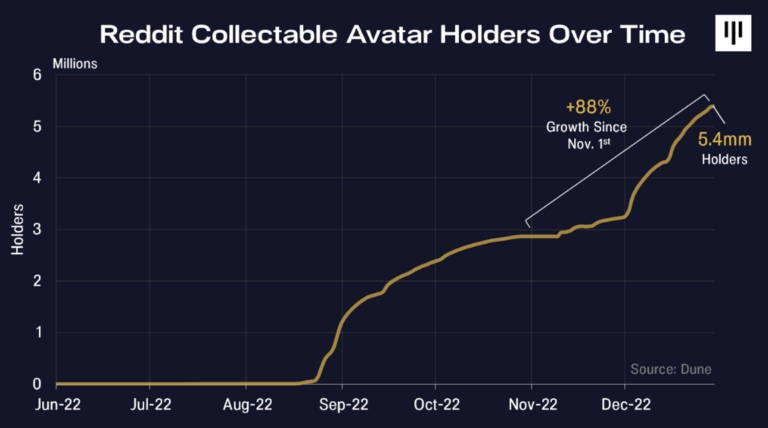
Reddit, a prominent chat-based social network, pioneered the use of blockchains and NFTs in deepening engagement within its communities. To-date, Reddit’s “Collectible Avatar” NFTs have been minted by over 4 million unique users. The key to its success was not mentioning blockchain or NFT anywhere (Reddit calls its NFTs “digital collectibles”), avoiding any connotative toxicity which could stymie adoption. 2023 will see prominent companies continue to adopt this strategy of “blockchains on the back-end, not front-end”, leading to a smoother adoption curve for their consumers.
Less Talk Of The Metaverse, More Building
We view the Metaverse as any digital environment where one can experience a digital immersion of the self, with blockchains providing infrastructure for digital identity and ownership. While 2021-2022 were both pivotal years for educating brands on the Metaverse (and at best, brands dipping their toes into the space by selling NFTs), we believe that 2023 will be the year where big brands actually implement Web3 in a meaningful way to deepen consumer engagement. Starbucks is the best example of this, with their use of the Polygon protocol to create “Starbucks Odyssey”, a Web3 addition to their existing loyalty program meant to offer digital collectibles, greater community building, and new coffee experiences. We believe loyalty programs, promotions, token-gated experiences, and gamified interactions will power several novel brand initiatives this year.
Web3 Gaming And The Innovator’s Dilemma
Despite investor interest in Web3, most large game publishers like Activision-Blizzard, TakeTwo, Rockstar, and Mojang will continue to stay away from NFTs and will rely primarily on the free-to-play model. For these companies, the risk of integrating Web3 via ownable assets (custody risk, smart contract risk, or anti-blockchain players churning away) still outweighs the rewards from any added monetization capabilities or player engagement. Without much guidance from the gaming giants, we expect a high failure rate for newly funded Web3 studios that are still finding the way. We believe that the Web3 native studios that survive will go on to become much larger and pave the path for sticky business models that will be adopted by traditional gaming studios for years to come.
Utility > Speculation
The speculative mania of the 2021 NFT bull run has already come to an end, but we expect utility-based NFTs from top Web3 games to drive healthy (i.e., not speculative) volumes in the 2023 NFT market. This does not necessarily mean that NFT volumes will return to 2021 levels (given those were driven by speculation), but we suspect that the transfer of NFTs will primarily be based on owners deriving (or exhausting) actual in-game utility. While it is almost impossible to point out the timing for such shifts, especially given the “hits-driven” nature of games, Axie’s case study proves that it only takes one successful Web3 game studio to drive every other Web3 (and potentially Web2) studio towards a sustainable, future-ready business model.