Morgan Stanley Debuts Crypto Trading On E*Trade With Lower Fees Than Rivals

bitcoinistPublished on 2026-05-07Last updated on 2026-05-07

Wall Street behemoth Morgan Stanley has launched its long-awaited crypto trading pilot on its E*Trade platform, aiming to challenge major established players with competitive pricing.

Morgan Stanley Debuts Crypto Trading Pilot

Baking giant Morgan Stanley has rolled out a pilot to offer direct crypto trading on its E*Trade platform, with cheaper pricing than its competition, Bloomberg reported on Wednesday.

According to the report, the bank is charging E*Trade users a 50-basis-point fee on the transaction value, placing its prices below those of other major players. For instance, Robinhood’s fees start at 95 basis points, while Coinbase and Charles Schwab’s fees start at 60 and 75 basis points, respectively.

Morgan Stanley is currently offering its crypto trading pilot to a limited number of users, but expects to give access to all of E*Trade’s 8.6 million clients later this year. Jed Finn, Morgan Stanley’s head of wealth management, said in an interview that the launch is “much bigger than trading crypto at a cheaper rate,” adding that “the strategy is disintermediating the disintermediators.”

The banking giant bought E*Trade in 2020 for $13 billion. In May 2025, it introduced plans to allow crypto trading on the platform, following the Trump administration’s efforts to make the US “the crypto capital of the world.”

People familiar with the matter told Bloomberg that executives are preparing an offering to directly convert cryptocurrencies into shares of exchange-traded products (ETPs) without selling the assets. In addition, the bank reportedly plans to add the ability to trade tokenized equities in the second half of 2026.

Morgan Stanley’s Strategic Digital Assets Push

The launch is part of Morgan Stanley’s broader push to expand in the digital assets space, an industry that until recently was off-limits to banks. Over the past few years, the Wall Street giant has been betting on the convergence of traditional finance (TradFi) and decentralized finance (DeFi).

In 2024, Morgan Stanley, which has built one of the most significant Bitcoin Exchange-Traded Fund (ETF) holdings in the US, allowed its managers to offer the funds as an investment option for its wealthy customers.

Last year, it expanded access to crypto fund investments for all clients, moving away from the previous restrictions that limited access to individuals with at least $1.5 million in assets and an aggressive risk tolerance. The shift allowed its financial advisors to present the funds to any client, including those with retirement accounts.

Notably, Morgan Stanley became the first Wall Street bank to debut a spot Bitcoin ETF in April, and made it the cheapest fund in the category. The bank also filed for spot Ethereum and Solana ETFs earlier this year, which are expected to debut this year.

In February, it joined the list of companies applying for a national trust bank charter with the Office of the Comptroller of the Currency (OCC). In its application, the bank said that the charter would be used to conduct crypto trading and staking for its investment clients, reinforcing its strategic push for the broader digital asset industry.
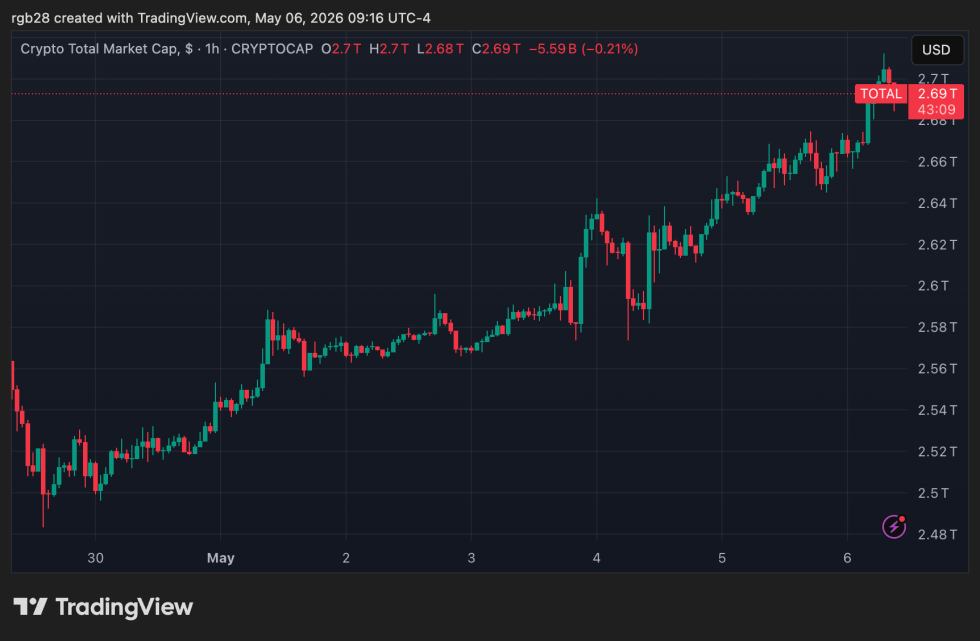
The total crypto market capitalization is at $2.69 trillion in the one-week chart. Source: TOTAL on TradingView


Related Reads

2026 Crypto Funding Reshuffle: Game and DePIN Are Dead, Prediction Market Duo Takes 18% of All Year's Funding with Two Deals

Cryptocurrency Funding in 2026: Gaming & DePIN Falter as Prediction Markets Dominate Data from the first four months of 2026 reveals a stark shift in crypto venture funding. The gaming and DePIN (Decentralized Physical Infrastructure Networks) sectors have seen capital nearly dry up. In contrast, the "Consumer" category, led by two massive deals for prediction market platforms Kalshi ($1B) and Polymarket ($600M), captured a significant share. These two deals alone accounted for 18% of the year's total $8.65 billion raised and exceeded the combined funding of all 47 DeFi projects. Overall, the $8.65B across 305 deals is misleading. A March surge to $4.57B was largely due to two major acquisitions (BVNK at $1.8B and Kalshi). Excluding these, the underlying monthly funding rate is approximately $1B, indicating continued softness. The "Payments" and "Consumer" sectors together consumed 72% of all capital. Another notable trend is the rise of mergers and acquisitions (M&A), with 48 deals nearly matching the 57 seed-round investments. This signals a market pivot from funding new ideas to consolidating around established leaders. The most active investors so far in 2026 are Coinbase Ventures (18 deals), Tether (13 deals), Animoca Brands (11 deals), and GSR (11 deals). Notably, a16z's pace has slowed significantly compared to previous years.

marsbit7m ago

2026 Crypto Funding Reshuffle: Game and DePIN Are Dead, Prediction Market Duo Takes 18% of All Year's Funding with Two Deals

marsbit7m ago

Bitcoin Treasury Companies That Promised Never to Sell Are Now Selling. Why?

The narrative of "never selling" Bitcoin treasuries is unraveling as major holders pivot to using BTC as a liquidity tool. MicroStrategy has formally integrated selling Bitcoin into its financial framework, stating it will sell when beneficial—for instance, to pay dividends if its mNAV ratio falls below 1.22x. CEO Michael Saylor outlined a model where selling BTC is preferable to equity issuance under certain conditions, based on quantified thresholds like a 2.3% annual Bitcoin appreciation break-even. Similarly, Marathon Digital (MARA) sold 15,133 BTC to repay convertible debt, framing it as "balance sheet optimization." Sequans Communications has sold Bitcoin for two consecutive quarters to service maturing convertible bonds, using its BTC holdings as collateral and operational liquidity amidst revenue declines. The shift redefines these companies from pure "belief-based reserves" to leveraged treasuries where capital management decisions—driven by debt obligations, financing costs, and shareholder returns—can override holding dogma. The future path hinges on Bitcoin's price: a bull market above $112,000 would ease financing pressure and absorb tactical sales, while a drop toward $50,000–$58,000 could force more defensive selling to meet liabilities, potentially creating a downward spiral of selling pressure and price declines. Investors must now price in debt maturities, collateral calls, and specific financial triggers alongside Bitcoin exposure.

marsbit13m ago

Bitcoin Treasury Companies That Promised Never to Sell Are Now Selling. Why?

marsbit13m ago

Ray Dalio's Latest Interview: Can the U.S. Still Escape the Cycle of Decline?

In a comprehensive interview, Ray Dalio, founder of Bridgewater Associates, analyzes whether the US can escape its historical "great cycle" of decline. He argues the nation faces a confluence of structural pressures, not a single crisis. Key points include: 1. **The Debt Cycle:** Unsustainable fiscal deficits and rising debt-to-income ratios are eroding national capacity, constraining spending on defense, welfare, and global commitments. 2. **Internal Political & Social Conflict:** Deep wealth gaps and value differences fuel intense political polarization. Addressing deficits becomes a zero-sum political battle over "who pays and who benefits," making consensus nearly impossible. 3. **Erosion of the World Order:** The post-1945 US-led, rules-based international system is breaking down, reverting to a state of great-power competition and conflict where raw power, not multilateral rules, resolves disputes. 4. **Currency & Safe Assets:** While the Chinese yuan may gain use as a medium of exchange, Dalio doubts it will become a primary global store of wealth. In an era of fiat currency debasement, assets like gold are regaining prominence as safe havens. 5. **AI's Dual Role:** Artificial Intelligence could boost productivity and help manage debt, but it also risks exacerbating wealth inequality, job displacement, and geopolitical tensions. Dalio concludes the US is in a period of increasing disorder, with debt, domestic strife, and international realignments converging. The critical factors for national recovery are foundational: improving education and civic素养, fostering social cohesion and productivity, and avoiding war—both civil and international. The path forward depends less on markets and more on these fundamental societal choices.

marsbit33m ago

Ray Dalio's Latest Interview: Can the U.S. Still Escape the Cycle of Decline?

marsbit33m ago

Conversation with Mai-Lan from AWS: The Next Battlefield for S3 – How to Handle the Data Consumption Surge in the Agent Era

The explosive rise of Agent AI, exemplified by OpenClaw in China, is putting unprecedented pressure on cloud data infrastructure. Unlike human engineers, Agents consume data in an "extremely active and aggressive" parallel fashion, launching tens to hundreds of queries simultaneously, leading to exponentially higher call frequencies and throughput. Mai-Lan Tomsen Bukovec, VP of Technology at AWS, emphasizes that cost-effectiveness in this data layer is now a decisive factor for customers building Agent systems. To address this, AWS is positioning its foundational Amazon S3 service, now 20 years old, as the critical data platform for the Agent era. Recent key innovations include: **S3 Table** with native Apache Iceberg support, enabling Agents to efficiently interact with structured data via familiar SQL; **S3 Vector**, which introduces vectors as a native type for building contextual data and serving as a shared "memory space" for AI systems; and the newly launched **S3 Files**, which provides a POSIX-compliant file system interface over S3, allowing Agents to interact with data through the familiar paradigm of files and directories. These enhancements are designed to meet the unique data interaction patterns of Agents, which are trained on models already proficient with SQL, file systems, and contextual vectors. By unifying these access methods on the scalable, durable, and cost-efficient S3 foundation, AWS aims to provide the data backbone capable of supporting the next wave of hyper-scale, high-frequency Agent applications.

marsbit47m ago

Conversation with Mai-Lan from AWS: The Next Battlefield for S3 – How to Handle the Data Consumption Surge in the Agent Era

marsbit47m ago

Trading

Spot
Futures
活动图片