Without Storytelling Power, Web3 Cannot Reach Vast Territories

marsbitPublié le 2025-12-30Dernière mise à jour le 2025-12-30

Résumé

Web3's failure stems not from a lack of ideas, but from its inability to resonate emotionally. Current Web3 narratives are dominated by abstract concepts—blockchains, infrastructure, protocols—which, while technically sound, lack humanity and fail to connect with ordinary people. Storytelling is crucial in Web3, more than in any other industry. Unlike topics like food or travel that evoke immediate sensory associations, Web3 feels distant and cold without emotional hooks. Projects often lead with technical explanations of how things work, neglecting the feelings they evoke—confusion, joy, relief—which are universal and relatable. Instead of listing features, effective communication starts with relatable user experiences. For example, rather than saying “this improves scalability,” describe the moment a user realizes a transaction completed instantly without waiting. Stories don’t dilute technical value; they prepare the audience to engage with complex ideas. By grounding concepts in human moments—struggles, breakthroughs, small victories—Web3 can become tangible and compelling. Practical experience shows that story-driven content, focusing on authentic user journeys, outperforms technical explanations in engagement and comprehension. The key is making Web3 feel human, not just functional.

Written by: Noir

Compiled by: Chopper, Foresight News

The failure of Web3 has never been due to a lack of creativity. In fact, its problem lies in its inability to resonate with people.

Most of the current Web3 narratives are filled with abstract concepts: public chains, infrastructure, protocols, layers... These terms are not wrong! But they lack any "human touch," making it impossible for ordinary people to feel a connection.

This is precisely where the value of storytelling comes in. In the Web3 field, the importance of storytelling far exceeds that of any other industry.

Web3 Is Built on Logic but Lacks Emotional Resonance

In other fields, people already come with a cognitive context. For example: talking about food can stimulate your appetite; discussing fitness can make you visualize progress; mentioning travel will immediately bring to mind the scenery of the destination.

But Web3 simply cannot do this. Creators and project teams are always painstakingly explaining how amazing those invisible systems and intangible processes are.

Without stories as a foundation, all of this seems distant and cold.

In short: utterly boring. Clearly, no one will pay for something boring.

Stories Are the Gateway for Ordinary People to Enter Web3

Most creators and project teams are eager to explain upfront how something works. But they forget that a good story always begins by describing how it feels.

Confusion, laughter, relief, vulnerability... these emotions are completely absent in Web3 narratives.

Friend, if this trend continues, the outcome is self-evident. Even if people don’t understand the technology, these emotions are universal. The key is that when someone recognizes familiar feelings in a story, they will instinctively follow you to hear your subsequent professional explanations.

Stop Listing Features; Talk More About User Experience Moments

Compare two ways of expression, and the difference is clear.

Feature-first version: This feature improves the system’s scalability by optimizing throughput.

There’s nothing wrong with this statement, but it’s forgettable, and... what does it even mean?😂

Story-first version: I kept refreshing the page, mentally prepared to wait again... only to find that the transaction had already been completed.

The same core information, but the latter has more warmth and is easier to understand.

Storytelling isn’t about downplaying technology; it’s about preparing the listener’s brain to receive complex information.

Got it? I hope you understand. Let’s continue...

Complex Concepts Need Real-Life Scenarios to Land
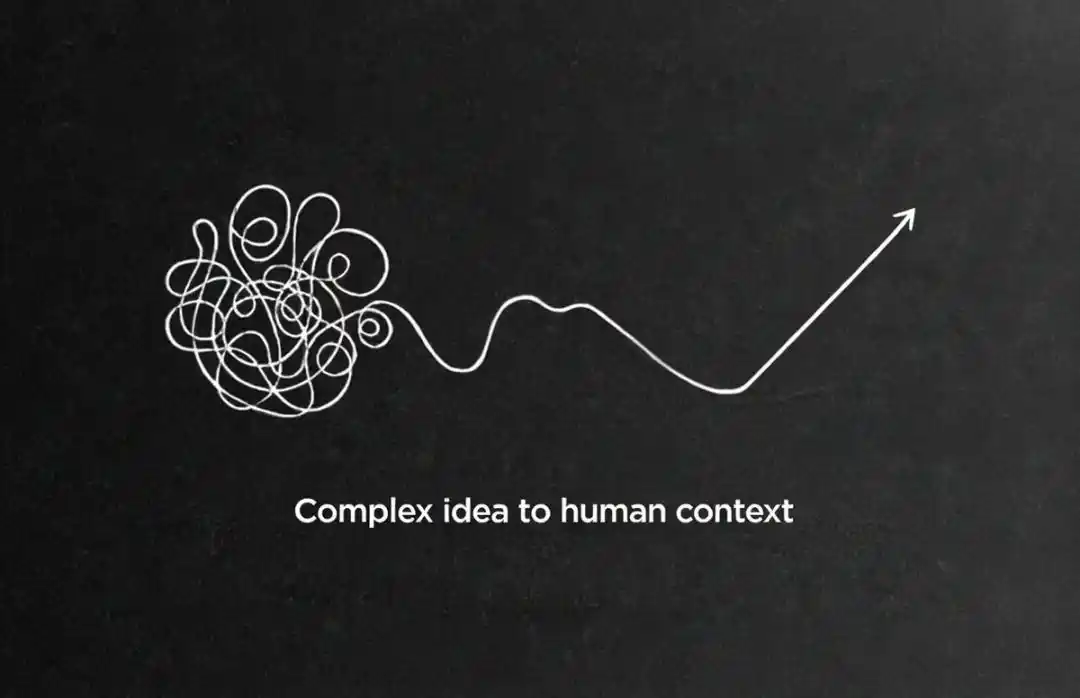
When faced with complex problems, people ask themselves: "What does this have to do with me?"

And stories can subtly provide the answer. All it takes is a simple real-life scenario to make the connection.

You don’t actually need to explain every detail. You just need to showcase a key moment: a frustrating bottleneck, a moment of relief, a small victory.

That’s enough to make a complex concept feel real and tangible.

Practical Validation: This Methodology Really Works

The core of my work is creating story-centric video content for Web3 bounty campaigns and sponsors.

Over time, I’ve noticed a pattern: the videos that win are never the ones with the most hardcore technical explanations, but those that begin with moments full of human touch.

I don’t start by listing features or explaining principles. Instead, I focus on these scenes: the initial awkwardness of using a product for the first time; the stumbling before understanding a function; the sudden clarity when everything finally connects.

This narrative approach always keeps viewers engaged longer and helps them understand faster. This is also why my videos stand out in bounty competitions.

It’s not because I explain more technology, but because I make complex concepts feel human and emotionally warm.


Questions liées

QWhat is the main reason for Web3's failure according to the article?

AWeb3's failure is not due to a lack of creativity, but rather its inability to resonate with people emotionally. Its narratives are filled with abstract concepts that lack a human touch, making it difficult for ordinary people to connect.

QHow does the article suggest making Web3 concepts more relatable?

AThe article suggests using storytelling to make Web3 concepts more relatable. Instead of listing technical features, creators should focus on describing the user's experience and emotional moments, such as confusion, joy, or relief, to create a connection.

QWhat is the difference between 'function-first' and 'story-first' approaches as described in the article?

AThe 'function-first' approach focuses on explaining technical details, like 'optimizing throughput to improve system scalability,' which can be boring and hard to understand. The 'story-first' approach describes a relatable user experience, such as 'I kept refreshing the page, expecting to wait... only to find the transaction was already complete,' making it more engaging and understandable.

QWhy are emotions like confusion or joy important in Web3 storytelling?

AEmotions like confusion or joy are important because they are universal and relatable. When they recognize familiar feelings in a story, people are more likely to engage and be open to understanding the subsequent technical explanations.

QWhat practical evidence does the author provide to support the effectiveness of storytelling in Web3?

AThe author, who creates story-focused video content for Web3 bounty campaigns and sponsors, found that winning videos are not the most technically detailed but those that begin with human, emotional moments. These videos, which focus on user experiences like initial struggles or moments of clarity, keep viewers engaged longer and help them understand complex concepts faster, leading to success in bounty competitions.

Lectures associées

Fujian Jinjiang, un super-licorne de stockage dans l'ombre

Voici un résumé de l'article en français : Au cœur de la ville de Jinjiang, Fujian, connue pour ses chaussures de sport, se cache Fujian Jinhua Integrated Circuit Co., un acteur majeur mais discret dans le domaine de la mémoire DRAM. Fondée en 2016 avec une mission nationale de briser le monopole de Samsung, SK Hynix et Micron, l'entreprise a connu un départ prometteur grâce à un partenariat technologique avec United Microelectronics Corporation (UMC) de Taïwan et la direction de Chen Zhengkun, ancien cadre de Micron. Cependant, son développement a été brutalement interrompu en 2018 lorsque les États-Unis l'ont placée sur la liste des entités et ont engagé des poursuites pénales pour espionnage économique, alléguant le vol de secrets commerciaux de Micron. Cette sanction a gelé sa chaîne d'approvisionnement et paralysé sa production pendant près de cinq ans. Malgré un verdict d'innocence rendu par un tribunal américain en février 2024, Jinhua reste sous sanction. Pendant cette période difficile, soutenue par les autorités provinciales et locales, l'entreprise a travaillé à reconstruire sa ligne de production en réduisant sa dépendance aux technologies américaines. Elle se concentre désormais sur le marché des DRAM de niche (pour téléviseurs intelligents, routeurs, etc.) avec une capacité mensuelle d'environ 40 000 plaquettes. Bien que ses performances (chiffre d'affaires annuel d'environ 2 milliards de yuans) soient loin derrière celles de ses homologues chinois ChangXin Memory Technologies (CXMT) et Yangtze Memory Technologies Corp (YMTC), Jinhua a survécu et maintient sa position. L'histoire de Jinhua s'inscrit également dans la transformation audacieuse de Jinjiang, une ville dont l'économie reposait traditionnellement sur le textile et l'agroalimentaire, vers l'industrie des semi-conducteurs. Cet investissement massif, symbolisant la ténacité de la ville, a donné naissance à un cluster intégré de la filière des puces. Alors que l'industrie mondiale de la mémoire entre dans un super-cycle porté par l'IA, Jinhua, bien que modeste en taille, représente la résilience d'une entreprise ayant résisté à une intense pression géopolitique.

marsbitIl y a 13 mins

Fujian Jinjiang, un super-licorne de stockage dans l'ombre

marsbitIl y a 13 mins

Trading

Spot
活动图片




