Without Storytelling Power, Web3 Cannot Reach Vast Territories

marsbitPublié le 2025-12-30Dernière mise à jour le 2025-12-30

Résumé

Web3's failure stems not from a lack of ideas, but from its inability to resonate emotionally. Current Web3 narratives are dominated by abstract concepts—blockchains, infrastructure, protocols—which, while technically sound, lack humanity and fail to connect with ordinary people. Storytelling is crucial in Web3, more than in any other industry. Unlike topics like food or travel that evoke immediate sensory associations, Web3 feels distant and cold without emotional hooks. Projects often lead with technical explanations of how things work, neglecting the feelings they evoke—confusion, joy, relief—which are universal and relatable. Instead of listing features, effective communication starts with relatable user experiences. For example, rather than saying “this improves scalability,” describe the moment a user realizes a transaction completed instantly without waiting. Stories don’t dilute technical value; they prepare the audience to engage with complex ideas. By grounding concepts in human moments—struggles, breakthroughs, small victories—Web3 can become tangible and compelling. Practical experience shows that story-driven content, focusing on authentic user journeys, outperforms technical explanations in engagement and comprehension. The key is making Web3 feel human, not just functional.

Written by: Noir

Compiled by: Chopper, Foresight News

The failure of Web3 has never been due to a lack of creativity. In fact, its problem lies in its inability to resonate with people.

Most of the current Web3 narratives are filled with abstract concepts: public chains, infrastructure, protocols, layers... These terms are not wrong! But they lack any "human touch," making it impossible for ordinary people to feel a connection.

This is precisely where the value of storytelling comes in. In the Web3 field, the importance of storytelling far exceeds that of any other industry.

Web3 Is Built on Logic but Lacks Emotional Resonance

In other fields, people already come with a cognitive context. For example: talking about food can stimulate your appetite; discussing fitness can make you visualize progress; mentioning travel will immediately bring to mind the scenery of the destination.

But Web3 simply cannot do this. Creators and project teams are always painstakingly explaining how amazing those invisible systems and intangible processes are.

Without stories as a foundation, all of this seems distant and cold.

In short: utterly boring. Clearly, no one will pay for something boring.

Stories Are the Gateway for Ordinary People to Enter Web3

Most creators and project teams are eager to explain upfront how something works. But they forget that a good story always begins by describing how it feels.

Confusion, laughter, relief, vulnerability... these emotions are completely absent in Web3 narratives.

Friend, if this trend continues, the outcome is self-evident. Even if people don’t understand the technology, these emotions are universal. The key is that when someone recognizes familiar feelings in a story, they will instinctively follow you to hear your subsequent professional explanations.

Stop Listing Features; Talk More About User Experience Moments

Compare two ways of expression, and the difference is clear.

Feature-first version: This feature improves the system’s scalability by optimizing throughput.

There’s nothing wrong with this statement, but it’s forgettable, and... what does it even mean?😂

Story-first version: I kept refreshing the page, mentally prepared to wait again... only to find that the transaction had already been completed.

The same core information, but the latter has more warmth and is easier to understand.

Storytelling isn’t about downplaying technology; it’s about preparing the listener’s brain to receive complex information.

Got it? I hope you understand. Let’s continue...

Complex Concepts Need Real-Life Scenarios to Land
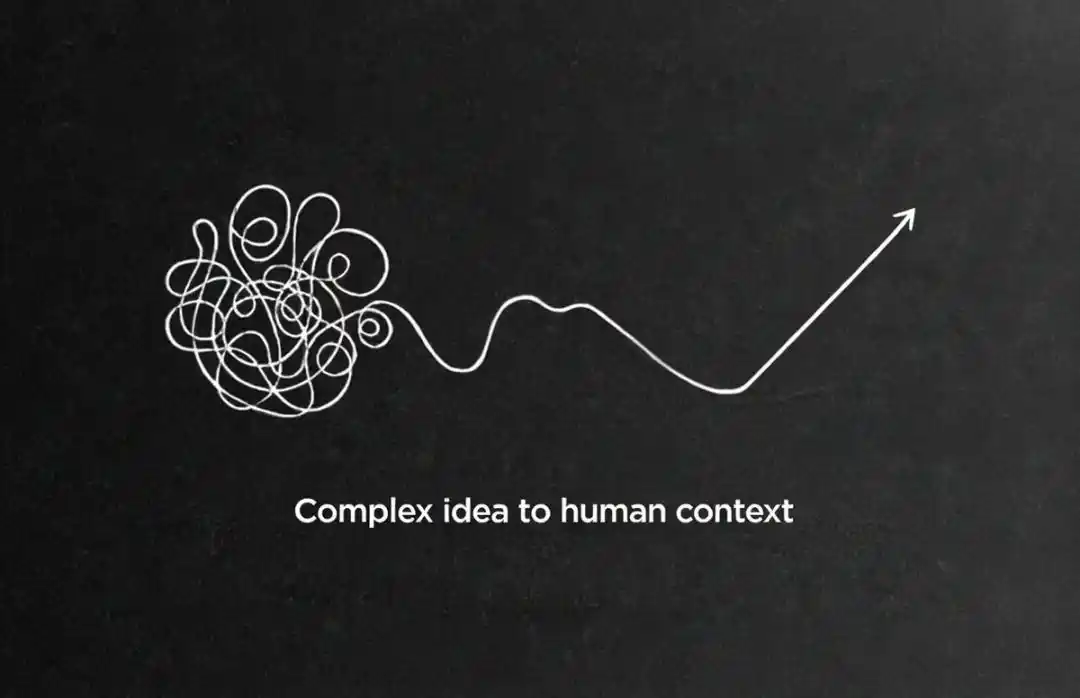
When faced with complex problems, people ask themselves: "What does this have to do with me?"

And stories can subtly provide the answer. All it takes is a simple real-life scenario to make the connection.

You don’t actually need to explain every detail. You just need to showcase a key moment: a frustrating bottleneck, a moment of relief, a small victory.

That’s enough to make a complex concept feel real and tangible.

Practical Validation: This Methodology Really Works

The core of my work is creating story-centric video content for Web3 bounty campaigns and sponsors.

Over time, I’ve noticed a pattern: the videos that win are never the ones with the most hardcore technical explanations, but those that begin with moments full of human touch.

I don’t start by listing features or explaining principles. Instead, I focus on these scenes: the initial awkwardness of using a product for the first time; the stumbling before understanding a function; the sudden clarity when everything finally connects.

This narrative approach always keeps viewers engaged longer and helps them understand faster. This is also why my videos stand out in bounty competitions.

It’s not because I explain more technology, but because I make complex concepts feel human and emotionally warm.


Questions liées

QWhat is the main reason for Web3's failure according to the article?

AWeb3's failure is not due to a lack of creativity, but rather its inability to resonate with people emotionally. Its narratives are filled with abstract concepts that lack a human touch, making it difficult for ordinary people to connect.

QHow does the article suggest making Web3 concepts more relatable?

AThe article suggests using storytelling to make Web3 concepts more relatable. Instead of listing technical features, creators should focus on describing the user's experience and emotional moments, such as confusion, joy, or relief, to create a connection.

QWhat is the difference between 'function-first' and 'story-first' approaches as described in the article?

AThe 'function-first' approach focuses on explaining technical details, like 'optimizing throughput to improve system scalability,' which can be boring and hard to understand. The 'story-first' approach describes a relatable user experience, such as 'I kept refreshing the page, expecting to wait... only to find the transaction was already complete,' making it more engaging and understandable.

QWhy are emotions like confusion or joy important in Web3 storytelling?

AEmotions like confusion or joy are important because they are universal and relatable. When they recognize familiar feelings in a story, people are more likely to engage and be open to understanding the subsequent technical explanations.

QWhat practical evidence does the author provide to support the effectiveness of storytelling in Web3?

AThe author, who creates story-focused video content for Web3 bounty campaigns and sponsors, found that winning videos are not the most technically detailed but those that begin with human, emotional moments. These videos, which focus on user experiences like initial struggles or moments of clarity, keep viewers engaged longer and help them understand complex concepts faster, leading to success in bounty competitions.

Lectures associées

OpenAI et des fonds de capital-investissement investissent 40 milliards de dollars, parlons du poste le plus en vogue dans la Silicon Valley : le FDE

Un nouveau poste phare émerge dans la Silicon Valley : l'Ingénieur de Déploiement Avant (FDE). Ces professionnels, à l'intersection de la technologie et du métier du client, ont pour mission cruciale de transformer les démonstrations d'IA en flux de travail opérationnels intégrés. La demande explose, avec des rémunérations médianes pouvant dépasser 700 000 $ pour les seniors, poussée par un changement stratégique majeur des géants de l'IA. OpenAI, en partenariat avec des fonds de capital-investissement, a investi 40 milliards de dollars pour créer une "société de déploiement", tandis qu'Anthropic a formé une coentreprise de 15 milliards de dollars. Ces initiatives soulignent une priorité : dépasser la simple fourniture d'outils pour implanter concrètement l'IA au cœur des processus métiers des entreprises. Un FDE, parfois jumelé à un Chef de Produit de Déploiement Avant (FDPM), agit comme un "CTO déployé". Il doit être un ingénieur compétent, maîtrisant le développement d'agents IA, tout en possédant l'expérience client et la résilience nécessaires pour naviguer dans des environnements complexes et imparfaits. Son rôle dépasse le codage ; il comprend la conception de solutions, les tests et la capitalisation des retours pour améliorer les produits. Cette tendance impacte aussi le capital-investissement. Pour les fonds, collaborer avec des leaders de l'IA offre une valeur signalétique forte pour lever des fonds, permet de créer de la valeur dans leurs sociétés en portefeuille (notamment dans les secteurs industriels ou de services) et représente une opportunité d'investissement attractif. L'accent se déplace de la réduction des coûts vers la création de nouveaux revenus en permettant ce qui était auparavant impossible. En parallèle, le conseil traditionnel voit son rôle évoluer. Une demande croissante existe pour guider la réflexion sur les modèles économiques à l'ère de l'IA. Cependant, la valeur durable est créée par ceux qui, comme les sociétés de déploiement, ne se contentent pas de discuter de la transformation mais laissent derrière eux une opération redéfinie et "native IA". Les clés du succès restent une plateforme de données solide et une identification rigoureuse des étapes de processus qui doivent rester déterministes, plutôt qu'une automatisation IA aveugle de l'ensemble d'un flux de travail.

marsbitIl y a 29 mins

OpenAI et des fonds de capital-investissement investissent 40 milliards de dollars, parlons du poste le plus en vogue dans la Silicon Valley : le FDE

marsbitIl y a 29 mins

Pourquoi personne n'achète l'assurance DeFi ?

L'assurance DeFi, conçue pour automatiser les indemnisations via des smart contracts et éliminer les refus malveillants, peine à séduire les utilisateurs malgré les failles de l'assurance traditionnelle. La principale raison est économique : les primes d'assurance absorbent une part trop importante des rendements DeFi. Par exemple, sur Aave V3, un rendement de 3,14% en USDC est réduit à 0,6%-1,6% après assurance, offrant un gain net à peine supérieur à un compte d'épargne bancaire. Pour des protocoles comme Maple Finance ou Ethena, l'assurance peut même rendre le rendement net négatif. Le marché est également structurellement fragile. Les risques en DeFi sont fortement corrélés (un bug d'oracle ou de bridge peut affecter de multiples protocoles simultanément), contrairement aux risques indépendants de l'assurance classique. Le pool de capitaux total du leader Nexus Mutual (environ 81,5 M$) est dérisoire face aux milliers de milliards de dollars d'actifs verrouillés dans le DeFi. Un seul piratage majeur comme celui de Kelp DAO (292 M$) pourrait épuiser toutes les réserves. De plus, le modèle de gouvernance où les membres votent sur les réclamations (avec leur capital en jeu en cas de paiement) crée un biais en faveur du refus. Face à ces limites, certains acteurs comme Nexus Mutual se tournent vers la prévention des risques (bug bounties) et cherchent à accéder aux marchés de la réassurance traditionnelle. En somme, l'assurance DeFi souffre d'un problème de "tragédie des biens communs" : sa valeur collective pour la stabilité du marché est évidente, mais les coûts individuels dissuadent l'adhésion, laissant le système sans protection suffisante contre les risques extrêmes.

Foresight NewsIl y a 53 mins

Pourquoi personne n'achète l'assurance DeFi ?

Foresight NewsIl y a 53 mins

Bullbit Lance $BUBI, Posant les Fondations d'un Écosystème Complet

Bullbit, une plateforme décentralisée de contrats perpétuels (Perp DEX), a officiellement lancé son jeton $BUBI, marquant ainsi son Événement de Génération de Jetons (TGE). Le jeton, d'un approvisionnement maximum fixe de 4 milliards d'unités, est initialement déployé sur le réseau Base (ERC-20) et sera listé sur BingX. L'offre en circulation initiale est limitée à 300 millions de jetons (7,5% du total). La majorité de l'offre (55%) est allouée à l'écosystème et aux airdrops, destinés aux récompenses et aux premiers utilisateurs. Le reste est réparti entre l'équipe de développement, le staking, la trésorerie et les conseillers, avec des périodes de vesting. $BUBI est conçu pour une utilité concrète au sein de l'écosystème Bullbit. Il offre aux détenteurs des réductions de frais de trading, des commissions de parrainage accrues et des droits de vote sur les paramètres du protocole. À l'avenir, il servira également de récompense pour les validateurs et de frais de gaz sur BullChain, la blockchain propre au projet. Depuis son lancement il y a six mois, Bullbit a enregistré plus de 7 000 portefeuilles créés et un volume total d'échanges dépassant 500 millions de dollars. Le TGE représente une étape clé dans l'ambition de Bullbit de passer d'une simple plateforme de trading à un écosystème financier décentralisé plus vaste, visant à intégrer à terme des actions et des ETF mondiaux via la technologie Chainlink.

TheNewsCryptoIl y a 55 mins

Bullbit Lance $BUBI, Posant les Fondations d'un Écosystème Complet

TheNewsCryptoIl y a 55 mins

Trading

Spot
Futures
活动图片