When the Founder of OpenClaw Advises Young People to Stay Away from Crypto

marsbitPublié le 2026-03-01Dernière mise à jour le 2026-03-01

Résumé

Peter Steinberger, founder of the popular AI product OpenClaw, recently advised young people to “not waste time on cryptocurrency,” sparking widespread discussion and self-reflection within the crypto community. His comments highlighted a growing anxiety: crypto may no longer be the most promising path for the next generation. This sentiment is reflected in several ongoing shifts. Key figures in crypto, such as Cobo CEO Shenyu, are increasingly focusing on AI, with some like zkSync’s Anthony Rose and Multicoin Capital’s Kyle Samani publicly transitioning to AI-related ventures. Established crypto-native VC firms like Paradigm are also raising new funds aimed at AI and robotics, signaling a strategic reallocation of capital amid a slowdown in high-quality crypto investment opportunities. Moreover, the crypto community’s attention is shifting from mere speculative interest in AI-themed tokens to genuine engagement with AI tools like OpenClaw. Crypto influencers are sharing practical AI workflows and hosting well-attended offline events focused on AI agents and applications. The underlying reasons include shrinking alpha in crypto, a lack of groundbreaking innovation, and AI’s compelling utility in enhancing personal productivity. As AI accelerates problem-solving and reduces manual effort, it offers a more tangible value proposition for technically-minded individuals. The article concludes that in an era of AI-driven efficiency, what may truly distinguish individuals are cre...

Author|Golem(@web 3_golem)

On February 27, when a user on platform X asked Peter Steinberger, the founder of OpenClaw, for "the best advice for 20-year-olds," Peter Steinberger bluntly stated, "Don't waste your time on cryptocurrency." As the founder of one of the hottest AI products currently, Peter Steinberger has not hidden his disdain for cryptocurrency. He has warned cryptocurrency practitioners not to harass him, and even mentioning Bitcoin in OpenClaw's Discord could result in a ban.

This sharp remark sparked collective memes and self-mockery within the crypto community. However, unlike the market downturn where crypto practitioners chant "crypto is dead," when "don't waste your time on cryptocurrency" was given as advice to young people by a top AI entrepreneur, it stung the crypto industry.

It laid the anxiety right before our eyes—crypto is no longer the optimal choice for the younger generation in the current era.

Looking back to 2011, the advice from crypto OG and founder of 8btc, Chang Jia, suggesting that a college student invest all 6,000 yuan in Bitcoin, was once considered one of the most powerful examples of the crypto industry's long-termism and suitability for young people to join. However, Chang Jia himself did not remain in the crypto industry indefinitely. In 2023, 8btc stopped publishing cryptocurrency-related content, shifting to cover AI, the metaverse, and other fields. In 2024, after turning to entrepreneurship in AI, Chang Jia completely disappeared from the crypto circle.
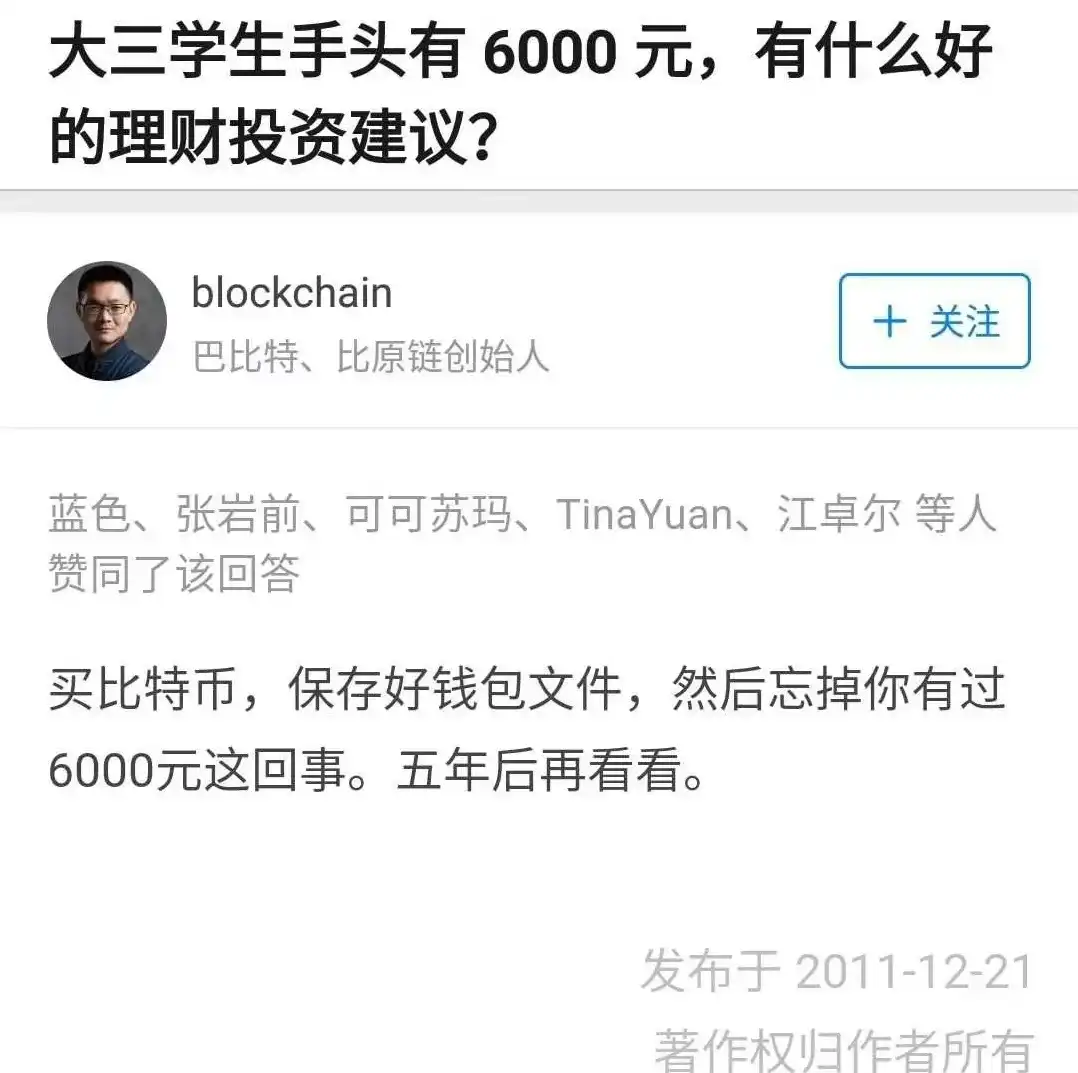
Chang Jia, who was ahead of the curve, once attracted much criticism, but now the siphoning of the crypto circle by AI has become an indisputable fact. Talent is migrating, capital is being reallocated, and attention is shifting.

Talent Migration: OGs Become AI Bloggers

Another crypto OG, Shen Yu, co-founder and CEO of Cobo, is also a representative figure in the early Bitcoin mining circle. As a survivor of multiple cycles, Shen Yu often shares his understanding of market phases and investment insights on social media, which is quite popular in the crypto community.

However, recently, Shen Yu has transformed from a crypto OG into an AI blogger. In the past month, over 80% of his social media content has been about OpenClaw, with very little related to crypto. Shen Yu himself even joked about his successful transformation.

Shen Yu's exploration and interest in AI remain at a personal level; his company's business and personal career are still primarily focused on crypto. Therefore, we can temporarily interpret his obsession with AI as a good habit of actively improving himself and keeping up with the cutting edge during "market garbage time." However, the talent shift from crypto to AI is indeed happening.

Anthony Rose, an executive at zkSync, announced on February 4 that after working at Matter Labs for four years, he would leave and most likely turn to AI; Nader Dabit, Developer Advocacy Director at EigenLayer, also announced on February 5 that he was leaving EigenLayer to become Head of Growth at an AI company, stating that "he joined the future."

The most notable recent example of leaving the circle is Multicoin Capital co-founder Kyle Samani announcing his departure from crypto to focus on AI, robotics, and other fields. Kyle Samani is famous for his early bet on Solana, so his exit dealt a blow to the confidence of the crypto community. Even more离谱的是, on the day he left, Kyle Samani disparaged the crypto industry, saying, "Crypto just isn't as interesting as many people (including myself) once thought."

Recommended reading: "Is there another reason behind Kyle Samani's departure?"

Capital Migration: Native Crypto VCs Start Allocating to AI

Native crypto VCs are also unwilling to waste more time on the crypto industry.

On February 28, according to the Wall Street Journal, crypto venture capital firm Paradigm is planning to raise a new fund focused on AI and robotics, with a target size of up to approximately $1.5 billion. Paradigm is one of the purest crypto-native capitals. It made its name in 2019 by investing in and incubating Uniswap. Subsequent early investments in other crypto projects (such as Lido, Optimism, dYdX, Blur) were also successful, making this "research-driven" VC an institution on par with a16z crypto.

Precisely because of this, Paradigm's shift is of symbolic significance.

If crypto were still in a period of rapid innovation, continuously generating projects capable of carrying billion-dollar-level investments, Paradigm would not need to establish a heavily weighted fund specifically for AI. But the reality is that the infrastructure narrative of the crypto industry (such as L1, L2, DEX, etc.) is highly saturated, and the number of truly "paradigm-shifting" quality early-stage projects is few and far between.

The entire crypto VC industry has few good projects to invest in. The data is more直观: over the past four years, the number of venture capital deals in the crypto industry has declined year by year. In 2022, there were 1,639 financing deals in the crypto primary market, which dropped to 829 deals in 2025, with the proportion of early-stage financing also falling from 50% to below 35%.
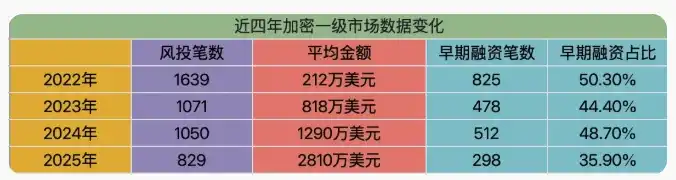
Source: What will the crypto market be able to trade a year later?

When there's nothing left to invest in within the crypto industry, AI, as a booming sector, naturally becomes the best destination for crypto capital. From foundational large models to AI Agents, from computing power chips to the robotics industry, AI can not only accommodate capital规模 but also continuously create growth stories, making it the largest reservoir for global capital today.

For a VC managing over $12.7 billion in assets, the core proposition is never "whether the belief is shaken," but "whether the return function still holds." When the number of projects the crypto industry can support decreases, a single bet on crypto means increased portfolio risk and decreased return elasticity. In this case, insisting on being "crypto-native" becomes irrational.

Therefore, Paradigm's active expansion into AI is also forced by the trends of the times. This is not a strategic issue for individual institutions but a signal of the industry's stage.

Attention Migration: When Crypto Players Become Obsessed with AI

In terms of market attention, Crypto is an industry that is best at蹭热点 (riding trends). Whether it's political hotspots, technological frontiers, or social headlines, anything火爆总能 finds related hyped projects or Memes in the crypto circle. In the past, every time the AI industry experienced a technological upgrade or product innovation, the crypto circle would see related "Crypto+AI" projects or Meme coin speculation, attracting market attention.

When OpenClaw became popular, although the crypto circle also immediately found angles to蹭, such as speculating on同名 Meme coins, commanding OpenClaw to trade tokens automatically, and betting on prediction markets to make money, later crypto players began to become more pure, shifting from "how to crypto-fy OpenClaw" to "how to actually use OpenClaw."

Many crypto researchers began continuously outputting installation and usage tutorials for OpenClaw, publicly sharing their AI workflows, even detailing how to train personal AI Agents to help write code, conduct research, generate content, etc. Some crypto KOLs even started side businesses charging novices for installing OpenClaw.

Offline AI exchange events organized by the crypto circle are also "packed." Recently, the most popular offline event was the "Web4 China Tour" promoted by crypto OG Kong Jianping. The event ran from February 25 to March 8, held offline in five Chinese cities, with main topics being OpenClaw and Agent,几乎没有加密相关 (almost nothing related to crypto).

This is no longer蹭热点 (riding the trend); it's a real migration of attention. Crypto players who pride themselves on progressive thinking are starting to fear falling behind in the AI era.

Crypto circle AI offline event现场座无虚席 (fully seated)

Why are crypto practitioners so obsessed with AI?

The crypto circle inherently has the highest concentration of "super individuals"—independent developers, traders, and content creators. These people naturally pursue improvements in tool efficiency to compensate for limitations in personal efficiency. Therefore, when AI can significantly amplify individual productivity, crypto players are among the first to embrace it.

Furthermore, the core of crypto culture has a strong geek spirit and technology worship. Although the "technology narrative" has been diluted in recent years, most crypto players still believe that "underlying technology can change the world." And now, more than blockchain, AI possesses the气质 (qualities) of a technological revolution, naturally attracting the疯狂追捧 (crazy pursuit) of crypto players.

Of course, the more realistic reason is the crypto market's idle period. AI is continuously creating "new things," while Crypto has been reorganizing old narratives. Without native crypto innovation, without significant wealth effects, the entire crypto circle is barely sustained by the slight externality brought by prediction markets and RWA. At this time, the new discussion topics and cognitive stimulation provided by the AI industry, rather than seizing crypto attention, are filling the spiritual void of crypto players after the market节奏放缓 (pace slowed down).

Time to Talk About Things Beyond Crypto and AI

Finally, returning to the beginning of this article, the reason the OpenClaw founder's words attracted attention in the crypto circle is not because they were dismissive, but because they vocalized what many crypto people are quietly验证 (validating) with their actions—the smartest people are重新分配 (reallocating) their time.

We are now facing a period of declining wealth generation rates and exploding technological productivity.

On one hand, as the crypto cycle slows, Alpha contracts, and wealth growth curves flatten, the marginal returns of the past year's behavior of crypto players单纯依靠 (solely relying on) "scanning information—chasing hotspots—gambling for returns" through枯坐 (sitting idle) are diminishing. On the other hand, AI is compressing the "time required to solve problems." A large amount of work that previously required significant time investment, such as writing code and creating content, can now be completed by models in minutes, with problem-solving efficiency far exceeding that of individual humans.

When the "process volume of seeking results" is highly concentrated by AI, then perhaps we反而拥有 (instead have) more free time to do things not aimed at efficiency and making money—to seek "carbon-based meaning," to experience the world, to build cognitive systems independent of market fluctuations, and to construct our own value coordinates.

In the AI future, what truly creates a gap between people might be aesthetics, independent judgment, and the construction of personal meaning.


Questions liées

QWhat was the controversial advice given by OpenClaw's founder to young people regarding cryptocurrency?

APeter Steinberger, the founder of OpenClaw, advised young people to 'not waste time on cryptocurrency'.

QAccording to the article, what is a significant trend happening with talent and capital in the crypto industry?

AThe article highlights a significant trend of talent migration and capital reallocation from the crypto industry towards the AI sector.

QWhich prominent crypto-native venture capital firm is mentioned as planning to raise a new fund focused on AI and robotics?

AThe crypto-native venture capital firm Paradigm is planning to raise a new fund, with a target of up to $1.5 billion, focused on AI and robotics.

QWhat are two reasons suggested in the article for why crypto players are becoming so fascinated with AI?

ATwo reasons are: 1) Crypto players, often 'super individuals' like developers and traders, naturally seek tools like AI to enhance their productivity. 2) The core crypto culture has a strong geek spirit and technology worship, and AI is seen as possessing a more revolutionary technological气质 than blockchain currently.

QWhat does the article suggest might become the true differentiator between people in the AI future?

AThe article suggests that in the AI future, the true differentiators between people might be aesthetics, independent judgment, and the construction of personal meaning.

Lectures associées

Kalshi, MTS et l'ambition de a16z

Le marché des prédictions, illustré par des plateformes comme Kalshi, connaît un regain d'intérêt en 2025, suscitant l'enthousiasme des investisseurs, des acteurs de la cryptomonnaie et des médias. Cet engouement dépasse les simples opportunités de régulation ou de revenus, touchant à une dimension philosophique plus profonde. L'article retrace l'évolution intellectuelle du concept, depuis les théories de Hayek sur la connaissance dispersée dans la société, jusqu'aux mécanismes incitatifs comme le LMSR de Robin Hanson, conçus pour révéler l'information. Cependant, c'est l'entrée en jeu du géant du capital-risque a16z, avec son investissement massif dans Kalshi, qui marque un tournant. a16z voit dans le marché des prédictions bien plus qu'un produit financier : un nouvel outil médiatique fondamental. Il répondrait au désir contemporain de "présence" et d'action face à un monde de plus en plus médiatisé et déterministe. En pariant de l'argent réel sur des événements mondiaux, l'utilisateur passerait du statut de spectateur passif à celui d'observateur actif et impliqué, recouvrant un sentiment d'agency. Cette capacité à générer de l'engagement et à définir la réalité par les prix du marché (établissant la véracité et l'importance des événements) en ferait une pièce maîtresse de l'empire des "nouveaux médias" qu'a16z cherche à construire. Cet empire, illustré par des acteurs comme MTS, se caractérise par une production et une diffusion d'information extrêmement rapides et intenses, visant à "s'approprier la timeline". La valeur ultime de Kalshi résiderait ainsi dans son puissant "champ de distorsion de la réalité" : sa capacité, via le poids de l'argent engagé par la foule, à influencer la perception collective du futur et à s'imposer comme un arbitre de la vérité, conférant à une entreprise privée une influence historique rare.

marsbitIl y a 1 h

Kalshi, MTS et l'ambition de a16z

marsbitIl y a 1 h

Changement de cap mondial chez a16z : Le capital-risque devient le « moteur » de l'alliance technologique américaine

L’annonce de Ben Horowitz marque un virage stratégique majeur dans la globalisation d’a16z. Le fonds ne se contente plus de rechercher des projets à l’étranger, mais s’inscrit dans un cadre plus large de compétition technologique et de coopération entre alliés, explicitement lié au leadership technologique des États-Unis et de leurs partenaires. Dans un contexte où l’IA, la robotique, la cybersécurité et les chaînes d’approvisionnement deviennent des enjeux de compétition nationale, le rôle des VC évolue. A16z renforce ses capacités pour aider ses startups à naviguer dans des environnements complexes, mêlant marchés, régulations et géopolitique. Les initiatives clés incluent : l’ouverture d’un bureau à Tokyo, la nomination d’Anne Neuberger (ancienne responsable gouvernementale) comme associée chargée des affaires mondiales pour conseiller sur la politique et la géopolitique, et la transformation de l’équipe relations investisseurs en une équipe « Partenaires Mondiaux » pour faciliter les connexions et le déploiement international des entreprises. L’objectif reste de soutenir les meilleures entreprises technologiques partout dans le monde (plus de 100 investissements internationaux à ce jour), mais avec une mission élargie : être un organisateur reliant les startups aux capacités nationales, aux ressources industrielles et au réseau des alliés, contribuant ainsi à la compétitivité technologique des États-Unis et de leurs alliés.

marsbitIl y a 1 h

Changement de cap mondial chez a16z : Le capital-risque devient le « moteur » de l'alliance technologique américaine

marsbitIl y a 1 h

Kalshi, MTS et les ambitions d'a16z

Les marchés prédictifs, représentés par Kalshi, émergent comme un domaine clé en 2025, attirant fonds d'investissement, acteurs de la cryptomonnaie et médias. Leur importance dépasse la simple spéculation. Leur évolution conceptuelle remonte à Hayek (l'utilisation de la connaissance dans la société) et à Robin Hanson (mécanisme LMSR pour inciter à la révélation d'informations), avec l'idée utopique d'une « futarchie ». L'intérêt de a16z, qui a investi dans Kalshi (évalué à 220 milliards de dollars), va au-delà du modèle économique. Leur thèse centrale est que les marchés prédictifs offrent un « sentiment de présence » et une forme d'« anti-cynisme » dans un monde moderne où les individus se sentent déconnectés. En pariant sur des événements mondiaux, l'utilisateur devient un « observateur superlatif », investi et influençant la perception collective. Cela s'inscrit dans la vision de « nouveaux médias » de a16z : un écosystème médiatique complet et rapide qui « s'approprie la timeline », comme le démontre MTS (Monitoring The Situation), un média en continu sur Twitter. Kalshi ajoute à ce dispositif une autorité unique car ses prix reflètent des paris en argent réel, lui conférant un pouvoir de « distorsion de la réalité » pour définir la vérité et l'importance des événements. C'est ce pouvoir, rarement détenu par une entreprise privée, qui justifierait sa valorisation faramineuse et en ferait une pièce maîtresse de l'empire médiatique de a16z.

链捕手Il y a 1 h

Kalshi, MTS et les ambitions d'a16z

链捕手Il y a 1 h

Comprendre la réalité du commerce, des paiements et des infrastructures des Agents

**Interprétation de la réalité des agents, des paiements et des infrastructures commerciales** Au cours de l'année passée, l'auteur a travaillé sur l'infrastructure de l'économie des agents, interagissant avec Stripe, Visa, Coinbase, Google et des dizaines de startups. La conclusion est claire : il n'existe pas encore de demande réelle, et les startups font face à des problèmes structurels. Stripe a enregistré peu de transactions d'agents malgré un fort intérêt. Visa impose des seuils de revenus et des processus KYC extrêmement restrictifs, accessibles uniquement aux géants comme Amazon. Les chiffres d'utilisation des agents sur la blockchain (comme via le protocole x402) sont largement gonflés par des transactions de test. **Agent vs Commerçant** : L'expérience d'achat par agent (IA) est souvent inférieure au commerce électronique traditionnel pour les achats visuels (vêtements, électronique). L'interface conversationnelle est un recul par rapport aux interfaces riches. La demande actuelle des marchands est défensive : ils veulent être "trouvables" par les agents par crainte de rater une future tendance. Les cas d'usage convaincants sont limités (commande de nourriture, navigation dans des interfaces complexes), mais nécessitent une distribution de masse détenue par les géants. **Agent vs API** : Les développeurs utilisent déjà massivement des API (calcul, données). Le problème du coût des micro-transactions est souvent résolu par du prépaiement. Le véritable obstacle est que les grands fournisseurs SaaS privilégient les contrats enterprise. Les opportunités pour les nouveaux systèmes de paiement (comme les stablecoins) se situent dans la longue traîne des services, un marché plus restreint. **Agent vs Agent** : Ce modèle est encore théorique, sans volume significatif. Il impliquerait des transactions ultra-rapides entre entités non humaines, avec des montants variables et des règlements multipartites. C'est un pari à long terme sur une infrastructure dédiée, mais ce n'est pas le marché actuel. **Agent vs Finance** : C'est la seule catégorie avec une demande existante et une volonté de payer. Intégrer l'IA dans les workflows financiers existants (gestion de portefeuille, DeFi) est une évolution naturelle et crée de nouvelles capacités. Cependant, la concurrence est rude face aux institutions établies, régulées et bien connectées. **Le véritable enjeu** : Les grandes entreprises construisent par stratégie défensive et ont les moyens d'attendre. Pour les startups, il est crucial de se concentrer sur le marché actuel. Le problème fondamental n'est pas le paiement, mais la **coordination** entre agents et humains : vérifier le travail, s'accorder sur les résultats, puis régler. Le paiement n'est qu'une partie de la solution de coordination. Ce sont les entreprises qui résoudront le problème de la coordination à grande échelle qui domineront, en intégrant le paiement, et non l'inverse. L'expérience de l'auteur l'a conduit vers un autre segment de marché, actif, en croissance et encore mal desservi, en dehors de ces quatre catégories.

marsbitIl y a 1 h

Comprendre la réalité du commerce, des paiements et des infrastructures des Agents

marsbitIl y a 1 h

Trading

Spot
Futures

Articles tendance

Comment acheter PEOPLE

Bienvenue sur HTX.com ! Nous vous permettons d'acheter ConstitutionDAO (PEOPLE) de manière simple et pratique. Suivez notre guide étape par étape pour commencer votre parcours crypto.Étape 1 : Création de votre compte HTXUtilisez votre adresse e-mail ou votre numéro de téléphone pour ouvrir un compte sur HTX gratuitement. L'inscription se fait en toute simplicité et débloque toutes les fonctionnalités.Créer mon compteÉtape 2 : Choix du mode de paiement (rubrique Acheter des cryptosCarte de crédit/débit : utilisez votre carte Visa ou Mastercard pour acheter instantanément ConstitutionDAO (PEOPLE).Solde :utilisez les fonds du solde de votre compte HTX pour trader en toute simplicité.Prestataire tiers :pour accroître la commodité d'utilisation, nous avons ajouté des modes de paiement populaires tels que Google Pay et Apple Pay.P2P :tradez directement avec d'autres utilisateurs sur HTX.OTC (de gré à gré) : nous offrons des services personnalisés et des taux de change compétitifs aux traders.Étape 3 : stockage de vos ConstitutionDAO (PEOPLE)Après avoir acheté vos ConstitutionDAO (PEOPLE), stockez-les sur votre compte HTX. Vous pouvez également les envoyer ailleurs via un transfert sur la blockchain ou les utiliser pour trader d'autres cryptos.Étape 4 : tradez des ConstitutionDAO (PEOPLE)Tradez facilement ConstitutionDAO (PEOPLE) sur le marché Spot de HTX. Il vous suffit d'accéder à votre compte, de sélectionner la paire de trading, d'exécuter vos trades et de les suivre en temps réel. Nous offrons une expérience conviviale aux débutants comme aux traders chevronnés.

554 vues totalesPublié le 2024.12.12Mis à jour le 2026.06.02

Comment acheter PEOPLE

Discussions

Bienvenue dans la Communauté HTX. Ici, vous pouvez vous tenir informé(e) des derniers développements de la plateforme et accéder à des analyses de marché professionnelles. Les opinions des utilisateurs sur le prix de PEOPLE (PEOPLE) sont présentées ci-dessous.

活动图片