Author:Mona,ChainCatcher
2026 portrays a seemingly contradictory picture for the cryptocurrency exchange industry.
On one hand, the expansion of TradFi, RWA, stablecoins, and on-chain derivatives continues to broaden the asset boundaries accessible to trading platforms. On the other hand, however, established exchanges likeBitMart andBitMEX are exiting the stage.
This points to a realistic question: For small and medium-sized exchanges, market trends and asset expansion can generate new trading demand, but it does not guarantee long-term growth. Liquidity, compliance, security, risk management, product iteration, customer acquisition costs, and user retention — any slowdown in these areas will impact a platform's short-term and even medium-to-long-term performance.
Against this backdrop, the three-year-old Websea has recently made intensive adjustments to its product and business layout.
Over the past month or so,Websea has centralized the launch or upgrade of several products and features, including futures insurance, copy trading, VIP services, gold and silver CFDs, Proof of Reserves (PoR), and co-hosted the Global RWA Summit in Almaty. According to its third-anniversary announcement, Websea disclosed over 150 million global registered users. Data fromCMCshows its recentaverage daily trading volume reached 50 billion USD.
From these moves,Websea's recent product adjustments mainly focus on risk management, multi-asset trading, and asset transparency.
Starting in the Aftermath of a Bear Market, Entering a New Phase of Competition Three Years Later
Websea was founded in 2023, when the industry was still grappling with the aftermath of the previous deleveraging cycle. Subsequently, the Bitcoin spot ETF, the halving cycle, and institutional capital spurred a market recovery, allowing exchanges to once again enjoy the industry dividends brought by rising trading volumes. By 2026, competition began to diverge again: top-tier platforms vie for global liquidity and compliant entry points; on-chain trading erodes some long-tail asset demand; and mid-sized platforms must find their niche between product differentiation, regional markets, and user operations.
This context is key to understanding Websea's third-anniversary data. The user base and trading volume disclosed byWebsea reflect its current business scale, but the quality of its operations requires longer-term data observation. More specifically, for exchanges, registered users, trading volume, and short-term campaigns only explain part of the growth. Whether users continue to trade, assets are retained long-term, and the platform can maintain its product operations after market sentiment cools will determine the quality of that scale.
Websea has also faced market pressures and business adjustments over the past three years.2026 in April, the platform announced a phased adjustment to its withdrawal services, stating it would conduct asset verification and subsequent resumption arrangements. For platforms that have gone through such phases, how to continuously improve asset transparency, risk management, and user trust has become a crucial test for their future business development.
Judging from recent moves,Websea is adjusting its products around several directions: futures insurance and copy trading primarily address risk management needs in derivatives trading; TradFi and CFDs expand the range of tradable instruments; PoR provides an entry point for users to verify platform reserves; and RWA points more towards regional industrial resources and potential asset partnerships.
These directions correspond to different challenges currently facing exchanges. However, whether they can eventually form stable business value still requires verification through subsequent trading data, user feedback, and business execution.
Can Risk Management Products Form Long-Term Competitiveness?
Spot trading, futures, copy trading, and wealth management have become standard offerings for centralized exchanges. As products become increasingly similar, user switching costs are low, and new users attracted by fee subsidies and campaign rewards are hard to retain naturally.
Websea has adjusted key products such as "Futures Insurance" and "Copy Trading." From a design perspective, these features mainly revolve around trading risk management and user engagement experience, with some mechanisms attempting to lower the barrier to understanding and using related products for first-time participants.
7 月 20 In an upgrade on July 20th,Websea began injecting transaction fees from insurance orders into the corresponding insurance pool and adjusted claim rounds and VIP benefits. On the copy trading side, new users can receive corresponding incentives.8 月 18 On August 18th, the maximum subscription limit for ordinary users was increased, the subscription period for some traders was changed to 7, 14, and 21 days, and subscription fees were adjusted from a fixed amount to a percentage of the copy trading amount.
From a product mechanism perspective,Websea is attempting to integrate new user incentives, copy trading, risk management, and VIP benefits. Users can first familiarize themselves with product mechanics using the trial funds provided by the platform for new users, then participate in actual trading, and utilize functions like take-profit/stop-loss, position management, and futures insurance in their operations. Compared to one-time user acquisition campaigns, this mechanism focuses more on linking user incentives with subsequent trading experiences.
However, risk management products have clear boundaries. They do not guarantee users a certain return, and futures insurance does not mean all losses from leveraged trading will be covered. How easily the protection conditions are understood, the sustainability of the insurance pool funds, and the stability of the compensation and claim rules will all affect users' genuine evaluation of the product.
Therefore, for Websea, whether futures insurance and copy trading can form long-term competitiveness ultimately depends on whether the product rules are clear, execution is stable, and relevant data can be continuously disclosed.
TradFi Heats Up, Exchanges Vie for Users' Asset Time
Crypto exchanges expanding into TradFi is driven by a straightforward commercial logic: when the crypto market lacks a clear trend, trading opportunities still exist in gold, US stocks, indices, forex, and commodities. By offering more asset classes, platforms can increase user dwell time and smooth out the impact of volatility in a single market on trading volume.
CoinGecko data states that in the first half of2026 , the TradFi perpetuals volume processed by crypto exchanges exceeded 1.45 trillion USD, with perpetual contracts accounting for 98.5%. This data indicates that, at this stage, users are more familiar with trading price exposure to traditional assets, while holding real-world assets on-chain involves more complex processes like issuance, custody, valuation, and redemption.
CoinGecko's "2026 RWA Report" also states that the market capitalization of tokenized RWA grew from $5.42 billion at the beginning of 2025 to $19.32 billion by the end of Q1 2026, with government bonds and commodities constituting the main portion, while stocks and ETFs are also gaining scale. The simultaneous rise in derivatives trading and asset tokenization presents exchanges with two types of opportunities: capturing price trading and connecting liquidity needs after assets are tokenized on-chain.
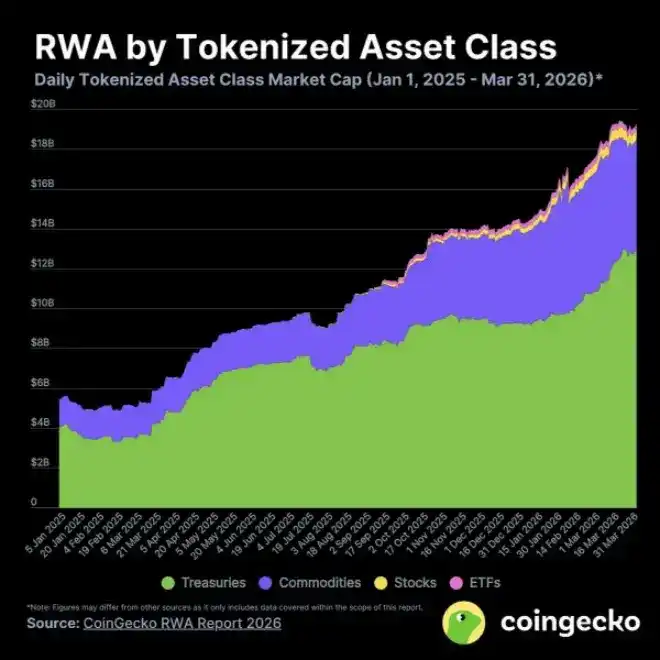
Figure: Market Cap Changes of Tokenized RWA by Asset Category; Source:CoinGecko"2026 RWA Report", data as of March 31, 2026.
Amid the ongoing TradFi uptrend,Websea gradually launched gold and silver CFDs around August 11, having already covered categories like US stocks, global indices, ETFs, forex, and commodities. Users can trade across different markets within their USDT accounts.
It's important to distinguish the product attributes here.CFD provides price exposure to the underlying asset; users do not directly hold the stocks, gold, or other underlying assets. While exchanges gain new trading scenarios, they must also handle price feeds, liquidity, funding rates, market closure periods, and risk control during extreme market conditions. TradFi's potential to become Websea's second growth curve still needs time to prove.
PoR and RWA: Two Different Competitive Strategies
8 月 18 On August 18th,Websea launched its first Proof of Reserves report. The platform disclosed reserve ratios of USDT, BTC, ETH , and WBS as 111%,100%,102%, and 174%respectively. Users can verify if their assets are included in the statistics via the Merkle tree, and can also download wallet addresses, user asset files, and open-source tools for independent verification.

Figure:WebseaProof of Reserves Officially Launched; Source:WebseaOfficial Poster
PoR provides a public verification entry for asset transparency in centralized platforms, but a single disclosure only offers a snapshot in time. Its reference value also depends on update frequency, address coverage, liability definition, and the continuity of historical reports. Websea CMO Herbert R. Sim stated:"The platform will regularly publish data for each period along with historical reports."
The Global RWA Summit held in Almaty on the same day may reveal another aspect of its expansion strategy. The summit covered industries such as mining, agriculture, real estate, and green energy, connecting industrial and investment participants from China, Kazakhstan, and other markets. Central Asia possesses energy, mineral, agricultural, and cross-border trade scenarios, providing a real-world asset foundation for RWA, but also presenting specific challenges regarding asset rights, compliance, custody, valuation, and cross-border settlement.

Figure:AlmatyRWA SummitVenue; Source:WebseaOfficial Poster
From a business logic perspective, such regional events can serve as a channel for Websea to access local asset sources and partnership networks. However, there are still multiple steps before reaching tradable, verifiable, and sustainably operable RWA products.
Of course, the effectiveness of this route will ultimately depend on project implementation, partner structure, asset cash flow, and legal arrangements. In summary, regional events provide an entry point, but business outcomes determine how far it can go.
After the Third Anniversary, What Does Websea Need to Prove?
Over the past three years, the competitive logic of crypto exchanges has continuously evolved.
Initially, it was about speed of listing new tokens and the number of trading pairs. During bull markets, the focus shifted to traffic and futures liquidity. As the industry matures, transparency, risk management, global assets, and regional services are becoming more prominent.
Websea's recent layout largely follows this evolution. Futures insurance and copy trading address users' risk perception, TradFi expands the range of tradable assets, PoR establishes a public verification entry, and Central Asian RWA cooperation extends its regional resource network.
These moves cover several important competitive dimensions for exchanges currently. However, for Websea , what truly deserves observation going forward may not be how many more products it can add, but whether these layouts can translate into sustained data performance that withstands user scrutiny.
Competition in the exchange industry continues.BitMart and BitMEX's changes remind the industry that past scale and fame cannot permanently guarantee a seat at the table.
For Websea, the third-anniversary milestone showcases the platform's recent business adjustments: continuing to expand asset trading scenarios while strengthening risk management and asset transparency, and exploring opportunities for regionalized RWA.
As for whether these strategies ultimately translate into stable liquidity, sustained user retention, and verifiable business growth, it will require longer-term data to answer.
This article is an industry analysis based on publicly available information and platform disclosures. The user scale, trading volume, reserve ratios, and product parameters of Websea are sourced from platform disclosures, and the relevant information is subject to its published announcements and product pages. The media has not independently audited or guaranteed the accuracy of the data. The analysis regarding the platform's business development in this article represents industry observation only and does not constitute a recommendation or investment advice for any trading platform, financial product, or digital asset.