Valentine’s Day Crypto Warning: US Attorney Issues Crypto-Fueled Romance Scam Alert

ccn.comPublié le 2026-02-14Dernière mise à jour le 2026-02-14

Résumé

The US Department of Justice has issued a Valentine’s Day warning about cryptocurrency-fueled romance scams. Fraudsters typically approach victims on dating sites or social media, using fake profiles and stolen photos to build emotional trust over weeks or months. They then fabricate emergencies and request payments in crypto, gift cards, or wire transfers—methods that are difficult to reverse. Recent cases include a Colorado man who lost $1.4 million after meeting a woman on a dating app who persuaded him to invest in crypto. According to Chainalysis, crypto scams received at least $14 billion in 2025, with impersonation scams surging by 1,400% compared to the previous year. Authorities advise conducting reverse image searches, consulting trusted friends before sending money, and reporting suspicious activity to the FBI.

Key Takeaways

  • The Department of Justice has issued a crypto warning as Valentine’s Day hits.
  • Real-world losses are escalating.
  • Crypto scam activity surged in 2025.

U.S. federal prosecutors are warning Americans not to let Valentine’s Day turn into a costly heartbreak, as romance scammers increasingly demand payment in cryptocurrency.

The U.S. Attorney’s Office for the Northern District of Ohio on Thursday urged the public to remain vigilant against online crypto romance scams that exploit victims’ trust and emotions.

Try Our Recommended Crypto Exchanges
Sponsored
Disclosure
We sometimes use affiliate links in our content, when clicking on those we might receive a commission at no extra cost to you. By using this website you agree to our terms and conditions and privacy policy.
"}' data-trk="6970dbafcbd599f15ce64045" href="https://links.ccn.com/links?code=6985b71f73f50d4865cba0f2" rel="nofollow" target="_blank">
ChangeNow<\/h3>"}' data-trk="6970dbafcbd599f15ce64045" href="https://links.ccn.com/links?code=6985b71f73f50d4865cba0f2" rel="nofollow" target="_blank">

ChangeNow

promotions
Receive 0.4% of the volume from each transaction with your referral link.<\/strong>"}' data-trk="6970dbafcbd599f15ce64045" href="https://links.ccn.com/links?code=6985b71f73f50d4865cba0f2" rel="nofollow" target="_blank"> Receive 0.4% of the volume from each transaction with your referral link.
Coins
217
Claim Offer
"}' data-trk="6899b9831836d97539c51aa6" href="https://links.ccn.com/links?code=693293fa4a5bcb6231949c97" rel="nofollow" target="_blank">
Bitunix<\/h3>"}' data-trk="6899b9831836d97539c51aa6" href="https://links.ccn.com/links?code=693293fa4a5bcb6231949c97" rel="nofollow" target="_blank">

Bitunix

promotions
Receive up to $100,000 worth of exclusive gifts for newcomers upon registration.<\/strong>"}' data-trk="6899b9831836d97539c51aa6" href="https://links.ccn.com/links?code=693293fa4a5bcb6231949c97" rel="nofollow" target="_blank"> Receive up to $100,000 worth of exclusive gifts for newcomers upon registration.
Coins
151
Claim Offer
"}' data-trk="67adf8d4f12aaec7e4808bf5" href="https://links.ccn.com/links?code=693291aa4a5bcb62319448b2" rel="nofollow" target="_blank">
Bitget<\/h3>"}' data-trk="67adf8d4f12aaec7e4808bf5" href="https://links.ccn.com/links?code=693291aa4a5bcb62319448b2" rel="nofollow" target="_blank">

Bitget

promotions
New user rewards up to 6,200 USDT.<\/strong>"}' data-trk="67adf8d4f12aaec7e4808bf5" href="https://links.ccn.com/links?code=693291aa4a5bcb62319448b2" rel="nofollow" target="_blank"> New user rewards up to 6,200 USDT.
Coins
89
Claim Offer
Explore All Offers

DOJ Flags Valentine’s Day Crypto Warning

Federal prosecutors said fraudsters typically approach victims on dating websites, social media platforms, and messaging apps, posing as romantic partners.

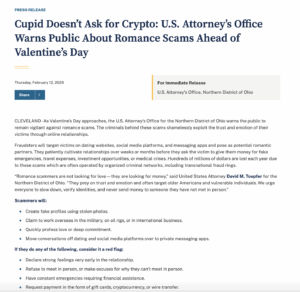
In a stark warning , titled “Cupid Doesn’t Ask for Crypto,” the DOJ explained how bad actors cultivate relationships over weeks or months before fabricating emergencies, travel needs, or medical crises.

Among the clearest warning signs, according to the Justice Department, are requests for payment in crypto, gift cards, or wire transfers, methods favored by scammers because they are hard to reverse.

The office said scammers frequently create fake profiles using stolen photos, claim to work overseas in the military or international business, and profess deep affection quickly.

The DOJ has issued a Valentine’s Day warning about crypto. | Source: DOJ

They often move conversations off mainstream dating platforms to private messaging apps and avoid meeting in person.

“Romance scammers are not looking for love — they are looking for money,” said U.S. Attorney David M. Toepfer for the Northern District of Ohio.

Adding: “They prey on trust and emotion and often target older Americans and vulnerable individuals. We urge everyone to slow down, verify identities, and never send money to someone they have not met in person.”

Regional Cases Underscore Growing Threat

Victims are advised to conduct reverse image searches of profile photos, consult trusted friends before sending funds, and report suspicious activity to the FBI’s Internet Crime Complaint Center (IC3).


In the report, authorities cited recent regional cases, including a Ghanaian national charged in an alleged scheme that took more than $8 million from elderly victims.

Last September, a Colorado man was also reported to have lost $1.4 million after falling victim to a crypto-linked romance scam.

The man, who first spoke to 9News , said he met a woman on Ashley Madison, a website marketed to married people seeking affairs.

After weeks of video chatting and exchanging photos, their conversations shifted to the woman’s interest in crypto and her view of it as a good opportunity for him.

Over roughly six weeks, the man said he made four separate cryptocurrency transfers, ultimately losing $1.4 million in retirement funds and life savings.

Crypto Scams Surge in 2025

The warning comes amid a broader surge in cryptocurrency-related fraud.

Blockchain analytics firm Chainalysis said in its 2026 report that crypto scams received at least $14 billion in on-chain funds last year, up sharply from initial 2024 estimates of $9.9 billion.

Based on historical trends, the firm projected that the 2025 total could exceed $17 billion as more illicit wallets are identified.

The average scam payment rose to $2,764 in 2025 from $782 in 2024, a 253% year-on-year increase, according to Chainalysis.

Impersonation scams, also known as Pig Butchering scams, recorded a 1,400% surge in inflows compared with the previous year.


Top Trending Crypto Articles
  • Best Exchanges Check Out Our Recommended Exchanges Here
  • Buy Crypto Fast How To Buy Crypto with a Credit Card Now
  • Safe Crypto Gambling See Our Picks for the Best Crypto Gambling Sites

Questions liées

QWhat is the main warning issued by the U.S. Department of Justice regarding Valentine's Day?

AThe U.S. Department of Justice has issued a warning about romance scammers who increasingly demand payment in cryptocurrency, urging the public to remain vigilant against online crypto romance scams that exploit victims' trust and emotions.

QWhat are some of the red flags mentioned by the DOJ to identify crypto romance scams?

ARed flags include requests for payment in cryptocurrency, gift cards, or wire transfers; scammers creating fake profiles using stolen photos; claiming to work overseas in the military or international business; professing deep affection quickly; and moving conversations off mainstream platforms to private messaging apps while avoiding in-person meetings.

QHow much did crypto scams receive in on-chain funds in 2025 according to Chainalysis?

AAccording to Chainalysis, crypto scams received at least $14 billion in on-chain funds in 2025, with projections that the total could exceed $17 billion as more illicit wallets are identified.

QWhat was the average scam payment in 2025 compared to 2024?

AThe average scam payment rose to $2,764 in 2025, which is a 253% increase from the $782 average in 2024.

QWhat advice does the DOJ give to avoid falling victim to these scams?

AThe DOJ advises victims to conduct reverse image searches of profile photos, consult trusted friends before sending funds, and report suspicious activity to the FBI’s Internet Crime Complaint Center (IC3). They also emphasize never sending money to someone they have not met in person.

Lectures associées

La dépeg de 11% de l'action privilégiée STRC : La machine à mouvement perpétuel de Strategy tourne-t-elle encore ?

L'action privilégiée STRC de MicroStrategy se détache de plus en plus de sa valeur nominale cible de 100 dollars, avec un écart dépassant 11%. Ce produit, conçu comme un titre à revenu stable, est le moteur clé de la "roue de capital" de l'entreprise, lui permettant de lever des fonds sans diluer les actions ordinaires pour acheter du Bitcoin. Son mécanisme d'ancrage, basé sur un ajustement dynamique du taux de dividende, semble actuellement inefficace malgré un dividende porté à 11,5%. Les raisons de ce décrochage sont multiples : dénouement de positions à effet de levier et, surtout, inquiétudes du marché quant à la solidité financière de MicroStrategy. Un rapport de JPMorgan a souligné que les réserves de trésorerie ne couvriraient que 6,3 mois de paiements de dividendes sur les actions privilégiées. Bien que MicroStrategy rétorque que ses réserves de Bitcoin pourraient couvrir 32 ans de dividendes, cela impliquerait de vendre des actifs, rompant avec son récit d'accumulation à long terme. La première vente symbolique de Bitcoin par l'entreprise ce mois-ci a accru ces craintes. Si le décrochage de la STRC persiste, la capacité de financement de MicroStrategy s'en trouverait affaiblie. Dans un scénario où ses réserves de trésorerie diminueraient, la pression pour vendre du Bitcoin afin de payer les dividendes augmenterait, transformant potentiellement le plus grand acheteur institutionnel en un vendeur et exerçant une pression baissière sur le marché du Bitcoin.

marsbitIl y a 25 mins

La dépeg de 11% de l'action privilégiée STRC : La machine à mouvement perpétuel de Strategy tourne-t-elle encore ?

marsbitIl y a 25 mins

Un lauréat du prix Nobel vient de rejoindre Anthropic

Le lauréat du prix Nobel de chimie John Jumper, ancien responsable principal d'AlphaFold chez Google DeepMind, rejoint Anthropic. Cette annonce, intervenue après le départ de Noam Shazeer (co-auteur du Transformer) vers OpenAI, représente une perte majeure pour Google en l'espace de 72 heures. Jumper, diplômé en 2017, avait été placé à la tête de l'équipe AlphaFold par Demis Hassabis après seulement six mois chez DeepMind, malgré son manque initial d'expérience en deep learning. Sous sa direction, AlphaFold a révolutionné la biologie structurale, résolvant le problème du repliement des protéines et générant des centaines de millions de structures, multipliant par 1000 le nombre de structures connues. Ces avancées lui ont valu le prix Nobel de chimie en 2024 à l'âge de 39 ans. Son départ intervient dans un contexte d'exode des talents de Google DeepMind, où plus de 20 chercheurs clés sont partis ces huit dernières années. Un commentaire suggère que les jeunes laboratoires d'IA offrent ce que Google ne peut plus : la sensation qu'une seule personne peut changer la trajectoire de l'entreprise. Anthropic renforce ainsi son pôle sciences de la vie, après l'acquisition de Coefficient Bio et le lancement d'outils dédiés comme Claude for Life Sciences. Ce mouvement reflète une concurrence accrue dans le domaine, avec OpenAI (GPT-Rosalind) et Google DeepMind (via Isomorphic Labs) investissant également massivement pour réinventer la recherche biomédicale avec l'IA. Le recrutement de Jumper marque une nouvelle étape dans cette course stratégique.

marsbitIl y a 31 mins

Un lauréat du prix Nobel vient de rejoindre Anthropic

marsbitIl y a 31 mins

La Haute Cour d'Australie offre une victoire majeure à l'ASIC dans l'affaire du produit à rendement crypto de Block Earner

La Haute Cour d’Australie a donné raison à l’autorité des marchés financiers (ASIC) dans une affaire concernant le produit à rendement fixe « Earner » de Block Earner. La cour a jugé à l’unanimité que ce produit crypto, proposé entre mars et novembre 2022, constituait un produit financier et un dérivé, soumis à la réglementation existante. Block Earner aurait donc dû détenir une licence de services financiers australienne. L’affaire est renvoyée devant la Cour fédérale pour déterminer les sanctions. Ce verdict établit un précédent important : il confirme que les produits crypto offrant des rendements structurés ou une exposition de type dérivé peuvent être soumis aux règles de licence, indépendamment de leur étiquette technologique. Bien que le produit en cause ne soit plus commercialisé, la décision renforce la position de l’ASIC pour les futurs cas similaires et s’inscrit dans une tendance mondiale de régulation des produits de rendement crypto. Pour les entreprises, cela signifie que les offres générant des rendements via le déploiement d’actifs par un tiers risquent d’être considérées comme des produits d’investissement. Pour les consommateurs, cela rappelle que ces produits comportent des risques spécifiques et exigent une structure réglementaire appropriée. L’industrie crypto australienne devra désormais composer avec ce cadre réglementaire plus strict.

bitcoinistIl y a 9 h

La Haute Cour d'Australie offre une victoire majeure à l'ASIC dans l'affaire du produit à rendement crypto de Block Earner

bitcoinistIl y a 9 h

Trading

Spot
Futures
活动图片