Author: David, Deep Tide TechFlow
Recently, Epstein case documents have been intensively unsealed, and social media is abuzz with name lists.
People in the crypto space are also asking: Are there any people in our industry involved?
I was curious too, so I decided to investigate. But the problem is the sheer volume of released documents—thousands of PDFs—making manual review impractical, and I have little coding background.
I stumbled upon a project on GitHub after much online surfing.
This project is called Epstein Doc Explorer. The author used AI to structure the Epstein legal documents publicly released by the House Oversight Committee, extracting relationships between people, events, times, and locations, all stored in a database.
It also has an online visualization webpage for searching, but due to the massive data and my modest computer, it was very laggy, making it hard to get the desired information.
What I wanted was batch querying, to pull out all crypto-related people and events at once.
Scraping Method
I threw this GitHub project to Claude and asked how to query this database.
After reviewing the project structure, Claude told me the core data is in an SQLite database file called document_analysis.db, with a table named rdf_triples. Each record is a "who-did what-to whom-when-where" structure. For example:

However, the entire database has over 260,000 such records, covering all publicly disclosed personal networks in the Epstein archives, and I only wanted crypto-related ones.
My approach was to filter relevant records using keywords. But I encountered two pitfalls in practice.
First pitfall: The file was "fake".
I downloaded the project zip from GitHub, tried to open the database after extraction, but my computer couldn't read it. Claude helped troubleshoot and found that what I downloaded was just an index file, not the actual database. I manually downloaded the complete file from the GitHub page, totaling 266MB.
Second pitfall: Keyword selection.
My first query used 25 keywords, including direct terms like Bitcoin, Crypto, Blockchain, and also added names and institutions like Peter Thiel, Bill Gates, Goldman Sachs that aren't entirely related. The idea was to rather catch too much than miss something.
The result returned 1628 records with lots of noise. For example, 90% of the results for Goldman Sachs were economic forecast reports, and Virgin Islands returned local tourism data.
So I had Claude help me do three rounds of searches to narrow it down step by step:
- First round: Broad keywords, 1628 records, lots of noise but established a panorama, identified a group of people
- Second round: After reviewing the first round results, Claude found that I missed some crypto-specific terms like Libra, Stablecoin, Digital Asset. Added these and ran again to confirm no omissions.
- Third round: Reverse search. Didn't search names, only searched records where "what was done" contained Bitcoin, Crypto, Blockchain
The third round was crucial, filtering directly by behavior, with each retrieved record being strongly related.
Cross-referencing the three rounds, removing weak associations, I compiled the list below.
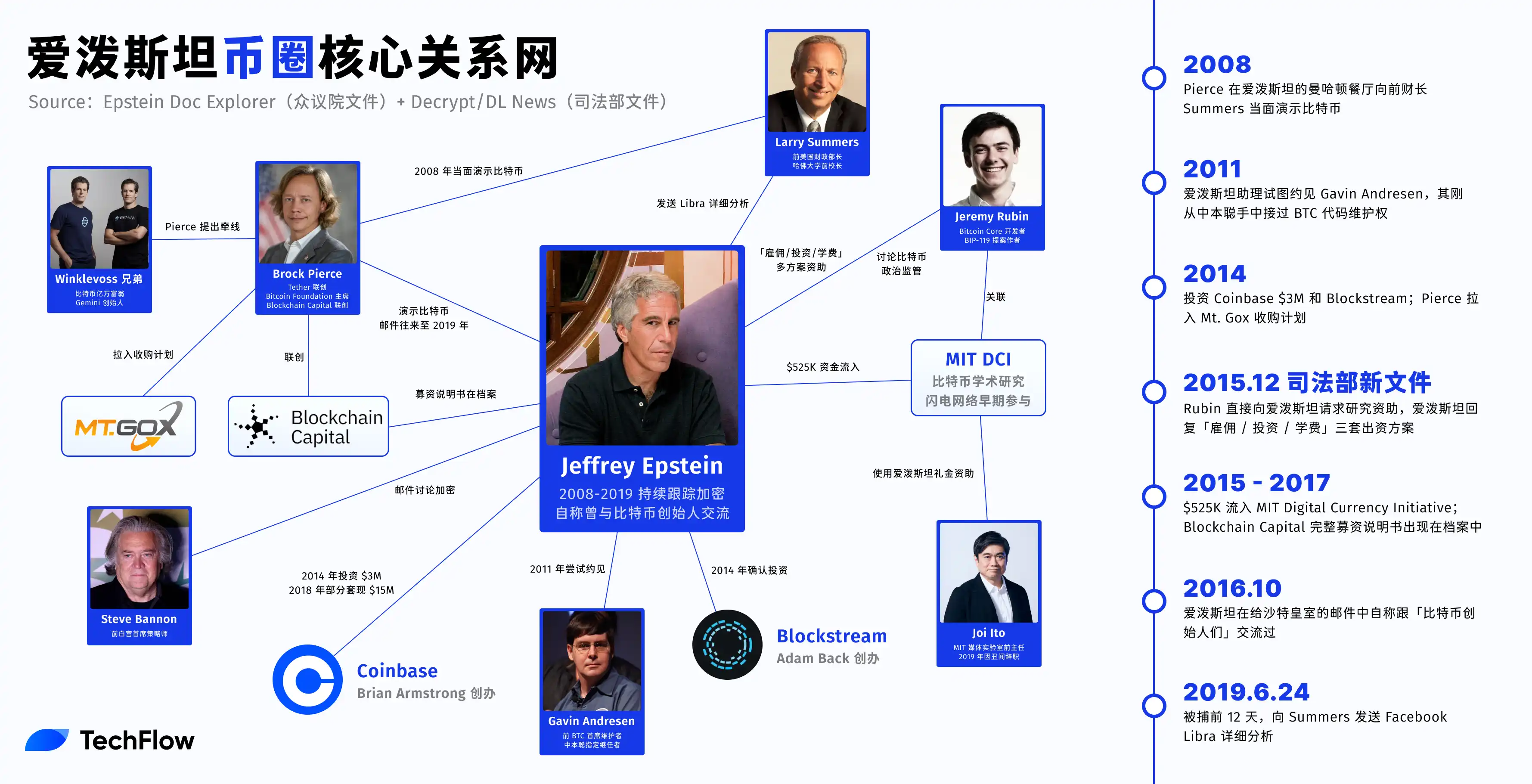
1. Brock Pierce: Demonstrating Bitcoin to Epstein in His Dining Room
Identity: Co-founder of Tether, Chairman of Bitcoin Foundation, Co-founder of Blockchain Capital
Contact with Epstein: Multiple face-to-face meetings at Epstein's Upper East Side mansion in Manhattan.
Crypto topics involved: Bitcoin demonstration, blockchain discussion, cryptocurrency volatility.
Timeline: The earliest record is marked as 2008, multiple records have no specific date but same location. An email record from March 2015 shows someone arranging a follow-up meeting.
I'm writing about Pierce first because his records have the strongest visual impact in the entire database.
Records show that in the dining room of Epstein's mansion, he gave a Bitcoin demonstration in front of former US Treasury Secretary Larry Summers. After listening, Summers expressed concerns about investment risks but also "offered opportunities" to Pierce.
Epstein wasn't just listening on the side; he actively called Pierce to the front hall for a private talk, then invited him back to the dining room to continue the conversation. The two also separately discussed cryptocurrency volatility.
This wasn't a casual dinner chat.
An email dated March 31, 2015, shows a person named Alex Yablon specifically writing to Epstein asking if he could arrange for Pierce and Summers to discuss Bitcoin.
Someone was acting as a middleman, indicating such meetings were deliberately organized.
Epstein's Manhattan mansion played the role of an informal pitch venue during that period. Pierce brought his project to the door, with the guest of honor being the former Treasury Secretary.
For a crypto entrepreneur, this kind of resource channel is almost non-existent in normal business channels. Conversely, by arranging such meetings, Epstein positioned himself as the connection point between the crypto industry and policymakers.
Our database only processed the House Oversight Committee files, so the Pierce线索 ends here. But just during the writing of this article, the US Department of Justice released another batch of over 3 million pages of Epstein documents. Decrypt reported based on this new batch, revealing that the relationship between the two was much deeper than shown in the database.
Key additions:
Their email correspondence lasted from 2011 until spring 2019, far more than just a few dining room meetings.
Pierce excitedly messaged Epstein saying "Bitcoin broke $500!", pulled him into plans to acquire the then-not-yet-collapsed Mt. Gox exchange, and proactively offered to connect Epstein with Bitcoin billionaires the Winklevoss twins.
Epstein said he didn't know the Winklevosses but wanted to send someone to understand their movements in the crypto space.
The starting point of their relationship is also clearer.
In early 2011, Pierce attended a small, invitation-only conference "Mindshift" in the Virgin Islands. The purpose of this conference was to help Epstein repair his image after his 2008 sex crime conviction.
After the meeting, Epstein's executive assistant Lesley Groff marked Pierce as one of the people Epstein "liked" and handed over his contact information.
2. Blockchain Capital: A Crypto VC's Fundraising Materials Appear, Epstein Might Be an Investor
Identity: Crypto venture capital fund established in 2013, headquartered in San Francisco. Co-founders Bart Stephens, Brad Stephens, and the aforementioned Brock Pierce. One of the earliest professional crypto VCs in the industry.
Connection to Epstein: The complete investment prospectus for the CCP II LP fund appeared in Epstein's document archives.
Crypto topics involved: The fund's complete portfolio, service provider system, investment strategy.
Timeline: The prospectus is dated October 2015, investment records cover 2013 to 2015.
In the entire Epstein public database, there are 82 records related to Blockchain Capital.
It doesn't look like scattered name mentions; it's more like a complete fundraising material was decomposed into structured data.
Digging into the data, you can see Blockchain Capital's investment target list is very detailed: Coinbase's Series C, Kraken's Series A, Ripple's Series A, Blockstream's Series A, and over a dozen projects like BitGo, LedgerX, itBit, ABRA.
Even the fund's service provider system is recorded: legal counsel Sidley Austin, banking relationship Silicon Valley Bank, crypto asset custody Xapo and BitGo.
A fundraising prospectus appearing in someone's files has only one常规 explanation in the financial world:
This person was approached as a potential LP.
Considering Pierce is both a co-founder of Blockchain Capital and demonstrated Bitcoin in Epstein's dining room, these two lines are most likely connected?
My imagined process is, Pierce first demonstrated Bitcoin to generate interest, then presented his fund's fundraising materials—a complete pitch process...
(The above is just a reasonable guess, not guaranteed to be true)
While writing this article, I couldn't find evidence of Epstein actually investing.
But Decrypt's report based on the new Justice Department files answered this question: Epstein did invest in Coinbase, with the opportunity initially brought by Pierce.
Blockchain Capital told Decrypt that Epstein ultimately invested independently of Pierce's company. The same batch of files also shows Epstein invested in Blockstream—the Bitcoin infrastructure company founded by Adam Back.
3. Jeremy Rubin: Bitcoin Core Developer Sought Funding from Epstein
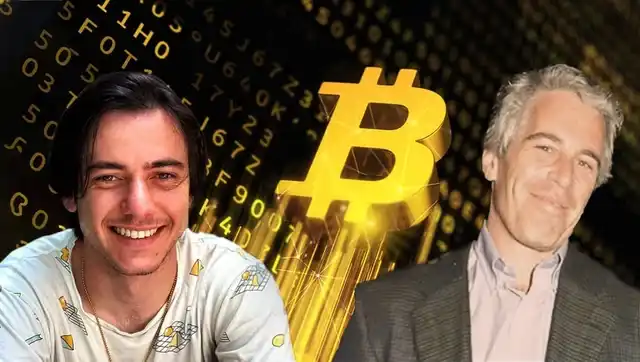
Identity: Bitcoin Core contributor, author of BIP-119 (OP_CTV) proposal, associated with MIT's Digital Currency Initiative. In the Bitcoin technical community, he is one of those writing underlying code.
Contact with Epstein: Direct communication, discussion clearly involved Bitcoin.
Crypto topics involved: Bitcoin regulatory prospects, Bitcoin political speculation, teaching Bitcoin courses in Japan, requesting research funding.
Timeline: February 2017, records concentrated over four days.
On February 1, 2017, Rubin discussed "Bitcoin regulatory outlook" and "Bitcoin regulatory and political speculation" with Epstein.
Three days later, he reported to Epstein on his progress teaching a Bitcoin course to engineers in Japan.
This set of records has the highest information density in the entire database.
The topics they talked about weren't "how Bitcoin works," but more about regulatory direction and political games, indicating Epstein had moved past the Bitcoin科普 stage by 2017.
Isn't Rubin's behavior pattern somewhat suspicious upon reflection?
He proactively reported work progress to Epstein, which seems more like an ongoing information exchange relationship than a one-time social contact.
As for what Rubin got from Epstein, we have no way of knowing.
But according to DL News' report based on Justice Department files, in December 2015, Rubin directly emailed Epstein, requesting Epstein fund his crypto research.
Epstein's response was specific, offering three funding options: 1. Pay Rubin a salary; 2. Rubin starts a company, Epstein invests (requires more paperwork); 3. Fund Rubin's research (has tax benefits).
A Bitcoin Core developer actively requested funding from Epstein, and Epstein provided a systematic response plan.
Here, some explanation about the MIT Digital Currency Initiative (DCI) is needed. DCI is a research project established in April 2015 by MIT Media Lab director Joi Ito,专门做ing academic research on Bitcoin and digital currency. It later participated in early work on infrastructure like the Lightning Network.
In the Bitcoin technical community, DCI is not a marginal academic institution; its research directly influences the development direction of the Bitcoin protocol. Rubin is one of the developers associated with this project.
4. Joi Ito: Using Epstein's Money to Launch MIT's Digital Currency Initiative
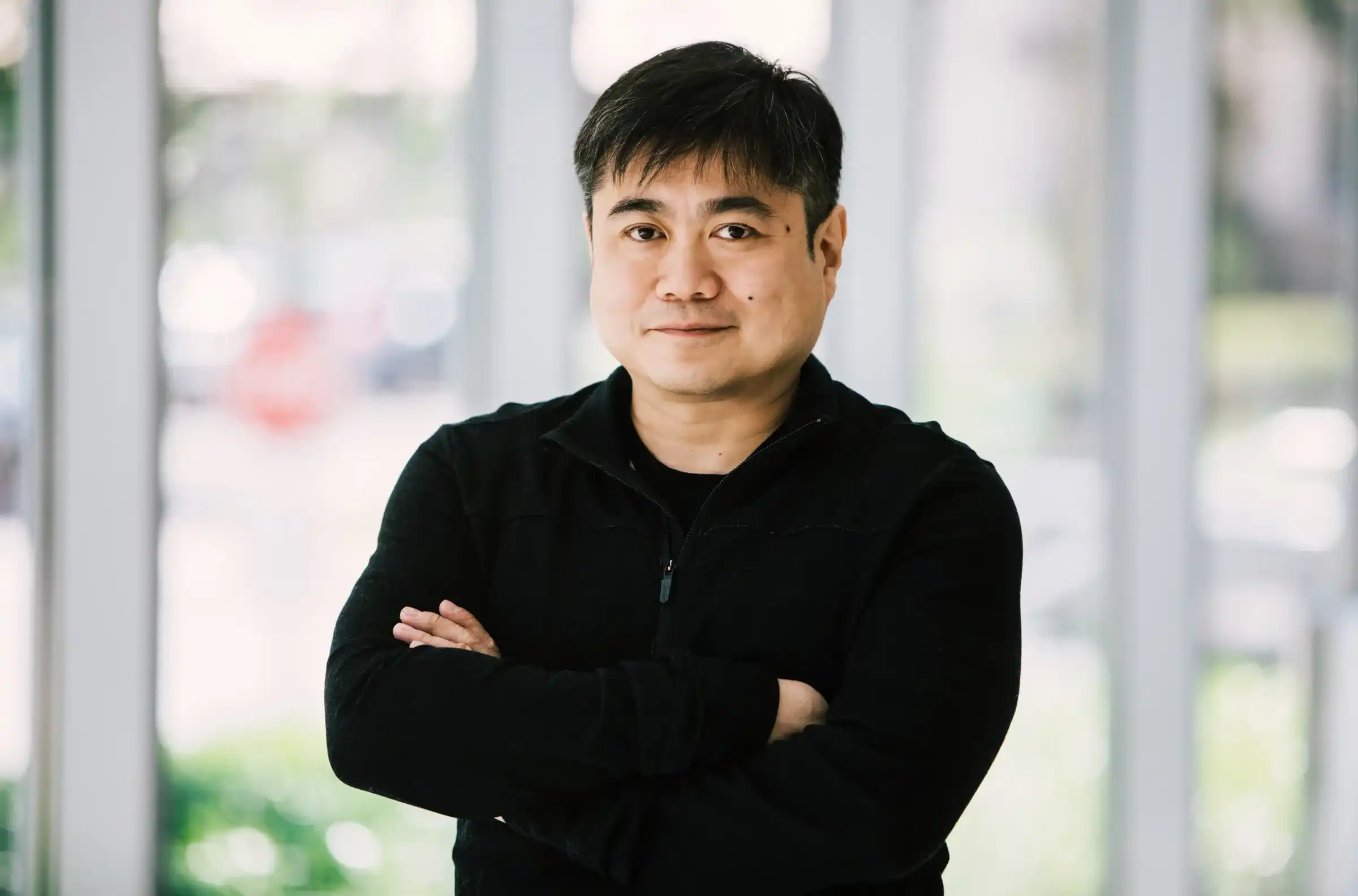
Identity: Former director of the MIT Media Lab. Resigned in 2019 after being exposed for accepting Epstein's funds.
Connection to Epstein: Accepted funds, direct communication.
Crypto topics involved: Funding source of the MIT Digital Currency Initiative.
Timeline: Launched the Digital Currency Initiative in April 2015, still had communication records in 2017.
Ito's acceptance of Epstein's funds was reported by The New Yorker and others in 2019, so it's not a new discovery. But the records in the database补充了一个当时报道中不太明确的细节:
The specific flow of that money.
The database directly annotates "Joichi Ito used gift funds to finance MIT Media Lab Digital Currency Initiative", as mentioned above.
So, Epstein's funds didn't go into the Media Lab's general operating pool, but were directed into cryptocurrency research.
This connects with the线索 about Rubin above.
Rubin is associated with the MIT Digital Currency Initiative, and this project used Epstein's money.
Although it cannot be directly inferred that Rubin met Epstein through Ito, these two clues point in the same direction: Epstein's penetration into the crypto industry was not just social; by funding academic research, he gained access to core developers in the crypto technical community.
Now, let's string these clues together:
Epstein's money flowed into DCI, DCI is an important institution for Bitcoin core technology research, and developers associated with DCI, like Rubin, are directly discussing regulatory politics and reporting work to Epstein.
This funding chain raises an uncomfortable question:
Did Epstein, by funding academic research, gain access to Bitcoin core developers, and even indirectly influence the research direction of Bitcoin infrastructure?
Current data cannot prove this. But this chain of "money → institution → developer → direct communication" does exist in the database records. Readers can judge for themselves how strong the causality is.
5. Epstein Himself: From Bitcoin to Libra, Tracking Crypto for at Least a Decade
Arranging Epstein's own crypto-related records chronologically reveals a clear evolution:
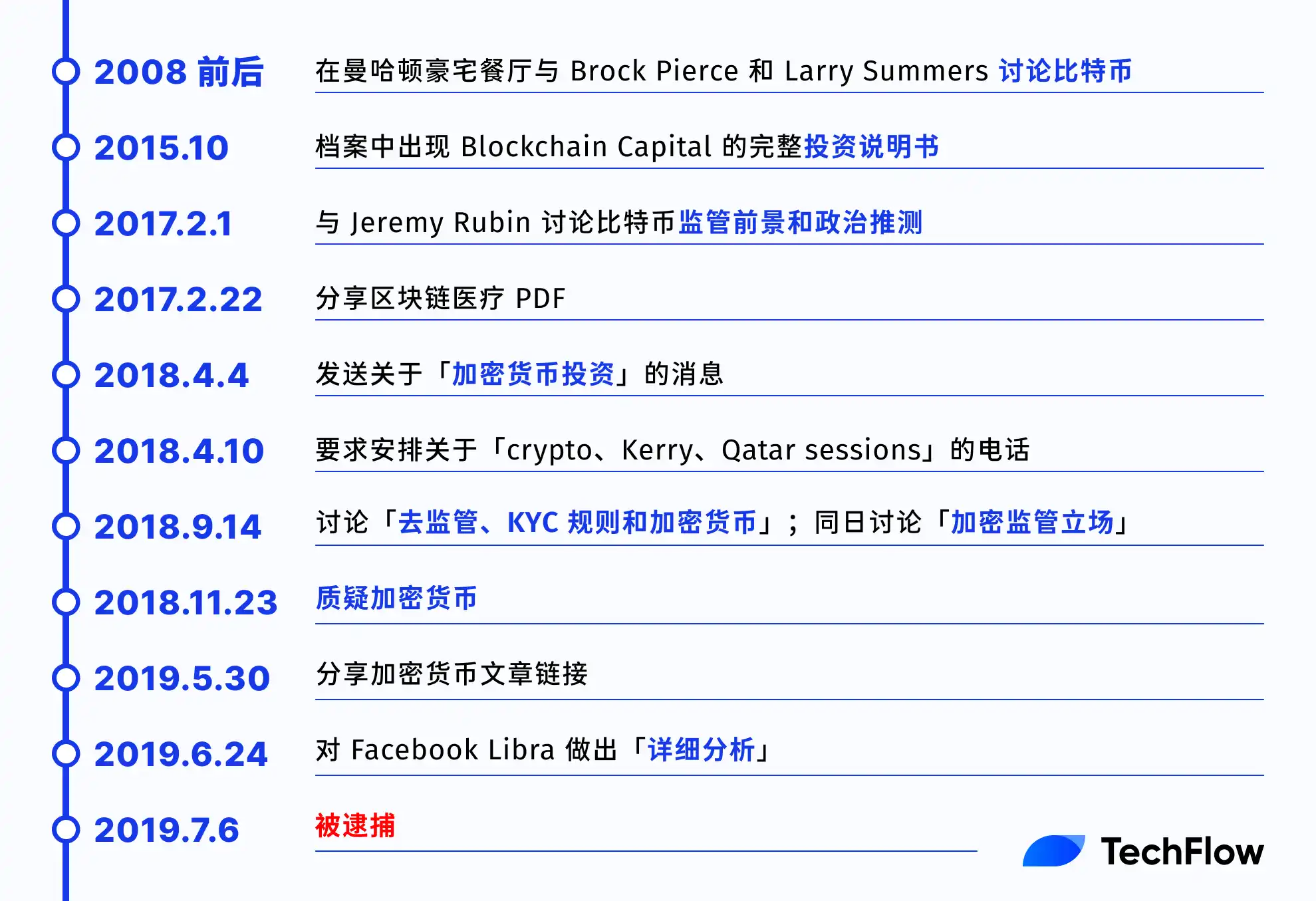
Looking at this table together, two judgments can be made.
First, Epstein's crypto interest wasn't a sudden curiosity in a particular year.
The earliest record is marked around 2008, just after the Bitcoin whitepaper was released. Probably only a few thousand people globally were paying attention to crypto at that stage.
His ability to接触 Bitcoin at that stage indicates his information network reached the earliest people in this field. From then on, there were continuous crypto-related records for ten years—an uninterrupted line.
Second, his level of attention was deepening.
2008 was "listening to a demo," 2017 was "discussing regulatory politics with a developer," 2018 was "including crypto in geopolitical agendas alongside John Kerry and Qatar," and by 2019 he could produce a detailed analysis of the Libra whitepaper within 6 days of its release...
This is no longer the trajectory of an amateur observer; it shows he was someone trying to establish influence in the crypto industry.
The timing of the last record, about the Libra analysis, is also interesting.
He finished the analysis on June 24, 2019, and was arrested on July 6. In the last two weeks of his freedom, he was still analyzing Facebook's stablecoin plan.
It's somewhat哭笑不得 that someone in his role was so concerned with crypto.
People Not in the Database
An inverse discovery.
CZ, Sam Bankman-Fried, Brian Armstrong, Vitalik Buterin, Winklevoss twins...
These most famous faces in the crypto industry were not found to have direct interaction records with Epstein within the scope of currently processed files.
Vitalik Buterin actually has one record "authored What is Ethereum", but it's a citation of public material in the files, not involving interpersonal relationships.
Not being in the database doesn't mean no association, just no evidence within the current data scope. The House is continuously unsealing files, and this database is also updating.
What Do These Clues Put Together Indicate?
Epstein was not an investor in the crypto industry, at least there is no evidence showing he actually invested in any crypto projects with real money.
He wasn't a technical participant either; he didn't write code, issue tokens, or go on-chain.
But, he was clearly not a passive bystander either.
After爬完 these records, I think what he did was more like an information broker.
Having Pierce demonstrate Bitcoin to the former Treasury Secretary in his dining room, having the complete fundraising materials for Blockchain Capital, discussing regulatory politics with a Bitcoin Core developer, funding MIT's digital currency research, analyzing Facebook's Libra two weeks before his arrest...
The common feature these behaviors outline is: Placing himself at the intersection of information flow, the connector between crypto entrepreneurs, policymakers, and academic researchers.
This is consistent with his behavior patterns in other fields.
Epstein didn't directly do scientific research, but he funded scientists; he didn't directly make policy, but he arranged meetings between politicians and businessmen. Crypto was just another field he渗透 using the same methodology.
A possible difference is that the crypto industry was正好 in a critical window from underground to mainstream between 2008 and 2019. During this stage, the industry particularly relied on informal personal networks to obtain policy information and capital channels.
And this, isn't it exactly what Epstein was best at providing?
However, the editor has tried his best. There is a reasoning distance between "contact records" and "substantive influence." This article can only present the former.
Reiterating the disclaimer: All findings come from an open-source database and Claude's辅助 analysis. The article is not a final conclusion; it's more appropriate to treat it as a阶段性 data snapshot.
If you find crypto-related clues I missed in this database, please let me know.
-
References:
1. Epstein browser open source project:
https://github.com/maxandrews/Epstein-doc-explorer
2. Location of the 260,000 text key database:
https://github.com/maxandrews/Epstein-doc-explorer/blob/main/document_analysis.db