US Stocks Hit Record Highs: Why Isn't the Market Afraid of the Flames of War?

marsbitPublié le 2026-04-16Dernière mise à jour le 2026-04-16

Résumé

U.S. stocks hit a record high on April 15, with the S&P 500 closing at 7,022.95, just 77 days after its previous peak. This rebound occurred in only 11 trading days—far faster than recoveries following past crises like the COVID-19 pandemic (103 days) or the 2011 debt crisis (106 days). The market's rapid recovery is attributed to "ceasefire expectations" rather than deteriorating economic fundamentals. During the sell-off triggered by the U.S.-Israel military action against Iran in late February, the S&P 500 fell nearly 10%. However, the market rallied twice on ceasefire rumors—first on March 24 and again on April 8—even before any permanent peace deal was signed. Notably, the VIX fear index fell below pre-war levels, indicating that the market had repriced the conflict from an uncertainty to a calculable risk. Major financial institutions like JPMorgan reported record trading revenues of $11.6 billion in Q1 2026, largely driven by volatility in commodities and emerging markets. Hedge funds turned net long for the first time since late 2025, while margin debt hit a record $1.28 trillion. This reflects a financial system that commercializes volatility, treating geopolitical shocks as tradable opportunities rather than systemic threats. However, the current optimism relies on assumptions of a sustained ceasefire and stable oil prices, leaving the market vulnerable if these conditions change.

On April 15, the S&P 500 closed at 7,022.95 points, exactly 77 days after it last hit a record high. In those 77 days, the U.S. fought a war, oil prices broke above $100, and the stock market experienced its fastest 10% correction in five years. Then, it returned to a new high in about 11 trading days.

This number is worth pausing to think about. 11 trading days—this is an impossible speed in U.S. history following every crisis of a similar scale.

What 11 Trading Days Mean in History

Where does the speed of this recovery stand in the historical context?

According to a PBS report, JPMorgan strategists called this rebound "the fastest since the COVID-19 pandemic." Looking at the historical numbers, this statement is not an exaggeration.

During the COVID-19 pandemic in 2020, the market took about 103 trading days to rebound from the low on March 23 to a new high on August 18. During the Gulf War in 1990, it took about 87 trading days from the low at the end of October to return to the previous high in February 1991. During the U.S. debt crisis in 2011, it took about 106 trading days from the low in October of that year to a new high in March 2012.

This recovery from the 2026 Iran War: 11 trading days.
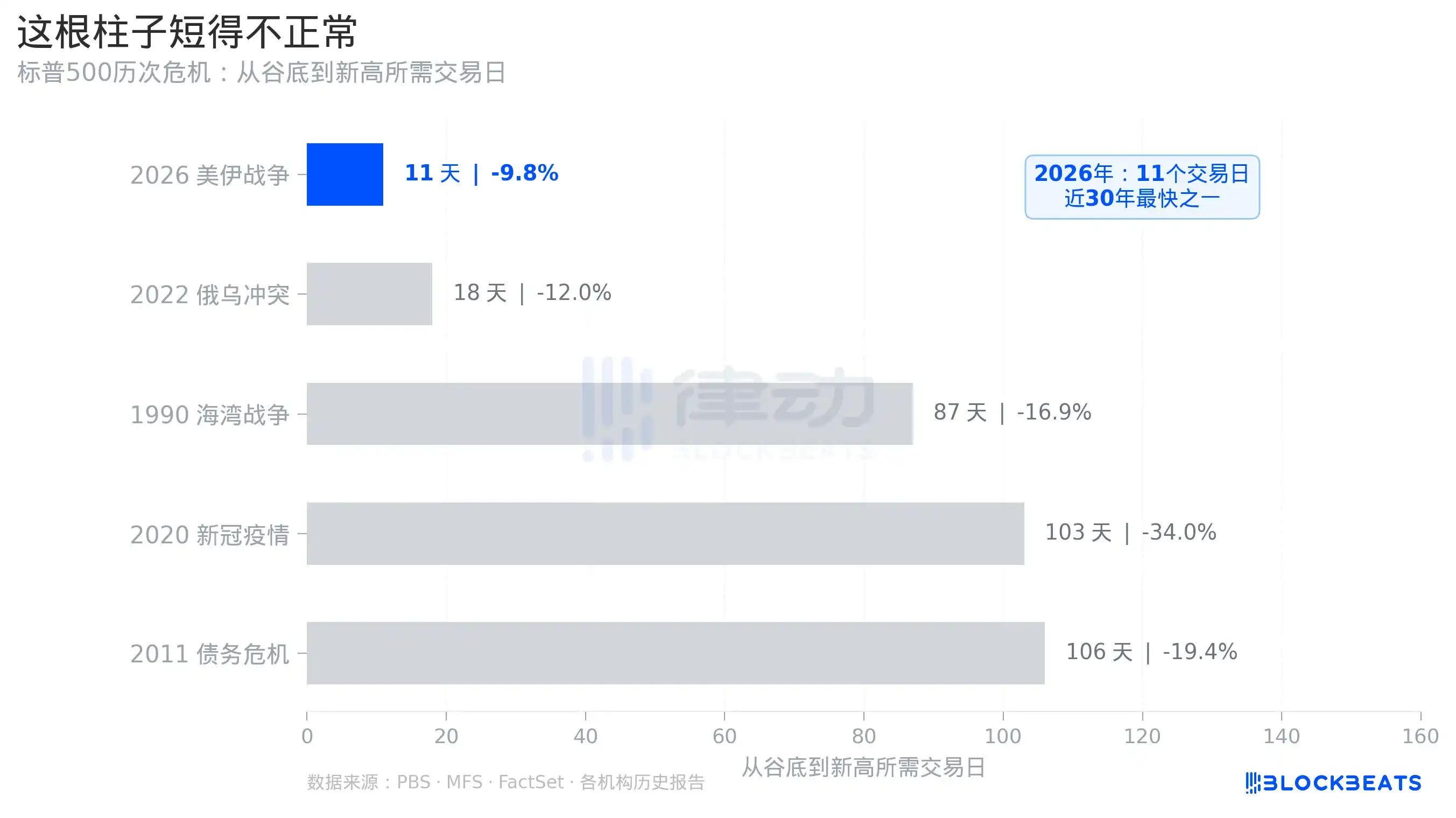
It should be noted that the magnitude of this correction (about 10%) was much smaller than during the COVID-19 period (about 34%) and 2011 (about 19%). But even compared to the 2022 Russia-Ukraine conflict, which had a similar decline, that recovery took about 18 trading days. Eleven days is still an outlier.

The narrative of this correction has always been "ceasefire expectations," not "deteriorating economic fundamentals." The market fell due to uncertainty, not profits. When ceasefire news actually emerged, the uncertainty pricing was quickly erased, without waiting for quarterly reports to rebuild confidence.

The Word "Ceasefire" Drove the Rally—Twice

To understand the speed of this recovery, it’s necessary to first clarify the news timeline.

On February 28, the U.S. and Israel launched military strikes against Iran. The S&P 500 began falling from its previous high of 7,002 points on January 28, dropping to 6,316 points by March 30, a maximum drop of nearly 10%. By Wall Street's definition, this was right on the edge of a "correction."

But during this decline, something strange happened. On March 24, rumors about the "possible unblocking of the Strait of Hormuz" circulated in the market, and the S&P rebounded that day. This was the first "ceasefire pricing." The rumors were later disproven, and the market continued to fall.

On April 8, Trump announced a two-week temporary ceasefire on social media, and Iran also accepted Pakistan's mediation proposal. The S&P 500 surged 2.5% in a single day. This was the second "ceasefire pricing," at a higher price, for almost exactly the same reason.
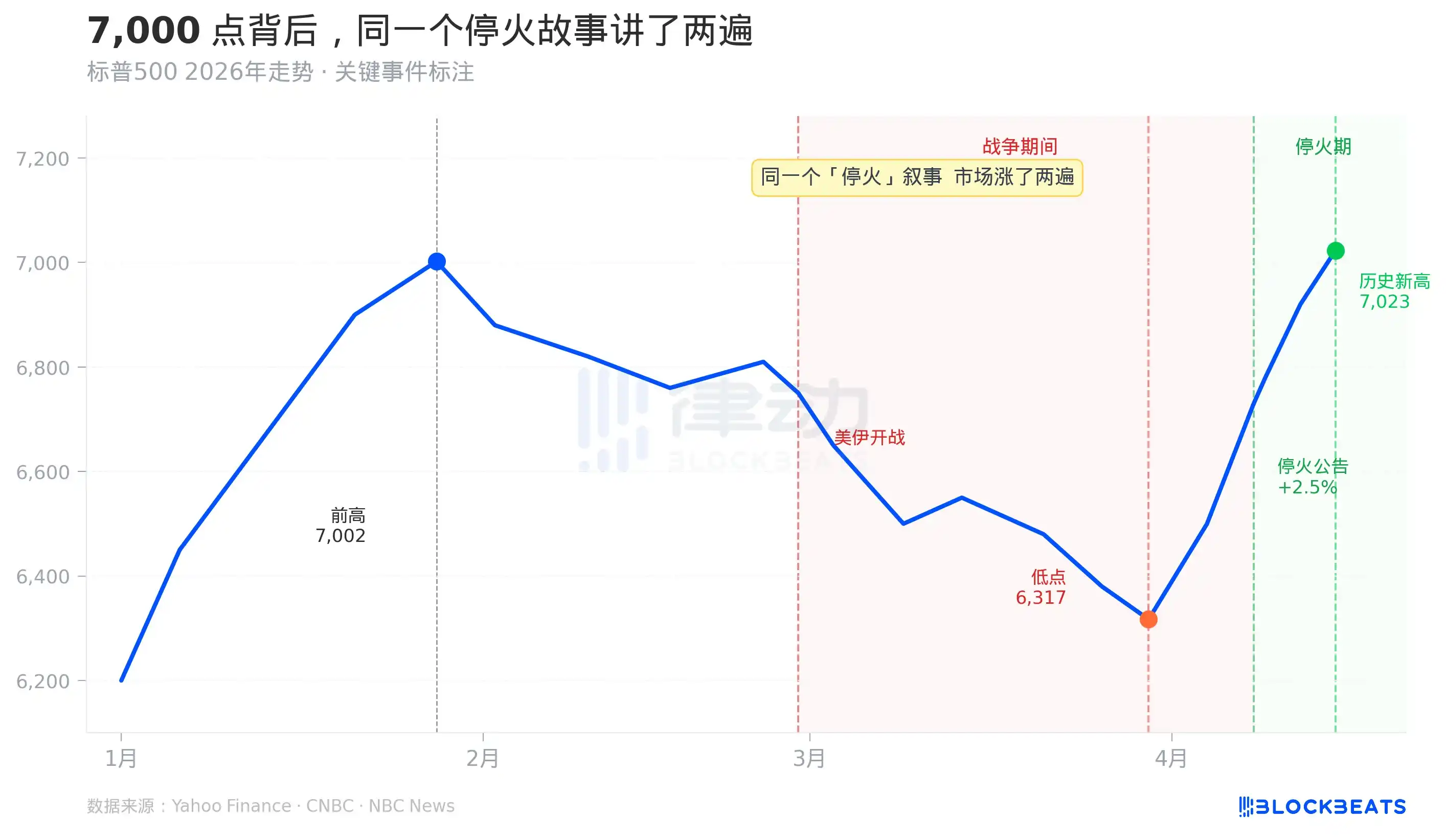
As shown in Chart 1, the two sharp rallies correspond to symmetrical event annotations, both labeled "increased possibility of ceasefire." It rose the first time, and then rose again the second time. As of April 15, when the new record high was set, the two-week temporary ceasefire agreement had not yet expired, and not a word of a permanent peace agreement had been signed.

What scenario is the market pricing in? Not "the end of the war," but "the possibility that the war could end." This expectation was priced—twice.

The Fear Index Is Lower Than Before the War

Even more counterintuitive is the number for the VIX, the index Wall Street uses to measure market panic.

When the war started on February 28, the VIX jumped from around 16 to touch 35.3 intraday on March 9. This aligns with common sense: war is a risk, and the market prices in uncertainty.
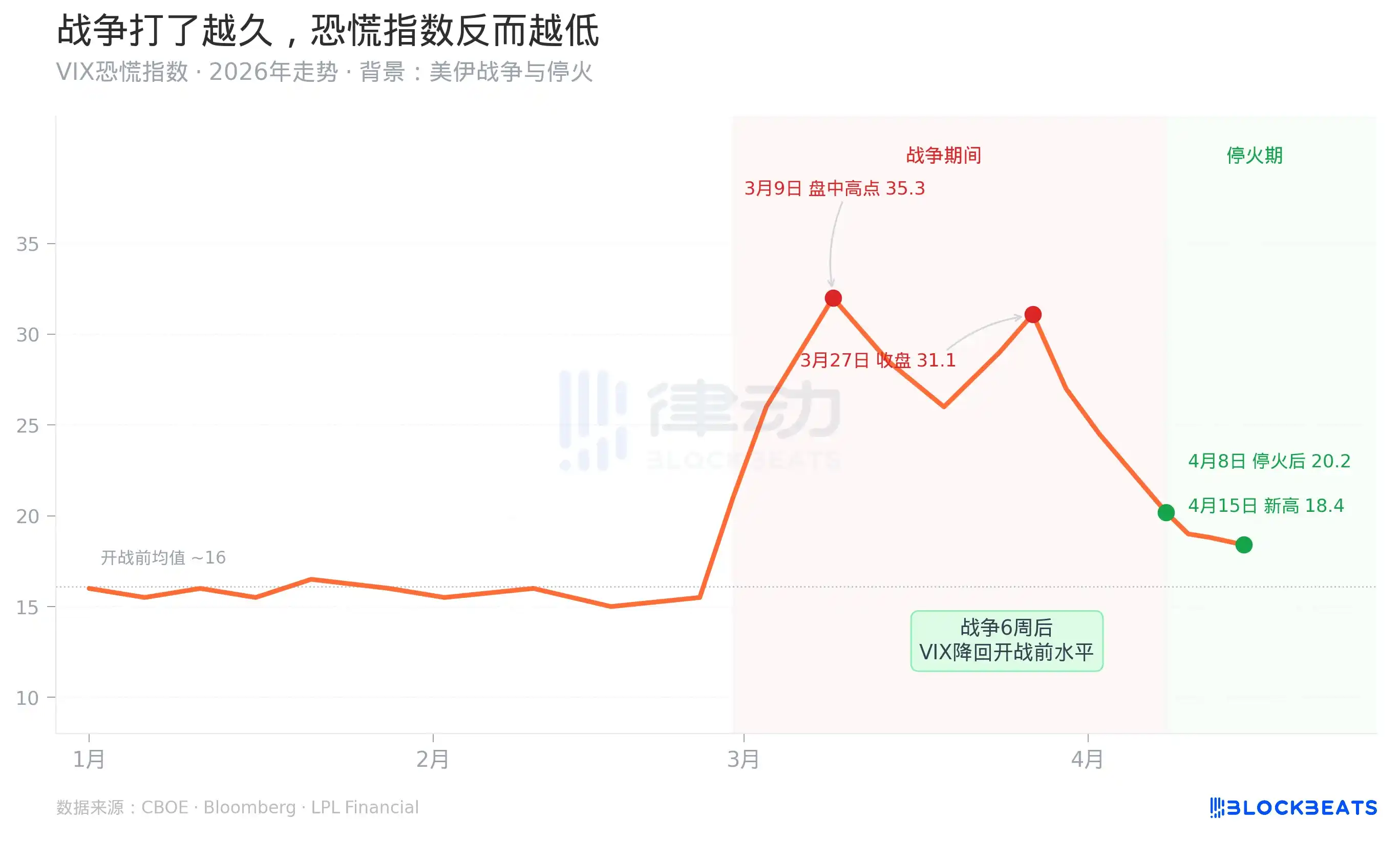
But the subsequent trend defies common sense. Starting from March 9, even as the war continued, oil prices rose, and the Senate voted on whether to authorize war powers, the VIX steadily declined. By April 15, the day the S&P hit its new record high, the VIX closed at around 18.4, lower than its level before the war started on February 28.

What does this mean? It means the market has reclassified this war from a "source of uncertainty" to a "calculable risk." Within six weeks, an ongoing war went from a "panic event" to "quarterly raw material."

This was achieved by a very specific financial mechanism. According to a CNBC report, JPMorgan's Q1 2026 trading division revenue reached $11.6 billion, a historical record, up 20% year-over-year. Fixed income division revenue was $7.1 billion, primarily driven by commodities, currency, and emerging market trading—precisely the areas where the Iran war generated the most "volatility."

In other words, while ordinary investors were feeling fear, professional institutions were harvesting volatility as profit. The more efficiently this mechanism operates, the more inclined the market is to "digest" the war, and the faster the VIX falls.

The Commercialization of Volatility

On April 15, the same day the S&P 500 hit a record high, the Pentagon announced the deployment of an additional 10,000 troops to the Middle East, and the Senate rejected the war powers authorization bill for the fourth time. These two things happened on the same day, and the market had no reaction to them.
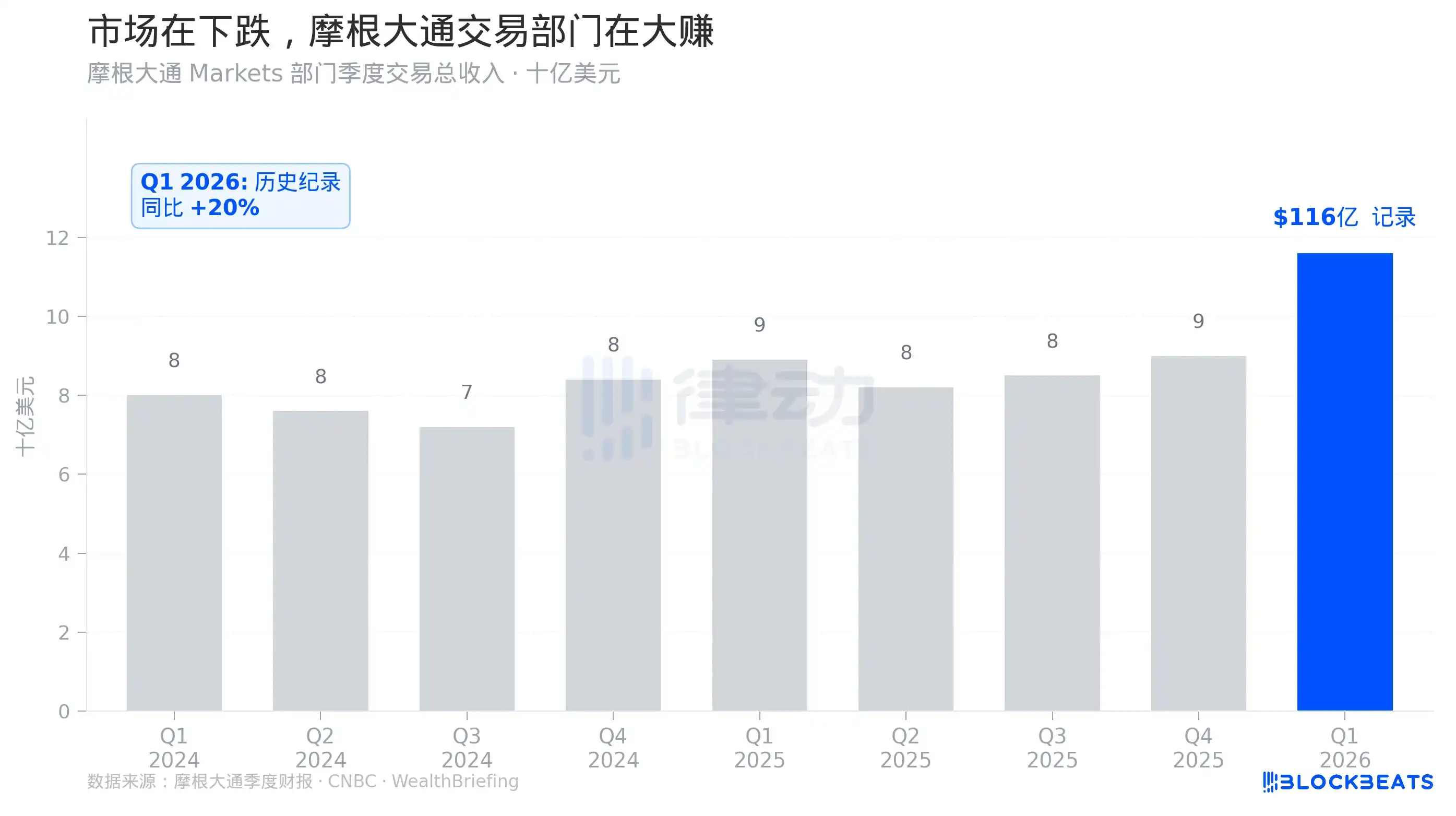
As shown in Chart 4, the bar for JPMorgan's Q1 2026 trading revenue is significantly higher than the previous eight quarters. This isn't a marginal improvement; it's a jump.

Supporting this jump are the profits hedge funds and market makers made from war volatility. According to Goldman Sachs Prime Brokerage data, as of April 14, the net long positions of U.S. hedge funds had turned positive for the first time since the end of 2025. During the same period, according to FINRA data cited by Atwater Malick, U.S. stock margin debt hit a record high of $1.28 trillion, up 36% year-over-year.

Three signals appeared simultaneously: hedge funds shifting from short to long, record leverage, and the market hitting record highs. This is a standard "trading on optimism" pattern.

Understanding this pattern involves looking at the financial infrastructure layer. When Wall Street's market makers, derivatives markets, and hedge funds are sufficiently mature, geopolitical shocks are no longer exogenous, unmeasurable risks but rather raw materials that can be priced, hedged, and commercialized. The Iran war, for JPMorgan's trading desk, is not a threat but an opportunity. The same goes for hedge funds that positioned correctly.

This is the true meaning of the "two screens, two worlds" on April 15. The Pentagon is prolonging the war; the market is pricing the end of the war. These two things are not contradictory because, for market makers, how long the war lasts is not important; whether the volatility is large enough is.

Of course, this mechanism has its fragility. The new high in 11 trading days implies an assumption: the two-week ceasefire will be smoothly extended, Iran nuclear negotiations will proceed as expected, and oil prices will fall. If any of these assumptions prove wrong, there is little buffer in the current pricing. The $1.28 trillion in leveraged funds is also an amplifier on the way down.

7,000 points is a price that only holds in the most optimistic scenario.

Questions liées

QHow many trading days did it take for the S&P 500 to recover to a new all-time high after the Iran War correction, and how does this compare to historical events?

AIt took 11 trading days for the S&P 500 to recover to a new all-time high after the Iran War correction. This is significantly faster than historical events such as the COVID-19 pandemic (103 days), the Gulf War (87 days), the 2011 US debt crisis (106 days), and even the 2022 Russia-Ukraine conflict (18 days).

QWhat was the primary narrative driving the market correction and subsequent rapid recovery during the Iran War event?

AThe primary narrative driving the market correction was 'ceasefire expectations' rather than a deterioration in economic fundamentals. The market fell due to uncertainty, not corporate earnings. When ceasefire news emerged, the uncertainty was quickly priced out, leading to a rapid recovery without the need to wait for quarterly earnings data to rebuild confidence.

QWhat unusual pattern was observed in the VIX (Volatility Index) during the Iran War, and what does it signify?

AThe VIX spiked from around 16 to 35.3 at the start of the war but then steadily declined, closing at approximately 18.4 by April 15—lower than its pre-war level. This indicates that the market rapidly reclassified the war from a source of 'uncertainty' to a 'calculable risk,' effectively commercializing the volatility it generated.

QHow did major financial institutions like JPMorgan perform during Q1 2026, and what was the driver behind this performance?

AJPMorgan's Q1 2026 trading department revenue reached a record $11.6 billion, a 20% year-over-year increase. This was largely driven by its fixed income division, which generated $7.1 billion in revenue from trading commodities, currencies, and emerging markets—areas most affected by the volatility from the Iran War.

QWhat are the potential risks associated with the market's rapid recovery and record-high leverage, as mentioned in the article?

AThe rapid recovery and record-high leverage of $1.28 trillion in margin debt assume optimistic scenarios, such as the temporary ceasefire being extended and Iran nuclear negotiations progressing smoothly. If any of these assumptions fail, the highly leveraged market has little buffer, and the same leverage that amplified gains could exacerbate losses in a downturn.

Lectures associées

Notes de huit ans d'entrepreneuriat du partenaire IA d'a16z

En 2018, bien avant l'émergence du GPT, l'auteur a fondé Rosebud AI avec la vision de rendre la création aussi simple que de jouer à un jeu. Travaillant initialement avec des modèles comme CycleGAN et StyleGAN, il a exploré le potentiel des médias synthétiques et développé des outils créatifs alimentés par l'IA, tels que TokkingHeads, qui a atteint plus de 2 millions d'utilisateurs. Au cours de ces 8 ans, l'accent a été mis sur la conception d'expériences utilisateur qui masquent les limitations des modèles précoces, en misant sur des solutions "approximatives mais utilisables". La pandémie et les crises bancaires ont rappelé la fragilité de l'écosystème, mais aussi le privilège de pouvoir innover. Avec l'avènement du GPT-4 en 2023, la génération de code est devenue suffisamment mature pour permettre la création des jeux via prompt. L'auteur souligne que les jeux représentent un terrain idéal pour l'IA générative, car ils combinent intuition créative et technicalité, tout en restant en dehors des priorités immédiates des grands labos de recherche. Aujourd’hui, l'auteur rejoint a16z en tant que partenaire pour investir dans la pile de modèles frontière et les infrastructures d'IA. Il passe le flambeau de Rosebud AI à un nouveau CEO, tout en restant convaincu que la prochaine phase de l'IA générative ne dépendra pas seulement des avancées techniques, mais de leur intégration produit, distribution et monétisation dans le monde réel.

marsbitIl y a 46 mins

Notes de huit ans d'entrepreneuriat du partenaire IA d'a16z

marsbitIl y a 46 mins

Turbulences sur le marché crypto : qui achète à contre-courant ?

Le marché crypto a connu une correction sévère au premier trimestre 2026, avec Bitcoin en baisse de plus de 25 % et Ethereum de 35 %. Pourtant, les flux institutionnels sont restés robustes, marqués par une forte dichotomie. Les acheteurs institutionnels ont été actifs : Strategy (ex-MicroStrategy) a accru ses réserves de Bitcoin pour atteindre 815 061 BTC, tandis que des fonds souverains comme Mubadala ont augmenté leurs positions dans les ETF Bitcoin. Plusieurs nouveaux ETF ont été lancés, notamment par Morgan Stanley (MSBT, premier ETF Bitcoin d'une grande banque) et BlackRock (ETHB, premier ETF de staking d'Ethereum). Les banques européennes ont formé un consortium pour un stablecoin euro (Qivalos), et des institutions comme UBS et Citi ont élargi leurs services crypto. À l’inverse, certains hedge funds (Brevan Howard, Tudor) et mineurs ont massivement vendu. Les investissements en capital-risque ont chuté de 49 % en nombre de transactions, mais trois méga-deals (BVNK, Kalshi, Polymarket) ont représenté la moitié des fonds levés (environ 34 milliards de dollars). Les secteurs dominants sont les paiements/stablecoins et les marchés prédictifs, supplantant la DeFi. En résumé, l’accumulation institutionnelle se poursuit, portée par les trésoreries d’entreprise, les fonds souverains et les nouveaux produits ETF, tandis que le risque se concentre sur quelques acteurs majeurs.

marsbitIl y a 3 h

Turbulences sur le marché crypto : qui achète à contre-courant ?

marsbitIl y a 3 h

Test pratique de Hunyuan Hy3 preview : L'IA de Tencent est-elle enfin compétitive ?

Le modèle de langage Hy3 preview de Tencent, récemment lancé en open source, présente des capacités améliorées en raisonnement complexe, génération de code, compréhension contextuelle et interaction naturelle. Avec 295 milliards de paramètres et une prise en charge de contexte jusqu'à 256K, il est présenté comme le modèle le plus performant de la série Hunyuan. Les tests montrent des forces dans le raisonnement logique structuré et l'extraction d'informations en contexte bruité, mais une certaine instabilité face aux pièges logiques ou aux questions ambiguës. En génération de code et en tant qu'agent intelligent (via WorkBuddy), il excède dans les tâches simples et fermées (comme créer un jeu Snake) mais peine à mener à bien des missions complexes nécessitant une analyse approfondie et une livraison complète de résultats. Ses progrès les plus notables concernent le dialogue naturel et l'écriture créative, où il produit des textes fluides, moins stéréotypés et mieux contextualisés, imitant même des styles littéraires spécifiques avec succès. Bien que Hy3 preview ne soit pas révolutionnaire dans tous les domaines, il se positionne comme un modèle pratique et polyvalent. Son lancement marque un virage important pour Tencent, qui cherche à rattraper son retard perçu dans la course à l'IA et à intégrer un modèle performant dans son écosystème de produits (QQ, Tencent Docs, etc.). Une version plus grande est attendue prochainement.

marsbitIl y a 5 h

Test pratique de Hunyuan Hy3 preview : L'IA de Tencent est-elle enfin compétitive ?

marsbitIl y a 5 h

Trading

Spot
Futures

Articles tendance

Comment acheter WAR

Bienvenue sur HTX.com ! Nous vous permettons d'acheter WAR (WAR) de manière simple et pratique. Suivez notre guide étape par étape pour commencer votre parcours crypto.Étape 1 : Création de votre compte HTXUtilisez votre adresse e-mail ou votre numéro de téléphone pour ouvrir un compte sur HTX gratuitement. L'inscription se fait en toute simplicité et débloque toutes les fonctionnalités.Créer mon compteÉtape 2 : Choix du mode de paiement (rubrique Acheter des cryptosCarte de crédit/débit : utilisez votre carte Visa ou Mastercard pour acheter instantanément WAR (WAR).Solde :utilisez les fonds du solde de votre compte HTX pour trader en toute simplicité.Prestataire tiers :pour accroître la commodité d'utilisation, nous avons ajouté des modes de paiement populaires tels que Google Pay et Apple Pay.P2P :tradez directement avec d'autres utilisateurs sur HTX.OTC (de gré à gré) : nous offrons des services personnalisés et des taux de change compétitifs aux traders.Étape 3 : stockage de vos WAR (WAR)Après avoir acheté vos WAR (WAR), stockez-les sur votre compte HTX. Vous pouvez également les envoyer ailleurs via un transfert sur la blockchain ou les utiliser pour trader d'autres cryptos.Étape 4 : tradez des WAR (WAR)Tradez facilement WAR (WAR) sur le marché Spot de HTX. Il vous suffit d'accéder à votre compte, de sélectionner la paire de trading, d'exécuter vos trades et de les suivre en temps réel. Nous offrons une expérience conviviale aux débutants comme aux traders chevronnés.

479 vues totalesPublié le 2024.12.11Mis à jour le 2026.04.23

Comment acheter WAR

Discussions

Bienvenue dans la Communauté HTX. Ici, vous pouvez vous tenir informé(e) des derniers développements de la plateforme et accéder à des analyses de marché professionnelles. Les opinions des utilisateurs sur le prix de WAR (WAR) sont présentées ci-dessous.

活动图片













