Trump's Crypto Craze: Who's Celebrating and Who's Paying the Price?

比推Publié le 2025-12-18Dernière mise à jour le 2025-12-18

Résumé

Former President Donald Trump's embrace of cryptocurrency has triggered a wave of speculative investments and regulatory shifts, creating both opportunities and significant risks. Dubbed the "Crypto Treasury Company Summer," this trend saw over 250 public companies, many with little experience, pivot to hoarding cryptocurrencies like Bitcoin and meme coins, often using heavy leverage. However, including firms linked to Trump’s associates and family—such as Anthony Scaramucci and Trump’s son Eric—suffered severe losses, with some stock prices plunging over 80% during a market crash in October. The crash exposed vulnerabilities: high leverage, volatile prices, and technical failures at major exchanges like Coinbase left investors stranded during a $19 billion liquidation event. Meanwhile, new products like tokenized stocks—promoted by startups like Plume and Kraken—aim to merge crypto with traditional finance but face regulatory uncertainty. Critics, including former Treasury officials, warn that the blurring of speculation and investment could threaten financial stability, while the SEC expresses concern but also openness to innovation under Trump’s pro-crypto policies.

Authors: David Yaffe-Bellany and Eric Lipton, The New York Times

Compiled by: Chopper, Foresight News

Original Title: The New York Times: The Untold Story Behind Trump's Embrace of Cryptocurrency


This summer, a group of corporate executives pitched a business plan to Wall Street financier and former Trump advisor Anthony Scaramucci. They wanted Scaramucci to join a publicly traded company with a unique strategy: boosting the company's appeal to investors by hoarding massive amounts of cryptocurrency assets.

"They didn't really have to say much," Scaramucci recalled. Soon after, he joined three little-known companies adopting this strategy as an advisor. "The whole negotiation process went very smoothly."

However, the frenzy didn't last long. This fall, the cryptocurrency market crashed, and the stock prices of the three companies Scaramucci was involved with plummeted, with the worst performer dropping over 80%.

The rise and fall of these companies is a microcosm of the cryptocurrency craze ignited by Trump. The self-proclaimed "first cryptocurrency president" not only ended the regulatory crackdown on cryptocurrency companies but also publicly endorsed cryptocurrency investments at the White House, signed bills supporting cryptocurrency development, and even issued a meme coin named TRUMP, thrusting this once-niche field into the spotlight of the global economy.

Now, the ripple effects of Trump's strong support for cryptocurrency are gradually becoming apparent.

This year, a large number of new cryptocurrency ventures pushing the boundaries of the industry have emerged, drawing more people into this highly volatile market. Currently, over 250 publicly traded companies have begun hoarding cryptocurrencies—digital assets whose price volatility is no different from traditional investments like stocks and bonds.
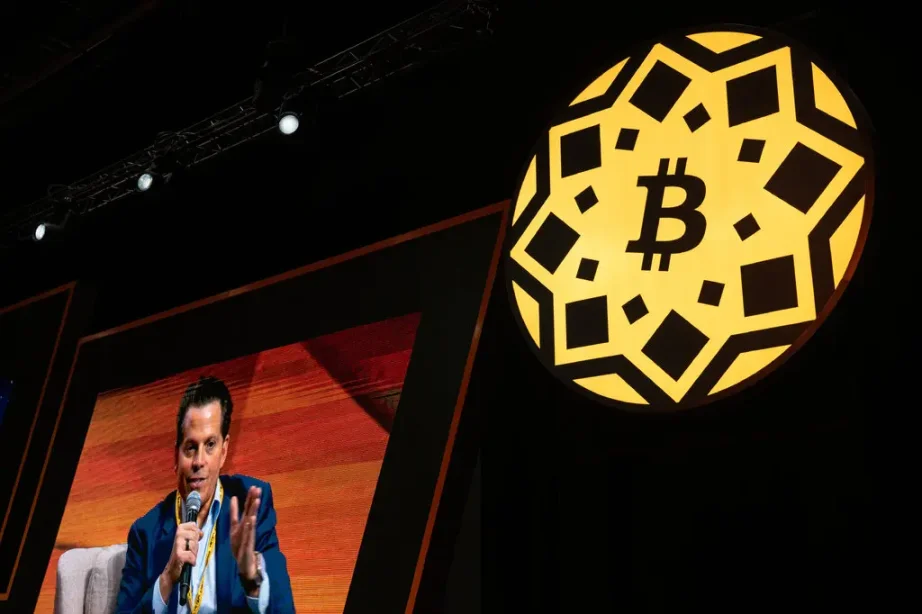
2024: Former Trump advisor Anthony Scaramucci attends the UAE Bitcoin Conference

A wave of companies has顺势 launched innovative products, lowering the barrier to including cryptocurrencies in brokerage accounts and retirement plans. Meanwhile, industry executives are lobbying regulators, planning to issue crypto tokens pegged to publicly traded company stocks, creating a stock trading market based on encryption technology.

This radical innovation wave has already exposed numerous problems. Over the past two months, the prices of mainstream cryptocurrencies have plummeted, causing companies heavily invested in crypto assets to face a crash crisis. Other emerging projects have also raised warnings from economists and regulators, as market risks continue to accumulate.

The core concern triggering各方担忧 is the continuous膨胀 of borrowing规模. By this fall, publicly traded companies had borrowed heavily to purchase cryptocurrencies; investors' futures contract holdings for cryptocurrencies exceeded $200 billion, with most of these trades relying on leveraged funds, which can bring huge profits but also hide the risk of liquidation.

More alarmingly, a series of new initiatives in the cryptocurrency industry have deeply tied the crypto market to the stock market and other financial sectors. Once a crisis erupts in the cryptocurrency market, the risk could spread to the entire financial system, causing a chain reaction.

"Now, the line between speculation, gambling, and investment has become blurred," said Timothy Massad, who served as Assistant Secretary of the Treasury for Financial Stability after the 2008 financial crisis. "This current state deeply worries me."

White House Press Secretary Karoline Leavitt responded that Trump's policies are "making the United States a global cryptocurrency hub by driving innovation and creating economic opportunities for all Americans."

Cryptocurrency industry executives argue that these emerging projects demonstrate the potential of encryption technology to reshape the outdated financial system. In their view, market volatility is precisely an opportunity for profit.

"High risk often comes with high reward," said Duncan Moir, president of 21Shares, which issues cryptocurrency investment products. "Our mission is to bring these investment opportunities to more people."

The rise of this innovation wave is inseparable from the comprehensive relaxation of the regulatory environment, making this the most friendly regulatory window for cryptocurrency companies. For many years prior, the U.S. Securities and Exchange Commission (SEC) had been in court battles with the cryptocurrency industry; but in January of this year, the agency established a dedicated cryptocurrency task force and has held meetings with dozens of companies seeking new regulations or product上市许可.

An SEC spokesperson stated that the agency is committed to "ensuring investors have sufficient information to make rational investment decisions."

U.S. Securities and Exchange Commission headquarters building in Washington, D.C.

Notably, many of these emerging companies are connected to the Trump family's expanding cryptocurrency business empire, a connection that has blurred the lines between business and government.

This summer, executives from Trump's cryptocurrency startup World Liberty Financial announced they would join the board of the publicly traded company ALT5 Sigma. This company, originally in the recycling business, now plans to raise $1.5 billion to enter the cryptocurrency market.

Capital Frenzy: An Out-of-Control Crypto Gamble

Cryptocurrency enthusiasts have named the high-risk investment frenzy催生 by the Trump administration the "Summer of Crypto Treasury Companies."

A Digital Asset Treasury (DAT) company is a publicly traded company whose core goal is to hoard cryptocurrency. Data from cryptocurrency consulting firm Architect Partners shows that among these emerging companies, nearly half focus on囤积 Bitcoin, the most well-known cryptocurrency, while dozens of others have announced plans to purchase non-mainstream coins like Dogecoin.
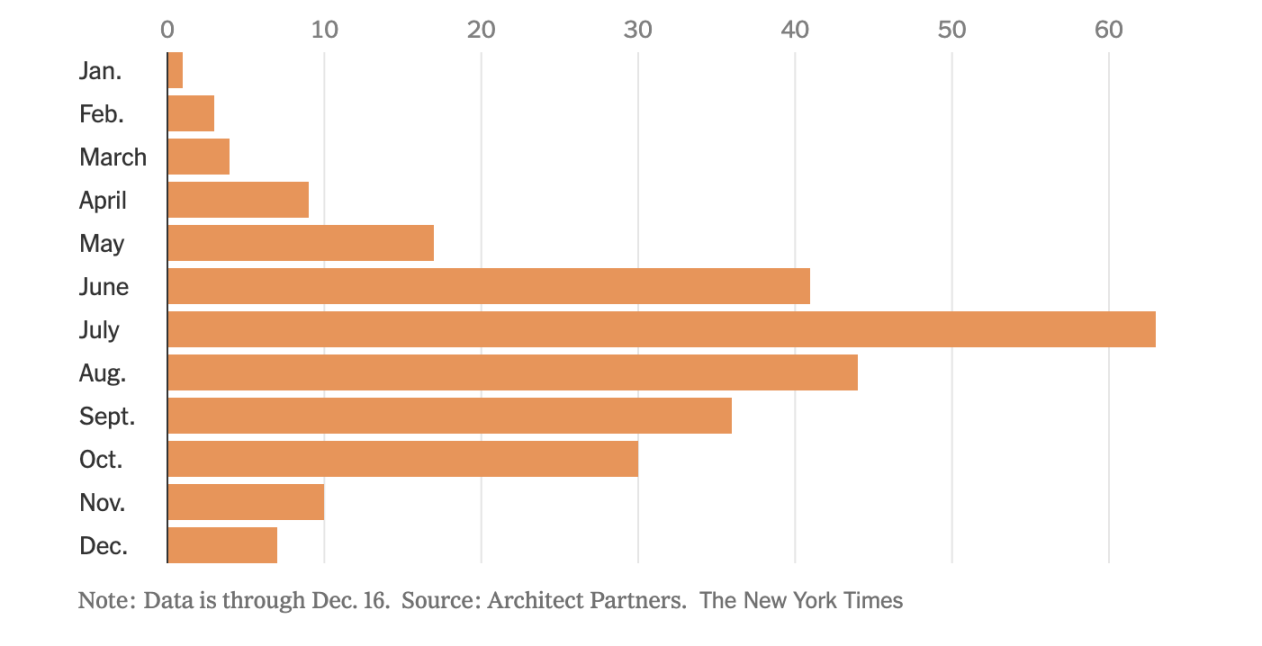
Number of Crypto Treasury Companies established each month in 2025. Source: Architect Partners, statistics as of December 16th.

The operating model of these companies is often straightforward: a group of executives identifies a small company trading on the public market (e.g., a toy manufacturer), persuades it to转型 into a cryptocurrency hoarding business; then partners with the company to raise hundreds of millions of dollars from high-net-worth investors, ultimately using the funds to purchase cryptocurrency.

The core purpose is to allow more people to participate in cryptocurrency investment by issuing traditional stocks that track the price of cryptocurrency. This strategy theoretically has considerable profit potential. Many investment funds and asset management institutions have been hesitant to invest directly in cryptocurrencies due to the complex and costly storage process and vulnerability to hacker attacks.

Investing in a crypto treasury company is equivalent to outsourcing the storage and other logistical work of cryptocurrencies. But these companies also隐藏巨大风险: Many are hastily established, and their management lacks experience in operating public companies. Data from Architect Partners shows these companies have collectively announced plans to borrow over $20 billion to purchase cryptocurrencies.

"Leverage is the primary culprit behind financial crises," warned Corey Frayer, a former SEC cryptocurrency advisor. "And the current market is generating a massive amount of leverage."

Some crypto treasury companies have already encountered operational difficulties or management crises, causing investors to suffer huge losses.

The publicly traded company Forward Industries转型 into a crypto treasury company and heavily invested in SOL. In September, the company raised over $1.6 billion from private investors, and its stock price一度飙升至 nearly $40 per share.

Allan Teh from Miami, who manages assets for a family office, invested $2.5 million in Forward Industries this year. "At that time, everyone thought this strategy was foolproof, and crypto asset prices would keep rising," Allan Teh recalled.

However, as the cryptocurrency market crashed, Forward Industries' stock price fell to $7 per share this month. The company announced plans to spend $1 billion to repurchase shares over the next two years, but this move failed to stop the stock's decline.

"The music stopped, the game is over. Now I'm starting to panic. Can I get out unscathed?" Allan Teh has lost about $1.5 million. "How much will this investment ultimately lose?" Forward Industries declined to comment.

The proliferation of crypto treasury companies has alerted the SEC. "Clearly, we are very worried about this," said the agency's Chairman, Paul Atkins, in an interview last month at a cryptocurrency conference in Miami. "We are closely monitoring the developments."

And behind this new cryptocurrency track lies the powerful support of the Trump family.

World Liberty Financial's founders include Trump's son Eric Trump and Zach Witkoff

In August, World Liberty Financial announced that its founders (including the president's son, Eric Trump) would join the board of ALT5 Sigma. This publicly traded company plans to囤积 the加密代币 WLFI issued by World Liberty Financial (Eric Trump's current title is Strategic Advisor and Board Observer).

This collaboration seemed poised to quickly profit the Trump family. According to the revenue-sharing agreement published on World Liberty Financial's website, commercial entities owned by the Trump family receive a cut whenever WLFI tokens are traded.

Subsequently, ALT5 Sigma's business took a turn for the worse. In August, the company disclosed that an executive of a subsidiary had been convicted of money laundering in Rwanda, and the board was investigating other "undisclosed matters." Soon after, ALT5 Sigma announced the suspension of its CEO and terminated contracts with two other executives.

Since August, the company's stock price has plummeted 85%. An ALT5 Sigma spokesperson said the company "remains confident about its future development."

Flash Crash: A Trillion in Market Value Vanishs Overnight

The recent turmoil in the cryptocurrency market can be traced back to one night in October.

Driven by Trump's policies, the cryptocurrency market had been rising for most of this year. But on October 10th, the prices of Bitcoin, Ethereum, and dozens of other cryptocurrencies collectively暴跌,上演了一场 flash crash.

The immediate trigger for this crash was Trump's announcement of new tariffs on China, a move that caused剧烈震荡 in the global economy. The reason the cryptocurrency market was hit so hard lies in the huge amount of leveraged funds that drove the market up.

On cryptocurrency trading platforms, traders can use their held crypto assets as collateral to borrow fiat currency or use leveraged funds to increase their cryptocurrency investment positions. Data from cryptocurrency data firm Galaxy Research shows that in the third quarter of this year, global cryptocurrency lending规模 grew by $20 billion in a single quarter, reaching a historical peak of $74 billion.

Previously, the riskiest cryptocurrency leverage trading mostly occurred in overseas markets. But in July of this year, the largest U.S. cryptocurrency exchange, Coinbase, announced the launch of a new investment tool allowing traders to bet on Bitcoin and Ethereum futures prices with 10x leverage. Prior to this, U.S. federal regulators had revoked guidance restricting such leveraged trading, giving Coinbase's new product the green light.

In July of this year, Coinbase exchange launched a 10x leverage cryptocurrency trading tool

The flash crash in October, while not causing an industry catastrophe like the bankruptcy of several large cryptocurrency companies in 2022, served as a wake-up call for the market, signaling the potential systemic crisis lurking in the cryptocurrency领域.

The nature of leveraged trading is that when the market falls, losses are magnified. Trading platforms will force liquidate, selling clients' collateral assets, a process that often further exacerbates price declines.

Data from cryptocurrency data firm CoinGlass shows that on October 10th alone, at least $19 billion worth of cryptocurrency leveraged trades were forcibly liquidated globally, affecting 1.6 million traders. This wave of liquidations was concentrated on platforms like Binance, OKX, and Bybit.

The crash caused a surge in trading volume, and several major exchanges experienced technical failures, preventing traders from transferring funds promptly. Coinbase stated it was "aware that some users experienced delays or degraded system performance while trading."

Derek Bartron, a software developer from Tennessee and also a cryptocurrency investor, said his Coinbase account was frozen during the flash crash. "I wanted to close my position and exit, but there was no way to operate," Derek Bartron said. "Coinbase effectively locked users' funds. We could only watch helplessly as asset values plummeted."

Derek Bartron said that in the days following the flash crash, his cryptocurrency assets lost about $50,000, partly because he couldn't close positions in time to stop losses.

A Coinbase spokesperson responded that the company provides automated risk management tools, "These tools functioned normally during this market volatility, and our exchange remained stable and operational throughout the event."

A Binance spokesperson admitted the exchange "experienced technical issues due to a surge in trading volume" and said measures had been taken to compensate affected users.

Crazy Experiment: The Regulatory Dilemma of the Tokenization Wave

One night this summer, cryptocurrency entrepreneurs Chris Yin and Teddy Pornprinya, dressed in formal wear, appeared at the Kennedy Center in Washington, D.C., attending a grand black-tie dinner.

The dinner was star-studded. Chris Yin, in a tuxedo bought the night before, met U.S. Vice President JD Vance, who had previously been involved in Silicon Valley venture capital; he and Teddy Pornprinya also exchanged words with former hedge fund manager and current U.S. Treasury Secretary Scott Bessent; they even took a photo with Trump, with the president giving a thumbs up to the camera.

Chris Yin and Teddy Pornprinya were there to pave the way for their startup, Plume. This company is advancing an industry-disrupting innovation plan, attempting to expand the underlying technology of cryptocurrency to a broader financial领域.

For months, Plume has been seeking permission from U.S. regulators to build an online trading platform to issue crypto tokens to clients pegged to real-world assets, covering everything from publicly traded company stocks to farms and oil wells.

Plume founders Chris Yin and Teddy Pornprinya pose for a photo at the Empire State Building

Currently, Plume has launched such tokenized products in overseas markets, where clients can buy and sell these asset tokens like cryptocurrencies. But this business, known as asset tokenization, exists in a legal gray area in the United States. Securities laws enacted decades ago impose strict regulatory rules on the issuance of equity in various assets, requiring issuers to disclose detailed information to protect investor rights.

This year, asset tokenization has become the hottest concept in the cryptocurrency industry. Industry executives claim that tokenized stocks can make stock trading more efficient and faster, creating a 24/7 global trading market. The major U.S. cryptocurrency exchange Kraken has already launched crypto-based stock trading services for clients in overseas markets.

Cryptocurrency industry executives say that cryptocurrency transactions are recorded on a public ledger, making them more transparent than the traditional financial system. "All transactions are traceable and auditable," said Kraken CEO Arjun Sethi. "It carries almost no risk."

Representatives from Kraken and Coinbase have met with the SEC to discuss regulatory rules for tokenized assets; meanwhile, Plume is also seeking a legal path to expand its business in the United States.

But this race for tokenized products has raised concerns among current and former regulatory officials, as well as executives of traditional financial giants.

In September of this year, Federal Reserve economists warned that asset tokenization could lead to the transmission of risks from the cryptocurrency market to the entire financial system, "weakening policymakers' ability to maintain the stability of the payment system during times of market stress."

SEC Chairman Paul Atkins, however, has a positive attitude towards tokenized stocks, calling them a "major technological breakthrough." "Under the securities laws, the Commission has broad discretion to provide regulatory support for the cryptocurrency industry. I am determined to push this work forward," Atkins said at a roundtable meeting on asset tokenization in May.

To promote the compliance of their company's business, Chris Yin and Teddy Pornprinya took a series of measures. In May, the two met with the SEC's cryptocurrency task force; they also provided chart support for the White House's cryptocurrency industry report; and established Plume's U.S. headquarters on the 77th floor of the Empire State Building.

At that black-tie dinner in Washington this summer, Trump's team showed great interest in the two founders. "They knew about Plume," Teddy Pornprinya recalled. "Everyone was somewhat aware of our business."

A few weeks later, Plume announced a key partnership, establishing a business relationship with the Trump family's World Liberty Financial.


Twitter:https://twitter.com/BitpushNewsCN

Bitpush TG Discussion Group:https://t.me/BitPushCommunity

Bitpush TG Subscription: https://t.me/bitpush

Original article link:https://www.bitpush.news/articles/7596713

Questions liées

QWhat is the main concern raised by the New York Times article regarding the cryptocurrency boom under Trump's influence?

AThe article raises concerns about the high risks associated with the cryptocurrency boom, including excessive leverage, market volatility, potential systemic risks to the broader financial system, and the blurring lines between speculation, gambling, and investment.

QHow did Anthony Scaramucci get involved in the cryptocurrency 'treasury company' trend, and what was the outcome?

AAnthony Scaramucci was quickly persuaded to join three little-known companies adopting a strategy of hoarding large amounts of cryptocurrency to attract investors. However, the trend did not last long, and the value of these companies plummeted, with the worst-performing one dropping over 80% after a market crash in the fall.

QWhat role did leverage play in the cryptocurrency market flash crash in October, as described in the article?

ALeverage significantly amplified the October flash crash. Traders used borrowed money to magnify their crypto bets. When prices fell, exchanges forced the sale of collateral assets, triggering a cascade of liquidations worth $19 billion that exacerbated the price decline and caused technical issues on major platforms.

QWhat is 'asset tokenization' as promoted by companies like Plume and Kraken, and why is it a regulatory concern?

AAsset tokenization involves creating cryptocurrency tokens that represent real-world assets like company stocks or real estate. It's a regulatory concern because it operates in a legal gray area in the U.S., potentially bypassing decades-old securities laws designed to protect investors through disclosure, and could transmit risks from the crypto market to the wider financial system.

QHow is the Trump family's business, World Liberty Financial, connected to the cryptocurrency companies discussed in the article?

AWorld Liberty Financial, founded by Eric Trump and Zach Witkoff, is connected to the cryptocurrency trend through its partnership with the public company ALT5 Sigma. ALT5 Sigma planned to hoard World Liberty's WLFI token, a move from which the Trump family's business entities stood to earn fees. Furthermore, World Liberty also established a business partnership with the tokenization startup Plume.

Lectures associées

Trading

Spot
Futures

Articles tendance

Qu'est ce que $S$

Comprendre SPERO : Un aperçu complet Introduction à SPERO Alors que le paysage de l'innovation continue d'évoluer, l'émergence des technologies web3 et des projets de cryptomonnaie joue un rôle central dans la façon dont se dessine l'avenir numérique. Un projet qui a attiré l'attention dans ce domaine dynamique est SPERO, désigné comme SPERO,$$s$. Cet article vise à rassembler et à présenter des informations détaillées sur SPERO, afin d'aider les passionnés et les investisseurs à comprendre ses fondations, ses objectifs et ses innovations dans les domaines du web3 et de la crypto. Qu'est-ce que SPERO,$$s$ ? SPERO,$$s$ est un projet unique dans l'espace crypto qui cherche à tirer parti des principes de décentralisation et de la technologie blockchain pour créer un écosystème qui favorise l'engagement, l'utilité et l'inclusion financière. Le projet est conçu pour faciliter les interactions entre pairs de nouvelles manières, offrant aux utilisateurs des solutions et des services financiers innovants. Au cœur de SPERO,$$s$, l'objectif est d'autonomiser les individus en fournissant des outils et des plateformes qui améliorent l'expérience utilisateur dans l'espace des cryptomonnaies. Cela inclut la possibilité de méthodes de transaction plus flexibles, la promotion d'initiatives dirigées par la communauté et la création de voies pour des opportunités financières via des applications décentralisées (dApps). La vision sous-jacente de SPERO,$$s$ tourne autour de l'inclusivité, visant à combler les lacunes au sein de la finance traditionnelle tout en exploitant les avantages de la technologie blockchain. Qui est le créateur de SPERO,$$s$ ? L'identité du créateur de SPERO,$$s$ reste quelque peu obscure, car il existe peu de ressources publiques fournissant des informations détaillées sur son ou ses fondateurs. Ce manque de transparence peut découler de l'engagement du projet envers la décentralisation—une éthique que de nombreux projets web3 partagent, privilégiant les contributions collectives plutôt que la reconnaissance individuelle. En centrant les discussions autour de la communauté et de ses objectifs collectifs, SPERO,$$s$ incarne l'essence de l'autonomisation sans désigner des individus spécifiques. Ainsi, comprendre l'éthique et la mission de SPERO reste plus important que d'identifier un créateur unique. Qui sont les investisseurs de SPERO,$$s$ ? SPERO,$$s$ est soutenu par une diversité d'investisseurs allant des capital-risqueurs aux investisseurs providentiels dédiés à favoriser l'innovation dans le secteur crypto. L'objectif de ces investisseurs s'aligne généralement avec la mission de SPERO—priorisant les projets qui promettent des avancées technologiques sociétales, l'inclusivité financière et la gouvernance décentralisée. Ces fondations d'investisseurs s'intéressent généralement à des projets qui non seulement offrent des produits innovants, mais qui contribuent également positivement à la communauté blockchain et à ses écosystèmes. Le soutien de ces investisseurs renforce SPERO,$$s$ en tant que concurrent notable dans le domaine en rapide évolution des projets crypto. Comment fonctionne SPERO,$$s$ ? SPERO,$$s$ utilise un cadre multifacette qui le distingue des projets de cryptomonnaie conventionnels. Voici quelques-unes des caractéristiques clés qui soulignent son unicité et son innovation : Gouvernance décentralisée : SPERO,$$s$ intègre des modèles de gouvernance décentralisée, permettant aux utilisateurs de participer activement aux processus de décision concernant l'avenir du projet. Cette approche favorise un sentiment de propriété et de responsabilité parmi les membres de la communauté. Utilité du token : SPERO,$$s$ utilise son propre token de cryptomonnaie, conçu pour servir diverses fonctions au sein de l'écosystème. Ces tokens permettent des transactions, des récompenses et la facilitation des services offerts sur la plateforme, améliorant ainsi l'engagement et l'utilité globaux. Architecture en couches : L'architecture technique de SPERO,$$s$ supporte la modularité et l'évolutivité, permettant une intégration fluide de fonctionnalités et d'applications supplémentaires à mesure que le projet évolue. Cette adaptabilité est primordiale pour maintenir la pertinence dans le paysage crypto en constante évolution. Engagement communautaire : Le projet met l'accent sur des initiatives dirigées par la communauté, utilisant des mécanismes qui incitent à la collaboration et aux retours d'expérience. En cultivant une communauté forte, SPERO,$$s$ peut mieux répondre aux besoins des utilisateurs et s'adapter aux tendances du marché. Accent sur l'inclusion : En proposant des frais de transaction bas et des interfaces conviviales, SPERO,$$s$ vise à attirer une base d'utilisateurs diversifiée, y compris des individus qui n'ont peut-être pas engagé auparavant dans l'espace crypto. Cet engagement envers l'inclusion s'aligne avec sa mission globale d'autonomisation par l'accessibilité. Chronologie de SPERO,$$s$ Comprendre l'histoire d'un projet fournit des aperçus cruciaux sur sa trajectoire de développement et ses jalons. Voici une chronologie suggérée cartographiant les événements significatifs dans l'évolution de SPERO,$$s$ : Phase de conceptualisation et d'idéation : Les idées initiales formant la base de SPERO,$$s$ ont été conçues, s'alignant étroitement avec les principes de décentralisation et de concentration sur la communauté au sein de l'industrie blockchain. Lancement du livre blanc du projet : Suite à la phase conceptuelle, un livre blanc complet détaillant la vision, les objectifs et l'infrastructure technologique de SPERO,$$s$ a été publié pour susciter l'intérêt et les retours de la communauté. Construction de la communauté et engagements précoces : Des efforts de sensibilisation actifs ont été entrepris pour construire une communauté d'adopteurs précoces et d'investisseurs potentiels, facilitant les discussions autour des objectifs du projet et recueillant du soutien. Événement de génération de tokens : SPERO,$$s$ a organisé un événement de génération de tokens (TGE) pour distribuer ses tokens natifs aux premiers soutiens et établir une liquidité initiale au sein de l'écosystème. Lancement de la première dApp : La première application décentralisée (dApp) associée à SPERO,$$s$ a été mise en ligne, permettant aux utilisateurs d'interagir avec les fonctionnalités principales de la plateforme. Développement continu et partenariats : Des mises à jour et des améliorations continues des offres du projet, y compris des partenariats stratégiques avec d'autres acteurs de l'espace blockchain, ont façonné SPERO,$$s$ en un acteur compétitif et évolutif sur le marché crypto. Conclusion SPERO,$$s$ se dresse comme un témoignage du potentiel du web3 et de la cryptomonnaie pour révolutionner les systèmes financiers et autonomiser les individus. Avec un engagement envers la gouvernance décentralisée, l'engagement communautaire et des fonctionnalités conçues de manière innovante, il ouvre la voie vers un paysage financier plus inclusif. Comme pour tout investissement dans l'espace crypto en rapide évolution, les investisseurs et utilisateurs potentiels sont encouragés à mener des recherches approfondies et à s'engager de manière réfléchie avec les développements en cours au sein de SPERO,$$s$. Le projet illustre l'esprit d'innovation de l'industrie crypto, invitant à une exploration plus approfondie de ses nombreuses possibilités. Bien que le parcours de SPERO,$$s$ soit encore en cours, ses principes fondamentaux pourraient en effet influencer l'avenir de nos interactions avec la technologie, la finance et entre nous dans des écosystèmes numériques interconnectés.

101 vues totalesPublié le 2024.12.17Mis à jour le 2024.12.17

Qu'est ce que $S$

Qu'est ce que AGENT S

Agent S : L'avenir de l'interaction autonome dans Web3 Introduction Dans le paysage en constante évolution de Web3 et des cryptomonnaies, les innovations redéfinissent constamment la manière dont les individus interagissent avec les plateformes numériques. Un projet pionnier, Agent S, promet de révolutionner l'interaction homme-machine grâce à son cadre agentique ouvert. En ouvrant la voie à des interactions autonomes, Agent S vise à simplifier des tâches complexes, offrant des applications transformantes dans l'intelligence artificielle (IA). Cette exploration détaillée plongera dans les subtilités du projet, ses caractéristiques uniques et les implications pour le domaine des cryptomonnaies. Qu'est-ce qu'Agent S ? Agent S se présente comme un cadre agentique ouvert révolutionnaire, spécifiquement conçu pour relever trois défis fondamentaux dans l'automatisation des tâches informatiques : Acquisition de connaissances spécifiques au domaine : Le cadre apprend intelligemment à partir de diverses sources de connaissances externes et d'expériences internes. Cette approche double lui permet de construire un riche répertoire de connaissances spécifiques au domaine, améliorant ainsi sa performance dans l'exécution des tâches. Planification sur de longs horizons de tâches : Agent S utilise une planification hiérarchique augmentée par l'expérience, une approche stratégique qui facilite la décomposition et l'exécution efficaces de tâches complexes. Cette fonctionnalité améliore considérablement sa capacité à gérer plusieurs sous-tâches de manière efficace et efficiente. Gestion d'interfaces dynamiques et non uniformes : Le projet introduit l'Interface Agent-Ordinateur (ACI), une solution innovante qui améliore l'interaction entre les agents et les utilisateurs. En utilisant des Modèles de Langage Multimodaux de Grande Taille (MLLMs), Agent S peut naviguer et manipuler sans effort diverses interfaces graphiques. Grâce à ces fonctionnalités pionnières, Agent S fournit un cadre robuste qui aborde les complexités impliquées dans l'automatisation de l'interaction humaine avec les machines, préparant le terrain pour d'innombrables applications en IA et au-delà. Qui est le créateur d'Agent S ? Bien que le concept d'Agent S soit fondamentalement innovant, des informations spécifiques sur son créateur restent insaisissables. Le créateur est actuellement inconnu, ce qui souligne soit le stade naissant du projet, soit le choix stratégique de garder les membres fondateurs sous le radar. Quoi qu'il en soit, l'accent reste mis sur les capacités et le potentiel du cadre. Qui sont les investisseurs d'Agent S ? Étant donné qu'Agent S est relativement nouveau dans l'écosystème cryptographique, des informations détaillées concernant ses investisseurs et soutiens financiers ne sont pas explicitement documentées. Le manque d'aperçus publiquement disponibles sur les fondations d'investissement ou les organisations soutenant le projet soulève des questions sur sa structure de financement et sa feuille de route de développement. Comprendre le soutien est crucial pour évaluer la durabilité du projet et son impact potentiel sur le marché. Comment fonctionne Agent S ? Au cœur d'Agent S se trouve une technologie de pointe qui lui permet de fonctionner efficacement dans divers environnements. Son modèle opérationnel est construit autour de plusieurs caractéristiques clés : Interaction homme-ordinateur semblable à l'humain : Le cadre offre une planification IA avancée, s'efforçant de rendre les interactions avec les ordinateurs plus intuitives. En imitant le comportement humain dans l'exécution des tâches, il promet d'élever l'expérience utilisateur. Mémoire narrative : Utilisée pour tirer parti des expériences de haut niveau, Agent S utilise la mémoire narrative pour suivre les historiques de tâches, améliorant ainsi ses processus de prise de décision. Mémoire épisodique : Cette fonctionnalité fournit aux utilisateurs un accompagnement étape par étape, permettant au cadre d'offrir un soutien contextuel au fur et à mesure que les tâches se déroulent. Support pour OpenACI : Avec la capacité de fonctionner localement, Agent S permet aux utilisateurs de garder le contrôle sur leurs interactions et flux de travail, s'alignant avec l'éthique décentralisée de Web3. Intégration facile avec des API externes : Sa polyvalence et sa compatibilité avec diverses plateformes IA garantissent qu'Agent S peut s'intégrer sans effort dans des écosystèmes technologiques existants, en faisant un choix attrayant pour les développeurs et les organisations. Ces fonctionnalités contribuent collectivement à la position unique d'Agent S dans l'espace crypto, alors qu'il automatise des tâches complexes en plusieurs étapes avec un minimum d'intervention humaine. À mesure que le projet évolue, ses applications potentielles dans Web3 pourraient redéfinir la manière dont les interactions numériques se déroulent. Chronologie d'Agent S Le développement et les jalons d'Agent S peuvent être encapsulés dans une chronologie qui met en évidence ses événements significatifs : 27 septembre 2024 : Le concept d'Agent S a été lancé dans un document de recherche complet intitulé “Un cadre agentique ouvert qui utilise les ordinateurs comme un humain”, présentant les bases du projet. 10 octobre 2024 : Le document de recherche a été rendu publiquement disponible sur arXiv, offrant une exploration approfondie du cadre et de son évaluation de performance basée sur le benchmark OSWorld. 12 octobre 2024 : Une présentation vidéo a été publiée, fournissant un aperçu visuel des capacités et des caractéristiques d'Agent S, engageant davantage les utilisateurs et investisseurs potentiels. Ces jalons dans la chronologie illustrent non seulement les progrès d'Agent S, mais indiquent également son engagement envers la transparence et l'engagement communautaire. Points clés sur Agent S Alors que le cadre Agent S continue d'évoluer, plusieurs attributs clés se distinguent, soulignant sa nature innovante et son potentiel : Cadre innovant : Conçu pour offrir une utilisation intuitive des ordinateurs semblable à l'interaction humaine, Agent S propose une approche nouvelle de l'automatisation des tâches. Interaction autonome : La capacité d'interagir de manière autonome avec les ordinateurs via une interface graphique signifie un bond vers des solutions informatiques plus intelligentes et efficaces. Automatisation des tâches complexes : Avec sa méthodologie robuste, il peut automatiser des tâches complexes en plusieurs étapes, rendant les processus plus rapides et moins sujets aux erreurs. Amélioration continue : Les mécanismes d'apprentissage permettent à Agent S de s'améliorer grâce à ses expériences passées, améliorant continuellement sa performance et son efficacité. Polyvalence : Son adaptabilité à travers différents environnements d'exploitation comme OSWorld et WindowsAgentArena garantit qu'il peut servir un large éventail d'applications. Alors qu'Agent S se positionne dans le paysage Web3 et crypto, son potentiel à améliorer les capacités d'interaction et à automatiser les processus représente une avancée significative dans les technologies IA. Grâce à son cadre innovant, Agent S incarne l'avenir des interactions numériques, promettant une expérience plus fluide et efficace pour les utilisateurs à travers divers secteurs. Conclusion Agent S représente un saut audacieux en avant dans le mariage de l'IA et de Web3, avec la capacité de redéfinir notre interaction avec la technologie. Bien qu'il soit encore à ses débuts, les possibilités de son application sont vastes et convaincantes. Grâce à son cadre complet abordant des défis critiques, Agent S vise à mettre les interactions autonomes au premier plan de l'expérience numérique. À mesure que nous plongeons plus profondément dans les domaines des cryptomonnaies et de la décentralisation, des projets comme Agent S joueront sans aucun doute un rôle crucial dans la façon dont la technologie et la collaboration homme-machine évolueront à l'avenir.

759 vues totalesPublié le 2025.01.14Mis à jour le 2025.01.14

Qu'est ce que AGENT S

Comment acheter S

Bienvenue sur HTX.com ! Nous vous permettons d'acheter Sonic (S) de manière simple et pratique. Suivez notre guide étape par étape pour commencer votre parcours crypto.Étape 1 : Création de votre compte HTXUtilisez votre adresse e-mail ou votre numéro de téléphone pour ouvrir un compte sur HTX gratuitement. L'inscription se fait en toute simplicité et débloque toutes les fonctionnalités.Créer mon compteÉtape 2 : Choix du mode de paiement (rubrique Acheter des cryptosCarte de crédit/débit : utilisez votre carte Visa ou Mastercard pour acheter instantanément Sonic (S).Solde :utilisez les fonds du solde de votre compte HTX pour trader en toute simplicité.Prestataire tiers :pour accroître la commodité d'utilisation, nous avons ajouté des modes de paiement populaires tels que Google Pay et Apple Pay.P2P :tradez directement avec d'autres utilisateurs sur HTX.OTC (de gré à gré) : nous offrons des services personnalisés et des taux de change compétitifs aux traders.Étape 3 : stockage de vos Sonic (S)Après avoir acheté vos Sonic (S), stockez-les sur votre compte HTX. Vous pouvez également les envoyer ailleurs via un transfert sur la blockchain ou les utiliser pour trader d'autres cryptos.Étape 4 : tradez des Sonic (S)Tradez facilement Sonic (S) sur le marché Spot de HTX. Il vous suffit d'accéder à votre compte, de sélectionner la paire de trading, d'exécuter vos trades et de les suivre en temps réel. Nous offrons une expérience conviviale aux débutants comme aux traders chevronnés.

1.4k vues totalesPublié le 2025.01.15Mis à jour le 2025.03.21

Comment acheter S

Discussions

Bienvenue dans la Communauté HTX. Ici, vous pouvez vous tenir informé(e) des derniers développements de la plateforme et accéder à des analyses de marché professionnelles. Les opinions des utilisateurs sur le prix de S (S) sont présentées ci-dessous.

活动图片