Theft Is Just the Beginning: The Slow Collapse Behind Cyber Attacks

比推Publié le 2026-03-23Dernière mise à jour le 2026-03-23

Résumé

The article "Theft Is Just the Beginning: The Slow Collapse Behind Hacker Attacks" discusses the long-term impacts of cryptocurrency hacks beyond the initial financial loss. Based on Immunefi’s "2026 On-Chain Security Report," the analysis reveals that while attacks themselves are swift, the aftermath unfolds over months, causing prolonged damage such as declining token prices, reduced funding, halted hiring, and delayed development. Key findings include: - The median direct loss per attack is around $25 million, but tokens experience a median drop of 61% within six months, with 16% recovering to pre-attack levels. - Although the number of attacks remains steady (94 in 2024, 97 in 2025), the concentration of losses is alarming: the top five attacks accounted for 62% of total stolen funds. - Centralized platforms, though fewer in attack frequency, represent over half of the financial losses, highlighting persistent vulnerabilities in trusted intermediaries. The report emphasizes that the true crisis begins after the theft—projects face extended recovery periods, reputational harm, and operational disruption, making survival particularly challenging for less-resourced teams. The interconnected nature of DeFi ecosystems further amplifies risks, as single incidents can trigger broader market repercussions. Ultimately, the article underscores that resilience is not just about preventing hacks but enduring their prolonged secondary effects.

Author: Andjela Radmilac

Compiled by: Saoirse, Foresight News

Original title: Under the Shadow of Hackers, More Than Just the Demise of Funds


Cryptocurrency exploits can drain a wallet in minutes, but the full extent of the losses often takes months to fully materialize. Token prices continue to fall, project treasuries shrink, hiring freezes, and even projects that survive the theft may completely lose their future in the subsequent turmoil.

Cryptocurrency hacks never end the moment the wallet is emptied. The theft is swift and direct, followed by a slower collapse that begins to spread within the project.

Tokens continue to decline, funding pools shrink accordingly, hiring plans are cut, product development is delayed, and partners withdraw one after another. Projects that should be focusing on recovery end up spending months rebuilding credibility instead of building.

This is precisely the scene depicted in Immunefi's latest "2026 On-Chain Security Status Report." Its core argument applies to any market—whether in the crypto industry or traditional sectors: the initial loss is only part of the damage.

The more serious issue lies in the devastating impact of the exploit on the project's future. Immunefi data shows that the average direct amount stolen per attack in their sample was approximately $25 million, while the median drop in stolen tokens within six months was as high as 61%. During this period, 84% of the tokens failed to return to their pre-attack prices, and project teams spent at least three months on post-incident recovery, delaying normal development.

However, this data comes with a caveat: token declines have multiple causes, and many projects were already vulnerable before the attack—suffering from poor liquidity, overvaluation, or having already lost momentum.

Immunefi acknowledges that they cannot completely separate the impact of hacks from broader market weakness or the projects' own issues. Even so, the patterns revealed in the report are still noteworthy: hacker attacks are no longer isolated theft events but more like a long-tail corporate crisis.

The value of this report lies in its proof that, after the热点 news fades, the后续 effects of hacker attacks continue to cause long-term harm.

Median Attack Losses Are Decreasing, but Extreme Attacks Are Becoming More Dangerous

According to Immunefi's statistics, 191 crypto attacks occurred in 2024-2025, with total losses of $4.67 billion; over five years, 425 attacks累计 occurred, with total losses reaching $11.9 billion.

The number of attacks per year has hardly changed: 94 in 2024, 97 in 2025, roughly flat with 2023. This indicates that the overall security of the market has not significantly improved. Hacker attacks have become the norm in the crypto industry, and a few giant attacks are enough to define the industry's risk for an entire year.

The report reveals a core contradiction:

The median loss from attacks in 2024-2025 was $2.2 million, lower than the $4.5 million in 2021-2023. On the surface, this seems like progress. However, the average loss was still about $24.5 million, more than 11 times the median; previously, this gap was only 6.8 times. The top five attacks accounted for 62% of all stolen funds; the top ten accounted for 73%.

This is an extremely dangerous distribution pattern: the market appears stable and safe until a giant event tears it apart. The scale of ordinary attacks has become smaller, but the real致命 risk lies in the tail—a few特大 incidents absorb the vast majority of losses and冲击 the entire market in a single day.

The most typical case is Bybit. The exchange's $1.5 billion exploit became the most iconic hack of 2025, with this single incident accounting for 44% of all funds stolen that year.

It's easy to view such events as news spectacles, but they expose a deeper problem of risk concentration: a single failure at a core platform is enough to distort the annual loss structure of the entire industry, revealing that huge risks are still piled up on a few critical nodes.

The Protracted Decline Is Where the Project Truly Begins to Collapse

The data on stolen funds in the report is certainly noteworthy, but the most alarming part is the section on price impact.

In Immunefi's sample of 82 hacked tokens:

  • Within two days of the hack, the median drop was about 10%, roughly flat with the previous cycle;

  • But the real冲击 emerged later: the median drop expanded to 61% after six months, higher than the 53% in 2021-2023.

Six months later:

  • 56.5% of the hacked tokens had fallen more than 50%;

  • 14.5% had fallen more than 90%;

  • Only about 16% of tokens returned to or exceeded their pre-attack price levels.
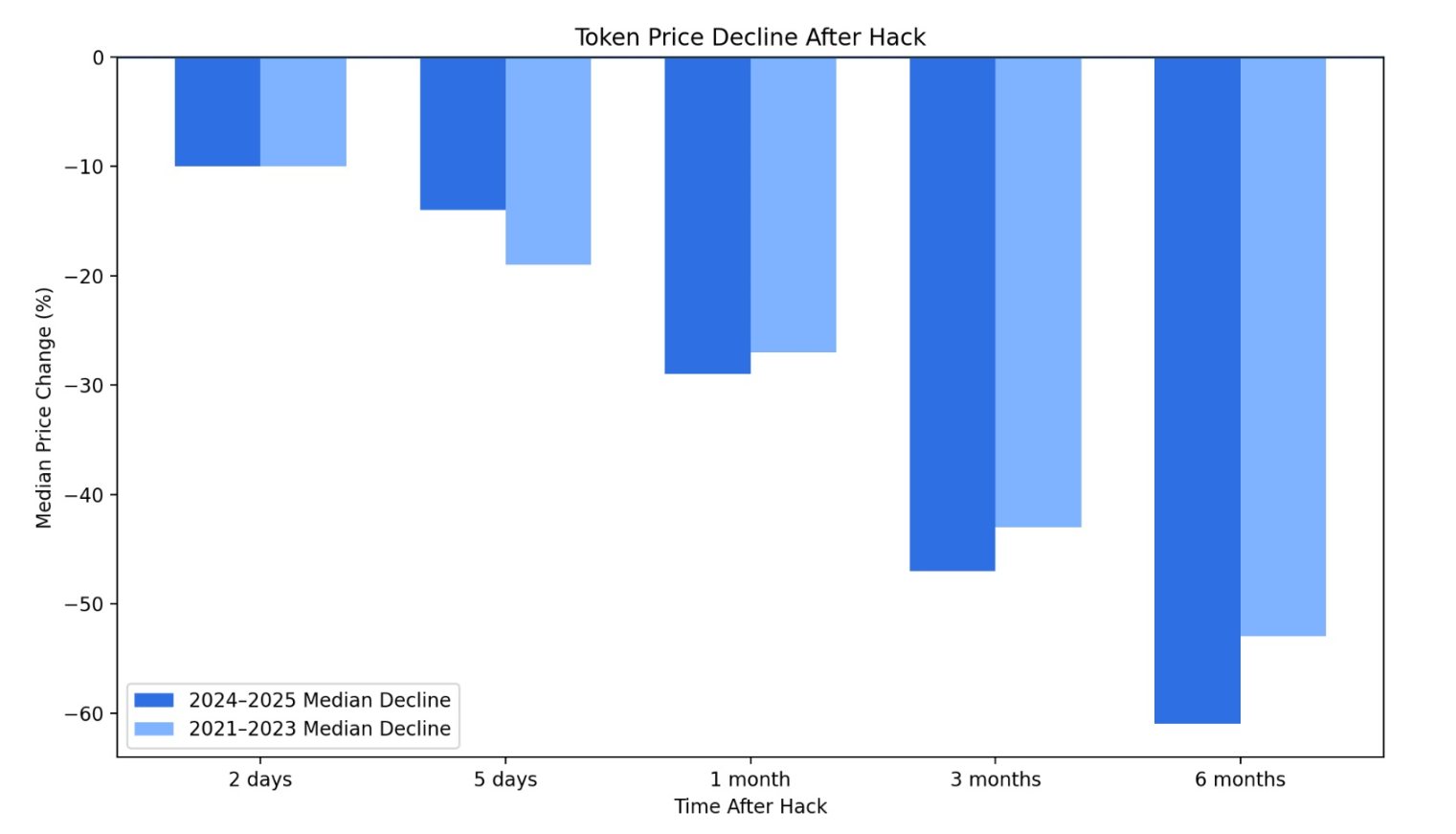
Chart shows the median token price decline for 82 hacked tokens in Immunefi's sample from 2024 and 2025 (Source: Immunefi)

To understand the full impact of a hack, we can no longer view token price as an isolated market indicator. For the vast majority of crypto projects, the token is the treasury, the foundation for fundraising, and the public report card of credibility. A prolonged暴跌 directly cripples the project's operational cycle, hiring ability, bargaining power in partnerships, and internal morale.

The report points out that projects that suffer attacks often lose their security lead within weeks and enter a recovery period of at least three months. Even if the timeline varies by project, the consequences are clear: projects with crashed tokens and damaged brands have almost no breathing room or chance for a turnaround.

Many markets can withstand a theft, a bad quarter, or even a reputation crisis. But the crypto industry often compresses all three into the same event: the attack empties the treasury → the token暴跌 publicly revalues the project → partners withdraw before the internal cleanup is even finished.

Recovery in this environment is extremely difficult, and致命 for teams that were not well-funded to begin with.

Interdependency makes the situation worse. Immunefi believes the DeFi ecosystem has become increasingly interconnected, forming longer, more fragile risk chains between cross-chain bridges, stablecoins, liquid staking, restaking, and lending markets.

Although some cases in the report require external verification, the overall trend is undeniable: today's crypto systems have more complex layers, meaning the impact of a single attack will extend far beyond the affected protocol itself.

Centralized platforms remain at the epicenter of explosions.

The report shows that out of the 191 attacks in 2024-2025, only 20 targeted centralized exchanges, but these 20 caused losses of $2.55 billion, accounting for 54.6% of the total losses.

This shifts the problem from smart contract vulnerabilities back to asset custody, key management, and over-concentrated infrastructure. For an industry that often sells itself on "decentralized risk resistance," most of the huge losses still occur on highly trusted, centralized nodes.

But this does not mean all hacked projects are doomed to fail. The industry has entered a new phase: a project's survival no longer depends on whether it can withstand an attack, but on whether it can withstand the six months *after* the attack.

Theft is just the beginning of the crisis. What truly determines whether a project has a future is the long, slow,持续的 secondary damage that follows the attack.


Twitter:https://twitter.com/BitpushNewsCN

Bitpush TG Discussion Group:https://t.me/BitPushCommunity

Bitpush TG Subscription: https://t.me/bitpush

Original link:https://www.bitpush.news/articles/7622471

Questions liées

QWhat is the main finding of Immunefi's '2026 On-Chain Security Status Report' regarding the impact of crypto hacks?

AThe main finding is that the initial theft is only part of the damage; the more severe problem is the devastating impact on a project's future, including prolonged token price declines, drained treasuries, halted hiring, and delayed development, which can lead to a slow, long-term collapse.

QAccording to the report, what was the median percentage drop in the price of hacked tokens after six months?

AThe median percentage drop in the price of hacked tokens after six months was 61%.

QWhat does the report reveal about the distribution of losses from crypto hacks between 2024 and 2025?

AThe report reveals a highly dangerous distribution: while the median attack loss decreased, the average loss was high, and a small number of extreme attacks accounted for the majority of the losses. The top 5 attacks represented 62% of all stolen funds, and the top 10 represented 73%.

QWhich type of platform was responsible for the majority of the financial losses from hacks in 2024-2025, despite having fewer incidents?

ACentralized exchanges were responsible for the majority of financial losses. Although only 20 attacks targeted CEXs, they resulted in losses of $2.55 billion, accounting for 54.6% of the total losses during that period.

QWhat key factor does the report suggest ultimately determines whether a project can survive a hack?

AThe report suggests that a project's survival is no longer determined by its ability to withstand the initial attack, but rather by its ability to withstand the subsequent six months of slow, prolonged secondary damage, including price collapse and reputational harm.

Lectures associées

La Banque du Japon émet des signaux sur une hausse des taux malgré leur maintien à 1 %

La Banque du Japon a maintenu son taux directeur à 1 % le 31 juillet, conformément aux attentes du marché, après l'avoir porté en juin à son plus haut niveau en 31 ans. Le vote du Conseil de politique monétaire fut de 8 contre 1, le seul membre dissident, Hajime Takata, plaidant pour une hausse à 1,25 % en raison de perspectives inflationnistes plus rigoureuses. Bien que l'inflation de base au Japon soit restée à 1,6 % en juillet, en dessous de l'objectif de 2 %, la Banque a adopté un ton globalement ferme. Elle a légèrement révisé à la baisse sa prévision d'inflation de base pour l'exercice 2026, mais a exprimé une plus grande confiance dans une accélération au-delà de 2 % à partir de la seconde moitié de l'exercice en cours, citant les coûts d'importation dus à la faiblesse du yen, la politique tarifaire des entreprises et les séquelles du choc énergétique. La Banque a également procédé à une intervention sur le marché des changes pour soutenir le yen, qui touche des creux de 40 ans face au dollar. Cette faiblesse s'explique par l'écart des taux d'intérêt avec les États-Unis, la tension géopolitique affectant les prix de l'énergie et les anticipations du marché concernant un futur resserrement monétaire. Le gouverneur Kazuo Ueda doit désormais naviguer entre un gouvernement réticent à un durcissement supplémentaire et un marché obligataire qui anticipe déjà de nouvelles hausses de taux, la prochaine étape pouvant intervenir en octobre ou en décembre.

cryptonews.ruIl y a 3 mins

La Banque du Japon émet des signaux sur une hausse des taux malgré leur maintien à 1 %

cryptonews.ruIl y a 3 mins

Point de vue : Pourquoi les ETF à effet de levier comme le 7709 sont-ils fondamentalement des produits à EV naturellement négatif ?

L'ETF à effet de levier 7709, souvent perçu comme un produit offrant simplement le double de la performance quotidienne de SK Hynix, est en réalité une stratégie structurellement désavantageuse sur le long terme. Son mécanisme de rebalancement quotidien pour maintenir un levier constant de 2x l'oblige à acheter après une hausse et vendre après une baisse, un comportement "suivre la tendance" systématique. Ce réajustement, toujours en retard sur le mouvement des prix, génère une perte structurelle : il achète plus cher après une hausse et vend moins cher après une baisse. Même en tendance haussière, le rebalancement unique en fin de journée retarde la réinvestissement des gains, pénalisant les intérêts composés. À l'inverse, une fréquence de rebalancement plus élevée, bien que meilleure en tendance, aggrave les pertes en période de volatilité et de marchés en dents de scie, où le produit subit des pertes par oscillation (volatility decay). Cette dynamique est similaire à celle d'un vendeur d'options qui doit constamment ajuster son delta (couverture dynamique), supportant un gamma négatif. Cependant, contrairement au vendeur d'options qui perçoit une prime (IV et thêta) en compensation de ce risque, l'investisseur dans le 7709 ne reçoit aucune telle compensation. Il supporte uniquement les coûts : frais de financement (swap), coûts des produits dérivés, frais de gestion et de transaction. Ainsi, le 7709 n'est pas un simple double levier. C'est l'exposition à la direction du sous-jacent, **moins** la dépréciation due à la volatilité réalisée, **moins** tous les coûts internes. Pour être rentable, l'investisseur a besoin non seulement d'une hausse du sous-jacent, mais d'une hausse suffisamment forte, lisse et soutenue pour couvrir ces drains constants. La promesse de "non-liquidation" masque simplement un risque de lente érosion de la valeur nette, qui peut tendre vers zéro. Pour une exposition directionnelle, d'autres instruments comme les contrats perpétuels peuvent offrir plus de contrôle et potentiellement une meilleure efficacité coût/risque.

marsbitIl y a 5 mins

Point de vue : Pourquoi les ETF à effet de levier comme le 7709 sont-ils fondamentalement des produits à EV naturellement négatif ?

marsbitIl y a 5 mins

Trading

Spot
活动图片





