The Scythe of Bitcoin's Leading Figure: A Record of a Nasdaq Robbery

marsbitPublié le 2026-02-18Dernière mise à jour le 2026-02-18

Résumé

This investigation details a sophisticated financial scheme orchestrated by David Bailey, CEO of Nakamoto Holdings ($NAKA). Through a reverse merger with a shell company, NAKA's stock skyrocketed from $2 to over $30, luring retail investors while early PIPE investors entered at just $1.12 per share. The stock then collapsed by 99% to $0.29. Amid the crash, Bailey engaged in desperate debt refinancing, accruing massive losses. He then used the crippled public company to acquire his own private firms, BTC Inc and UTXO Management, at a fixed share price of $1.12—nearly four times the market rate. This acquisition, approved by shareholders during the stock's peak without their full understanding, resulted in massive dilution for existing investors. The entire operation, while technically compliant, transferred wealth from retail investors to insiders. Bailey, who compared himself to historical financial dynasties, ultimately used the wreckage of the public company to enrich himself and his private empire, showcasing a brutal intersection of influencer culture and public markets.

Editor's Note: This article provides an in-depth analysis of the astonishing capital operations behind David Bailey and the Nakamoto Holdings ($NAKA) he controls. From the frenzied surge during the backdoor listing to the 99% crash after retail investors entered the market, and then using the devastated listed company to acquire his private assets at a high premium, it is a meticulously designed wealth transfer leveraging information asymmetry and regulatory loopholes.

This is a brutal investigation into greed, compliance games, and influencer capitalism. It serves as a warning that when belief is packaged as a financial product, and when the slogan of decentralization meets centralized greed, retail investors are often the last exit liquidity. Understanding this story might give you more clarity and less blind following the next time a big name promotes an investment.

Below is the full content:

This morning, David Bailey used a listed company whose market value has evaporated by 99% to acquire two private companies he founded at a premium four times the current stock price—all without requiring a shareholder vote.

What's most shocking? This asset transfer drama was locked in long before retail investors bought their first share.

To understand how this was done, we must start from the beginning.

In May 2025, a zombie company named KindlyMD announced a merger with Nakamoto Holdings, a Bitcoin reserve tool founded by David Bailey.

The stock price soared from $2 to over $30 within days, attracting a flood of retail investors. Bitcoin influencers celebrated, and Bailey even compared himself to the Morgans, the Medicis, and the Rothschilds.
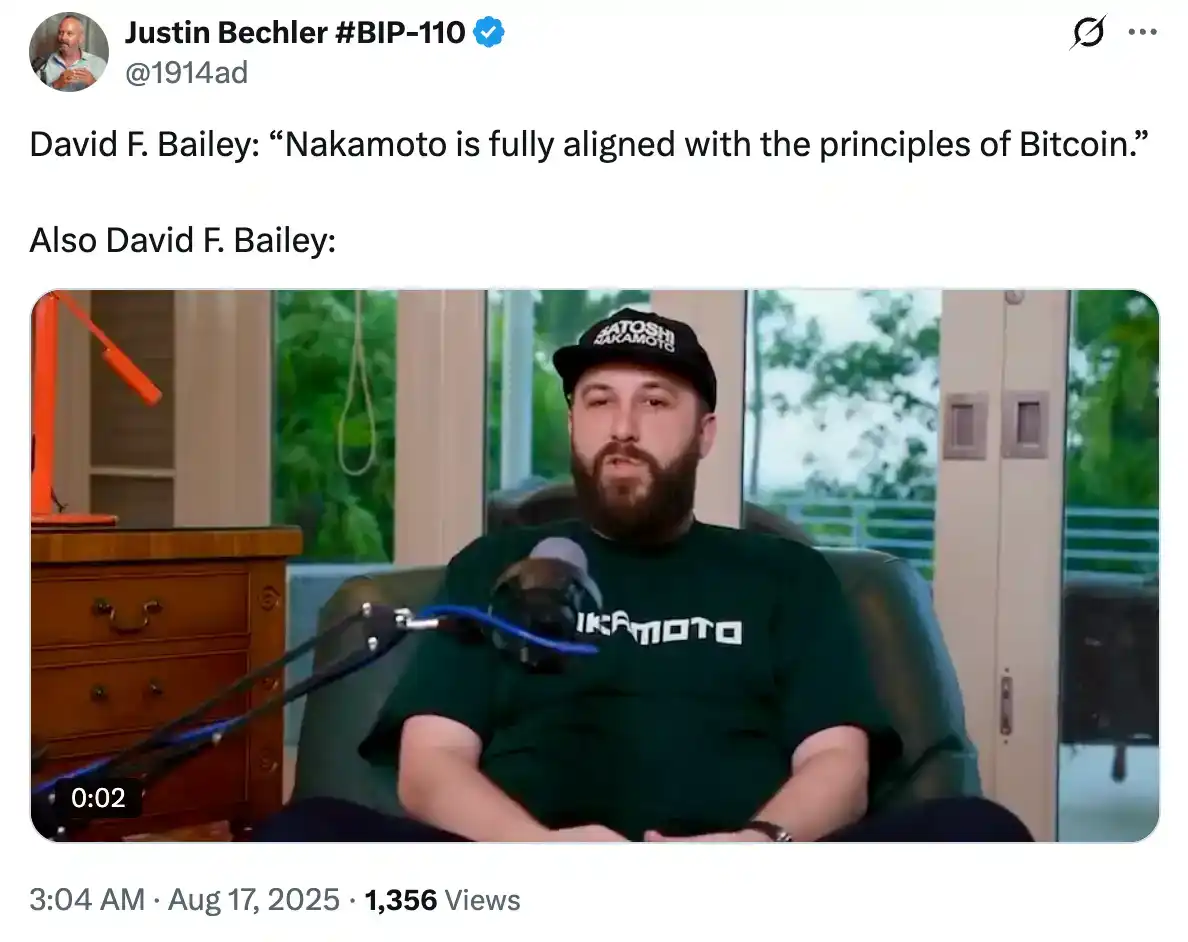
Nine months later, the stock price fell to 29 cents, and Bailey just used this stock to buy his own companies.

The Pump

The mechanism was quite ingeniously designed.

KindlyMD was originally an unnoticed micro-cap stock on Nasdaq. Nakamoto Holdings went public through a reverse merger, backed by $510 million in PIPE (Private Investment in Public Equity) financing and $200 million in convertible bonds.

On paper, it seemed like the birth of a Bitcoin reserve giant, with a new generation of Bitcoin influencers rushing to tell you why to buy $NAKA (of course, the reason was to own more Bitcoin).

Within days, NAKA's price-to-NAV ratio reached an astonishing 23x, meaning speculators paid $23 for every $1 of Bitcoin held by the company.

Michael Saylor's MicroStrategy never reached such a premium. The difference is that MicroStrategy has years of operational history, a software business generating actual revenue, and a CEO who didn't manipulate the transaction structure to enrich himself on the backend.

Insiders knew secrets that retail investors didn't. The PIPE investors—including the notorious BIP-110 opponents Udi Wertheimer, Jameson Lopp, and Adam Back—got in at $1.12 per share. Retail investors bought at $28, $30, $31, and even higher.

This information asymmetry was built into the structure from day one.

In June, Bailey completed another $51.5 million PIPE financing at $5.00 per share. Although the second batch of investors got in at a much lower cost than retail, it was still far above the $1.12 floor price, and they were ultimately harvested too.

Bailey celebrated the financing, saying it took less than 72 hours and investor demand was extremely strong.

Let's take a closer look at this strategy.

The Dump

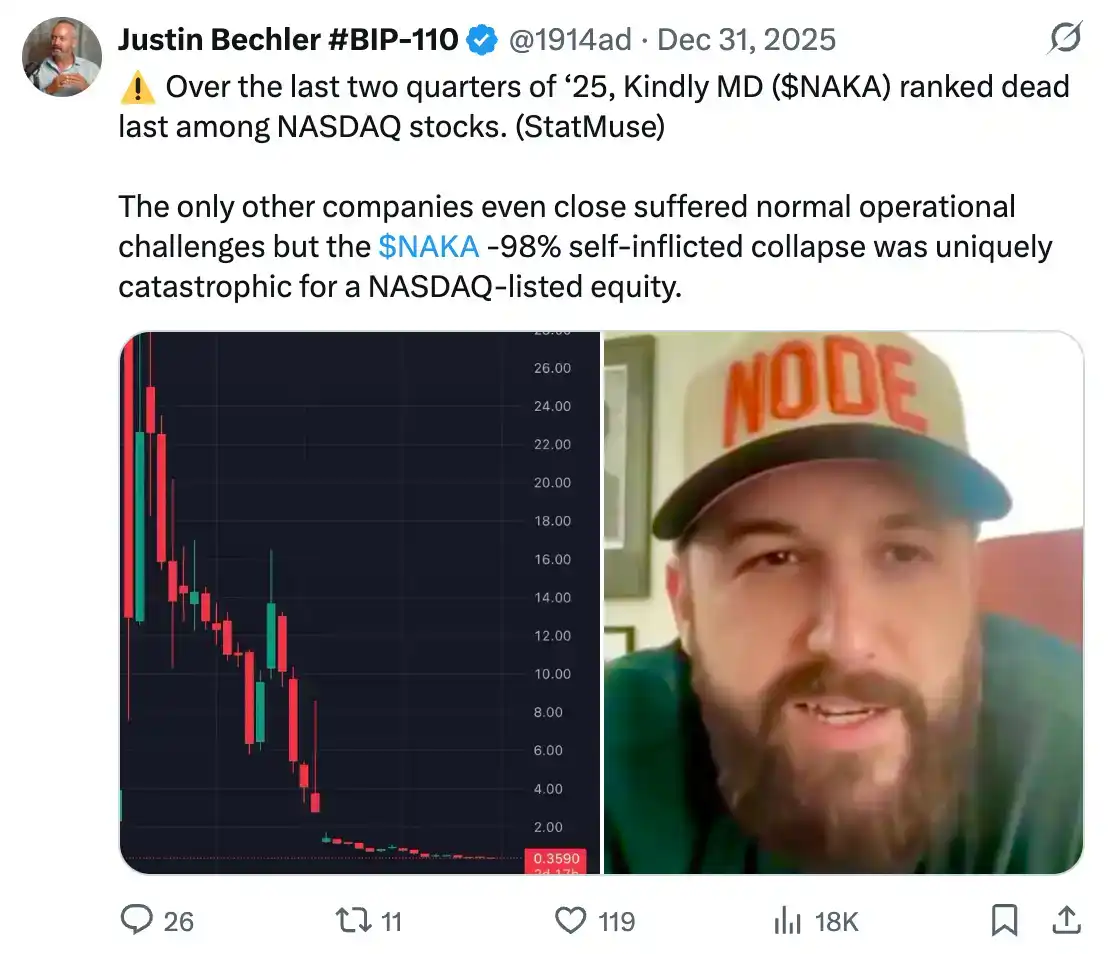
By September, NAKA had plummeted by 96%.

The early PIPE investors who obtained shares at $1.12 could finally cash out after the merger was completed in August, and they did so.

Bailey's response was quite bizarre for a public company CEO; he told shareholders who were just there for a quick trade to leave.

So they left.

The stock price continued to fall. Below $1. Below 50 cents. Below 30 cents. A company holding about 5,765 Bitcoins (worth over $500 million) now had a market cap of less than $300 million.

The market valued Nakamoto even lower than the Bitcoin on its balance sheet, which says a lot about how investors view the management team and corporate structure wrapped around these Bitcoins.
Debt Spiral

As the stock price crashed, Bailey changed lenders frequently, like a gambler borrowing money on the casino floor.

The initial capital structure included $200 million in convertible bonds from Yorkville Advisors, with a conversion price of $2.80. As NAKA's stock price fell below this level, the convertible bonds became debt that could devour equity. So, on October 3, Nakamoto took out a $203 million term loan from Two Prime Lending to redeem Yorkville's notes and interest.

Four days later, on October 7, they borrowed $206 million in USDT from Antalpha at 7% interest to repay Two Prime. Antalpha's loan had a term of only 30 days (with an option to extend for another 30 days). They replaced the term loan with a 30-day bridge loan within a week.

The plan was to convert this bridge loan into a $250 million 5-year secured convertible bond from Antalpha. Use the new convertible to repay the bridge loan, the bridge loan to repay the term loan, and the term loan to repay the old convertible.

But that $250 million convertible never materialized on Antalpha's terms.

On December 16, Nakamoto borrowed $210 million in USDT from Kraken at 8% interest, over-collateralized by 150% with Bitcoin from its treasury.
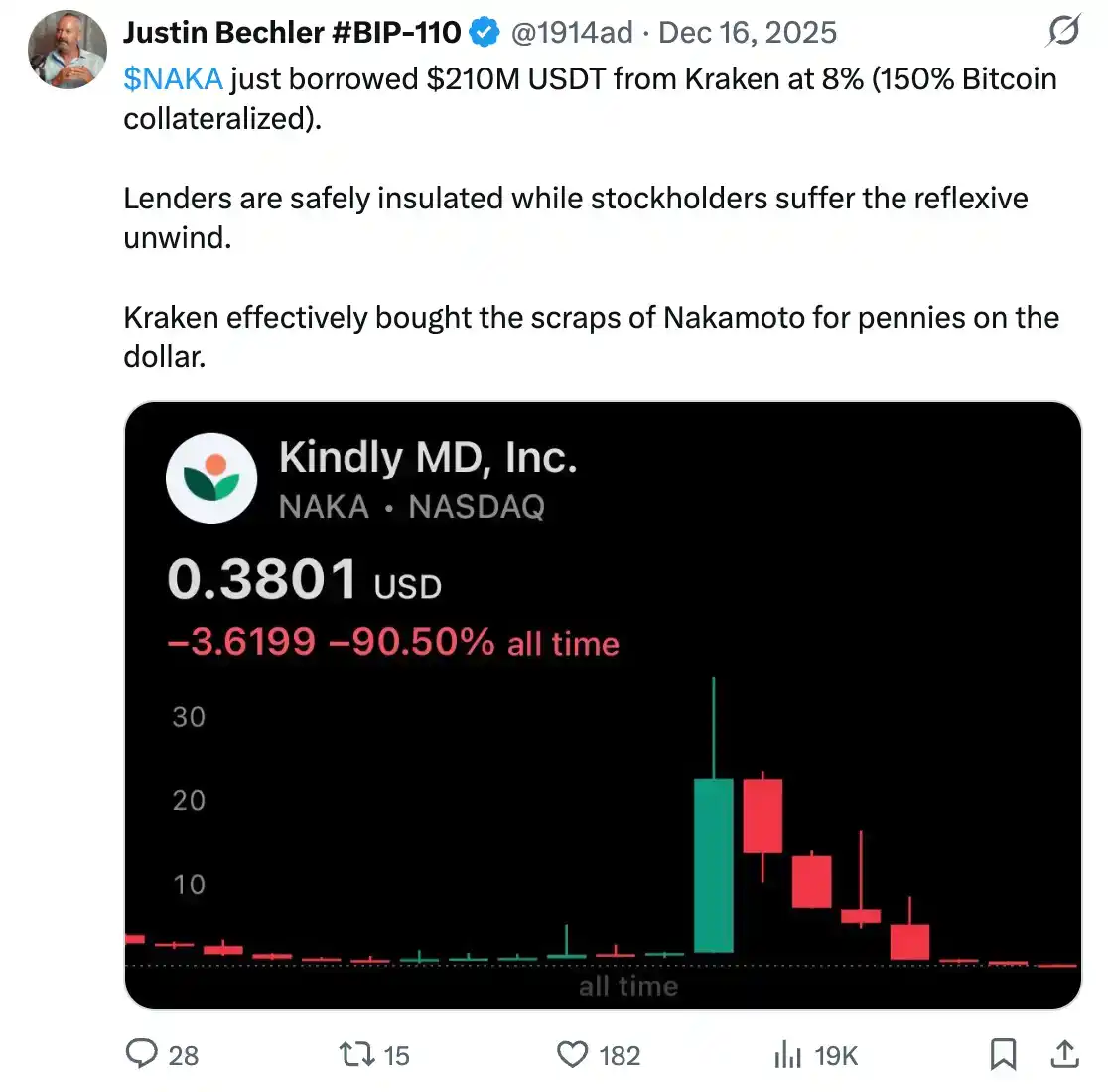
Do the math: The lender has $315 million worth of Bitcoin as collateral for a $210 million loan. If NAKA's stock goes to zero, Kraken takes the collateral. If Bitcoin drops 33%, Kraken remains unscathed. At every stage of this drama, the lenders were tightly protected, while common shareholders bore the full brunt of the reflexive crash.

Each new loan tightened the noose.

Countdown

On December 10, Nasdaq notified Nakamoto that it faced delisting risk because its stock price had been below $1 for 30 consecutive business days. The company must regain compliance by June 8, 2026, meaning the closing price must be above $1 for 10 consecutive trading days.

The current stock price is 29 cents.
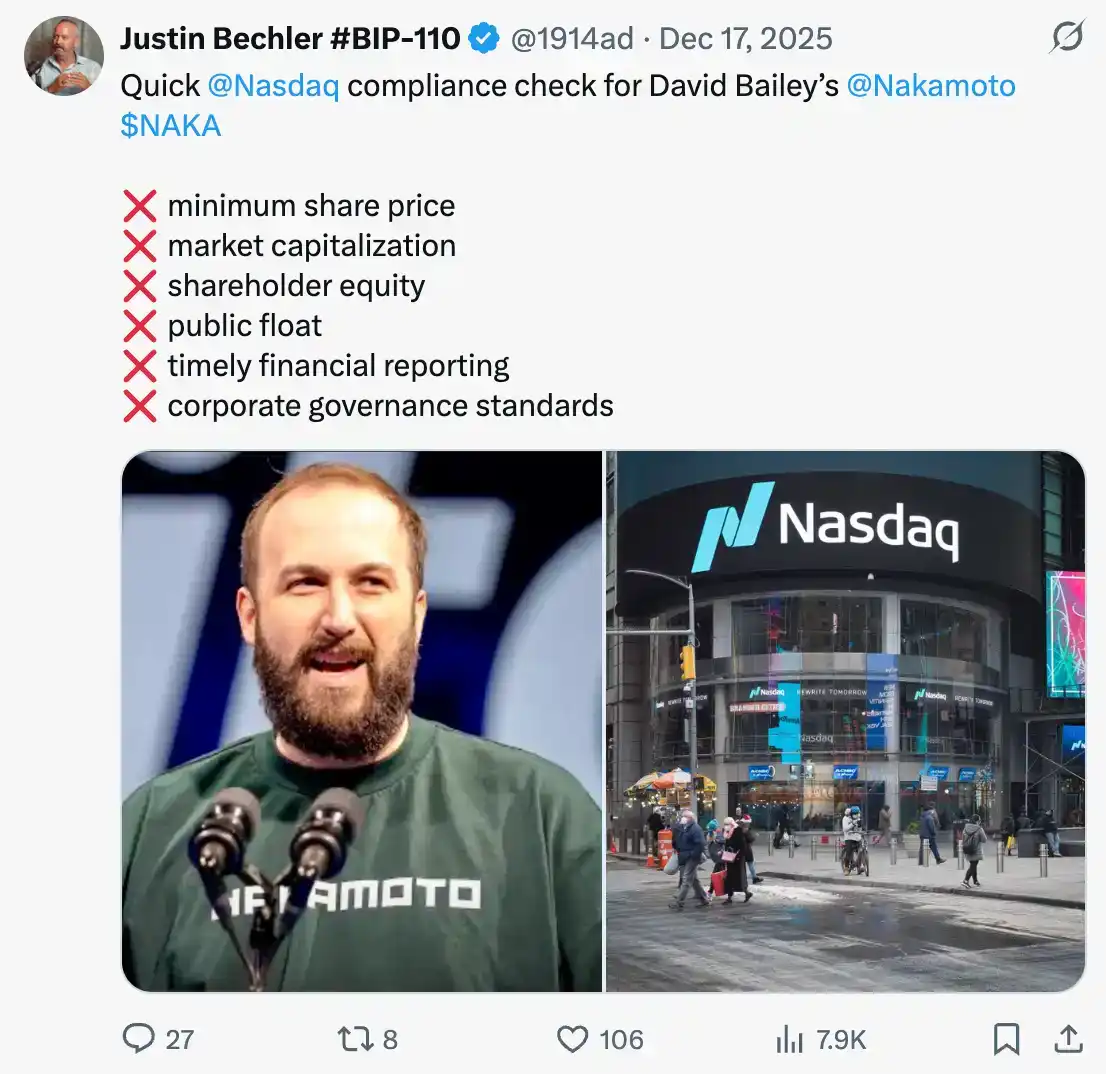
If delisted, Nakamoto would be unable to conduct ATM (at-the-Market) offerings, issue convertible bonds, or use stock as acquisition currency. Everything Bailey assembled in this shell relies on a Nasdaq listing that currently cannot be maintained.

Accounting Disaster

In November, Nakamoto filed a Form 12b-25 with the SEC, admitting it could not submit its quarterly financial report on time due to accounting complexities from the merger. Preliminary data revealed the truth:

The Nakamoto acquisition resulted in a $59.75 million loss (payment price higher than net asset value)

$22.07 million unrealized loss on digital assets

$1.41 million realized loss from selling Bitcoin

$14.45 million loss on debt extinguishment from refinancing rotations

A quarterly loss of approximately $97 million, partially offset by a $21.8 million accounting gain from contingent liabilities. This company, which was supposed to be the perfect Bitcoin reserve tool, couldn't even submit its books on time.

The Heist

This brings us back to this morning.

Nakamoto announced signing a definitive merger agreement to acquire BTC Inc and UTXO Management. BTC Inc owns Bitcoin Magazine and operates the Bitcoin Conference. UTXO manages a Bitcoin-focused hedge fund.

Bailey is the Chairman and CEO of the buyer, Nakamoto.

He is also the founder of the sellers, BTC Inc and UTXO.

He is the buyer, the seller, and the CEO approving the terms.

But weeks before the acquisition, he quietly handed the CEO title to Brandon Greene, creating a paper-thin separation between himself and the entities he was about to buy with shareholder equity.

This morning's deal was entirely financed with Nakamoto stock, priced at $1.12 per share based on a call option embedded in the original marketing services agreement. And $NAKA is still struggling to climb back to $0.29.

Bailey's companies received a stock valuation nearly four times the current market price. Security holders of BTC Inc and UTXO will receive 363.6 million shares, valuing the deal at $107.3 million at market prices.

But these shares were issued at $1.12, meaning the deal was structured when NAKA's stock was flying high, and the terms were never adjusted when the stock crashed.

Forget the fictional pricing on the contract. What really matters is that 363.6 million new shares just entered the float. Regardless of whether the documents say $1.12 or $0.29, existing shareholders were diluted by this quantity. The $1.12 label is a courtesy to the seller, but the dilution is real.

No additional shareholder approval was needed because the call option was already embedded in the original merger documents, and shareholders voted to approve them when NAKA's stock was still at $20, $30.

The retail investors who approved these terms had no idea they were authorizing the future acquisition of Bailey's private business at a locked-in high premium while their own shares were turning to dust.

Architecture of Self-Dealing

Stepping back, the entire architecture is breathtakingly elegant.
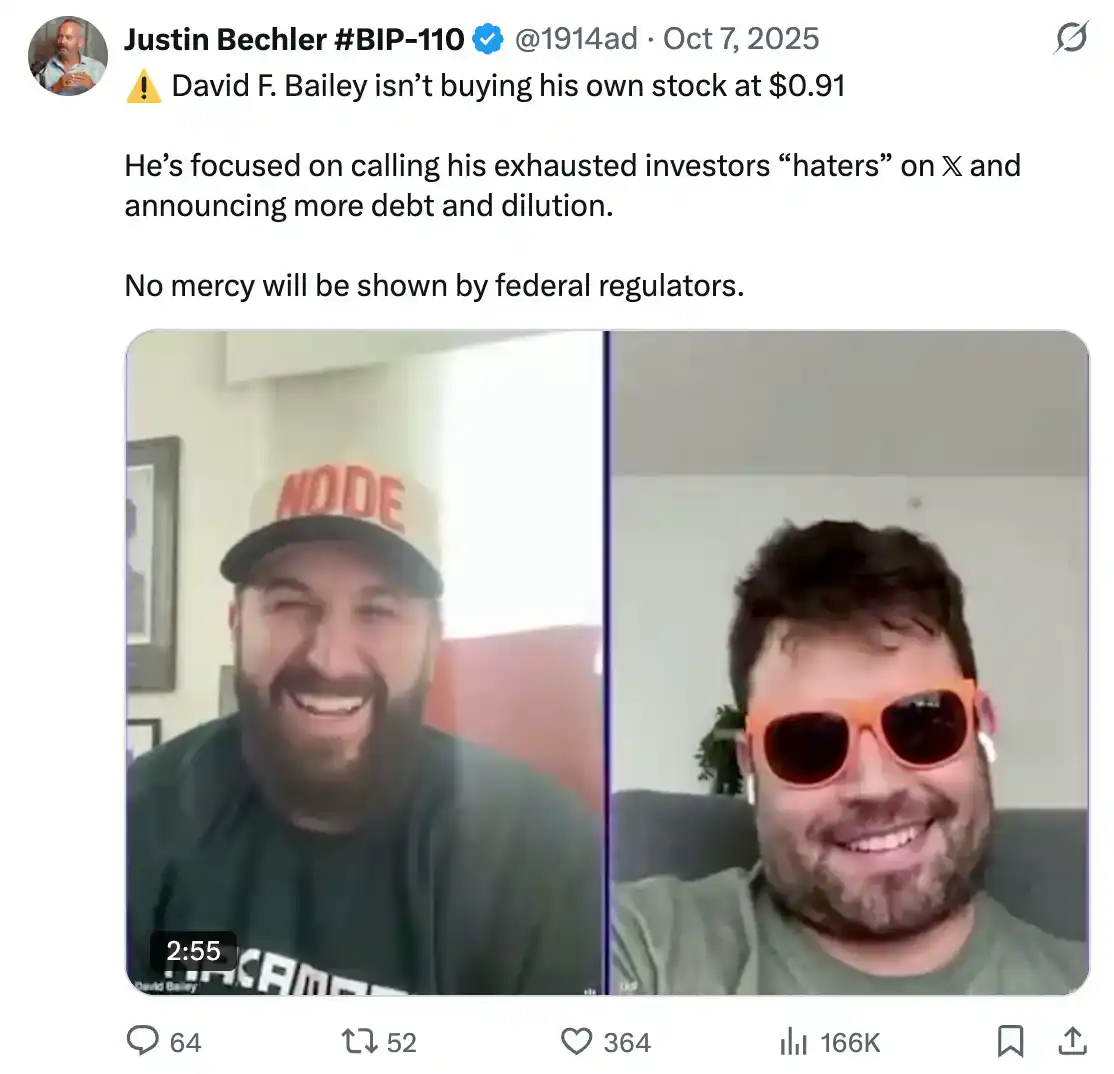
Bailey created Nakamoto Holdings. Merged it into a public shell company via KindlyMD, raising $710 million in the process. Driven by retail enthusiasm, the stock was pumped to 23x NAV. PIPE investors got in at $1.12, while the public paid 20 to 30 times that. The stock then crashed 99%.

During this time, the company changed lenders three times in a week, trying to manage $200 million in debt that was structured to convert to equity when the stock price was much higher.

Now, with the shattered stock price below 30 cents, Bailey is using this hollowed-out tool to swallow his private empire at terms agreed upon when the stock was a hundred times higher. The initial KindlyMD merger was the Trojan horse, and the acquisition of BTC Inc was the real payload.

Bailey told us from the start. In the initial press release, he said Nakamoto would acquire BTC Inc, subject to audit and call option exercise. The MSA was publicly filed, and the option terms were disclosed. Everything was legally compliant and fully transparent—just like all complex financial engineering, the truth was buried in piles of documents no one would read.

The person who operates Bitcoin Magazine, organizes the world's largest Bitcoin conference, and positions himself as a leader of the Bitcoin movement, built a public company, destroyed 99% of shareholder value, and is now using it to acquire his own businesses at a premium.

He once compared himself to the Medicis. At least the Medicis created value for Florence before taking their cut.

Nakamoto is the freak show that happens when influencer culture meets the public stock market.

Exit Liquidity

David Bailey raised $710 million from over 200 investors across six continents. He promised them a future like the Morgans, Medicis, and Rothschilds, a financial dynasty built on Bitcoin. He told them Nakamoto would bring Bitcoin to the center of global capital markets. He said their names would echo through history.

But he delivered a 99% loss.

He priced the PIPE at $1.12 while retail bought at $28. He embedded call options to acquire his own companies into the filings without shareholders understanding what they were authorizing. He rotated three lenders in a week to prevent $200 million in debt from crushing equity, accumulating $14 million in debt extinguishment losses along the way. He sold Bitcoin at a loss from the treasury that was supposed to only accumulate, not sell. He couldn't even submit quarterly financial reports on time. And when the stock price finally fell to 29 cents...

When the rubble was cleared and the retail investors who trusted him were wiped out, he exercised that call option, using the wreckage of their investment to buy his private empire at four times the market price.

Bailey holds 11 million shares at a cost of $1.12. Adam Back holds nearly 9 million shares. Balaji, Lopp, Yusko, Salinas, Jihan Wu—they all got in at a price that teachers, truck drivers, or first-time investors could never access. These are the people who shape the Bitcoin narrative. They run conferences, publish magazines, manage funds, post tweets. They are the supply chain of belief, turning skeptics into believers and believers into bag holders.

Now, Bailey owns Bitcoin Magazine, the Bitcoin Conference, and a hedge fund, all packed into a public company with a market cap only a fraction of its Bitcoin holdings, all acquired with stock priced four times the market value, all approved before a single cent from retail entered.

And he's not done.

Nakamoto has already filed with the SEC for a $5 billion ATM (At-the-Market) stock offering. Bailey now controls the media division, the conference division, the hedge fund, and a shelf registration that allows him to keep issuing stock collateralized by the Bitcoin treasury until the last bit of value is squeezed out.

When exactly did the Bitcoin community hand the keys to conference promoters and influencer capitalists? And why is anyone surprised when they drive away with the car?


Questions liées

QWhat was the key mechanism David Bailey used to acquire his private companies at a premium using the struggling Nakamoto Holdings stock?

AHe utilized a call option embedded in the original marketing services agreement, which was approved by shareholders when the stock price was high, allowing the acquisition at $1.12 per share despite the market price collapsing to $0.29.

QHow did the PIPE investors benefit from the retail investors in the Nakamoto Holdings deal?

APIPE investors, including prominent Bitcoin figures, acquired shares at $1.12, while retail investors bought in at prices 20 to 30 times higher, around $28 to $31, creating a massive information asymmetry from the start.

QWhat was the consequences of Nakamoto's stock price falling below $1 for an extended period?

AThe company received a delisting notice from Nasdaq, threatening its ability to conduct ATM offerings, issue convertible notes, or use its stock as acquisition currency, which was crucial for Bailey's plans.

QWhat financial maneuvers did Nakamoto employ to manage its $200 million debt as the stock price collapsed?

AThe company rapidly cycled through lenders, first replacing a convertible note with a term loan, then a 30-day bridge loan, and finally a loan from Kraken secured by 150% over-collateralization of its Bitcoin treasury, accruing significant losses in the process.

QHow did David Bailey structure the acquisition to avoid additional shareholder approval for buying his own companies?

AThe call option for the acquisition was pre-approved by shareholders in the initial merger documents when the stock was highly valued, so no further vote was required when the deal was executed after the price crash.

Lectures associées

Trading

Spot
Futures

Articles tendance

Qu'est ce que BITCOIN

Comprendre HarryPotterObamaSonic10Inu (ERC-20) et sa position dans l'espace crypto Ces dernières années, le marché des cryptomonnaies a connu une augmentation de la popularité des monnaies mèmes, suscitant l'intérêt non seulement des traders, mais aussi de ceux qui recherchent un engagement communautaire et une valeur divertissante. Parmi ces jetons uniques, HarryPotterObamaSonic10Inu (ERC-20) est un projet intrigant qui mêle des références culturelles à l'univers des cryptomonnaies. Cet article explore les aspects clés de HarryPotterObamaSonic10Inu, en examinant ses mécanismes, son ethos axé sur la communauté, et son engagement avec le paysage crypto plus large. Qu'est-ce que HarryPotterObamaSonic10Inu (ERC-20) ? Comme son nom l'indique, HarryPotterObamaSonic10Inu est une monnaie mème construite sur la blockchain Ethereum, classée selon la norme ERC-20. Contrairement aux cryptomonnaies traditionnelles qui peuvent mettre l'accent sur l'utilité pratique ou le potentiel d'investissement, ce jeton prospère grâce à sa valeur divertissante et à la force de sa communauté. Le projet vise à favoriser un environnement où des utilisateurs engagés peuvent se rassembler, partager des idées et participer à des activités inspirées par divers phénomènes culturels. Une caractéristique notable de HarryPotterObamaSonic10Inu est son absence de taxe sur les transactions. Cet élément attrayant vise à encourager le trading et l'implication de la communauté, sans frais supplémentaires pouvant décourager les petits traders. L'offre totale de la monnaie est fixée à un milliard de jetons, un chiffre qui marque son intention de maintenir une circulation substantielle au sein de la communauté. Créateur de HarryPotterObamaSonic10Inu (ERC-20) Les origines de HarryPotterObamaSonic10Inu sont quelque peu obscures ; les détails concernant le créateur restent inconnus. Le développement de ce jeton ne comporte pas d'équipe identifiable ou de plan explicite, ce qui n'est pas rare dans le secteur des monnaies mèmes. Au lieu de cela, le projet a émergé de manière organique, son progrès s'appuyant fortement sur l'enthousiasme et la participation de sa communauté. Investisseurs de HarryPotterObamaSonic10Inu (ERC-20) En ce qui concerne les investissements externes et le soutien, HarryPotterObamaSonic10Inu reste également ambigu. Le jeton ne mentionne aucune fondation d'investissement connue ou un soutien organisationnel significatif. Au lieu de cela, le cœur battant du projet est sa communauté de base, qui informe sa croissance et sa durabilité par des actions collectives et un engagement dans l'espace crypto. Comment fonctionne HarryPotterObamaSonic10Inu (ERC-20) ? En tant que monnaie mème, HarryPotterObamaSonic10Inu opère principalement en dehors des cadres traditionnels qui régissent souvent la valeur des actifs. Plusieurs aspects distinctifs définissent comment le projet fonctionne : Transactions sans taxe : Sans frais de taxe sur les transactions, les utilisateurs peuvent acheter et vendre librement le jeton sans se préoccuper de frais cachés. Engagement communautaire : Le projet prospère grâce à l'interaction communautaire, exploitant les plateformes de médias sociaux pour créer du bruit et faciliter l'implication. Les discussions, le partage de contenu et l'engagement sont des éléments cruciaux qui aident à étendre sa portée et à favoriser la loyauté parmi les supporters. Pas d'utilité pratique : Il est important de noter que HarryPotterObamaSonic10Inu n'offre pas d'utilité concrète au sein de l'écosystème financier. Au contraire, il est classé comme un jeton principalement pour des activités de divertissement et communautaires. Référence culturelle : Le jeton intègre habilement des éléments de la culture populaire pour susciter l'intérêt, s'adressant à la fois aux amateurs de mèmes et aux suiveurs de crypto. HarryPotterObamaSonic10Inu illustre comment les monnaies mèmes fonctionnent différemment des projets de cryptomonnaies plus traditionnels, entrant sur le marché en tant que constructions sociales innovantes plutôt qu'actifs utilitaires. Chronologie de HarryPotterObamaSonic10Inu (ERC-20) L'histoire de HarryPotterObamaSonic10Inu est jalonnée de plusieurs étapes notables : Création : Le jeton est né d'un mème viral, captivant l'imagination de nombreux passionnés de crypto. Les dates de création spécifiques ne sont pas disponibles, soulignant son ascension organique. Listing sur les échanges : HarryPotterObamaSonic10Inu a fait son apparition sur divers échanges, permettant un accès et un trading plus faciles par la communauté. Initiatives d'engagement communautaire : Activités en cours visant à améliorer l'interaction communautaire, y compris des concours, des campagnes sur les réseaux sociaux, et la génération de contenu par des fans et des défenseurs. Plans d'expansion futurs : La feuille de route du projet comprend le lancement d'une collection NFT, de marchandises, et d'un site eCommerce lié à ses thèmes culturels, engageant davantage la communauté et tentant d'ajouter plus de dimensions à son écosystème. Points clés concernant HarryPotterObamaSonic10Inu (ERC-20) Nature axée sur la communauté : Le projet privilégie l'apport collectif et la créativité, garantissant que l'implication des utilisateurs est au cœur de son développement. Classification de monnaie mème : Il représente l'apogée de la cryptomonnaie basée sur le divertissement, se distinguant des véhicules d'investissement traditionnels. Pas d'affiliation directe avec Bitcoin : Malgré la similitude dans le nom du ticker, HarryPotterObamaSonic10Inu est distinct et n'a aucun lien avec Bitcoin ou d'autres cryptomonnaies établies. Focus sur la collaboration : HarryPotterObamaSonic10Inu est conçu pour créer un espace de collaboration et de partage d'histoires parmi ses détenteurs, offrant une voie pour la créativité et le lien communautaire. Perspectives d'avenir : L'ambition de s'étendre au-delà de son concept initial vers des NFT et des marchandises dessine un chemin pour le projet afin de potentiellement entrer dans des avenues plus grand public au sein de la culture numérique. Alors que les monnaies mèmes continuent de captiver l'imagination de la communauté des cryptomonnaies, HarryPotterObamaSonic10Inu (ERC-20) se distingue par ses liens culturels et son approche centrée sur la communauté. Bien qu'il ne corresponde pas au modèle typique d'un jeton axé sur l'utilité, son essence réside dans la joie et la camaraderie cultivées parmi ses supporters, soulignant la nature en évolution des cryptomonnaies dans un âge de plus en plus numérique. À mesure que le projet continue de se développer, il sera important de surveiller comment les dynamiques communautaires influencent sa trajectoire dans le paysage toujours changeant de la technologie blockchain.

1.4k vues totalesPublié le 2024.04.01Mis à jour le 2024.12.03

Qu'est ce que BITCOIN

Comment acheter BTC

Bienvenue sur HTX.com ! Nous vous permettons d'acheter Bitcoin (BTC) de manière simple et pratique. Suivez notre guide étape par étape pour commencer votre parcours crypto.Étape 1 : Création de votre compte HTXUtilisez votre adresse e-mail ou votre numéro de téléphone pour ouvrir un compte sur HTX gratuitement. L'inscription se fait en toute simplicité et débloque toutes les fonctionnalités.Créer mon compteÉtape 2 : Choix du mode de paiement (rubrique Acheter des cryptosCarte de crédit/débit : utilisez votre carte Visa ou Mastercard pour acheter instantanément Bitcoin (BTC).Solde :utilisez les fonds du solde de votre compte HTX pour trader en toute simplicité.Prestataire tiers :pour accroître la commodité d'utilisation, nous avons ajouté des modes de paiement populaires tels que Google Pay et Apple Pay.P2P :tradez directement avec d'autres utilisateurs sur HTX.OTC (de gré à gré) : nous offrons des services personnalisés et des taux de change compétitifs aux traders.Étape 3 : stockage de vos Bitcoin (BTC)Après avoir acheté vos Bitcoin (BTC), stockez-les sur votre compte HTX. Vous pouvez également les envoyer ailleurs via un transfert sur la blockchain ou les utiliser pour trader d'autres cryptos.Étape 4 : tradez des Bitcoin (BTC)Tradez facilement Bitcoin (BTC) sur le marché Spot de HTX. Il vous suffit d'accéder à votre compte, de sélectionner la paire de trading, d'exécuter vos trades et de les suivre en temps réel. Nous offrons une expérience conviviale aux débutants comme aux traders chevronnés.

5.1k vues totalesPublié le 2024.12.12Mis à jour le 2025.03.21

Comment acheter BTC

Qu'est ce que $BITCOIN

OR DÉMATÉRIEL ($BITCOIN) : Une Analyse Complète Introduction à OR DÉMATÉRIEL ($BITCOIN) OR DÉMATÉRIEL ($BITCOIN) est un projet basé sur la blockchain opérant sur le réseau Solana, qui vise à combiner les caractéristiques des métaux précieux traditionnels avec l'innovation des technologies décentralisées. Bien qu'il partage un nom avec Bitcoin, souvent appelé “or numérique” en raison de sa perception en tant que réserve de valeur, OR DÉMATÉRIEL est un jeton distinct conçu pour créer un écosystème unique au sein du paysage Web3. Son objectif est de se positionner comme un actif numérique alternatif viable, bien que les spécificités concernant ses applications et fonctionnalités soient encore en développement. Qu'est-ce qu'OR DÉMATÉRIEL ($BITCOIN) ? OR DÉMATÉRIEL ($BITCOIN) est un jeton de cryptomonnaie explicitement conçu pour une utilisation sur la blockchain Solana. Contrairement à Bitcoin, qui joue un rôle de stockage de valeur largement reconnu, ce jeton semble se concentrer sur des applications et caractéristiques plus larges. Les aspects notables incluent : Infrastructure Blockchain : Le jeton est construit sur la blockchain Solana, connue pour sa capacité à gérer des transactions rapides et peu coûteuses. Dynamique de l'Offre : OR DÉMATÉRIEL a une offre maximale plafonnée à 100 quadrillions de jetons (100P $BITCOIN), bien que les détails concernant son offre en circulation soient actuellement non divulgués. Utilité : Bien que les fonctionnalités précises ne soient pas explicitement décrites, il y a des indications que le jeton pourrait être utilisé pour diverses applications, impliquant potentiellement des applications décentralisées (dApps) ou des stratégies de tokenisation d'actifs. Qui est le Créateur d'OR DÉMATÉRIEL ($BITCOIN) ? À l'heure actuelle, l'identité des créateurs et de l'équipe de développement derrière OR DÉMATÉRIEL ($BITCOIN) reste inconnue. Cette situation est typique parmi de nombreux projets innovants dans l'espace blockchain, en particulier ceux alignés avec la finance décentralisée et les phénomènes de meme coin. Bien qu'une telle anonymité puisse favoriser une culture axée sur la communauté, elle intensifie les préoccupations concernant la gouvernance et la responsabilité. Qui sont les Investisseurs d'OR DÉMATÉRIEL ($BITCOIN) ? Les informations disponibles indiquent qu'OR DÉMATÉRIEL ($BITCOIN) n'a pas de bailleurs de fonds institutionnels connus ou d'investissements en capital-risque notables. Le projet semble fonctionner sur un modèle peer-to-peer axé sur le soutien et l'adoption de la communauté plutôt que sur des voies de financement traditionnelles. Son activité et sa liquidité se situent principalement sur des échanges décentralisés (DEX), tels que PumpSwap, plutôt que sur des plateformes de trading centralisées établies, soulignant davantage son approche de base. Comment fonctionne OR DÉMATÉRIEL ($BITCOIN) Les mécanismes opérationnels d'OR DÉMATÉRIEL ($BITCOIN) peuvent être élaborés en fonction de sa conception blockchain et des attributs du réseau : Mécanisme de Consensus : En s'appuyant sur le mécanisme de preuve d'historique (PoH) unique de Solana combiné à un modèle de preuve d'enjeu (PoS), le projet assure une validation efficace des transactions contribuant à la haute performance du réseau. Tokenomics : Bien que des mécanismes déflationnistes spécifiques n'aient pas été largement détaillés, l'immense offre maximale de jetons implique qu'elle pourrait répondre à des microtransactions ou à des cas d'utilisation de niche qui restent à définir. Interopérabilité : Il existe un potentiel d'intégration avec l'écosystème plus large de Solana, y compris diverses plateformes de finance décentralisée (DeFi). Cependant, les détails concernant des intégrations spécifiques restent non spécifiés. Chronologie des Événements Clés Voici une chronologie qui met en évidence des jalons significatifs concernant OR DÉMATÉRIEL ($BITCOIN) : 2023 : Le déploiement initial du jeton a lieu sur la blockchain Solana, marqué par son adresse de contrat. 2024 : OR DÉMATÉRIEL gagne en visibilité en devenant disponible à la négociation sur des échanges décentralisés comme PumpSwap, permettant aux utilisateurs de l'échanger contre SOL. 2025 : Le projet connaît une activité de trading sporadique et un intérêt potentiel pour des engagements dirigés par la communauté, bien qu'aucun partenariat notable ou avancée technique n'ait été documenté jusqu'à présent. Analyse Critique Forces Scalabilité : L'infrastructure sous-jacente de Solana prend en charge des volumes de transactions élevés, ce qui pourrait améliorer l'utilité de $BITCOIN dans divers scénarios de transaction. Accessibilité : Le potentiel faible prix de négociation par jeton pourrait attirer les investisseurs de détail, facilitant une participation plus large grâce aux opportunités de propriété fractionnée. Risques Manque de Transparence : L'absence de bailleurs de fonds, de développeurs ou de processus d'audit connus publiquement peut susciter du scepticisme quant à la durabilité et à la fiabilité du projet. Volatilité du Marché : L'activité de trading dépend fortement du comportement spéculatif, ce qui peut entraîner une volatilité des prix significative et une incertitude pour les investisseurs. Conclusion OR DÉMATÉRIEL ($BITCOIN) émerge comme un projet intrigant mais ambigu au sein de l'écosystème Solana en rapide évolution. Bien qu'il tente de tirer parti du récit de “l'or numérique”, son éloignement du rôle établi de Bitcoin en tant que réserve de valeur souligne la nécessité d'une différenciation plus claire de son utilité prévue et de sa structure de gouvernance. L'acceptation et l'adoption futures dépendront probablement de la résolution de l'opacité actuelle et de la définition plus explicite de ses stratégies opérationnelles et économiques. Remarque : Ce rapport englobe des informations synthétisées disponibles jusqu'en octobre 2023, et des développements peuvent avoir eu lieu au-delà de la période de recherche.

83 vues totalesPublié le 2025.05.13Mis à jour le 2025.05.13

Qu'est ce que $BITCOIN

Discussions

Bienvenue dans la Communauté HTX. Ici, vous pouvez vous tenir informé(e) des derniers développements de la plateforme et accéder à des analyses de marché professionnelles. Les opinions des utilisateurs sur le prix de BTC (BTC) sont présentées ci-dessous.

活动图片













