Original Author: Long Yue
Original Source: Wall Street News
More than a month after the outbreak of the Middle East conflict, US stocks have rallied back.
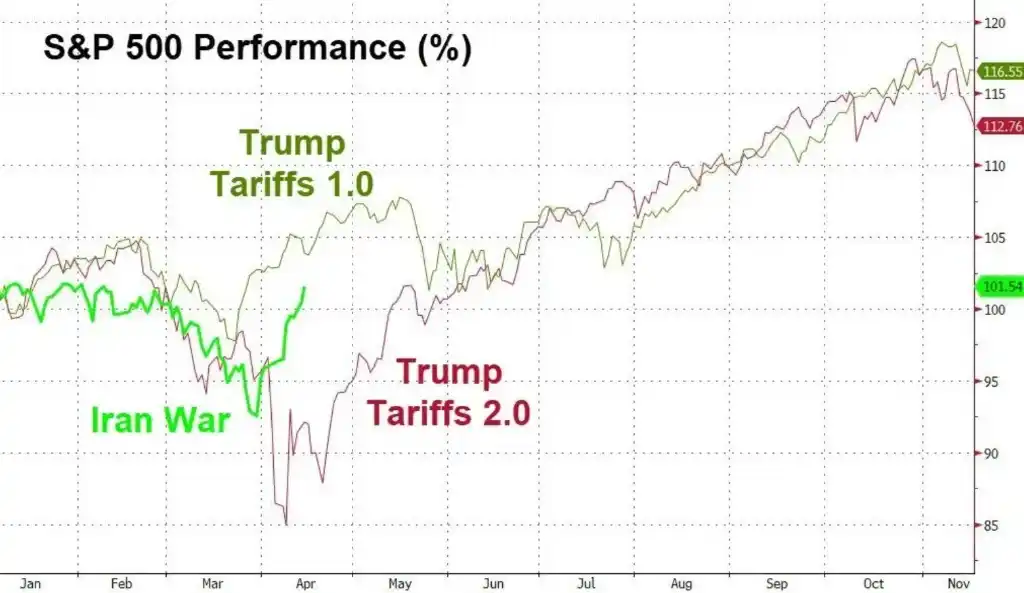
Over the past period, Wall Street has been selectively "filtering out the noise."The S&P 500 index has risen nearly 10% since March 27, while the Nasdaq 100 has gained about 12% over the same period, closing higher for 10 consecutive trading days—marking the index's longest winning streak since 2021.
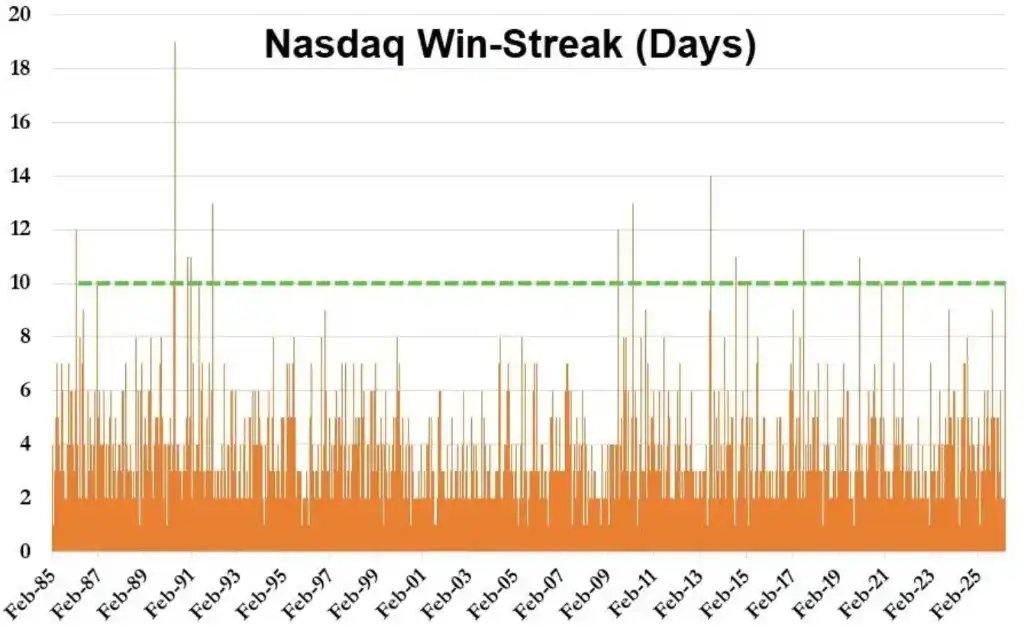
More crucially, the S&P 500 had completely erased all its losses since the Iran war began during Monday's trading session.
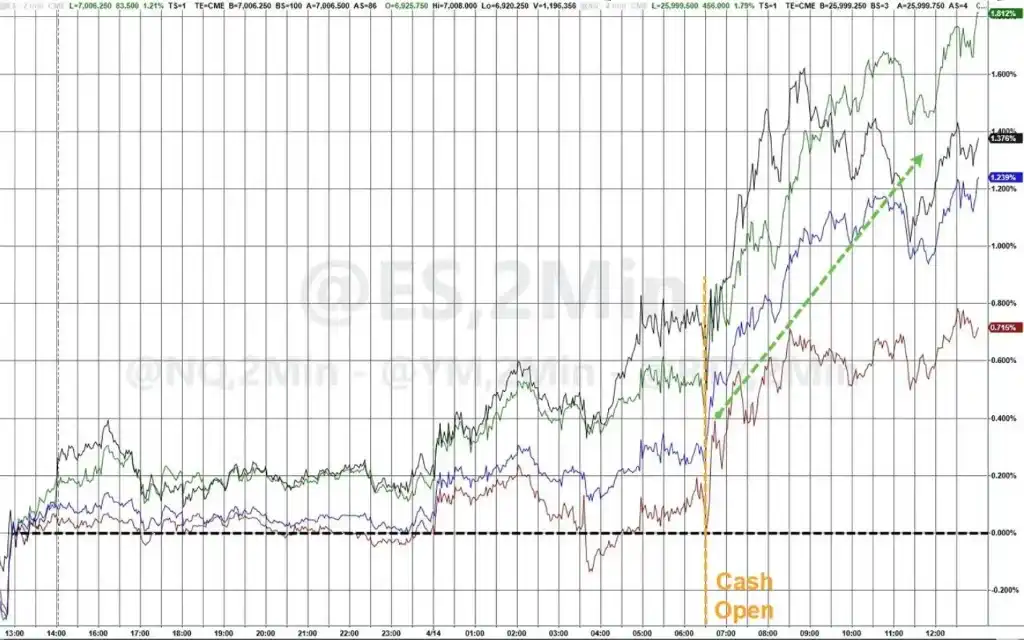
"The Market Has Declared Victory"
Rich Privorotky, Head of Goldman Sachs' Delta One trading desk, pointed out:"The market seems to have declared itself the winner in the 'war' with Iran, even though the conflict itself hasn't truly ended."
Although some believe Iran is merely biding its time, Privorotky expressed surprise at Iran's current response: "The Houthis have not taken any escalatory actions in the Red Sea region, drone attacks have not increased, and the ceasefire agreement has not been broken." He believes it might be premature to declare victory, but the stock market clearly views the situation as stabilized.
Goldman Sachs strategist Chris Hussey stated bluntly: "It has been over a month since the Iran war broke out, and it's incredible that the S&P 500 is now up 1.6% year-to-date, which was unthinkable just last week. Despite numerous ups and downs on the path toward eventual peace, stocks are forward-looking instruments, and as we wrote before, the market cannot afford to wait for the resolution of a problem they know will eventually be solved—this dynamic explains today's market behavior and the reason for the return to outperformance."
The market's logic is shifting. Doug Peta, Chief US Investment Strategist at BCA Research, said: "The stock market, and indeed the entire financial market, seems to care less and less about the situation in the Strait of Hormuz."
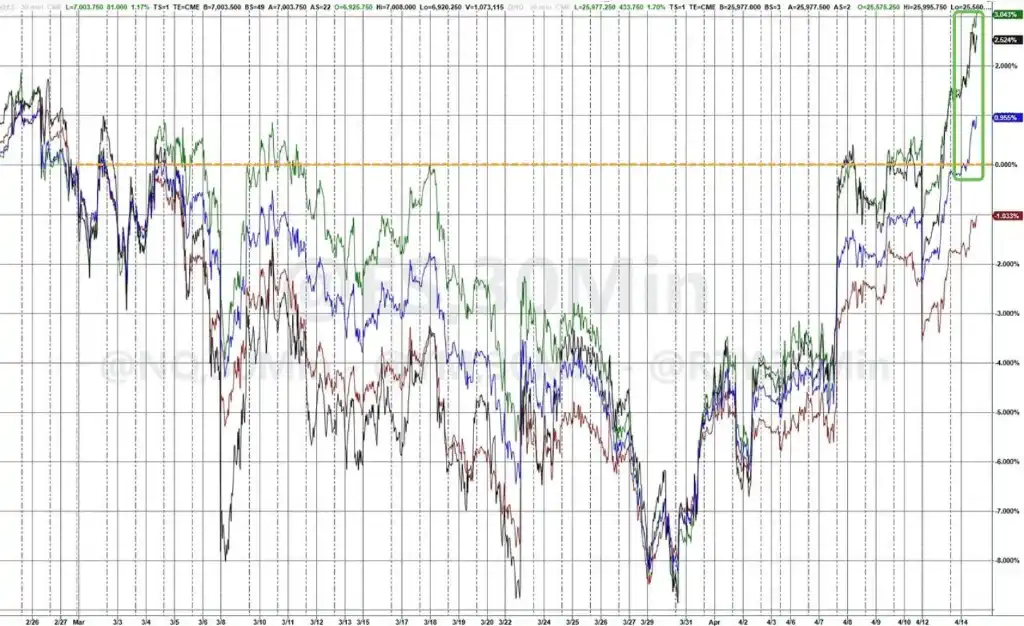
In the overnight market, leading companies in the artificial intelligence sector were also making their mark. The Mag 7 continued their strong performance, rising 3%, and have gained 15% over the past 10 trading days (rising in 9 out of those 10 days).
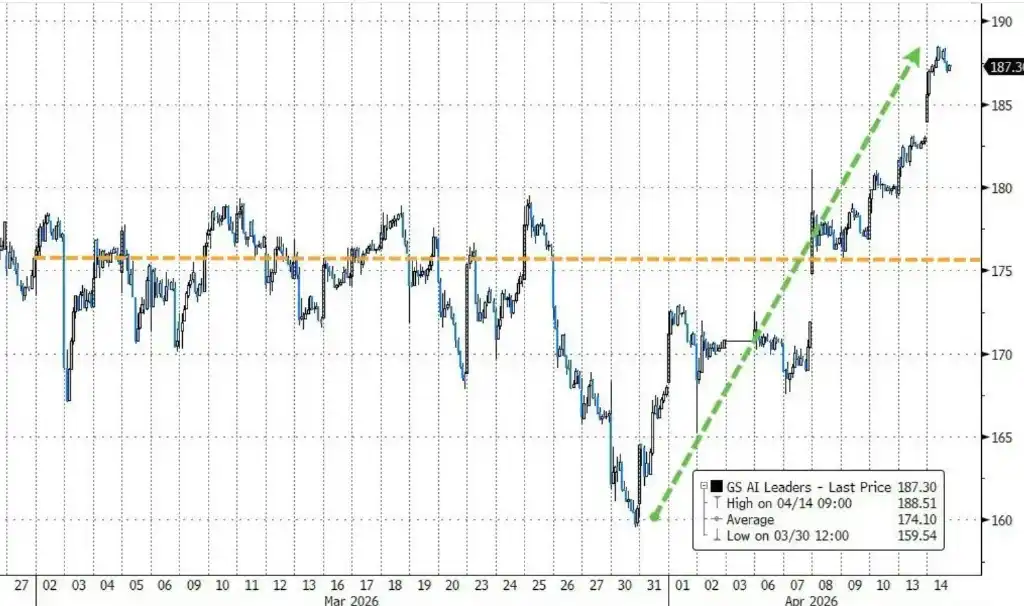
The chip sector was a key driver of this rally. Bloomberg data shows that earnings expectations for the chip sector jumped about 10% in just three trading days, significantly boosting the overall EPS forecast for the S&P 500. Goldman Sachs data indicates that Nvidia and Micron alone are expected to contribute over 50% of the S&P 500's EPS growth this quarter.
And this rally isn't just a stock story.
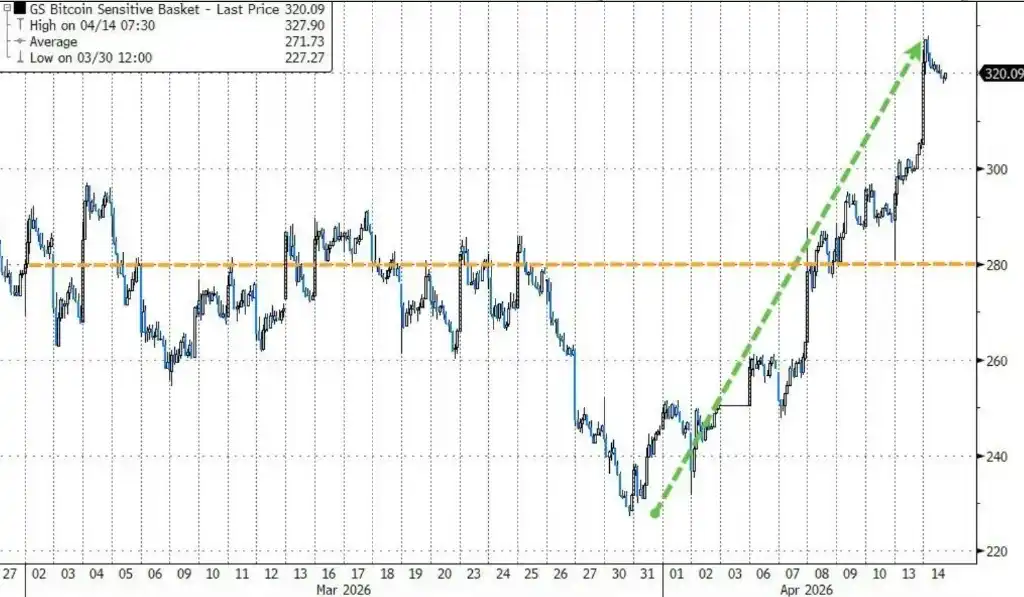
US Treasury yields fell alongside declining oil prices, down about 3 to 4 basis points across the curve. Bitcoin broke through $76,000, hitting a new high since the conflict began. Gold traded above $4800, its highest level since March 18. The US dollar continued to weaken, nearly erasing all its gains since the war outbreak.
Market liquidity is also returning to normal. Goldman Sachs data shows that the top-of-book liquidity for S&P 500 constituents has recovered to about $13.16 million from around $3.5 million at the peak of geopolitical uncertainty, an increase of 141% above the 20-day average. The proportion of ETF volume to total market volume has also retreated from a peak of about 50% to 29%.
An interesting phenomenon is that Trump's "familiar script" seems to be playing out again......
Funds "Chase Gains One-Directionally", Shorts Forced to Cover
Regarding this strong rebound in US stocks, a veteran equity trader said: "The flow of funds is one-directional...... CTAs, clients, everyone was underweight risk exposure, and now they are all chasing the rally."
Behind this "panic buying" is a combination of multiple forces:
Institutional investors led the rebound. Mark Hackett, Chief Market Strategist at Nationwide, pointed out that after the large-scale sell-off, institutional attention has turned back to fundamentals, and the fundamental data is supportive.
CTA funds bought heavily, but long-only funds and hedge funds were selling. According to Goldman Sachs trading desk data, long-only (LO) funds were slight net sellers, while hedge funds (HF) were net sellers to the tune of 3%, mainly reducing exposure to Information Technology, Industrials, and Communication Services sectors—they were "selling into" the buying from CTAs.
Short covering accelerated. Goldman's rolling short basket saw three significant surges, unprofitable tech stocks rose sharply, and the most shorted stocks experienced a short squeeze.
The Goldman trading desk attributed the continued strength of the "Magnificent Seven" (Mag 7) to four factors: the improved geopolitical backdrop triggering the covering of index hedge positions (Mag 7 accounts for about 33% of the S&P 500 weight), the settling down of fund rotation trades since Q1, the market positioning ahead of strong earnings season expectations, and ongoing stock buyback program support.
Earnings Season Takes the Baton, Fundamentals Repriced
The shift in market narrative is supported by data.
This week, major financial institutions like JPMorgan Chase, Citigroup, Wells Fargo, and BlackRock陆续 released Q1 earnings. Goldman's Chris Hussey noted that the banking sector is often seen as a barometer of the overall health of the US economy, "This morning's earnings show that, despite concerns about inflation, AI, private credit, and consumer spending, households and businesses remain in solid shape."
Inflation data also provided support. March PPI rose 0.5% month-on-month, below expectations. But Blake Gwinn, Interest Rate Strategist at RBC Capital Markets, cautioned, "The market is increasingly interpreting PPI data through the lens of PCE transmission," and tends to "view weak data as lagging indicators, believing inflationary pressures are still on the way."
Stocks "Look Forward", Oil Market Still Waits
Notably, a clear divergence has emerged between the stock market and the oil market.
WTI crude futures fell below the $91 mark during the day. Polymarket data shows the probability of WTI falling below $90 by month-end is rising quickly. The immediate triggers for the oil price drop were: reports that Iran is considering suspending some oil exports to push for talks, and that the US and Iran are discussing a second round of peace negotiations.
Market data—the crude forward curve (represented by December Brent futures)—suggests the oil market believes resolving the supply disruption will take longer—contrasting with the stock market's "mission accomplished" optimism.
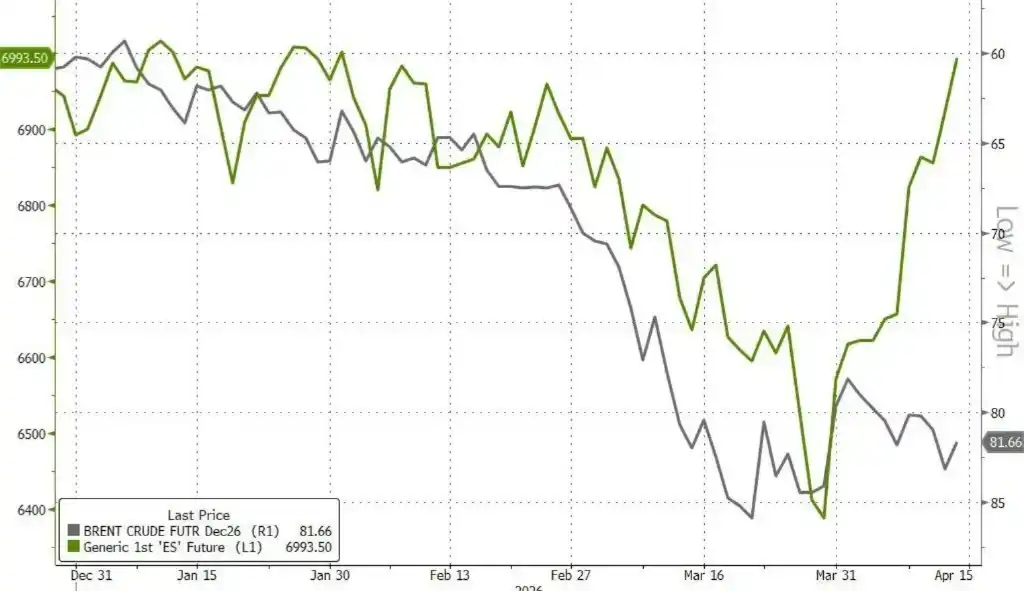
Goldman's Chris Hussey explained this: "Stocks are forward-looking instruments, and the market cannot afford to wait for the resolution of a problem they know will eventually be solved—this dynamic explains today's market behavior and the reason for the return to优异表现."
Risks Remain After the Rally
Despite the明显 improved sentiment, several strategists remain cautious about the outlook.
Lori Calvasina of RBC Capital Markets warned that the uncertainty of the war and its ripple effects keep the risk of a "growth scare pullback" hanging high. She wrote in a client report on Sunday: "If the fundamental narrative around the war or its impact changes, from a valuation perspective, there is still room for stocks to fall again, potentially even deeper than before."
Nationwide's Hackett is skeptical about the S&P 500's ability to break through to new all-time highs: "Before substantial progress is made in peace talks, I doubt we can truly break through to new all-time highs. But once that day comes, conservative positioning, strong fundamentals, and reset expectations will form a powerful, coiled-spring force."
Bond investors also remain skeptical about the improving inflation news. Raghav Datla, Global Markets Rates Strategist at Citi, said: "In future reports, it will be difficult to see lower inflation numbers again, and no one can accurately predict what the numbers will be."
Veteran strategist Ed Yardeni is more optimistic. In his investor report on Sunday, he stated that, similar to the Russia-Ukraine conflict, financial markets are learning to live with the Iran war and maintained his call that the S&P 500 bottomed on March 30th.




















