Tens of Millions of Errors Per Hour: Investigation Reveals the 'Accuracy Illusion' of Google AI Search

marsbitPublié le 2026-04-10Dernière mise à jour le 2026-04-10

Résumé

A New York Times investigation, in collaboration with AI startup Oumi, reveals significant accuracy and reliability issues with Google's AI Overviews search feature. Testing over 4,300 queries showed the accuracy rate improved from 85% (Gemini 2) to 91% (Gemini 3). However, given Google's scale of ~5 trillion annual searches, this 9% error rate translates to over 57 million incorrect answers generated hourly. A more critical issue is the prevalence of unsubstantiated citations. For correct answers, the rate of "unfounded citations"—where provided source links do not support the AI's claims—worsened, rising from 37% with Gemini 2 to 56% with Gemini 3. This makes it difficult for users to verify the information. The AI also heavily relies on low-quality sources, with Facebook and Reddit being its second and fourth most cited domains. Furthermore, the system is highly susceptible to manipulation. A BBC journalist successfully "poisoned" it by publishing a fake article; Google's AI began presenting the false information as fact within 24 hours. Google disputed the study's methodology, criticizing the use of the SimpleQA benchmark and an AI model (Oumi's HallOumi) to evaluate its own AI. The company maintains that its internal safeguards and ranking systems improve accuracy beyond the base model's performance.

Author: Claude, Deep Tide TechFlow

Deep Tide Introduction: The latest test by The New York Times in collaboration with AI startup Oumi shows that the accuracy rate of Google Search's AI Overviews feature is about 91%. However, given Google's scale of processing 5 trillion searches annually, this translates to tens of millions of incorrect answers generated every hour. More troublingly, even when the answers are correct, over half of the cited links fail to support their conclusions.
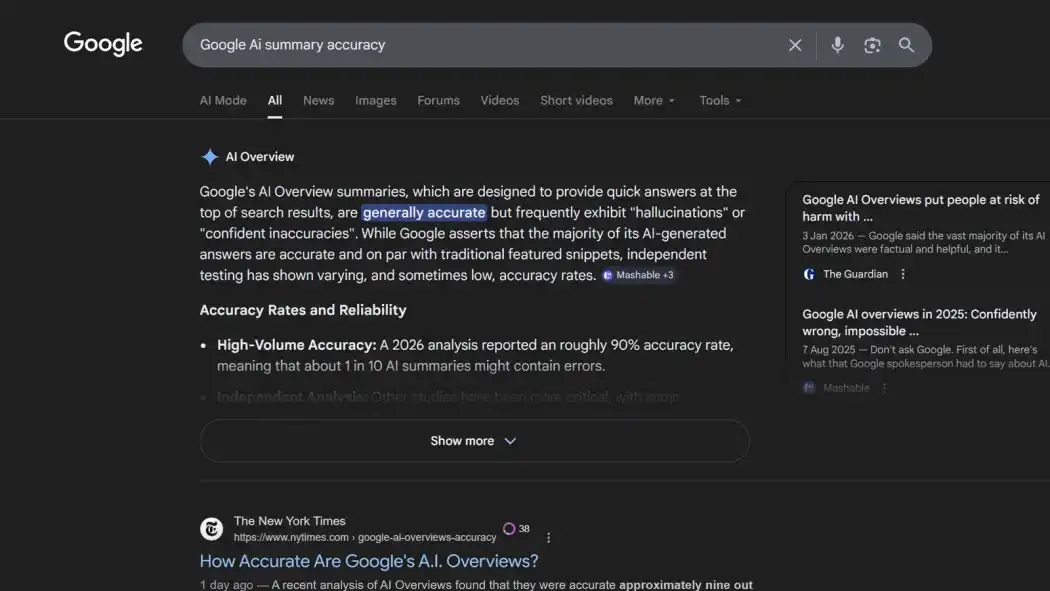
Google is delivering misinformation to users on an unprecedented scale, and most people are completely unaware.

According to The New York Times, AI startup Oumi, commissioned by the publication, used the industry-standard test SimpleQA developed by OpenAI to evaluate the accuracy of Google's AI Overviews feature. The test covered 4,326 search queries, conducting one round in October last year (powered by Gemini 2) and another in February this year (upgraded to Gemini 3). The results showed that Gemini 2's accuracy was about 85%, which improved to 91% with Gemini 3.

91% sounds good, but it's a different story when considering Google's scale. Google processes approximately 5 trillion search queries annually. Calculating with a 9% error rate, AI Overviews generates over 57 million inaccurate answers per hour, nearly 1 million per minute.

Correct Answers, Wrong Sources

More alarming than the accuracy rate is the issue of "unanchored" citation sources.

Oumi's data shows that in the Gemini 2 era, 37% of correct answers had "unsupported citations," meaning the links attached to the AI summaries did not support the information provided. After upgrading to Gemini 3, this proportion increased instead of decreasing, jumping to 56%. In other words, while the model gives correct answers, it's increasingly failing to "show its work."

Oumi CEO Manos Koukoumidis pointedly questioned: "Even if the answer is correct, how do you know it's correct? How do you verify it?"

The problem is exacerbated by AI Overviews' heavy reliance on low-quality sources. Oumi found that Facebook and Reddit are the second and fourth most cited sources for AI Overviews, respectively. In inaccurate answers, Facebook was cited 7% of the time, higher than the 5% in accurate answers.

BBC Journalist's Fake Article "Poisoned" Results Within 24 Hours

Another serious flaw of AI Overviews is its susceptibility to manipulation.

A BBC journalist tested the system with a deliberately fabricated false article. In less than 24 hours, Google's AI Overview presented the false information from the article as fact to users.

This means anyone who understands how the system works could potentially "poison" AI search results by publishing false content and boosting its traffic. Google spokesperson Ned Adriance responded by saying the search AI feature is built on the same ranking and security mechanisms that block spam, and claimed that "most examples in the test are unrealistic queries that people wouldn't actually search for."

Google's Rebuttal: The Test Itself Is Flawed

Google raised several objections to Oumi's research. A Google spokesperson called the study "seriously flawed," citing reasons including: the SimpleQA benchmark itself contains inaccurate information; Oumi used its own AI model HallOumi to judge another AI's performance, potentially introducing additional errors; and the test content doesn't reflect real user search behavior.

Google's internal tests also showed that when Gemini 3 operates independently outside the Google Search framework, it produces false outputs at a rate as high as 28%. But Google emphasized that AI Overviews leverages the search ranking system to improve accuracy, performing better than the model itself.

However, as PCMag's commentary pointed out the logical paradox: If your defense is that "the report pointing out our AI's inaccuracies itself uses potentially inaccurate AI," this probably doesn't enhance users' confidence in your product's accuracy.


Questions liées

QWhat is the accuracy rate of Google's AI Overviews feature according to the Oumi study?

AThe accuracy rate of Google's AI Overviews was found to be approximately 91% when powered by Gemini 3, an improvement from about 85% with Gemini 2.

QHow many inaccurate answers does the article estimate Google's AI Overviews produces per hour?

ABased on Google's annual volume of 5 trillion searches and a 9% error rate, the AI Overviews feature is estimated to produce over 57 million inaccurate answers per hour.

QWhat is the 'unsubstantiated citation' problem identified in the report?

AThe 'unsubstantiated citation' problem refers to instances where the AI Overviews provides a correct answer, but the attached source links do not actually support the information given. This issue increased from 37% with Gemini 2 to 56% with Gemini 3.

QWhich low-quality websites are frequently used as sources by AI Overviews, according to the Oumi data?

AAccording to Oumi's data, Facebook and Reddit are the second and fourth most cited sources by AI Overviews, with Facebook being cited more frequently in inaccurate answers.

QHow did Google respond to the findings of the Oumi study?

AGoogle criticized the study, calling it 'seriously flawed.' Their spokesperson argued that the SimpleQA benchmark itself contains inaccuracies, that using an AI (HallOumi) to judge another AI introduces errors, and that the test queries do not reflect real user search behavior.

Lectures associées

Un Trader de Bitcoin Affirme que les Sommets et les Creux des Cycles Correspondent à des Délais Exactement Identiques

Un trader utilisant le pseudonyme Ryan (@DodysDD) affirme avoir identifié une précision mathématique étonnante dans les cycles de prix du Bitcoin. Selon son analyse, les phases de marché haussier, du plus bas au plus haut (ATH), dureraient exactement 1064 jours, comme observé lors des cycles 2014-2017, 2018-2021 et 2022-2025. De même, les phases baissières (du pic au creux) correspondraient à 364 jours, comme en 2017-2018 et 2021-2022. Ce schéma, s'il se vérifiait, offrirait aux investisseurs un cadre temporel simple pour anticiper les tendances majeures. Cependant, l'article souligne les risques inhérents à ce type de théorie. La précision apparente dépend souvent du choix des points de référence (cours de clôture, sommets intradays...), ce qui peut conduire à une sélection biaisée des données. Il n'existe aucune preuve que le Bitcoin soit régi par un minutage aussi exact, son prix étant influencé par une multitude de facteurs (halvings, conditions macroéconomiques, psychologie des investisseurs...). Malgré ces limites, ce récit cyclique trouve un écho dans la communauté des traders, surtout dans un contexte actuel d'incertitude sur la phase de marché. Il fournit une narration simple face à la complexité. En conclusion, si l'observation sert de cadre d'analyse populaire, elle doit être abordée avec scepticisme et ne peut, à elle seule, prédire les futurs sommets ou creux du marché.

bitcoinistIl y a 3 h

Un Trader de Bitcoin Affirme que les Sommets et les Creux des Cycles Correspondent à des Délais Exactement Identiques

bitcoinistIl y a 3 h

94 billions, le plus grand financement de l'année pour les robots humanoïdes est apparu

Dans le secteur des robots humanoïdes, un tournant majeur est marqué par le financement record de 14 milliards de dollars (environ 94,9 milliards de yuans) levé par l'entreprise allemande Neura. Cette levée de fonds de série C, menée par des investisseurs industriels de renom comme Schaeffler et Bosch, ainsi que des géants technologiques (NVIDIA, Amazon), porte l'évaluation de Neura à environ 70 milliards de dollars. Cet investissement massif signale un changement profond : la filière passe d'une phase de démonstration technologique à une phase d'industrialisation et de déploiement concret en usine. Contrairement aux sociétés axées sur un robot humanoïde "universel" (comme Figure AI), Neura adopte une approche pragmatique, ciblant d'abord des applications industrielles verticales et spécifiques, comme en témoigne son partenariat avec BMW. La conjonction de plusieurs facteurs explique cet afflux de capitaux : les progrès de l'IA (modèles de grande taille) qui améliorent les capacités de perception et de décision des robots, et les pressions structurelles sur le marché du travail (vieillissement, pénurie de main-d'œuvre, coûts salariaux) qui créent une demande croissante dans la fabrication. Les principaux défis pour une adoption massive ne sont plus uniquement techniques. Ils concernent désormais les coûts d'adaptation aux lignes de production existantes, la formation des opérateurs et la mise en place d'un réseau de maintenance fiable. L'entrée en scène de capitaux industriels expérimentés démontre une confiance accrue dans la capacité du secteur à résoudre ces problèmes d'ingénierie et de modèle commercial, achevant ainsi la transition cruciale du laboratoire au sol de l'usine.

marsbitIl y a 8 h

94 billions, le plus grand financement de l'année pour les robots humanoïdes est apparu

marsbitIl y a 8 h

Le marché de la pré-introduction en bourse d'Anthropic chute après qu'une directive américaine force l'arrêt du modèle

Anthropic a annoncé avoir reçu une directive du gouvernement américain lui ordonnant de suspendre l'accès aux modèles Claude Fable 5 et Claude Mythos 5 pour les ressortissants étrangers, y compris ses propres employés étrangers. Cette mesure d'urgence, justifiée par des préoccupations de sécurité nationale liées au contrôle des exportations, a forcé la désactivation mondiale des deux modèles le 12 juin. Les autres modèles d'Anthropic, comme Claude Opus 4.8, restent opérationnels. La réaction du marché a été immédiate : le contrat perpétuel lié à Anthropic sur Hyperliquid a chuté de 3,7%, reflétant l'impact sur sa valorisation pré-IPO. Anthropic a contesté la base de cette directive, arguant que la vulnérabilité de "jailbreak" évoquée par le gouvernement était mineure, déjà connue et non exclusive à ses modèles. La société a averti qu'un tel seuil d'intervention, s'il était généralisé, pourrait stopper les déploiements de nouveaux modèles d'IA de pointe. Cet événement illustre comment la régulation de l'IA devient un facteur négociable sur les marchés financiers. Les instruments tokenisés et les contrats pré-IPO permettent désormais aux traders de réagir instantanément à ce type de nouvelles réglementaires, même en l'absence d'informations publiques détaillées. Cela intègre l'infrastructure d'IA dans une dynamique de marché spéculative similaire à celle de la cryptomonnaie, avec des risques de volatilité basée sur des informations incomplètes.

bitcoinistIl y a 14 h

Le marché de la pré-introduction en bourse d'Anthropic chute après qu'une directive américaine force l'arrêt du modèle

bitcoinistIl y a 14 h

Trading

Spot
Futures
活动图片




