Single Post with 150 Million Views: Dan Koe and His Super Individual Business

marsbitPublié le 2026-01-19Dernière mise à jour le 2026-01-19

Résumé

Dan Koe, a prominent figure in the "one-person business" space, recently achieved 1.5 billion views on X with a post titled "How to fix your entire life in 1 day." Despite the massive reach, he earned only $4,495 from the platform in two weeks. His real income comes from his broader business: Koe made over $4 million in 2024 through paid newsletters, books, and digital products aimed at teaching people how to build personal brands and escape traditional employment. His success is built on years of content creation, a large following (750k on X, 1.2M YouTube subscribers), and a trusted brand. The viral post served as a top-of-funnel tool to attract potential customers into his paid ecosystem, rather than a direct revenue source. The "super individual" trend reflects a growing desire for self-directed work, but the market is increasingly crowded. While AI tools allow easy imitation of high-engagement content, established creators like Koe retain advantage through authenticity and timing. X's recent push for long-form content, including a $1M incentive program, benefits top creators most, reinforcing a cycle where platforms and influencers mutually profit—while most followers remain consumers, not successful creators.

Author: Curry, Deep Tide TechFlow

What was the hottest article on X last week?

"How to fix your entire life in 1 day." Fix your entire life in one day.

Author Dan Koe, an American, creates content about "super individuals," teaching people how to not work a 9-to-5 job and make a living by writing. A week after its release, this article had already reached 150 million views.
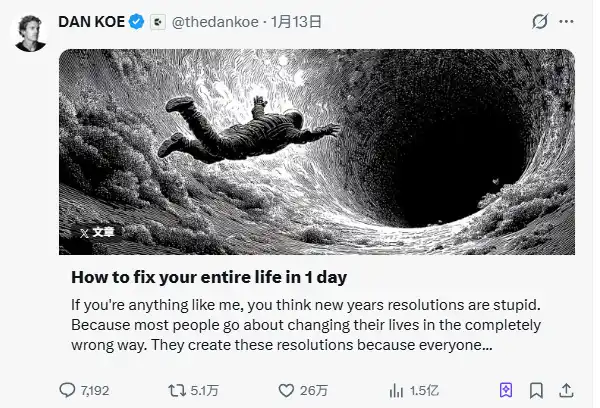
What does 150 million mean? X has just over 600 million monthly active users globally, meaning one in every four users has come across this article.

Some wondered how much money this could make. Dan Koe shared a screenshot of his earnings: in 14 days, X platform paid him $4,495.

150 million views, $4,495. But Dan Koe actually earned over $4 million last year.

The money clearly doesn't come from platform revenue sharing.

You must have seen the term "super individual."

It generally means you don't need to work a job or have a team; you just need to turn your ideas and creativity into content posted online to attract a group of people who resonate with you, and then sell courses to them. In the U.S., this is called a One-Person Business.

Dan Koe is a top player in this field. He has 750,000 X followers, 1.2 million YouTube subscribers, and an email list of 170,000 people.

His story is also standard. He studied design in college, worked as a freelancer after graduation, tried e-commerce, and lost money. He started writing on Twitter in 2019, but no one read it. He persisted for two years before gaining traction.

These experiences are part of the content itself. Failure, struggle, persistence, and triumph—you can see this narrative structure in any successful self-help blogger.

Li Xiaolai talked about it, Luo Zhenyu talked about it, Fan Deng talked about it.

Americans package it as Philosophy and Productivity; Chinese package it as "cognitive upgrade." The skeleton is the same.

How does Dan Koe make money?

Open his official website, and you'll see several types of products: paid newsletter subscriptions, two books ("The Art of Focus" and "Purpose & Profit"), and an AI tool he co-founded called Eden.
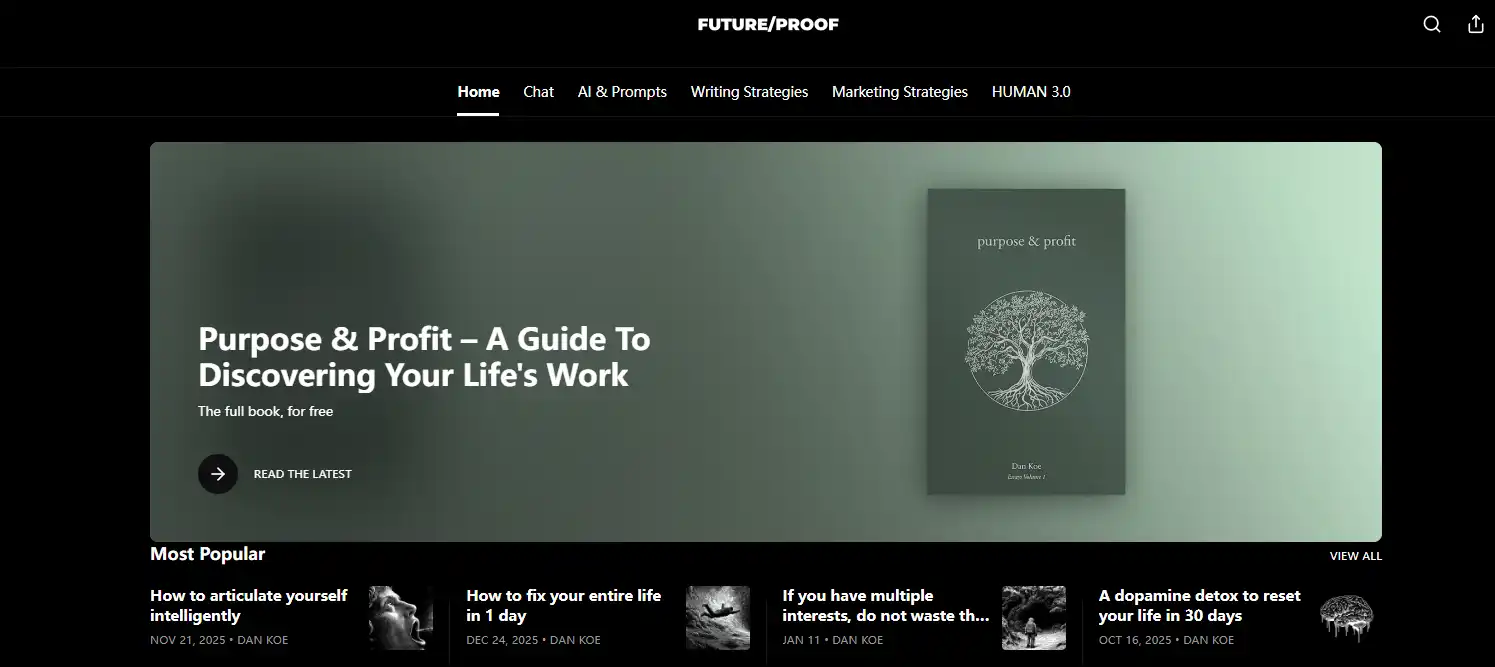
He used to sell writing courses and membership communities, but they are no longer visible on the official website. They might have been taken down or merged into the paid subscriptions.

I couldn't find official pricing data, but the logic of such products is generally similar:

Free content filters out those willing to pay; low-priced products filter out those willing to pay more.

How much does he earn? In 2023, he posted on Twitter that his income that year was $2.5 million. In a 2024 interview with the subscription software beehiiv, Dan also revealed that he earns over $4 million annually.

But given his follower size, it's not far-fetched. With nearly 200,000 email subscribers and millions of YouTube fans, assuming 5% have purchased paid products, that's nearly 50,000 paying users.

So what is the 150 million views to him?

A traffic entry point at the top of the funnel. The $4,495 platform share on X is pocket change; what's more important is increasing his brand recognition and reach. The real money comes from those willing to pay later.

You might ask, who is buying these things?

The answer is undoubtedly those who want to become the next Dan Koe.

The goal of such course participants is basically to "build a personal brand," "monetize self-media," and "escape the 9-to-5 grind." What they pay to learn is exactly what Dan Koe is doing.

For this model to work, there is one prerequisite: there are always new people wanting to join.

Just like gym memberships always surge at the beginning of the year, the "super individual"赛道 always has people who believe they can become the next top player. Dan Koe published that article on January 12, right when New Year's resolutions are strongest.

The title is "How to fix your entire life in 1 day." What do you think people clicking on it are thinking?

Meanwhile, X is also betting on it.

On January 16, a few days after Dan Koe's article went viral, X announced a new policy: the creator revenue pool doubled, long-form article权重 increased, and an additional $1 million reward for the best-performing original articles.
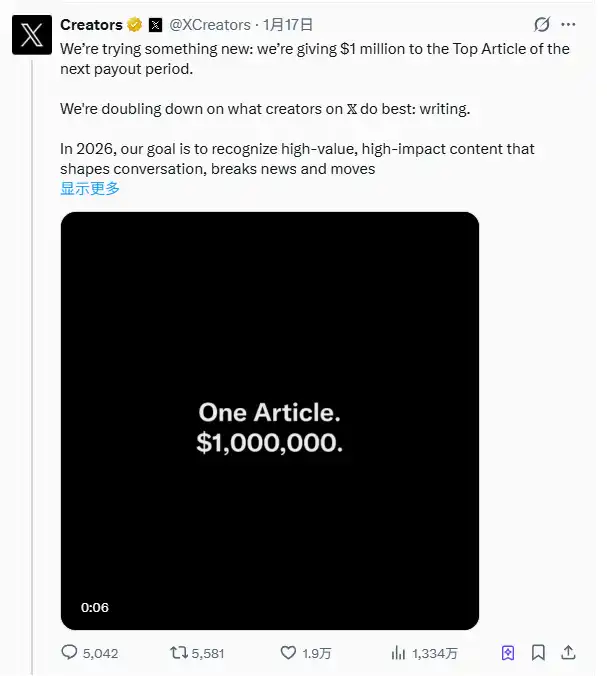
What Musk wants to do is obvious. TikTok has cut everyone's attention into 15-second碎片; X wants to go the opposite way, using long-form content to retain users. Dan Koe wrote a comment大意 saying that short videos are刷得太狠了, and now the internet has a chance to swing back.

X loves to hear that.

But what can $1 million buy?

Search on X, and you'll already find a lot of imitators. Various AI skill tutorials and inspirational articles are emerging, such as "How to change your life in 2026," "The one skill you need," "Why most people will never succeed"...

The structure is the same, the image style is the same as Dan's viral post, and even the "I'm here to tell you the truth" tone is the same.

This writing style has even become a meme,引得大家争相模仿和尝试.

It's not surprising. Dan Koe himself said he uses AI to assist写作, by having AI interview himself, extract ideas, and then format them into highly传播 content structures.

Anyone can learn this method. ChatGPT can generate a "life-changing" long article in ten minutes, with correct grammar, complete structure, and even automatically add a few psychological terms to appear profound.

But it's Dan Koe who went viral, not the imitators.

Why?

One explanation is that trust takes time. Dan Koe has been writing for six years, has real failure experiences, and has a traceable growth trajectory. AI can imitate his sentence structure, but it can't replicate these.

Another explanation is that the super individual赛道 is too crowded.

When everyone is teaching "how to become a super individual," whether it's about AI tools, guide to success, life fixes, or business insights, attention concentrates at the top. Those who enter early eat the meat, those who come later drink the soup, and those even later get nothing.

Another explanation is luck. Dan Koe hit the window of X's algorithm adjustment, the New Year emotional cycle, and the policy tailwind of Musk pushing long-form content. Three things叠加 together, and 150 million views happened.

Change the person, change the timing, the same quality article might only get 1.5 million views.

An interesting point is that Dan Koe's article was published a few days too early and is not eligible for X's $1 million content reward selection.

But he doesn't care. His business model doesn't rely on platform revenue sharing. The 150 million views have already fulfilled their mission:让更多人知道 Dan Koe 这个名字,让漏斗顶端灌进去更多的人.

So who will X's $1 million eventually go to? According to the rules, it must be original long-form articles, at least 1000 words, calculated based on the首页展示量 of paying users.

Translation: you not only have to write well, but you also need to already have a large number of fans.

So most likely, the top players will take it.

This is the structure of the game. The platform needs top creators to prove that "long-form content has a future"; top creators need platform traffic to feed their funnel; AI allows everyone to mass-produce "life-changing" content, but only a very few can actually make money from it.

What is the role of most people?

Readers.

After reading a "How to fix your entire life in 1 day," feeling inspired to become a super individual, then sharing, liking, bookmarking it, and continuing to scroll to the next one.


Questions liées

QWhat was the title of Dan Koe's viral article on X and how many views did it achieve?

AThe title was 'How to fix your entire life in 1 day' and it achieved 150 million views.

QHow much revenue did Dan Koe generate from X platform's ad share for that viral article, and what was his actual annual income in 2024?

AHe earned $4,495 from X's ad share for the article, but his actual annual income in 2024 was over $4 million.

QWhat is the core business model of a 'super individual' or 'one-person business' as described in the article?

AThe core model involves creating content to build a personal brand, attracting an audience, and monetizing through selling courses, subscriptions, books, or tools to followers who want to achieve similar success.

QHow did X platform's policy change shortly after Dan Koe's article went viral, and what was its goal?

AX announced a new policy that doubled the creator earnings pool, increased the weight of long-form articles, and allocated an additional $1 million to reward the best-performing original articles, aiming to promote long-content and retain users.

QWhy did Dan Koe's article succeed despite many AI-generated imitations, according to the analysis?

AHis success is attributed to six years of building trust through authentic experiences and a track record, timing with X's algorithm changes and New Year resolutions, and the 'winner-takes-most' effect in the crowded super-individual niche.

Lectures associées

Enquête sur les parts de marché mondiales : les entreprises japonaises en tête dans le secteur des matériaux pour semi-conducteurs

Enquête sur les parts de marché mondiales en 2025 : les entreprises japonaises restent dominantes dans les matériaux semi-conducteurs, avec Shin-Etsu Chemical en tête pour les plaquettes de silicium et trois firmes nippones (Tokyo Ohka Kogyo, JSR, Shin-Etsu) occupant le podium des photorésines, détenant ensemble 60,5 % du marché. Leur force contraste avec leur présence limitée dans les mémoires et GPU, où les coréennes SK Hynix et Samsung dominent. Cependant, dans d'autres secteurs clés comme l'automobile, la progression japonaise stagne. Toyota conserve la première place mondiale, mais avec seulement 12,3 % de part de marché, et aucune entreprise japonaise ne figure parmi le top 5 des véhicules électriques, dominé par BYD et Tesla. Dans la construction navale, Imabari Shipbuilding grimpe à la 3ᵉ place mondiale (7,2 %), tirée par les commandes de grands porte-conteneurs. Mais les leaders sont désormais le chinois CSSC (17,8 %) et le coréen HD Hyundai Heavy Industries (13,7 %). Le gouvernement japonais vise un doublement de la production d'ici 2035, ce qui nécessitera des investissements massifs et une réponse à la pénurie de main-d'œuvre. L'enjeu pour les entreprises japonaises est de poursuivre des investissements à haut risque pour maintenir leur avance dans les matériaux semi-conducteurs face aux géants qui investissent massivement, comme Samsung et SK Hynix.

marsbitIl y a 16 mins

Enquête sur les parts de marché mondiales : les entreprises japonaises en tête dans le secteur des matériaux pour semi-conducteurs

marsbitIl y a 16 mins

STRC a décroché : La première communication financière post-décrochage, comment Strategy répare sa dynamique capitalistique ?

Le fournisseur de trésorerie Bitcoin Strategy a publié ses résultats pour le deuxième trimestre 2026, enregistrant une perte nette de 8,22 milliards de dollars en raison de la volatilité du BTC, malgré une légère hausse de son chiffre d'affaires. La principale préoccupation des investisseurs reste la capacité de l'entreprise à rétablir la durabilité de son modèle de financement après le décrochage de son instrument de prédilection, le STRC, qui échange toujours en dessous de sa valeur nominale cible. Strategy continue d'accumuler des BTC, détenant désormais 843 775 unités, mais sa stratégie de capital a évolué. Elle adopte désormais une gestion active et bilatérale, utilisant non seulement ses réserves de liquidités et ses rachats d'actions pour gérer les pressions, mais aussi un nouveau « programme de monétisation » ayant déjà vendu pour 218 millions de dollars de BTC. La priorité absolue reste de ramener le STRC à sa valeur nominale. La direction s'engage à ne pas émettre de nouvelles actions STRC à escompte et mise sur l'augmentation de ses réserves de trésorerie (3,75 milliards de dollars) et sur un programme de rachat de titres de 1 milliard de dollars pour restaurer la confiance. Un objectif de réalignement d'ici le 8 septembre a été fixé. L'avenir du modèle de Strategy dépend à court terme du succès de la ré-ancre du STRC, et à long terme d'une reprise du prix du Bitcoin, fondement ultime de sa logique de croissance.

marsbitIl y a 59 mins

STRC a décroché : La première communication financière post-décrochage, comment Strategy répare sa dynamique capitalistique ?

marsbitIl y a 59 mins

Le premier rapport financier après le décrochage majeur du STRC, comment Strategy répare-t-elle la roue du capital ?

STRA, la société trésorerie Bitcoin, a publié ses résultats financiers du deuxième trimestre 2026. Malgré des revenus de 122 millions de dollars (en hausse de 6.9%), elle a enregistré une perte nette de 8.22 milliards de dollars, principalement due à des pertes non réalisées sur ses réserves de Bitcoin, évaluées à 550 milliards de dollars pour 843 775 BTC. Le rapport se concentre sur la réponse de STRA à la crise de son instrument de financement privilégié, le STRC, qui s'est décroché de sa valeur nominale cible de 100 dollars, tombant jusqu'à 74.57 dollars. La priorité absolue de l'entreprise est de ramener le STRC à son ancrage. Pour cela, elle ne procédera à aucune nouvelle émission à prix réduit, maintient son taux de dividende à 12% et utilise un programme de rachat de 10 milliards de dollars pour acquérir des STRC décotés sur le marché. STRA vise une stabilisation d'ici début septembre. Parallèlement, STRA opère un changement stratégique majeur dans la gestion de son capital. Elle passe d'un modèle linéaire "lever des fonds -> acheter du BTC" à une gestion active et multidirectionnelle de ses quatre piliers : Bitcoin, liquidités en dollars, actions ordinaires (MSTR) et titres de crédit numérique (STRC). Le Bitcoin n'est plus seulement une réserve à accumuler mais peut être monétisé si nécessaire. L'entreprise optimise activement sa structure de dette et joue sur les opportunités d'arbitrage entre ses différents actifs. En résumé, la capacité de STRA à relancer sa "roue du capital" dépend à court terme de la réussite du réancrage du STRC, et à long terme de la reprise d'une tendance haussière du prix du Bitcoin, fondement ultime de son modèle économique.

Odaily星球日报Il y a 1 h

Le premier rapport financier après le décrochage majeur du STRC, comment Strategy répare-t-elle la roue du capital ?

Odaily星球日报Il y a 1 h

Coinbase affiche des pertes pour le deuxième trimestre consécutif et doit compter sur des sources de revenus autres que le trading

La plateforme d'échange de cryptomonnaies américaine Coinbase a publié ses résultats pour le deuxième trimestre, affichant une baisse de son chiffre d'affaires à 1,22 milliard de dollars et une perte nette GAAP de 359 millions de dollars, marquant ainsi son deuxième trimestre consécutif dans le rouge. Malgré un marché global des cryptos en recul (volumes de transactions au comptant en baisse de 25%), Coinbase a augmenté sa part de marché estimée à 10,3%. Ceci démontre que sa position d'acteur conforme aux régulations américaines lui permet de capturer une part plus importante de l'activité, même en période de volatilité réduite. La structure des revenus évolue significativement. Les revenus de transaction (599M$) et les revenus d'abonnement/services (555M$) sont désormais presque à égalité. Une part importante des revenus de services provient des stablecoins, générant 292M$ grâce aux intérêts sur les soldes USDC détenus sur ses produits. Ceci crée un flux de revenus plus récurrent, moins dépendant du seul volume transactionnel. La plateforme développe également ses offres sur les produits dérivés, dont les volumes (1,03 trillion de dollars) sont restés stables tandis que les volumes au comptant diminuaient. L'objectif est d'intégrer comptant, stablecoins et dérivés sur une même plateforme de liquidités pour fidéliser les utilisateurs. Bien que le résultat net GAAP soit négatif, l'EBITDA ajusté reste positif à 208M$, soulignant la capacité opérationnelle à couvrir les coûts courants. La société contrôle ses dépenses mais le défi reste de valider la croissance de ces nouvelles sources de revenus (stablecoins, dérivés, services) pour mieux résister aux cycles futurs du marché.

marsbitIl y a 1 h

Coinbase affiche des pertes pour le deuxième trimestre consécutif et doit compter sur des sources de revenus autres que le trading

marsbitIl y a 1 h

Trading

Spot
活动图片