"Shelling" Google Gemini, But Apple Hasn't Given Up on Its Own Model

marsbitPublié le 2026-01-13Dernière mise à jour le 2026-01-13

Résumé

Apple has reportedly entered into a significant partnership with Google to integrate its Gemini AI model into Apple's ecosystem, as a "foundation" component for its future AI features, including a more personalized Siri expected later this year. The deal, estimated at around $1 billion annually, is not a direct replacement of Apple's own models but rather a strategic collaboration where Gemini will assist in training and enhancing Apple's proprietary on-device AI, with all processing occurring on Apple's private cloud servers to ensure user data privacy and isolation from Google. This move is seen as a tactical, transitional step for Apple to accelerate its AI capabilities and meet product launch timelines, especially after facing delays and setbacks with its in-house Apple Intelligence development and losing key AI talent to competitors like Meta. Despite this partnership, Apple continues its independent research and is reportedly developing its own trillion-parameter model, targeted for around 2027. The collaboration has drawn criticism, notably from Elon Musk, who raised concerns about the concentration of power with Google, which also controls Android and Chrome. For Google, the deal is a major win, boosting its market valuation, while OpenAI's existing partnership with Apple, which positions ChatGPT as a supplementary option for Siri, appears less central by comparison. The arrangement highlights Apple's pragmatic approach to bridging its AI gap while maintaining its l...

Written by: Xiaojinya, Zimu AI

Apple has "bowed its head".

On January 12 local time, Apple and Google issued a joint statement:

"After careful evaluation, Apple believes that Google's artificial intelligence technology provides the most robust foundation for the Apple base model, and is excited about the innovative experiences it will unlock for Apple users."
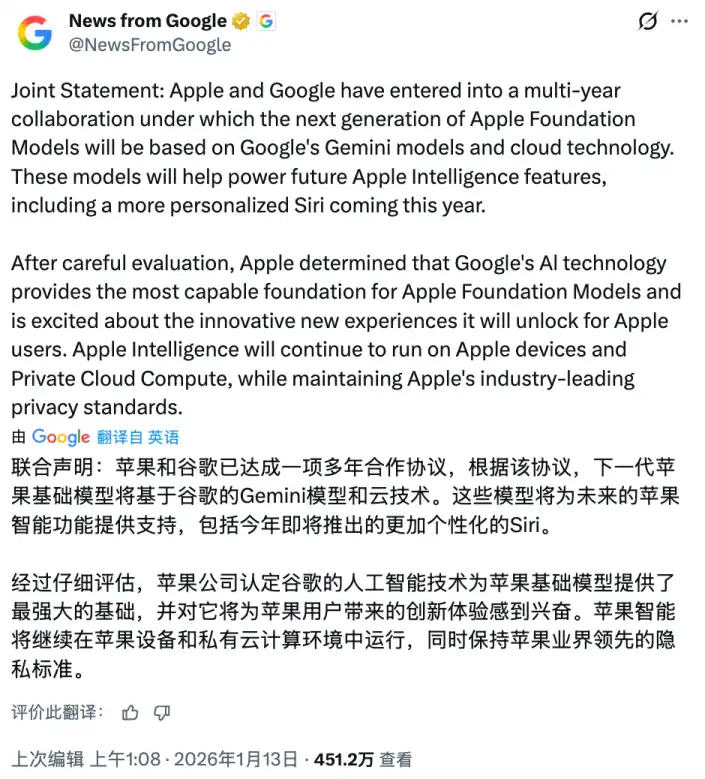
The two companies stated that these models will help support future Apple Intelligence features, including a more personalized Siri set to launch later this year.

As soon as the news broke, Musk was the first to express displeasure, commenting on X that this kind of "power concentration" is unreasonable, given that Google also owns Android and the Chrome browser.
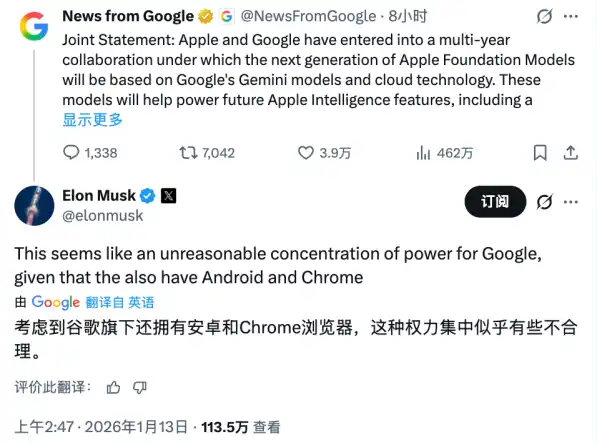
This is tantamount to saying that Google now controls Apple's AI as well. But Apple would certainly disagree with this statement.

For Apple, this is a temporary bowing of the head, but by no means an admission of defeat or surrender.

The introduction of Google Gemini is more like a temporary worker Apple has found for the transition period; it will not completely replace Apple's self-developed model. Moreover, Apple is still developing a trillion-parameter model.

Gemini Has Not Replaced Apple's Self-Developed Model

The statements released by Apple and Google are limited and deliberately vague, but one thing is clear: Gemini will participate in the construction of the new Apple base model.

This matter was reported by Bloomberg's Mark Gurman back in November last year, when he cited sources familiar with the matter saying that Apple would pay Google about $1 billion annually.

However, this is not a simple "one-for-one" swap of the Gemini model for the Apple base model, but rather a system architecture that allows Apple to continue using its own model while not providing any data to Google.

As the initial rumor pointed out, Gemini will not be directly embedded into Apple's operating system.

Instead, everything will still be presented externally with the Apple base model at its core, but at the underlying architectural level, Gemini will become its "foundation." In other words, Apple's use of Gemini falls somewhere between "shelling" and "distillation," and of course, given the cooperation between the two parties, this is certainly legal.

This is crucial; interpreting this news as "Apple's AI will be powered by Gemini" is inaccurate.

When you buy an iPhone, it internally uses chips manufactured by TSMC, displays from Samsung, and various components from all over the world. But no one would therefore claim that Samsung is "powering" the iPhone.

The on-device Apple Intelligence will still be powered by the Apple base model.

In other words, the Gemini model will serve as a tool to help train the Apple base model, enabling it to better perform the various tasks Apple sets for it.

Last year, Gurman's report mentioned that, according to the agreement between Google and Apple, Google's Gemini model would be responsible for Siri's summarization and planning functions—components that help the voice assistant synthesize information and decide how to execute complex tasks. Some of Siri's functions will continue to use Apple's self-developed model.

The report also stated that the model would run on Apple's own private cloud computing servers, ensuring user data is completely isolated from Google's infrastructure. Apple has allocated AI server hardware to support the operation of this model.

As the current public statements from both sides are ambiguous, the above content has not been refuted.

This deal is fundamentally different from the "Google Search" type of cooperation because it is completely invisible to the end user. When conversing with Siri, there will be no Gemini branding, nor should there be.

Apple Has Not Given Up

Further cooperation with Google is Apple's "transitional" choice.

Apple users have been looking forward to the new Siri since 2024, when Apple showcased it at WWDC and said it would be rolled out gradually. But since then, it has been repeatedly delayed, becoming a major embarrassment for Apple.

Currently, multiple media reports indicate that the new Siri will be released in March with iOS 26.4.

In addition, Apple Intelligence itself has not been progressing smoothly either; the initially launched features like "News Summaries" have been questioned for making errors.

Worse still, when Meta suddenly initiated a "war for AI talent" last year, Apple also suffered heavy losses. The most well-known case was the head of Apple's AI base model team at the time, Ruoming Pang, being poached, reportedly offered a sky-high compensation of $200 million by Meta.

In this situation, if delays continue, it would not only mean falling behind in the AI race for Apple but would also severely damage market trust.

At this point, turning to a third party to push forward the most urgent matters (like the new Siri) according to the schedule and deliver results to users is Apple's top priority.

And choosing Google is not surprising.

Apple and Google have a long-standing cooperative relationship; for example, Google has been paying Apple over $20 billion annually for years to remain the default search engine in Apple's Safari browser.

Their cooperation has attracted antitrust lawsuits, but the latest ruling only required adjustments to specific practices; the $20 billion cooperation between the two is still permitted.

Furthermore, Gemini is currently one of the strongest models. According to previous coverage, Apple tested several mainstream models including Gemini, GPT, and Claude, and ultimately selected Gemini.

As an aside, Apple's emphasis on "user privacy" in this new cooperation with Google Gemini, stressing that everything runs on the "Apple Private Cloud" and that no data will be shared with Google, is also a lesson learned from past collaborations with Google. In 2012, the "Safari tracking cookie scandal" occurred, where Google was accused of exploiting a privacy setting vulnerability in the Safari browser to place tracking cookies, bypassing the policy of blocking third-party cookies by default. Ultimately, Google was fined $22.5 million by the FTC and required to make changes. Additionally, Google reached a $17 million settlement with 37 states and the District of Columbia to resolve a class-action lawsuit.

In summary, this cooperation between Apple and Google can be called a temporary "bowing of the head," but by no means "admitting defeat" or "giving up."

Apple is still developing its own trillion-parameter model, expected to be launched around 2027.

Even when that model is released, Apple will likely still retain Gemini for reinforcement training, comparative analysis, and further optimization. Using it as a "tool" to strengthen itself is precisely what Apple expects from Google Gemini.

The One Who Benefits Most is Still Google

Although we just spent a long篇幅 trying to clarify what this deeper cooperation between Apple and Google is and is not.

But it can be foreseen that the perception that "Apple's AI relies on Gemini" will be difficult to eliminate.

Some can't help but imagine: Imagine if by March or April, Siri suddenly becomes super easy to use......
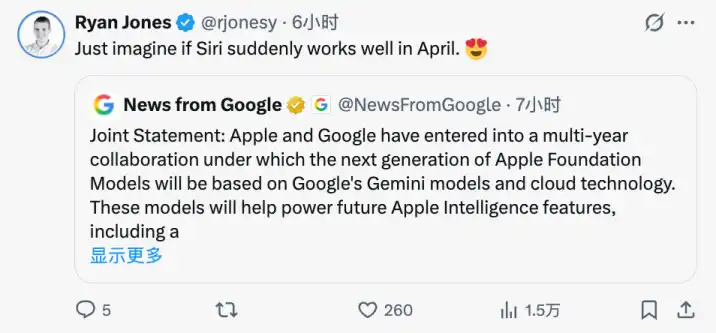
This isn't hard to imagine. The awkward situation Apple faces now is that if the introduction of Gemini indeed has an immediate effect and significantly accelerates the progress of Apple Intelligence and Siri, then the evaluation that "Apple really isn't up to it" would be confirmed.

In this case, even if Apple successfully develops its own trillion-parameter model and moves from the transition phase to self-reliance, Gemini would still be considered the功臣 (meritorious servant), not Apple itself.

As for Google, the market has already given it positive feedback.

After the joint statement from Apple and Google was released, Alphabet's stock price rose by up to 1.7%, and its market capitalization closed the day by breaking through the $4 trillion mark for the first time, setting a company record, while Apple's stock price rose by less than 1%.

This cooperation also puts other peers under pressure.

Elon Musk, who spoke out to express dissatisfaction, is one of them. He criticized Google, which controls Android and Chrome, for now also penetrating Apple, calling it an embodiment of "excessive concentration of power," hinting at monopolistic tendencies.

Another who might be uncomfortable is OpenAI's Sam Altman. OpenAI previously reached a cooperation agreement with Apple, where ChatGPT would serve as a "supplementary option" when Siri answers user questions. That is, just as Siri sometimes lists web search results now, it would, when necessary, provide answers from ChatGPT in the future.

This cooperation had previously brought glory to OpenAI, but now it pales in comparison to the new cooperation between Apple and Google.

Clearly, this cooperative status of being a "supplementary option" on the front stage is far inferior to Google Gemini's status as a "foundational helper" in the back stage. It's like the Apple club is putting on a show: OpenAI is performing on stage, but Google is working the lights backstage. Altman has not yet commented on this.

And in the Chinese market, whether Apple is also looking for a "transitional helper" before it builds its trillion-parameter self-developed model remains to be seen.


Cryptos en tendance

Questions liées

QWhat is the nature of the partnership between Apple and Google regarding AI, as announced on January 12th?

AApple and Google announced a partnership where Google's Gemini AI technology will serve as the foundational base for Apple's on-device models. This is not a direct replacement but a system where Gemini helps train and support Apple's own models, with all processing occurring on Apple's private cloud servers to ensure data privacy and isolation from Google.

QAccording to the article, why did Apple choose to partner with Google's Gemini instead of relying solely on its own AI development?

AApple chose this partnership as a transitional solution to meet its deadlines, particularly for the launch of the new, more personalized Siri. The company has faced delays and setbacks with its own Apple Intelligence and Siri development, including the loss of key AI talent to competitors like Meta.

QHow does the article describe the potential market perception of this Apple-Google deal, and what is the risk for Apple?

AThe article states that the public perception will likely be that 'Apple AI is powered by Gemini,' which could solidify the view that 'Apple is not capable' on its own. Even if Apple later succeeds with its own trillion-parameter model, Gemini could still be seen as the功臣 (key contributor), damaging Apple's reputation.

QWhat was Elon Musk's reaction to the Apple-Google AI partnership, as mentioned in the article?

AElon Musk expressed dissatisfaction on X, criticizing the partnership as an unreasonable 'concentration of power' because Google already controls Android and Chrome, and this deal further expands its influence into Apple's ecosystem.

QHow does the status of OpenAI's partnership with Apple compare to Google's new role, according to the article?

AOpenAI's partnership with Apple is described as significantly less important. OpenAI's ChatGPT is a 'supplementary option' presented to users on the front end, similar to web search results, whereas Google's Gemini is a foundational 'helper' in the backend, akin to a backstage technician compared to a stage performer.

Lectures associées

Venus Protocol Intègre des Actions Tokenisées comme Collatéral de Prêt sur BNB Chain

Venus Protocol intègre désormais des actions tokenisées comme garantie pour les prêts sur la BNB Chain, élargissant ainsi les cas d'utilisation des actifs du monde réel (RWA) dans le marché du crédit DeFi. **Points clés :** * Des actions tokenisées d'entreprises comme Apple, Tesla et Microsoft sont acceptées comme collatéral dans des pools de prêt isolés. * Ces actifs seraient adossés à 1:1 à des actions réelles détenues par des dépositaires régulés. * Les déposants peuvent emprunter des stablecoins ou du BNB contre ces garanties. Cette initiative permet aux détenteurs d'accéder à des liquidités sans vendre leurs positions sous-jacentes, rapprochant le crédit DeFi du financement sur marge traditionnel. Elle représente également une étape dans la compétition des blockchains pour attirer l'activité RWA. Cependant, ce collatéral introduit un profil de risque différent des actifs crypto-natifs, dépendant d'entités régulées hors-chaîne, de garde d'actifs et de processus de rachat. La gestion de l'évaluation des garanties, notamment avec des horaires de marché traditionnels, constitue un autre défi. Dans le contexte actuel du marché, cette intégration s'inscrit dans les tendances majeures que sont la tokenisation des actifs réels et la recherche d'une liquidité moins spéculative. Son succès dépendra de l'adoption réelle, de la fiabilité des custodians et des oracles de prix, ainsi que de la clarté des règles opérationnelles.

bitcoinistIl y a 1 h

Venus Protocol Intègre des Actions Tokenisées comme Collatéral de Prêt sur BNB Chain

bitcoinistIl y a 1 h

Le Triangle impossible est en réalité un faux problème

L'auteur conteste la pertinence du "trilemme" classique (décentralisation, scalabilité, sécurité) pour les blockchains. Il propose que les vrais freins à l'adoption massive sont la légitimité (environnement réglementaire) et le manque de confidentialité par défaut. La blockchain est définie comme un ordinateur partagé, lent et cher, dont la seule valeur unique est de fonctionner sans propriétaire ni permission. Seul l'argent natif (comme les stablecoins) est un actif adapté, car sa simple inscription au registre constitue sa valeur. Le marché actuel ne sert qu'une niche ("les gens assez aisés"). Les gros capitaux institutionnels restent à l'écart, principalement à cause des risques opérationnels et de deux défauts structurels : 1. **Légitimité** : L'absence de permission, essentielle, crée des zones grises réglementaires. Des progrès législatifs récents (ex: loi GENIUS) commencent à combler ce fossé. 2. **Transparence** : Celle-ci est présentée comme une vertu, mais constitue en réalité une taxe. Elle expose chaque transaction, position et paiement, permettant le MEV (extraction de valeur maximale) et décourageant toute entité sérieuse de révéler sa trésorerie au monde. L'auteur souligne l'ironie d'un système fondé sur la cryptographie qui ne protège pas la vie financière des utilisateurs. La solution réside dans une **confidentialité par défaut avec des preuves de conformité** (via des preuves à connaissance nulle - ZK). Cela permet de prouver un fait (solvabilité, respect des limites, KYC) sans révéler les données sous-jacentes, combinant ainsi protection individuelle et vérifiabilité pour les auditeurs et régulateurs. Cette évolution, purement améliorative, pourrait enfin attirer les milliers de milliards de capitaux institutionnels et faire de la blockchain l'infrastructure financière qu'elle était censée être.

marsbitIl y a 11 h

Le Triangle impossible est en réalité un faux problème

marsbitIl y a 11 h

L'impossible trilemme est un faux problème

L'industrie de la cryptographie a construit le système de cryptographie le plus puissant de l'histoire, mais son principal échec est l'absence de confidentialité financière par défaut. Chaque transaction, paiement et portefeuille est diffusé publiquement. La blockchain est essentiellement un ordinateur partagé, lent et coûteux, dont la seule valeur réside dans son absence de propriétaire unique et sa résistance à la censure. Pendant des années, le débat s'est concentré sur le "trilemme" (décentralisation, évolutivité, sécurité), qui est aujourd'hui largement résolu. Le vrai frein à l'adoption massive n'est pas là. La véritable contrainte est double : la légitimité juridique et le manque de confidentialité. Les fonds sont l'actif natif de la blockchain, mais les grands capitaux institutionnels restent à l'écart car l'environnement est perçu comme trop risqué et non conforme. La transparence totale de la chaîne n'est pas une vertu, mais une taxe. Elle expose les utilisateurs au MEV (Maximum Extractable Value), où les transactions sont espionnées et exploitées avant leur règlement, drainant des milliards de dollars de valeur. La plus grande ironie est que ce système, bâti sur la cryptographie, n'applique pas le chiffrement aux activités financières des utilisateurs, contrairement à la communication qui l'a adopté il y a des décennies. La solution n'est pas un anonymat total, mais une confidentialité prouvable et conforme. Les technologies cryptographiques modernes (comme les preuves à connaissance nulle) permettent de vérifier la solvabilité, la conformité KYC ou les limites de risque sans révéler les données sous-jacentes. Cela préserve les avantages de l'auditabilité tout en éliminant l'exposition permanente. En combinant un cadre réglementaire émergent (comme le GENIUS Act) et une confidentialité par défaut avec des mécanismes de divulgation vérifiable, la blockchain peut effectuer une mise à niveau pure. Elle cesse d'être un "tableur public coûteux" pour devenir une machine partagée qui confirme la véracité des transactions sans en divulguer le contenu. C'est le pont qui permettra aux capitaux institutionnels et à la finance traditionnelle de rejoindre la chaîne, débloquant ainsi les milliers de milliards de dollars qui attendent. Le système cryptographique le plus puissant apprend enfin à garder un secret, et cela change tout.

链捕手Il y a 11 h

L'impossible trilemme est un faux problème

链捕手Il y a 11 h

Des puces optiques en pleine expansion de production collective

La demande de puces photoniques connaît une croissance exponentielle, stimulée par les besoins en interconnexion optique des centres de données d'IA. Une course mondiale aux capacités de production est engagée. Aux États-Unis, Coherent étend sa ligne de production de semi-conducteurs InP de 6 pouces au Texas, soutenue par un financement et un investissement stratégique de Nvidia. Nokia développe ses capacités de test et d'emballage avancés en Pennsylvanie. Le japonais JX Advanced Metals prévoit d'augmenter sa production de substrats InP par 7 à 10 fois. En Europe, IQE et Tower Semiconductor ont conclu un accord d'approvisionnement à long terme pour les plaquettes InP, illustrant la tendance à l'intégration hétérogène des composants InP performants dans les plateformes silicium-optique matures. En Chine, l'expansion est rapide. Suzhou TFC Optical Communication (Solstice) investit 12 milliards de dollars dans un projet d'expansion. San'an Photonics possède une capacité de production mensuelle de 2 750 plaquettes pour les puces InP. Yunnan Germanium a lancé un projet pour augmenter la production de tranches de monocristal InP. La chaîne d'approvisionnement chinoise se consolide de la matière première au module. Malgré les débats sur les délais de déploiement du CPO (Co-Packaged Optics), l'augmentation globale de la consommation de contenu optique (moteurs photoniques, lasers) est incontestable, tirée par la demande croissante de bande passante dans l'IA. Le paysage futur impliquera probablement plusieurs architectures (silicium-optique, VCSEL, MicroLED) coexistant pour différentes distances et besoins. Cette frénésie d'expansion mondiale, des États-Unis et du Japon à l'Europe et la Chine, représente un pari collectif de l'industrie des semi-conducteurs sur l'avenir photonique de l'informatique à haute performance.

marsbitIl y a 14 h

Des puces optiques en pleine expansion de production collective

marsbitIl y a 14 h

Trading

Spot
Futures

Articles tendance

Comment acheter T

Bienvenue sur HTX.com ! Nous vous permettons d'acheter Threshold Network Token (T) de manière simple et pratique. Suivez notre guide étape par étape pour commencer votre parcours crypto.Étape 1 : Création de votre compte HTXUtilisez votre adresse e-mail ou votre numéro de téléphone pour ouvrir un compte sur HTX gratuitement. L'inscription se fait en toute simplicité et débloque toutes les fonctionnalités.Créer mon compteÉtape 2 : Choix du mode de paiement (rubrique Acheter des cryptosCarte de crédit/débit : utilisez votre carte Visa ou Mastercard pour acheter instantanément Threshold Network Token (T).Solde :utilisez les fonds du solde de votre compte HTX pour trader en toute simplicité.Prestataire tiers :pour accroître la commodité d'utilisation, nous avons ajouté des modes de paiement populaires tels que Google Pay et Apple Pay.P2P :tradez directement avec d'autres utilisateurs sur HTX.OTC (de gré à gré) : nous offrons des services personnalisés et des taux de change compétitifs aux traders.Étape 3 : stockage de vos Threshold Network Token (T)Après avoir acheté vos Threshold Network Token (T), stockez-les sur votre compte HTX. Vous pouvez également les envoyer ailleurs via un transfert sur la blockchain ou les utiliser pour trader d'autres cryptos.Étape 4 : tradez des Threshold Network Token (T)Tradez facilement Threshold Network Token (T) sur le marché Spot de HTX. Il vous suffit d'accéder à votre compte, de sélectionner la paire de trading, d'exécuter vos trades et de les suivre en temps réel. Nous offrons une expérience conviviale aux débutants comme aux traders chevronnés.

559 vues totalesPublié le 2024.12.10Mis à jour le 2026.06.02

Comment acheter T

Discussions

Bienvenue dans la Communauté HTX. Ici, vous pouvez vous tenir informé(e) des derniers développements de la plateforme et accéder à des analyses de marché professionnelles. Les opinions des utilisateurs sur le prix de T (T) sont présentées ci-dessous.

活动图片