Same Case, Different Verdicts: Why Was Uniswap Acquitted While Tornado Cash Was Not?

marsbitPublié le 2026-03-03Dernière mise à jour le 2026-03-03

Résumé

In a landmark ruling, the New York Southern District Court dismissed a class-action lawsuit against Uniswap and its founder, Hayden Adams, holding them not liable for scam tokens traded on the platform. The court, presided over by Judge Katherine Polk Failla, compared the case to holding a self-driving car developer responsible for crimes committed using the vehicle, emphasizing that open-source developers should not bear responsibility for misuse by third parties. This decision contrasts sharply with the legal outcome for Tornado Cash developers. Despite the same judge being involved, Tornado Cash co-developer Roman Storm was convicted for operating an unlicensed money-transmitting business, while another developer, Alexey Pertsev, received a prison sentence in the Netherlands for money laundering. The U.S. Treasury had previously sanctioned Tornado Cash for allegedly facilitating over $7 billion in money laundering, including for North Korean hackers. The divergent rulings highlight a key regulatory stance: decentralization is permissible, but privacy tools enabling illicit activities face strict scrutiny. The author suggests that while Uniswap’s legal victory aligns with principles of developer immunity for open-source code, Tornado Cash’s case underscores that protocols knowingly aiding crime, especially at a state level, won’t be tolerated. The piece concludes by questioning if Uniswap, despite its legal win, should take more proactive steps to screen for scams to prot...

Original Author: Eric, Foresight News

At 3 a.m. Beijing time on March 3, a class action lawsuit demanding that Uniswap and its founder Hayden Adams be held responsible for scam tokens on Uniswap was dismissed by the U.S. District Court for the Southern District of New York. Brian Nistler, General Counsel of the Uniswap Foundation, called it a "landmark ruling for DeFi."
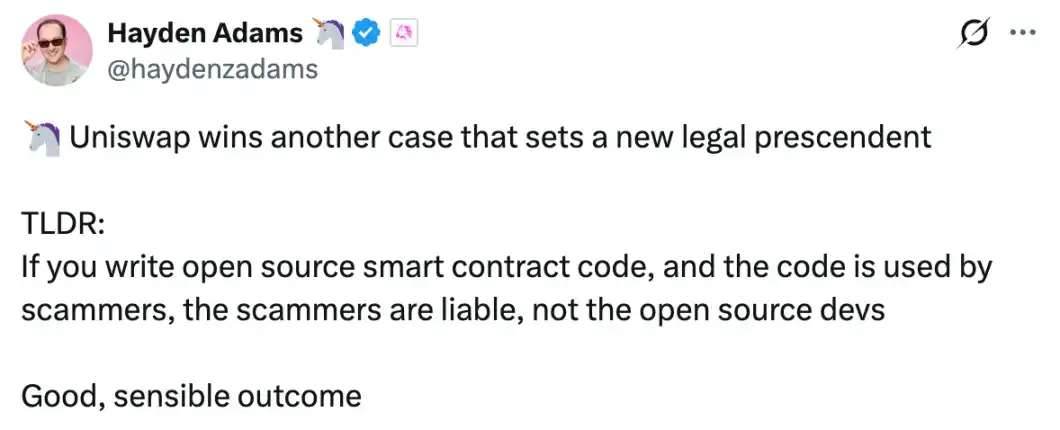
Hayden Adams also tweeted, "If you write open-source smart contract code and that code is used by scammers, the scammers are responsible, not the open-source developer. This is a reasonable and just outcome."

For Web3 developers, this is undoubtedly good news. But what is less known is that the judge who made this "just ruling" is the same person who, during the tenure of the former SEC chairman, found the developers of the mixer Tornado Cash guilty.

The Finalized Verdict

Nearly four years have passed since the class action lawsuit against Uniswap was filed and today's final resolution.

In April 2022, Uniswap users, represented by Nessa Risley, filed a class action lawsuit in court, accusing defendants including Paradigm, a16z, Uniswap, and its founder Hayden Adams of violating federal securities laws by issuing and selling unregistered securities, including UNI, in the form of tokens on Uniswap. The defendants were accused of failing to register Uniswap as an exchange or broker-dealer under applicable securities laws and failing to provide investors with registration statements for the securities they issued and sold.

This lawsuit was initiated by the law firms Kim&Serritella and Barton, representing users who traded EtherumMax, Bezoge, MatrixSamurai, Alphawolf Finance, RocketBunny, and BoomBaby.io tokens on Uniswap between April 5, 2021, and April 4, 2022.

The phrase "unregistered securities" had extraordinary destructive power for the crypto industry at the time, but this lawsuit unexpectedly quickly tilted in Uniswap's favor.

Presiding Judge Katherine Polk Failla, while agreeing that the so-called "scam tokens" were indeed securities, ruled that Uniswap did not need to be held responsible for them. Failla believed that the decentralized nature of Uniswap meant the protocol had no control over which tokens were listed on the platform or who could interact with it. "The case is more like holding the developer of a self-driving car responsible for traffic violations or bank robberies committed by third parties using the car."

Based on this, Failla dismissed the federal securities law charges in August 2023. The plaintiffs then appealed, and the Second Circuit Court of Appeals affirmed the dismissal of the federal part in 2025 but remanded the state law part for retrial.

Subsequently, the plaintiffs amended their complaint and sued again. This time, the investors who lost money accused Uniswap and other defendants of aiding and abetting fraud and misrepresentation, profiting from transactions involving scam tokens, and violating fraud laws in multiple states.

After another review by the same judge, Failla, the amended claims were dismissed again, with no further amendments allowed, bringing the case to a complete end.

The judge's reasoning this time was largely the same as before: Uniswap was not aware of the scam tokens, and even if it were, it did not provide substantial assistance. It also did not meet the definition of fraudulent behavior under any state law. Regarding unjust enrichment, Uniswap did not obtain direct benefits, and the speculative indirect benefits from such scam projects expanding the user base were too tenuous.
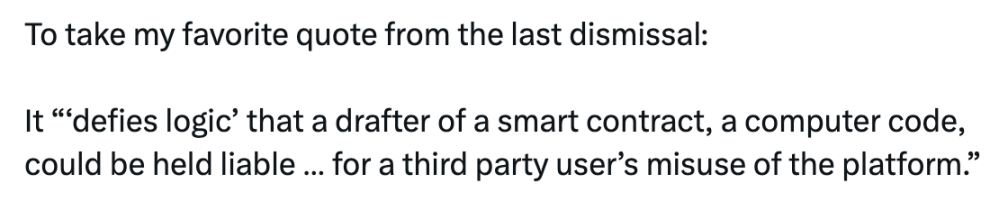
In a tweet, Brian Nistler stated, quoting a sentence from the previous ruling, that it "defies logic" to hold the drafters of smart contracts responsible for the abusive behavior of third-party users on the platform.

The Different Outcome for Tornado Cash

Facing the same judge, Roman Storm of Tornado Cash met a different fate.

Tornado Cash was first added to the sanctions list by the U.S. Treasury Department's Office of Foreign Assets Control (OFAC) on August 8, 2022, accused of helping criminals, including North Korean hackers, launder over $7 billion. Two days after being added to the sanctions list, Dutch police arrested Alexey Pertsev, one of the core developers of Tornado Cash.

On May 14, 2024, a Dutch court found Alexey Pertsev guilty of money laundering and sentenced him to 64 months in prison. The court believed that Pertsev was aware that the platform he developed and operated was used for crime but did not stop it, subjectively acquiescing to Tornado Cash being used as a money laundering tool. Alexey Pertsev is still appealing, but there have been no recent developments.

Seven months before Alexey Pertsev was found guilty, the U.S. Department of Justice sued two other developers, Roman Storm and Roman Semenov, in the Southern District of New York. Roman Storm was previously arrested in Washington State, while Roman Semenov remains at large.
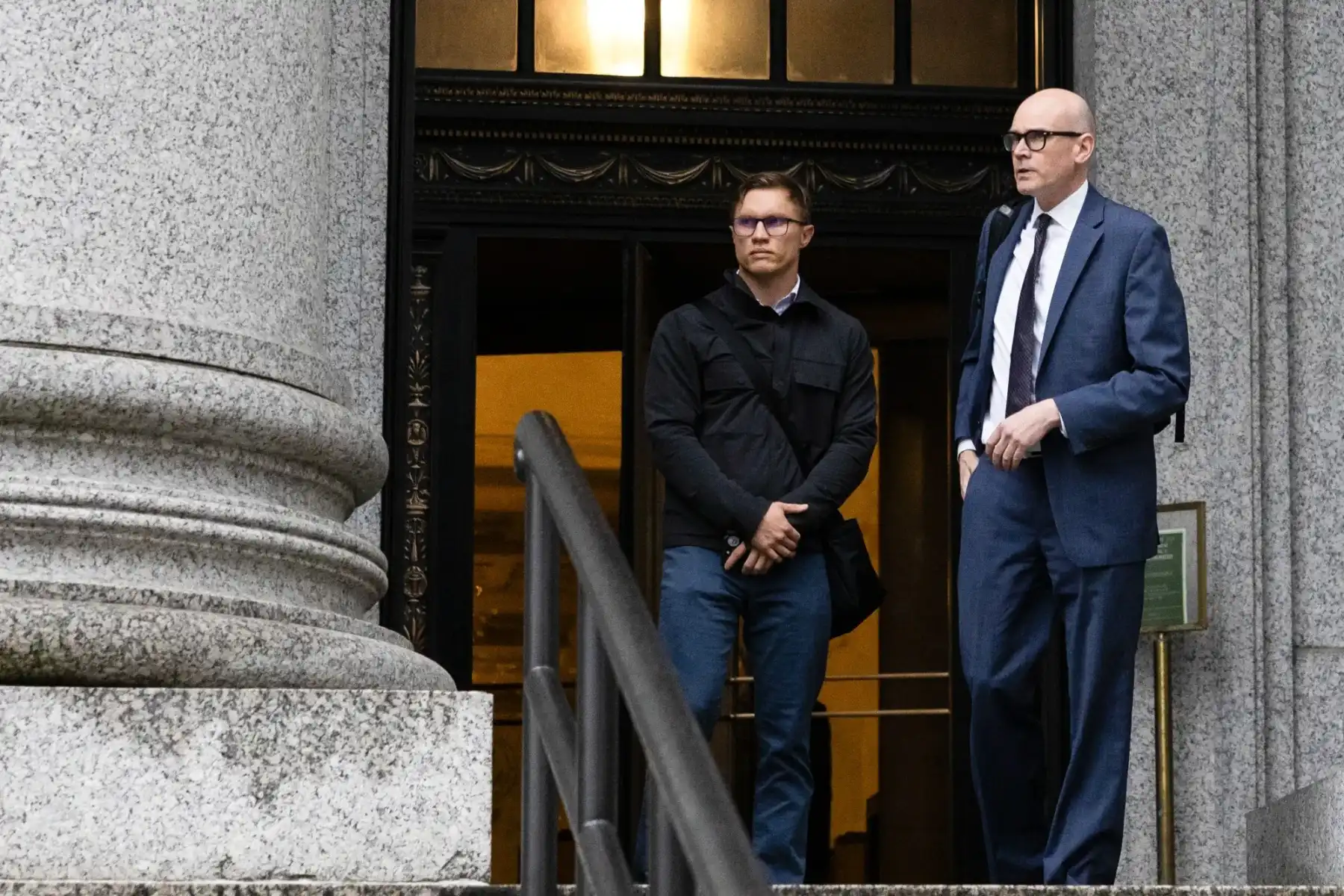
Roman Storm in court

Although an appeal later determined that OFAC's sanctions against Tornado Cash were an overreach and invalid, Roman Storm still found himself in the defendant's seat last July. After a trial presided over by Judge Katherine Polk Failla, the jury found Roman Storm guilty of "conspiracy to operate an unlicensed money transmitting business," but no formal sentencing has been announced yet.
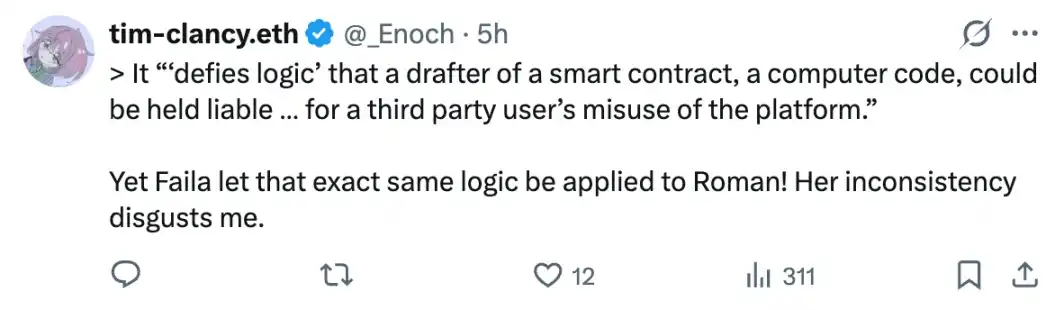
Under Brian Nistler's tweet celebrating Uniswap's victory, a comment by Sigil developer tim-clancy.eth criticizing Failla's contradictory rulings (the verdict against Roman Storm was actually made by a jury) received the most likes among all comments.

Decentralization Is Allowed, but Privacy Is Not

I am not a professional lawyer, but putting aside political factors and from a simple emotional perspective, I can roughly understand why Uniswap and Tornado Cash had different outcomes.

The core reason is that Tornado Cash's developers should have been well aware that a mixer would inevitably be used for money laundering. This clearly reveals the regulatory attitude: decentralization is acceptable, but it must be traceable. Tether once faced the same dilemma, so it later began cooperating with money laundering investigations and added freezing functionality.

Perhaps Roman Storm, behind bars, would feel unjust upon learning of today's verdict, but he should realize that even in a crypto-friendly U.S. under Trump, platforms helping North Korean state-level hackers launder money cannot be tolerated. With the current strength of Crypto, it is still not enough to对抗 national power.

Web3 practitioners sympathize with Tornado Cash's developers and cheer for Uniswap's victory. In our eyes, the two protocols are not fundamentally different; in fact, Tornado Cash is even superior in privacy protection. Uniswap's addition of front-end blocking of sanctioned addresses in 2022 once sparked some debate. Now, it seems that permissionlessness within the existing legal framework may be the only way for decentralized protocols to survive.

But that said, did Uniswap really have no responsibility at all in these scam incidents?

Strictly logically speaking, as the judge's analogy suggests, you cannot hold Mercedes responsible for a bank's losses just because a robber used a Mercedes to rob the bank. But on a commercial level, we tend to believe that giants should provide protection within their capabilities. Current security tools can already identify a large number of potential scam projects in advance. For these established projects that have benefited greatly from Web3's development, simple screening is not troublesome.

Doing their part to protect investors is not a mandatory obligation, but it is a responsibility that ordinary investors hope Uniswap and others will actively shoulder.


Questions liées

QWhat was the outcome of the class action lawsuit against Uniswap and its founder Hayden Adams?

AThe class action lawsuit was dismissed by the U.S. District Court for the Southern District of New York. The judge ruled that Uniswap and its founder were not responsible for the scam tokens traded on the platform, as the protocol's decentralized nature meant it had no control over which tokens were listed or who interacted with it.

QWho was the judge presiding over both the Uniswap case and the Tornado Cash case involving Roman Storm?

AThe judge presiding over both cases was Katherine Polk Failla of the U.S. District Court for the Southern District of New York.

QWhy was Tornado Cash developer Roman Storm found guilty, while Uniswap was not held liable?

ARoman Storm was found guilty of conspiracy to operate an unlicensed money transmitting business because Tornado Cash mixer was used for money laundering, including by North Korean hackers. The court believed the developers were aware of its illicit use. In contrast, Uniswap was deemed a neutral, decentralized protocol with no control over user actions, similar to an autonomous vehicle developer not being liable for misuse by third parties.

QWhat does the article suggest is the key difference in regulatory treatment between Uniswap and Tornado Cash?

AThe article suggests that regulatory tolerance exists for decentralized protocols like Uniswap that are transparent and compliant (e.g., blocking sanctioned addresses), but not for privacy-focused tools like Tornado Cash that enable illicit activities such as money laundering, especially on a scale involving state actors like North Korean hackers.

QWhat responsibility does the article imply Uniswap should have, despite its legal victory?

AThe article implies that while Uniswap has no legal obligation, it has a moral or commercial responsibility to use available security tools to screen and prevent scam projects on its platform, given its influence and benefits from the Web3 ecosystem, to protect ordinary investors.

Lectures associées

Un Trader de Bitcoin Affirme que les Sommets et les Creux des Cycles Correspondent à des Délais Exactement Identiques

Un trader utilisant le pseudonyme Ryan (@DodysDD) affirme avoir identifié une précision mathématique étonnante dans les cycles de prix du Bitcoin. Selon son analyse, les phases de marché haussier, du plus bas au plus haut (ATH), dureraient exactement 1064 jours, comme observé lors des cycles 2014-2017, 2018-2021 et 2022-2025. De même, les phases baissières (du pic au creux) correspondraient à 364 jours, comme en 2017-2018 et 2021-2022. Ce schéma, s'il se vérifiait, offrirait aux investisseurs un cadre temporel simple pour anticiper les tendances majeures. Cependant, l'article souligne les risques inhérents à ce type de théorie. La précision apparente dépend souvent du choix des points de référence (cours de clôture, sommets intradays...), ce qui peut conduire à une sélection biaisée des données. Il n'existe aucune preuve que le Bitcoin soit régi par un minutage aussi exact, son prix étant influencé par une multitude de facteurs (halvings, conditions macroéconomiques, psychologie des investisseurs...). Malgré ces limites, ce récit cyclique trouve un écho dans la communauté des traders, surtout dans un contexte actuel d'incertitude sur la phase de marché. Il fournit une narration simple face à la complexité. En conclusion, si l'observation sert de cadre d'analyse populaire, elle doit être abordée avec scepticisme et ne peut, à elle seule, prédire les futurs sommets ou creux du marché.

bitcoinistIl y a 2 h

Un Trader de Bitcoin Affirme que les Sommets et les Creux des Cycles Correspondent à des Délais Exactement Identiques

bitcoinistIl y a 2 h

94 billions, le plus grand financement de l'année pour les robots humanoïdes est apparu

Dans le secteur des robots humanoïdes, un tournant majeur est marqué par le financement record de 14 milliards de dollars (environ 94,9 milliards de yuans) levé par l'entreprise allemande Neura. Cette levée de fonds de série C, menée par des investisseurs industriels de renom comme Schaeffler et Bosch, ainsi que des géants technologiques (NVIDIA, Amazon), porte l'évaluation de Neura à environ 70 milliards de dollars. Cet investissement massif signale un changement profond : la filière passe d'une phase de démonstration technologique à une phase d'industrialisation et de déploiement concret en usine. Contrairement aux sociétés axées sur un robot humanoïde "universel" (comme Figure AI), Neura adopte une approche pragmatique, ciblant d'abord des applications industrielles verticales et spécifiques, comme en témoigne son partenariat avec BMW. La conjonction de plusieurs facteurs explique cet afflux de capitaux : les progrès de l'IA (modèles de grande taille) qui améliorent les capacités de perception et de décision des robots, et les pressions structurelles sur le marché du travail (vieillissement, pénurie de main-d'œuvre, coûts salariaux) qui créent une demande croissante dans la fabrication. Les principaux défis pour une adoption massive ne sont plus uniquement techniques. Ils concernent désormais les coûts d'adaptation aux lignes de production existantes, la formation des opérateurs et la mise en place d'un réseau de maintenance fiable. L'entrée en scène de capitaux industriels expérimentés démontre une confiance accrue dans la capacité du secteur à résoudre ces problèmes d'ingénierie et de modèle commercial, achevant ainsi la transition cruciale du laboratoire au sol de l'usine.

marsbitIl y a 7 h

94 billions, le plus grand financement de l'année pour les robots humanoïdes est apparu

marsbitIl y a 7 h

Le marché de la pré-introduction en bourse d'Anthropic chute après qu'une directive américaine force l'arrêt du modèle

Anthropic a annoncé avoir reçu une directive du gouvernement américain lui ordonnant de suspendre l'accès aux modèles Claude Fable 5 et Claude Mythos 5 pour les ressortissants étrangers, y compris ses propres employés étrangers. Cette mesure d'urgence, justifiée par des préoccupations de sécurité nationale liées au contrôle des exportations, a forcé la désactivation mondiale des deux modèles le 12 juin. Les autres modèles d'Anthropic, comme Claude Opus 4.8, restent opérationnels. La réaction du marché a été immédiate : le contrat perpétuel lié à Anthropic sur Hyperliquid a chuté de 3,7%, reflétant l'impact sur sa valorisation pré-IPO. Anthropic a contesté la base de cette directive, arguant que la vulnérabilité de "jailbreak" évoquée par le gouvernement était mineure, déjà connue et non exclusive à ses modèles. La société a averti qu'un tel seuil d'intervention, s'il était généralisé, pourrait stopper les déploiements de nouveaux modèles d'IA de pointe. Cet événement illustre comment la régulation de l'IA devient un facteur négociable sur les marchés financiers. Les instruments tokenisés et les contrats pré-IPO permettent désormais aux traders de réagir instantanément à ce type de nouvelles réglementaires, même en l'absence d'informations publiques détaillées. Cela intègre l'infrastructure d'IA dans une dynamique de marché spéculative similaire à celle de la cryptomonnaie, avec des risques de volatilité basée sur des informations incomplètes.

bitcoinistIl y a 13 h

Le marché de la pré-introduction en bourse d'Anthropic chute après qu'une directive américaine force l'arrêt du modèle

bitcoinistIl y a 13 h

Un portefeuille lié à une exploitation convertit des jetons volés en 18 510 ETH et 1 548 BNB

Un portefeuille lié à une exploitation a converti des actifs compromis en 18 510 ETH (évalués à environ 30,83 millions de dollars) et 1 548 BNB (environ 924 000 dollars), selon une alerte de suivi sur la chaîne partagée par WuBlockchain citant Lookonchain. L'attaquant, associé à des « jetons H » compromis, détient encore 111,36 millions de ces jetons d'une valeur d'environ 14 millions de dollars. Cette conversion vers des actifs plus liquides comme l'ETH et le BNB est une étape courante après une exploitation, souvent avant une tentative de retrait ou de mélange de fonds. Les grands échanges de ce type peuvent exercer une pression sur les liquidités, signaler les prochaines étapes de l'attaquant et offrir de nouvelles pistes de transaction à suivre pour les enquêteurs. Le suivi sur la chaîne, bien qu'utile pour visualiser les mouvements de fonds en temps réel, présente des limites : les portefeuilles peuvent fractionner les actifs rapidement, les déplacer entre différentes chaînes ou utiliser des adresses intermédiaires, compliquant le traçage. Les étiquettes attribuées aux portefeuilles peuvent également changer. Ces données représentent donc un instantané et non une estimation finale des pertes. Cet incident souligne l'utilité des comptes de surveillance sur la chaîne comme Lookonchain, qui peuvent révéler une activité avant la publication d'une enquête officielle. La conversion en actifs liquides rend également plus difficile et urgente toute tentative de récupération des fonds volés.

bitcoinistIl y a 15 h

Un portefeuille lié à une exploitation convertit des jetons volés en 18 510 ETH et 1 548 BNB

bitcoinistIl y a 15 h

Trading

Spot
Futures
活动图片




