Reviewing Arthur Hayes' 2025: All Hype Calls Ultimately Lead to Cashing Out

marsbitPublié le 2026-01-29Dernière mise à jour le 2026-01-29

Résumé

Arthur Hayes, the founder of BitMEX and a prominent crypto influencer, had a highly profitable yet controversial 2025. While his public calls, such as predicting "$1 million Bitcoin" and "$10,000 ETH," attracted retail traders, his on-chain actions often contradicted his bullish narratives, resulting in gains for him and losses for followers. His strategies fell into three main categories: 1. **"Pump and Dump" of VC Coins**: Hayes frequently promoted tokens like Hyperliquid (HYPE), where he held early, low-cost shares. He would build hype with ambitious predictions, then sell near peaks. For instance, he sold HYPE just before a price drop, citing "unlock risks," only to buy back months later. 2. **Failed Revival of "Old Narratives"**: Attempts to boost outdated sectors like DeSci (e.g., BIO) and metaverse projects (e.g., WILD) largely failed. His investments in these areas saw significant losses, with some tokens dropping over 85%. 3. **The ZEC "Smokescreen"**: Hayes aggressively promoted Zcash (ZEC), claiming a "$10,000 target," while simultaneously selling ETH and other assets to fund ZEC purchases. This move allowed him to shift transparent assets (ETH) into privacy-focused ZEC, obscuring his true position. He later sold ETH again to reinvest in other areas, using ZEC’s volatility to divert market attention. Hayes operates as a pragmatic trader, not a steadfast "HODLer." His public analyses are valuable for macro insights, but his on-chain activity reveals a pattern o...

Original author: angelilu, Foresight News

Looking back at 2025, Arthur Hayes remains the big winner who is both loved and hated.

As the founder of BitMEX and the KOL in the crypto circle who is best at writing "essays," every "hype call" he made in 2025 could stir up retail trading enthusiasm. But looking back at 2025, you will suddenly realize that if you got on board every time he made a call, the result would be that he made money, and you lost.
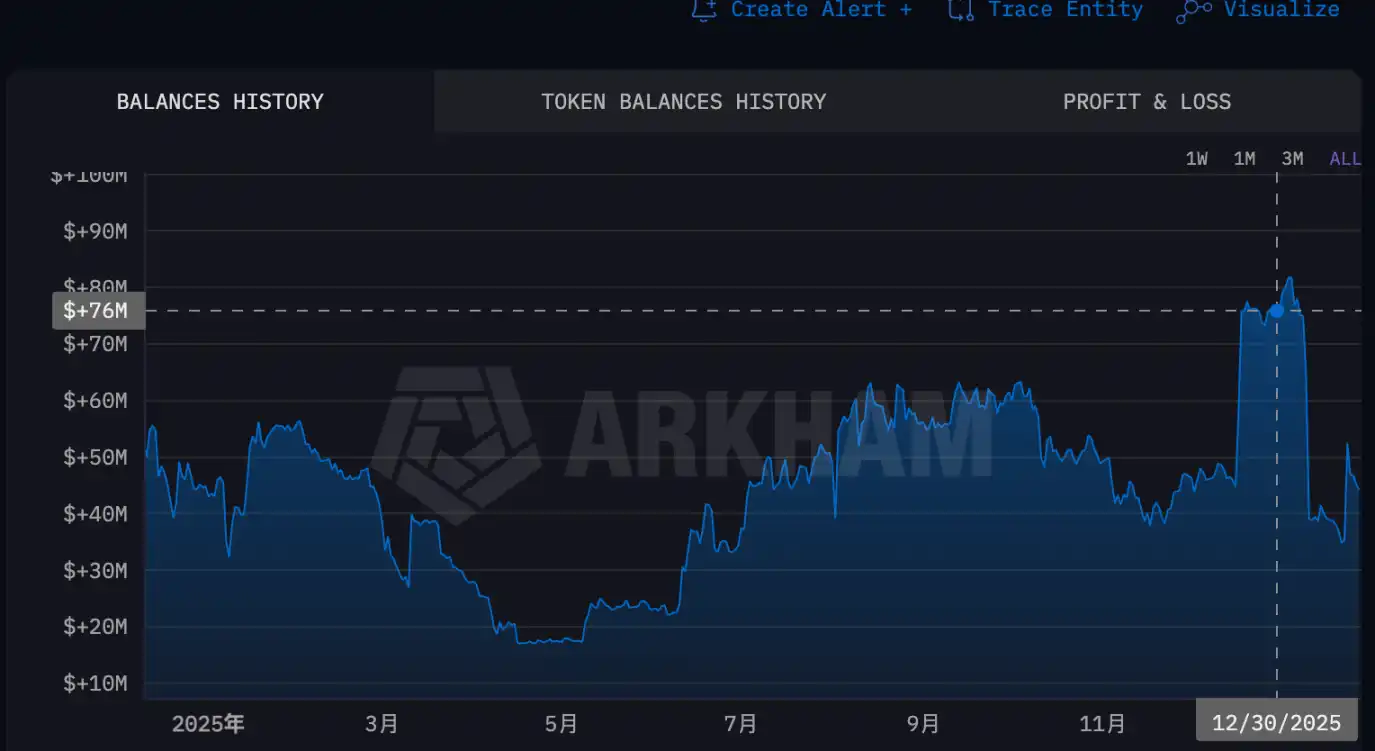
He shouted "Bitcoin to one million dollars" and "ETH to $10,000" on Twitter, but on-chain, Arthur Hayes would always inadvertently sell the assets he once favored. If we lay out all his operations from last year, you will find an extremely calm, even冷酷 (cold-blooded), trading record of a top trader.

We can break down his operations into three categories.

VC Coins: "Publicly Hype, Privately Dump"

Hayes' most controversial operations usually occur with projects where he obtained early筹码 (chips/allocations). This is actually a completely asymmetrical game: perhaps he made 10x when selling at $50, while your losses were just beginning when buying at $60.

The most typical script happened with Hyperliquid (HYPE). As an early investor who obtained extremely low-cost筹码 (chips), his operating logic is very simple and crude:

Step one: Use influence to hype at high prices, building grand narratives (e.g., "HYPE 100x in three years");

Step two: Wait until the token unlocks or liquidity is sufficient, then decisively clear the position.
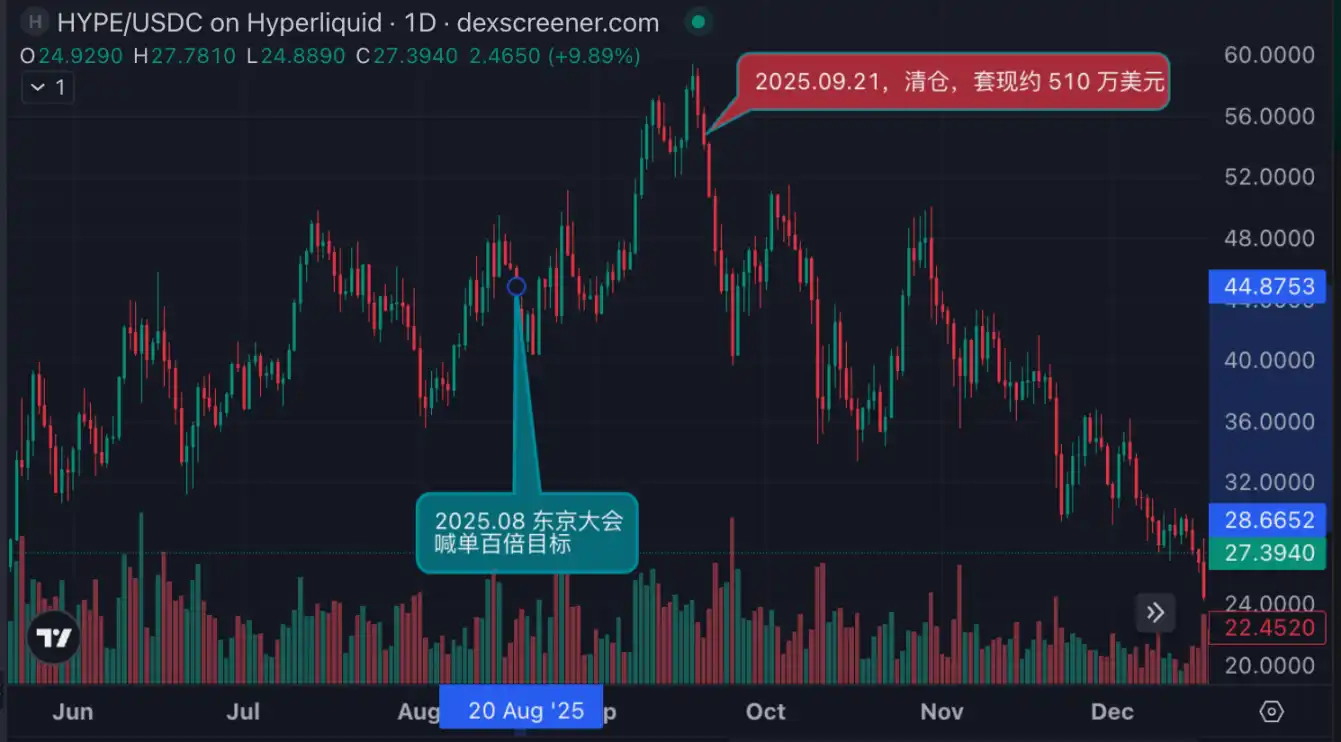
For example, last August, Hayes predicted at a conference in Tokyo that HYPE would have hundred-fold growth and高调 (high-profile) bought in. Just one month later, he cleared his position before HYPE fell and made millions of dollars in profit, giving the reason "to avoid unlocking risks."
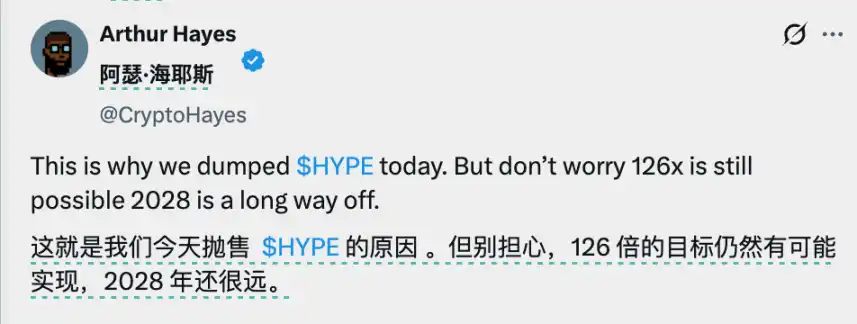
But HYPE was not completely abandoned by him. In mid-January 2026, Hayes bought about $499,000 worth of HYPE again after three months.

The same story happened repeatedly, including with ETHFI, ATH, etc., all experiencing similar scripts.

But imagine, if you were Arthur Hayes, what would you do? To achieve profit with large capital, this seems to be the standard playbook: first, put forward market analysis that is足以自圆其说 (sufficient to justify itself),征服 (conquering) the audience with logic; when believers flock in, the market will naturally confirm his prophecy.

And for whales, the only window to quietly exit is when the crowd is bustling and liquidity is most abundant.

The "Old Narratives" That Couldn't Be Hype

After reviewing Hayes' successful hype narratives, we found that Hayes also had times when he failed. Especially when he tried to "revive" some old or niche sectors.

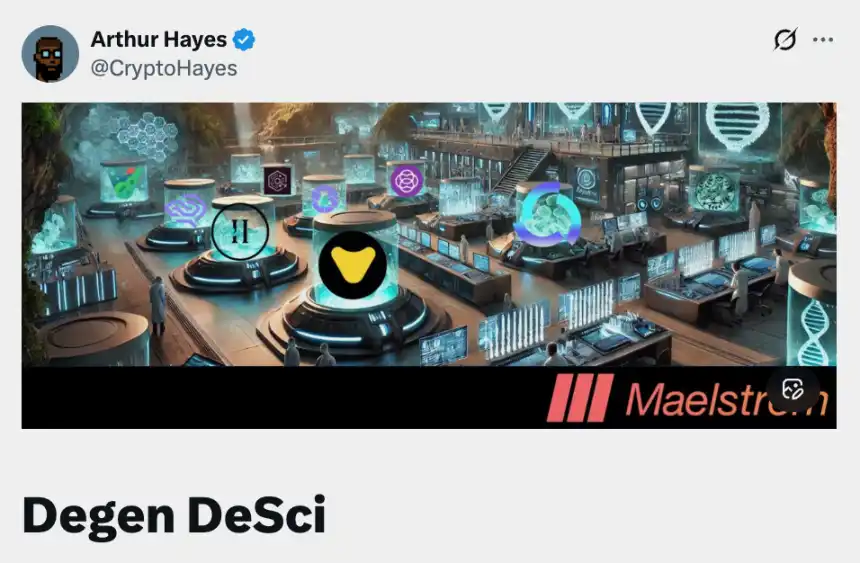
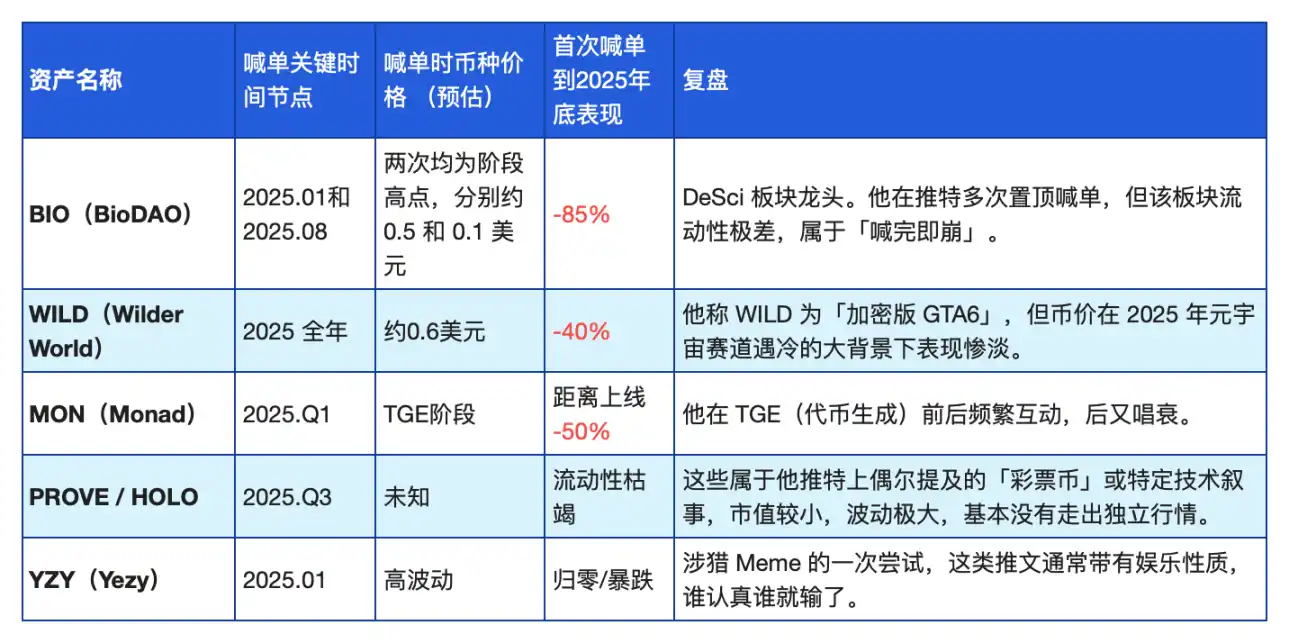
In early 2025, his family fund Maelstrom wrote a long and profound article "Degen DeSci," strongly bullish on the DeSci (Decentralized Science) sector. He listed a bunch of coins, BIO, GROW...

The result is clear for all to see: the DeSci sector almost全军覆没 (was completely wiped out), with many tokens falling more than 85% from their highs. Hayes built a position of $1.1 million worth of BIO again in August and finally deposited 7.66 million BIO into Binance in late November, with a potential loss of $640,000 (-58%).
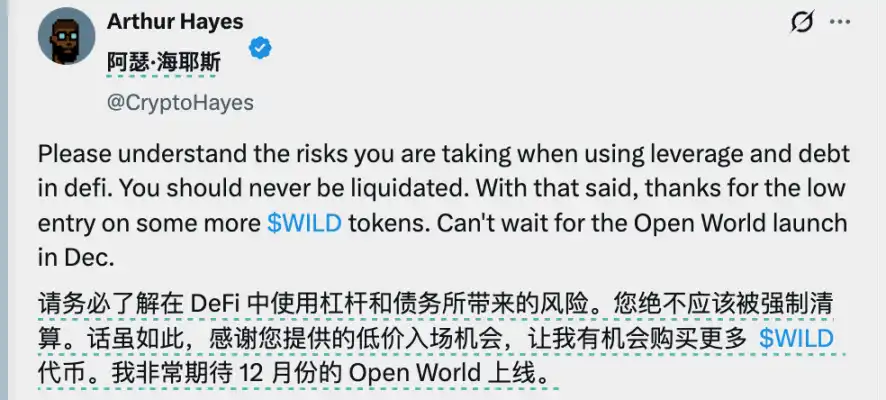
Then there's Wilder World (WILD), which he called the "Crypto version of GTA6." He hyped it for a whole year, and finally the price sank along with the metaverse concept.
Most of the tokens Hayes hyped had热度 (heat/hype) at specific stages. A summary is shown in the chart:
ZEC's "Smoke Screen"

This might be Hayes' most brilliant and intriguing operation in 2025.

On the surface, Hayes疯狂 (crazily) hyped Zcash (ZEC), stating that he initially bought millions of dollars worth after hearing the suggestion from Silicon Valley big shot Naval at a private dinner during Token 2049. In November last year, he shouted the slogan "target $10,000."

Hayes even initiated a withdrawal movement, calling on everyone to withdraw their coins to the chain to lock up liquidity.
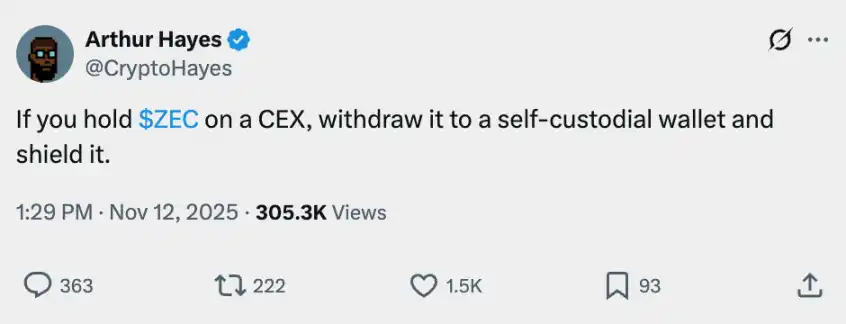
Many people watched his wallet to see if he was secretly selling ZEC. The result: he didn't sell; he was even adding to his position.

Perhaps the real purpose of Hayes creating this ZEC frenzy was: to sell ETH and exchange it for anything that was rising fast at the time.

Hayes had actually already taken a "knife" to ETH several times before this. Although he高喊 (shouted loudly) in 2025 that ETH would rise to $10,000, he experienced several "反复横跳" (back-and-forth jumps). He sold about $13.34 million worth of ETH and other tokens on August 2nd but expressed regret on August 9th for taking profits and had to buy back.

By November 15, 2025, just when he was vigorously hyping ZEC, Lookonchain monitored him transferring millions of dollars worth of ETH and ENA to Binance. On the same day, Hayes publicly declared on Twitter that he had "Aped more ZEC." On-chain analyst EmberCN also分析指出 (analyzed and pointed out) that this selling was极大概率 (most likely) to supply "ammunition" for adding to the ZEC position.
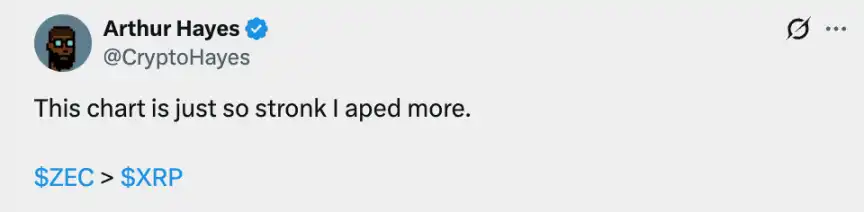
Due to ZEC's privacy features, his transparent ETH was sold and exchanged for opaque assets. On the chain, we can only see him "exiting" (selling ETH) but cannot quantify the scale of his "entering" (buying ZEC).

But in the last two weeks of 2025, Hayes sold another 1,871 ETH (about $5.53 million) and went back to buy the DeFi assets he had abandoned a month earlier.

This is a very冷酷 (cold) signal: in his logic, Ethereum is the "cash reserve" in his investment组合 (portfolio). He sells it when he needs money to buy new narratives (ZEC), and he still sells it when he needs money to bottom-fish old sectors (DeFi).

In the end, you will find that he used ZEC's price increase to attract the attention of the entire market, and then quietly completed his position rotation while everyone was discussing the "privacy renaissance." It wasn't until early 2026, when ZEC plummeted due to internal team strife, that everyone realized that although Hayes's holdings had shrunk, he successfully exited the top of ETH, which performed even worse during that phase.

How to Understand Arthur Hayes?

After reviewing this year, you will find that Hayes,正如 (just as) written in his X background picture, is not a "believer" HODLer but an extremely精明 (shrewd) businessman.
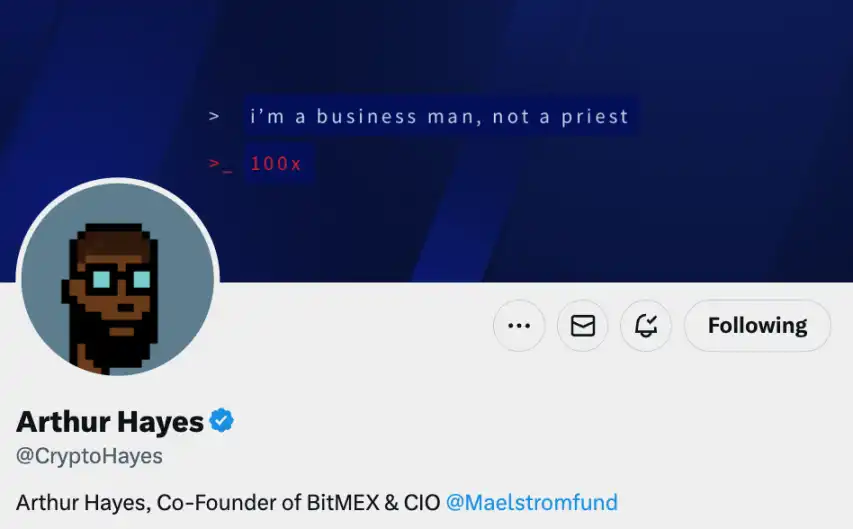
He uses words to build dreams to attract liquidity; he uses on-chain operations to harvest profits to avoid risks; he dares to quickly admit mistakes when he is wrong (e.g., abandoning ETH) to preserve capital.

So, his articles are still worth reading because his macro judgments have been verified. But before you press the "buy" button, please take one more step: don't listen to what he says, go see what his on-chain wallet is doing.

After all, in this残酷 (cruel) market, his loyalty to "volatility" is far higher than his belief in any single project. And volatility is precisely the money transferred from the pockets of retail traders to the pockets of traders.

Questions liées

QWhat was the main criticism of Arthur Hayes' actions in 2025 according to the article?

AThe main criticism was that Hayes' public endorsements ('calling orders') were often a strategy to create market hype and liquidity, allowing him to profitably sell his positions at high prices, while retail investors who followed his advice frequently ended up losing money.

QDescribe Hayes' typical strategy with VC coins like Hyperliquid (HYPE).

AHis strategy involved two steps: first, using his influence to endorse the coin at high prices and build a grand narrative (e.g., 'HYPE will grow 100x in three years'); second, liquidating his position for substantial profits once the token was unlocked or liquidity was sufficient, often just before a price drop.

QWhich investment narrative promoted by Hayes in 2025 failed significantly, and what was the result?

AHis promotion of the DeSci (Decentralized Science) narrative failed significantly. Coins in this sector, such as BIO, plummeted by over 85% from their highs. Hayes' investment in BIO resulted in a loss of approximately $640,000, a 58% decrease.

QWhat was the suspected real purpose behind Hayes' strong public endorsement of Zcash (ZEC)?

AThe suspected real purpose was to create a market frenzy around ZEC to attract attention and liquidity, which allowed him to discreetly sell his transparent assets like ETH and convert them into the more opaque ZEC. This move helped him rotate his portfolio away from underperforming assets like ETH.

QHow does the article suggest investors should interpret Hayes' public statements and actions?

AThe article advises investors to read his macro analyses but to verify his on-chain wallet activities before making investment decisions. It emphasizes that his loyalty is to 'volatility' and profit, not to any specific project's long-term success, making his actions more those of a shrewd trader than a faithful holder.

Lectures associées

Rapport du premier trimestre 2026 d'Ethereum : Baisse des frais, nombre d'utilisateurs et volume de transactions à des niveaux historiques

**Rapport du T1 2026 sur Ethereum : Baisse des frais, mais nombre d'utilisateurs et volume de transactions atteignent des records** Le premier trimestre 2026 présente une dynamique clé pour Ethereum : l'utilisation explose tandis que les revenus liés aux frais baissent. Le nombre d'utilisateurs actifs mensuels (+85,9% en glissement annuel), le nombre de transactions (+81,5%) et le débit du réseau ont tous atteint des sommets historiques. En revanche, les frais totaux sur le réseau principal se sont effondrés de 81,9% sur un an. Ce paradoxe s'explique par la stratégie délibérée d'Ethereum de privilégier la croissance à court terme en réduisant le coût de l'espace bloc grâce aux mises à niveau comme Fusaka (capacité de données augmentée). C'est l'effet Jevons : la baisse des coûts libère une nouvelle demande. Le rapport souligne également un pivot narratif majeur : Ethereum consolide son rôle de couche de règlement financier mondial pour les actifs tokenisés. Il domine ce marché naissant, détenant des parts majoritaires dans les stablecoins (61,8%), les fonds tokenisés (73%), les matières premières tokenisées (84%) et les prêts DeFi (79,2%) parmi les cinq principales blockchains. L'entrée en force d'institutions comme BlackRock, JPMorgan et Fidelity, avec des produits concrets, valide cette tendance. Ainsi, Ethereum sacrifie une capture de valeur à court terme (frais, TVL, capitalisation baisse) pour renforcer ses effets de réseau et sa position d'infrastructure neutre et ouverte, pariant sur une croissance à long terme alimentée par la tokenisation massive de la finance traditionnelle.

marsbitIl y a 59 mins

Rapport du premier trimestre 2026 d'Ethereum : Baisse des frais, nombre d'utilisateurs et volume de transactions à des niveaux historiques

marsbitIl y a 59 mins

Premier entretien en podcast du PDG d'Intel, Lip-Bu Tan : « Notre objectif est une multiplication par 10 en 5-10 ans », en misant sur l'emballage avancé, les substrats en verre et le diamant synthétique

Le PDG d'Intel, Lip-Bu Tan, a exposé sa vision ambitieuse de transformer l'entreprise avec pour objectif de multiplier par 10 la valeur pour les actionnaires dans les 5 à 10 prochaines années. Lors d'un podcast, il a détaillé sa stratégie axée sur trois piliers technologiques pour dépasser les limites physiques de la miniaturisation : l'emballage avancé (EMIB), les nouveaux matériaux de substrat comme le verre, et les semi-conducteurs de nouvelle génération (GaN, SiC, InP, diamant synthétique). Il souligne la reprise de la demande en CPU pour l'IA, notamment l'inférence et les agents intelligents, modifiant le ratio CPU/GPU dans les serveurs. Tan défend également la division de fonderie d'Intel, essentielle pour la sécurité de la chaîne d'approvisionnement américaine, en se concentrant sur la confiance client, le rendement et les délais. Il révèle le projet Terafab en collaboration avec Elon Musk pour construire des capacités de fabrication de semi-conducteurs. Selon lui, le plus grand malentendu des investisseurs est de sous-estimer le potentiel d'Intel, encore en phase de "rampement". Il prévoit que le véritable potentiel de l'entreprise, au-delà du PC, dans l'informatique en périphérie, l'IA physique et les agents IA, sera pleinement reconnu vers 2030-2032.

marsbitIl y a 1 h

Premier entretien en podcast du PDG d'Intel, Lip-Bu Tan : « Notre objectif est une multiplication par 10 en 5-10 ans », en misant sur l'emballage avancé, les substrats en verre et le diamant synthétique

marsbitIl y a 1 h

Il vient de lever 2,7 milliards, et Fei-Fei Li y a investi.

Le chercheur en intelligence artificielle Pete Florence, ancien employé de Google DeepMind et co-créateur de l'architecture VLA (Vision-Language-Action), a levé 400 millions de dollars (environ 2,7 milliards de RMB) pour sa startup Generalist AI, portant sa valorisation à 2 milliards de dollars. Parmi les investisseurs figurent NVentures (NVIDIA), Bezos Expeditions, ainsi que des personnalités comme Li Fei-Fei, co-fondateur de Xiaomi Lin Bin et le fondateur de Zoom, Eric Yuan. Contrairement à la tendance actuelle, Florence rejette catégoriquement l'étiquette "modèle du monde" pour son entreprise. Issu du MIT et influencé par son mentor Russ Tedrake, il prône une approche orientée "objectif" plutôt que "technologie". Pour lui, l'objectif ultime n'est pas de construire un modèle du monde, mais de créer des robots capables d'accomplir avec un taux de réussite et une vitesse élevés des tâches variées et inédites, sans nécessiter de données spécifiques. Generalist AI a dévoilé deux modèles d'intelligence incarnée : GEN-0 en novembre 2025, démontrant que les lois d'échelle des LLM s'appliquent au mouvement physique, et GEN-1 en avril 2026. Ce dernier, entraîné sur plus de 500 000 heures de données collectées via un dispositif portable, atteint un taux de réussite de 99% sur des tâches manuelles précises comme plier des cartons. Florence estime que GEN-1 approche d'un point d'inflexion similaire à GPT-3, avec des performances atteignant un niveau utile pour des déploiements commerciaux. Ce financement record, intervenu rapidement après la démonstration de GEN-1, valide la vision pragmatique de Florence : développer des robots généralistes réellement utiles en se concentrant sur la résolution de tâches physiques concrètes.

marsbitIl y a 1 h

Il vient de lever 2,7 milliards, et Fei-Fei Li y a investi.

marsbitIl y a 1 h

Trois jours, deux légendes de perdues : le barrage de talents en IA de Google est-il en train de se fissurer ?

En l'espace de trois jours, Google a perdu deux figures légendaires de l'IA, signe d'un exode massif de ses talents vers des concurrents comme OpenAI et Anthropic. Noam Shazeer, co-auteur de l'architecture Transformer, a rejoint OpenAI, tandis que John Jumper, lauréat du Nobel et responsable d'AlphaFold, est parti chez Anthropic. Ce mouvement, renforcé par le recrutement d'Andrej Karpathy par Anthropic, révèle une tendance structurelle. La cause profonde est un désalignement des missions. Les priorités de Google restent centrées sur son activité publicitaire, contraignant la recherche. À l'inverse, OpenAI et Anthropic offrent une focalisation exclusive sur l'innovation et la sécurité de l'AGI. De plus, les perspectives d'introduction en bourse de ces startups promettent des gains financiers considérables via leurs actions, un avantage que Google, déjà géant établi, ne peut égaler. La fusion de Google Brain et DeepMind en 2023, censée unifier les forces, a en réalité accru les tensions entre recherche fondamentale et pression commerciale, créant un environnement moins attractif pour les scientifiques de haut vol. Cette restructuration du paysage des talents, potentiellement irréversible, représente une crise silencieuse pour Google. Son avantage en matière de données, de puissance de calcul et de publications académiques dépend ultimement des personnes capables de les exploiter, et celles-ci partent.

marsbitIl y a 3 h

Trois jours, deux légendes de perdues : le barrage de talents en IA de Google est-il en train de se fissurer ?

marsbitIl y a 3 h

Derrière les bulletins de notes de l'IA, se cache un concepteur de "sujets d'examen" chinois

Le domaine de l'IA suit de près les scores des grands modèles sur des benchmarks comme MMLU-Pro et MMMU, devenus des références pour évaluer les capacités de raisonnement et de compréhension multimodale. Derrière ces outils d'évaluation influents se trouve Wenhu Chen, professeur assistant à l'Université de Waterloo et fondateur du TIGERLab. Face aux limites des anciens benchmarks comme MMLU, où les modèles de pointe atteignaient des scores quasi parfaits, Chen a dirigé le développement de MMLU-Pro. Cette nouvelle base de données, plus difficile et stable avec des questions à choix multiples élargis, permet de mieux distinguer les véritables capacités de raisonnement des modèles. Dans le domaine multimodal, les benchmarks MMMU et MMMU-Pro, également créés par son équipe, évaluent rigoureusement la capacité des modèles à combiner informations visuelles complexes et connaissances disciplinaires pour résoudre des problèmes avancés. Cette expertise en évaluation découle des recherches de Chen sur la compréhension d'informations complexes et le raisonnement, renforcée par son expérience chez Google DeepMind sur Gemini. Aujourd'hui au Meta Super-Intelligence Lab, il continue ses travaux sur l'évaluation et l'entraînement de modèles multimodaux. Son parcours illustre le rôle crucial, bien que moins visible, des chercheurs dans la construction des fondations méthodologiques qui guident les progrès de l'IA.

marsbitIl y a 3 h

Derrière les bulletins de notes de l'IA, se cache un concepteur de "sujets d'examen" chinois

marsbitIl y a 3 h

Trading

Spot
Futures
活动图片