Range Judgment Realized, Strategy Fully Executed | Guest Analysis

marsbitPublié le 2026-01-09Dernière mise à jour le 2026-01-09

Résumé

In his weekly analysis, Cody Feng, a quantitative trading expert, reviews Bitcoin's price action from January 5 to 11. BTC movement aligned closely with his initial forecast, trading within a range of $84,000 to $94,500. The price faced strong resistance at the $93,000–$94,500 zone and later pulled back toward the mid-to-lower part of the range. A short position was executed near $94,000 based on signals from momentum and spread trading models, and the trade was closed around $90,584, capturing a profit of approximately 3.4%. The strategy emphasized pre-planned execution and disciplined risk management. Currently, Bitcoin has found support around $86,500, with technical indicators suggesting oversold conditions and a potential bounce. However, the overall structure remains a broad consolidation. A rebound toward $92,000–$93,000 is anticipated, where renewed selling pressure may emerge. A break above $94,500 would require a reassessment of the market outlook. Feng concludes that in a ranging market, executing well-defined strategies with strict risk controls is more critical than predicting directional moves.

Odaily guest market analyst Cody Feng, Master of Financial Statistics from Columbia University, has focused on quantitative trading of US stocks since college and gradually expanded to digital assets such as Bitcoin. He has built a systematic quantitative trading model and risk control system through practical experience; possesses keen data insight into market fluctuations, and is committed to continuous growth in the professional trading field, pursuing stable returns. He will delve into BTC technical, macroeconomic, and capital flow changes weekly, review and showcase practical strategies, and preview noteworthy upcoming developments for reference.
Bitcoin Mid-Week Review(01.05~01.11)

Conclusion First:

This week, Bitcoin's overall price action largely operated within the 84,000~94,500 USD oscillation range we provided at the beginning of the week. The price precisely encountered resistance in the 93,000~94,500 USD pressure zone and subsequently fell back to the middle-lower part of the range. Our core level judgments were verified by actual market performance.

In this trade, we established short positions near 94,000 USD and exited all positions near 91,000 USD, capturing approximately 3.4% profit (spot) from the range, completing a high-probability, low-drawdown profit realization in a ranging market.

I. Validation of This Week's Core Range and Key Levels

At the beginning of the week, we clearly stated that this week required close attention to the battle between bulls and bears at the upper and lower boundaries of the 84,000~94,500 USD range.

The actual movement showed that Bitcoin clearly met resistance after rebounding to the 93,000~94,500 USD pressure zone, with multiple failed attempts to break higher, subsequently leading to a pullback under pressure, validating the effectiveness of this area as a阶段性 "ceiling".

Regarding support levels, the price showed clear signs of stopping declines and stabilizing after falling to the 86,000~86,500 USD area, where buying interest began to emerge. The more critical support level at 84,000 USD has not been touched yet, and the overall structure remains within the wide-range oscillation framework.

II. Execution of Plan A (From Entry to Exit)

Based on the range oscillation judgment, our Plan A formulated at the start of the week was effectively executed.

When the price rebounded to the 93,000~94,500 USD zone showing signs of upward exhaustion, and both the (momentum, spread trading) models simultaneously issued top signals, we immediately established short positions at 93,771 USD. The market subsequently declined as expected.

When the "Spread Trading" model issued a bottom signal, we finally exited all positions at 90,584 USD, completing a full, emotion-free short trade. The entire trading process was not "hindsight analysis" but involved pre-planning, in-execution, and post-verification.

III. Operational Thoughts for the Latter Half of the Week

Bitcoin 4-Hour Chart: (Momentum Quantitative Model + Spread Trading Model)
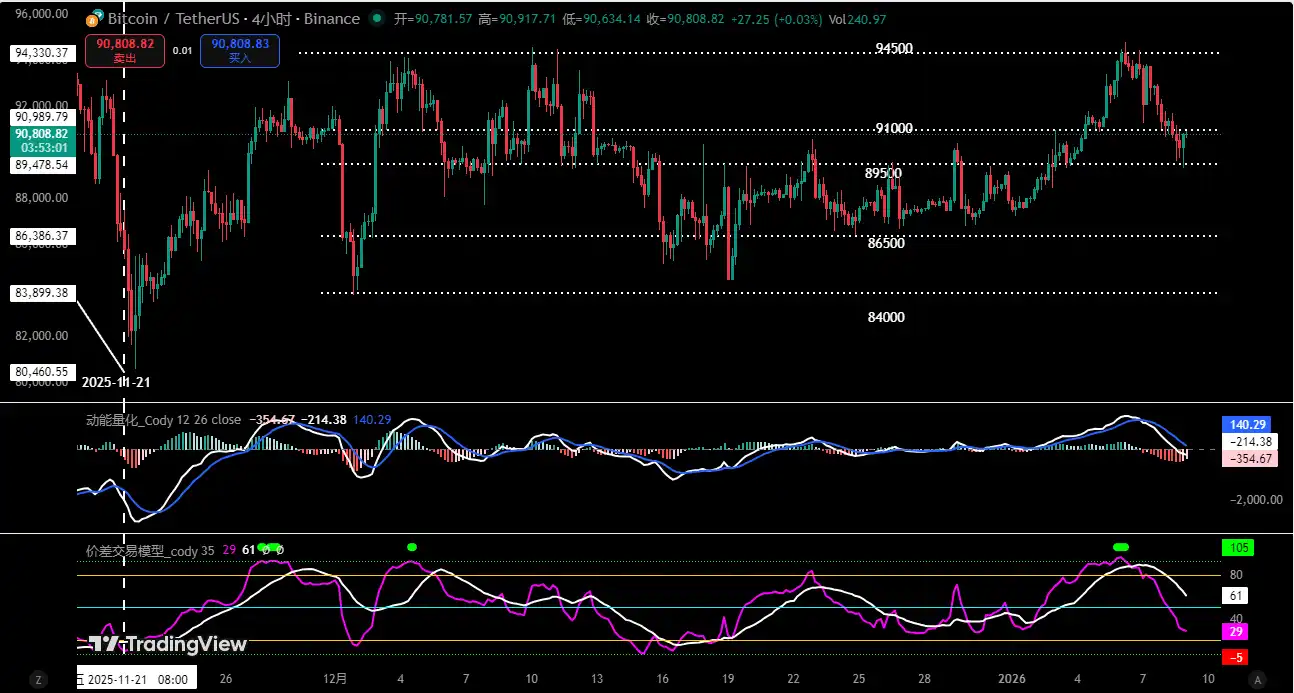
From the 4-hour technical structure (see chart above), Bitcoin has currently found effective support near 86,500 USD. Multiple technical indicators have entered oversold territory, indicating short-term selling pressure has been released. The market has a demand for a technical rebound correction (oscillatory rebound), but this is not yet sufficient to confirm a reversal of the downtrend.

Based on this, we anticipate the price may first rebound to test the 92,000~93,000 USD area. This level also coincides with the middle-upper part of the previous oscillation range and is expected to form resistance again.

For short-term operations, maintain a range-trading mindset: if the price reaches this zone and shows signs of momentum exhaustion or failed breakouts, consider building short positions on rallies; if it effectively breaks above 94,500 USD, stop loss decisively and reassess the market structure.

IV. Summary

Overall, Bitcoin continues to operate within the wide-range oscillation pattern defined at the beginning of the week: lower support provides room for rebounds, while upper resistance limits the upside. At present, rather than betting on a unilateral trend, it is more important to respect the range structure, focus on high-probability levels, and maintain strict risk control.

In ranging markets, formulating flexible response strategies and achieving stable profits is far more important than predicting direction.

Disclaimer: The above content is solely personal market opinion sharing and does not constitute any investment advice. Cryptocurrencies are highly volatile; please make independent judgments and strictly control risks.


Questions liées

QWhat was the price range for Bitcoin's consolidation as predicted by analyst Cody Feng at the beginning of the week?

AThe predicted consolidation range for Bitcoin was between $84,000 and $94,500.

QAt what price level did the analyst establish a short position and what was the profit from this trade?

AA short position was established near $94,000 and closed near $91,000, capturing a profit of approximately 3.4%.

QWhat are the two technical models mentioned that provided signals for the trade execution?

AThe two technical models mentioned are the Momentum Quant Model and the Spread Trading Model.

QAccording to the 4-hour chart analysis, what is the expected next move for Bitcoin's price and the key resistance area to watch?

AA technical rebound or震荡反弹 (oscillatory rebound) is expected to test the $92,000 to $93,000 area.

QWhat is the overarching trading philosophy emphasized for the current market conditions described in the article?

AThe philosophy is to focus on high-probability price points and strict risk control within the range-bound structure, rather than betting on a one-directional trend, as formulating flexible strategies for stable profits is more important than predicting direction.

Lectures associées

BREAKING : Mastercard ouvre son réseau de paiement mondial aux crypto-monnaies — Quelles altcoins font partie de l'accord ?

**Mastercard ouvre son réseau mondial de paiement à la crypto.** Le 3 juin, Mastercard a annoncé élargir son infrastructure de règlement mondial pour prendre en charge le règlement sur chaîne via des stablecoins réglementés. Cela permet pour la première fois de régler les transactions par carte 24h/24 et 7j/7, y compris les week-ends et jours fériés. **Stablecoins et blockchains sélectionnés.** Six stablecoins réglementés sont pris en charge dans un premier temps : l'USDC de Circle, le PYUSD de PayPal, l'USDG et l'USDP émis par Paxos, le RLUSD de Ripple et le SoFiUSD de SoFi. Le règlement s'effectuera sur huit réseaux blockchain : Ethereum, Solana, Polygon, Base, Arbitrum, XRP Ledger, Canton et Tempo. **Changements en back-end uniquement.** Cette annonce concerne la couche de règlement, pas une modification des produits pour les consommateurs. Les émetteurs et acquéreurs du réseau Mastercard peuvent désormais choisir de régler les transactions par carte en utilisant ces stablecoins sur chaîne, en parallèle des processus traditionnels en monnaie fiduciaire. Aucun changement n'est requis pour le titulaire de la carte. **Avantages clés.** L'infrastructure backend de compensation et de finalisation des transactions peut désormais fonctionner en continu sur des blockchains, éliminant les interruptions dues aux horaires bancaires, fermetures de week-end et jours fériés, une source historique de friction. **Partenaires et déploiement.** Les premiers partenaires incluent ARQ, CBW Bank, Cross River, Lead Bank et Nuvei. Le déploiement initial cible les États-Unis et l'Amérique latine avant une expansion plus large d'ici 2026. **Une validation institutionnelle majeure.** Ce déploiement en conditions réelles (et non comme un pilote) par le deuxième plus grand réseau de cartes au monde représente la validation institutionnelle la plus claire à ce jour pour l'économie des stablecoins, selon l'annonce.

bitcoinistIl y a 2 h

BREAKING : Mastercard ouvre son réseau de paiement mondial aux crypto-monnaies — Quelles altcoins font partie de l'accord ?

bitcoinistIl y a 2 h

Le Rallye Qui N'a Pas Eu Lieu

Le marché du Bitcoin subit une pression significative dans un contexte macroéconomique plus strict, avec des anticipations de resserrement de la Fed et un retrait massif des ETF spot américains. Le prix, en baisse de 13% à environ 67 000$, est repassé sous la moyenne du marché (True Market Mean à 77,8k$), confirmant la persistance du régime de marché baissier. Les indicateurs on-chain se détériorent : la base de coût des détenteurs à court terme est inférieure à la moyenne clé, signe d'un marché baissier avancé. Le ratio des profits/pertes réalisés s'est effondré, montrant une dominance des ventes à perte. Les nouveaux acheteurs, notamment ceux entrés entre 78k$ et 82k$, sont sous pression. Hors-chaîne, le prix a été rejeté à la base de coût moyenne des ETF (~83k$), désormais une résistance. Les flux spot sont nettement négatifs, indiquant une domination des vendeurs. Bien qu'un événement de liquidation de positions longues ait réduit l'effet de levier, la demande spot durable reste absente. Les marchés d'options reflètent une prudence persistante, avec une demande pour une protection contre la baisse et une prime de volatilité élevée, sans pour autant signaler un point de capitulation majeur. En conclusion, le marché reste fragile, avec une faiblesse structurelle, une offre provenant d'investisseurs piégés et un manque de demande d'achat solide, le laissant vulnérable à d'autres corrections au sein de la structure baissière plus large.

insights.glassnodeIl y a 4 h

Le Rallye Qui N'a Pas Eu Lieu

insights.glassnodeIl y a 4 h

WLFI lance l'alerte : Les portefeuilles sous sanctions pourraient bloquer les transferts de crypto

Les sénateurs américains Elizabeth Warren et Jack Reed surveillaient déjà World Liberty Financial (WLFI) avant l'avis de conformité de mardi, ayant précédemment demandé aux autorités d'examiner si des adresses liées à la Russie, à la Corée du Nord et au mélangeur de confidentialité Tornado Cash avaient contourné les contrôles de la présale du projet. WLFI a rejeté ces allégations, affirmant appliquer des vérifications strictes contre le blanchiment d'argent et d'identité. Cependant, le projet a admis que ses contrats intelligents intègrent des pouvoirs codés pour geler, restreindre ou brûler les soldes des portefeuilles, ce qui suscite des interrogations sur son positionnement dans la finance décentralisée (DeFi). L'avertissement de conformité publié mardi sur X indique clairement que les transferts impliquant des personnes, entités ou adresses de portefeuille sous sanctions peuvent être retardés, restreints ou rejetés. WLFI justifie ces contrôles par la nécessité de respecter les obligations réglementaires. Cet avis est intervenu le même jour où le Département du Trésor américain a pris des sanctions contre plusieurs plateformes cryptographiques iraniennes, dont le plus grand échange, Nobitex, accusé d'avoir traité des transactions pour le Corps des gardiens de la révolution islamique. Le Trésor affirme que le régime iranien utilise les actifs numériques pour contourner les sanctions. WLFI exhorte ses utilisateurs à vérifier que leurs fonds et adresses n'ont aucun lien avec des activités interdites avant tout transfert, et poursuivra son examen des transactions pour les risques liés aux sanctions. Cette posture de conformité crée une tension avec l'image publique du projet, car si la couche blockchain est décentralisée, l'application doit respecter les règles fédérales.

bitcoinistIl y a 4 h

WLFI lance l'alerte : Les portefeuilles sous sanctions pourraient bloquer les transferts de crypto

bitcoinistIl y a 4 h

Trading

Spot
Futures
活动图片