On-chain Pokemon Card Packs Cool Down for the First Time, Is Speculative Capital Turning to Memecoins?

marsbitPublié le 2026-08-10Dernière mise à jour le 2026-08-10

Résumé

On-Chain Gashapon (Digital Collectible Cards) Experiences First Cooldown Since February, Speculative Capital Shifts to Memecoins? The on-chain gashapon (digital collectible card) market saw its first monthly decline since February 2026, with July transaction volume dropping to $290.3 million from a record $354.8 million in June. Meanwhile, memecoin platform activity, exemplified by Pump.fun, increased. This suggests potential rotation of crypto speculative capital—some card traders may shift focus when memecoin momentum returns. Notably, Courtyard, likely with the least crypto-native user base, bucked the trend by hitting a record $85.3 million in July, indicating resilient genuine collector demand. While overall secondary trading card volume remained near record highs, leading crypto-native platforms like Collector Crypt saw a 26% MoM drop. Analysis points to this being a natural market correction, possibly amplified by the resurgence in memecoin speculation rather than a fundamental weakening of the digital collectibles market. Concurrently, broader crypto market volatility and correlations have declined, leaving a sustained BTC price rise as the final perceived catalyst for a new bull cycle.

Authors: Marc Arjoon & Jake Koch-Gallup, Blockworks

Compiled by: TechFlow

TechFlow Introduction: On-chain gachapon (mystery boxes) experienced their first monthly decline since February, with July transaction volume dropping from $354.8 million in June to $290.3 million. At the same time, trading volume on platforms like Pump.fun is rising. This hints that crypto speculative funds might be rotating—when the Memecoin market heats up, some gachapon players leave. Notably, Courtyard, with the least crypto-native user base, hit a new all-time high, indicating that genuine collector demand remains strong.

The market is quiet but lacks the final push! Market volatility and asset correlations continue to decline, entering a calmer state. This leaves the market with the final piece needed to start a new bull run. Meanwhile, on-chain gachapon has seen its first monthly decline since February, suggesting some speculative capital might be flowing back to Memecoins. Let's dive deeper.

Market Dynamics

In the past 24 hours, the 2025 crypto stock sector led the market, rising 2.6%, the only sector with significant gains. Gains were concentrated in Galaxy (+3.6%) and Circle (+3.1%), which both just released Q2 earnings. Circle benefited from low expectations after Morgan Stanley previously slashed its price target by 64% to $38. However, the strength was narrow. Bullish (-1.5%) and Gemini (-0.6%) closed lower, and the broader crypto stock index fell 1.1%. This indicates the rally was driven by company-specific earnings reactions, not a re-rating of the entire sector.
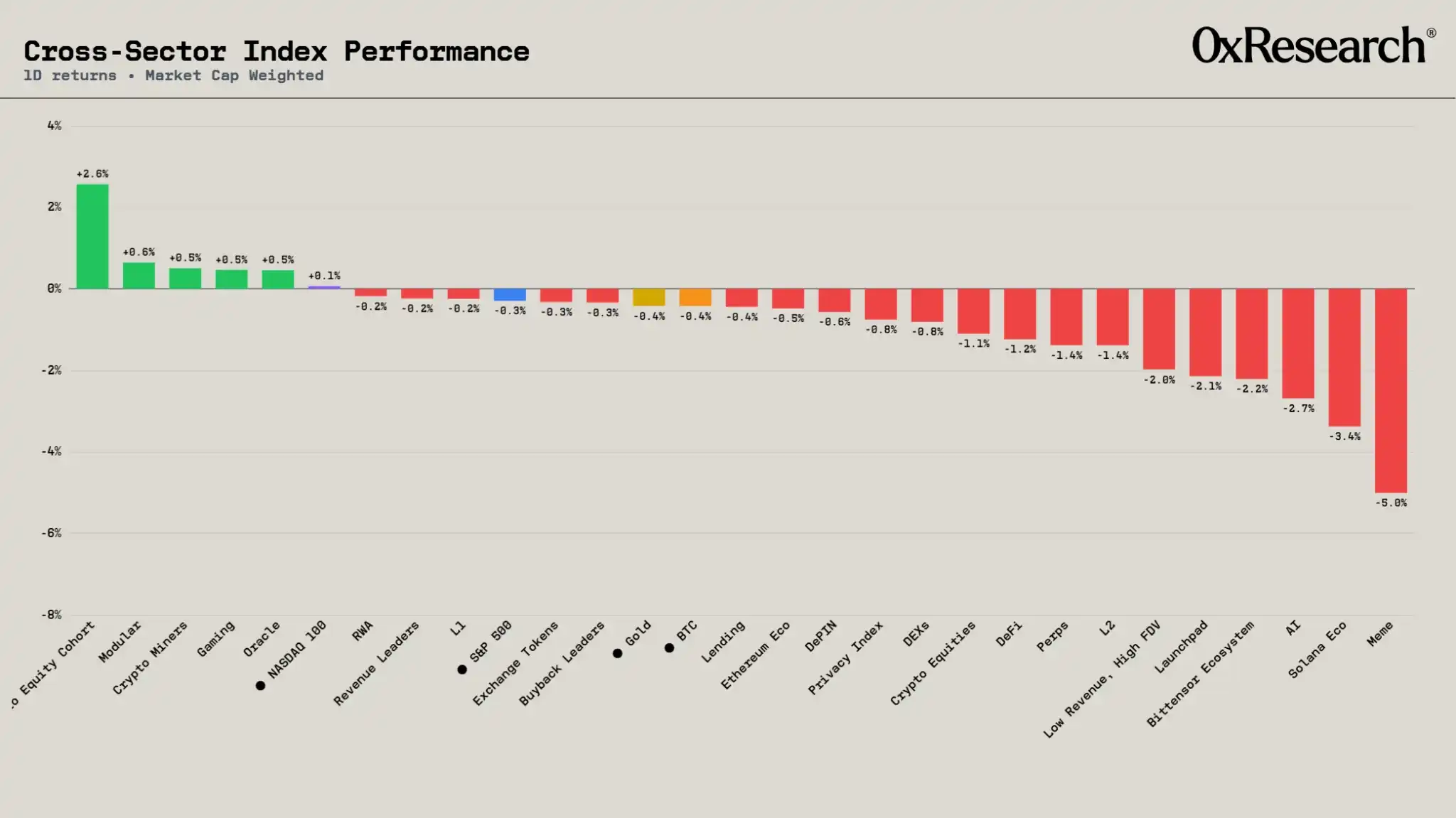
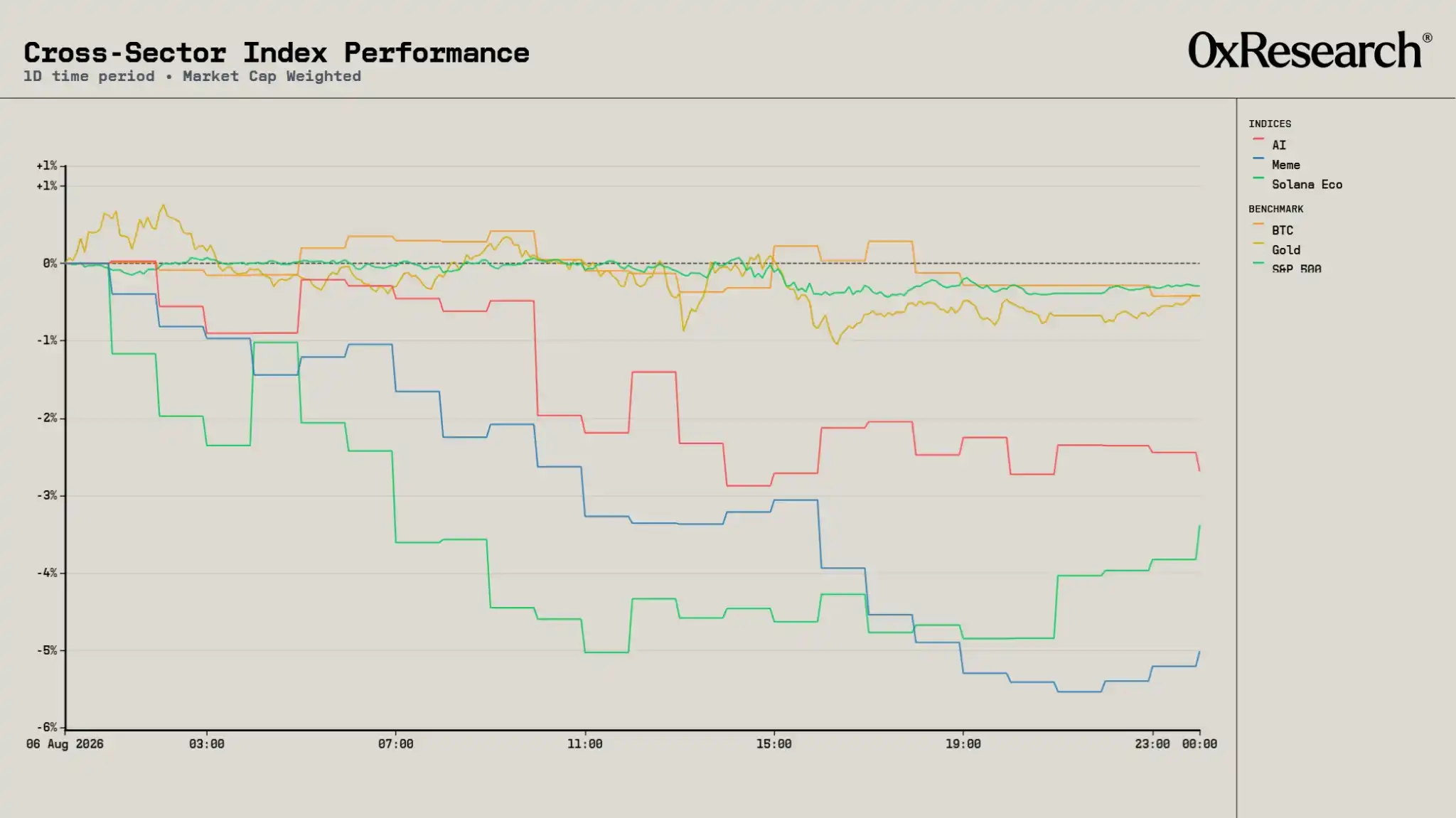
Aside from that sector, market performance was negative. As the stock market consolidated below record highs this week, BTC fell 0.4%, largely in line with gold (-0.4%) and the S&P 500 (-0.3%). BTC's downside resilience during the stock market pullback once again failed to translate into upside participation. The relative strength story is actually within crypto. BTC sits at the top of the digital asset sector, with long-tail assets selling off, led by Meme (-5.0%), Solana ecosystem (-3.4%), and AI (-2.7%).
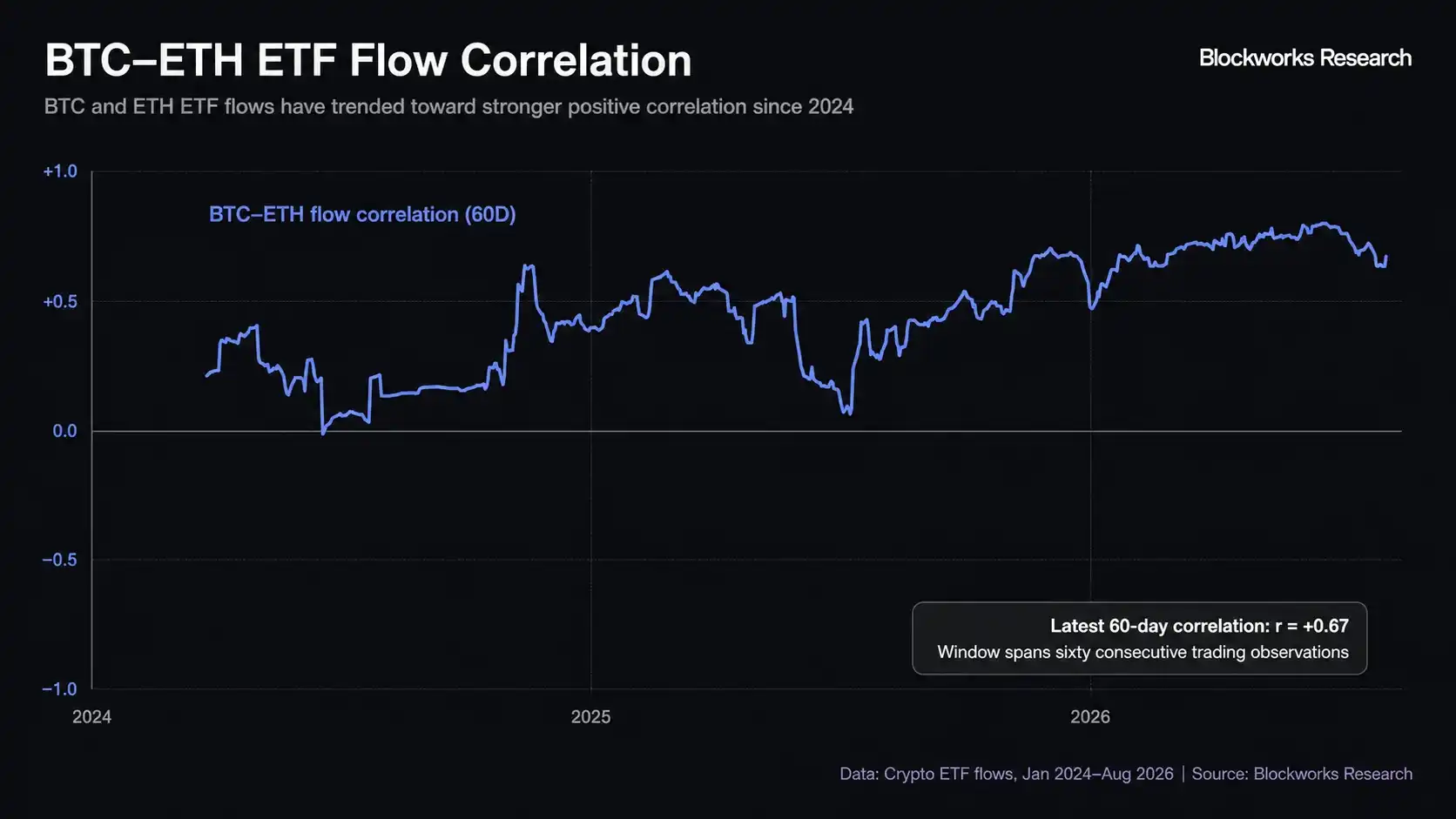
As mentioned in yesterday's article, we know crypto ETF flows have been weak. BTC and ETH ETF flows are increasingly synchronized. Their 60-day rolling correlation has risen to +0.67, near the top of the range. ETF demand behaves more like a single crypto allocation, but this isn't surprising, as it often happens during declining markets.
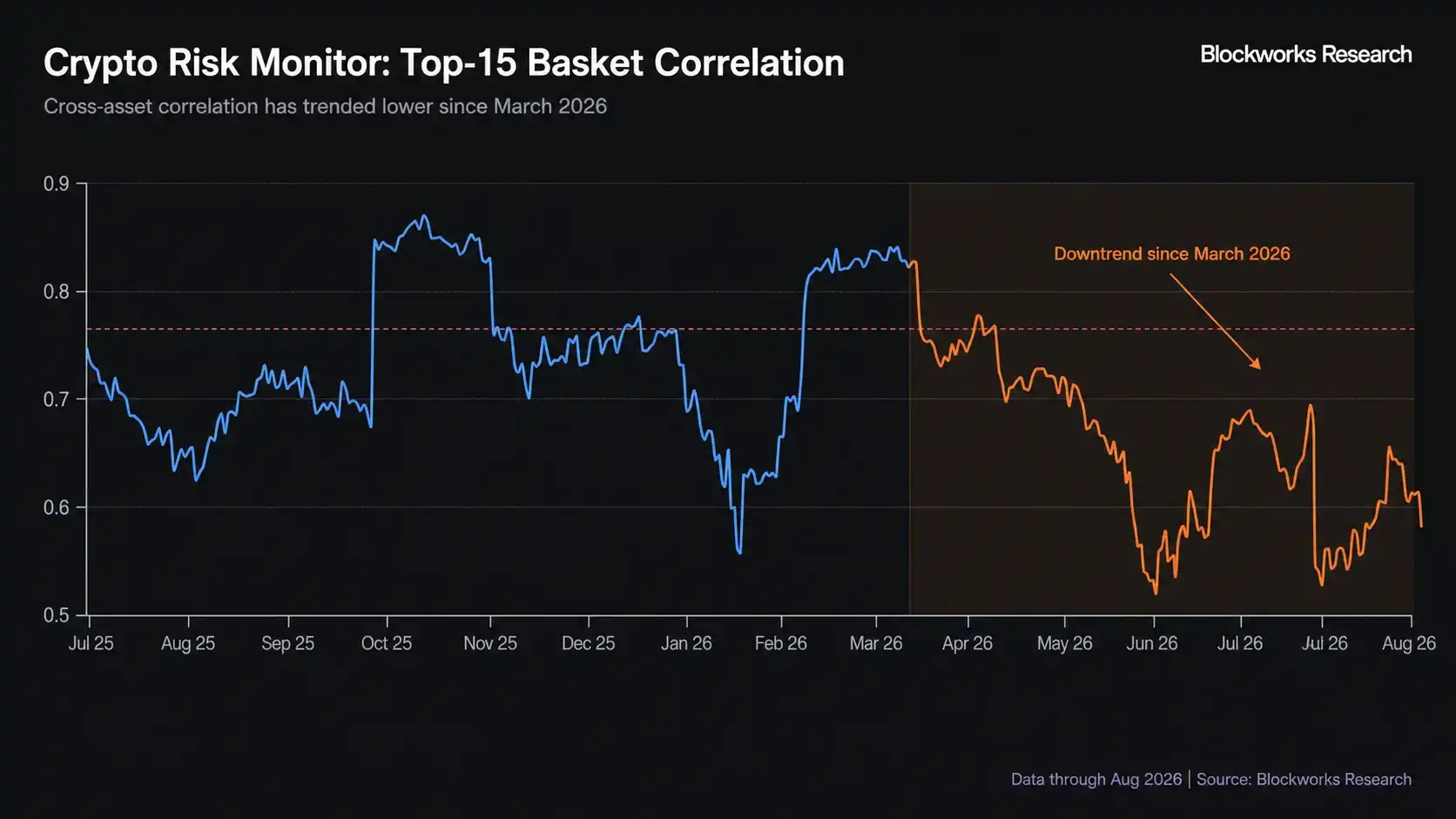
Fortunately, overall correlations have been trending lower since March 2026. This has led to weaker overall market co-movement and a more fragmented trading environment.
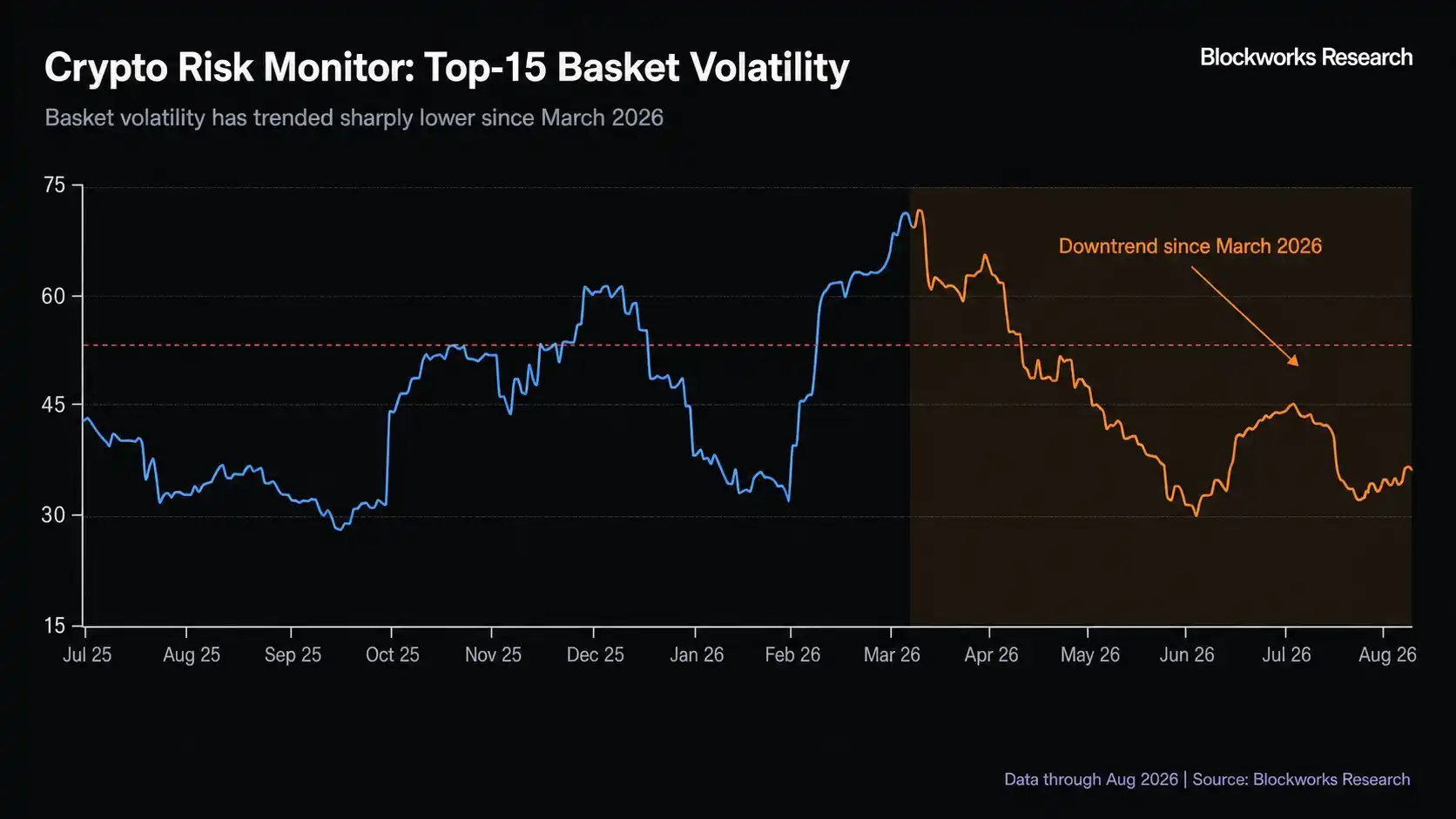
Similarly, market volatility has fallen from above 60 in March to the 30s in August. The decline indicates the market has entered a calmer state, with readings now comfortably below the risk threshold.
With market volatility and correlations declining, the only missing piece for starting a new bull market is sustainable price appreciation in BTC.

Gachapon Cooling

On-chain gachapon has been one of crypto's hottest sectors in 2026, but July marked the first monthly decline since February.

Total on-chain gachapon spending in July was $290.3 million, the second-highest monthly total ever, just behind June's record of $354.8 million. For the fifth consecutive month, Collector Crypt was the largest gachapon platform, generating $154.9 million in spending, accounting for 53% of July's total. However, Collector Crypt's monthly spending declined 26% month-over-month from June's $209.5 million.

Courtyard achieved its best month ever in July, reaching a new all-time high of $85.3 million, up 7% month-over-month. Courtyard's performance is particularly notable because it likely has the least crypto-native user base among major platforms. Its consistent growth suggests on-chain gachapon is a product category that resonates beyond the existing on-chain user base. Courtyard accounted for 29% of July's gachapon spending.
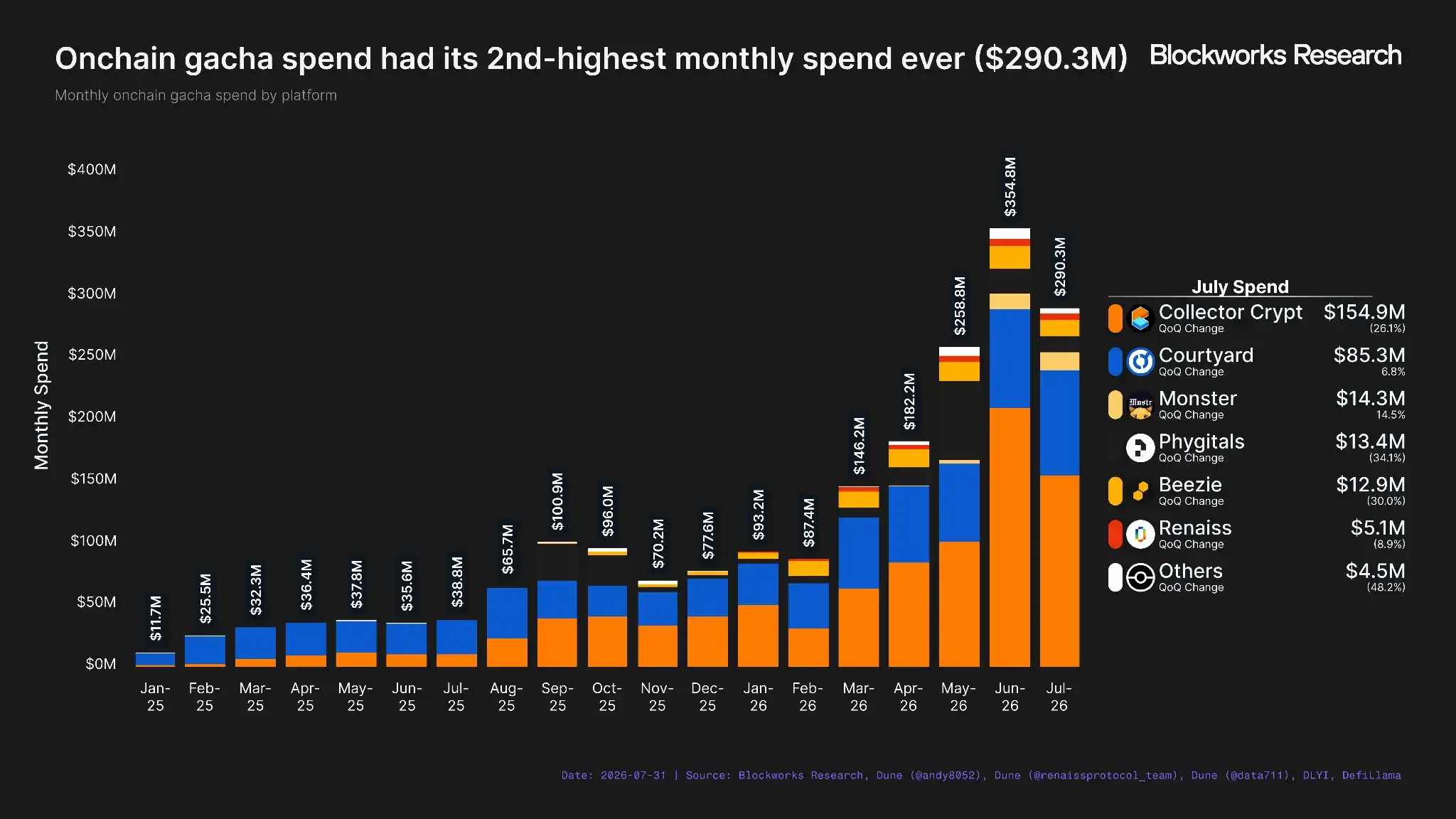
The platform rankings also saw a reshuffle, with Monster surpassing Phygitals and Beezie to become the third-largest gachapon platform in July. Monster generated $14.3 million in volume, up 15% month-over-month, and released a series of updates aimed at improving user experience:

Lucky Boost - Opening a pack and getting a common card increases the expected value of the next pack by 0.1%

Dupe Shield - Pulling the same card in consecutive packs gives the user a free pack

These updates went live on July 17 and 23, respectively. From the Lucky Boost launch to the end of the month, Monster generated $9.7 million in volume, 68% of its July total.

Phygitals ($13.4 million, down 34% MoM) and Beezie ($12.9 million, down 30% MoM) both had down months despite significant product updates. Phygitals launched a mobile app at month-end, while Beezie expanded to Solana on July 23. Overall, the top five gachapon platforms (Collector Crypt, Courtyard, Monster, Phygitals, and Beezie) accounted for 97% of July's on-chain gachapon spending.

Zooming out from on-chain gachapon, secondary market trading card volume remained largely at its historical high of $694.7 million, compared to $695.6 million in June. Weaker trading card demand was not the reason for the July on-chain gachapon decline.

It's also possible that a one-month dip doesn't offer much to interpret. On-chain gachapon spending grew at a staggering pace in the first half of 2026, and some level of pullback was inevitable. However, another possible explanation is that on-chain gachapon is facing new competition for attention and capital from crypto-native traders.

Throughout July, Collector Crypt spending declined while Pump.fun trading volume rose. Collector Crypt's average daily spending fell from $5.6 million in the first seven days of July to $3.4 million in the last seven days, a decline of 39%. Over the same period, Pump.fun's average daily trading volume increased from $320.6 million to $388.5 million, a gain of 21%. This relationship doesn't necessarily imply causation, but intuitively it makes sense. A significant portion of Collector Crypt's user base consists of active on-chain traders who rotate to whichever sector is hot. When Memecoins regain momentum, some of the capital and attention flowing into on-chain gachapon might shift elsewhere, even if trading card demand remains robust.
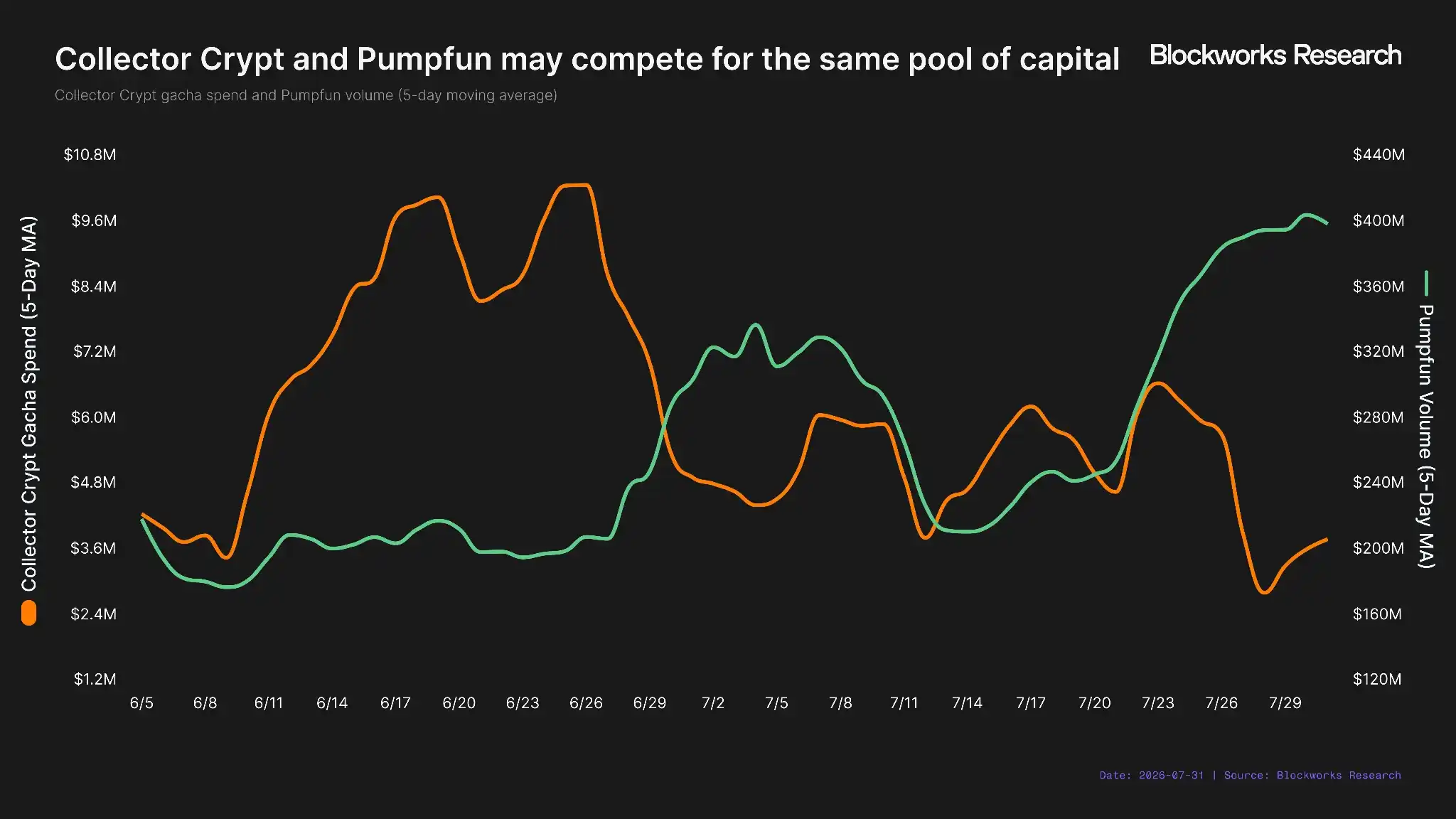
Courtyard's performance further supports this possibility. While most crypto-native gachapon platforms experienced a pullback, Courtyard hit a new all-time high in July. As noted, Courtyard likely has the least crypto-native user base among major platforms, meaning its users are probably less inclined to rotate back to Memecoins when speculative activity heats up.

For now, July's decline looks more like a natural pullback, potentially amplified by renewed Memecoin activity, rather than evidence of a broader slowdown in the trading card market.


Questions liées

QWhat does the July cooling of on-chain Gacha (Pokemon card opening) activity suggest about speculative capital flow in the crypto market?

AThe data suggests that speculative capital might be rotating. While on-chain Gacha transaction volume fell for the first time since February, activity on Memecoin platforms like Pump.fun increased. This implies that some crypto-native Gacha players may be shifting their funds and attention back to Memecoins as that sector regains momentum.

QHow did the Courtyard platform perform in July compared to other major Gacha platforms, and what is the significance?

ACourtyard set a new all-time monthly high in July with $85.3 million in transaction volume, a 7% increase. This is significant because it likely has the least crypto-native user base among major platforms. Its growth during a general Gacha cooldown indicates strong, genuine collecting demand exists beyond the core speculative crypto trading community.

QWhat are the two key platform-specific features introduced by Monster to improve user experience?

AMonster introduced two key features: 1) Lucky Boost, which increases the expected value of the next pack by 0.1% if a user pulls a common card, and 2) Dupe Shield, which grants a free pack if a user pulls the same card in consecutive packs.

QWhat overall market conditions, according to the article, are currently lacking for a new bull run to begin?

AThe article states that market volatility and asset correlations have been declining, leading to a calmer, less interconnected trading environment. The only remaining element needed to kick off a new bull market is a sustainable increase in the price of Bitcoin (BTC).

QWhat was the trend observed between Collector Crypt's daily spending and Pump.fun's daily trading volume in July?

AIn July, Collector Crypt's average daily spending declined while Pump.fun's average daily trading volume rose. Specifically, Collector Crypt's spending fell 39% from the first 7 days to the last 7 days of the month, whereas Pump.fun's volume increased 21% over the same period, indicating a potential inverse relationship in speculative capital allocation.

Lectures associées

Perspectives de l'ère post-cryptomonnaie : retour à l'évaluation des actifs, quels seront les enjeux de la prochaine décennie ?

L'économie cryptographique est en pleine transformation, passant d'une phase de spéculation excessive à une maturité croissante. Après les attentes démesurées de 2021, les valorisations se sont rationalisées. Des problèmes structurels comme la cyclicité des revenus, l'incertitude réglementaire et les asymétries d'information s'atténuent. Parallèlement, des cas d'usage à valeur réelle émergent et connaissent une croissance composée : des plateformes pair-à-pair, des dollars numériques globaux, des bourses sans autorisation, de nouveaux instruments dérivés et des marchés de collatéral mondiaux. Des blockchains comme Ethereum, Solana et Hyperliquid consolident leurs effets de réseau en tant que couches de base monétaires et financières de l'Internet. Les géants de Wall Street et de la Silicon Valley déploient désormais des produits de production sur des blockchains publiques. Un consensus se forme : la plupart des actifs doivent générer des flux de trésorerie. Les opportunités d'investissement à long terme sur les principaux projets sont sous-évaluées. Bien que la concurrence s'intensifie et que de nombreux projets puissent échouer, le contexte macroéconomique - déclin de la confiance institutionnelle, dépenses publiques insoutenables, dévaluation monétaire - favorise l'adoption de la cryptéconomie. Il ne s'agit pas d'un marché mûr uniforme, mais d'un ensemble de produits à différentes étapes d'adoption. L'ère de la spéculation n'est pas terminée, mais se transforme. Le défi est maintenant de naviguer dans cette nouvelle réalité et d'identifier les gagnants durables qui façonneront le futur système financier, plutôt que de cultiver le cynisme. Une opportunité générationnelle se cache derrière le brouillard actuel de la désillusion.

Odaily星球日报Il y a 4 mins

Perspectives de l'ère post-cryptomonnaie : retour à l'évaluation des actifs, quels seront les enjeux de la prochaine décennie ?

Odaily星球日报Il y a 4 mins

EthSystems et Undefined Labs signent un protocole d'accord pour soutenir l'adoption institutionnelle d'Ethereum en Corée du Sud

Le 11 août 2026, EthSystems, une entreprise spécialisée dans l'infrastructure institutionnelle Ethereum, a annoncé la signature d'un protocole d'accord stratégique (MOU) avec Undefined Labs, un cabinet de conseil Web3 sud-coréen de premier plan. Ce partenariat vise à accélérer l'adoption institutionnelle d'Ethereum en Corée du Sud en collaborant avec les institutions financières, les régulateurs et les entreprises. EthSystems, fondée par l'équipe à l'origine du Groupe de travail sur la confidentialité institutionnelle de la Fondation Ethereum (IPTF), se concentre sur la fourniture d'infrastructures Ethereum adaptées aux exigences de confidentialité, de conformité et de sécurité des institutions financières. Dans le cadre de cette collaboration, EthSystems apportera son expertise technique en matière de tokenisation, de stablecoins et d'infrastructure d'actifs numériques, tandis qu'Undefined Labs facilitera l'engagement commercial sur le marché sud-coréen, en mettant en relation EthSystems avec les principales institutions financières et décideurs politiques du pays. Ensemble, les deux sociétés soutiendront le secteur financier sud-coréen par le biais de formations, d'ateliers, de conseils stratégiques et de projets pilotes, alors que le pays établit son cadre réglementaire pour les actifs numériques. L'objectif est de faire d'Ethereum une pierre angulaire de la prochaine génération d'infrastructure financière institutionnelle en Corée du Sud.

cointelegraphIl y a 42 mins

EthSystems et Undefined Labs signent un protocole d'accord pour soutenir l'adoption institutionnelle d'Ethereum en Corée du Sud

cointelegraphIl y a 42 mins

Quand le trafic des Memes rencontre les RWA : Les ambitions financières d'Hyperliquid et Robinhood

L'article explore le rôle de la spéculation comme moteur d'évolution dans l'industrie de la cryptographie, en la présentant non comme une fin en soi mais comme un fondement potentiel pour des infrastructures financières durables. Il établit un parallèle historique avec le marché à terme des céréales de Chicago au 19ème siècle, où la liquidité créée par les spéculateurs a finalement permis l'émergence d'un système mondial de découverte des prix. L'analyse se concentre sur deux cas contemporains : Hyperliquid et Robinhood Chain. Hyperliquid, initialement une plateforme de trading à effet de levier sur crypto, a étendu son modèle aux actifs traditionnels (actions, matières premières, indices), créant une couche de prix fonctionnant 24h/24. En juillet, le volume de ses contrats perpétuels sur actifs réels a dépassé celui des cryptomonnaies. Robinhood Chain, conçue à l'origine pour le trading d'actions tokenisées, a vu son adoption exploser grâce au lancement de Pools (par Uniswap), une plateforme de meme coins. L'afflux d'utilisateurs et de liquidités généré par cette spéculation sert désormais de capital de départ pour développer son infrastructure de trading d'actifs traditionnels. L'article souligne que la spéculation n'est ni bonne ni mauvaise en essence. Sa capacité à se transformer en une activité économique durable dépend de la valeur de l'actif sous-jacent auquel elle s'ancre. Ainsi, lorsque la spéculation s'appuie sur des actifs ayant une valeur intrinsèque (comme les matières premières ou les actions), elle peut catalyser la construction d'infrastructures de marché solides, suivant une trajectoire observée tout au long de l'histoire financière.

marsbitIl y a 1 h

Quand le trafic des Memes rencontre les RWA : Les ambitions financières d'Hyperliquid et Robinhood

marsbitIl y a 1 h

La pénurie de HBM de NVIDIA limite la prochaine génération de GPU, mais ce disque dur vole la vedette

**Résumé** À l'ère des agents IA, le rôle du stockage évolue fondamentalement. Il ne s'agit plus seulement de persister des données passives, mais de participer activement au cycle de perception, de mémoire et de décision des agents intelligents. Cela conduit à l'émergence de « SSD fonctionnels » intégrant des capacités de chiffrement, compression, indexation et gestion du cycle de vie des données directement au niveau du contrôleur, pour servir les besoins spécifiques en mémoire contextuelle, mémoire à long terme et traçabilité des agents. Le marché se structure en trois axes principaux : la **fonctionnalisation des SSD** (avec des capacités dédiées découvertes dynamiquement), la **nodalisation du stockage** (des nœuds dédiés aux agents, en local ou dans le cloud, garantissant des SLO) et la **recomposition hiérarchique de la mémoire** (HBM, HBF, DRAM/CXL, SSD fonctionnels et stockage partagé collaborant en fonction de la criticité, de la chaleur et de la persistance des données). Des acteurs comme Phison (aiDAPTIV), Longsys (SPU+iSA) et la collaboration Yinpu-Maxio illustrent cette transition, où l'innovation ne réside pas dans une simple accélération, mais dans une redéfinition de l'interface sémantique entre l'exécutif des modèles IA et la couche de persistance. L'enjeu final est de réduire le coût par token, d'améliorer la continuité des agents et de garantir un cycle de vie des données sécurisé et efficace.

marsbitIl y a 1 h

La pénurie de HBM de NVIDIA limite la prochaine génération de GPU, mais ce disque dur vole la vedette

marsbitIl y a 1 h

Trading

Spot
活动图片