Is Crypto Trading Taxation Becoming a Reality? An In-Depth Analysis of the 2026 Global Crypto Tax Regulations

marsbitPublié le 2026-01-13Dernière mise à jour le 2026-01-13

Résumé

"Tax on Crypto Trading Becomes Reality? In-Depth Analysis of 2026 Global Crypto Tax Regulations" Hong Kong recently announced a consultation to implement the OECD's Crypto-Asset Reporting Framework (CARF) and revised Common Reporting Standard (CRS). The goal is to automatically exchange tax-related information on crypto asset transactions with partner jurisdictions starting in 2028, with revised CRS rules taking effect in 2029. Furthermore, from January 1, 2026, the UK and over 40 other countries will begin enforcing new tax rules, requiring local crypto service providers to collect user wallet and transaction data for future international tax information exchange. For example, UK-based exchanges must collect detailed records of all customer transactions. HM Revenue & Customs (HMRC) will use this data to cross-check tax returns for compliance, with sanctions for violations. This data may also be used for identity verification, anti-money laundering, and criminal investigations, significantly impacting the anonymity and compliance landscape of the crypto industry. CARF is an international standard developed by the OECD under G20 mandate to enhance tax transparency for crypto assets. It aims to collect standardized information on often opaque, cross-border crypto transactions and automatically exchange it annually with the tax authorities in the user's jurisdiction of tax residence. The framework covers a broad range of crypto assets, including stablecoins, crypto-derived fi...

Original Author: ChandlerZ, Foresight News

Recently, Hong Kong, China announced through a government gazette that the authorities are conducting consultations on the implementation of the Organisation for Economic Co-operation and Development (OECD)'s Crypto-Asset Reporting Framework (CARF) and related amendments to the Common Reporting Standard (CRS).

It was pointed out that since 2018, Hong Kong has been automatically exchanging financial account information with partner tax jurisdictions annually under the Common Reporting Standard developed by the OECD, enabling relevant tax authorities to use this information for tax assessments, as well as detecting and combating tax evasion. The future goal is to automatically exchange tax-related information on crypto asset transactions with relevant partner tax jurisdictions starting from 2028, and to implement the revised new CRS rules from 2029.

Additionally, starting from January 1, 2026, the first batch of over 40 countries, including the UK, will implement new crypto asset tax regulatory rules, requiring local crypto service providers to begin collecting user crypto wallet and transaction data in preparation for subsequent cross-border tax information exchange.

Taking the UK as an example, crypto exchanges operating in the UK must begin collecting detailed transaction records and complete information for all UK customers. HMRC will use the collected data to cross-check users' tax returns to ensure tax compliance, and violators will face sanctions. Industry insiders point out that the relevant data may be used for identity verification, anti-money laundering, and criminal investigations in the future, having a profound impact on the anonymity and compliance environment of the crypto industry.

"Is crypto trading taxation becoming a reality?" A wide-ranging discussion has begun in the market. If Hong Kong reports, will mainland China also report? Will crypto trading be subject to back taxes in the future?

What is the CARF Global Taxation Framework

The "Crypto-Asset Reporting Framework" is a set of international standards for crypto asset tax information transparency developed by the OECD under the authorization of the G20. Its core purpose is to bring crypto asset transactions, which were previously difficult for tax authorities to penetrate and highly prone to cross-border flow, into a network of information that can be collected in a standardized manner and automatically exchanged between tax authorities. The OECD adopted and published the rules and commentary of CARF in 2022, clarifying that its design goal is to collect taxpayer-related information in a unified manner and automatically exchange it annually with the jurisdictions where taxpayers are tax residents, thereby reducing the risk of cross-border crypto asset tax evasion and underreporting.

In the context of CARF, crypto assets are not equivalent to Bitcoin or Ethereum in the narrow sense; any digital value carrier that can be held and transferred in a decentralized manner without the involvement of traditional financial intermediaries is within the scope. Its coverage is deliberately made closer to the real market form, including stablecoins, derivatives issued in the form of crypto assets, and even bringing some NFTs into the observation scope that may trigger similar tax risks.

Corresponding to the coverage, CARF's reporting obligations focus on market intermediaries that provide key services for transactions and exchanges. The OECD's approach is to anchor compliance at the link that is most capable of mastering transaction value and counterparty information. Any entity or individual that commercially facilitates or executes exchange transactions of relevant crypto assets for customers (including exchanges between crypto assets and fiat currency, as well as swaps between crypto assets) may in principle be identified as a Reporting Crypto Asset Service Provider and bear the obligations of data collection, due diligence, and reporting.

What is the relationship between CARF and the previously discussed CRS?

Understanding CARF requires placing it within the larger global tax information exchange system for comparison. The previous wave of tax supplements for Hong Kong and US stocks occurred under the mechanism of the Common Reporting Standard (CRS).

Over the past decade, cross-border tax transparency has mainly relied on the CRS standard. Countries require banks, securities firms, funds, and other financial institutions to identify account holders who are non-resident taxpayers and report key information such as account balance, interest, dividends, and disposal gains to their domestic tax authorities annually, which are then automatically exchanged with the other country's tax authorities.

China began fully implementing CRS in September 2018, exchanging resident financial account information with over 100 countries and regions. After data declaration, tax authorities issued notices based on CRS and other data, requiring users to explain the situation and pay back taxes.

CRS operates relatively maturely in the traditional financial system, but a large amount of crypto asset transactions, exchanges, and transfers occur outside the bank account system, especially forming an independent value circulation network between centralized trading platforms, custodial wallets, and on-chain transfers, making it difficult for CRS alone to achieve the same level of penetration. CARF supplements the on-chain and crypto asset market structure that CRS originally had difficulty covering.

While launching CARF, the OECD conducted the first systematic revision of CRS. On the one hand, it brought new financial products such as electronic money products and central bank digital currencies (CBDCs) into the scope of CRS; on the other hand, it adjusted the caliber for paths that indirectly invest in crypto assets through derivatives or investment vehicles to avoid the market circumventing information declaration and exchange through product structures. Overall, CARF is responsible for the transaction and service provider dimensions of the native crypto asset market, while the revised CRS continues to be responsible for the relevant risk exposures that may be carried within the financial account system. Together, they form a more complete automatic exchange puzzle.

The OECD pointed out that after the technical transmission format and supporting guidance for CARF and the revised CRS are perfected, the first batch of cross-border automatic exchanges is expected to start in 2027; before that, multiple jurisdictions will first implement domestic data collection and reporting requirements to prepare the data foundation for subsequent cross-border exchanges.

At the EU level, DAC8 was approved by member states in October 2023 and published in the official gazette in the same month. Its system design is based on the OECD's CARF international standards, aiming to incorporate crypto asset user information into automatic exchanges between member states' tax authorities.

Will Mainland China also join?

As of early December 2025, 76 countries/regions globally have committed to adopting CARF. The UK and the EU will be the first to implement this framework (data collection starting in 2026, first exchange in 2027); Singapore, the UAE, and Hong Kong, China follow closely, planning to collect data in 2027 and fully implement in 2028; Switzerland has postponed the implementation to 2027 and is still prudently assessing exchange partners; the US IRS's CARF joining proposal is still under internal review.

This means that China is not on the first batch of exchange lists, and CARF data will not be automatically exchanged with Chinese tax authorities through the CARF mechanism.
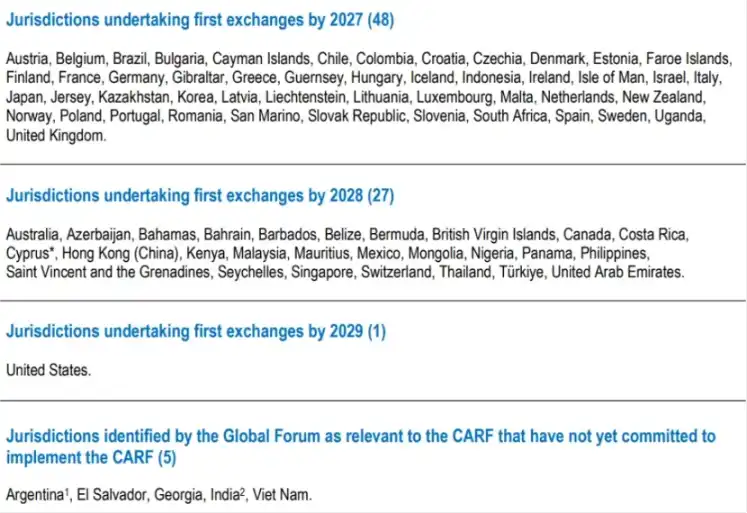
China has accumulated mature systems and collection and management experience under the CRS automatic exchange system, indicating that it has the infrastructure in terms of legal design, due diligence caliber, data exchange governance, and information security to undertake international standards.

The problem is that the compliance anchor of CARF mainly falls on regulated crypto asset service providers, while mainland China has long adopted a strong regulatory or even prohibitive governance approach towards virtual currency-related businesses. There is no locally licensed trading platform system that can be routinely included in CARF.

Hong Kong's advancement of CARF may increase the intensity of tax resident identification and information reporting for customers by crypto service providers in Hong Kong, but this does not automatically mean that the relevant information will naturally flow back to mainland tax authorities. Whether cross-border exchange occurs still depends on whether mainland China chooses to participate and establish exchange relationships with relevant jurisdictions, as well as arrangements between the two places regarding data usage restrictions, privacy protection, and technical对接.

But it is equally important to emphasize that not having joined does not mean it can be ignored. Even without the automatic exchange path of CARF, cross-border tax information may still flow through existing tax treaties and international collection and management cooperation frameworks, through case-by-case requests, joint law enforcement, or other cooperation methods. As major jurisdictions around the world begin to systematically collect crypto asset transaction and transfer data, the clues available to tax authorities will be more complete, and cross-border risk identification capabilities will also improve simultaneously.

For individuals and institutions, the most realistic change is that as long as the main operational path relies on centralized trading platforms, custody services, or fiat currency gateways, the traceability and追溯性 of transaction data will become increasingly stronger, and the compliance exposure will shift from a probability event to a常态.


Questions liées

QWhat is the Crypto-Asset Reporting Framework (CARF) and what is its main purpose?

AThe Crypto-Asset Reporting Framework (CARF) is a set of international standards for tax information transparency on crypto assets, developed by the OECD under the G20's mandate. Its core purpose is to bring crypto asset transactions, which are difficult for tax authorities to track and easily cross borders, into a standardized information network that can be collected and automatically exchanged between tax authorities. This aims to reduce the risk of cross-border tax evasion and underreporting related to crypto assets.

QWhen will the first batch of countries, including the UK, begin implementing the new crypto tax rules, and what are the key requirements?

AThe first batch of countries, including the UK and over 40 others, will begin implementing the new crypto tax rules on January 1, 2026. Key requirements include mandating local crypto service providers to start collecting detailed transaction records and complete information of users' crypto wallets and transactions to prepare for subsequent cross-border tax information exchange.

QHow does CARF complement the existing Common Reporting Standard (CRS)?

ACARF complements the Common Reporting Standard (CRS) by addressing the gaps in CRS's coverage of crypto assets. While CRS focuses on traditional financial accounts and has been effective in the banking and securities sectors, it struggles to track crypto asset transactions that occur outside the traditional banking system. CARF specifically targets the native crypto asset market, requiring crypto service providers to report transactions. The revised CRS also now includes some crypto-related financial products, ensuring a more comprehensive automatic exchange of information between the two frameworks.

QIs mainland China currently part of the CARF automatic exchange system?

ANo, as of the information in the article, mainland China is not among the first batch of over 76 countries committed to adopting CARF and will not receive data through the CARF automatic exchange mechanism. This is primarily because China's strong regulatory stance has prohibited licensed crypto trading platforms domestically, which are the key entities required to report under CARF.

QWhat is the significance of Hong Kong's move to implement CARF and CRS revisions for potential data flow to mainland China?

AHong Kong's implementation of CARF and CRS revisions means that crypto service providers in Hong Kong will enhance their identification of client tax residency and information reporting. However, this does not automatically mean the data will be shared with mainland China's tax authorities. Any cross-border exchange would depend on whether mainland China chooses to participate in CARF and establishes a specific data exchange relationship with Hong Kong, involving agreements on data usage limits, privacy protection, and technical integration.

Lectures associées

Quel lien existe entre Huang Zheng, le fondateur de Pinduoduo, et la blockchain ?

L'auteur de l'article explore le lien entre Huang Zheng, fondateur de Pinduoduo, et la technologie blockchain, à travers une réflexion inspirée par l'essai de Huang « Inverser le capitalisme ». L'article explique que le modèle économique fondamental de Pinduoduo est une « affaire d'assurance » basée sur la gestion de l'« incertitude ». Huang Zheng observe que les capitaux tendent à s'accumuler chez les riches car ils peuvent absorber les incertitudes (comme les risques de maladie ou de perte d'emploi) que les plus pauvres paient pour éviter via des assurances ou des achats sécurisés. Le concept de Pinduoduo, le « group buying » (achat groupé), fonctionne comme une « assurance inversée ». Il agrège la demande préalable d'un grand nombre de consommateurs pour créer une commande certaine et massive, permettant aux usines de réduire le risque de surproduction. Cette certitude permet aux fabricants de baisser leurs prix, faisant ainsi refluer une partie de la valeur vers les consommateurs. Le lien avec la blockchain apparaît comme la pièce manquante pour perfectionner ce modèle. Le principal défi de « l'assurance inversée » est que l'engagement individuel d'un consommateur n'est pas crédible ou coûteux à faire respecter. La blockchain, via ses contrats intelligents (smart contracts), pourrait résoudre ce problème en rendant les engagements (comme une intention d'achat) contraignants, vérifiables et exécutables automatiquement, sans intermédiaire. Huang Zheng lui-même s'interroge : la blockchain n'est-elle pas idéalement conçue pour ce type d'« assurance inversée » ? En conclusion, l'article compare deux voies pour créer de la certitude : la voie « Pinduoduo », qui utilise la masse pour aplanir l'incertitude, et la voie « Bitcoin », qui verrouille les règles par un code inviolable, remplaçant la confiance en une institution par la confiance en un protocole.

链捕手Il y a 32 mins

Quel lien existe entre Huang Zheng, le fondateur de Pinduoduo, et la blockchain ?

链捕手Il y a 32 mins

Le magnat du stockage qui a conquis des milliers de milliards de territoire ne deviendra jamais l'homme le plus riche

Fondateur de GigaDevice et ChangXin Technology, Zhu Yiming est une figure majeure de l'industrie chinoise des puces mémoire. Malgré la valeur boursière potentielle de ses entreprises (ChangXin visant les 1 000 milliards de yuans, GigaDevice valant 340 milliards), sa fortune personnelle reste limitée en raison de sa faible participation directe (moins de 3% dans ChangXin). GigaDevice (兆易创新), créée en 2005, a débuté avec des NOR Flash, profitant du désengagement des géants comme Samsung pour capturer des parts de marché (20% mondial en 2025). L'entreprise a diversifié ses activités vers les microcontrôleurs (MCU), les capteurs et les puces analogiques, mais les mémoires et MCU représentent 92% de son chiffre d'affaires. Son modèle économique Fabless (sans usine) et sa focalisation sur les segments de moyenne et basse gamme lui ont permis de maintenir une rentabilité solide, avec des marges brutes autour de 40%. Cependant, l'industrie des semi-conducteurs mémoire est très cyclique, comme en témoignent les fluctuations de ses bénéfices nets. L'article souligne que le modèle Fabless présente une vulnérabilité face aux cycles sévères du secteur. C'est pourquoi Zhu Yiming a cofondé ChangXin Technology en 2016 avec le gouvernement de Hefei, adoptant un modèle IDM (intégré) nécessitant des investissements massifs (équipements évalués à 169,3 milliards de yuans fin 2025). Son engagement personnel – renoncement au salaire, partage des incitations actions, verrouillage prolongé de ses parts – a été crucial pour sécuriser le financement public. En définitive, bien que Zhu Yiming ait "bâti un empire" dans le stockage, sa stratégie de dilution du capital pour assurer le développement de ses entreprises le place loin des tout premiers rangs des fortunes individuelles chinoises.

marsbitIl y a 38 mins

Le magnat du stockage qui a conquis des milliers de milliards de territoire ne deviendra jamais l'homme le plus riche

marsbitIl y a 38 mins

Une faille de gouvernance sur Token Of Power a drainé 1,58 million de dollars en WETH, selon TRM

La société d'intelligence blockchain TRM Labs a détaillé une attaque par prise de contrôle de gouvernance contre le protocole Token of Power, drainant environ 1,58 million de dollars en WETH. Selon l'analyse, l'attaquant a exploité une faille dans la configuration DAO Aragon du protocole : l'absence de délai d'exécution (timelock). Cela lui a permis de proposer, voter et exécuter une action de gouvernance malveillante en un seul bloc. L'opération aurait été financée avec 662 ETH retirés de Tornado Cash. L'attaquant a acheté suffisamment de jetons TOP pour obtenir le pouvoir de vote majoritaire, a frappé 10 milliards de nouveaux TOP et les a échangés contre du WETH via un pool Balancer avant de blanchir les fonds via Tornado Cash. Cette attaque illustre comment la conception de la gouvernance peut devenir un risque de sécurité direct. Sans timelock pour donner aux utilisateurs et aux équipes de sécurité un temps de réaction, un vote hostile peut être exécuté instantanément. Pour les utilisateurs de la DeFi, cet incident rappelle que les risques ne se limitent pas aux bugs de code smart-contract. Les paramètres de gouvernance, les contrôles des trésoreries et les seuils de vote sont tout aussi critiques. L'affaire montre également comment les mixers et les pools de liquidités peuvent être utilisés dans le sillage d'une exploitation. La suite à surveiller concerne les mouvements potentiels des fonds volés et d'éventuels détails de correction de la part du protocole, d'Aragon ou des fournisseurs de liquidités affectés.

bitcoinistIl y a 3 h

Une faille de gouvernance sur Token Of Power a drainé 1,58 million de dollars en WETH, selon TRM

bitcoinistIl y a 3 h

XRP Ledger : les frais journaliers tombent sous la barre des 400 $, la question de l'activité du réseau revient sur le tapis

Le réseau XRP Ledger (XRPL) suscite à nouveau des interrogations après que des données ont montré que ses frais quotidiens totaux sont tombés en dessous de 400 dollars. Si des frais bas correspondent à la conception du réseau et sont souvent présentés comme un atout pour l'accessibilité, ils peuvent aussi être un indicateur de l'activité et de la demande réelle. Ce chiffre hebdomadaire d'environ 3 100 dollars brûlés contraste fortement avec des blockchains comme Ethereum ou Bitcoin. Pour les partisans, cela confirme l'efficacité du XRPL. Pour les critiques, cela peut soulever des questions sur le niveau d'adoption transactionnelle à haute valeur, un point central pour le récit des paiements autour du XRP. Les données sur les frais permettent ainsi d'évaluer si l'activité on-chain correspond aux ambitions du réseau. Il est important de ne pas tirer de conclusions excessives : une journée à faibles frais ne signifie pas un dysfonctionnement. Cela alimente simplement le débat sur l'utilisation du XRPL, d'autant plus dans le contexte des initiatives de Ripple comme le RLUSD ou les paiements par agents IA. Il convient désormais d'observer si les frais rebondissent et si les comptes de transactions confirment cette tendance. Dans le paysage crypto actuel, où l'infrastructure et l'utilité gagnent en importance, cette information mérite d'être rapportée comme un point de données factuel pour une conversation de marché équilibrée, en évitant tout sensationnalisme.

bitcoinistIl y a 5 h

XRP Ledger : les frais journaliers tombent sous la barre des 400 $, la question de l'activité du réseau revient sur le tapis

bitcoinistIl y a 5 h

Ripple lance le kit de démarrage IA XRPL pour les paiements par agents utilisant XRP et RLUSD

Ripple a lancé le XRPL AI Starter Kit, une boîte à outils destinée aux développeurs pour faciliter les paiements par des agents logiciels en utilisant le XRP et le Ripple USD (RLUSD). Cette version constitue la Phase 1 d'une initiative plus large visant à développer les paiements automatisés (agentic payments) sur le XRP Ledger. L'outil intègre la norme de paiement x402 et inclut le XRPL Docs MCP Server, permettant de connecter des systèmes d'IA (comme Claude et Cursor) directement à la documentation technique du XRPL. L'objectif est de fournir aux agents logiciels des infrastructures de paiement à règlement rapide, avec des frais faibles, pour des transactions machine-à-machine, sans nécessiter d'approbation humaine pour chaque micro-paiement. Pour Ripple, cette annonce représente une tentative concrète d'ancrer l'utilité du XRP au-delà de la spéculation, en le positionnant dans l'infrastructure de paiement pour développeurs. L'adoption réelle par les développeurs et l'émergence effective des paiements automatisés en tant que catégorie significative restent des éléments à surveiller. Les prochaines étapes à observer seront les mises à jour de la documentation sur xrpl.org, les exemples de code, l'utilisation sur le testnet et les retours des développeurs. Ce développement s'inscrit dans une tendance plus large de l'écosystème crypto où l'infrastructure, l'utilité des tokens et les mises à jour produits gagnent en importance.

bitcoinistIl y a 7 h

Ripple lance le kit de démarrage IA XRPL pour les paiements par agents utilisant XRP et RLUSD

bitcoinistIl y a 7 h

Trading

Spot
Futures
活动图片




