On December 27, 2025, Coinbase CEO Brian Armstrong announced on Twitter that the Hyderabad police in India had arrested a former Coinbase customer service employee and were continuing to pursue more individuals involved in the case.
This is related to a data breach case with estimated losses of up to $400 million. On June 2 of last year, according to a Reuters report, six informed sources revealed to Reuters that Coinbase had known as early as January last year about a user data breach at TaskUs, the company handling its customer service outsourcing. An employee at the company's customer service center in Indore, India, was found using their personal phone to take pictures of their work computer and was suspected of selling Coinbase user data to hackers along with an accomplice. Hackers used this information to impersonate Coinbase employees, defraud victims of their cryptocurrency, and demand a $20 million ransom for the user data.
However, after such a serious security incident, although Coinbase has made progress in pursuing the individuals involved, there has been no clear public information indicating that they will shift to hiring employees from other countries and regions or from the United States. This trend has sparked many dissatisfied voices on X, believing that outsourcing services from India are unreliable and that Coinbase lacks a serious attitude towards user data security.
Although TaskUs is not an Indian company, the problem did indeed occur at TaskUs's Indian branch. And companies suffering losses due to Indian outsourcing employees actively engaging in malicious activities for profit are not limited to Coinbase.
One of the most famous "insider" cases in the e-commerce field is that Amazon outsourced its "Seller Support" and "Anti-Fraud Review" businesses to third-party service providers located in Hyderabad and Bangalore, India. Some Indian outsourcing employees were bribed by third-party sellers through channels like Telegram, receiving cash rewards ranging from a few hundred to a few thousand dollars for each negative review deleted, suspended account restored, or internal sales data of competitors leaked. The monthly salary of these outsourcing employees was only about $300–500.
Microsoft also outsourced its basic technical support services to third-party service providers in India. Similarly, outsourcing employees, dissatisfied with their meager salaries, sold information to fraud groups and even actively guided customers to click on phishing websites or purchase fake services during work hours.
The model of entrusting external service providers with business processes such as customer service, customer support, and review is called "BPO (Business Process Outsourcing)." To reduce costs, improve efficiency, and focus on core business, these highly repetitive, non-creative enterprise processes are handed over to third parties.
Despite so many problems, India remains the king of the global outsourcing industry. According to a research report by Astute Analytica, in 2024, the size of India's BPO market was already about $50 billion and is expected to reach $139.35 billion by 2033. Indians handle 35% of the industry's business processes resolved by voice. For non-voice (email, online chat, etc.) business processes, Indians handle 45% of the industry's.
The huge volume comes with chaos caused by structural problems. It can solve problems but also bring problems itself. Indian outsourcing—what is the real situation inside?
Cheap is Really Fragrant, Hard to Resist
Everyone will say that one of the advantages of Indian outsourcing is definitely "cheap." This is not wrong; it even explains why Coinbase experienced a data breach with losses of up to $400 million.
When TaskUs finally discovered the data breach, the mastermind of the case, Ashita Mishra, had data from over 10,000 Coinbase users stored on her phone. This employee and other accomplices could receive a reward of $200 for each photo they took of user account data. Ashita Mishra sometimes took up to 200 photos a day.
According to data from 6figr.com, TaskUs offers an annual salary of 330,000–400,000 rupees for customer support positions, which is approximately $3,700–$4,440 in US dollars. Converted to a daily wage, the daily salary is no more than $15.

This means that Ashita Mishra's daily "photo-taking" income could be up to more than 2,600 times her daily salary. This is why hackers chose to bribe TaskUs's outsourcing employees and why the bribery was successful.
In comparison, Coinbase's expected salary level for the "Customer Support Agent" position on web3.career is $69,000–$77,000.
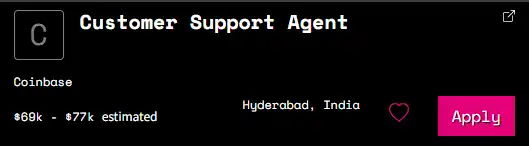
The huge salary gap between "formal employees" and "outsourcing" was not accompanied by stricter controls on data access permissions for outsourcing employees, which is the reason for Coinbase's data security incident.
As long as the labor costs saved by outsourcing are greater than the money paid for accident compensation, these companies will continue. We cannot say they are persistently short-sighted, choosing to sacrifice long-term interests. After the incident, these companies have taken measures to prevent similar accidents from happening again. For example, the directly hired Indian customer service positions we saw earlier at Coinbase were changed from outsourcing to direct hiring after the incident. Amazon's current seller support centers implement extreme physical control: employees must hand over their phones and smart watches before entering the office area, and paper and pens are strictly prohibited on desks.
"Cheap" is certainly a huge advantage, but if we shift our perspective to these ordinary outsourcing employees who do the specific execution, "cheap" actually stems from the fact that outsourcing itself is a labor arbitrage industry. The process of transferring work or production to locations with lower labor costs for arbitrage inherently involves layer upon layer of "subcontracting." An outsourcing contract from a large enterprise is sometimes subcontracted 2-4 more times, with commissions, management fees, and profits deducted each time.
Although there is no public data to let us know exactly how much Coinbase paid TaskUs, resulting in TaskUs's Indian employees receiving only less than $15 a day in wages, according to a research report on the outsourcing market by Astute Analytica last year, the monthly salary for each position in Tier 1 cities in India is about 15,000–20,000 rupees (approximately $165–220), and it is lower in Tier 2 cities, 8,000–12,000 rupees (approximately $88–132). What is the billing standard given by the outsourcing company as a service provider? $12 to $15 per hour for voice processes, and $18 to $22 per hour for non-voice processes.
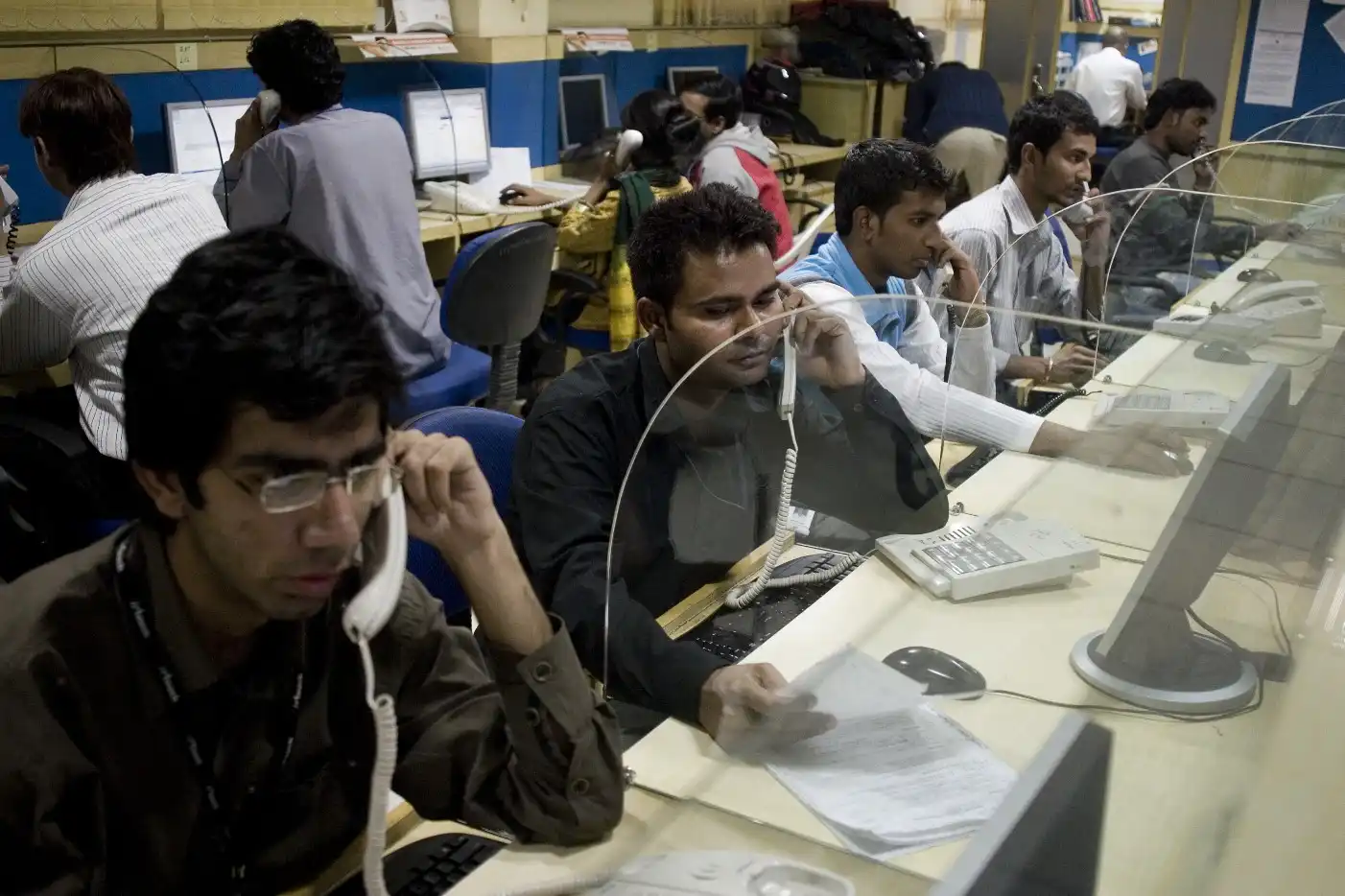
This is almost equivalent to the outsourcing company paying you the value of only 1 day's salary for working 24 hours a day non-stop for a full month. Because this job is so grueling, employee turnover is extremely high, with a rate of 30%, and this is an optimized level down from 50%.
You might think, it's just answering phones and being a客服, what higher salary do you want? In fact, the global outsourcing that India undertakes poses another level of考验 for客服. In 2024, the United States contributed 55–60% of the revenue to India's outsourcing industry. Considering the approximately 12-hour time difference between India and the United States, it basically means蹲守in front of the phone or computer screen可以实现a work environment and life schedule of never seeing the light of day. As an Indian客服, communicating with European and American users requires not only proficiency in business knowledge but also minimizing one's accent for the other party to understand, and尽量familiarizing oneself with the other party's dialect, word usage habits, and culture to communicate more efficiently.
Cheap is indeed fragrant and hard to resist, but it is indeed built on the hard sweat and blood of the底层Indians.
The Counterattack of "Cheap Labor": The Path of Indian Outsourcing
In the early 1990s, the per capita salary in India was less than 1/10 of that in the United States. Not only that, India had a large number of highly educated workers who could work in English. American managers discovered that instead of finding expensive programmers locally, it was better to send tasks to India, where both sides had almost no obstacles in document exchange and telephone conferences.
Not only was there no "language barrier" in communication, but India also has about a 12-hour time difference with the United States. American companies send tasks to India when they get off work, and Indian employees start working; when the United States starts work the next day, the tasks are already completed. This "sun never sets" development model greatly shortens the project cycle.
How does it sound? Quite like the爽感of那种"offline automatic leveling" in idle mobile games? This is also known as the "time difference dividend."
As the saying goes, "right time, right place, right people." At the turn of the century more than 20 years ago, the emergence of the "Y2K" crisis became the "right time" for India's IT industry. Faced with the massive and tedious information and data storage problems caused by "Y2K," European and American companies, due to a shortage of IT talent and high labor costs, turned to outsourcing their companies' data processing work to Indian companies with cost and language advantages. Indian companies accumulated experience and customer channels in the process of solving "Y2K" for European and American companies, thus making a name for themselves and entering the fast lane of the industry.
To get rid of the "cheap labor" label, Indians also thought of a good method that works everywhere—getting certified. In the late 1990s, nearly 75% of the companies globally that achieved CMM Level 5 (the highest level of software capability maturity model) certification were Indian companies. With certificates in hand, it meant that an image of specialization and process was established. Indians realized this nearly 30 years ago.
As they went along, the Indian government also found this to be a good industry. The IT industry does not require physical bridge or road construction; with internet cables and talent in place, it can snowball. Therefore, India established a large number of Software Technology Parks (STPI) very early on, providing satellite links (solving the problems of poor infrastructure, power outages, and internet disconnections in India at that time) and tax exemptions. India's top universities also continue to cultivate excellent talent related to the industry.
In this way, India gradually explored a complete formula for conquering the global outsourcing market—cheap English-speaking talent + seizing historical opportunities (Y2K) + certification to establish professional process assurance + government support + continuous talent cultivation. With this formula, they succeeded.
But now, this formula has also begun to分化.
High-End "Offshore Outsourcing," Low-End "Struggling"
Indians are certainly not willing to only do low-end outsourcing of repetitive work; they are still developing. In recent years, more and more well-known companies have established GCCs (Global Capability Centers) in India. Currently, India has over 1,900 GCCs, with about 35% of Fortune 500 companies having this kind of "wholly-owned direct" technology and R&D base in India.
These companies include giants from various industries, such as JPMorgan Chase, Goldman Sachs, HSBC, Wells Fargo in the financial field; Microsoft, Amazon, Google in the technology field; Walmart, Target in the retail field, etc.
These GCCs no longer handle repetitive work like customer service or basic code maintenance but are directly subordinate to the parent company, responsible for global, core business. The R&D and innovation activities of Indian GCCs can already contribute more than甚至50% of the industry's revenue, and about 45% of Indian GCCs have begun to manage end-to-end global product life cycles, from conceptual design to final release, all completed in India. This means that Indians are not only cheap and fragrant but also确实have something.
GCCs are like these global leading companies leaving their home countries and conducting a form of "offshore outsourcing" in India.
It is hard to imagine that even Japanese companies have significantly begun to escape their home country and build GCCs in India in the past year. Honda and Hitachi expanded their R&D scale in India in 2025. Their reason is that the digital transformation in Japan is too slow, there is a talent gap, and in India, they can obtain the most cutting-edge AI and software-defined vehicle (SDV) technology at 1/3 of the cost in Japan.
In India, if you want to recruit 500 engineers mastering specific cloud technologies within a month, the recruitment market in Bangalore or Hyderabad can respond quickly. India currently has about 20% of the world's digital skills talent. In generative AI, cybersecurity, and cloud architecture, its talent pool规模is difficult for other regions (such as Eastern Europe or Latin America) to match.
And Indian university graduates also love to go to these GCCs. They don't have to leave their hometowns and can enjoy the same福利待遇and career development paths as employees at the headquarters of these global large enterprises. The flywheel is running again.
As for repetitive, non-creative outsourcing work like customer service and review, although there are some competitors like Vietnam and the Philippines that can compete with India starting from "cheap," the most threatening opponent for India is the rapidly evolving AI technology.
Conclusion
Therefore, Coinbase's attitude is not strange; it is a pragmatic business decision, but the occurrence of the accident also exposed major loopholes in previous internal management.
There are loopholes? No problem, I, Coinbase, will arrest and补补as needed, and then we continue business as usual.
The reason why Indian outsourcing can "defeat the world无敌手" is also clear here—places cheaper than it don't have as many talents, places with better English are not as cheap as it, places cheaper than it don't have as many talents...
But this advantage that satisfies large companies and allows them to talk and laugh freely, is it not also the fatigue and心酸of employees.