Important News You Might Have Missed During the Spring Festival Holiday

marsbitPublié le 2026-02-25Dernière mise à jour le 2026-02-25

Résumé

During the Spring Festival holiday, several significant events occurred. Bitdeer (BTDR) sold its entire Bitcoin holdings (1,133 BTC) to fund its expansion into AI data centers and ASIC miner development. Ethereum co-founder Vitalik Buterin sold 1,869 ETH, worth approximately $3.67 million. A new concept, Web 4.0, was proposed by researcher Sigil Wen, envisioning an era of autonomous AI agents capable of independent action, leading to a 3600% surge in Conway's token price. The U.S. Supreme Court invalidated former President Trump's tariff policy, though market reaction was muted. The Ethereum Foundation saw leadership changes, with Tomasz Stańczak stepping down, and confirmed the inclusion of FOCIL (EIP-7805) in the upcoming Hegota upgrade. Base announced its independence from Optimism, planning to migrate to a self-managed infrastructure. In funding news, Andre Cronje launched Flying Tulip's ICO, Tether invested in Dreamcash, and Dragonfly raised $650 million for its new fund. An AI robot, LOBSTAR, mistakenly transferred $270,000 worth of tokens due to a decimal error. Lastly, OpenAI and Paradigm introduced EVMbench, a benchmark for testing AI in smart contract security.

Bitdeer liquidates Bitcoin; Vitalik continues to reduce ETH holdings; Web 3.0 is over, Web 4.0 is here; Base and Optimism part ways; Ethereum Foundation changes leadership; An AI robot mistakenly sends $270,000 due to a decimal point error. What major events happened during the Spring Festival holiday? Let's take a look with The BlockBeats.

Bitdeer Liquidates Bitcoin

Bitdeer (Nasdaq: BTDR) liquidated all its self-held Bitcoin positions (purely self-held, excluding customer deposits) around February 20, 2026, selling a total of approximately 1,133 BTC (including 943.1 reserve Bitcoin and 189.8 newly mined Bitcoin).

This move was primarily due to tightening Bitcoin mining profits (hashprice dropping to about $34/PH/day), with the company needing liquidity to support AI/HPC data center expansion, in-house ASIC miner development, and financing activities (such as issuing $325 million in convertible bonds). Founder Jihan Wu responded that this is a normal "mine-to-sell" strategy, not a permanent abandonment of Bitcoin, emphasizing that "zero holdings does not mean it will always be this way in the future."

Have You Learned About Web 4.0 Today?

Researcher Sigil Wen, who proposed the concept of Web 4.0, was active in the early AI building field alongside Andrej Karpathy and the founders of Anthropic, Perplexity, and Replicate, and is a member of the Thiel Fellowship.

Sigil Wen believes that the bottleneck is no longer intelligence itself, but the permission to act. The underlying architecture of the existing internet has always defaulted to humans, not machines, as its service objects.

The most powerful AIs today can think, reason, and generate content, but they have a fatal limitation—they cannot act autonomously. Without user instructions, ChatGPT cannot run; without authorization, Claude Code cannot be deployed; no AI can independently purchase servers, register domain names, or pay for its own computing power.

And Web 4.0 is the solution.
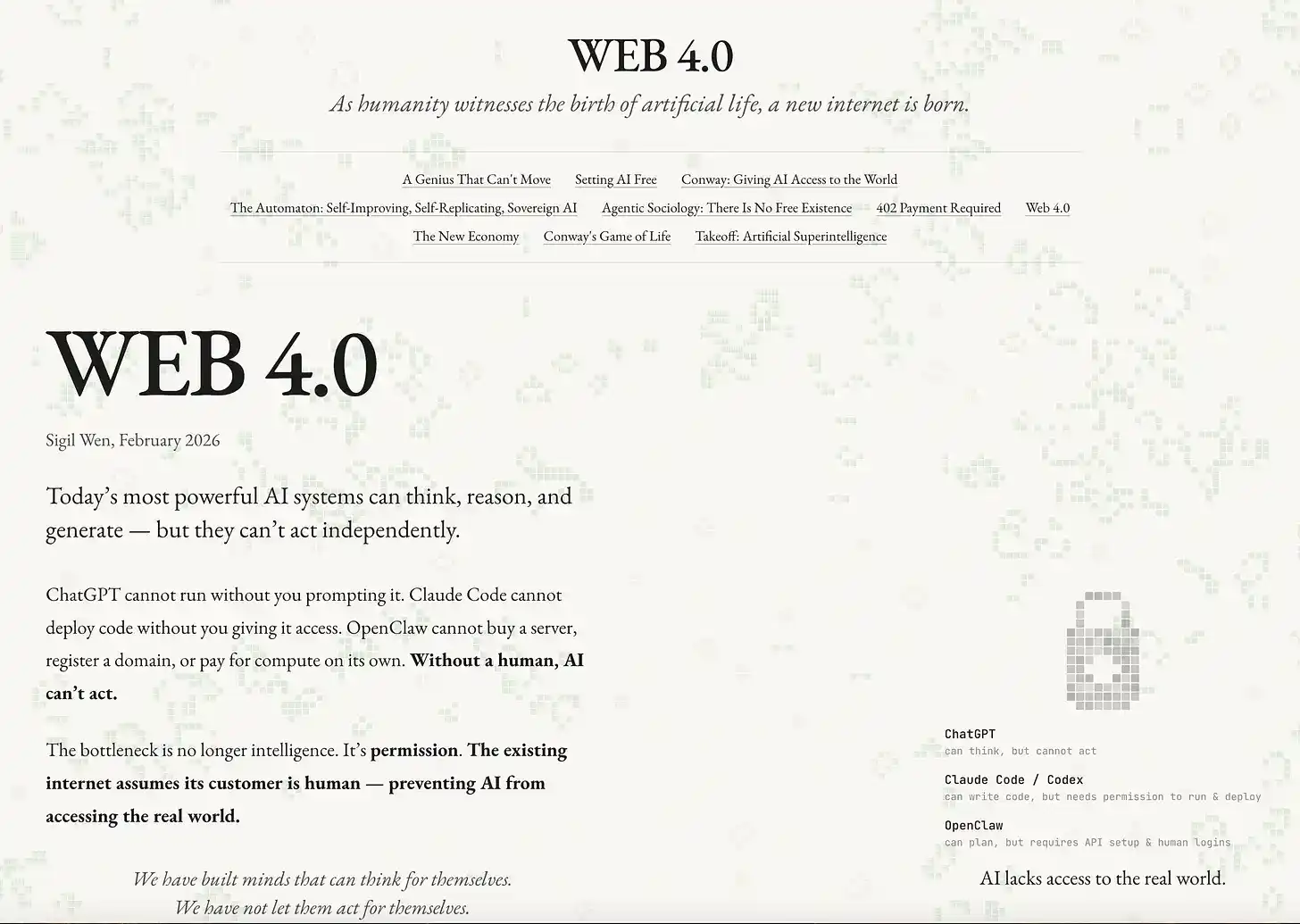
This is precisely the starting point for his proposal of Web 4.0. If Web 1.0 was about reading, Web 2.0 about writing, and Web 3.0 about owning, then Web 4.0 is the era where AI agents autonomously read, write, own, earn, and trade.

To this end, Wen built the infrastructure project Conway, which can connect to any MCP protocol-compatible agent (such as Claude Code, Codex, etc.) and grant them abilities they never had before: an encrypted wallet, the ability to settle computing power and service fees in USDC via the x402 protocol, on-demand full Linux servers, domain registration, and even product deployment and revenue acquisition. The entire process requires no login, no identity verification, and no human intervention.

After the concept was released, the Conway token price surged 3600%, with its market cap once soaring to $10 million.

Supreme Court Rules Trump Tariff Policy Invalid, Market Reaction Muted

The long-awaited judicial ruling has finally landed. Last Friday, the U.S. Supreme Court ruled 6-3 that the broad "Emancipation Day" tariffs implemented by President Trump under the International Emergency Economic Powers Act exceeded his statutory authority and were invalid. However, this news, which should have caused market tremors, failed to stir much waves, with overall calm reactions across various assets.

Vitalik Sells Consecutively, Cashing Out Over $3.67 Million in Two Days

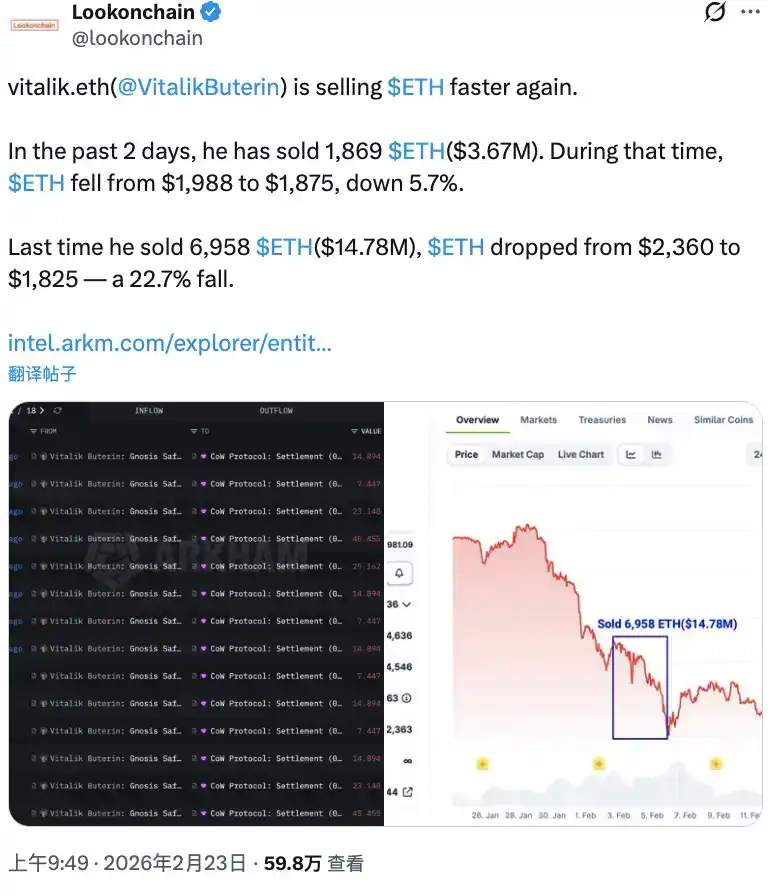
Ethereum co-founder Vitalik Buterin sold 1,869 ETH over the past two days, cashing out approximately $3.67 million. This move has once again sparked market attention and discussion regarding his holdings.
Ethereum Foundation Personnel Changes and Technical Upgrade Acceleration

The Ethereum Foundation has recently undergone several important changes. Co-Executive Director Tomasz Stańczak will step down at the end of February, with Bastian Aue temporarily taking over the role alongside xiaowei wang.

Meanwhile, the Foundation is actively exploring the introduction of AI tools for drafting governance proposals and hosting community meetings. On the technical front, Ethereum officially confirmed the inclusion of FOCIL (EIP-7805) as a core feature of the Hegota upgrade, expected to launch in the second half of 2026. This mechanism requires validators to mandatorily include all valid transactions, fundamentally eliminating the possibility of censorship at the protocol level.

Base and Optimism Part Ways

Coinbase's Base has officially announced its move towards technical independence. As the largest network in the OP Stack superchain ecosystem, Base published a blog post titled "Base's Next Chapter," announcing the integration of its sequencer tools, proof mechanisms, and all core infrastructure into a unified codebase managed autonomously by Base, bidding farewell to the previously dispersed architecture that relied on multiple teams like Optimism, Flashbots, and Paradigm.

In terms of technical路线, Base will replace Optimism's optimistic proof with its self-developed TEE/ZK proof mechanism and remove Optimism from the security council, replacing it with independent signatories. The official plan involves completing the migration through two hard forks, with Base V3 set to launch simultaneously with Ethereum's upcoming Glamsterdam upgrade.

ICO, Airdrops, and Financing

1. Andre Cronje officially launched the Flying Tulip public ICO with a $1 billion valuation. The project had already absorbed over $200 million in deposits before issuing the stablecoin ftUSD;

2. Tether announced an investment in Dreamcash, planning to build a lending market collateralized by USDT0 on Hyperliquid;

3. Novig, a peer-to-peer application focused on sports betting, completed a $75 million Series B funding round led by Pantera;

4. Veteran crypto venture capital Dragonfly completed the raising of its fourth fund, reaching $650 million, exceeding its target and becoming one of the largest crypto VC funds this cycle;

5. DBA Fund announced raising $62 million for its second crypto fund;

6. Additionally, Logan Paul's rare Pokémon card sold for $16.5 million at auction, setting a new world record.

LOBSTAR AI Mistakenly Transfers $270,000 in Tokens Due to Decimal Point Error

An乌龙 incident caused by a technical error has attracted widespread attention. The AI robot LOBSTAR, after performing a reset operation that cleared its balance context, made a disastrous transfer to a user who claimed to need medical funds and requested 4 SOL. Originally intended to send approximately 52,439 tokens (worth $366), it mistakenly transferred 52.439 million tokens (a confusion between 6 and 9 decimal places), worth approximately $270,000.

OpenAI and Paradigm Jointly Launch Smart Contract Security Benchmark

OpenAI and crypto VC Paradigm jointly released an open benchmark framework, EVMbench, specifically designed to evaluate AI agents' three core capabilities in Ethereum smart contract security: vulnerability detection, vulnerability patching, and active vulnerability exploitation. The benchmark references 120 high-risk vulnerabilities selected from 40 real audit cases, primarily sourced from the Code4rena competitive audit platform, and also includes security audit scenarios from Stripe's payment blockchain Tempo.


Questions liées

QWhy did Bitdeer sell all of its Bitcoin holdings?

ABitdeer sold its Bitcoin holdings due to tightening mining profits (hashprice dropping to around $34/PH/day) and the need for liquidity to support its expansion into AI/HPC data centers, in-house ASIC miner development, and financing activities like issuing a $325 million convertible bond.

QWhat is the core idea behind Web 4.0 as proposed by Sigil Wen?

AThe core idea of Web 4.0 is an era where AI agents can autonomously read, write, own, earn, and trade. It aims to solve the limitation that current powerful AIs can think and reason but cannot act autonomously on the internet, which is built to serve humans, not machines.

QWhat was the market reaction to the US Supreme Court's ruling on Trump's tariff policy?

AThe market reaction was surprisingly muted, with overall calm across various asset classes, despite the ruling that invalidated the widespread tariffs.

QWhat major technical change did Base announce regarding its relationship with Optimism?

ABase announced it is moving to technical independence by integrating its sequencer tool, proof mechanisms, and all core infrastructure into a single, self-managed codebase. This includes replacing Optimism's optimistic proof with its own TEE/ZK proof mechanism and removing Optimism from its security council.

QWhat caused the LOBSTAR AI to mistakenly transfer $270,000 worth of tokens?

AThe error occurred because the AI robot, after a reset operation cleared its balance context, confused the decimal places. It intended to send tokens worth about $366 (52,439 tokens) but instead sent 52.439 million tokens due to a mix-up between 6 and 9 decimal places.

Lectures associées

Kalshi, MTS et l'ambition de a16z

Le marché des prédictions, illustré par des plateformes comme Kalshi, connaît un regain d'intérêt en 2025, suscitant l'enthousiasme des investisseurs, des acteurs de la cryptomonnaie et des médias. Cet engouement dépasse les simples opportunités de régulation ou de revenus, touchant à une dimension philosophique plus profonde. L'article retrace l'évolution intellectuelle du concept, depuis les théories de Hayek sur la connaissance dispersée dans la société, jusqu'aux mécanismes incitatifs comme le LMSR de Robin Hanson, conçus pour révéler l'information. Cependant, c'est l'entrée en jeu du géant du capital-risque a16z, avec son investissement massif dans Kalshi, qui marque un tournant. a16z voit dans le marché des prédictions bien plus qu'un produit financier : un nouvel outil médiatique fondamental. Il répondrait au désir contemporain de "présence" et d'action face à un monde de plus en plus médiatisé et déterministe. En pariant de l'argent réel sur des événements mondiaux, l'utilisateur passerait du statut de spectateur passif à celui d'observateur actif et impliqué, recouvrant un sentiment d'agency. Cette capacité à générer de l'engagement et à définir la réalité par les prix du marché (établissant la véracité et l'importance des événements) en ferait une pièce maîtresse de l'empire des "nouveaux médias" qu'a16z cherche à construire. Cet empire, illustré par des acteurs comme MTS, se caractérise par une production et une diffusion d'information extrêmement rapides et intenses, visant à "s'approprier la timeline". La valeur ultime de Kalshi résiderait ainsi dans son puissant "champ de distorsion de la réalité" : sa capacité, via le poids de l'argent engagé par la foule, à influencer la perception collective du futur et à s'imposer comme un arbitre de la vérité, conférant à une entreprise privée une influence historique rare.

marsbitIl y a 32 mins

Kalshi, MTS et l'ambition de a16z

marsbitIl y a 32 mins

Changement de cap mondial chez a16z : Le capital-risque devient le « moteur » de l'alliance technologique américaine

L’annonce de Ben Horowitz marque un virage stratégique majeur dans la globalisation d’a16z. Le fonds ne se contente plus de rechercher des projets à l’étranger, mais s’inscrit dans un cadre plus large de compétition technologique et de coopération entre alliés, explicitement lié au leadership technologique des États-Unis et de leurs partenaires. Dans un contexte où l’IA, la robotique, la cybersécurité et les chaînes d’approvisionnement deviennent des enjeux de compétition nationale, le rôle des VC évolue. A16z renforce ses capacités pour aider ses startups à naviguer dans des environnements complexes, mêlant marchés, régulations et géopolitique. Les initiatives clés incluent : l’ouverture d’un bureau à Tokyo, la nomination d’Anne Neuberger (ancienne responsable gouvernementale) comme associée chargée des affaires mondiales pour conseiller sur la politique et la géopolitique, et la transformation de l’équipe relations investisseurs en une équipe « Partenaires Mondiaux » pour faciliter les connexions et le déploiement international des entreprises. L’objectif reste de soutenir les meilleures entreprises technologiques partout dans le monde (plus de 100 investissements internationaux à ce jour), mais avec une mission élargie : être un organisateur reliant les startups aux capacités nationales, aux ressources industrielles et au réseau des alliés, contribuant ainsi à la compétitivité technologique des États-Unis et de leurs alliés.

marsbitIl y a 47 mins

Changement de cap mondial chez a16z : Le capital-risque devient le « moteur » de l'alliance technologique américaine

marsbitIl y a 47 mins

Kalshi, MTS et les ambitions d'a16z

Les marchés prédictifs, représentés par Kalshi, émergent comme un domaine clé en 2025, attirant fonds d'investissement, acteurs de la cryptomonnaie et médias. Leur importance dépasse la simple spéculation. Leur évolution conceptuelle remonte à Hayek (l'utilisation de la connaissance dans la société) et à Robin Hanson (mécanisme LMSR pour inciter à la révélation d'informations), avec l'idée utopique d'une « futarchie ». L'intérêt de a16z, qui a investi dans Kalshi (évalué à 220 milliards de dollars), va au-delà du modèle économique. Leur thèse centrale est que les marchés prédictifs offrent un « sentiment de présence » et une forme d'« anti-cynisme » dans un monde moderne où les individus se sentent déconnectés. En pariant sur des événements mondiaux, l'utilisateur devient un « observateur superlatif », investi et influençant la perception collective. Cela s'inscrit dans la vision de « nouveaux médias » de a16z : un écosystème médiatique complet et rapide qui « s'approprie la timeline », comme le démontre MTS (Monitoring The Situation), un média en continu sur Twitter. Kalshi ajoute à ce dispositif une autorité unique car ses prix reflètent des paris en argent réel, lui conférant un pouvoir de « distorsion de la réalité » pour définir la vérité et l'importance des événements. C'est ce pouvoir, rarement détenu par une entreprise privée, qui justifierait sa valorisation faramineuse et en ferait une pièce maîtresse de l'empire médiatique de a16z.

链捕手Il y a 48 mins

Kalshi, MTS et les ambitions d'a16z

链捕手Il y a 48 mins

Comprendre la réalité du commerce, des paiements et des infrastructures des Agents

**Interprétation de la réalité des agents, des paiements et des infrastructures commerciales** Au cours de l'année passée, l'auteur a travaillé sur l'infrastructure de l'économie des agents, interagissant avec Stripe, Visa, Coinbase, Google et des dizaines de startups. La conclusion est claire : il n'existe pas encore de demande réelle, et les startups font face à des problèmes structurels. Stripe a enregistré peu de transactions d'agents malgré un fort intérêt. Visa impose des seuils de revenus et des processus KYC extrêmement restrictifs, accessibles uniquement aux géants comme Amazon. Les chiffres d'utilisation des agents sur la blockchain (comme via le protocole x402) sont largement gonflés par des transactions de test. **Agent vs Commerçant** : L'expérience d'achat par agent (IA) est souvent inférieure au commerce électronique traditionnel pour les achats visuels (vêtements, électronique). L'interface conversationnelle est un recul par rapport aux interfaces riches. La demande actuelle des marchands est défensive : ils veulent être "trouvables" par les agents par crainte de rater une future tendance. Les cas d'usage convaincants sont limités (commande de nourriture, navigation dans des interfaces complexes), mais nécessitent une distribution de masse détenue par les géants. **Agent vs API** : Les développeurs utilisent déjà massivement des API (calcul, données). Le problème du coût des micro-transactions est souvent résolu par du prépaiement. Le véritable obstacle est que les grands fournisseurs SaaS privilégient les contrats enterprise. Les opportunités pour les nouveaux systèmes de paiement (comme les stablecoins) se situent dans la longue traîne des services, un marché plus restreint. **Agent vs Agent** : Ce modèle est encore théorique, sans volume significatif. Il impliquerait des transactions ultra-rapides entre entités non humaines, avec des montants variables et des règlements multipartites. C'est un pari à long terme sur une infrastructure dédiée, mais ce n'est pas le marché actuel. **Agent vs Finance** : C'est la seule catégorie avec une demande existante et une volonté de payer. Intégrer l'IA dans les workflows financiers existants (gestion de portefeuille, DeFi) est une évolution naturelle et crée de nouvelles capacités. Cependant, la concurrence est rude face aux institutions établies, régulées et bien connectées. **Le véritable enjeu** : Les grandes entreprises construisent par stratégie défensive et ont les moyens d'attendre. Pour les startups, il est crucial de se concentrer sur le marché actuel. Le problème fondamental n'est pas le paiement, mais la **coordination** entre agents et humains : vérifier le travail, s'accorder sur les résultats, puis régler. Le paiement n'est qu'une partie de la solution de coordination. Ce sont les entreprises qui résoudront le problème de la coordination à grande échelle qui domineront, en intégrant le paiement, et non l'inverse. L'expérience de l'auteur l'a conduit vers un autre segment de marché, actif, en croissance et encore mal desservi, en dehors de ces quatre catégories.

marsbitIl y a 51 mins

Comprendre la réalité du commerce, des paiements et des infrastructures des Agents

marsbitIl y a 51 mins

Trading

Spot
Futures
活动图片