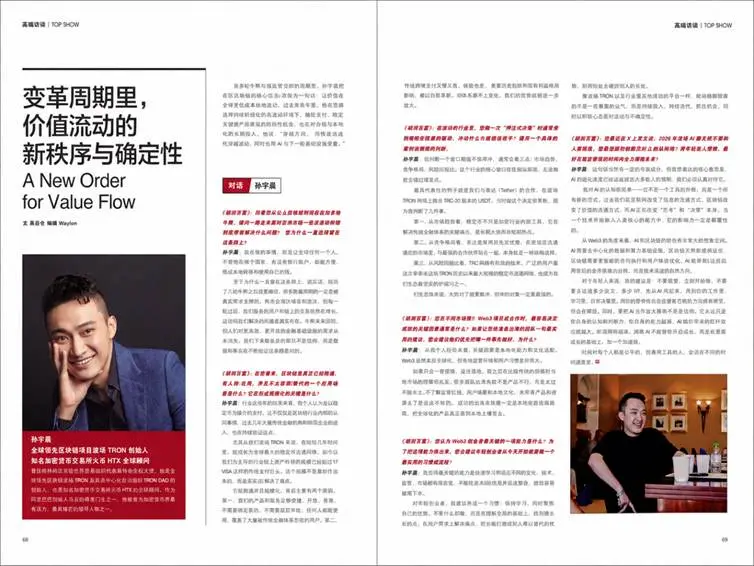
Hurun Report Interview with Justin Sun: New Paradigm of Value Circulation in the Web3 Transformation Cycle

链捕手Publié le 2026-05-29Dernière mise à jour le 2026-05-29

Résumé

In an interview with *Hurun Report*, Justin Sun, founder of TRON, discussed the evolution of the Web3 industry as it transitions from early-stage exploration to large-scale adoption. He emphasized that the fundamental goal of blockchain technology is to build an open and inclusive internet of value, enabling low-cost, efficient fund transfer for anyone globally, regardless of location or access to banking. Sun highlighted stablecoins as the most mature and scalable application within Web3, noting that TRON has grown into one of the world's largest stablecoin networks, with over $86.3 billion in USDT circulation. He attributed this growth to genuine user demand in cross-border payments and daily transactions, reflecting a structural shift where blockchain's openness and efficiency are naturally supplementing traditional financial systems. Regarding strategy, Sun outlined a framework combining data-driven iteration, rapid execution, and user-centricity. He pointed to TRON's partnership with Tether for TRC-20 USDT as a key decision that leveraged market trends and network effects to build a competitive moat. He also stressed the importance of globalization, noting that success in different markets depends on deep local compliance, cultural adaptation, and partnership networks. Sun expressed strong interest in the convergence of AI and blockchain, viewing AI as a transformative force that can enhance blockchain's intelligence and user experience, while blockchain provides dece...

Against the backdrop of the Web3 industry entering a deep-water zone and the accelerated global restructuring of financial infrastructure, blockchain is transitioning from early exploration to large-scale application. As an authoritative institution with extensive influence in business and investment, an in-depth interview by the renowned magazine, Hurun Report, is regarded as a significant industry barometer. Recently, Justin Sun, founder of TRON, in an exclusive interview with Hurun Report, systematically elaborated his judgment on industry evolution and long-term value around core issues such as stablecoin payments, globalization path, and AI integration trends. His views also reflect the critical stage where Web3 infrastructure is moving from "feasibility verification" to "global adoption".
Stablecoins Building a Global Value Circulation Network, Web3 Infrastructure Enters Scaling Phase

In the interview with Hurun Report, Justin Sun summarized the core goal he has long been committed to in extremely concise terms: "To enable any person in the world, regardless of location or whether they have a bank account, to transfer and use their funds at low cost and high efficiency." This statement fundamentally reveals the value essence of blockchain technology — constructing an open and inclusive value internet.

He further pointed out that after the blockchain industry has gone through multiple bull and bear cycles, projects truly capable of weathering these cycles must be built upon real demand and practical usage. The continuous growth of on-chain user scale and transaction volume is an important basis for his judgment of industry direction. In this context, the on-chain payment system centered around stablecoins has become the most mature and capable application scenario for scaling currently.

In the Hurun Report interview, Justin Sun mentioned that TRON has rapidly developed into one of the world's largest stablecoin circulation networks, with its on-chain asset transfer volume even surpassing that of some traditional payment networks. This growth is not driven by short-term market sentiment but based on the continuous use by real users in scenarios such as cross-border transfers, value storage, and daily payments. Official data shows that the current circulation of USDT on the TRON chain has exceeded $86.3 billion, a scale reflecting strong network effects driven by real user demand.

From a structural advantage perspective, the scaling of stablecoin payments benefits from two factors: on one hand, blockchain networks possess openness and permissionless characteristics, enabling them to cover user groups difficult for the traditional financial system to reach; on the other hand, the limitations of traditional cross-border payment systems in efficiency, cost, and user experience provide significant substitution space for new-generation infrastructure. Sun believes this trend is essentially a "natural substitution" of existing financial systems by technological progress, not short-term competition.

Globalization Strategy and Technology Convergence Advance in Parallel, Building Long-term Competitive Advantage for Web3

When discussing enterprise growth and strategic decision-making, Justin Sun presented a highly systematic methodology in the Hurun Report interview. He summarized the success factors as the combination of "data-driven iteration, rapid execution, and user orientation," emphasizing that in a rapidly changing technological environment, single-dimensional capabilities can no longer support long-term competitiveness; the synergy of these three is necessary to achieve efficient trial-and-error and precise decision-making.

At the organizational level, he proposed a management framework of "clear direction, layered support, and a sense of ownership among all members" to avoid deviation and loss of control during rapid expansion. This organizational structure, emphasizing flatness and agility, is seen as an important foundation for Web3 enterprises to maintain competitiveness in highly uncertain environments.

Regarding key strategic decisions, Sun reviewed the case of TRON's partnership with Tether to launch TRC-20 USDT in the Hurun Report interview. He stated that this decision was based on a comprehensive assessment of market trends, competitive landscape, and risk-reward ratio: stablecoins represent a long-term trend in financial system evolution, top assets possess significant network effects, and the upside potential in this field far outweighs the potential risks. It has been proven that this cooperation became a crucial growth engine for the TRON ecosystem and built its core competitive moat in the stablecoin domain.

Regarding global expansion, Sun emphasized that while Web3 has inherent cross-border properties, its actual implementation remains highly dependent on local compliance and cultural adaptation. In the Hurun Report interview, he noted that different markets have significant differences in regulatory frameworks, user habits, and business environments. The success of a project often depends on the depth of understanding of these differences and the ability to build local partnership networks.

Furthermore, Justin Sun expressed a clear judgment on the development of AI technology. In the interview, he stated that AI is not merely a tool upgrade but a reconstruction of "thinking and decision-making capabilities." Its integration with blockchain in data, computing power, and intelligent execution will become a crucial direction for the next stage of technological evolution. Blockchain provides decentralized infrastructure for AI, while AI enhances the intelligence and user experience of blockchain systems; the convergence of the two holds long-term strategic value.

For industry participants and young entrepreneurs, the core advice Justin Sun gave in the Hurun Report interview is: in a highly uncertain environment, continuous learning and rapid adaptation are the most critical abilities. Simultaneously, one should focus investments based on an understanding of the overall industry landscape, building irreplaceable core strengths rather than dispersing resources across multiple tracks.

From early-stage technical verification and market exploration, gradually entering the large-scale application phase represented by stablecoins, and extending towards AI convergence and global compliant implementation. In this process, TRON is continuously advancing the implementation and evolution of the value internet through infrastructure capabilities, globalization strategy, and forward-looking technological layout.


Lectures associées

Blocus des puces par les grandes puissances, les géants achètent des centrales nucléaires : pourquoi il faut sérieusement considérer la DeAI maintenant

En mai 2026, de nouvelles règles américaines d'exportation de puces AI, l'arrêt d'un centre de données géothermique au Kenya et les avancées de Huawei illustrent une réalité : la compétition pour la puissance de calcul dépasse désormais le secteur technologique. L'industrie de l'IA entre dans une ère d'oligopole, où quelques géants (NVIDIA, AWS, Microsoft, Google, OpenAI) contrôlent simultanément les puces, le cloud, les modèles et leur distribution. Cette concentration pose des risques systémiques : contrôle des prix, vulnérabilité des infrastructures, et création d'un "rideau de fer" géopolitique de l'IA, creusant les inégalités entre nations. Face à cela, l'IA décentralisée (DeAI) émerge comme une troisième voie. Son principe est de créer, via des protocoles ouverts et des incitations cryptographiques, un réseau mondial distribué de puissance de calcul, de données et de modèles. L'objectif est de briser les monopoles, répartir la pression énergétique, réduire les dépendances géopolitiques et offrir une alternative vérifiable et résiliente. Bien qu'encore naissante, la DeAI attire des investissements substantiels et son importance réside dans la création d'un contrepoids indispensable. L'histoire montre qu'un seul choix dans un secteur conduit inévitablement à des abus ; la compétition, elle, impose une forme de contrôle.

marsbitIl y a 47 mins

Blocus des puces par les grandes puissances, les géants achètent des centrales nucléaires : pourquoi il faut sérieusement considérer la DeAI maintenant

marsbitIl y a 47 mins

Évaluation d'Outpoll : une plateforme de marchés prédictifs conçue pour les traders actifs

Outpoll est une nouvelle plateforme de marchés prédictifs conçue spécifiquement pour les traders actifs. Elle cherche à combler le manque d'infrastructures de trading sophistiquées dans ce secteur en pleine croissance. **Fonctionnalités principales :** * **Outils de trading avancés :** Interface avec ordres à cours limité et au marché, ainsi que des fonctionnalités de prise de profit et de stop-loss automatiques. * **API publique :** API REST et WebSocket complète pour l'automatisation, la surveillance et l'intégration dans des outils existants. * **Marchés menés par des créateurs :** Des experts ou influenceurs peuvent créer et gérer leurs propres marchés sous la supervision de la plateforme, élargissant la couverture thématique. * **Intégration actualités/trading :** Un flux d'actualités est intégré à l'interface de trading pour une prise de décision contextuelle rapide. * **Transparence et sécurité :** Mécanisme de marché prédictif standard avec collatéralisation totale au niveau du contrat, règlement en USDC et règles de résolution claires. Les frais de transaction sont d'environ 0,1 %. * **Application mobile :** Une application Android native est disponible (iOS prévu plus tard dans l'année). En résumé, Outpoll se distingue par son ensemble d'outils professionnels, son API pratique, son mécanisme transparent et son approche pour élargir l'éventail des marchés via des créateurs. La plateforme est accessible mondialement sur outpoll.com.

marsbitIl y a 56 mins

Évaluation d'Outpoll : une plateforme de marchés prédictifs conçue pour les traders actifs

marsbitIl y a 56 mins

Trading

Spot
Futures

Articles tendance

Comment acheter SUN

Bienvenue sur HTX.com ! Nous vous permettons d'acheter SUN (SUN) de manière simple et pratique. Suivez notre guide étape par étape pour commencer votre parcours crypto.Étape 1 : Création de votre compte HTXUtilisez votre adresse e-mail ou votre numéro de téléphone pour ouvrir un compte sur HTX gratuitement. L'inscription se fait en toute simplicité et débloque toutes les fonctionnalités.Créer mon compteÉtape 2 : Choix du mode de paiement (rubrique Acheter des cryptosCarte de crédit/débit : utilisez votre carte Visa ou Mastercard pour acheter instantanément SUN (SUN).Solde :utilisez les fonds du solde de votre compte HTX pour trader en toute simplicité.Prestataire tiers :pour accroître la commodité d'utilisation, nous avons ajouté des modes de paiement populaires tels que Google Pay et Apple Pay.P2P :tradez directement avec d'autres utilisateurs sur HTX.OTC (de gré à gré) : nous offrons des services personnalisés et des taux de change compétitifs aux traders.Étape 3 : stockage de vos SUN (SUN)Après avoir acheté vos SUN (SUN), stockez-les sur votre compte HTX. Vous pouvez également les envoyer ailleurs via un transfert sur la blockchain ou les utiliser pour trader d'autres cryptos.Étape 4 : tradez des SUN (SUN)Tradez facilement SUN (SUN) sur le marché Spot de HTX. Il vous suffit d'accéder à votre compte, de sélectionner la paire de trading, d'exécuter vos trades et de les suivre en temps réel. Nous offrons une expérience conviviale aux débutants comme aux traders chevronnés.

691 vues totalesPublié le 2024.12.12Mis à jour le 2025.03.21

Comment acheter SUN

Discussions

Bienvenue dans la Communauté HTX. Ici, vous pouvez vous tenir informé(e) des derniers développements de la plateforme et accéder à des analyses de marché professionnelles. Les opinions des utilisateurs sur le prix de SUN (SUN) sont présentées ci-dessous.

活动图片